warwick.ac.uk/lib-publications
A Thesis Submitted for the Degree of PhD at the University of Warwick
Permanent WRAP URL:
http://wrap.warwick.ac.uk/109472/
Copyright and reuse:
This thesis is made available online and is protected by original copyright.
Please scroll down to view the document itself.
Please refer to the repository record for this item for information to help you to cite it.
Our policy information is available from the repository home page.
Yang-Mills instantons over Hopf surfaces
David Stevenson
Thesis submitted in partial fulfilment
o f the requirements fo r the degree of
Doctor of Philosophy at the University of Warwick.
The Mathematics Institute,
University o f Warwick,
C o v e n try .
Contents
Acknowledgem ents v
D eclaration v *
N otation and conventions viii
Introduction x
1 Prelim inaries 1
1.1 Geometry of S1 x S3 ... 1
1.2 Th e Anti-Self-Duality E quations... 3
1.3 Holomorphic vector bundles on complex s u rfa c e s ... 4
1.4 Stability and Hermitian-Einstein connections... 6
1.5 Some sheaf th e o ry ... 8
2 Prin cip al elliptic surfaces 10 2.1 Line bundles on elliptic c u rv e s ... 10
2.2 Principal elliptic b u n dles... 11
2.3 5 L (2 , C ) bundles on principal elliptic s u r f a c e s ... 16
2.4 Destabilising line bundles and exact se q u e n c e s ... 18
2.5 Stable S L ( 2, C ) bundles on Hopf surfaces... 22
2.5.1 Line bundles on Hopf su rfaces... 22
2.5.2 5 L (2 ,C ) bundles on Hopf surfaces ... 24
2.5.3 Stratification o f the moduli s p a c e ... 25
3 T h e lowest stratum 26 3.1 Destabilising line bundles... 26
3.2 Relationship with the d iviso r... 27
3.3 Th e Serre con stru ction ... 29
3.4 Construction o f a generic e le m e n t... 31
3.5 Th e generic substratum ... 3.6 Construction o f an exceptional element 3.7 Charge 1 instantons: the lower s tra tu m ... 37
g
C O N T E N T S
4 M o n o p o les on D 2 x 5 1 41
4.1 Description as a sheaf ex te n s io n ... 41
4.2 Charge 1 monopoles ... 45
5 H igh er strata 51 5.1 Graphs and double c o v e r s ... 51
5.2 Th e Serre construction on the double c o v e r ... 55
5.3 Th e Friedman construction... 56
5.4 Construction o f the s t r a t a ... 62
5.5 Charge 1 instantons: the upper stratum ... 68
6 Stable 51.(2, C ) bundles over 5 ‘ xLen s space 72 6.1 Lens s p a c e s ... 72
6.2 Holomorphic 51.(2, C ) bu ndles... 74
6.2.1 Upper stratum ... 74
6.2.2 Lower stratum ... 76
6.3 Th e charge 1 moduli s p a c e ... 79
6.4 Concluding remarks... 82
7 T w isto rial methods 84 7.1 Tw istor spaces and the Ward correspondence... 84
7.2 Th e twistor space o f 51 x 53... 86
7.3 Holomorphic 51.(2, C ) bundles on twistor s p a c e ... 89
7.4 Instantons, monopoles and spectral s u r fa c e s ... 91
7.5 Th e Atiyah-Ward construction for 1-instantons... 95
7.6 A construction o f generic 1-instantons... 99
Acknowledgements
I would like to thank m y supervisor John Rawnsley for his help and patience, M iles Reid for useful conversations and Nigel Hitchin for the many inspiring discussions and his constant encouragement.
This thesis was prepared using I^TjjX-macros written by Silvio Levy for the University of Minnesota Geometry Centre, which were kindly installed and explained for me by Greg McShane.
Declaration
Th e work in this thesis is, to the best of my knowledge, original, except where attributed to others.
Summary
The 4-manifold S ' x S 3, when endowed with the structure o f a certain com plex H opf surface, is an example of a principal elliptic fibration. W e use this structure to study the moduli spaces of anti-self-dual connections (instantons) on SU (2) bundles over S ' x S3.
Chapter 1 is introductory. W e define Buchdahl's notion of stability and outline the correspondence between instantons and stable holomorphic S L (2 ,C ) bundles over 5* x S3. In Chapter 2 we study holomorphic line and SL(2, C ) bundles over a general principal ellip tic surface using an extension of the ‘graph’ invariant introduced by Braam and Hurtubise. We prove some auxiliary results needed in later chapters and introduce a stratification o f the moduli space.
In Chapter 3 we construct elements o f one o f the strata using the ‘ Serre construction’ of algebraic geometry and deduce a structure result for the charge 1 case.
Chapter 4 applies the results of the previous chapters in the construction o f monopoles on the solid torus with a hyperbolic metric. W e recover easily a result o f Braam and Hurtubise.
In Chapter 5 we adapt a construction o f Friedman to describe a method o f construction for elements of the remaining strata o f the moduli spaces over the Hopf surface. In the charge 1 case we again determine the diffeomorphism type o f the stratum completely. Combined w ith the results of Chapter 3 we deduce the natural action o f S1 x S3 on the charge 1 moduli space is free.
In Chapter 6 we study the charge 1 instanton moduli spaces over secondary Hopf surfaces diffeomorphic to the product o f S l and a Lens space.
Notation and conventions
I f X is a complex manifold we denote by O x the sheaf of germs o f holomorphic functions on X , and by fCx the canonical bundle o f X . W e denote the Picard group H l ( X ; O mx ) of isomorphism classes o f holomorphic line bundles on X by P ic (X ). Th e subgroup consisting of classes whose first Chern class vanishes is denoted by P ic ° (X ). W e shall denote objects on X which have holomorphic structures by script letters, and objects with smooth structures by roman letters. Thus a holomorphic vector bundle may be denoted by £ , whereas the underlying smooth bundle w ill be denoted by E . W e shall normally drop the words ‘holomorphic’ and ‘ smooth’ when the structure is clear from the context. For given integers p and q, we use QP( E ) to denote the smooth p -forms on X with values in E , and i l p'q( E ) the smooth £ - valued forms o f bidegree (p ,q ).
There is a natural isomorphism between the category o f holomorphic vector bundles over X and the category of locally free sheaves o f <9* -modules given by associating to a holomorphic vector bundle £ its sheaf of holomorphic sections 0 { £ ). W e shall usually make this identification. However, since we shall also denote coherent sheaves o f O x -modules by script letters, this may on occasion lead to confusion. In such instances we shall always state whether mean ‘ sheaf’ or ‘vector bundle’ .
W e denote by £xt0x the sheafification o f the functor Ext from the category o f C^-modules to the category of Abelian groups. Likewise we denote the sheafification of Horn by 'Homr<x. Given coherent sheaves o f C?x-modules T and G, we shall usually denote the tensor product T ® o x G sim ply by T Q .
W e shall sometimes use the notation O x { L ) for the holomorphic line bun dle defined by a divisor L . W e use the notation L\ ~ L2 to indicate when two divisors L \ ,L2 on X are linearly equivalent. For a given point x G X the local intersection number o f L\ and L2 at x is denoted L\.XL 2. The global intersection number is denoted by L\.L2.
By a subscheme (Z , O z ) o f X we mean the zero-set defined by a sheaf of ideals J z C O x together w ith its structure sheaf O z defined to b e the quotient O x / J z - Usually we shall om it O z from the notation and refer simply to ‘ a subscheme Z ' . Th e integer dime H ° (O z ) is denoted by 1 {Z ). Likewise, a skyscraper sheaf S on X is a coherent sheaf supported on a finite number of points and we define l ( S ) = dime
Finally, when M is a closed oriented n-dimensional (real) manifold, the orientation defines an isomorphism H n(M ;Z > ) =* Z , and we shall normally
Introduction
T h e original motivation for this thesis stemmed from the introduction by Floer [22] o f a homology theory constructed from the moduli spaces o f finite action anti-self-dual Yang-Mills instantons over R x F , where Y is a homology 3- sphere. It was a natural question to ask whether one could deduce similar or other invariants of Y from the instanton moduli spaces over 51 x Y . It soon became apparent, however, that although there was a great deal o f literature on the instanton moduli spaces associated to simply-connected 4-manifolds, relatively little was known about the corresponding spaces over 4-manifolds w ith non-trivial fundamental group, and the question o f the structure o f these spaces became more interesting in its own right.
Th e first advances in this direction were made by Braam and Hurtubise [16], who studied SU (2) instantons over the simplest example S ' x S 3. In particular they were able to determine the structure of the moduli space M \ o f charge 1 instantons. Using the natural action o f the subgroup 5* x 51 of the isometry group o f S1 x S3 on the moduli space, they proved that M \ is a principal 5* x 5 1-bundle over S2 x R4 with total space diffeomorphic to 51 x S3 x R 4.
Earlier work of Braam [14, 15] identified monopoles on the solid torus D2 x 5 \ where D2 is the 2-disc with its standard hyperbolic metric, with instantons on S1 x S3 invariant under an action o f S 1. This led to the second main result o f [16]; namely that the moduli space of monopoles on D2 x 5* of mass m and charge 1 is diffeomorphic to D2X S l x S 1.
Th e critical observation o f Braam and Hurtubise is that 5* x S3 can be given the structure o f a complex principal elliptic surface X : it is an example o f a Hopf surface. A theorem of Buchdahl [18] then gives a diffeomorphism between the instanton moduli spaces and the moduli spaces o f stable holo- morphic S L (2 ,C ) bundles over X , changing the problem to one of complex analysis. To each isomorphism class o f holomorphic SL(2, C ) bundle over X , Braam and Hurtubise associate a divisor in P1 x P 1. Their analysis of the moduli space then proceeds in an essentially constructive manner. Given a suitable divisor, they construct SL(2, C ) bundles locally with the same divisor and patch together. T h e hard work involved in their proof lies in showing that this gluing can actually be done, when it results in a stable bundle and finally how changing the ‘glue’ affects the isomorphism class o f the resulting bundle.
Around the same tim e as the work o f Braam and Hurtubise, algebraic ge ometers were studying stable rank 2 algebraic bundles over simply-connected algebraic elliptic surfaces. Following Donaldson’s use o f a specific Dolgachev surface in his counterexample to the h-cobordism conjecture in four dimen sions [20], the moduli space of stable holomorphic S L (2 ,C ) bundles over more general Dolgachev surfaces was studied extensively, notably by Friedman and Morgan [25], and Okonek and van de Ven [40]. More generally still, in his paper [24] Friedman constructed stable holomorphic SL(2, C ) bundles over ar bitrary simply-connected algebraic surfaces using an invariant similar to that o f [16]. The constructions o f the aforementioned authors involve extensive use o f coherent sheaves and their associated algebra. In particular they are o f an intrinsically global nature.
Although S1 x S3 is neither algebraic nor simply-connected, the algebraic methods mentioned above, and particularly those of Friedman, are quite gen eral and can be applied also in this case. It is the aim o f the first part o f this thesis to show how these methods can be adapted to the case o f S x x S 3. After setting up the necessary machinery, we find the results o f Braam and Hurtubise follow quite easily and can even be strengthened. Indeed the group S l x SU(2) acts on S1 x S3 by isometries, extending the action o f S1 x 5 ' . W e shall prove that the corresponding action on M \ is free. This result corresponds to the intuitive idea that each instanton has an associated ‘centre’ . In the charge 1 case at least, these constructions are somewhat simpler than those o f Braam and Hurtubise in that they reduce to pure algebra. Although they do involve a fair amount o f algebraic machinery, the role played by configurations of points ( ‘ centres’ ) becomes somewhat clearer.
Th e thesis is organised as follows. In Chapter 1 we outline the results of Buchdahl and Braam and Hurtubise relating instantons and stable holomor phic bundles, principally to fix notation. In Chapter 2 we place the ‘graph’ or ‘ divisor’ invariants for holomorphic SL(2, C ) bundles used by Braam, Hur tubise and Friedman in the more general context o f principal elliptic fibrations and prove some o f the auxiliary results required in later chapters. In partic ular we consider the obstruction to the existence of certain line bundles over principal elliptic fibrations and questions o f stability. Finally we observe that the divisors provide a means of stratifying the moduli spaces.
Th e ‘ lowest stratum’ consists o f bundles which can be constructed by sheaf extensions using a result o f Serre. This is the method applied to Dolgachev sur faces in [25] and [40]. In Chapter 3 we review the corresponding construction for 51 x S3 and determine when it leads to stable bundles. Since the Picard group of the Hopf surface is not discrete, the stability condition is slightly m ore complicated. Th e treatment we give combines aspects o f both [16] and [24]. In the charge 1 case the construction becomes particularly simple and the stratum is a complex 3-manifold fibred b y Hopf surfaces.
Having set up all the machinery o f commutative algebra in Chapter 3, in Chapter 4 we digress to monopoles on D3 x S l and find that the theorem of
Braam and Hurtubise is obtained with little extra effort. An application of the residue theorem determines stability.
In Chapter 5 we return to the case of instantons over the H opf surface and describe a construction for those stable bundles which cannot be obtained by the method o f Chapter 3. T h e method is that used by Friedman in [24] for simply connected algebraic surfaces. Over a double cover o f the H opf surface X we construct a certain line bundle and push it down to obtain a rank 2 bundle on X . Th e required SL(2, C ) bundle is then given as an extension of a certain torsion sheaf by this rank 2 bundle. Many o f Friedman’s results can also be applied to the Hopf surface, and for those which cannot, because they are specific to the algebraic case, we give our own. In particular, the existence of the required line bundle follows by a result of Chapter 2. Th e method used by Friedman to determine the generic stratum for the most part goes through, but we need a little extra argument to exclude ‘borderline’ cases. Finally, we use the construction to determine the structure o f the generic stratum of the moduli space o f charge 1 instantons. Knowledge o f the structure o f the strata then allows us to deduce information about the action o f S1 x SU(2).
In Chapter 6 we observe that the product of S1 w ith certain Lens spaces is also a principal elliptic fibration. In two special cases the results o f the previous chapters allow us to determine the diffeomorphism type o f the corresponding charge 1 instanton moduli spaces including the result o f Braam and Hurtubise for the case o f S1 x S 3. T h e only essential difference is the appearance of torsion in the fundamental group and its consequences for stability. W e have to remove a set of ‘ bad points’ which gives rise to ‘ new’ ends o f the moduli space. This is a result expected from representation theory.
Chapter 7 forms the second part o f the thesis. In it we address the problem of finding explicit solutions to the anti-self-duality equations over S1 x S3 in the form of connections. A 3-dimensional family has already been found by Braam [14]. Th e principal tools are twistor spaces and the Ward correspondence, which identifies SU(2) instantons on S1 x S3 with certain holomorphic SL(2, C) bundles on its twistor space Z . The twistor space Z is an elliptic 3-fold and the general results o f Chapter 2 associate a divisor invariant to each instanton bundle on Z . Using ideas o f Garland and Murray [27, 28] first applied to the case o f instantons on 51 x R 3, we identify SU(2) instantons on S1 x S3 with monopoles on a bundle over S3 with gauge group a semi-direct product of S1 with the loop group o f SU (2). The divisor invariant can then be viewed as a spectral surface for the corresponding monopole, provided one replaces the asymptotic decay conditions o f Hitchin’s original definition for spaces whose geodesics are non-compact [33] with a monodromy condition around the closed geodesics in S 3.
Unfortunately, the spectral surface o f a general instanton appears to be a rather complicated object and we quickly return to the charge 1 case, where we can identify it relatively easily. W e then use the spectral surface to show that, unlike the case o f S 4, on 51 x S3 the constructions o f ’t Hooft, Atiyah
and Ward [9] fail to fill out the whole moduli space, reflecting the dearth of curves in the twistor space and the absence of an ample line bundle.
Chapter 1
Preliminaries
In this chapter we recall briefly the anti-self-duality equations for connections on an SU(2) bundle over an oriented Riemannian 4-manifold M , and describe the relationship between anti-self-dual connections and holomorphic vector bundles when M is a complex Hermitian surface. In so doing we shall introduce the notation and fundamental results which we shall use throughout, and in particular indicate how these apply to Hopf surfaces. These results are for the most part standard and this chapter contains no original material. Th e main background references on the Yang-Mills equations are [21], [23] and [35]. For the material on complex geometry see [16], [18], [21], [30] and [34].
1.1. Geometry o f
5 1
x S
3
In this section we show how S1 x S3 may be regarded as a complex manifold, and describe some o f its complex analytic geometry.
Fix A G R * with |A| > 1. There is a free action o f Z on R4 \ { 0 } generated by the map
1.1.1. x y -* \ x ,
with quotient space (R4 \ { 0 } )/Z diffeomorphic to 51 x 53 = (R/2?rZ) x S3 via the map defined by
x •-» ( 2 * log |x|/ log A,x/|x|).
W e identify R4 \ { 0 } with the non-zero quaternions H* via the map 1.1.2. (*0,*1,*2,*3) *-» *o + *i* + *aj + *3k.
Regarding H as a left H-module, multiplication b y an element of 1.1.3.
S
= {<r G ImH : |a| = 1 },induces a complex structure on H* with respect to which the action o f Z defined by (1.1.1) is holomorphic. Hence each element o f
S
endows S l x S3 with the1.1. Geometry of 51 x S
3
2
structure o f a complex manifold. (In particular, the quaternions i , j and k define integrable complex structures I , J and K respectively, which satisfy I J = —J I = K , so S x x S3 is a so-called hyper-complex manifold). N ote that since H2( S X x S'3; Z ) = 0 there can be no Káhler metric on 5* x S 3. However the standard metric on 51X S3 possesses properties which will prove useful.
The m etric (•, •) on H* given at a point z G HP by
where £, tj € T -(H * ) = 1HI and k € R>o is a constant, is invariant under the action o f Z and § and so descends to give a metric on 51 x S3 which is Hermitian with respect to every complex structure in S. Choosing k = (47r2 log A)- 1 /2 normalises the metric so that v o l(X ) = 1. The resulting metric is conformally equivalent to the product metric on S1 x S3 given by the the usual m etric on S l (rescaled b y a factor of (log A)/2tt) and the usual metric on S3. N ote that this metric has positive scalar curvature and is conformally flat.
Give S1 x S3 the complex structure defined by i G S and denote the resulting H opf surface by X . I f we identify C2 with HI via the map
The non-zero complex numbers C* act freely on the left o f C2 \ { 0 } by scalar multiplication, extending the action of Z defined by (1.1.1). Consequently X inherits a free holomorphic C*/Z = T action giving the quotient map
the structure o f a principal elliptic fibration [12]. Here T is the elliptic curve C* /Z given b y the quotient of C* by the Z-action generated b y the map z ► Az.
Th e group GL(2, C ) acts on X by complex automorphisms and with sta biliser subgroup {A "7 : n 6 Z } = Z , identifying the quotient group G L (2 ,C )/ Z 1.1.4.
(z0,zx) i z0 + Z ij,
then the m etric (1.1.4) is given by
t dz0 g) dzp + dz\ <8> dzx ^
It is then easy to check that u; satisfies 7)duj = 0.
1.2. The A
nti-Self-Duality Equations 3with A u to (A ), the identity component of the automorphism group o f X . Us ing the description o f X in terms of quaternions, the natural left and right actions of H* on itself induce corresponding actions on X . The right action of H* is holomorphic, preserves the metric and has stabiliser subgroup Z gen erated by A. This then defines a free right action o f X on itself by complex automorphisms, the action of w0 + W\j € X corresponding to the left action o f the matrix
W e make this into a left action in the usual way by defining the left action of g € X as
The subgroup S p (l) — SU(2) o f H ' acts freely on the left preserving the metric, but ‘rotates’ the complex structures. Denoting these two groups by 5 ‘ X SU(2)+ find SU (2 )_ respectively, we have a left action of S1 x SU(2)+ x SU (2 )_ on X , covering that of the isometry group 5* x SO(4). The factor S U (2)+ x SU (2)_ corresponds to the double cover Spin(4) of S 0 (4 ).
1.2. The Anti-Self-Duality Equations
Let M be a closed oriented Riemannian 4-manifold. The metric and orienta tion on M define a Hodge »-operator
such that *2 = 1, and a corresponding decomposition o f Q2( M ) into ± 1 eigenspaces:
where i l2 ( M ) and f l l ( M ) are the self-dual and anti-self-dual two forms re spectively. Clearly we obtain an analogous decomposition of i l 2( £ ) for any smooth vector bundle E over M .
Let E —► M be an SU(2) bundle; i.e., a rank 2 complex vector bundle with a Hermitian metric on its fibres and with A 2E trivialised. It has one topological invariant: its second Chern class c2( E ) € H * (M ; Z ) Z . Let A denote the space of connections on E which preserve the SU(2) structure, i.e., both the metric and trivialisation of A2E . (Sometimes we shall refer simply to “ a connection on E " , when the structure is understood). Given a connection V 6 A , denote its curvature by F ij. N ote that Ft? is an element of n2(E n d (£ )). Denote by Q the group o f complex linear automorphisms of E
g.x = x.g , for x 6 X .
* : n p(A/) —
where i l p( M ) =
r(Apr*M).
Setting p = 2, we have a linear map * : D2( M ) - » n2(M ),1.3. Holomorphic vector bundles on complex surfaces
4
which preserve the metric and trivialisation. Th e group Q is called the group o f gauge transformations and acts on A as follows. Given g G Q and V 6 A , we define
s . v = j o V o j - 1 : n ° ( E ) -> n '(£ ;). The curvatures o f <7.V and V are related by
F ,.v = s « F, « ) - 1 e S !'(E n d (E )).
Suppose 02( E ) = k > 0. Let B denote the subset of A consisting of irreducible connections V which satisfy the anti-self-duality equation:
1.2.2. i*V = — * F v .
If a connection V satisfies equation 1.2.2 we say V is anti-self-dual, and some times call it a k-instanton or just instanton. The integer k is called the charge o f the instanton. Instantons are the absolute minima of the Yang-Mills func tional y A i defined on A by
1.2.3.
y M ( V )= i
j uifviVoi,,.
If a connection V satisfies equation 1.2.2 then so does <7.V for all g G G, corresponding to the invariance o f y M under the action of Q. The group Q therefore acts on B. W e shall study the moduli space A ik — B/Q o i irreducible anti-self-dual connections on E.
The following theorem is due to Atiyah, Hitchin and Singer [8], and Taubes [42].
T h eorem 1.2.4. Suppose M is a closed oriented anti-self-dual Riemannian 4- manifold and let E —* M be an SU(2) bundle with 02( E ) > 0. Then the moduli space A ik o f irreducible anti-self-dual connections on E is a non-empty smooth 8k — 3(1 — 61 + 62 ) dimensional manifold, where b\ is the first Betti number o f M and fej is the dimension o f the space H + ( M ) o f self-dual harmonic 2-forms.
Th e functional (1.2.3) is invariant not only under the action of the group of isometries of M , but also under the action of the group of conformal trans formations. The identity components o f these groups therefore act on Aik'- the action of an element ip o f either group lifts to an action on E and we can define 1/3. V = <p o V o . Th e lift is defined uniquely up to the action of Q, hence we obtain a well-defined action on the moduli spaces A
ik-1.3. Holomorphic vector bundles on complex surfaces
Let X be a complex surface. A holomorphic vector bundle E on X carries a natural Dolbeault operator
1.3. Holomorphic vector bundles on complex surfaces
5
where E is the underlying C°° bundle. This operator extends to give
DE
: n**(£) -» nM+,(E),
and has the following properties:
( i ) De(/s) = H f.s + f.dES for all / G C ° ° ( X ) , s G f l ° ( E ) , where D is the usual Dolbeault operator on X .
Conversely, suppose we have a C °° complex vector bundle E —* X equip ped with an operator
A well-known theorem o f Koszul-Malgrange (see Chapter 2 o f [21], for instance) shows that there then exists a holomorphic structure £ on E whose Dolbeault operator satisfies
Now suppose X is equipped with a Hermitian metric, whose associated (1 ,1 ) form we denote by u>. The Hermitian structure induces the following decompositions of the self-dual and anti-self-dual two forms on X:
be an SU(2) bundle, then a connection A on E induces a Dolbeault operator Da ■ n ° { E ) —* f l0,1( E ) defined to be the composition
where the last map is orthogonal projection. There is a natural extension to Da : n p,,( £ ) - » n p« + l( E ) ,
with D\ = Fa'2, where Fa is the curvature of A and F^'2 denotes its component in fi0,2(E n d (F )). The operator Da satisfies the integrability condition (1.3.1) if and only if
In this case there is a holomorphic structure £ = ( E , De) on E , such that Da = De- Since the connection A preserves the trivialisation o f A2E , we also have A2£ = O x \ i-e., £ is an SL(2, C ) bundle.
( i i ) D2e = 0.
Da : n P« ( E ) - » n p* + ,( F ) ,
satisfying ( i ) and the integrability condition: 1.3.1.
1.3.2. A2 3S A2,0 ® A0’2 © C M ; *2 ~ A 1.1 A _ — A0 ,
where A j’1 denotes the space o f (1,1) forms orthogonal to u>. Let E —* X
fi ° ( E ) i l ' ( E ) — ► il° ’' ( ^ ) ,
1.4. Stability and Hermitian-Einstein connections
6
For a connection A on E , under the decomposition (1.3.2) the anti-self duality equation,
Equation (1.3.4) is just the integrability condition for the complex structure given by A , so any anti-self-dual connection on E defines a holomorphic bundle £. Let A1,1 denote the set of SU(2) connections on E satisfying (1.3.4), i.e., those connections whose curvatures are of type (1,1). T h e space .41,1 is then precisely the set o f SU(2) connections which induce holomorphic structures on E . The action of Ç on A preserves A1 '1 and extends to an action o f the complexified group Gc, defined by
1.3.7. \ a = g o d A ogT1;
for g 6 Gc, where g ‘ is the adjoint o f g. The group Gc is the group of complex
they are equivalent under the action of Qc. Hence the space o f holomorphic structures on E is parameterised by A1,1 /Gc- (This space is generally non- Hausdorff, but in our examples we shall consider only an open subspace A] '1 C A1,1 preserved by Gc such that the quotient A\,l/Gc is a smooth manifold). The natural inclusion B *-» A1 •' then defines a map
Conversely, given a holomorphic SL(2, C ) bundle £ on X with a Hermitian metric on its fibres, there is a unique SU(2) connection A on E such that ~Be = ~Ba [30, p.73]. T h e integrability condition (1.3.3) shows that Fjj'° = F^ 2 = 0. Hence, A G A 1’* is anti-self-dual if and only if equation (1.3.5) is satisfied. W e discuss equation (1.3.5) in the next section.
1.4. Stability and Hermitian-Einstein connections
If u> is a Kaliler form on X , then there is a well-defined notion of the degree o f a holomorphic vector bundle (or coherent sheaf) on X , and of stability.
Fa = ~ * Fa
splits into two equations: 1.3.4.
1.3.5.
where Fa is the section of E n d (F ) defined by
1.3.6. Fa = * (Fa A u>).
do a = (9“) 1 ° d o { g m),
linear automorphisms of E which preserve the isomorphism A 2E = C. Tw o connections in A1,1 define the same holomorphic structure on E if and only if
1.4. Stability and Hermitian-Einstein connections
7
The correspondence between stable holomorphic structures and Yang-Mills connections on bundles over Kahler manifolds has been studied in some detail. (See, for instance, [19],[21],[34] and [45].)
In the case of S ' x 5 3, the Hermitian form u is not closed, but does satisfy ddu> = 0. Buchdahl [18] has shown that this is enough to define a suitable notion o f stability, as we now explain.
Suppose X is a closed Hermitian surface whose Hermitian form ui is e n closed. (In this case we call u> a Gauduchon metric). Given any coherent sheaf S o f O x -modules on X , there is a well defined determinant line bundle det«S on X [34]. I f we put a Hermitian m etric h on det<S, we obtain a unique connection on det«S whose curvature form F is given locally with respect to some trivialisation o f det S by ¿53 log h [30].
Definition 1.4.1. W e define the degree o f S , deg S by
where k G R >ois a normalising constant (to be chosen appropriately). A priori, this definition depends on the choice o f Hermitian metric on det<S, but for any two choices of metric, the resulting curvatures differ by a term of o f Stoke’s theorem shows this term contributes nothing to the integral, so is Kahler. Moreover, it behaves in the usual manner with respect to exact sequences o f sheaves on X [18]. Unlike the Kahler case, however, the degree of a bundle depends on its holomorphic structure and not just on the topology o f the underlying C°° bundle.
W e now define the idea of stability.
Definition 1.4.2. A holomorphic bundle E on X is stable if whenever S is a coherent subsheaf of E with 0 < rank5 < rank£, we have
Definition 1.4.3. Let E = (E ,7 )e) be a holomorphic vector bundle over X with a Hermitian metric on its fibres. A connection A on E is called Hermitian- Einstein i f it is compatible with the unitary structure and satisfies
for some constant n € C.
R em ark 1.4.4. The constant /< is uniquely determined; we have
In the case when E is an SL(2, C ) bundle, fi(E ) = 0 and a Hermitian-Einstein connection on E satisfies (1.3.3) and (1.3.5), i.e., it is anti-self-dual. the form id d {i for some real function fi on X . Since 33u> = 0, an application the degree o f S is well-defined, and agrees with the usual definition when X
1.5. Some sheaf theory
8I f E is an SU (2 ) bundle, equations (1.3.4) and (1.3.5) and Remark (1.4.4) show that the image o f the natural map (1.3.8) is the space of orbits of Hermitian-Einstein connections on E under Qc. Th e question o f just how ‘ large’ this subspace is, is answered by the following theorem o f Buchdahl [18]: T heorem 1.4.5 (B u ch d ah l). I f X is a closed H erm itian surface whose Her- mitian fo rm to satisfies Hdu> = 0, then a holomorphic bundle £ with Hermitian metric admits an irreducible Hermitian-Einstein connection i f and only i f £ is stable. The connection is then unique.
Now let X denote S l x S3 equipped with the complex structure and met ric described in Section (1.1). As we saw there, the m etric on X is Hermitian and its associated (1,1) form u satisfies Hdui = 0. Th e results of Sections (1.3) and above therefore apply. Suppose E —* X is an SU(2) bundle with
c2( E ) = k > 0. Since H2(X\ Z ) = 0, all connections on E are irreducible. Fur thermore, the metric on X is conformally flat and has positive scalar curvature. Theorem 1.2.4 then shows that A ik is an 8A:-dimensional manifold. Denote by A\’1 the open subset o f A xi consisting o f stable holomorphic structures on E . As a result of the Buchdahl’s theorem, Braam and Hurtubise proved the following:
Proposition 1.4.6 ([16], P ro p .3.4.3). F or k > 0, the natural map B *—» A1 '1 induces a diffeomorphism A ik —* A\’x/Qc.
This map endows A ik w ith the structure o f a 4fc-dimensional complex manifold. T h e Riemannian and complex structures o f X also mean that we have two different groups acting on A ik • As already described in Section 1.1, the group S ' x SU(2)+ x S U (2 )_ acts on X by isometries and hence also on A ik - In a similar way, the identity component A u to (X ) of the complex automorphism group acts holomorphically on A\'x/Gc, and hence by (1.4.6) on A ik - This action w ill prove useful in the sequel.
In summary, Proposition 1.4.6 shows that study o f anti-self-dual conn ections on E is equivalent to the study of stable holomorphic SL(2, C ) struc tures on E . Hence our problem has been translated into one of complex analysis.
1.5. Some sheaf theory
Since we shall heavily use the language of coherent sheaves, we state below some o f the basic results used. For further details and proofs, as well as all the necessary material on sheaf cohomology, see [11], [39], Chapter 3 o f [32] and Chapter 5 o f [34].
Recall that i f S is a coherent sheaf of C?x-modules over a complex manifold X then its singularity set <r(S) C X is defined by
1.5. Some sheaf theory
9
and is an analytic subset of X o f codimension at least 1. W e say that S is torsion free if for each x 6 X , the stalk Sz is a torsion-free 0 * , , -module. In this case cr(S) is of codimension at least 2. In particular, any torsion free coherent sheaf on a Riemann surface is locally free.
A coherent sheaf is reflexive i f S S S ” , where S ’ = 'hom.nx ( S ■ O x ). Equivalently S is reflexive if and only if it is torsion free and normal, i.e., for every open set U C X and every analytic subset V C U o f codimension at least 2, the restriction map
H ° ( U ; S ) - * H ° (U \ V - , S )
is an isomorphism. Note that i f S and T are coherent, with T reflexive, then O g m o x 1S a^so reflexive. In particular the dual S ’ o f S is reflexive.
I f S is a coherent sheaf on X and there exists some r > 1 such that for each x € X there exists an open neighbourhood U of x and an exact sequence
0 —► Su —* O y ' —► O y1 O y r ,
then w e say S is locally an r ,h syzygy sheaf. In this case the singularity set ct( S ) o f S is o f codimension at least r + 1.
T h e following lemma taken from [39] (see also [19]) applies some o f these results and is useful in the sequel.
L e m m a 1.5.1. Let € be a holomorphic SL(2, C ) bundle over a closed complex surface X equipped with a Gauduchon metric. Then S is stable i f and only i f there is n o line bundle C admitting a non-trivial map to € with deg C > 0.
P r o o f o f 1.5.1: W e need only show that if 5 is a rank 1 coherent subsheaf of £ with deg S > 0, then there is a line bundle £ with deg C > 0, which admits a non-trivial map to £. Since S is a subsheaf o f £ it is torsion free, and so is locally free outside a codimension 2 subset Y of X . Thus the line bundle C = det«S is isomorphic to S on X \ Y . Since £ is reflexive, the natural map C — * £ defined on X \ Y extends over Y , so C maps non-trivially to £ and
deg£ = deg S > 0. 11.5.11
Chapter 2
Principal elliptic surfaces
Braam and Hurtubise [16] studied stable holomorphic S L (2 ,C ) bundles over Hopf surfaces by means o f a ‘ graph’ or ‘divisor’ invariant. Here we give an extension of their invariant to SL(2, C) bundles over a general non-trivial prin cipal elliptic fibration and study its properties. W e shall need it in this gener ality in later chapters, when w e come to consider bundles on principal elliptic surfaces over curves other than P 1.
2.1. Line bundles on elliptic curves
A ll our elliptic curves shall b e of the form C* /Z where the Z action on C* is generated by the dilation 2 *—► \z, with A G R and A > 1. More commonly, we shall fix A and denote this curve simply by T . W e give T the structure of an Abelian variety by choosing the point determined by 1 6 C* as the identity element. Since H '( T ; Z ) S Z © Z , H2( T , Z ) “ Z a n d H '(T \ O t ) * C ,we have:
P i c ° ( r ) S H X(T\ Ot)/ Hx (T ; Z ) 3f C* /Z 3£ T; P i c ( T ) 2 P ic °(T ) x Z.
The choice o f identity for T gives the isomorphism P ic °(T 1) = T [32]. Explicitly we can see the isomorphism as follows: a specific representative for the isomorphism class o f line bundles represented by \i 6 C* can be constructed by taking the quotient o f C * x C by the action of Z generated by
( s v0 ~ ( A s , n e ) '
If v,, = for /i, n ' e C* th en n = A "/ for some n g Z , giving the identifica tion of P ic ° (T ) with C */Z = T . We shall usually make this identification for convenience.
The map z t-* z~l on C * descends to give a holomorphic involution 1 on T , the usual “hyperelliptic involution” . Geometrically 1 corresponds to rotation of an angle jt about the axis o f the torus passing through the four half-periods.
2.2. Principal elliptic
bundles11
The quotient of T by the Z2 action is isomorphic to P1 and we have a double cover
q : T — P \
ramified at the half-periods ±1, ±\/A in T .
2.2. Principal elliptic bundles
Let 7r : Y —► B be a principal elliptic fibration, where B and Y are closed complex manifolds of dimensions n, n + 1 respectively, with fibre the elliptic curve T . Then, as in [12], Y is given by an elem ent of the cohomology group H l (B\ T ) , where T is the sheaf of germs o f holomorphic maps from B to the group o f translations of T . (N ote that the la tter group is naturally identified with T itself). Thus there is an open cover { U a } o f B such that V is isomorphic to the quotient of LiUa X T by the relation generated by ( z , t ) ~ (z ,g a0(z )t ) for some Cech cocycle {gaa} representing a class in H l ({ U a}; T ).
Alternatively, there is a line bundle C over B such that the quotient o f the C* bundle £ *, obtained by removing the zero section of £ , by the Z action generated by scalar multiplication by A G C* in each fibre is isomorphic to Y . (T h e transition functions o f C are lifts to C* o f the maps ga0 : Ua H Up —► T ). For further details of principal elliptic fibrations, we refer to [12].
In the case when Y is a non-trivial principal elliptic surface, its holomor phic and topological invariants are summarised in the following lemma. L e m m a 2.2.1. A non-trivial principal e llip tic surface w : Y —► B over a closed compact Riemann surface B o f genus g has the following invariants:
h ° '( Y ) = 0 + 1; h °’* ( Y ) = g ; H '( Y , Z ) * £ Z 2tf+t; H2( Y ; Z ) = Z 4* © Z m,
where m is the degree o f the holomorphic line bundle over B associated to Y . The intersection form is negative definite on restriction to the image o f P ic (K ) in H ' l y W / H ^ Y - ' Z ) ^ .
P ro o f o f 2.2.1: Topologically Y is C x S 1, where C is a circle bundle over B with Euler class of degree m. The associated Gysin sequence [12, p.145] gives exact sequences
2.2. P
rincipal elliptic bundles12
L et P ic0(y , A ) denote the subgroup of P ic (K ) consisting o f lin e bundles which restrict to bundles o f degree 0 on all fibres o f i t.The follow ing construc tion was given in [16]. Using the first description o f Y , given C G P ic ° (y , A ) we can restrict it to a local trivialisation Ua x T . Restricting to the fib re 7r-1(x) above x G Ua defines a map <j>a : Ua —> P ic °(T ). I f x G Ua fl Up then <i>a{x) and <t>p(x) G P ic °(T ) differ by the action of translation by gap (x ) on P ic°(T ). But this action is trivial [30, p.312], and so <t>a and 4>p agree on Ua f~l Up. Thus we obtain a well-defined homomorphism
2.2.2. <(>: P ic ° (r , B ) — M a p (fl, P i c ° ( r ) ) = M ap(B , T ),
where M a p (B , T ) denotes the group of holomorphic maps from B t o the Abel ian variety T .
D efin ition 2.2.3. Th e graph o f the map <£(£) : B —* T defined above is called the graph of the line bundle C.
It is natural to ask i f given a holomorphic map g : B —* T whether or not there is a line bundle C G Pic° ( Y , B ) whose graph is that of g. W e describe briefly the obstruction to the existence of C and refer to [31] for further details. Pushing down the exact sequence
0 - > Z - > O Y - > O y - > 0
gives an exact sequence
2.2.4. 0 - » R 'tt. Z - * R 'jt.C V - » R 'ir .O y - * Z.
Since a ll fibres of it are non-singular, the locally constant sheaf R17T.Z is closed in R 'tt. Oy and the quotient R ' tt.Oy/R ' tt. Z = ¿Jac(Y, B ) is precisely the sheaf o f sections o f the Jacobian variety Jac(V’ B ) associated to the ellip tic fibratiou Y [12, p.153]. In our case, Jac (Y , B ) = B x T and the space M a p (B ,T ) is just H ° ( J a c (Y , B )). Following Grothendieck, denote the group H ° ( R1n .O Y) by P ic (Y / B ). (The sheaf R }tt,Oy is the sheaf o f sections o f the rela tive Picard variety [31].) We then have an injection
2.2.5. H ° { R 'ir .O Y /R l * . Z ) = M ap(B , T ) ^ Pic (Y / B ) induced by the exact sequence
0 - » J a c (Y ; f l ) - » R l K .O y - » Z
com ing from (2.2.4). T h e lower term sequence o f the Leray spectral sequence for O y with ¿Z'9 = f l p( A ; R9tt. Oy) gives an exact sequence
2.2.6. 0 - H '( B , 0 - „ ) H '( Y , O y ) - . H °(B \ R 't . O y ) i (using 7rmO y = O g ); i.e.,
0 P ic (B ) P ic (V ) - P ic (Y / B ) - i B r'(B ),
2.2. P
rincipal elliptic bundles13
Lem m a 2.2.7. An elem ent T) o f M ap(B, T ) lifts to give a globally defined line-bundle on Y i f and only i f i] maps to 0 in B r '(B ) under the composition
M » p ( B , T ) Pic(K / B ) - i - . B r '(fl). As a corollary we have:
Corollary 2.2.8. I f H \ B , 0 'b ) = 0 then the map « : P ic ° (K B ) -> M ap(B , T ) is surjective.
In this case there is a rather explicit construction o f such a line bundle. Choose a Leray cover { U a } for 0 B such that Y\Ua — Ua x T for each a. Let g : B —► T be given and let ga : Ua —► T be the restriction o f g to Ua. Define a line bundle Ca on Y\Ua to be the pull-back of a fixed Poincare bundle V —* P ic ° (T ) x T by the map
i . i l i . x T - . P ic ° (T ) x T, ( * , t ) -+ (^ „ (* ),< ).
On Uaß = Ua r\Uß, the lin e bundle n »(C ~ xCß) is trivial so there is an isomorph ism
+.ß ■■ c .
|w-,(«rt)
cß\*-\v„ß).
We wish to define a lin e bundle £ on Y by gluing the Ca together using the local isomorphisms <f>aß • W e may do so provided the condition:
Paß-, = 4>aä4>ß-,<t>-,a = 1,
is satisfied. The Cech 2-cocycle paß-, defines an element in H2{B\ 0"B). If H2( B ; O b ) = 0, there is a 1-cochain (0aß) € C l ( { U ay , 0 “B) such that
Paß7 = 9aß$ßy0ya. Defining 4>'aß = (6aß o ir )~ l <f>aß gives isomorphisms
4 * : Ä . I » - Cß\w -'(U aß), with
fiapfifafi-ia = 1*
Hence we may glue the { £ a } together to obttiin a bundle £ G Pic°(Vr, B ) with the required graph.
As a further corollary o f (2.2.7) we obtain:
C orollary 2.2.9. I f ir : Y —* B is a principal elliptic surface then the map <f>: P ic ° (r , B ) —» M ap(13, T ) is surjective and we have an exact sequence:
2.2. P
rincipal elliptic bundles14
P ro o f o f 2.2.9: The first statement follows since H2(B ; 0 ’B) = 0 and corollary
(2.2.8).
The last part follows for if £ G Pic°(y, B ) is such that = 1, then £ is trivial on fibres of 7r and so must be th e pull-back o f some line bundle onB. 12.2.91
Definition 2.2.11. Let Pic5(y , B ) denote the subgroup o f P ic °(y , B ) which maps to the subgroup T of Map(2?, T ) consisting of constant maps.
W e therefore have an exact sequence
2.2.12. 1 — » Pic(B) —► Pic'(y, B ) — ►T
—
♦ 1.Definition 2.2.13. Let Picr ( y ) denote th e subgroup of P i c ( y ) consisting of elements V such that c j(V ) G H2( Y ; Z ) ton.
There is an obvious exact sequence,
2.2.14. 1 - » Pic°(y) - » PicT( y ) - » H2( Y ; Z ) ^ -*■ 0.
R em ark 2.2.15. Elements o f Pic*(y, B ) can be constructed easily using our second description of Y as the quotient space £*/Z where £ is a line bundle over B . Given /i £ C , one defines a line bundle on Y to be the quotient o f £ ‘ x C by the Z-action generated by ( l , ( ) ►—* (A/, p£). The graph of C,, is then the constant map (p ) G T . Since has constant transition functions it is flat as a C°°-bundle and hence also an element o f PicT( y ) .
The following result is a standard corollary of the base change theorem (see [11], [32] or [38]), whose relevance w ill soon become apparent. Lem m a 2.2.16. Suppose n : Y —► B is a proper holomorphic fibration o f complex spaces and let P be a coherent sheaf over Y which is fla t with respect to it. I f fo r some q G Z the direct image sheaf = 0, then the natural evaluation map
( I P - '* . ? ) ,
-is a surjection fo r all x G B .
W e apply this result in the case where ir : Y —> B is a non-trivial principal elliptic surface to give an alternative construction of the graph o f a line bundle, which coincides with that o f [16]. Suppose we are given C G Pic°(y, B ) and let Cp be the bundle constructed in Rem ark 2.2.15 for some p G C*. W e then have either
* • ( » - * ( * ) ; ^ £ ) = 1, for all * G B ; or
2.2.17. h °(x _1(x ); C ~ 'C ) = 0, generically.
2.2. Principal elliptic bundles
15
In the second case, the restrictions o f £ and £ p to a generic fibre tire non-isomorphic. However they are isomorphic on fibres 7r_ , ( x ) for which ^ '(^ ■ "'(x ); £ “ ’ £ ) = 1. Since the fibres o f t are 1-dimensional, the sheaf R2irm( C ~ '£ ) vanishes and so by Lemma 2.2.16 the sheaf R l n .(C ~ l C ) is a skyscraper sheaf supported precisely at those points x G B for which
£ ; ' £ ) = i.
L e m m a 2.2.18. W ith the above notation R1irm(C~ 1 £ ) is a skyscraper sheaf supported on a divisor o f degree — ^Ci( £ ) 2 on B .
P r o o f o f 2.2.18: This follows from the Grothendieck-Riemann-Roch theorem
[26, 32] using the fact that £ p is flat. 12.2.181
W e can now identify the subgroup Pic*(K, B ) in topological terms. L e m m a 2.2.19. The subgroups P ic * (y ,f? ) and Picr( y ) coincide when Y is a n on -trivia l principal elliptic surface.
P r o o f o f 2.2.19: First we show that Picr( y ) C Pic'iV', B ). I f £ € PicT( y ) then its restriction to each fibre o f n is o f degree 0. Lemma 2.2.18 and the fact that
C i( £ ) 2 = 0 show that the case 2.2.17 cannot occur. Hence b y the discussion above, £ is isomorphic to £ |J ® ir’U for some p € <C* and line bundle U on B. T h e graph of £ is then the constant (p ) G T .
Conversely, i f V G P ic* (Y ,B ) has graph (p ), then V is isomorphic to <g> ■k’ U for some line bundle U on B . Th e flatness o f £ M gives c ^ V)2 = 0. T h e negative-definiteness of the intersection form on the image of P ic (F ) in
H 2(Y \ Z )/ H 2(Y ; Z )t o n then gives the result. 12.2.191
L e m m a 2.2.20. Under the hypotheses o f Lemmas (2 .2 .1 ) and (2.2.19) there is an isomorphism
P icT( K ) )r*Pic0( B ) x C x Z m. P r o o f o f 2.2.20: W e have a commuting diagram of exact sequences
0 0 0
I
I
1
0 — H 'l Y - . Z ) — H '(Y - , O y ) — H '(Y - ,0 - y )
1
I
o----
z
—
c
2 .3 . S L (2 , C ) BUNDLES ON PRINCIPAL ELLIPTIC SURFACES 16
where the first two columns arise from the Gysin sequence with coefficients in Z and C respectively. The diagram gives rise to an exact sequence
0 —
H'(Y-,Oy) / H ' ( Y ; Z ) -+ C/Z-» 0,
o -»
P ic °(B ) P i c ° ( r )— c -»o.
Hence each element o f P ic °(V ) can be written in the form ® -k'U fo r some /i € C* and 14 € P ic ° (B ). The exact sequence (2.2.14) leads to the result.
12.2.20I
A choice o f Poincare line bundle for B and holomorphic line bundle on Y whose first Chern class generates Z m allows us to construct a Poincare line bundle V - * V x P ic * (Y ,B ). Let if : Y x Pic• (Y ,B ) —* B x P i c '( y , B ) and pi : Y x P ic *(y , B ) —► Y be the obvious projections. We form the direct image sheaf i2Iir,(V - I pJ£). This is supported on a divisor G of B x P ic *(y , B ) with the following properties:
( i ) A point ( x , U ) lies on G if and only if £|w- i(x) =
( i i ) The divisor G is invariant under the action induced by tensoring P ic*(y, B ) by elements of P ic(B ).
Properties (i) and (ii) show that the divisor G descends to a divisor G on B x P ic *(y , B )/ P ic (B ) = B x T . Since the divisor {6} x T intersects G in exactly one point for all b € B , and generically B x {< } intersects G in d — —l c j( £ ) 2 points by Grothendieck-Riemann Roch (as above), the divisor G must be the graph o f a degree d map from B to T . This definition clearly coincides with the earlier definition of the graph. As a corollary we have: C orollary 2.2.21. Suppose C € Pic°(y, B ). Let Bt = B x {< } f o r t € T . I f the graph G o f C is non-constant then G .B t = —jC i(£ )2, fo r all t G T .
2.3. SL(2,C) bundles on principal elliptic surfaces
W e recall the following theorem of Atiyah classifying SL(2, C) bundles on an elliptic curve [6, 32].
Theorem 2.3.1. Suppose £ is a holomorphic S L(2,C ) bundle over an elliptic curve T , then either £ is decomposable or £ is a non-trivial extension
0 — ►C— >£ — ► C~' — ► 0 , With C25? O
r-Hence if £ an S L(2, C) bundle over T it falls into one o f the follow ing three classes:
2 .3 . S L (2 , C ) BUNDLES ON PRINCIPAL E L L IP T IC SURFACES 17
2 A non-trivial extension:
with £ € P ic ° (D and £ 2 fit 0 T ; 3 £ ^ £ fc © £ i 1 with £ * G Picfc(T ), fc > 0.
R e m a r k 2.3.2. N ote that £ is o f type (3 ) i f and only if for all £ 0 € Pic°(!T),
H°(T\CZ'£) *
o.
W e wish to examine certain S L (2 ,C ) bundles on principal elliptic surfaces 7r : Y —* B , and in particular over H opf surfaces. The classification of Atiyah enables us to analyse the bundle ‘fibrewise’ , and we describe an extension of the ‘graph’ invariant o f [16]. Note, however, that our notation is different. R e m a r k 2.3.3. Unless otherwise stated, in the sequel n : Y —► B will denote a non-trivial principal elliptic surface over a smooth closed complex curve B. D e fin itio n 2.3.4. Let S L o (Y ,B ) denote the set of rank 2 bundles £ on Y which satisfy the following conditions:
( i ) det£ | »-i(x) is trivial for all x € B;
( i i ) £|»-i(x) is o f type (1) or (2) for generic x 6 B . R e m a r k 2.3.5. Condition ( i ) is equivalent to the condition ( i ) ' det £ = -k’ U for some line bundle U on B .
D e fin itio n 2.3.6. Let S Lq( Y ) denote the set o f S L(2,C ) bundles £ on Y with c2( £ ) = kwhich satisfy condition ( i i ) above.
Suppose £ G S L0( Y , B ) and that c2( £ ) = k > 0. Fix an element £ 6 Pic* ( Y , B ) such that for generic x € B , h °(ir~ , ( x ); £ “ *£ ) = 0. Thus the direct image sheaf jr .(£ ~ '£ ) = 0. However, by (2.2.16), the first direct image sheaf R 'i r . ( £ - l £ ) is a skyscraper sheaf supported at those points x G B for which ^‘ (^ ■ ‘ (x ); £ - , £ ) > 0, i.e. for which £|x- i ( x) is o f type (1) or (2) with £|x- i(x) as a sub-bundle, or £|x- « (x) is of type (3). T h e sheaf i2, 7r»(£-1£ ) is coherent and since B is a curve, it always has local resolutions of length one. Thus, any point x G B has an open neighbourhood U with a local resolution
0 — OJ7 OJ! — ( R 't. C - '£ ) ( U ) -> 0,
where A is an m x m matrix of functions holomorphic on U. Locally the first Chern class o f f?17r«(£_1£ ) is given by the zero-divisor of det A [16], [34]. Hence the divisor on which it is supported may b e identified with C|(fi1jr.(£ - , £ )). By the Grothendieck-Riemann-Roch theorem, this is a divisor o f degree kon B.
2.4. Destabilising line bundles and exact sequences
18
supported on a divisor D . The points in the support o f D are those points (x , C ) G B x Pic*(K, B ) for which
Hence D has the following properties:
( i ) D is invariant under the action o f P ic "(f? ) on B x P ic *(Y , B ) induced by tensor product with the second factor.
( i i ) Since (2.3.7) remains true with C ~ x replacing £ , D is invariant under the action o f Z2 on P ic*(Y, B ).
Property (i) and the exact sequence (2.2.12) show that D descends to a divisor on
B x P i c '(r , B )/ P ic (B ) = B x T ,
and property (ii) shows this divisor further descends to a divisor D (£ ) on B X r / Z 2 = f l X P 1.
D e fin itio n 2.3.8. Th e divisor D ( £ ) constructed above is called the divisor
Generically, by (2.3.7) the “horizontal fibres” B x {/ } for / 6 P 1 contain it points o f D (£ ) counted with multiplicity. The “vertical fibres” { x } x P 1, for x € B , generically contain just one point o f D (£ ). Otherwise the entire “vertical” fibre { x } x P 1 is included in the divisor (w ith some multiplicity). In this case £\w- i i x) is of type (3).
Consequently the divisor reduces into distinct components:
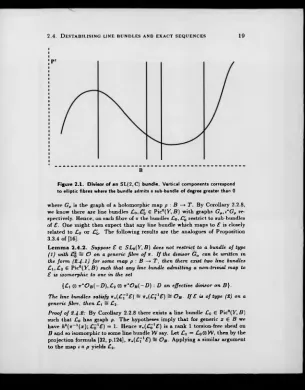
as illustrated in Figure 2.1. Here G a is the graph o f a holomorphic map a : B —► P 1 of degree r. Th e
Fj
= {x ^ } x B are the vertical fibres over a set { x j , . . . , x , } o f distinct points in B for which >s ° f type (3), and n j 6 Z are their multiplicities. These quantities satisfy the relation:D e fin itio n 2.3.11. The divisor G a on B x P 1 given by (2.3.9) is called the graph o f £.
2.4. Destabilising line bundles and exact sequences
Suppose now that £ € S L0(Y ., B ) and D (£ ) is o f the form (2.3.9). The divisor G a is the image under the quotient map B x T —* B x P 1 o f an » invariant divisor G on B x T . Suppose
2.3.7. h °(w -l ( z ) ; C - l £ ) > 0 .
of £.
2.3.9.
2.3.10.
2.4. Destabilising line bundles and exact sequences
19
[image:34.334.10.315.9.399.2]B
Figure 2.1. Divisor of an SL(2,C) bundle. Vertical components correspond to elliptic fibres where the bundle admits a sub-bundle of degree greater than 0
where G p is the graph of a holomorphic map p : B —► T . By Corollary 2.2.8, we know there axe line bundles £o,£q G Pic°(K , B ) with graphs G p,i* G p re spectively. Hence, on each fibre o f 7r the bundles Co, C'Q restrict to sub-bundles o f £. One might then expect that any line bundle which maps to £ is closely related to Co or C'Q. The following results are the analogues of Proposition 3.3.4 o f [16].
L e m m a 2.4.2. Suppose £ G S L0(Y , B ) does not restrict to a bundle o f type (1 ) with Cq = O on a generic fibre o f x. I f the divisor G a can be written in the fo rm (2-4.1) fo r some map p : B —* T , then there exist two line bundles £j, £ 2 G P ic°(K , B ) such that any line bundle admitting a non-trivial map to £ is isomorphic to one in the set
{ £ i ® v* Ob( —D ),C3 ® 1!* Ob{ - D ) : D an effective divisor on B ) . The line bundles satisfy n . ( £ f , £ ) = ir ^ C ^ E ) — Ob- I f £ is o f type (2 ) on a generic fibre, then C\ = £ 2.
2.4. Destabilising line bundles and exact sequences
20
I f £ is any line bundle admitting a non-trivial map to £, then without loss of generality we may assume C has the same graph as C\. Then n ,(C ~ l C\) is a line bundle U on B , giving £ = C\ ®14~1. Now h °(B ; n .{C ~ l £ ) ) = h ° (Y ; C ~ x £ ) / 0, but by the projection formula ir,(£ ~ l £ ) = U . Thus U =i Ob( B ) for some effective divisor D on B and £ = C\ ®it" Ob{ —D ) as r 1
L e m m a 2 .4 .3 . Suppose £ € S L o (Y , B ) restricts to a direct sum o f half-periods on a gen eric fibre o f n, then there exists a line bundle C\ G P ic °(y , B ) such that n, ( £ f 1£ )) = W , where W is a rank 2 bundle on B with the property that h ° ( B , W ) ^ 0, but f o r any line bundle U on B with deg U < 0, the space H ° ( B , U W ) = 0 . I f C is a line bundle which admits a non-trivial map to £, then it is isomorphic to an element o f the set
P ro o f o f 2.4-8: The graph of £ must be that o f a constant map, and so by (2.2.8) th ere exists a line bundle £ 0 G P ic °(y , B ) whose graph maps to this con stant under the quotient map T —* P 1. The hypotheses imply that jt, ( £q l £ ) is a torsion-free rank 2 sheaf on B , and so corresponds to a rank 2 vector bundle, W ' say. By [32, p.372], there exists a line bundle U on B such that i f we define W = W U , then VV satisfies the stated property. Hence we may take C\ = C o ® ir’U.
I f £ is a line bundle admitting a non-trivial map to £, then C = C \ ® 7r*V for some lin e bundle V on B and
D e fin it io n 2.4.4. If £ G S L0(Y , B ) has a graph o f the form (2.4.1) for some holomorphic map p : B —* T ,v r e say that £ splits.
D e fin it io n 2.4.5. If £ € S L o(Y , B ) splits, the line bundles £ i, £2 constructed in (2.4.2) and (2.4.3) are called the maximal destabilising line bundles o f £. Suppose now that £ G S L „ (Y ) w ith k > 0 satisfies the hypotheses o f (2.4.2). W e then have
with exceptions only when £|»-i(x) is of type (3) or a direct sum o f half- periods. Hence i21j r . ( £ f , £ ) = V -1 © S , where V is a line bundle on B and S is a skyscraper sheaf supported at the exceptional points. The dual sheaf { R xnm(C ~ x£ ) Y = H m ir v (R1ir .(C ~ l £ ) . O v ) is the locally free rank 1 sheaf V.
Th e bundles £i,£ 2 are not independent. In this case we have: L e m m a 2.4.6. I f £ G S Lq( Y ) with k > 0 satisfies the hypotheses o f (2.4-2), then C\ and £2 are related by
{ £ 1 ® tt'V : V a line bundle on B with deg V < 0}.
* . ( £ - * £ ) ^ T . ( £ r ‘ £ ) ® V * 5? V 1. Since h ° ( B ; 7r„(£-1£ )) ^ 0, we must have degV < 0.
fc1(w-1( x ) ; £ [ l £ ) = 1, for generic i G f l ,
-2.4. Destabilising line bundles and exact sequences
21
P ro o f o f 2.4-6: Since ir : Y —* B is principal, its relative canonical bun dle is trivial and hence, by relative Serre duality [36], [12, p.89], ir.(C \£ ) = {R}-k.(C ^xS ) Y = V. Thus > r * ((£ f, V )“ 1£ ) = Ob, and the results follows by
uniqueness. 12.4.61
Given S € S L0( Y ) w ith a maximal destabilising line bundle £ , let s G H ° (Y ; C~x£ ) be a non-zero section. I f s vanishes on a fibre / = ir~x( x ) and £|/ is o f type (1) or (2 ), th en s must vanish along the entire fibre. W e then obtain a non-trivial map £ <g> tt' Ob(x) —♦ £, contradicting the m a x im a lly o f £. Hence the zero-set o f s must be contained within fibres of type (3). If / = 7r-1(x ) is such a fibre and s vanishes on all o f /, again we obtain a non trivial map £ <g) it’ Ob(x) —* S. Thus s can only vanish on a O-dimensional subscheme. Hence we have shown:
Lem m a 2.4.7. I f £ G S L0( Y ) splits and has a maximal destabilising line bundle £ then any section o f C ~ x£ vanishes on a O-dimensional subscheme o f
Y.
This situation is well-known and is described in detail in [30, p.726] and [39, p.90]. Here we summarise the details. Let Y be a complex manifold (o f any dimension) and £ —* Y a holomorphic SL(2, C ) bundle. Suppose £ is a line bundle on Y such that th e bundle J = C~x£ admits a non-trivial section s vanishing on a codimension 2 subscheme o f Y . O n any holomorphic chart U of Y where there exists a loca l holomorphic frame {e i , e 2} for T , the section s restricted to U may be w ritten
S|t/ = 8\ei + «2^2»
for some s i,s 2 £ Of/- T h e zero-set Z is then given locally as the set of x G U such that s i(x ) = s2(x ) = 0, and so is a locally complete intersection. Its ideal sheaf J z is given on U by the ideal (s\,S2)O u of O u ■ II we denote by {VUV2} the dual frame to { e i , e 2} for the bundle T * over U , then we have a local resolution for J z on U
0 — . K l T - \ „ ^ I t , - i - J z \u — 0, where a and /J are defined b y
ot(m A i?2) = V\(s)V2 ~ i?a(4)i7i; 2.4.8.
+
9
m
) =
fmU
0
+ $>73(4),
2.4.9.
for f , g G O u • Th e local resolutions fit together to give the Koszul complex o f Z:
2.4.10.
0 — ►
— ►
T '— ►
J z— ►
0.
Tensoring (2.4.10) with d e t j " and using the natural isomorphism T ’ ® det^7 = T gives an exact sequence o f sheaves