University of Warwick institutional repository: http://go.warwick.ac.uk/wrap
This paper is made available online in accordance with
publisher policies. Please scroll down to view the document
itself. Please refer to the repository record for this item and our
policy information available from the repository home page for
further information.
To see the final version of this paper please visit the publisher’s website.
Access to the published version may require a subscription.
Author(s): Nobuko Kawashima
Article Title: The Making of a Programme Diary: A Study into the
Programming of Arts Presentation at Arts Centres in Britain
Year of publication: 1999
Link to published article:
http://www2.warwick.ac.uk/fac/arts/theatre_s/cp/publications/centrepub
s/
The Making of a Programme Diary:
A Study into the Programming of
Arts Presentation at Arts Centres
in Britain
Nobuko Kawashima
1999
RESE
ARCH
P A P E R S
Centre for Cultural Policy Studies
Centre for Cultural Policy Studies University of Warwick
CONTENTS
Page
List of Abbreviations i
Preface and Acknowledgements iii
Executive Summary v
Introduction 1
Organisation of Paper and Guide for Reading 7
Research Methodology 9
Literature Review 13
Part 1: How Programmes Emerge 23
Chapter 1. Context 25
Chapter 2. A Year at an Arts Centre 29
2.1 The Business and Busi-ness of Arts Centres 29
2.2 Constraints on Programming 30
2.3 Work Patterns of Programmers 32
Chapter 3. Antiquated Courtship or Antagonistic Co-operation?
—The Relationship between Venues and Visiting Companies 35
3.1 Booking a Tour—How to Approach Venues 35
3.2 Marketing for Touring 38
Chapter 4. A Changing Relationship between Arts Centres and Visiting Companies 41
4.1 Venues as a Producer 41
4.2 The Relationship between Venues and Visiting Companies 43
Part 2: Strategies for Programming—The Social Construction of Programme Diaries 47
Chapter 5. Product Acquisition 49
5.1 Various Means of Product Acquisition 49
5.2 Analysis of Product Aquisition—Queue Discipline 51
Chapter 6. Strategies for Programme Making 57
6.1 Policy Discourse for Justification 57
6.2 Routinisation for Programme Development 59
Part 3: Arts Centres in the Cultural Production System 65
Chapter 7. Programming as Collective Action 67
7.1 Collectivity at the Micro Level 67
7.2 Collectivity at the Macro Level 70
7.3 Programming as the Projection of Personal Charisma? 73
Chapter 8. The Reputation System 77
8.1 The Reputation System 77
8.2 Strategies for a Reputation System Building 87
Chapter 9. Arts Centres in the Cultural Production System 91
9.1 The Cultural Production System 91
9.2 Different Art Worlds 93
9.3 A Sector of Arts Centres? 95
Conclusion 99
Summary 99
Issues for Future Research 101
List of Abbreviations
ACE
Arts Council England
ACGB
Arts Council of Great Britain
ADA
Arts Development Association
BFI
British Film Institute
DCMS
Department for Culture, Media and Sport
DNH
Department of National Heritage
GLA
Greater London Arts
NAAC
National Association of Arts Centres
RAA
Regional Arts Association
RAB
Regional Arts Board
Preface
This is the third Working Paper produced under a Research Partnership between the
University of Warwick and the West Midlands Arts Board. Since the inception of the
scheme I have conducted research into cultural policy with an emphasis on a regional
perspective. The first project dealt with the issue of decentralisation in cultural policy and
tried to unpack this amorphous concept and examine changes in the arts funding system.
The second project investigated the impact of government policy on cultural organisations
with particular reference to the new emphasis on management and efficiency.
Having examined a key principle of cultural policy and aspects of cultural management I
now embark on the examination of creation in the arts. Each of the papers has thus
approached cultural policy studies in Britain from a different angle. Although one research
strategy might be to concentrate on an issue area or a sector, I wish to see my history of
research in the three year period positively as being a process through which I have managed
to gain insights into different operations, issues and debates in cultural fields in Britain and
beyond.
The specific themes of the papers vary, and the papers are primarily academic in nature
rather than for immediate use in practise, but my aim has been to generate research, the
findings and implications of which are useful to strategic thinking for practitioners in the
cultural sector. I hope that by providing concepts with which to analyse their issues I have
been of some help to them and that through my papers they are better able to understand the
theoretical context of their work.
I have been most fortunate in receiving support from officers of the West Midlands Arts at
various stages of this study. I am extremely grateful to my interviewees for their time and
the information so generously given. As this paper keeps their names and organisational
identities anonymous, I can only thank them all here. Without their co-operation, it would
have been impossible to write this paper.
A large number of people have kindly read the draft and made helpful comments. Many
officers from the West Midlands Arts have made insightful and encouraging comments.
Oliver Bennett, Chris Bilton, Christopher Gordon, Stella Hall and Andy Feist have given
general comments and specific advice on certain parts of the paper for improvement. David
Fisher and Jane Woddis have read a part of the draft and directed me to relevant literature
on specific points. All of them have helped me in re-writing with their specialist knowledge
and expertise. Dos Elshout and Diana Crane have given their advice on sociologists and
their non-British views have made a distinctive contribution. I am deeply indebted to all of
these people. The views expressed in the paper and any errors are however solely my own.
Nobuko Kawashima
Autumn 1998
Executive Summary
This paper examines the framework, processes and mechanisms of arts centre programming
defined as the presentation of professional arts and cultural activities. Whilst
acknowledging the diverse roles played by arts centres particularly in their local
communities, the paper is focused on the function of professional presentation. The findings
and analysis are based on qualitative research, consisting of both personal interviews
conducted at nine arts centres in Britain and a review of the literature.
The paper starts with the outline of the context in which professional presentation at arts
centres works. It then proceeds to describe empirical findings and evolves into analytical
and theoretical arguments. The unit of analysis is firstly arts centres in relation to arts
companies and artists, and then the work of arts centre programmers. Finally the scope of
discussion is widened in Part 3 to examine arts centres as a whole in the larger cultural
production system.
The paper consists of three major parts. Each part is of a different nature and may serve a
different primary readership as follows:
Part 1 seeks to give a basic understanding of the ways in which the presentation of
professional arts is programmed at arts centres in the UK. Particular attention is paid to
the relationship between arts centres and visiting performing arts companies. This part is
largely descriptive and explanatory and meant to form a foundation for the later
discussion. Those who are not very familiar with the work of arts centres in Britain may
find the details useful. Experienced practitioners working in arts centres may wish to
skim through this part by reading summaries attached at the end of each chapter and go
directly to Parts 2 and 3.
Part 2 analyses the making of programme diaries by examining the behaviour and
discourse of venue programmers. This part is explanatory and analytical. It may well be
helpful for artists and administrators of arts companies in particular, as it offers an
insight into programme making.
Part 3 draws on the findings presented in Parts 1 and 2 and develops a theoretical and
conceptual discussion. Its focus is on arts centres as a whole and examines the arts
centre ‘sector’ in a wider context. This part may be useful for policy-makers in the arts
funding system and practitioners in arts centres, as well as cultural policy academics and
students.
The paper aims to contribute to the two following research fields in different but
inter-connected ways:
to the study of cultural policy by providing insights into how arts centres construct their
programme diaries and by analysing their place in the large cultural production system
to the sociology of culture by highlighting the distributive aspect of the arts and culture, a phase
of cultural production relatively under-researched in the literature compared with the phases of
creation and consumption.
The following lists the main arguments made in the paper. A summary is provided at the end of
each chapter in the text and in the Conclusion.
Part 1: How Programmes Emerge
Arts centres in the UK embrace an enormous range of art forms and genres. Programmers who
are often in charge of managerial and administrative duties as well as artistic decision-making
on presentation have insufficient time and budgets to explore what is available on the market.
The touring market is largely buyer-led, allowing programmers to make choices from what
is offered, albeit under various constraints. The costs, estimated audience potential and
perceived artistic quality of particular products affect programmers’ decisions.
In recent years arts centres have started to call themselves ‘presenting venues’ rather than
‘receiving houses’, a change suggesting a more professional and proactive approach to the
acquisition and development of product. Commissioning and co-producing work is a
significant and growing area in this transition.
Part 2: Strategies for Programming—The Social Construction of
Programme Diaries
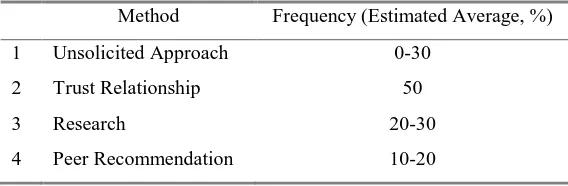
While arts companies send information packs and make follow-up calls to venues, arts
programmers prefer to use personal contacts to acquire product. They constantly seek
professional opinions on products from different networks and circles.
In order to manage complexity and reduce the uncertainty involved in programming, arts
centre programmers employ various strategies to routinise planning and optimise the
predictability of outcome. Effective methods of achieving this goal include establishing
contents is also important so as to appeal to the whole local community and spread the
financial and artistic risks of products.
Part 3: Arts Centres in the Cultural Production System
Programming is better seen as a collective action involving a large number of actors than as
a projection of programmers’ personal taste. Collectivity takes place at the micro,
person-to-person level where influence is exerted by various arts professionals in networks and
circles of which programmers are part. Collectivity works at the macro, industrial level as
well, where conventions, economics and government policy on specific industries have
knock-on effects which pre-determine what is available to arts centres.
Unlike many other subsidised arts, arts centres as a whole have only a vague and fragmented
‘reputation system’ to provide relevant organisations with differentiated prestige and status.
One of the major reasons for the relative lack of a rigid ‘reputation system’ is that arts
centres have two distinct markets of resources: the audience market on the one hand and that
of visiting companies and artists on the other hand, each of which has different criteria for
judging the ‘quality’ of arts centres. The aspiration of arts centres to expand their producer
role through commissioning may be seen as a strategy for the development of a reputation
system.
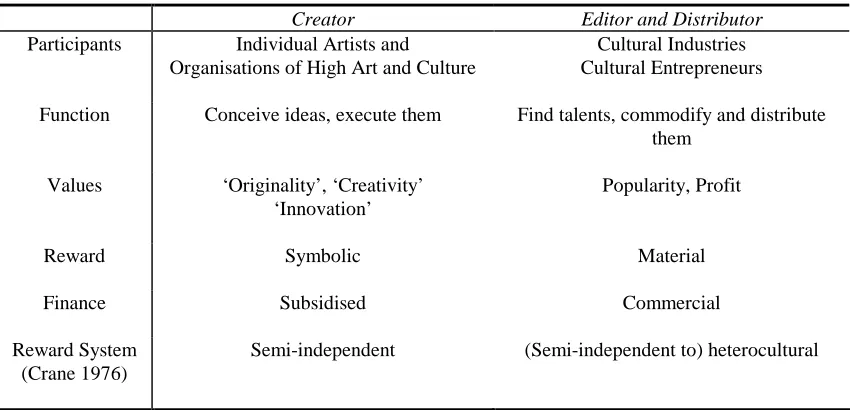
The place of arts centres in the cultural sector as a whole is hard to locate in conceptual
terms. One reason for this is that, when seen as presenting venues, arts centres are similar to
the cultural industries in being ‘editors’ of cultural products, but constitutionally they are in
the subsidised sector which is dominated by creators of the arts at least in the British system.
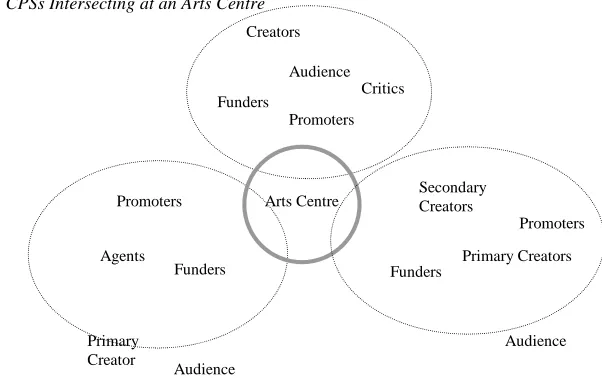
Another reason is that, because of the eclectic nature of their programmes, arts centres are
involved with a large number of ‘art worlds’ (called Cultural Production Systems in this
paper), which in effect obscures their place in each world. This explains why arts centres in
the UK have difficulty in forming a ‘sector’ as such.
Conclusion
Despite the last point made in Part 3 above, it can also be argued that the collectivity of the
partners in programme making at arts centres, which is the very essence of their working
style, may enable a sectoral field to develop. There are advantages in forming a distinct
sector, such as a stronger basis for advocacy, and disadvantages, such as the
institutionalisation of culture in arts centres.
After raising various issues for future research, the paper concludes with a suggestion that it
would be interesting to study the extent to which arts centres, which present a wide range of
different cultural forms and genres, contribute to the eradication, or enhancement or
re-configuration, of the divisions between high and popular cultures.
Introduction
Introduction
‘Arts Centres’ play a number of important roles in British cultural life. As primarily receiving,
non-producing venues for the arts, they provide a platform for arts companies and artists to
present their work. In so doing they serve one of the major goals of national cultural policy,
namely, to distribute professional arts and cultural products so as to ensure geographical equity
in arts consumption across the country. Moreover, they offer a variety of courses in the arts
and educational activities for local communities and encourage public participation in the arts.
A large number of arts centres are also committed to giving support to emerging and/or local
arts groups, both professional and amateur. These functions are performed across a wide range
of art forms.
It has been repeatedly emphasised by arts centres that they are very different from each other in
terms of scope and type of activities as well as in financial and physical size and the
characteristics of their geographic locations. However, it is possible to identify some common
features among them. A major one is that almost all of them present professional arts activities,
if to different degrees. A recent major survey on arts centres commissioned by the Arts Council
of England (MacKeith 1996) has examined their activities, management and operational issues;
it finds the presentation of professional arts indicated as a ‘high’ priority area of activities by
81% of the respondents (pp11-12). Providing sessions and workshops has also been given a
high priority but only by half of the respondents in an accompanying report to MacKeith (1996)
(O’Brien [1997], p11). This was the case even in the heyday of the arts centre movement. As
Lane (1978) put it, “it is certainly true that the arts-centre movement...is more concerned with
presentation—with performance and exhibition—than any other single element.” (p41)
Literature on arts centres is notoriously scarce, but a few papers are available on the
educational aspect of arts centres at least (eg Forster 1983; Greater London Arts [GLA] 1987).
When it comes to arts presentation, namely, bringing in products made elsewhere by
non-building-based companies and artists or by commissioning works from them to present at their
venues, however, there is very little, except for passing comments. MacKeith (1996, pp27-29)
for example touches upon the area of presentation and mentions that programmers
generally feel they lack resources with which to programme in a more effective way. She also
reports that whilst the economic pressures of recent years have forced arts centres to present
works which can achieve high box office returns, it is difficult for arts centres to find sufficient
numbers of products available that can be expected to draw in audiences.
The above observations made by MacKeith, however, leaves us with tantalising questions. If
arts centre programmers do not have enough time and budgets to explore potential products in
the market, or if they find insufficient products available, how do they manage to make the
programme as it is? Considering that the average number of staff directly involved in arts
programming is only less than three per arts centre (MacKeith 1996, p10), how can they make
informed judgements on the wide range of art forms they present? Can we assume that, like for
most arts organisations, the conflict between economic imperatives and artistic aspirations is a
major factor to affect the process of arts programming?
This paper tries to answer these questions. I will examine the framework in which
programming decisions are located by identifying the range of constraints and influencing
factors on programming at arts centres with particular reference to the presentation of
professional activities in the arts and culture. The paper will explore the decision-making
process and mechanisms that shape programming at arts centres. The focus will be on the work
of programmers in relation to the given structures rather than on tensions in arts programming
between artistic autonomy and economic constraints.
One of the major reasons for this approach is that the tensions could be researched empirically,
for example, by a quantitative study which classifies ‘funding-led’ products and
‘non-funding-driven’ ones and examines the correlation between the funding structure and the programme
characteristics. This is the kind of approach taken by DiMaggio and Stenberg (1985a; 1985b),
Alexander (1996) and others (see Literature Review in the following for more details).
However, the diversity of performances and exhibitions presented at arts centres makes this
type of research almost impossible.
Moreover, generally speaking, these tensions are already resolved or built-in, depending upon
one’s point of view, in the operation of arts centres. As MacKeith (1996) mentions, Regional
Arts Boards (RABs), major funders for arts centres, tend to emphasise artistic objectives
whereas local authorities, another major funder, put more emphasis on social and community
developments. However, the demand from local authorities can be and is in many cases met by
educational and participatory activities and hiring out to amateur societies, which lets the
RABs take a lead in the area of professional presentation. In other words, the areas of arts
activities and the degree of emphasis attached to each area at arts centres have been historically
shaped by the funding patterns specific to each arts centre.
Another tension which certainly exists is that between arts centres’ cultural leadership role and
the demands of the market, and this will appear from time to time in the following chapters.
However, it is so deeply-embedded in the business of promotion which seeks to bring cultural
producers and consumers together that it is hard to separate the two sides and discuss their
conflict as a topic on its own. At the same time, what I aim to tease out is not so much the
programmer’s agony over art vs money. In other words, whilst I will examine the conflicting
objectives arts programmers need to achieve within their organisations, I will pay much more
attention to the wider work environment in which programmes emerge. Such an approach will
include a spotlight to be shed on the web of complex relationships of which arts programmers
are a part.
I am aware that some arts centres might vigorously oppose the particular angle of this paper,
arguing that although they do present professional performances and exhibitions, professional
presentation does not necessarily represent the most important area of activity or their ethos.
As quoted by the Arts Council of England (ACE 1997, no pagination, para. 4-3), they would
argue that:
[Our arts centre] is a place where we manage a real relationship between us and our communities.
A definition of an arts centre is that it’s a place where...arts are represented, and where there is a high
degree of participatory activity.
English (undated) has also emphasised one fundamental distinctiveness of arts centres as being
“the facility for the individual to participate in arts experiences not only as a consumer, but as a
doer, a creator, a performer.” (p12)
Bearing these comments in mind, however, a paper of this length and nature has to be
well-focused, and knowledge can only be advanced by continuously researching into different
aspects one by one. I would also like to make it clear at the beginning that I intend neither to
draw an overall picture of arts centre activities nor to statistically generalise the ways arts
centres do programming. My ambition in this paper which is based on case studies focusing on
a specific area of arts centre activity is that its findings will lead to analytical generalisations
and raise wider issues. Therefore, although I broadly follow the definition of arts centres
given by previous publications (see below), due to the exclusive focus of this study on
professional presentation the discussion, particularly in Part 3, may be more applicable to
arts venues in general than to the arts centres whose emphasis is on educational/participatory
course provision. My hope is that the study will prove useful to non-producing arts venues
in a broad sense. I also hope that the conclusions will indicate policy implications for the
distribution of the arts and culture in the regions.
Definitions
The definition of an arts centre is itself contentious and I generally employ the one given
by Hutchison and Forrester (1987, p3) as “a building which provides a regular base for
substantial programmes of activities in more than one art form.” Five other characteristics to
describe an arts centre have often been added in publications and they are worth
introduction:
1. there is a programme and a policy for more than one art form
2. more than one space is used for arts activities
3. there is some professional input (artistic or managerial)
4. there is a substantial usage which is not part of formal education (or adult education)
5. it is not primarily subsidised as a theatre.
As the above list suggests, arts centres are hard to define and overlap with many kinds of
venues. It seems that the fourth one is to exclude studios of schools and colleges and the final
one to rule out Regional Repertory Theatres. This paper largely follows the convention
established in the literature, employing these characteristics as indicators to suggest what an
arts centre is.
Middle- and small-scale,adjectives which are frequently used both for venues and for visiting
companies, are terms which have been debated both in relation to their definition and
usefulness. My definition is mostly concerned with the seating capacity of an auditorium.
Bearing in mind that different papers use these words in different ways, my definition is loose.
In principle, however, if the seating capacity is less than 250, it is small-scale. Companies
In practice, these ‘small-scale’ companies are very often small in annual budgets, in the number
of permanent staff and contractual performers. ‘Large-scale’ denotes a seating capacity of
more than 900 and ‘middle-scale’ between these. It has been argued by Lancaster (1977, p9)
that middle-scale should be distinguished between 250 to 400 and 400 to 900 and that the 250
to 400 band is very much of a grey zone. Since the majority of arts centres do not have any
auditoria of the 400 to 900 capacity band, a middle-scale venue in this paper would mostly
imply a space with the seating capacity of 250 to 400.
Programmersin this paper refer to those individuals who are responsible for booking visiting
companies and artists in performing arts, for organising exhibitions in the visual arts and
choosing titles of films and negotiating the hire of prints in cinema. The exact job title varies,
including Director, Artistic Director, Head of Live Arts, Curator, Film Programmer and so on.
As will be mentioned, booking itself may well be only part of the job for these staff.
Organisation of the Paper and Guide for Reading
For the purposes outlined in the Introduction, the study proceeds in the following way.
After giving details of research methodology the paper will provide a literature review. The
literature review will extend this Introduction by laying out the theoretical framework and
approaches taken in this study.
Part 1 consists of four chapters which describe the range of activities at arts centres and explain
how the programming of professional presentation is conducted. It will start by describing the
practical context of arts centres, arts venues and arts touring in general in Chapter 1. Chapter 2
will overview the range of activities undertaken at arts centres. It will then narrow the focus
down to professional presentation and outline fundamental constraints and parameters existing
in this particular area of activity. Chapter 3 will illustrate the typical relationship between arts
centres and visiting companies in performing arts. Chapter 4 will return to the wider context of
arts centre operation as outlined in Chapter 1 and examine recent trends in the area of
professional presentation at arts centres. Particular attention will be paid to an increase in
commissioning and co-production. The chapter will examine the reasons for this development
despite the financial difficulties which arts centres have been experiencing. The chapter will
then revisit the relationship between visiting companies and arts centres.
Part 2 will analyse the emerging process of programme making by focusing on the ways in
which programmers work: to acquire materials, to select them and put them together. Chapter 5
will examine the work of programmers at arts centres and identify the variety of ways in which
‘products’ come to their attention. The focus on programmers is back in the first part of
Chapter 6, where the process of creating the programme ‘diary’ will be described. The analysis
will draw on findings in Chapters 3 and 4 and locate them in the context of annual planning.
An investigation will be conducted into the ways in which individual programmers organise
their work and the kinds of considerations they would take into account in making programme
diaries.
Part 3 will be a conceptualisation of arts centres in a wider context of what I call the Cultural
Production System. Chapter 7 will discuss programming as ‘collective action’ rather than
personal choice of cultural connoisseurs, working at all levels: industrial, inter-organisational
7
Chapters 8 and 9 will be still more conceptual than the previous chapters. It will be based on a
premise that the subsidised arts generally work for symbolic rewards, or reputation and
recognition, in the particular value system where each art world is located. Chapter 8 will
argue that arts centres do not fit in well with this proposition and explain why this may be the
case. The second part of this chapter will, however, show some strategies being developed for
a reputation system. Chapter 9 will examine the role of arts centres as venues in the larger
cultural production system, which will lead to a discussion that arts centres as a whole do not
seem to form a sector as such.
In the Conclusion, I will summarise the findings and arguments made in Chapters 1 to 9. I will
conclude by discussing some of the issues emerging for future research.
For those practitioners in the cultural sector who are already familiar with the work of arts
centres, it may be advisable to skip Part 1, particularly Chapters 1 to 3 which aim to give a
flavour of programming work at arts centres, and go directly to Part 2. Part 2 is theoretical and
may be useful for those who like to reflect on what they do in systematic accounts. Part 3 is
conceptual and meant particularlyfor senior managers and policy-makers who like to have some
strategic thinking for arts centres.
For students of cultural policy and the sociology of culture, the Literature Review and Parts 2
and 3 will be of interest. For those of the readers who are less familiar with arts centres in the
UK, however, descriptive information found in Part 1 will be necessary as a foundation.
Research Methodology
The discussion in this paper is based on qualitative research, combining personal interviews
and a review of archival material. Semi-structured interviews were conducted and
tape-recorded by the author between January and June 1998. Interviewees and their organisations
whose names are kept anonymous in this paper include the following:
1. Twenty-one programmers from nine arts centres, including those who have left the posts before or during the course of my study.
2. Five individuals who are non-programming staff of the above arts centres (eg marketing officer) or some kind of ‘stakeholder’ such as board members.
3. Thirteen individuals who are in the position of providing strategic support to the arts centres, such as officers from funding organisations and trade bodies.
4. Ten individuals from arts organisations which have offered their productions to the nine arts centres, in the areas of dance, theatre and music. Three of the individuals in this category are artists and the rest are administrative staff.
Most interviews ran for one to one and a half hours and six individuals were interviewed twice.
This resulted in fifty-five recorded interviews which totalled some seventy hours in all. All
interviews were conducted in person, except for one which was done on the phone. Some
individuals, particularly in the first category, were contacted again for factual clarification after
the initial interviews.
In addition, as much archival material was collected as possible, although not all the arts
centres could provide documents such as annual reports due to lack of time. Annual reports,
business plans, grant applications and programme diaries were the key documents. Research
reports written for particular arts centres in marketing and management in general were
obtained wherever possible. Fliers for art productions which were on display at the arts centres
were also collected whenever a visit was made. They often indicated the range of venues the
companies were touring, including the arts centres under examination.
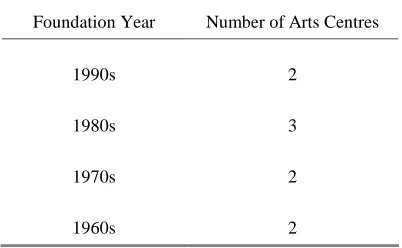
The nine arts centres from which programmers were drawn represent different types of the
institution in many respects: budget size, physical size, geographical characteristics, range of
activities, legal status and the number of professional presentations (see Tables 1 to 3).
The majority have small auditoria (smaller than a 250-seater theatre) only, but the sample
includes middle-scale and large-scale auditoria as well. In terms of constitution, all are private
and have charitable status, except one which is part of a university. All receive funding from
their RABs and local authorities, and occasionally from the Arts Council for specific projects.
The kind of activities undertaken in addition to professional presentation varies. They include
programmes of classes and workshops, artist-in-residence, community projects and support for
young artists
The mix of these income sources varies and there is no pattern of correlation between the
income structure with the features shown in the tables below. The proportion of funding from
RABs is the only one that is similar across the sample, in the region of 10-20%, with an
exception that has a larger proportion of funding from one of the Arts Councils. Funding from
local authorities ranges from close to none to 55% of the total income, but generally around
30%. Two arts centres rely substantially on charitable donations. The proportion of
self-earned income (box office sales, catering, sponsorship etc) can be anything between 30% and
70% of the total revenue.
Table 1. Arts Centres by Budget Size
Annual Income Number of Arts Centres
over £1,000,000 3
£400,000 to £999,999 3
£200,000 to £399,999 2
£100,000 to £199,999 1
N=9
Table 2. Arts Centres by Location
Location Number of Arts Centres
Urban/Metropolitan 3
Suburban/Town 2
Rural 2
Inner London 1
Outer London 1
[image:21.595.155.356.557.681.2]N=9
Table 3. Arts Centres by Foundation
Foundation Year Number of Arts Centres
1990s 2
1980s 3
1970s 2
1960s 2
N=9
Literature Review
The following literature review is organised as two parts: in the first part, practical and policy
documents which have relevance to the subject of the present paper will be reviewed. It will
expand on my brief comment in the Introduction that very little literature in general, not to
mention on their presentation of professional arts in particular, is available on arts centres. The
second part will introduce books and articles of academic research on cultural sectors different
from arts centres. They are nonetheless relevant to the subject and useful for two purposes.
One purpose is to present the theoretical and analytical framework formulated for this research.
The other is to review findings in various other cultural sectors, ranging from repertory
theatres, to publishing and television, which have implications for the present study. The
introduction to each work is kept to the minimum, and some of the reviewed literature will
where appropriate be referred to in more detail in the following chapters.
1. Policy-Oriented Research
Literature that is specifically related to arts centres is very scarce. Mention has been made of
their artistic and social values up until the mid-1970s, for example, in the Labour Government’s
White Paper of 1965 (Cmnd 2601, pp12-13) and by Lord Redcliffe-Maud (1976, p160), but
systematic study on arts centres has been limited. Exceptions are Hutchison and Forrester
(1987) and MacKeith (1996).1 These two reports provide overviews of the sector, by outlining
the origin, finance, staffing and other operational issues of arts centres in Britain. An earlier
study by Hutchison (1977) provides a detailed, sometimes evaluative description of three
particular arts centres in these aspects. The founding spirit of the arts centre movement can be
understood by consulting Lane (1978) and English (undated). Kushner (undated), Greater
London Arts (1987), and Forster (1983) more systematically, survey educational activities at
arts centres. The above is an almost exhaustive rather than selective list of works which have
arts centres as their focus. Little documentation on arts centres, with the exception of
conference proceedings from the National Association of Arts Centres (NAAC 1986) and arts
funding bodies, is currently available from trade bodies (since the NAAC and its successor, the
Arts Development Association, ceased to exist in 1989 and 1992 respectively). In all these
papers professional presentation is only given a cursory glance.
1
In order to examine programming at arts centres which receive products from producing
companies and artists, ‘touring’ serves as a key word to search for relevant materials. The Arts
Council has been concerned with this area, if in an uneasy way, as it represents access, one of
the principles of public funding for the arts. The policy of improving geographical access to
the arts has seen many twists and turns in implementation since the Council’s early days (Elsom
1971, pp93-96; Kawashima 1996, pp23-25). There was a time when the Council was mainly
concerned with bringing people to where arts were presented (eg by providing transport for
people to theatres),2 but soon after it chose to concentrate its resources on funding ‘exemplary’
institutions in London and some major regional cities (Arts Council of Great Britain undated,
p21). ‘Housing the Arts’ to provide buildings for the arts and culture around the country, thus,
had been a major project in this policy. Touring, the other means of increasing cultural
provision in the regions, turned out to be more complicated for the Council to plan centrally
and has largely been left to the market; today some of the revenue-funded clients receive
additional funding for touring and some specialist touring is organised by the Council (eg
Contemporary Music Network), and many of its project-funded clients are required to tour to
different regions for performance as a condition of funding. However, beyond these measures
there is not a great deal of intervention.
The existence of reviews on touring provision, commissioned by the Arts Council from time to
time, signifies the lack of policy in this area rather than a continuous interest. Review reports
have been written on different areas such as small- and middle-scale drama by Lancaster (1977)
and Devlin (1985), large- and middle-scale contemporary dance by Skene (1987), large-scale
lyric work by the Arts Council (1998) and more comprehensively by Marchant (1992). They
have pointed out the mismatch between the provision of touring products and the needs of
venues, and made specific recommendations to the funding body to create a coherent strategy
for touring. Reflecting the concerns of the Arts Council, these reports primarily address the
relationship between the funding body and the touring companies it subsidises. They mention
as an issue the quality and diversity of the products available in the regions, but make relatively
less reference to venues. Exceptions are Barker (1991) and Mackenzie and Scott (1991),
discussion documents prepared for the National Arts
14
2
and Media Strategy on the touring of visual and performing arts respectively.3 They offer
critical views and raise a number of issues. A stronger message given by Mackenzie is that
venues should serve to help products of top quality only in terms either of audience
development or artistic improvement or both (Mackenzie and Scott 1991, p15).
Some of the policy documents written or commissioned by the Arts Council on specific art
forms also mention touring as one of the issues. For dance, where virtually all the companies
are non-building-based, see Devlin (1989) and Foley (1994). On drama, the Arts Council’s
policy document (Arts Council of England 1996) discusses the specific roles the funding body
should play to support the touring of independent theatre groups and to develop large-scale
touring in partnership with the commercial sector. Overall, these documents are on the side of
the producing companies the Arts Council supports and they suggest that venues do not know
enough about art forms nor do they have the time to explore potential products because of their
tight budgets.
On film, distribution (the equivalent concept to touring for visual and performing arts) has
lately started to receive attention from the Department for Culture, Media and Sport (DCMS
1998), reflecting the Government’s policy to strengthen the British film industry (eg DCMS
1998; Department of National Heritage [DNH] 1995). This has been spearheaded by the
introduction of Lottery funding which has supported film production, since film is technically
classified as ‘capital’ assets. Film distribution however has largely been left to trade practice
and convention and little has been written, except for a detailed description given by Durie
(ed)(1993) in a practical guidebook to marketing for independent filmmakers in Europe.
Another is a research report commissioned by the Arts Council and other quasi-public bodies
on the ‘specialised cinema’ sector of which arts centres constitute the major part (London
Economics 1997). However, much less research has been done to describe and analyse
distribution and exhibition than the production and consumption aspects of the film industry.4
As far as papers with a focus on venues are concerned, very few are written from a national
policy point of view. This derives from the fact that the national arts funding system as a whole
has largely been concerned with producers of the arts, as Scott (Mackenzie and Scott 1991) puts
it:
15
3
...the [receiving] theatres are not Arts Council clients and the Arts Council has always had great
difficulty representing or even talking with the art forms and activities that it does not actually
subsidise. (P20)
The theatre management consultant Raymond has developed a series of papers on the
management of touring theatres (ie middle- to large-scale venues primarily for theatrical work)
commissioned by the Touring Department of the Arts Council (Raymond 1990; 1991; 1993).
There is some (though limited) overlap between these theatres and arts centres with
middle-scale auditoria and the papers are helpful in throwing light on the relationship between venues
and visiting companies. Raymond (1991, p13) describes the relationship as an “antiquated
Courtship Ritual”. Maitland (undated a; undated b) has written two manuals on marketing for
touring to be used both by venues and by touring companies of different scales. The manuals
provide us with clues to the various stages of the process by which touring companies obtain
tour bookings. Being management manuals, however, they offer only limited insight into
programming at non-producing arts venues.
Finally, mention has to be made of Lewis (1990, pp34-49) who makes a lengthy reference to
arts centres in his analysis of the values which underline public funding of the arts in Britain.
He concludes that despite their ethos arts centres have largely failed to attract a wide range of
people but remain predominantly a preserve of the middle-class.
In short arts centres and venues generally are poorly-documented and very little is available to
describe or examine their arts programming and presentation activities.
2. Sociological Literature—the Production of Culture
The analytical approach employed in this study relies heavily on the literature collectively
called the ‘production of culture’ in sociology. This is a branch in the sociology of culture with
an empirical emphasis, developed in the last two to three decades mostly by American
sociologists. For the most part, ‘production of culture’ research has applied sociologies of
organisation, industry, work and occupation to the field of the arts and culture, including the
area of mass communication. Unlike the traditional approach to the sociology of culture which
is primarily theoretical or aesthetic (Wolff 1993, pp26-31), this body of literature has been
based on empirical (ie statistical, historical or organisational) research and stresses the
4
importance of examining economic and organisational contexts in which recorded culture is
created, distributed, evaluated and consumed. This sociological approach was taken early on,
for example, by Peterson (1976) and DiMaggio and Hirsch (1976) in their mapping out of a
research strategy for the sociology of culture. As DiMaggio and Hirsch (1976) succinctly put
it, the perspective should be:
to examine and compare the diverse range of situations in which works of art [meaning culture in a
broader sense] are conceived, sketched, actualized, and enjoyed....We adopt this perspective
because...it is naive to ask “How does society affect art?” or “What is the role of art in society?” or
“What happens to art under socialism?” until we better understand the concrete range of activities and
channels through which art is produced. (p736)
Therefore, to recapitulate what needs to be studied, it would include:
to understand the social context of production—who produces art, what biases of selection make art
which is produced and distributed systematically different from that which is not, and what political
and economic factors to which they are directed. (p747)
The following two decades have seen a proliferation of research undertaken from this
perspective, leading to Peterson’s (1994) excellent review of the literature. He identifies six
distinct lines of research. They include research on:
comparative market structures
market structure over time
reward structure
gatekeeping and decision chains
careers of creative workers
structural conditions facilitating creativity.
Each of these has different units of analysis, and it is impractical to identify exclusive
relationships between a level of analysis and an area of research. One of the analytical levels is
micro (ie personal interaction) which is largely related to the fourth and fifth areas of research.
Other levels of analysis include institutional (ie inter-organisational relationships) for many of
the research areas in the above list and finally societal (ie relating to socio-political values of
entire societies), which again cuts across the study areas. There are too many papers in this
body of literature to be discussed here, and the numerous review articles which are available
(eg Peterson 1994; Wolff 1993, chapter 2; Griswold 1993 on the field of literature; for a
critique of this perspective, see for example Heywood 1997) make another attempt unnecessary.
Taken together, the researchers in the ‘production of culture’ have analysed the ways in which
organisational and economic factors have affected artistic content and changes and have
thereby attempted to de-consecrate and de-mystify Romantic ideas of artists as autonomous
geniuses. In Britain, there have been some empirical studies into the production of culture in
the field of the media (eg Elliott 1972; Silverstone 1985). However, most studies in the
sociology of culture have largely been much more abstract and interdisciplinary, developed
with literary critics and social historians of art. They have approached the production of culture
by constructing theories on the issue of art vs society or art vs commerce (Wolff 1993, pp29-32;
Seed and Wolff 1988, pp10-11).
In the present paper, I will follow the empirical, American orientation and apply their findings
to British cultural policy wherever appropriate. It also needs to be mentioned that my paper
will freely cut across the categories of research identified by Peterson (1994). To some extent,
the aspect of comparative market structure will be introduced as arts centres represent multiple
art forms with different industrial structures. In Chapters 5 and 6 in particular, gatekeeping and
decision chains will form the main part of the argument. In Chapter 6 reward system and
structural conditions facilitating creativity of arts centres will be most relevant. As to the unit
of analysis, the study will be largely conducted at an institutional and organisational level, and
only marginally at the personal level. Thus, I will examine programmers as part of
organisations but pay little attention to their psychology, for example, personal career
motivations of programmers or their personal conflicts with artists or other individuals. Unlike
humanist scholars, I will not be concerned, either, with the ways in which societal values are
reflected into the meanings and narratives produced by arts centres.
Having described the theoretical framework in which this study is placed, I will now proceed to
review relevant works from this body of literature. As has been the case with policy-oriented
research, there has been very little on artistic decision-making at non-producing venues, let
alone at anything equivalent to arts centres in Britain. There are however at least two areas in
the literature which shed light on the topic under investigation in this paper. All the papers
introduced here inform the present paper and many of them will reappear in Part 2.
First, there have been some research papers which examine producing performing arts
organisations, such as repertory theatres, opera companies and symphony orchestras, whose
production derives largely from existing canons of work. They are, like arts centres, under
constant pressure to reconcile economic and artistic considerations in the choice of titles for
production. In general, these papers try to establish the degree of correlation between what
orientation expressed in the output (eg the reliance on what are empirically known to attract
large audiences). With a risk of over-simplification but for the good reasons and rationales
provided, the qualitative dimension of the output is mostly measured by the titles from
repertories without taking into account styles of stage design and performance. Therefore,
despite being on producing (as opposed to distributing) organisations of the arts, these papers
are relevant to my research insofar as they analyse the programme decisions made in the choice
of play (or opera) titles from a repertoire (and the choice between the repertoire and new work).
Not surprisingly, almost all the papers in this category conclude that market forces tend to
suppress programme diversity in terms of title. DiMaggio and Stenberg (1985a; 1985b) have
examined American repertory theatres in two papers with different units of analysis to identify
what leads some theatres to present something different from the others. They find that the
smaller a theatre’s seating capacity is and the less dependent on earned income the theatre is,
the more divergent its repertoire tends to be from those of the other non-profit theatres
surveyed. Those ‘innovative’ theatres would be more likely to put on new works or bring
forgotten, unpopular works back to the stage than larger houses with high rates of earned
income (DiMaggio and Stenberg 1985a). Accordingly, therefore, in the other paper (DiMaggio
and Stenberg 1985b) which examines programmes of repertory theatres as an aggregate over
time, they conclude that as the resident theatre sector matured and became institutionalised and
many of them grew larger towards the end of the 1970s, the conformity of repertoires at
sectoral level increased. The cultural economist Austin-Smith (1980) in his empirical study on
British repertory theatres similarly concludes that public subsidies encourage the presentation
of relatively higher levels of minority interest plays. Martorella (1977) on American opera
houses finds the tendency for standardised repertories to be strongly correlated with
dependence on box office income.
Secondly, since arts centres as venues can be seen as close to what one might call ‘editing’
organisations, in other words, organisations which select creative materials, attach meanings to
them and turn them into consumer products, a useful analogy and insights can be obtained from
research on cultural industries which have the same function. There are a number of industries
in the category of ‘editing’ organisations and studies on them which will throw much needed
light on our analysis of arts centres, as the following shows.
Publishing houses are an obvious example of editing organisations; they filter book proposals
and manuscripts received from authors and produce books. Coser et al (1982) have conducted
a comprehensive study of the US publishing industry by using two levels of analysis mentioned
example, between editors and authors, marketing departments of the houses and other key
outsiders in the book trade and argue all of these shape the production and distribution of
books. The descriptions and analysis of these aspects illuminate the whole process in the
making of the books as they finally appear on the shelves of book shops.
Television is another major industry in this respect as the product is at least partly purchased
from programmes made elsewhere. Powell and Friedkin (1986) offer an interesting study of
programme-making in public broadcasting television in the US, in which one of the stations
studied relies heavily on two central bodies which distribute programmes to local stations. The
authors reveal how the bidding mechanism at one of the central bodies where programme
producers and buying stations meet affects the characteristics of programmes which come to be
shown. A paper by Bielby and Bielby (1994) examines a similar process in the American
commercial television world. Prime-time programming at national television networks in the
US has been highly dependent on outside production companies. Bounded by the commercial
imperatives of the organisation and faced with the uncertainty of quality involved in the choice
of projects, buyers develop strategies and discourses that provide legitimate accounts of their
actions targeted to different constituencies (eg advertisers), which eventually affect the
characteristics of programmes aired in prime-time slots.
Art dealers and commercial galleries form the third major industry of editing organisations
which have attracted research interests. They are largely brokers with little involvement in the
creation process; they find talents, assign meanings to them and sell them. White and White
(1993 [1965]) is one of the founding works for the ‘production of culture’ theory, in arguing
that the development of commercial dealers and their middle-class clients made a major
contribution to the emergence of Impressionist painting in the French art market at the turn of
the last century. Bystryn’s (1989 [1978]) study examines the relationship between art dealers
and the artists promoted by them in New York of the 1940s and 1950s. Crane (1987) is a major
work, more systematically and comprehensively researched, on the avant-garde art development
in New York between 1940 and 1985. Moulin (1987 [1967]) and Peterson, K (1997) on the
French art market of recent decades and Plattner (1996) on an American local art scene have
enriched the scope of the study on art dealers. Martorella (1990) is an interesting study on art
collections of American corporations to explain why they buy art and what they do with it. She
explores the impact of relatively new but increasingly important art patrons in the US on art
style and aesthetic judgements in the art market.
There are some papers which focus specifically on art critics, as they perform the functions of
selection and validation, if not the selling itself. These papers have examined the effects of
critics in providing authority for new movements in fine art (eg Mulkay and Chaplin 1982 on a
small but influential group of curators and critics who championed Jackson Pollock) as well as
in literature (van Rees 1987) and drama (Levo 1993).
Finally news organisations such as the press and broadcasting houses can be seen as editing
organisations. Although they do create their own works in reporting news, news is a
constructed social reality: the essence of news report is to select potentially ‘newsworthy’
events from what is available and produce news by presenting them as such (Tuchman 1978a,
1978b, 1973). Not unexpectedly, research has suggested that journalists work under economic
and political constraints and what is presented to us by them as neutral and objective reality is
much dictated by the organisation of their work. Mortensen and Svendsen (1980) on Danish
newspaper journalists and Powell and Friedkin (1986) mentioned earlier are works of this kind.
Golding and Elliott (1979) is a comprehensive study on news making from a comparative
perspective, examining news broadcasting in Nigeria, Sweden and Ireland. The authors argue
that broadcast news is a cultural product manufactured through a highly routinised and
standardised procedure. Kannis (1991) argues local news-making in the US is an amalgamation
of the economic motives held by media owners, the professional aspirations of journalists and
tactics used by elected and appointed officials of local government to influence news. In a
similar vein, Elliott (1972) is a case study on the making of a documentary series at what was
then called Associated Television (ATV) in Britain. He reveals the whole process and
organisation of programme making, from the emergence of an idea through the organisation of
the production team, item selection to the final filming at the studio.
The kinds of cultural organisations mentioned so far may have seemed remote from arts centres
in Britain. Many of those mentioned above are multi-billion, global industries for
profit-making whereas arts centres in Britain are tiny, local and not-for-profit in comparison. Bearing
these differences in mind, however, I will show later that the theoretical implications of the
reviewed papers are suggestive and applicable to the phenomena under investigation in this
study; arts centres as receiving venues can be compared to repertory companies which are
producing houses insofar as both are in the business of making choices from what is available:
arts centres choose what to present and repertory theatres which title to interpret for production.
Arts centres as venues will more appropriately be considered as part of editing organisations many
of which are so-called cultural industries. The range of industries mentioned here for reference
and analogy to arts centres as venues in fact suggest the ambiguity and versatility of arts centres in
the cultural sector, which will be the central point for exploration in Chapter 9.
Part 1: How Programmes Emerge
The objectives of Part 1 are to show the context in which the presentation of professional
activities in the arts and culture takes place at arts centres in the UK and to provide an empirical
account of the framework and mechanisms in which programmers’ choices are located.
Chapter 1 will explain the historical development of arts centres and regional touring of the arts
in Britain. Chapter 2 will draw an overall picture of arts centre activities and outline basic
constraints on programming. Chapter 3 will depict the typical relationship between arts centre
programmers and visiting companies in performing arts in the negotiation over booking a date
and marketing. Chapter 4 will explain recent phenomena which affect the relationship between
the two, including an increase in commissioning by arts centres.
Chapter 1. Context
The objective of this chapter is to provide background and contextual information which places
the subject of this study, namely, the presentation of professional arts at arts centres, in a larger
picture. The following will review the development of arts centres in relation to the scene of
arts presentation in the regions.
According to a chronological review given by Lane (1978), the first wave of arts centres was
established in Britain in the 1950s and came to fruition from the mid-1960s to the explosion of
the 1970s. This coincides with the movement in which the ideals of cultural democracy and the
democratisation of culture were put into practice through the establishment of Regional Arts
Associations (RAAs) and the development of community arts projects. The descriptive account
of arts centre development up to the 1970s offered by Lane (1978) also gives a flavour of the
spirit in support of artistic experimentation.
While this chronology probably explains the overall pattern of development over the decades
well, it is interesting to note that quite a few arts centres were opened even after the ideology of
community arts faded, owing above all to funding made available by local authorities
(Hutchison and Forrester 1987, pp7-12). Although the level of involvement in culture and the
arts has varied from one authority to another, it can be said that the period from the 1980s to the
early 1990s has seen a notable expansion of cultural policy at selected authorities. As an
indication of the level of growth in recent years, the study of MacKeith (1996) which included
129 arts centres in the survey had 57 ‘new’ centres that had appeared since the previous study
by Hutchison and Forrester (1987).5
Not only the expansion but also some degree of professionalisation and clarification of policy
and strategies characterise the change in cultural policy at the local level in recent decades.
This reflects a general trend in public service provision at local government level, which now
has to aim at greater efficiency, effectiveness and not least economy. Harsh criticism made by
the Audit Commission (1991a) was primarily levelled at local authority support for the arts and
entertainment at receiving theatres and concert halls. This does not specifically include arts
centres, but, taken together with the same message delivered in another report on
25
5
the provision of museum services (Audit Commission 1991b), it has been more broadly
received. Therefore, the original ideal and enthusiasm alone would no longer be enough; arts
centres of the 1990s need to be professional and strategic in artistic as well as managerial terms.
Other drives in the direction of professionalism include the change of corporate culture in the
national arts funding system in which the Regional Arts Boards (RABs, formerly the RAAs)
have gained more prominence than before, working in enhanced harmony with the Arts Council
(Kawashima 1996, pp32-33). The increasing need for plural funding since the 1980s has forced
arts centres to review their self-earned income in areas such as catering, sponsorship and
marketing (National Association of Arts Centres 1986). Due to the dwindling level of local
authority funding and standstill funding from the RABs, financial difficulty at arts centres has
increased particularly since the 1990s. At the same time, however, funding for capital projects
from the National Lottery has enabled major refurbishment and building work.
In the meantime, Regional Repertory Theatres, which are primarily producing theatres, have
been putting on work made elsewhere. This change is mentioned here for two reasons. One is
that the works presented in their studio spaces (if not in the main theatres) often overlap with
those seen at arts centres. Secondly, the Venue Development Fund of the Arts Council which
was initially created to promote Regional Repertory Theatres in this direction benefited arts
centres, too.
Many Regional Repertory Theatres present productions by other companies for both financial
and artistic purposes. Like arts centres, the Repertory Movement has since its inception early
this century and throughout the decades hailed the theatre as a meeting place for the local
community where art exhibitions, lectures and discussions would be held in the café and the
foyer (Jackson 1984, p92). At the beginning of the 1980s, however, Repertory Theatres found
it difficult to move forward. Jackson (1984) described the Repertory Movement in
retrenchment:
...the expansiveness and accompanying sense of adventure and purpose, and the ideal of the theatre as
the cultural powerhouse of the community, had all taken a severe knock. The idea of the permanent
company resident in the community, striven for if attained only at a handful of theatres, has become
increasingly in the regions a thing of the past. (p97)
The gradual decline of audiences for these works at Regional Repertory Theatres and the
financial stringency of recent years have driven them to review their traditional way of
during the summer in particular, by inviting other companies to perform or offer workshops
(see for some cases the journal for theatresPrompt1997a, pp16-17). This has been in the hope
that non-drama works in particular would bring an audience to the theatres who would then
come back or start to come to the main productions. It has also become important for Repertory
Theatres to co-produce and co-promote productions with external partners which may be
non-building-based companies so as to economise on production costs (see for some unusual cases
Prompt1996, pp8-9;Prompt1997b, pp10-11).
Taken as a whole, therefore, Repertory Theatres are increasing their role as a presenter,
co-producer and co-promoter, whereas arts centres are taking advantage of the Venue and
Promoter Development Fund to commission new works albeit on a small scale.
Conclusion
The invention in the early 1990s of the term ‘presenting venue’ instead of ‘receiving house’,
which marked a turning point for venues, is located in the context outlined in this chapter.
Arts centres have been evolving to become more professional, entrepreneurial and
market-sensitive. Also the distinction between presenting and producing venues has become
blurred as both arts centres and Regional Repertory Theatres struggle to broaden their
traditional boundaries in order to survive in an increasingly challenging climate for the arts.
Key words preferred by arts funding bodies and local authorities include strategy, planning,
partnership and vision. Thus, while financial constraints for arts centres are increasingly
tough, it has become very important for them to invest boldly in new artistic territories and
improve facilities (particularly with Lottery awards), which it is hoped will bring in further
income.
Chapter 2. A Year at an Arts Centre
Arts centres present a wide range of professional arts and cultural productions, but presentation
is only one aspect among many activities undertaken in one year. The following aims to
provide an illustration of what annual programmes in a variety of activities at arts centres look
like. It will then focus on the area of professional presentation and outline the constraints on
programming in this area such as the economics of costs and income. Finally the patterns of
work undertaken by programmers are described.
2.1 The Business and ‘Busi-ness’ of Arts Centres
As MacKeith (1996) identifies, there are at least three major areas in which arts centres are
generally involved: presentation (both professional and amateur, both visual and performing
arts), community participation (eg course provision) and artistic development (eg
artist-in-residence programme). There is some overlap between the three. A community theatre project
directed by professionals is an example which crosses over the three major objectives of arts
centres. In quantitative terms, sessions for participatory courses can number several hundreds
annually up to some five thousands per arts centre. An arts centre may let studios to more than
ten arts companies or visual artists for very low rents, or host artists in residence.
In professional presentation alone, the sheer volume of presented work is staggering. An arts
centre with a large turnover may present 300-400 performing arts productions, 800-1,000 film
screenings and 10-40 exhibitions per year. Even a medium-sized arts centre in budgetary terms
in my sample presents 90 professional productions alongside as many amateur presentations
and 20 exhibitions.6 The ‘busi-ness’ of these places as they draw people in to their cafés, bars
and restaurants is equally impressive.
What characterises arts centre programming is its enormous variety even within one
organisation. At any arts centre, art forms range from music, theatre, dance, visual arts,
comedy to literature. In music alone, for example, there are events of folk music, world music,
jazz, rock, chamber music and many more. Many of them would include what one might call
6The median number of professional presentations in the survey by MacKeith (1996) is however only