D
EVELOPMENT OF A
P
LATFORM
S
TRATEGY
F
RAMEWORK
A good platform is like a box of Lego bricks.
Use and recombine components in any way you want,
they will always fit.
Page 2 of 160
Management Summary
The goal of this thesis is to develop a platform strategy framework for the company Tersof (a pseudonym for the protection of the competitive position of the company).
A platform in this thesis is considered an online platform on which a company can present a basic offering to users while also inviting partners to create and offer complementary products on this platform. The platform strategy is developed to give structure and guidance to the efforts that are made to make the platform a success.
The platform strategy framework has been developed based on literature and the context of the company Tersof. The platform strategy framework has then been verified and validated by case studies. Based on the case studies a final revised platform strategy framework has been developed and is presented in the thesis.
From the literature study the most significant result was a list of 6 dimensions of platform strategy which contribute to a selection of critical success factors which are critical for the success of the platform. These six dimensions have been chosen based on how frequently they were mentioned in literature, how compelling the arguments for that dimension in the literature were and their relevance in the specific context of the company Tersof.
The six dimensions of platform strategy are trust, governance, pricing, usability, evolution, and users and partners. These six dimensions were found to be of great importance not only in the studied literature but also in practice as discovered during the case studies. The case studies illustrated the need for an updated version of the platform strategy framework which lead to the final revised version of the framework.
The concept of the platform strategy core has been introduced in the final version and is found at the heart of the framework. On the left side of the framework four dimensions are presented, trust, governance, usability and pricing. In these dimensions choices must be made which will contribute to the platform strategy core. On the right side the concepts of users and partners, and evolution can be found. These concepts are also related to the platform strategy core and to the other dimensions through their relation with the platform strategy core.
The revised framework supports three different viewpoints, or starting off points, to approach platform strategy. The boxes are connected with lines instead of directional arrows to illustrate the fact that the framework can be used and approached from different directions. The platform strategy can be developed with as a starting out point certain choices which are made in the dimensions, a certain strategy core that is deemed most important or by being led by the type of users, partners and evolution that is desirable. When the dimensions are leading they will determine the core of the strategy and as a result the users and partners that are attracted to the platform and how the platform evolves.
If the strategy core is chosen as the starting point the choices made in the dimensions much reflect this strategy core and the strategy core will attract certain users and partners and determine evolution. If the desired users and partners and/or evolution is chosen as the starting point this determines what the core of the strategy will be and which choices have to be made in the dimensions to attract the desired users and partners or to orchestrate the desired evolutionary process.
Page 3 of 160
Figure 1: The revised and final platform strategy framework.
Page 4 of 160
Preface
This thesis has been a once in a lifetime experience of six months of hard work and many new learning experiences, found at the intersection of the business world and the University of Twente.
Most of my fellow students have told me that during the first two months of your thesis project you have no idea what you are doing, during the third and fourth month it starts to become clear and during the fifth and sixth month you wish you had known from the start what you should do, because now you know, but you don’t have enough time anymore to do everything you want to do. Now, looking back on the project I would have to say they were right. If I had known from the start what the final result would be it would have been much easier. That, however, is not how the world works and it definitely would not have been such a valuable learning experience.
The Tersof software is based on the think-do-learn principle, during my thesis I noticed the same structure happening in my personal process. I thought of a way to do something, I did it, and I learned how I should have done it. This was my first and last master thesis, and as such the learning curve on how to approach such a project was very steep and the process was one of the most challenging things I have come across during my years as a student. It was however also one of the most rewarding processes. I learned a lot about the ‘real world’ after so many years in school and at the university and I learned a lot about the subject of my thesis, platforms and the strategic world of software businesses, and about myself. When working on my thesis at the office of Tersof I experienced firsthand how a software company operates from day to day. From daily stand up meetings and monthly reviews to long term strategy planning. After many years of learning in an educational setting it was nice to finally have the opportunity to see all the things I have learned about in practice. After many years of studying only for my own benefit it also feels great to be doing something that contributes to a larger goal and that contributes to the real world.
For me this assignment has been a perfect reflection of my study program and the electives I choose during it. Therefore it has been a very appropriate ending to my years of studying Business and IT at the University of Twente.
Acknowledgements
I would like to thank Klaas Sikkel and Chintan Amrit, my supervisors from the University of Twente for their support and guidance. They have helped me and encouraged me throughout the entire process and I greatly appreciate their support during this project.
I would also like to thank S. Nijenhuis for all his insights and contributions to this thesis and for giving me the opportunity to experience the day to day running’s of a software company. It was an incredibly valuable learning experience that I will never forget.
Page 5 of 160
Definitions and Acronyms
How a PaaS using APIs and a VCE can improve CRM and increase the NPS and contribute to SPM may be a bit of a confusing sentence for those who are not well-versed in the world of IT and Business acronyms. So in the next table the acronyms and core concepts that are used in this thesis are explained.
Concept/ acronym Definition of concept
Business Model A conceptual model that describes the product and services a company offers and how revenue streams are related to these product and services [1].
Platform The shared basis of technologies, rules and agreements on which several players can innovate, and develop new products and services in a coordinated way [2]. In this research project a platform is considered a technological base on which applications can be build and run. Through APIs the platform facilitates interactions between the different applications on the platform.
Ecosystem The platform together with its users, external complements, partners and external developers
Prince2 A change management methodology that was developed in 1996 by the British
Office of Government Commerce.
SaaS Software as a service
PaaS Platform as a service
IaaS Infrastructure as a service
B2B Business to business
B2C Business to consumer
C2C Consumer to consumer
CSF Critical Success Factor.
Critical success factors are properties that the platform or platform business must have to be able to succeed in becoming a successful platform.
Multi-homing A platform user or developer is active on several platforms at the same time.
API Application Programming Interface
SDK Software development kit
ISO International Organization for Standardization which develops and publishes international standards.
On-premise The IT and the hosting of the IT are done in-house.
Cloud hosted Software and related services that are hosted on a remote location and can be accessed through the internet.
One Sided Platform
A platform that has only a single type of users on it.
Two Sided Platform
A platform with two different sides, either two types of users or users and partners.
Multisided Platform
Page 6 of 160
Table of Contents
Management Summary ... 2
Preface ... 4
Acknowledgements ... 4
Definitions and Acronyms ... 5
1. Introduction ... 9
About Tersof ... 9
Problem Statement, Research Objective and Research Questions ... 10
Research Framework ... 10
Structure of the Thesis ... 11
2. Literature Study on Platforms, Platform Strategies, Platform Strategy Dimensions and Critical Success Factors for Platforms ...12
IT Business Models ... 12
Ecosystems ... 14
Platforms ... 14
Market Disruption ... 15
Platform Core Concepts ... 16
3. Platform Strategies from Literature ...25
Limiting the Thesis ... 25
Platform Strategy 1: Toolbox, Magnet and Matchmaker ... 27
Platform Strategy 2: Church – 2 Question Strategy ... 28
Platform Strategy 3: Kreijveld’s 10 Basic Rules ... 29
Platform Strategy 4: Accenture 5 P model ... 33
Platform Strategy 5: Molenaar Strategy ... 36
Platform Strategy 6: Every Organization needs a Digital Platform Strategy ... 39
Platform Strategy 7: The Ambidexterity Perspective ... 41
Platform Strategy 8: The Nine Guiding Principles... 46
Platform Strategy 9: 8 Ways to Launch a Successful Digital Platform ... 56
Platform Strategy 10: Plug and Play Organization ... 59
Platform Strategy 11: Characteristics and Success Factors of Digital Platforms ... 64
Platform Strategy 12: 5 Questions ... 72
Platform Strategy 13: Platform Leadership ... 74
Page 7 of 160
Platform Strategy 15: Bundling or Constellation ... 81
Cumulative Tables ... 86
Critical Success Factors Frequency Found in Literature Matrix ... 86
Strategy Dimensions Frequency Found in literature Matrix ... 88
4. The Context of the Strategy Development: Tersof ...90
Legacy ... 92
Legacy at Tersof ... 92
Desires and Wishes/ Requirements ... 93
5. The Framework ...95
The Meta Model of the Framework ... 95
The Framework ... 95
Dimension: Trust ... 96
Dimension: Usability ... 98
Dimension: User Attraction Strategy ... 99
Dimension: Pricing ... 102
Dimension: Governance ... 105
Dimension: Evolution ... 110
6. Case Studies ...114
Thesis Framework ... 114
Atlassian Case Study ...115
About Atlassian ... 115
Atlassian Mission ... 115
Atlassian Strategy Core ... 115
Atlassian Core Values ... 115
Atlassian Platform ... 116
Atlassian in the Framework ... 119
Dimension: Trust ... 119
Dimension: Usability ... 121
Dimension: User/partner Attraction Strategy ... 122
Dimension: Pricing ... 123
Dimension: Governance ... 124
Dimension: Evolution ... 125
Page 8 of 160
Salesforce Case Study ...128
Salesforce World Tour ... 128
Salesforce Official Value Proposition ... 128
Salesforce Core Strategy ... 128
Salesforce Ecosystem and Platform ... 129
Salesforce Community ... 130
Salesforce in the Platform Strategy Framework ... 131
Dimension: trust ... 131
Dimension: Usability ... 132
Dimension: User/Partner Attraction Strategy ... 133
Dimension: Pricing ... 134
Dimension: Governance ... 136
Dimension: Evolution ... 137
Salesforce Case Study Analysis and Conclusion ... 139
7. Revised Platform Strategy Framework ...140
Original Platform Strategy Framework ... 140
Revised Version ... 140
Approach 1: Dimensions are Leading ... 140
Approach 2: The Platform Strategy Core is Leading ... 141
Approach 3: The Users, Partners and Evolution are Leading ... 141
8. Conclusion ...142
Goal of the Thesis ... 142
Framework Validation through Case Studies ... 142
Conclusions for Tersof ... 143
References ...144
Appendices ...153
Appendix 1: Atlassian Products ... 153
Appendix 2: Atlassian Annual Pricing ... 155
Appendix 3: Atlassian Time Line ... 156
Page 9 of 160
1. Introduction
In this thesis the process and results of the development of a platform strategy framework for the company Tersof Solutions B.V (henceforth: Tersof) are documented. Tersof is a pseudonym used to protect the competitive position and interests of the company.
The process of writing this thesis started with getting to know Tersof and the domain in which they operate. Learning more about the company, their strategy, and their plans for the future helped to create a frame of reference. Getting to know the company and the context of this thesis was done by interviewing several employees from different departments, attending review meetings, having meetings with my supervisor at the company, the director S. Nijenhuis, and by reading documentation about the company.
After this exploratory phase a final decision was made on the subject for the thesis that would benefit Tersof the most at this point in time, platform strategy. The goal of this thesis is therefore to design a platform strategy framework for Tersof.
About Tersof
Tersof is a software company located in Enschede and Amersfoort in The Netherlands. The company has about 40 employees and its change enabling software has 80.000 users at companies such as Friesland Campina, Vopak, and many Dutch government bodies. Tersof is going through a big change in its business proposition, the company has existed for 20 years and is gearing up for the future. The traditional product offered by Tersof is based on Prince2 methodologies. However, Agile practices are becoming more popular and therefore a new product, a multi app platform, is added to the Tersof value proposition. The new Tersof product supports working with Scaled Agile.
With the new Tersof product comes a shift in the entire organization. The new product will be available worldwide and not just on the traditional home market. The software is currently personally sold by the sales department, based on leads that have been pursued personally by the marketing department. After the sale has been made a consultant will visit the buyer to personally configure the software for the client. The new Tersof product is supposed to be much more plug and play. Users should be able to buy, download, install and configure the software themselves. This change from personal contact to enabling the users to do everything independently will influence and change many of the current business processes. Considering that Tersof has the goal to grow to 1.000.000 users in the next five years, self-service for users will be a key issue.
Page 10 of 160
Problem Statement, Research Objective and Research Questions
Doing nothing is going backwards, because all your competitors keep moving, a common statement in business which has a certain amount of truth to it. To remain a relevant player in the business software market it is important to regularly change and update your value proposition. Tersof is changing their value proposition by introducing the new multi app platform that supports both agile working and more traditional styles of project management. Tersof is a relatively small company with about 20 developers, with their own development team they can only develop a limited amount of apps to be offered on the multi app platform. This is where the concept of a platform strategy comes into play. By allowing third parties to create apps for the Tersof platform the value proposition of the product is increased. This thesis focuses on the development of a platform strategy framework for Tersof.
Research Framework
To achieve this objective a research framework has been developed following the research design concept that was created by Verschuren and Doorewaard [3]. The framework is a visual representation of the different steps that will be taken to achieve the determined research objective [3]. It shows how the different phases in the research are connected and in which order they will be done [3]. The research process starts with a literature study on platform strategies and getting to know the context of this thesis, the company Tersof. After studying both the literature and the context on which the literature will be applied a platform strategy framework has been developed. After that two cases studies have been done in which in the case study companies, Atlassian and Salesforce, are compared and measured against the platform strategy framework to see whether the proposed framework contains the proper dimensions for a platform strategy framework. This validation is done by looking at the strategic decisions that the platform companies have made in the different proposed dimensions and if and how these decisions play an important role in supporting the overall platform strategy of the company. In the end this will result in a validated platform strategy framework.
Figure 2: Research Framework
Page 11 of 160
Based on this research framework the research questions have been created. To achieve the research objective the following research questions will be answered to obtain adequate and sufficient knowledge to develop the platform strategy framework.
1. Which critical success factors for platforms can be found in literature on platform strategies? 2. What are the different strategy dimensions in which choices are made to contribute to the
achievement of the critical success factors?
a. For each choice that can be made, what are the expected results of this choice and how does this contribute to the overall platform strategy goal?
3. What context specific requirements should be taken into account when developing a platform strategy framework for Tersof?
4. Based on the literature and the context of this thesis, which critical success factors and dimensions are the most important?
5. What is a suitable platform strategy framework for Tersof based on the answers from the previous questions?
6. For each of the case study companies does the developed platform strategy indeed encompass the most important efforts that are made towards their overall strategy?
7. Based on the case studies, is the platform strategy framework validated?
Structure of the Thesis
The chapter structure of this thesis follows the research framework that was presented earlier in this chapter. In the table below a brief summary of the content of each chapter can be seen.
Chapter Content
Chapter 1: Introduction Introduction of the thesis, the company and the research method
Chapter 2: Literature Study A general introduction to platforms based on a literature study
Chapter 3: Platform Strategies from Literature Overview of the 15 studied platform strategies from the literature
Chapter 4: The Context of the Strategy Development
Study of the company, Tersof, for which the platform strategy framework is developed
Chapter 5: Framework Development Development of the platform strategy framework Chapter 6: Case Studies The case studies of Atlassian and Salesforce
Chapter 7: Revised Platform Strategy Framework The framework is revised based on the results of the case studies
Page 12 of 160
2. Literature Study on Platforms, Platform Strategies, Platform
Strategy Dimensions and Critical Success Factors for Platforms
The goal of this chapter is to report on some existing platform strategies to be able to derive usable strategy dimensions and critical success factors from them. The chapter starts with some background information on IT Business models and a reflection on how platforms are a relatively new phenomenon which are affecting traditional business. Some background information on platforms is given. Then summaries of several platform strategies are given and finally the platform strategy dimensions and platform critical success factors that can be derived from those strategies are presented.
For this part of the thesis the following types of sources have been studied:
Scientific Literature
The scientific literature was found using Scopus and Google Scholar. The goal of this thesis is to develop a high-level platform strategy, so papers that fit with this objective were selected and studied.
Business and management literature
The business and management literature was found using Google, webpages from consultancy agencies and books found through managementboek.nl. Consultancy agencies such as McKinsey publish many articles and reports about business and digital developments. These sources often contain very recent and thoroughly researched data. The books were all written to support companies who want to become a platform or exploit their platform better. The books were recommended by the company supervisor and had good reviews.
Other sources Because platforms as a business model are so fast changing in nature also some other sources such as blogs, news and other webpages have been used. This has been done to include the latest insights in this thesis which may not yet be covered in scientific or management literature.
IT Business Models
Page 13 of 160
interesting because as a platform there is no value unless customers and other third parties are participating on the platform and co-creating value with Tersof.
This change to service-dominant logic in the IT business was made possible because of the creation of the cloud. Companies like Amazon, Google, IBM and Microsoft were among the first to create cloud architectures [9]. They initially used them for their own processes and later started selling their excess capacity [9]. Tersof initially provided an on-premise product, and many clients still use the on-premise version. However, one of the goals for the future of Tersof is to have more clients transfer from on-premise to the cloud and to have all new clients use the cloud version of the Tersof product.
Tersof is a SaaS-provider and looking into how they may also offer some PaaS capabilities. For the sake of clarity and completeness a general introduction to the most common IT business models is presented below.
SaaS – Software as a Service
SaaS stands for software as a service. In SaaS agreements a company supplies applications to a customer. The applications are running on a cloud infrastructure provided by the supplier [10]. The client can access the applications which are running remotely through a thin client interface, for example a web browser, or through an API [10]. Management, control and maintenance of the applications and the system on which they are running is the responsibility of the SaaS provider [10]. The infrastructure, network, servers, operating systems, storage and application capabilities are also all taken care of by the SaaS provider [10]. For the client it is plug and play, and therefore ideal for smaller organizations or any organizations who do not want to invest in their own software and hardware infrastructure. The user may have limited options for application configuration [10].
Tersof currently offers a SaaS solution. Customers can access the Tersof products through a web browser and the software and underlying structures are maintained by Tersof who in turn receives a subscription fee from its users.
PaaS – Platform as a Service
PaaS stands for Platform-as-a-Service. In a PaaS configuration the customer can deploy created or acquired applications onto a cloud infrastructure provided by the PaaS provider. Those applications are build using specific programming languages, libraries, services and tools that have been provided by the PaaS provider [10]. The services provided by the PaaS provider include program deployment, execution support, data storage and management, authentication and user management, background tasking and more [11]. The user has no control over the underlying infrastructure, but can control which applications he deploys and has some configuration options for the application-hosting environment [10]. It is a distributed software system [11]. It exports a wide variety of scalable application services through APIs: application programming interfaces [11].
Page 14 of 160
Polyglot PaaS
A variation on traditional PaaS is Polyglot PaaS. A polyglot PaaS structure supports applications which are written in multiple high-level programming languages [11]. Using several languages can be preferable over supporting only a single language as each programming language has its own strengths. Tersof for example uses several different languages and frameworks to construct their application. When offering a platform for others to build on it can be a selling point to allow potential developers to use different languages as this will increase the likelihood that your platform supports a language the developer is familiar with. However, on the technical side of the platform it may greatly increase the complexity when more different programming languages have to be supported.
IaaS – Infrastructure as a Service
IaaS stands for Infrastructure-as-a-Service. The service provider provides capabilities for processing, storage, networks and other computing resources, the customer can deploy and run any software, including applications and operating systems [10]. The infrastructure is controlled by the supplier, the customers have control over operating systems, storage and deployed applications; they have possibly limited control over the selection of networking components [10].
Ecosystems
An ecosystem is an interconnected set of services and products that fulfils several needs customers may have in a single integrated experience [13]. Ecosystem business models are the result of the accelerated pace of change due the increase in volume of electronic data, the ubiquity of mobile interfaces and the growing power of artificial intelligence [13]. Google and Amazon for example are typical ecosystem players, they offer many different services from a single place thereby redefining traditional industry boundaries [13]. Ecosystems provide additional value compared to traditional business models, through acting as a gateway to many different services [13]. They reduce the friction that customers experience while switching between related services through integration of several user interfaces into a single user interface [13]. An example is Facebook Messenger which enables its users to shop online, check into hotels, talk to their Facebook friends, read news and chat with external parties [13]. A user could do all of this within the single Facebook Messenger interface. There is no need to switch between different service providers, websites or portals and thereby friction is reduced. Ecosystems also harness network effects, a powerful concept, which will be discussed later in this thesis. McKinsey expects that 12 massive ecosystems will emerge by 2025 which will account for 60 trillion dollars, which is 30% of all global revenues [13].
Platforms
Page 15 of 160
and many people use these platforms every day [13]. Many people cannot imagine a world without social media anymore, this dependency on these platforms gives the owners of these platforms tremendous power. A major benefit of platforms is the scalability of the strategy. Because the platform owner does not need to own anything, except for the platform, large numbers of any product or service can be offered without any inventory risk or maintenance costs for the platform owner. Airbnb for example has an inventory of more than a million rooms, without having to build or maintain any of them and has become hugely successful with this strategy [13].
The platform strategy book by Amrit Tiwana gives a nice overview of how platforms differ from traditional business models, shown in the table below [16].
Market Disruption
Page 16 of 160
Phases of Disruption
The arrival of new players on the market has consequences for the old players [17]. In the first phase, a new player with an innovative concept can grow quickly and gain market share [17]. Often a new player uses a low pricing strategy with small margins and very limited profits at this stage of the disruption [17]. In the second phase the old players in the market are starting to feel the pressure of the low prices of their new competitor. Old players may have a tendency to ignore the new threat or underestimate the severity of the new threat [17]. Once it has sunk in that they need to change to remain competitive they will lower their prices to match the new player [17]. However, the old players do not have the business model in place with which they can be profitable at such prices [17]. So when most of the competition has disappeared the new player can increase the prices [17]. The new player with an innovative business model, which enables it to bind customers to the company, can therefor remain successful for a long period of time [17].
Platform Core Concepts
A platform, as the concept is used in this thesis, is a place where an entity (business or consumer) can offer something to another entity (B2B, B2C or C2C), it enables connections and transactions between parties by offering a solid base on which entities can build or which other entities can use. In practice to actually create a business software platform there are many details, concepts and decisions to consider. A platform can also offer a base offering itself, stand-alone value, next to the enabling of others to offer goods or services on the platform. Tersof for example already has several apps to offer, which in the future might be complemented by additional apps from external developers.
Platform Stakeholders
A platform derives its right of existence from the people and organizations who use the platform. In this section the main stakeholders of a platform are discussed including the different terms which are used for these stakeholders.
The Platform Provider
The platform provider, sometimes also called the platform owner or platform supplier, is the party who creates and maintains the platform and represents the legal entity that owns the platform [18], [19]. The goal of this stakeholder is to gain financial benefits from running the platform. The platform owner designs and develops the platform, controls the intellectual property and is in charge of running the platform [20]. The owner also has to manage the users and partners who add value to the platform [20]. In this thesis the platform provider is Tersof and as commissioner of the thesis the platform provider Tersof is the main stakeholder of this thesis.
The Platform Developer
Page 17 of 160 The Platform User or End User
The platform user is the individual or company who uses the platform and the applications that are available on it [18], [19]. Use in the case of Tersof is the usage of the basis software offering of the platform combined with third parties applications, configurations or sharing of knowledge through the platform. For this stakeholder it is important the platform is easy to use and not too expensive.
The goal of this stakeholder in the case of Tersof is to create value for the organization for which the user is working. The goal of any company using Tersof software is to enable change and they have chosen to support this process using software.
The Platform Buyer
In many cases the person who buys applications on the platform or subscribes to the platform is the same as the end user. However, in large companies the person who decides to buy and install the platform may be a different person than the actual end user. Because Tersof is expecting to get more smaller clients in the future in this thesis the buyer is considered to have the same goals and wishes as the end user of the platform as the buyer is the representative for the end users and wishes to achieve the same organizational goals.
The book by Amrit Tiwana offers an overview of what the different value propositions of a platform are for the different stakeholders groups [16]
Stakeholder group Value proposition Explanation Platform owner Massively distributed innovation
Innovation on a scale and scope that would not be possible with a traditional business model. Increased likelihood that innovations will be created that will differentiate the platform in the market. The platform owner can focus on core activities. The rate of innovation around the platform is increase by the large number of complementors. This increased innovation rate will raise the bar for rival platforms.
Risk transfer The risk of any new innovation around the platform lies with the external party
developing it. Only the costs of maintaining the platform are for the platform owner and can be spread across all the different third parties on the platform.
Capturing the long tail
Both the mass market and the niche markets can be attracted to the platform. Catering to the niche markets is done by complementors of the platform. Catering to them would not be possible by traditional businesses. Mass customization to meet unique needs. Competitive
sustainability
Competitive sustainability is increased. The more utility the platform offers the more attractive it is. With more users the platform is more attractive to developers. Once the virtuous cycle is established it becomes difficult for rivals to compete.
App developers
Technological foundation
Provides developers the advantages of scale without the burden of ownership. The platform has already invested in the shared assets for all apps. Apps developers need only create their specific functionality that creates distinct value. They do not need to make common elements are provide any infrastructure so there is a lower barrier to entry. Developing for long tail markets becomes economically viable.
Market access Developers can reach markets they would otherwise not have been able to. There is a large pool of prospective buyers. The platform will reduce the transaction and distribution costs.
End users Mix-and-match
customization A platform that offers many complements allows for an immense level of customization. Every person can create their own version of the platform by mixing and matching different apps.
Faster innovation and network benefits
Platform will continue to evolve after adoption. The competition between platforms will speed up the rate of innovation which will benefit the end user. Innovation on the platform will be an incentive for more users to join the platform creating network effects.
Competition among rivals
Rival platforms will compete and that will lead to the creation of more value for users. Competition will first be around offering superior functionality and later shift to lowest price competition.
Lower search and transaction costs
Page 18 of 160
Platform Components
A platform consists of three main types of components: physical components, data components and marketplace or community components [18]. Every platform has these components and the components combined make up the platform. The physical component consists of the technology that makes the platform work, the infrastructure, communication protocols and standards for example. The physical component works together with the data component which is responsible for the information exchange between the different parts of the platform and the data analysis. Finally the marketplace and community components bring together the different entities that are active on the platform, so they can exchange goods, services and knowledge.
Platform Components
Physical component Digital technology Standards
Communication protocol Product or infrastructure
Data component Information exchange between platform parts Data analysis
Marketplace or community component Bring together consumers and producers Reputation mechanisms
Modularization
The concept behind the technology of a platform is the use of standardized building blocks which can be modified, reconfigured and extended [2]. This is called modularization, which is breaking a system up into chunks that communicate through standardized interfaces to increase reusability and flexibility because of more possible configurations [21]. By recombining the chunks or modules a large variety of systems can be build. This structure allows for rapid changes and decreases innovation costs [2], [21]. All the modules together are the platform [21]. A platform provides core functionality that can be extended by other modules through standardized interfaces [21]. This enables and encourages platform and ecosystem growth because adding another piece to the modularized structure is easy [14]. The benefit of using modularization is also that it is just as easy to add the first app as it is to add several thousands of apps, because they all use the same interface structure, so the base platform can always remain the same.
API’s and SDK’s
API’s
Page 19 of 160
standard APIs available, such as the REST and SOAP API which are frequently used, or a platform provider could decide to make their own API. To create optimal support it can be an option to combine several API’s [18]. Because adding additional functionality to the platform is made easy by APIs they offer great opportunities for scaling up and they can make the platform more agile because it is easy to add and remove components from the platform [18].
Software Development Kits
As a part of the platform a Software Development Kit (SDK) is usually provided [12], [18]. This SDK allows third parties to create software that can run on the platform. Tersof already has a very nice SDK that is used within the company for software development. It could be an option to make this SDK available to third parties. Another option would be to supply a more basic and easier to provide and use SKD to third party developers.
Platform Lifecycle
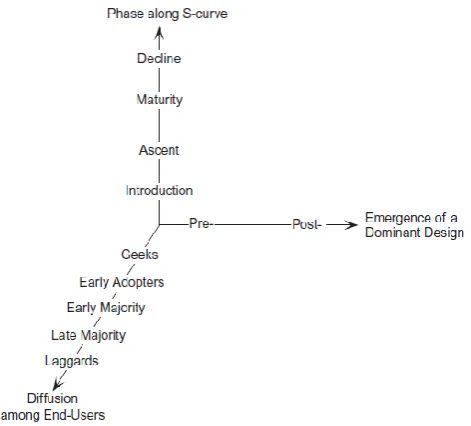
There are three dimensions in the platform lifecycle. Whether the platform is in the pre- or post-dominant design phase, the adoption among end users which is shown in the next figure and the phase along the s-curve which is explained after that.
There are two main stages in the platform lifecycle described in the book by Amrit Tiwana: the pre-dominant design phase and the post pre-dominant design phase of the platform evolution lifecycle [16]. A new technological development will lead to a mass entry of many firms on the newly created market with competing alternative designs which address roughly the same needs of the market. They will offer different features and test different capabilities and designs on the market. These varying designs will be tested and improved until at some point a certain design will become widely accepted and thereby becomes the winning standard. Some competitors will try to imitate this winning design or make small improvements on it, and most will leave the market. The design will be continuously improved, making it more difficult to introduce a new, radically different design on the market. Complements will be created to work with the dominant design making it even more appealing to users. Finally there will only be one design left, this is called the rule of one [16].
Page 20 of 160
Figure 4: Technology diffusion lifecycle on the end-user side [16].
The second dimension is about the adoption of the platform. Figure 4 shows the average distribution of how technology is adopted. Technology adoption reaches from the very first ‘geeks’ who adopt to finally the ‘laggards’ who are the last people to adopt a new technology.
The third dimension is about using succeeding technologies. The s-curve is a construct that is used to describe how technology rises and declines and how company can jump from the top of the curve to the top of the next curve by adopting the succeeding technology to stay competitive.
There are four phases on the s-curve: 0. Research and development stage 1. Introductory stage
2. Ascent stage (break-even is reached and the platform is beginning to gather steam) 3. Maturity stage
4. Decline phase (the platform is not as useful as it used to be)
When the decline phase is reached the company should leapfrog to the next S-curve or accept that usage of the technology will continue to decline.
Figure 5: The Technology Lifecycle S-curve [16]
[image:20.595.138.470.471.662.2]Page 21 of 160
Figure 6: The Three Dimensions of the Technology Lifecycle
Market Leadership
The trust in a market leader is often leading in decision making [1]. Consumers believe that by buying their software from a market leader they are ensured that the software will remain supported for years to come [1]. Market leadership is also seen as a measurement of quality, if most consumers chose a certain product they must have a good reason for choosing that particular product [1].
A platform market goes through three stages [1].
1. The young market. When the market is still young there are often many different providers of a certain type of platform. Consumers are testing the different platforms.
2. The growth phase. During this phase usually two or three dominant vendors emerge.
3. The market is mature, there are two or three winners in the market and the smaller providers have become almost non-existent.
Following these phases a company only has a short amount of time to become a market leader. Therefore if market leadership is an important goal for a company it may be advisable to make market leadership a priority over other goals such as revenue and profitability [1].
The reputation a company may have as a leading party can be an important factor in getting third parties to join the platform [2].
Customers don’t switch from platform easily. Because of this once platforms have a position as market leader they can endure for many years and after the initial investments the margins are high [22]. Switching costs are high so once a choice for a platform has been made it tends not to change. Winning platform companies can create 100-fold returns [22].
Platform Stickiness
Page 22 of 160 Ways to Increase Stickiness of End Users [16]:
1. There is a correlation between complementor and user stickiness so increasing complementor stickiness will increase user stickiness. Driving innovation by supporting complementors will create a more valuable platform for end-users.
2. Have a high cost of switching that is noncoercive (offer added value that is not available in a different ecosystem) and value-driven and thereby create a lock-in of users.
[image:22.595.154.446.279.385.2]3. Be strategically incompatible with rival platforms. A platform can be compatible, one-way compatible or not compatible with rival platforms. This is something that can be varied to throughout the platform lifecycle to best suit the situation at the time. By being incompatible it becomes difficult for users to switch to a different platform. When networks effects are difficult to generate one-way compatibility can be a good choice.
Figure 7: Virtuous Loop Between End-user Stickiness and App-developers Stickiness [16].
Platform Metrics
Metrics can be used to remain informed on how the platform is evolving. If the platform is moving in the wrong direction metrics can help to spot this early on and adjust accordingly. Platform metrics help to steer evolution, separate signals from noise and manage trade-offs [16]. When using platform metrics a short term focus is important for the measure, adjust, and measure again process, but this process should contribute to the long term platform goals [16]. A risk when using metrics is that the tracking and measuring may actually cost more than the amount of value that can be gained from it [16].
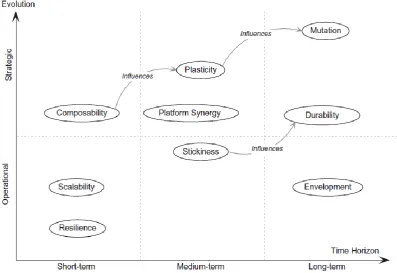
The book by Amrit Tiwana suggest nine metrics for platform evolution, focusses on the short, medium and long term; those are summarized in the table below [16].
Nine metrics of evolution
Short term
Resilience How well subsystems continue to function when there is a failure outside
of the ecosystem
Scalability The subsystem must remain economically viable and deliver good
functional performance when the ecosystem grows
Composability How easy it is to change a single component without losing the seamless integration with all other components
Medium term
Stickiness How many users continue to use the subsystem
Page 23 of 160
Nine metrics of evolution
Plasticity How easily a system can be adapted to offer different value than what
it’s originally intended functionality was.
Long term
Envelopment When a subsystem also starts offering the functionality of an adjacent
market with overlapping users.
Durability How much endurance the subsystem has on a competitive market
Mutation A system that is derived from an existing system and inherent certain properties but is created with a different purpose.
The book also suggests measurable variables to track the performance of each of these metrics as summarized in the table below [16].
Page 25 of 160
3. Platform Strategies from Literature
Every book, blog and paper about platforms presents its own version of what the writer thinks the ideal platform strategy is or what the possible strategies are. These different strategies often share some dimensions but differ on other dimensions. A platform strategy dimension in this thesis is considered any variable that can be used for a platform strategy. Being a variable, the platform dimension has at least two different possible values. By changing these values different results can be obtained from the strategy. The combination of the different platform dimensions with the different values and corresponding results of these variable values comprises the platform strategy which will contribute to the critical success factors of the platform. You could compare the strategy to a sound or light desk as you can find in music venues, with a bunch of buttons, faders, levers and dials who each influence different things, by altering
the settings of all those variables different results can be obtained. For some strategy dimensions there is a simple yes or no, on or off choice, for other dimensions there is an endless range of possible values like you would have with a fader. If the result
is not what you expected or wanted to achieve, you change the settings on the desk, and the new combination of values in the strategy will lead to new results. Just like sound checking or setting stage lights, it is a process of adjusting settings and trying out different settings and combining them in the right way until you get the result you want.
Limiting the Thesis
Presenting and reflecting on all platform strategies that have ever been published is so time consuming that it falls way beyond the scope of this thesis. Therefore only 15 platform strategies have been studied in detail. The strategies that have been used have been selected based on recommendations by the company project supervisor and a literature search. For each of these strategies a short summary will be given first and in the second part of this section each identified strategy dimension and critical success factors will be discussed along with the possible values and results of each value. Some strategies are very detailed where others have chosen a more high-level view, one paper even looked at more than a hundred platform strategies to find a set of platform strategy dimensions. The chosen strategies are from different types of sources and different years to get a broad cross section of platform strategy dimensions and critical success factors.
When I started working on this section I expected to find variables that you can give different values to in order to create different strategies. However, many strategies found in literature focus on what the result of the strategy should be, the critical success factors, much more than how to achieve that result. I think a strategy should be about how to achieve the goal and not just what the goal is. So when a strategy provided only goals and no usable variables on how to achieve that goal these goals have been considered critical success factors for a platform which can provide guidance for what the result of the strategy should be and how different dimensions could lead to that result.
Page 26 of 160 The following strategies have been studied:
Strategy Published by
Publication title Publisher Source type
1 Toolbox, Magnet, Matchmaker
[23] Three elements of a Successful Platform Strategy
Harvard Business Review
Web article
2 2 Question Strategy [24] Platform Strategies Explained MIT Sloan
Management Review
Web article
3 10 Basic Rules [2] De kracht van platformen (The power of platforms)
Vakmedianet Management book
4 5p Model [20] Five Ways to Win with Digital Platforms
Accenture Strategy Consultancy report
5 6 Rules for
Disruptive Two-way Platforms
[17] De Kracht van Platformstrategie (The power of platformstrategy)
Boom Management
book
6 Explore, Plan,
Deliver and Evolve [25] Every Organization needs a Digital Platform Strategy Gartner Web article
7 Ambidexterity Perspective
[26] Unraveling Platform Strategies: A Review from an Organizational Ambidexterity Perspective
Journal of Sustainability
Scientific paper
8 The Nine Guiding Principles
[16] Platform Ecosystems – Aligning Architecture, Governance and Strategy
Elsevier Scientific research book
9 8 Ways to Launch a Successful Digital Platform
[27] 8 Ways to Launch a Successful Digital
Platform MIT Sloan Management Review Web article
10 Platform Evolution [18] De plug & play organisatie (the plug
and play organization) Vakmedianet Management book
11 Characteristics and Success Factors of Digital Platforms
[28] Characteristics and Success Factors of Digital Platforms
iit Institut für Innovation und Technik
Consultancy report
12 5 Questions [29] How to Launch your Digital Platform Harvard Business Review
Web article
13 Platform Leadership Components
[30] Success factors of platform leadership in web 2.0 service business
Springer Scientific article
14 Innovation versus Breaching
[31] Innovation and Breaching Strategies in Multi-Sided Platform Markets: Insights from a Simulation Study
Thirty Sixth International Conference on Information Systems Scientific article
15 Bundling or Constellation
Page 27 of 160
Platform Strategy 1: Toolbox, Magnet and Matchmaker
This strategy was published in the Harvard Business Review [23]. According to the article by Bonchek and Choudary there are three components to a successful platform strategy. All three components need consideration, however, only focusing on one or two of the components can also lead to a successful platform strategy.
1. Connection – The Toolbox
The connection element of a platform strategy refers to how easy or difficult it is for other companies or individuals to plug into your platform and start sharing knowledge and making transactions. The toolbox is what should make plugging in and creating connections easy. The toolbox contains the infrastructure that enables interactions between the various participants on the platform.
2. Gravity – The Magnet
Gravity, or gravitational force, refers to attracting producers and users to your platform. The magnet is what should create the gravitational forces towards the platform and pull participants towards it. A platform needs a certain critical mass to work and that mass consists of users and producers. To get them to participate media can be used to harness the network effect, the more users there are the more users will join, and create rapid growth in the user base. The design of incentives is also a part of the magnet component, for example pricing models and reputational systems.
3. Flow – The Matchmaker
The platform should be a fostering environment that creates a flow experience for the exchange and co-creation of value. The matchmaker component is what will make the connections between producers and users on the platform. These matches can be made using data analysis and search refinement options.
Reflection on the Strategy
At first glance this strategy article focusses not really on the strategy dimensions but on the desired results that can be achieved by having the proper values for the dimensions. It is about the critical success factors of a platform, not so much about which strategic choices will lead to success.
The toolbox element that is mentioned is all about how easy it is to join the platform. How easy it is to join the platform depends on how open the platform is, or how strict the rules of the platform are, it depends on the costs that are related to joining the platform and maybe other dimensions but those are not mentioned in the article. So although some interesting critical success factors are mentioned, in terms of usable strategy dimensions and what the results of those are the article has little to offer.
Platform
Strategy
Flow - TheMatchmaker
Connection -The Toolbox
Gravity - The Magnet
Page 28 of 160
Dimensions Possible values Positive effects Negative effects Ease of joining the platform Easy to difficult n/g (not given) n/g
Pricing n/g n/g n/g
Reputational systems Yes/no n/g n/g
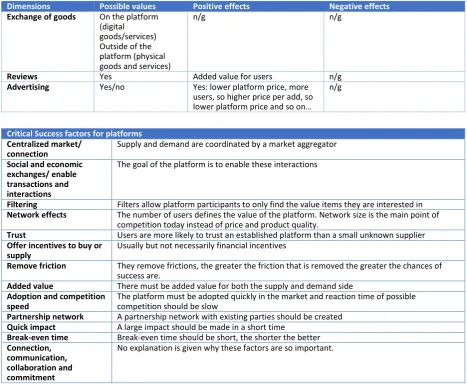
Critical Success factors for platforms
Gravity The need to have both users and developers on the platform. A platform needs to achieve critical mass.
Flow Flowing of value should be fostered by creating connections between platform users.
Matchmaking The users and developers need to be interested in each other. The developer should develop offerings that the users want. Successful matchmaking is achieved by using data.
Connection An infrastructure should connect different platform participants.
Network effects With more users the platform is more valuable to the other users.
Incentives Provide incentives to join the platform.
Reputational systems n/g (not given)
Platform Strategy 2: Church – 2 Question Strategy
In this article by Zach Church a platform strategy is considered an approach to enter a market [24]. The value of the platform, and therefore the willingness to pay for it, does not come from the individual product but from how many users and producers are active on the platform, so success is determined more by the strategy than by the platform itself.
According to Church platform strategy is not that complicated. Only two questions must be answered to create a platform strategy:
1. How will the platform attract customers?
2. How will you make your technology the core of an ecosystem?
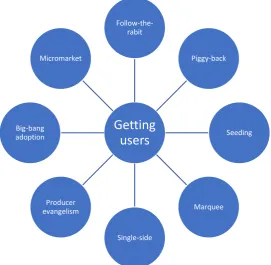
The first question is related to the chicken-or-egg problem, how to get users to join the platform when there are not many other users yet. A good platform strategy needs a plan on how to overcome this problem. A seeding mindset, focusing on getting participants, is more important than a feature mindset, focusing on what the platform can do (also called product mentality) according to his platform strategy. How to seed users:
- Recruit a marquee user. This can help kickstart the platform as this user will draw other users to the platform. The risk is that the marquee can usurp control of the platform.
- Low pricing or being free. There is a risk that when customers have gotten used to the low price they expect the platform to remain low priced in the long run.
Another part of this platform strategy is making your platform the core of an ecosystem: where customers and producers are meeting and where transactions are made. A platform needs governance and policies to properly fulfill such a core role.
Page 29 of 160
Reflection on the Strategy
This strategy also focusses on critical success factors, it does mention a few dimensions, mostly related to how to get users.
Dimensions Possible values Positive effects Negative effects User attraction
strategy
Marquee user Get users at the start of the platform
The marquee can take control over the platform
Pricing Low or Free Get many users fast Users get used to the price and expect to stay low or free.
Availability of data gathered on the platform
Openly available to external parties
n/g n/g
Not available
Critical Success factors for platforms
Customers A platform needs to attract customers and connect different groups. The chicken-or-egg problem needs to be overcome. The worth from a platform comes from the users, not the functionality.
Ecosystem core It should be a strategic goal to have your platform be the core of an entire ecosystem.
Build trust Have governance, rules, policies, guidelines and review systems to ensure trust and reliability on the platform.
Data Governance Decide who can do what with which data.
Platform Strategy 3: Kreijveld’s 10 Basic Rules
Maurits Kreijveld, the author of the book “The Power of Platforms”(original Dutch Title: De Kracht van Platformen) concludes his book with 10 basic rules to follow to build an economically successful platform [2].
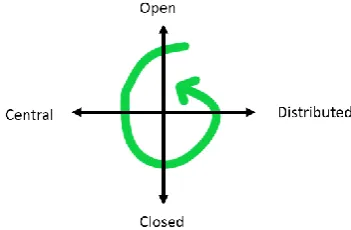
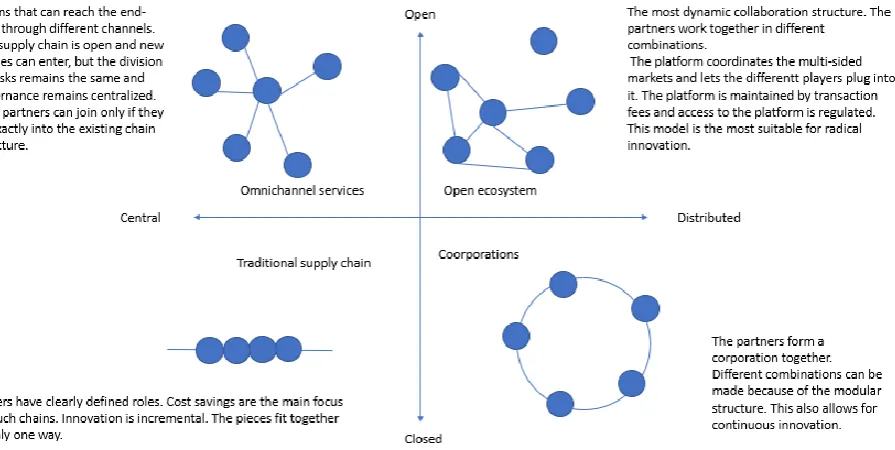
There are two axes along which platforms can be measured and placed. Dimension 1: collaborative culture/innovation style. Dimension 2: openness towards new users and developers and applications. Platforms will move in the diagram as they evolve through time.
Dimension 1: collaborative culture: cooperative or competitive. Platforms with a clear central leader who is in control versus platforms which
are controlled by a dispersed community. Platforms have different governance structures ranging from centrally controlled to communities who decide together about governance issues.
Dimension 2: open or closed relates to how easy it is for developers to join the platform. An open platform is accessible to anyone who want to join, while on closed platforms there are strict rules about participation and what can be created on the platform.
Page 30 of 160
The 10 rules
1. Open Your Product or Service
Make the decision to turn your product or service business into a platform business and open up your product to third parties, because innovation can be achieved faster with partners. Make sure you create building blocks that are easy to use and modify, so others can easily plug into your platform and offer their products and services over your platform, to achieve this develop an API to connect all users.
2. Scale Up
Find partners who can add value to your ecosystem. Create either closed partnerships or open up the platform to any third party to stimulate use of the platform. Absorb any new innovations made on the platform back into the platform so the innovations can evolve and be improved.
3. Cherise Developers and Partners
Make use of the newest technologies and software, thereby maximizing your developers capabilities to develop new products and services. Make design and development easy and take into account the costs for developers, such as necessary investments to participate in the platform. Listen to wishes and complaints and regularly create new opportunities. Enter into new markets as a joined effort with your partners to ensure value is created for all parties. Make sure that developers can make a profit by building for your platform. Develop opportunities for platform sponsoring through advertising and other financial models.
4. Prune when Necessary
Make sure that the platform does not get out of control or too many spin-off versions are created. Keep the platform alive by regularly absorbing new functions into to the platform, so developers do not get lazy but remain active with building new features. Standardization should be done in a timely manner.
5. Show Leadership and Trade
Consider an arbitration committee or governance structure to discuss the further development of the platform and make choices together about the specification of hardware, software and new markets. If you, as a platform owner, feel strong you can make these decisions alone. If a collaborative culture is important to you, make sure there is room for discussion. However, do consider that too much discussion and negotiation will decrease the speed with which the platform can be realized.
6. Share
Sharing information and data within the ecosystem is essential for the operational excellence of all those involved with the platform. Each participant should have access to the newest aggregated and combined information from the system. Data is one of the most valuable resources in a digital ecosystem. Combined data has much more value.
7. Cherish Users and Consumers
Page 31 of 160
8. Stimulate Use
Create scale through sponsoring. Give access to the platform for free or be installed everywhere. Be imbued in processes, products and services.
9. Curate
Have a good reputation management system. Have a strong selection process for new ideas and projects, control quality. Help searching consumers find their way, make recommendations, offer templates and offer a helping hand.
10. Evaluate
Keep testing and determining whether your platform should be more open or closed. Openness can be a good strategy in the starting phase to get the platform started, being closed can offer security to those operating on your platform. Extend the reach of your platform to new markets to profit from network effects in those markets as well.
Reflection on the Strategy
This strategy presents a mixture of critical success factors and platform dimensions. There are many usable factors and dimensions mentioned, although for many dimensions the possible values and corresponding results are not given in the book.
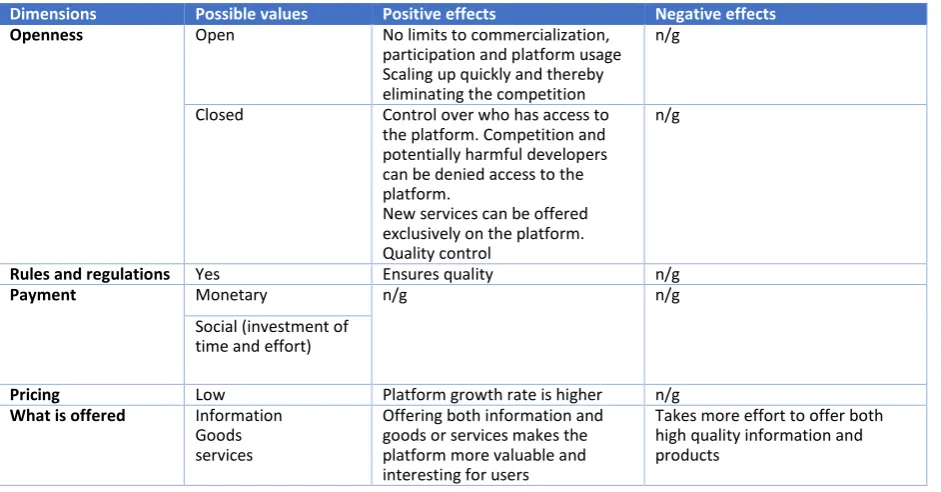
Dimensions Possible values Positive effects Negative effects Openness Open (more developers,
services and applications, even the competition is allowed to operate on the platform.
Good in the starting phase to get the platform started, easier for user and developers to join the platform, more new apps are developed, more freedom for radical innovation, Innovation is faster with more partners
n/g
Closed
More intensive partnerships but the rest of the world is kept out
Security for those operating on the platform, better opportunities for investors to get their money back, better quality control, less noise, no unprofessional or slow developers and slow consensus processes, clear rules for quick results,
more efficiency
Getting stuck because there is no room for alternatives
Scale Company, several companies, value chain or industry wide
n/g n/g
Partnerships Close partnerships with carefully selected partners
n/g n/g
Opening up the platform to any partner who want to join
With more partners innovation is faster
Modularization Easy building blocks Easy to develop for the platform, encourages developers to develop for your platform
n/g
Absorbing of platform layers (aka
envelopment)
Yes/no The new innovation can then be further developed and improved, the developers cannot get lazy and will remain active
Page 32 of 160
Dimensions Possible values Positive effects Negative effects Reputation
management
Yes/some/no A good reputation management system will lead to trust
n/g
Sponsoring Yes Grow a specific side of the platform, being free can support the goal of being installed everywhere n/g Governance Competitive or collaborative Complete freedom Consensus culture Collaborative
Make decisions together with partners
Consensus culture improves collaboration among involved parties. Platform profits are shared equally which will improve long term collaboration
Discussions, meeting and finding consensus can take up a lot of time, a few slow developers can slow the entire platform development down, too much discussion and negotiation will decrease the speed with which the platform can be realized, Risk of dispersion if people can make their own separate versions of the platform as products and services might not work together anymore Control, strong leadership
Competitive
Make decisions alone
Maintain the user experience, Avoid an explosion of offerings, High development speed
Can scare developers away and limit innovation. When there are too many spin-offs the platform gets out of control.
Cost of switching high n/g n/g
Possibility to integrate with other platforms
Yes/no n/g n/g
Allow competitors of developers on the platform
No Incentive for developers to develop for the platform No dispersion
n/g
Horizontal/vertical
integration None, and, or n/g n/g
Market leadership or specialization
n/g n/g n/g
Ease of use n/g n/g n/g
Social media integration
Yes, allowing liking, inviting and sharing
Create publicity for the platform n/g
Critical Success factors for platforms
Get partners Innovation is faster with partners and they will add value to your ecosystem
Being imbued in processes, products and services
This will stimulate use
Modularization Easy to modify building blocks will allows other to develop for the platform
Relationship management n/g
Quality control Ensure quality through reputation management systems
Network effect Starts working when the chicken-or-egg problem is overcome
Absorbing of innovations into the platform
This way they can be further improved and developed upon and developers will remain active instead of getting lazy.
Use the newest technology This maximizes the capability of developers to develop new products and services
Easy design and development on the platform
Keep the costs for developers low
Listen to wishes and complaints n/g
Page 33 of 160
Critical Success factors for platforms Enter new markets as a joined effort with partners
This ensures that value is created for all involved parties
Develop sponsoring opportunities n/g
Standardization This should be done in a timely manner
Room for discussion Make sure there is room for discussion on collaboratively managed platforms
Utilize the value of data All participants should have access to all data as combined data has more value.
Have a variety of offerings at a high quality
This will make the platform interesting to a variety of users
Have clear added value The user must have a clear understanding of what the added value of the platform is
Be easy to use n/g
Create word-of-mouth Let users like and share and invite their friends to join the platform
Scale A platform needs to have a certain size, this can be achieved by giving easy access to the platform and thereby getting a large userbase dependent on your platform
Reputation management n/g
Quality Control Be strict in the selection of what new ideas and projects are allowed on the platform
Offer guidance Help consumers to find their way on the platform and get the most out of it.
Evaluate Keep testing the platform especially in regard to if the platform should be more open or closed
Extend your reach Enter new markets and profit from more network effects
Platform Strategy 4: Accenture 5 P model
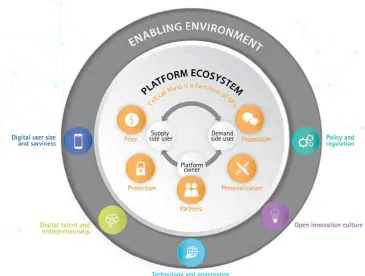
In their research report “Five Ways to Win with Digital Platforms” Accenture describes a platform strategy which has as core the 5 p’s: proposition, personalization, price, protection and partners [20].
![Figure 4: Technology diffusion lifecycle on the end-user side [16].](https://thumb-us.123doks.com/thumbv2/123dok_us/9701687.471387/20.595.138.470.471.662/figure-technology-diffusion-lifecycle-end-user.webp)
![Figure 7: Virtuous Loop Between End-user Stickiness and App-developers Stickiness [16]](https://thumb-us.123doks.com/thumbv2/123dok_us/9701687.471387/22.595.154.446.279.385/figure-virtuous-loop-end-user-stickiness-developers-stickiness.webp)