University of Warwick institutional repository: http://go.warwick.ac.uk/wrap
This paper is made available online in accordance with
publisher policies. Please scroll down to view the document
itself. Please refer to the repository record for this item and our
policy information available from the repository home page for
further information.
To see the final version of this paper please visit the publisher’s website.
Access to the published version may require a subscription.
Author(s): L. Ofman, J. M. Davila, V. M. Nakariakov, and A.-F. Vinas
Article Title: High-frequency Alfven waves in multi-ion coronal
plasma: Observational implications
Year of publication: 2005
Link to published article:
http://dx.doi.org/10.1029/2004JA010969
Publisher statement: An edited version of this paper was published by
AGU. Copyright (2005) American Geophysical Union.
L. Ofman, J. M. Davila, V. M. Nakariakov, and A.-F. Vinas, (2005),
High-frequency Alfven waves in multi-ion coronal
High-frequency Alfve´n waves in multi-ion coronal
plasma: Observational implications
L. Ofman,1,2 J. M. Davila,3 V. M. Nakariakov,4 and A.-F. Vin˜as5
Received 9 December 2004; revised 18 March 2005; accepted 29 April 2005; published 9 September 2005.
[1] We investigate the effects of high-frequency (of order ion gyrofrequency) Alfve´n and ion-cyclotron waves on ion emission lines by studying the dispersion of these waves in a multi-ion coronal plasma. For this purpose we solve the dispersion relation of the linearized multifluid and Vlasov equations in a magnetized multi-ion plasma with coronal abundances of heavy ions. We also calculate the dispersion relation using nonlinear one-dimensional hybrid kinetic simulations of the multi-ion plasma. When heavy ions are present the dispersion relation of parallel propagating Alfve´n cyclotron waves exhibits the following branches (in the positive W kquadrant): right-hand polarized nonresonant and left-hand polarized resonant branch for protons and each ion. We calculate the ratio of ion to proton velocities perpendicular to the direction of the magnetic field for each wave modes for typical coronal parameters and find strong enhancement of the heavy ion perpendicular fluid velocity compared with proton perpendicular fluid velocity. The linear multifluid cold plasma results agree with linear warm plasma Vlasov results and with the nonlinear hybrid simulation model results. In view of our findings we discuss how the observed nonthermal line broadening of minor ions in coronal holes may relate to the high-frequency wave motions.
Citation: Ofman, L., J. M. Davila, V. M. Nakariakov, and A. F. Vin˜as (2005), High-frequency Alfve´n waves in multi-ion coronal plasma: Observational implications,J. Geophys. Res.,110, A09102, doi:10.1029/2004JA010969.
1. Introduction
[2] The observation of minor ion emission lines in EUV
in the solar corona has been the major diagnostic tool of coronal physical properties, such as temperature and densi-ty, for the past several decades. The launch of spectroscopic EUV instruments on sounding rockets [Hassler et al., 1990;
Neupert et al., 1992; Davila et al., 1997] and Ultraviolet Coronagraph Spectrometer (UVCS) [Kohl et al., 1995], Coronal Diagnostic Spectrometer (CDS) [Harrison et al., 1995], and Solar Ultraviolet Measurement of Emitted Radiation (SUMER) [Wilhelm et al., 1995] on the Solar and Heliospheric Observatory (SOHO) further increased the use on these remote sensing tools as one of the major coronal observation methods. Ground-based observations of coronal lines in the visible spectrum were also obtained [e.g.,Hara and Ichimoto, 1999].
[3] The observed emission lines have finite width in
wavelength due to the Doppler effect of the emitting ion
motion along the line of sight (i.e.,Dl/lv/c, whereDlis the Doppler shift at wavelength l, vis the corresponding velocity of the emitting ion, andcis the speed of light) and due to instrumental effects [e.g., seeWithbroe et al., 1982;
Kohl and Withbroe, 1982]. The Doppler broadening due to Maxwellian velocity distribution of the ions leads to Gauss-ian emission line profile with a 1/ewidth that corresponds to twice the thermal speed of the ions, vth,i =
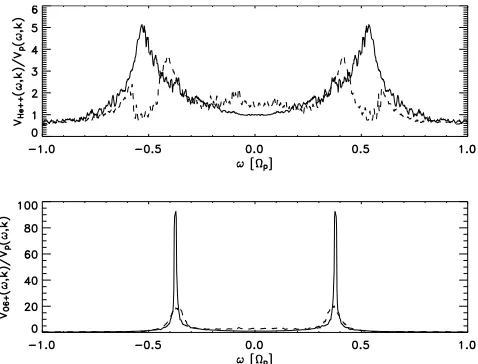
ffiffiffiffiffiffiffiffiffiffiffiffiffiffiffiffiffiffi
2kBTi=mi p
. Thus the observed line is usually separated in two parts: thermal and nonthermal. The temperature and the corresponding thermal velocity can be determined indepen-dently, for example, from emission line intensity ratio of two ions. The nonthermal motions can be obtained by subtracting the thermal Gaussian profile from the observed emission line profile. The nonthermal motions may contain microscopic non-Maxwellian kinetic motions of the emit-ting ions and unresolved macroscopic bulk motion of the plasma due to waves or turbulence. If both thermal and nonthermal motions have Gaussian distribution, then the observed 1/eion emission line width square is the sum of squares of the thermal and nonthermal widths (i.e., in terms of velocitiesv1/e2 =vth,i2 +x2, wherexis the rms nonthermal
velocity). Evidently, the relation of the observed line emis-sion to the actual physical properties and motions of the plasma depends strongly on the assumptions and the modeling used in the reduction of the observations and on the correction for the instrumental effects [Kohl et al., 1997;
Ofman and Davila, 1997, 2001].
[4] The detection of unresolved plasma motions at the
base of the corona, such as Alfve´n waves or turbulence, is
JOURNAL OF GEOPHYSICAL RESEARCH, VOL. 110, A09102, doi:10.1029/2004JA010969, 2005
1Department of Physics, Catholic University of America, Washington,
DC, USA.
2Also at NASA Goddard Space Flight Center, Code 612.1, Greenbelt,
Maryland, USA.
3NASA Goddard Space Flight Center, Code 612.1, Greenbelt, Maryland,
USA.
4Physics Department, University of Warwick, Coventry, UK. 5
NASA Goddard Space Flight Center, Code 612.2, Greenbelt, Maryland, USA.
Copyright 2005 by the American Geophysical Union. 0148-0227/05/2004JA010969$09.00
an important goal for the understanding of the heating of the corona, and the acceleration of the solar wind since these waves and motions are the main ‘‘ingredients’’ in many recent coronal heating and solar wind acceleration models [Marsch and Tu, 1997; Tu and Marsch, 1997;Ofman and Davila, 1998;Nakariakov et al., 2000;Ofman and Davila, 2001; Cranmer, 2002; Dmitruk et al., 2002; Hollweg and Isenberg, 2002; Ofman, 2004; Cranmer and van Ballegooijen, 2003;Li, 2003;Vainio et al., 2003;Li et al., 2004;Isenberg, 2004, and references therein]. The observed nonthermal broadening of minor ion emission lines in various locations in the solar corona provide the constraints for possible presence of Alfve´n waves or turbulent fluctu-ation spectra [Ofman and Davila, 1997;Narain et al., 2001;
Peku¨nlu¨ et al., 2002;O’Shea et al., 2003]. However, these studies considered Alfve´n waves in the MHD regime where the response of heavy ions to wave motions is practically identical to protons.
[5] Since the corona is nearly collisionless beyond 2 –
3R(i.e., the collision frequency is smaller than the relevant
wave frequency) and weakly collisional close to the Sun, the wave motions of the minor ions in the corona may be in principle different then the proton and electron wave motions. In particular waves with frequencies near and above ion gyrofrequencies, which is significantly above the typical collision frequency in the corona, can affect heavy ions in dramatically different ways than protons. As shown in this paper, the difference in velocity depends on the charge to mass ratio, the abundance of the ions relative to protons, and on the ion temperatures. Therefore determina-tion of the ion thermal and nonthermal modetermina-tions from observed line widths requires taking high-frequency wave motions into account.
[6] Propagation of Alfve´n waves in a multi-ion plasmas
have been considered in the past using Vlasov’s collision-less theory [e.g., see Smith and Brice, 1964; Gendrin and Roux, 1980; Gomberoff and Elgueta, 1991]. Multifluid equations for Maxwellian plasma that consists of interacting electron, proton, and heavy ions fluids are well applicable to the lower solar corona and produce similar results. The dispersion relation (real frequency versus wave number) obtained with the multifluid equations in the cold plasma approximation is similar to the dispersion relation obtained from the more complex collisionless Vlasov equations.
[7] Recently, two-dimensional three fluid model of the
fast solar wind driven by Alfve´n waves was developed [Ofman and Davila, 2001; Ofman, 2004]. Ofman [2004] investigated the acceleration of the fast solar wind in coronal holes with a spectrum of low-frequency Alfve´n waves (wWi) by solving numerically the nonlinear,
time-dependent, three-fluid equations in two dimensions. The three fluids were electrons, protons, and O5+or He++ions. The heating of the solar wind plasma due to dissipation of the low-frequency MHD waves by hyperviscosity and hyperresistivity, in addition to an empirical heat input term, was investigated.
[8] Ofman and Davila [2001] and Ofman[2004] found
that nonthermal motions due to low-frequency Alfve´n waves with amplitudes constrained by observations in the lower corona can explain the nonthermal line broadening of hydrogen (Ly-a) emission lines in coronal holes observed by UVCS [Kohl et al., 1995], but these waves cannot account
for the broad emission lines of O5+ ions. Motivated by temperature anisotropy deduced from observations of O5+ ion line emission and the Doppler dimming effect [Kohl et al., 1998;Li et al., 1998], it has been suggested that the broad emission lines are due to perpendicular heating by ion cyclotron waves [Cranmer et al., 1999; Marsch, 1999]. Ion-cyclotron waves were suggested as the heating mecha-nism for coronal plasma ions in the past [Dusenbery and Hollweg, 1981;McKenzie and Marsch, 1982;Isenberg and Hollweg, 1982; Axford and McKenzie, 1992] and were extensively studied in this context using linear Vlasov, quasilinear, and nonlinear kinetic simulation methods (see the review byHollweg and Isenberg[2002]). In this study we are not concerned with heating by these waves but with the possible contribution of high-frequency Alfve´n cyclotron waves to perpendicular ion motions.
[9] Recently, one-dimensional (1-D) hybrid simulations
were used to study proton-He++-O5+ plasma in the solar wind [Xie et al., 2004]. In the hybrid model the electrons are treated as fluid and the ions are described kinetically [e.g.,
Winske and Omidi, 1993]. In the work ofXie et al.[2004] a driving spectrum of ion-cyclotron waves was included and in some cases a relative drift between the heavy ions and protons and good qualitative agreement with Vlasov dis-persion relation was found. However, owing to numerical reasons, the abundance of the O5+was unrealistically high. In this study we include the more abundant O6+ ion in addition to protons and He++ and do not include ion drift (note thatnO6+/nO5+ 150 [Wimmer-Schweingruber et al.,
1998]).
[10] The present study is focused on the dispersion
properties of Alfve´n cyclotron waves and their observational implication. Here, we use the linearized multifluid equations for cold multi-ion plasma, Vlasov dispersion relation for warm multi-ion plasma, and 1-D hybrid kinetic model of warm multi-ion plasma to explore the effects of high-frequency waves of the order of the ion gyrohigh-frequency on the dispersion and motion of the heavy ions and discuss their observational implications. We include the two most abun-dant heavy ions, He++and O6+, with their typical coronal abundances in the models, and consider the typical plasmab (ratio of thermal to magnetic pressure) in the lower corona. [11] In section 2 we present the linear multifluid cold
plasma model, in section 3 we present the multifluid dispersion relations, in section 4 we show the relation between ion and proton fluid velocities, in section 5 we show the solution of the Vlasov dispersion relation for warm multicomponent plasma, in section 6 we present the dispersion relation obtained from the hybrid kinetic model of the warm multi-ion plasma, and section 7 is devoted to discussion of the observational implications and to conclusions.
2. Linearized Multifluid Equations
[12] Assuming that the characteristic spatial scales of the
inhomogeneity are much larger than the relevant wave-lengths, we consider Alfve´n and ion-cyclotron waves in a homogeneous multifluid cold plasma which consists of electrons, protons, and heavy positive ions of the electric charge qi = Zie and mass mi = Aimp. Gravity, pressure
this study. We assume quasi-neutrality and neglect the displacement current. Also, we study linear perturbations only (i.e.,jVj CA, whereCAis the Alfve´n speed defined
below). Owing to the effects of Coulomb friction in the lower corona (r< 2R) the drift of heavy ions relative to
[image:4.592.302.539.494.584.2]protons is small compared with the Alfve´n speed, and we neglect it in this study. This is confirmed by the 2-D three-fluid model of the fast solar wind in coronal holes that includes Coulomb friction terms [Ofman, 2004]. The model calculations show that the relative drift between protons and heavy ions is negligible for r < 2R [see Ofman, 2004,
Figure 10]. In addition, according to UVCS observation [Kohl et al., 1998], the O5+ drift below 1.9R may be
negligible, and therefore the O6+ ion which is more abundant by two orders of magnitude than O5+ ion is unlikely to drift considerably relative to protons due to Coulomb friction. The governing equations are the equations of motions for protons,
@Vp @t ¼
e
mpc VpVe
B0; ð1Þ
and for each heavy ion,
@Vi @t ¼
Zie
micðViVeÞ B0; ð2Þ
and the magnetic induction equation,
@B
@t ¼ r ðVeB0Þ; ð3Þ
whereVpis the velocity of protons andViis the velocity of ions (in this study we set i = He++, O6+), b0 is the background magnetic field, and the electron velocity is given by
Ve¼X
i Zini
neViþ np neVp
c
4pener B; ð4Þ
where Bis the perturbed magnetic field and np,ni, andne
denote proton, ion, and electron number densities, respec-tively. As we consider waves with frequencies significantly below the electron plasma frequency, the quasi-neutrality condition implies that electron charge density is equal to the sum of the proton and positive ion charge densities,
ne¼npþX
i
Zini: ð5Þ
In equations (1) – (5), ions and protons interact with each other electromagnetically, through the perturbations of the field and the charge neutrality condition. Since we neglected pressure gradients and the Alfve´n waves are incompressible, we do not need to solve the equations of continuity.
[13] In the following, we assume that the unperturbed
magnetic field is directed along the z-axis and consider transverse waves propagating parallel to the field, which perturb thexandycomponents of the velocity vectors and the magnetic field propagating parallel to the field only. Also, we assume the harmonic dependence of the perturbed
quantities upon time and the longitudinal coordinate, /
exp(iwtikz).
3. Multifluid Dispersion Relation
[14] It is convenient to consider left-hand and right-hand
circularly polarized transverse waves, thus introducing the following variables [e.g., seeStix, 1992]:
Vp¼VpxiVpy; Vi¼VixiViy;
Ve¼VexiVey; B¼BxiBy: ð6Þ
With the use of these variables, equations (1) – (4) can be rewritten as
wVp¼ WpVpVe; ð7Þ
wVi¼ WiðViVeÞ; ð8Þ
wB¼ kB0Ve; ð9Þ
Ve¼
X
i Zini
ne Viþ np neVp
kc
4peneB; ð10Þ
where
Wp¼ eB0 mpc; Wi¼
ZieB0
mic ð11Þ
are the proton and ion cyclotron frequencies, respectively. The consistency condition gives us the dispersion relation for the transverse parallel waves in multi-ion plasma [e.g., seeSmith and Brice, 1964],
1C
2 Ak
2
Wpw
X
i fiWi Wiw
1X
ifi
Wp
Wpw
¼0; ð12Þ
where
CA¼ B0
4pmpne
1=2 ð13Þ
is the convenient definition of the Alfve´n speed (which reduces to the single fluid Alfve´n speed in the absence of heavy ions) and
fi¼Zini
ne ð14Þ
is the relative heavy ion charge density. For the solar coronal conditions, the typical value of the parameter fi is
0.1 for He++and 4.8103for O6+.
[15] In the low-frequency limit, dispersion relations (12)
contain two small parameters, the ratiosw/Wpandw/Wi. As
the MHD limit is approached, both ratios tend to zero and may be considered of the same order. Expanding up to the
A09102 OFMAN ET AL.: HIGH-FREQUENCY ALFVE´ N WAVES IN MULTI-ION PLASMA
3 of 10
quadratic terms of the ratios the denominators of the third and the fourth terms of the dispersion relation and assuming that one heavy ion is present, we obtain
w2C2Ak2w
3
Wp
þfiw2 Wp Wi
1
w
Wp W2p
W2i
1
! " #
¼0:
ð15Þ
[16] In the absence of the heavy ions (fi = 0), the
dispersion relation reduces to
w2CA2k2w
3
Wp
¼0: ð16Þ
Taking into account that w CAk, the third term may be
rewritten as CA3k3/Wp. Note that in the low-frequency limit
(w Wp) equation (16) reduces to the ideal MHD Alfve´n
wave dispersion relation (w = CAk in the positive w k
quadrant).
[17] In the general case, dispersion relation (12) describes
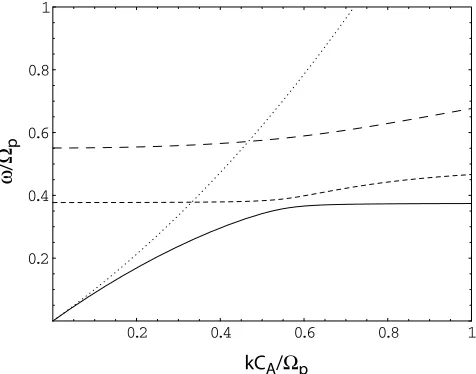
resonant dispersive branches for multi-ion plasma. The multifluid cold plasma dispersion is close to the warm plasma Vlasov dispersion relation for the real frequency of the parallel propagating Alfve´n waves (see section 5 below). Figure 1 shows the solutions of the dispersion relation for multi-ion plasma with observed coronal abun-dances of He++ ions (fi = 0.1,Wi/Wp = 0.5) and O6+ (fi =
4.8103,Wi/Wp= 0.375). The exact analytical solution of
the dispersion relation for the two heavy ions was obtained and plotted with Mathematica#. The sign in equation (12)
is selected to show the right-hand and left-hand polarized branches in the positive w k quadrant (the other three quadrants exhibit symmetric and antisymmetric reflections of the branches in this quadrant). The typical feature of this
plot is the presence of three resonant branches of the left-hand polarized waves, due to the He++ and O6+ions, and proton cyclotron resonances, in addition to one right-hand polarized nonresonant wave, which at high frequencies (w Wp) becomes the whistler wave.
[18] The dispersion exhibits the well-known frequency
gaps, in which no parallel left-hand polarized waves can propagate. The width of frequency gap decreases with the relative (to proton) abundance of the heavy ions [see Cornwall and Schulz, 1971; Cuperman et al., 1975;
Isenberg, 1984; Cuperman et al., 1988]. The dispersion relation was investigated for the three most abundant ions in the solar corona: p, He++, and O6+. The abundance of other minor ions is one to three orders of magnitude smaller than the abundance of O6+, and their effect on the dispersion relation can be neglected for the purpose of this study (the effect of multitude of the coronal ions on ion-cyclotron wave heating was considered byCranmer[2000]).
4. Alfve´n Wave Velocity Amplitudes
[19] Consider perturbations of the plasma by the Alfve´n
and ion-cyclotron waves described by dispersion relation (12). Rewriting equations (7) and (8), we obtain
Vp¼ Wp wWp
Ve; ð17Þ
Vi¼ Wi wWi
Ve; ð18Þ
which allows us to calculate the ratio of the ion and proton linear fluid velocity perturbations induced by Alfve´n and ion-cyclotron waves,
Vi
Vp
¼w=Wp1
w=Wi1
: ð19Þ
[20] Clearly, in the MHD regime (wWp,Wi), equation
(19) reduces to the single fluid limit, with Vi± = Vp±. For
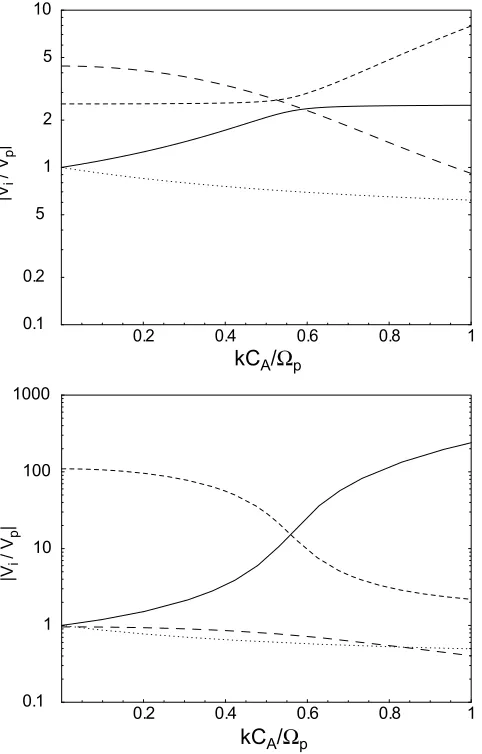
higher frequencies, comparable with the resonant frequen-cies, the frozen-in condition does not apply, and the dy-namics of protons and ions becomes very different. This is shown in Figure 2, for the plasma with He++ ions (upper panel) and O6+(lower panel) (the ion abundances and other parameters are the same as in Figure 1). Note that the resonant branches are heavily damped forkCA/Wp> 1 in a
warm plasma (see section 5 below); therefore we show the dispersion up tokCA/Wp= 1.
[21] In the long wavelength limit (k!0), one of the roots
of dispersion relation (12) tend to the value
w!Wiþfi WpWi
: ð20Þ
For this limiting value we get
jVi=Vpj !
Wið1fiÞ
[image:5.592.52.290.69.256.2]Wpfi ð21Þ Figure 1. The solution of the four-fluid Alfve´n wave
for the ion-cyclotron branch. For the typical coronal hole parameters used here (CA2000 km s
1
,Wp= 9.58104 Rad s1) this limit is about 4.5 for the He++ branch and about 78 for the O6+branch.
[22] It is interesting to note that according to equation
(21), the perpendicular velocity amplitude of low-abun-dance heavy ions (fi ! 0) in the corona is much larger
than proton perpendicular velocity amplitude for this wave mode (see also Figure 2). However, this linear cold plasma result is valid for small velocitiesjVi±j CAandjVp±j CA, and, as evident from the lower panel in Figure 3 below,
the damping increases as the abundance decreases. Thus in cases wherejVi±/Vp±j 1 the linear approximation implies
thatjVp±j jVi±j CAbut still allows for proton and ions
velocities on the order of several hundred km s1 with typical value ofCA2000 km s
1
in the lower corona hole.
Below, we show that this result hold in the nonlinear hybrid simulation model.
5. Vlasov Dispersion for Parallel Propagating
Electromagnetic Waves in Warm Plasma
[23] To check whether the effect discussed in the previous
sections takes place in a realistic low but finitebplasma of the solar corona, we investigate the effects of finite tem-perature on the dispersion relation of ion-cyclotron waves in the multicomponent plasma by solving numerically the dispersion relation of the linearized Vlasov equation for parallel propagating electromagnetic waves in warm multi-component plasma. The dispersion relation for isotropic, stationary (i.e., zero drift), multicomponent plasma can be written as [Scharer and Trivelpiece, 1967; Davidson and Ogden, 1975;Gary, 1978, 1993;Araneda et al., 2002]
k2c2w2X
i w2pi w
vikz wWi
vik
¼0; ð22Þ
where w = wr + ig is the complex frequency andk is the
wave number along the magnetic field. In the above equation the parallel thermal speed isvi= (2kBTi/mi)1/2,zis
the plasma dispersion function [Fried and Conte, 1961], and the plasma frequencywpi= (4pniqi2/mi)1/2. The plasma
is assumed to be charge neutral (Piniqi= 0) and carry zero
current. In the limit of cold plasma (T!0) the dispersion relation given by equation (22) approaches the multifluid cold plasma dispersion relation (12).
[24] The solution of Vlasov’s dispersion relation (22) for
[image:6.592.53.294.69.446.2]warm plasma with protons, He++, and O6+ions is shown in Figure 3. As discussed above, the relative drift between the protons and ions is small in the lower corona due to the effect of Coulomb friction [Ofman, 2004] and was neglected here. Solutions of the Vlasov dispersion relation with drift for proton-He++ plasma can be found in the work of
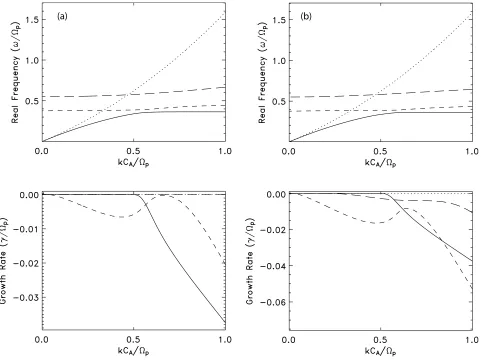
Gomberoff and Elgueta[1991] andXie et al.[2004]. [25] We have used nHe++/np = 0.05 and nO6+/np = 8
104withb= 0.01 (Figure 3a) andb= 0.03 (Figure 3b). It is evident that the real frequency dependence onkis close to the four-fluid (and therefore cold plasma) solution shown in Figure 1. This justifies the use of the four-fluid equations in the undamped or weakly damped solutions of the dispersion relation to estimate the fluid velocity components. The imaginary parts show the damping rate (negative growth rate).
[26] The long-dashes branch of the real frequency goes
asymptotically to w/Wp = 1 and is thus due to proton
resonance. The corresponding imaginary part of this branch is negligible forkCA/Wp< 1. The short-dashed branch of the
real frequency starts above theO6+gyroresonant frequency (w/Wp= 6/16) and goes asymptotically to theHe++resonant
frequency (W/wp = 0.5). Calculation of the ion cyclotron
resonance factors (the argument of the z function in equation (22) for each ion species, indicating resonance if the value is ]3 [Gary et al., 1984]) shows that the corresponding damping rate is mostly due to the He++
resonance for kCA/Wp ! 1 and dominated by the O6+
resonance for kCA/Wp 0.5. The solid line branch of the
real frequency goes asymptotically to 6/16, with the
Figure 2. The dependence of the wave velocity amplitude ratio for ions and protons on the normalized wave number (He++ in the top panel and O6+ in the lower panel). The solid and the dashed curves corre-sponds to the left hand circularly polarized waves, which experience proton and ion cyclotron resonances. The dotted curves correspond to the right-hand polarized waves.
A09102 OFMAN ET AL.: HIGH-FREQUENCY ALFVE´ N WAVES IN MULTI-ION PLASMA
5 of 10
corresponding resonant damping due to O6+. The lower resonant branch (solid line) is nearly undamped belowkCA/Wp0.5, and the middle resonant branch (short
dashes) is weakly damped belowkCA/Wp1, with minima
at kCA/Wp = 0, and kCA/Wp 0.66. The damping rate
increases for all the resonant branches when b increases from 0.01 to 0.03. The nonresonant branch is not damped.
6. Hybrid Model Dispersion
[27] We use a one-dimensional hybrid code [e.g.,Winske and Omidi, 1993] to model a collisionless, homogeneous, magnetized multispecies plasma. In the hybrid model the ions are represented as particles, while the electrons are described as a massless fluid to maintain quasi-neutrality of the plasma. The particle and field equations are integrated in time using a rational Runge-Kutta method, whereas the spatial derivatives are calculated by pseudospectral FFT method.
[28] In previous hybrid simulation studies, O5+ions were
included in multi-ion plasma with unrealistically large abundance due to the numerical difficulty to include the coronal abundance of O5+[Ofman et al., 2002; Xie et al., 2004]. Here, the goal is to study the dispersion relation with
coronal ion abundances, and we include the more abundant O6+ions in addition to protons and He++ ions. The simu-lations were initialized with an isotropic Maxwellian veloc-ity distributions for the ions, and an initial transverse magnetic field perturbation was imposed. We use a periodic system inz with the background magnetic fieldB0=^z B0
with 256 grid cells to solve for the fields, with 100 particles per cell for each component (i.e., 300 particles per cell, with the total of 76,800 particles) and with grid sizeDx= 1.5c/wpp. The integration time step wasWpDt= 0.05.
[29] Heating due to continuously driven wave spectrum
was investigated previously [Ofman et al., 2002; Xie et al., 2004]. In the present study the wave spectrum was imposed in two steps: first, an f1spectrum of circularly polarized magnetic fluctuation with small amplitude (DB/B0= 0.01)
and in the frequency range 0.1 – 0.3Wpwas driven for 50Wp1
in a small region at the center of the simulated plasma (see detailed description of the driver in the work ofOfman et al.
[2002] and Xie et al. [2004]). Next, the self-consistent (undriven) hybrid simulations were initialized using the results of the driven simulations as the initial state and run for about 1600Wp1. The dispersion relation was
[image:7.592.58.539.64.424.2]obtained by Fourier transforming the magnetic fluctuations and ion velocities in the second stage. During the first stage
of the simulations, perpendicular heating has taken place in
O6+, increasing the temperature by 45%. Note that the resultingO6+temperature anisotropy is stable in the low-b plasma and hence does not significantly affect the disper-sion relation [Ofman et al., 2001;Gary et al., 2001]. The perpendicular heating of protons (2%) and of He++ (7%) was insignificant. In the second stage the perpendicular temperature has increased by 10% forO6+and did not vary significantly for He++ and protons. The parallel thermal speed remains close to the initial value forb= 0.02. Withne
= 108cm3, B = 5 G, and the correspondingT= 1.4106 K, we get the proton thermal speed 1.1 108 cm/s, the
He++thermal speed of 5.5107cm/s, and theO6+thermal speed 2.7107cm/s.
[30] The dispersion relation of the proton-He++-O6+plasma
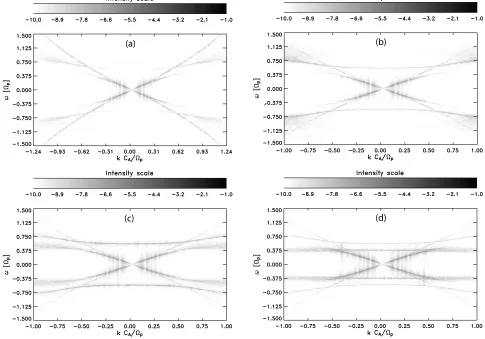
shown in Figure 4 with the coronal abundances of the ions, and b = 0.02 was constructed as follows: the transverse magnetic field components (B?) (Figure 4a) and the fluid velocity components of the ions (V?) (Figures 4b – 4d) were
Fourier transformed both in space and time, and the modes were decomposed to modes with positive and negative helicity [Terasawa et al., 1986]. The fluid velocity compo-nents in space-time were calculated by numerically
inte-grating the moments of the velocity distributions of the protons and the heavy ions obtained from the hybrid simulations.
[31] The undamped and weakly damped parts of the
dispersion branches are evident (here, all four quadrants in the w kspace are shown). The branches are in good agreement with the four-fluid and Vlasov calculations of the dispersion relation. The right-hand polarized Alfve´n wave branch extends throughout theWrange. The lower left-hand polarized resonant branch approaches WO6+ and is evident
below jkCA/Wpj 0.5. The weakly damped part of
the middle left-hand polarized resonant branch is evident for 0.4]kCA/Wp]0.7 in the magnetic field fluctuation and
for the full range ofkin the ion velocity fluctuations. The branch corresponds to the weakly damped region in the Vlasov dispersion relation (Figure 3). The normalized intensities of the branches are different for each ion velocity,
V?i(W, k). The intensities are consistent with the expected perpendicular fluid velocity ratios calculated from the multifluid cold plasma dispersion.
[32] In order to compare the hybrid simulation results
[image:8.592.53.538.72.411.2]with the four fluid results, we show in Figure 5 the ratio of the ion to protons fluid velocities as a function ofwfor two
Figure 4. The dispersion relation of the proton-He++-O6+ plasma is evident from the power of the Fourier transform in w k space of (a) transverse magnetic field fluctuations, B?; transverse fluid
velocities of the ions (b) V?p; (c) V?He++; (d)V?O6+calculated from the hybrid simulation model with
coronal abundances of the ions andb= 0.02. Note the difference in the intensity of the resonant branches in each case. The dispersion branches agree with the four-fluid and Vlasov dispersion.
A09102 OFMAN ET AL.: HIGH-FREQUENCY ALFVE´ N WAVES IN MULTI-ION PLASMA
7 of 10
given values ofk, calculated from the hybrid model run for about 3300Wp1 with the three ion species. To eliminate
noise in the ratio due to the finite nature of the Fast Fourier Transform (FFT), the w kspectrum was smoothed over five points in the kgrid space (where the kgrid spacing is
Dk= 2p/L, with L= 256Dz= 384c/Wpp). The ratio of the
velocities in the Fourier space VHe++/Vpis shown in the top
panel for kCA/Wp 0 (solid line) and forkCA/Wp 0.52
(dashes) and the ratio VO6+/Vpfor the same values of k is
shown in the lower panel. The peaks of the velocity ratios are on the resonant branches of the dispersion. The approximate peak ratios of 100 and 20 for VO6+/Vp, and
3.5, and 5 for VHe++/Vp are in good agreement with the
values of the velocity ratios for the corresponding k’s on the resonant branches calculated from the four-fluid theory, shown in Figure 2. Thus the multifluid cold plasma velocity ratios are recovered in the fully nonlinear and self-consistent hybrid simulations of the warm multi-ion plasma.
7. Discussion and Conclusions
[33] We investigated the dispersion relation of Alfve´n and
ion-cyclotron waves in a multi-ion plasma using linearized multifluid cold plasma, Vlasov warm plasma, and nonlinear 1-D hybrid warm plasma models with coronal temperature and abundances of the He++and O6+ions. The advantages of the multifluid cold plasma model over kinetic description is the relative simplicity and the numerical tractability that allow to obtain global fluid quantities of each particle species for wave modes of interest. Since most observations of the corona are in minor ion emission lines, the multifluid cold plasma model is useful in the analysis of these observations. The main limitation of the multifluid cold plasma model is the lack of detailed information on the
kinetic velocity distribution and the thermal damping effects. Therefore we have solved the linear Vlasov disper-sion relation for warm multi-ion plasma and found good agreement with the four fluid cold plasma dispersion relation. The results were further confirmed with the hybrid simulation model of warm multi-ion plasma that is fully nonlinear and self-consistent. The main limitations of our models are the neglect of possible heavy ions drift relative to protons and the effects of possible temperature anisotropy in ion temperatures. Some aspects of these effects were investigated by previously using the 1-D hybrid model [Ofman et al., 2002;Xie et al., 2004].
[34] It is well known that in the presence of heavy ions
the dispersion relation of the parallel propagating Alfve´n cyclotron waves exhibits multiple branches: left-hand po-larized resonant (due to each ion species) and right-hand polarized whistler branch. Using the multifluid cold plasma equations, we find the various relations between the ion and proton velocity amplitudes of each branch. The resonant branches results in high ion-to-proton velocity amplitude ratio. However, thermal effects limit the range of wave-lengths that these branches can exist. For typical coronal temperatures and abundances the effect is strong for O6+ ions and significant for He++ions for weakly damped wave numbers (kCA/Wp]1).
[35] The contribution of the high-frequency waves to the
observed ion emission line widths depends on the actual wave spectrum in the observed coronal structure and in particular on the power contained in the resonant branches. At present the exact spectrum of waves in the lower corona is unknown. Heliospheric observations beyond 0.3 AU by Helios show that the spectrum has a form of W1 for frequencies below 104Hz andW5/3for higher frequencies [e.g.,Grappin et al., 1990]. Ofman and Davila[2001] and
Ofman [2004] have shown that the nonthermal motion of the protons due to the low-frequency waves can explain the observed hydrogen line broadening and that additional contribution of other processes is required to account for the heavy ion line broadening. We find that high-frequency Alfve´n cyclotron waves can in principle account for the enhanced (compared with protons) minor ion nonthermal line broadening, and further, quantitative investigation of this effect on observed emission line widths of heavy ions is needed.
[36] In particular, we find that the resonant high-frequency
[image:9.592.52.291.67.249.2](hybrid) branches of the dispersion relation can result in large unresolved wave motions that can lead to broad emission lines of He++ and O6+compared with protons at the same temperature. Thus the observed line broadening of other heavy ions, such as O5+ may be the result of the averaged over the line-of-sight contribution of thermal and wave motions, with the high-frequency resonant waves contributing significantly to the line widths. Although the wave power spectrum may be concentrated in the low-frequency range, small fraction of that power at the heavy ion resonant frequencies can result in significantly enhanced average perpendicular ion velocities. The form of the unknown wave spectrum in various parts of the corona, the relative abundance of the heavy ions, the temperatures, and the local Alfve´n and ion-cyclotron frequencies are the main factors that affect the nonthermal broadening of the emission lines due to this effect.
Figure 5. The ratio of the ion to protons velocities calculated from the hybrid model. The ratio VHe++/Vp is
shown in the top panel forkCA/Wp0 (solid line) and for kCA/Wp0.52 (dashes). Bottom panel is the same as the top
panel but for the ratio VO6+/Vp. Note, the good agreement
[37] Hybrid resonance waves have been observed for
decades in the multi-ion space plasma of the ionosphere [Smith and Brice, 1964] and the magnetosphere in the past [Young et al., 1981; Fraser and McPherron, 1982] and recently [e.g.,Mouikis et al., 2002]. In these observations it was found that the minor ions play a dramatic role in the modification of the electromagnetic ion cyclotron wave spectrum and that the minor ions can be strongly energized by the ion-cyclotron waves. Similarly, it is reasonable to assume that if ion cyclotron waves are present in the solar corona, then the heavy ions will strongly affect the ion-cyclotron wave spectrum. Several mechanism were pro-posed for the excitation of the hybrid resonance waves in the magnetosphere in the past [Gendrin and Roux, 1980;
Roux et al., 1982], and it is reasonable to assume that similar mechanisms may act in the solar coronal multi-ion plasma. For example, proton-cyclotron waves can be gen-erated by a population of protons with temperature anisot-ropy (T?> Tk). The spectrum can interact resonantly and
nonlinearly with the minor ions, generating the hybrid branches and eventually energizing the minor ions.
[38] Acknowledgments. LO would like to thank NASA grants NAG5-11877 and NNG04GA96G and NSF grant ATM-0135889.
[39] Shadia Rifai Habbal thanks S. Peter Gary and another referee for their assistance in evaluating this paper.
References
Araneda, J. A., A. F. Vin˜as, and H. F. Astudillo (2002), Proton core temperature effects on the relative drift and anisotropy evolution of the ion beam instability in the fast solar wind,J. Geophys. Res.,107(A12), 1453, doi:10.1029/2002JA009337.
Axford, W. I., and J. F. McKenzie (1992), The origin of high speed solar wind streams, inSolar Wind Seven, edited by E. Marsch and R. Schwenn, pp. 1 – 5, Elsevier, New York.
Cornwall, J. M., and M. Schulz (1971), Electromagnetic ion-cyclotron instabilities in multicomponent magnetospheric plasma,J. Geophys. Res.,76, 7791 – 7796.
Cranmer, S. R. (2000), Ion cyclotron wave dissipation in the solar corona: The summed effect of more than 2000 ion species,Astrophys. J.,532, 1197 – 1208.
Cranmer, S. R. (2002), Coronal holes and the high-speed solar wind,Space. Sci. Rev.,101, 229 – 294.
Cranmer, S. R., and A. A. van Ballegooijen (2003), Alfve´nic turbulence in the extended solar corona: Kinetic effects and proton heating,Astrophys. J.,594, 573 – 591.
Cranmer, S. R., G. B. Field, and J. L. Kohl (1999), Spectroscopic constraints on models of ion cyclotron resonance heating in the polar solar corona and high-speed solar wind,Astrophys. J.,518, 937 – 947. Cuperman, S., L. Gomberoff, and A. Sternlieb (1975), Requirements on
singly ionized lithium concentrations for magnetospheric seeding experi-ments,J. Geophys. Res.,80, 4643 – 4647.
Cuperman, S., L. Ofman, and M. Dryer (1988), On the dispersion of ion cyclotron waves in H+-He++solar wind-like magnetized plasmas,J. Geo-phys. Res.,93, 2533 – 2538.
Davidson, R. C., and J. M. Ogden (1975), Electromagnetic ion cyclotron instability driven by ion energy anisotropy in high-beta plasmas,Phys. Fluids,18, 1045 – 1050.
Davila, J. M., R. J. Thomas, J. Brosius, and A. Poland (1997), The structure of the solar corona as observed by the Solar Extreme Ultraviolet Rocket Telescope and Spectrograph,Adv. Space Res.,20, 2293 – 2298. Dmitruk, P., W. H. Matthaeus, L. J. Milano, S. Oughton, G. P. Zank, and
D. J. Mullan (2002), Coronal heating distribution due to low-frequency, wave-driven turbulence,Astrophys. J.,575, 571 – 577.
Dusenbery, P. B., and J. V. Hollweg (1981), Ion-cyclotron heating and acceleration of solar wind minor ions,J. Geophys. Res.,86, 153 – 164. Fraser, B. J., and R. L. McPherron (1982), Pc 1 – 2 magnetic pulsation
spectra and heavy ion effects at synchronous orbit - ATS 6 results, J. Geophys. Res.,87, 4560 – 4566.
Fried, B. D., and S. D. Conte (1961),The Plasma Dispersion Function, Elsevier, New York.
Gary, S. P. (1978), Ion-acoustic-like instabilities in the solar wind,J. Geo-phys. Res.,83, 2504 – 2510.
Gary, S. P. (1993),Theory of Space Plasma Microinstabilities, Cambridge Univ. Press, New York.
Gary, S. P., D. W. Forslund, C. W. Smith, M. A. Lee, and M. L. Goldstein (1984), Electromagnetic ion beam instabilities,Phys. Fluids,27, 1852 – 1862.
Gary, S. P., L. Yin, D. Winske, and L. Ofman (2001), Electromagnetic heavy ion cyclotron instability: Anisotropy constraint in the solar corona, J. Geophys. Res.,106, 10,715 – 10,722.
Gendrin, R., and A. Roux (1980), Energization of helium ions by proton-induced hydromagnetic waves, J. Geophys. Res., 85, 4577 – 4586.
Gomberoff, L., and R. Elgueta (1991), Resonant acceleration of alpha particles by ion cyclotron waves in the solar wind,J. Geophys. Res., 96, 9801 – 9804.
Grappin, R., A. Mangeney, and E. Marsch (1990), On the origin of solar wind MHD turbulence: Helios data revisited,J. Geophys. Res.,95, 8197 – 8209.
Hara, H., and K. Ichimoto (1999), Microscopic nonthermal plasma motions of coronal loops in a solar active region, Astrophys. J., 513, 969 – 982.
Harrison, R. A., et al. (1995), The coronal diagnostic spectrometer for the Solar and Heliospheric Observatory,Sol. Phys.,162, 233 – 290. Hassler, D. M., G. J. Rottman, E. C. Shoub, and T. E. Holzer (1990), Line
broadening of MG X 609 and 625 A coronal emission lines observed above the solar limb,Astrophys. J.,348, L77 – L80.
Hollweg, J. V., and P. A. Isenberg (2002), Generation of the fast solar wind: A review with emphasis on the resonant cyclotron interaction,J. Geo-phys. Res.,107(A7), 1147, doi:10.1029/2001JA000270.
Isenberg, P. A. (1984), The ion cyclotron dispersion relation in a proton-alpha solar wind,J. Geophys. Res.,89, 2133 – 2141.
Isenberg, P. A. (2004), The kinetic shell model of coronal heating and acceleration by ion cyclotron waves: 3. The proton halo and dispersive waves, J. Geophys. Res., 109, A03101, doi:10.1029/ 2002JA009449.
Isenberg, P. A., and J. V. Hollweg (1982), Finite amplitude Alfven waves in a multi-ion plasma - Propagation, acceleration, and heating,J. Geophys. Res.,87, 5023 – 5029.
Kohl, J. L., and G. L. Withbroe (1982), EUV spectroscopic plasma diag-nostics for the solar wind acceleration region,Astrophys. J.,256, 263 – 270.
Kohl, J. L., et al. (1995), The Ultraviolet Coronagraph Spectrometer for the Solar and Heliospheric Observatory,Solar Phys.,162, 313 – 356. Kohl, J. L., et al. (1997), First results from the SOHO Ultraviolet
Corona-graph Spectrometer,Solar Phys.,175, 613 – 644.
Kohl, J. L., et al. (1998), UVCS/SOHO empirical determinations of aniso-tropic velocity distributions in the solar corona, Astrophys. J., 501, L127 – L131.
Li, B., X. Li, Y. Hu, and S. R. Habbal (2004), A two-dimensional Alfve´n wave-driven solar wind model with proton temperature anisotropy, J. Geophys. Res.,109, A07103, doi:10.1029/2003JA010313.
Li, X. (2003), Transition region, coronal heating and the fast solar wind, Astron. Astrophys.,406, 345 – 356.
Li, X., S. R. Habbal, J. Kohl, and G. Noci (1998), The Effect of temperature anisotropy on observations of Doppler dimming and pumping in the inner corona,Astrophys. J.,501, L133 – L137.
Marsch, E. (1999), Cyclotron heating of the solar corona,Astrophys. Space Sci.,264, 63 – 76.
Marsch, E., and C.-Y. Tu (1997), The effects of high-frequency Alfven waves on coronal heating and solar wind acceleration.,Astron. Astro-phys.,319, L17 – L20.
McKenzie, J. F., and E. Marsch (1982), Resonant wave acceleration of minor ions in the solar wind,Astrophys. Sp. Sci.,81, 295 – 314. Mouikis, C. G., et al. (2002), Equator-S observations of He+energization
by EMIC waves in the dawnside equatorial magnetosphere, Geophys. Res. Lett.,29(10), 1432, doi:10.1029/2001GL013899.
Nakariakov, V. M., L. Ofman, and T. D. Arber (2000), Nonlinear dissipative spherical Alfve´n waves in solar coronal holes,Astron. Astrophys.,353, 741 – 748.
Narain, U., P. Agarwal, R. K. Sharma, L. Prasad, and B. N. Dwivedi (2001), On coronal loop heating by torsional Alfve´n waves,Solar Phys.,199, 307 – 315.
Neupert, W. M., G. L. Epstein, R. J. Thomas, and W. T. Thompson (1992), An EUV imaging spectrograph for high-resolution observations of the solar corona,Solar Phys.,137, 87 – 104.
Ofman, L. (2004), Three-fluid model of the heating and acceleration of the fast solar wind, J. Geophys. Res., 109, A07102, doi:10.1029/ 2003JA010221.
Ofman, L., and J. M. Davila (1997), Do first results from SOHO UVCS indicate that the solar wind is accelerated by solitary waves?,Astrophys. J.,476, L51 – L54.
A09102 OFMAN ET AL.: HIGH-FREQUENCY ALFVE´ N WAVES IN MULTI-ION PLASMA
9 of 10
Ofman, L., and J. M. Davila (1998), Solar wind acceleration by large-amplitude nonlinear waves: Parametric study,J. Geophys. Res., 103, 23,677 – 23,690.
Ofman, L., and J. M. Davila (2001), Three-fluid 2.5-dimensional magne-tohydrodynamic model of the effective temperature in coronal holes, Astrophys. J.,553, 935 – 940.
Ofman, L., A. Vin˜as, and S. P. Gary (2001), Constraints on the O+5 aniso-tropy in the solar corona,Astrophys. J.,547, L175 – L178.
Ofman, L., S. P. Gary, and A. Vin˜as (2002), Resonant heating and accel-eration of ions in coronal holes driven by cyclotron resonant spectra, J. Geophys. Res.,107(A12), 1461, doi:10.1029/2002JA009432. O’Shea, E., D. Banerjee, and S. Poedts (2003), Variation Of coronal line
widths on and off the disk,Astron. Astrophys.,400, 1065 – 1070. Peku¨nlu¨, E. R., Z. Bozkurt, M. Afsar, E. Soydugan, and F. Soydugan
(2002), Alfve´n waves in the inner polar coronal hole, Mon. Not. R. Astron. Soc.,336, 1195 – 1200.
Roux, A., S. Perraut, J. L. Rauch, C. de Villedary, G. Kremser, A. Korth, and D. T. Young (1982), Wave-particle interactions near omega He+ observed on board GEOS 1 and 2:2. Generation of ion cyclotron waves and heating of He+ions,J. Geophys. Res.,87, 8174 – 8190.
Scharer, J. E., and A. W. Trivelpiece (1967), Cyclotron wave instabilities in a plasma,Phys. Fluids,10(3), 591 – 595.
Smith, R. L., and N. Brice (1964), Propagation in multicomponent plasmas, J. Geophys. Res.,69, 5029 – 5040.
Stix, T. H. (1992),Waves in Plasmas, Springer, New York.
Terasawa, T., M. Hoshino, J. Sakai, and T. Hada (1986), Decay instability of finite amplitude circularly polarized Alfve´n waves: A numerical simulation of stimulated Brillouin scattering,J. Geophys. Res.,91, 4171 – 4187. Tu, C.-Y., and E. Marsch (1997), Two-fluid model for heating of the solar
corona and acceleration of the solar wind by high-frequency Alfven waves,Solar Phys.,171, 363 – 391.
Vainio, R., T. Laitinen, and H. Fichtner (2003), A simple analytical expres-sion for the power spectrum of cascading Alfve´n waves in the solar wind, Astron. Astrophys.,407, 713 – 723.
Wilhelm, K., et al. (1995), SUMER - Solar Ultraviolet Measurements of Emitted Radiation,Solar Phys.,162, 189 – 231.
Wimmer-Schweingruber, R. F., R. von Steiger, J. Geiss, G. Gloeckler, F. M. Ipavich, and B. Wilken (1998), O5+ in High Speed Solar Wind Streams: SWICS/Ulysses Results,Space Sci. Rev.,85, 387 – 396.
Winske, D., and N. Omidi (1993),Computer Space Plasma Physics: Simu-lation Techniques and Sowftware, edited by H. Matsumoto and Y. Omura, pp. 103 – 160, Terra Sci., Tokyo.
Withbroe, G. L., J. L. Kohl, H. Weiser, and R. H. Munro (1982), Probing the solar wind acceleration region using spectroscopic techniques,Space Sci. Rev.,33, 17 – 52.
Xie, H., L. Ofman, and A. Vin˜as (2004), Multiple ions resonant heating and acceleration by Alfve´n/cyclotron fluctuations in the corona and the solar wind,J. Geophys. Res.,109, A08103, doi:10.1029/2004JA010501. Young, D. T., S. Perraut, A. Roux, C. de Villedary, R. Gendrin, A. Korth,
G. Kremser, and D. Jones (1981), Wave-particle interactions near Omega/He+observed on GEOS 1 and 2. I - Propagation of ion cyclo-tron waves in He+-rich plasma,J. Geophys. Res.,86, 6755 – 6772.
J. M. Davila and L. Ofman, NASA Goddard Space Flight Center, Code 612.1, Greenbelt, MD 20771, USA. ([email protected]; leon. [email protected])
V. M. Nakariakov, Physics Department, University of Warwick, Coventry, CV4 7AL, UK. ([email protected])
![Figure 10]. In addition, according to UVCS observation�5+](https://thumb-us.123doks.com/thumbv2/123dok_us/9778614.478930/4.592.302.539.494.584/figure-addition-according-uvcs-observation.webp)