A Behavioural Power Index
Serguei Kaniovski and Dennis Leech
No 831
WARWICK ECONOMIC RESEARCH PAPERS
A behavioral power index
Serguei Kaniovski∗ Dennis Leech†
March 11, 2009
Abstract
We propose an empirically informed measure of the voting power that relaxes the as-sumptions of equally probable and independent votes. The behavioral power index measures the voter’s ability to swing a decision based on the probability distributions of the others’ behavior. We apply it to the Supreme Court of the United States using roll-call data to estimate voting probability distributions, which lead us to refute the assumption of equally probable and independent votes, and estimate the equivalent number of independent Justices for the Warren, Burger and Rehnquist benches, which turns out to be very low.
JEL-Codes: D72
Key Words: behavioral voting power, constitutional voting power, U.S. Supreme Court
∗Austrian Institute of Economic Research (WIFO), P.O. Box 91; A-1103 Vienna, Austria.
Email: [email protected].
1.
Introduction
A common criticism of the widely used Penrose (1946) or Banzhaf (1965) measure of voting
power is that it fails to take account of preferences.1 It is a measure of the a priori voting
power of an individual member of a voting body defined as the probability of her being decisive,
considering all possible voting behavior by the other members. Power is assumed to arise purely
from the voting rules and its measurement is based on an examination of the possibilities that
exist for voters to affect decisions by switching their votes. All outcomes permitted under the
rules are treated as being equiprobable, rather than their probability distribution being derived
empirically from evidence on actual behavior. A standard power index is therefore best described
as a measure of constitutional voting power: power that is inherent in the formal rules of the
voting body only.
The assumption that all voting profiles are equally probable is equivalent to the binomial
model of probabilistic voting in which each vote has an equal probability of being cast for or
against a motion, and all votes are independent. Felsenthal and Machover (2004) defend the
binomial model on three counts. First, it is a reasonable assumption in the absence of prior
knowledge about the future issues on the ballot and how divided over these issues voters will be.
Second, it therefore suits the purpose of measuring the distribution of a priori or constitutional
voting power that follows from the rules of the voting body only in a purely formal sense. Third,
it is attractive on normative grounds because it presumes the maximum freedom of choice for the
voter.2 It therefore is the benchmark model to use in constitutional design but lacks descriptive
1
See, for example, Garrett and Tsebelis (1999), Gelman, Katz and Bafumi (2004). This topic has been extensively debated in Journal of Theoretical Politics; see Napel and Widgr´en (2004) and the critique in Braham and Holler (2005a), as well as the reply in Napel and Widgr´en (2005) and the rejoinder in Braham and Holler (2005b).
2
In a binary voting game, the assumption of equally probable and independent votes maximizes the information entropy of the distribution on the choice set of each voter{0,1}, and also maximizes the entropy of the distribution on the set of all 2nvoting profiles. The model can therefore be interpreted as presuming the maximum freedom
realism.
In this paper we propose an empirically informed power measure by relaxing this very strong
assumption of binomial voting and replacing it by probability distributions that reflect real
preferences. Since, for each individual, it is the behavior of the other voters that determines
the likelihood that she will be decisive, this approach makes it necessary to base the definition
of the power index for each voter on a different probability distribution. These probability
distributions can be estimated empirically from a relative frequency distribution over the set of
all theoretically possible voting profiles; that is, from observation of the frequency of occurrence
of every one of the large number of possible roll-calls over a suitable period of time.
We apply this approach to data for the Supreme Court of the United States. Using a large
sample of voting data we are led to reject the binomial voting model. A major reason for this
is evidence of positive correlations between votes. There is a large discrepancy between the
Penrose measure of constitutional power and the behavioral power index.
The plan of the paper is as follows. In the next section we introduce the behavioral index
of voting power. Section 3. describes the data and presents computations of behavioral power
for the justices in the U.S. Supreme Court. Section 4. presents estimates of Coleman’s measure
of the overall dependence and the correlation coefficients between justices’ votes. Section 5.
summarizes the paper.
2.
A behavioral power index
We assume that the voting body consists of n members, labeled i = 1,2, . . . , n; the set of all
members isN ={1,2, . . . , n}. Each member has a number of votes (or voting weight) wi and
majority quota or threshold number of votes,q, such that, if the total number of votes cast by
Yes voters is greater than or equal toq, the decision isYes, and otherwise it isNo. A decisive
voting rule requires 0.5Pni=1wi< q≤
Pn
i=1wi, which is assumed.3
We seek to define a measure of the voting power of a particular voteriin relation to decisions
taken under the rules, recognizing the behavior of all the other voters.
In defining a behavioral power index for an individual voter we follow Braham and Holler
(2005a) and Morriss (2002), who argue that, because power is fundamentally dispositional in
nature, its possession or its magnitude do not depend on its exercise. That is, power exists as
a potential whether or not its possessor uses it. This means that thebehavior of voteri has no
relevance to a measure of the power of i, which depends on the behavior of the other voters.
That is, the actual behavior of voter i, in the sense of how frequently she votes Yes or No, is
not part of the measure.
Thus, for example, if it is known that voter ialmost always votes Y es whenever the other
voters are tied, and almost never votes N o in the same circumstances, this information is
irrelevant to the measurement of the power ofi. Voter i’s power depends only on the potential
she faces to affect decisions, which arises due to the behavior of the other voters (as well as her
voting weight and the decision rule).
2.1. Definition of the power index
We refer to any particular voting profile, or the result of a ballot, as a division. We represent a
division of allnvoters by the setD (where D⊆N). The members ofDare those voting Y es.
The total number of Yes votes cast isw(D) =Pj∈Dwj.4
3
Later it will be convenient to let wirepresent the number ofYes votes cast by memberi, and setwi= 0 if
she votesNo.
4
Now consider the measurement of the voting power of member i. In general a member’s
power index measures the likelihood of her being able to bring about a change in a decision by
changing her vote, that is, the probability of being a swing voter. This probability depends on
the distribution of divisions ofall voters other than i. Thus in our probability model the number
of elements in the set of elementary outcomes equals 2n−1. We represent such a division by D
i,
whereDi ⊆N\{i}. Di is a swing foriifq−wi ≤w(Di)< q. Let the set of swings for ibeHi
and the total number of swings beηi.
We assume a probability distribution over Di, with the probability πDi such that πDi ≥
0,∀Di⊆N\{i} and PDiπDi = 1.
Then we can define a behavioral power index as the probability of a swing for voter i:
γi =
X
Di∈Hi
πDi (1)
A special case, of course, is the Penrose-Banzhaf measure, where we take all divisions as equally
probable, that isπDi = 2
1−n for allD
i. Then
γi =
X
Di∈Hi
21−n= ηi 2n−1 =β
′
i (2)
using the usual notation β′
i for the index, also known as the absolute Banzhaf index.
We follow Morriss (2002) in making an important distinction between ‘power as ability’ and
‘power as ableness’. A voter’s ability is defined as her power to affect decisions whatever the
actions of others. On the other hand, the term ableness refers to the situation in which the
voter finds herself given specific actions by others. The suggestion is that the former leads to
the voters other than i, treating all divisions that could possibly occur as equiprobable: the
Penrose-Banzhaf measure. The latter means taking account of the actual behavior of the voters
other thani, as in definition (1).
2.2. Allowing for asymmetries in voting behavior
Definition (1) assumes that the probability distribution of divisions of voters other thani does
not depend on how voter i votes. Empirically this is unlikely to be the case because of both
asymmetries in the way in which issues are presented and correlation of voter behavior. That
is, certainDi will be more/less likely to occur when voter ivotes Y es than when she votes N o
and this fact is relevant to how the measure is constructed. This kind of dependence can arise
in various ways. It can be causal in either direction or reflect common influences; but that is
immaterial to a measure of voting power which is merely a description of the potential to swing
a vote.
It may be, to take an example, that voteri happens to be some kind of leader on issues on
which she votesY es and that the other n−1 voters are likely to follow her in also votingY es,
while on an issue where she votesN o, there is high probability that they are evenly split, with
similar numbers of votes on each side. This is observationally equivalent to a situation where,
for whatever reason, voter i votes Y es when there is often a large Y es vote anyway, but N o
when the others are evenly divided. But in both casesi’s voting power is the same.
It is therefore necessary to allow for this kind of asymmetry by the use of two different
probability distributions for divisionsDi.
Definition 1. Let: φDi =P r[Di]when i votes Y es; and ψDi =P r[Di] wheni votes N o.
indices, one for each way that i votes, by substituting φDi and ψDi for πDi in (1). However,
we seek a single measure that is independent of voteri’s behavior and so we need some way of
combining them.
The measure we propose combines the two probabilities for each Di equally, on the grounds
that, since power is inherent in its disposition rather than its exercise, there is no reason to
regard voteri’s power as greaterbecause she has chosen to vote in a certain way. We must allow
for the fact that voter i has a sovereign right to choose whether to vote Y es or N o equally.
Therefore the two probability distributions must have equal weight in the behavioral power
index.
We therefore replace πDi in (1) by a simple mean of these probabilities, and define the
behavioral power indexαi in terms of the two distributions as:5
αi = 1 2
X
Di∈Hi
(φDi+ψDi). (3)
It might be objected that this leads to inconsistency in that, when measuring the power
of another voter, j, the behavior of voter i is then treated differently, as random. However
such inconsistency is inherent in the fundamental approach to the measurement of power we are
employing and the idea of power as ableness.6
An alternative measure has been proposed by Morriss (2002). He suggests a measure of
power equal to the probability of a swing for voter i where the basic probability model is a
5
In basingαi on the key distinction that the behavior of all the members ofN\{i}is random, but that ofiis
not, means that our approach differs fundamentally from that of Laruelle and Valenciano (2005), whose starting point is to assume a probability model for all divisions of N. The set of elementary outcomes in their model contains 2ninstead of 2n−1
elements. Consistent with their model they speak of conditional probabilities of being decisive, conditioned on whetherivotesYes orNo.
6
The Penrose, or absolute Banzhaf, measure has the same logical inconsistency in the treatment of iandDi
but it is less apparent because the probabilities of theDis are equal. This only becomes an important issue when
distribution over all divisions,D⊆N, rather than, as here,Di⊆N\{i}. It therefore treats the
voting behavior ofias probabilistic. In our view this measure fails as a power index because it
depends on the behavior ofiherself, and therefore is subject to the exercise fallacy.
Suppose, for example, that voter i’s probability of a swing is 0.9 when she votesYes, and 0
when she votesNo. If she votesYes on 90% of occasions we might say that the swing probability
index is equal to 0.9·0.9 + 0·0.1 = 0.81. On the other hand, if she decides to vote No with
probability 0.9, the index will be 0.9·0.1 + 0·0.9 = 0.09. The value of this particular power
measure therefore depends on the exercise of power. The index αi, however, disregards the
behavior of voteriand gives a value of 0.45 reflecting only the probabilities of swings.
2.3. Estimation and computation
The calculation of the power index αi using the definition in (3) requires knowledge of the
probabilities of divisions, the φDis and ψDis. In practice these must be estimated from the
observed frequencies with which each division occurs, separately for eachi.
Let assume that we know the relative frequencies of occurrence of divisions of all voters,
obtained from historical data. That is, for each divisionD⊆N we know its relative frequency
fD (where 0≤fD ≤1,
P
fD = 1).
We estimate theφDis andψDis from the conditional frequencies
7 for the cases whereivotes
Yes and No respectively. Let the relative frequency with which ivotes Yes be denoted by fi;
that isfi=
P
D;i∈DfD. The frequency with whichihas voted No is equal to 1−fi.8
7
Note the fact that these are conditional frequencies does not imply that the probabilitiesφDi andψDi should be regarded as conditional probabilities. Such terminology would be inappropriate since the vote of i is not probabilistic with respect to the measure of voting power ofi.
8
The use of this approach to estimate probabilities requiresfi 6= 0 andfi6= 1. The probabilities cannot be
Now, our estimates of the probabilities are:
φDi =
fD
fi
, when i∈D, that is, whenD=Di∪ {i}, Di ⊆N\{i} (ivotes Yes)
ψDi =
fD (1−fi)
when i /∈D, that is, whenD=Di, Di ⊆N\{i} (ivotes No).
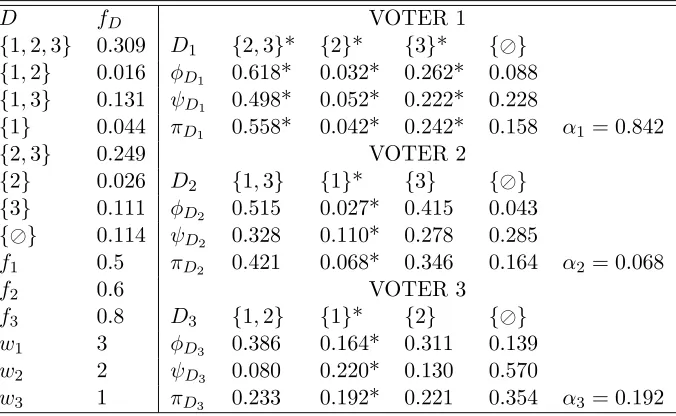
Table 1 gives an example illustrating the above calculation for a weighted voting game with
n = 3, q = 4, w1 = 3, w2 = 2 and w3 = 1. The discrepancy between the behavioral and
constitutional power measures is evident in this example.
2.4. Preferences
In seeking to allow for preferences in a power measure, we agree with Braham and Holler
(2005a: 138) that “the basic concept of power as a potential or capacity cannot accommodate
the preferences of the players whose power we are measuring”. But we believe that a power
measure should accommodate the preferences of the players other that the one whose power is
being measured. In this we hope to reconcile the fundamental critique by Braham and Holler
with the counter-argument by Napel and Widgr´en (2005: 379) that “preferences are needed to
screen outcomes that are possible and can potentially be affected or forced by a given player
from those that are not possible given all players’ strategic efforts to realize their own will”.
We do not model preferences in the way true preference-based measures do. Typically these
measures model preferences as points in a suitably labeled Euclidean space.9 Our measure does
not specify preferences, strategies, informational asymmetries that may influence the distribution
of votes, and yet it fully accounts for the statistical consequences of the preferences conveyed
by the roll-call data on voting. Whether it was differences in preferences, a plot on the part of
9
other voters, or a basic lack of information that caused this distribution may be important to
the voter, but has no bearing on the measurement of voting power. We therefore do not call
our measure preference-based, but rather empirically informed. Since our measure is based on
the probability space of the classic Penrose-Banzhaf-Coleman measures, it cannot be compared
directly to measures based on a spatial representation of preferences as they have different spaces
of elementary outcomes, and hence also different probability spaces.
3.
Voting power in the U.S. Supreme Court
The U.S. Supreme Court is the highest judicial authority of the United States. The Court
comprises the Chief Justice and eight Associate Justices. The justices are nominated by the
President and appointed with the advice and consent of the Senate to serve for life.
The Court votes under simple majority rule provided at least six justices are present for
the Court to be in session. Justices vote in the order of their seniority, starting with the Chief
Justice. Although the Chief Justice has a number of exclusive prerogatives and responsibilities,
all justices have equal a priori voting power.
It is customary to refer to the Court by the name of the presiding Chief Justice, who usually is
the longest-serving member of the Court. We define a bench as a Court in which the same group
of persons sit as justices, and study three benches from the Chief Justice Warren (1953-1969),
Burger (1969-1986) and Rehnquist’s (1989-2005) eras.
3.1. The data
The Supreme Court Justice-Centered Judicial Databases sponsored by the University of
and opinions of individual justices during the three eras.10
Several decisions had to be made when preparing the data. Our focus is on the relative
frequencies of divisions. For a meaningful analysis we therefore confine the analysis to cases in
which the same bench of justices voted. Out of 228 observed benches we chose the three which
had the largest number of cases, one for each era. The high number of different benches arises
from the combinations of six to nine justices possibly attending a session, and from the fact that
associate justices retired and were replaced in the same era. Our selection includes 416, 1110,
and 683 cases from respectively the Warren, Burger and Rehnquist eras, with all nine justices
voting on each case. Since we would like the cases to be as independent from each other as
possible, we exclude those with multiple legal issues or multiple legal provisions. Finally, we
define aYes vote as one in favor of the petitioning party.11
3.2. Relative frequencies of divisions
Figure 1 shows the relative frequencies of divisions. With nine justices there will be 512 possible
divisions. The abscissa scale shows the divisions ordered from a unanimous vote against the
petitioning party to a unanimous vote in favor of the petitioning party. Note that:
(i) only a small minority of possible divisions actually has occurred, the percentage in each
bench being Warren (9.4), Burger (31.6) and Rehnquist (21.5);
(ii) the relative frequencies of those which are observed are very unequal;
(iii) unanimity is by far the most common of all voting profiles. The Burger bench is an
excep-tion with the 2:7 divisions against the petiexcep-tioning party occurring slightly more frequently
than the 0:9 divisions;
10
These data are available athttp://www.cas.sc.edu/poli/juri/sctdata.htm.
11
(iv) a unanimous vote in favor of the petitioning party is more frequent than a unanimous
vote against the petitioning party. This suggests a selection bias in the data in favor of
petitions with a reasonable chance of success.
These observations refute the binomial model of equally probable and independent votes as an
empirical description. Although comprehensive voting records such as that for the U.S. Supreme
Court are scarce, data on several other voting bodies reveal that divisions typically occur with
very different frequencies. This is true of the Supreme Court of Canada (Heard and Swartz 1998),
the European Union Council of Ministers (Hayes-Renshaw, van Aken and Wallace 2006) and the
institutions of the United Nations (Newcombe, Ross and Newcombe 1970). In the next section
we show that positive correlations between votes are the primary cause of the observed pattern.
3.3. The behavioral power index
In a voting game with equal weights all voters have equal a priori powers. Under simple-majority
rule with an odd number of votes the Banzhaf absolute measure equals the binomial probability
of (n−1)/2 successes in n−1 trials with 0.5 as the probability of success. For n = 9 this
probability equals 0.273.
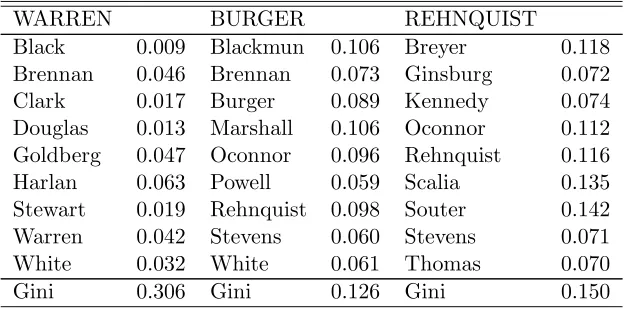
Table 2 reports the behavioral power indexαi for each justice. It is evident that the justices’
behavioral powers are not equal. We quantify this inequality by comparing the Gini coefficient
of αi. The largest inequality is observed in the Warren bench, followed by Rehnquist and
Burger. The biggest losers in terms of behavioral versus a priori voting power were justices
Black, Douglas and Clark of the Warren bench. None of the justices had more behavioral power
than a priori power.
The actual distribution of voting power in the U.S. Supreme Court has been studied
Banzhaf measure of voting power, in which a devision is defined by the group of justices who
join the Court’s opinion. They identify Justice Kennedy as the one who wielded the most voting
power during this period of time. This conclusion is not supported by our calculations for the
Rehnquist bench. We find that it was Justice Souter who had the most power. The difference
can be explained by three facts. First, Edelman and Chen (1996) based their calculations on a
subsample of the data we used, covering the Court’s 1994 and 1995 October Terms only.
Sec-ond, their calculations account for the Court opinions joined by the Justices. Opinions and votes
differ occasionally. A justice may vote with the majority and yet write a dissenting opinion.
Defining divisions based on opinions in the context of a binary choice is also problematic because
the Court may deliver more than two opinions (‘seriatim opinion’). And third, Edelman and
Chen’s measure differs conceptually in that it is not free from the effect of the own vote on the
collective outcome.
4.
Coleman’s measure of dependence
The fact that unanimity is by far the most frequent of all divisions points to a positive correlation
between the justices’ votes. The correlation coefficient is a pairwise measure of linear dependence.
But is there a measure of the overall dependence between votes? One such measure has been
proposed in Coleman (1973).
Under the binomial model the variance of the fraction ofYes votes isσ2 =p(1−p)/n, where
pis the probability of aYes vote, here common to all voters. The sample variance s2 will differ
systematically fromσ2 if the assumptions of the binomial model are not met. This will be the
case if votes are not independent, or if the true probability is not p, or both. For example,
provided (1−n)−1 ≤c≤1. The equality is only approximate sinces2 depends on the sample of
voting data, i.e., is a statistic. Assuming that the true probability is indeedp, the ratio σ2/s2
is a rough measure of the overall dependence in a voting body of size n.
Coleman used this fact to compute the equivalent number of independent votersm. Setting
s2 =p(1−p)/myields m=p(1−p)/s2. For independent voterss2≈p(1−p)/nso thatm≈n.
Compared ton= 9, low values of m for the Warren (1.48), Burger (2.21) and Rehnquist (1.79)
benches suggest a high positive correlations between votes.
A measure of the overall dependence similar to Coleman’s has been proposed in Sirovich
(2003). Sirovich claims that the second Rehnquist U.S. Supreme Court “acts as if composed
of 4.68 ideal Justices”. His measure is based on the concept of informational entropy and is
computed for a sub-sample of the data for the Rehnquist bench analyzed in this paper. We find
an even lower equivalent number of independent Justices on the Rehnquist bench.12
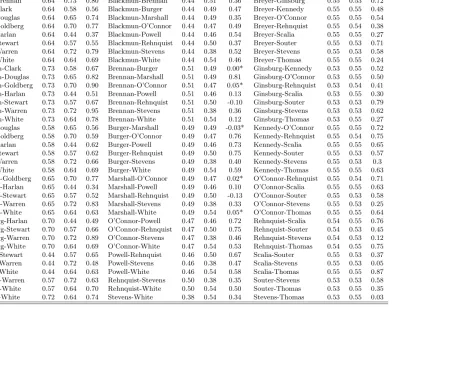
Coleman’s is a measure of the overall dependence. Table 3 reports estimates of the individual
marginal probabilities and correlation coefficients. They show that in most cases the probability
of a Yes vote is not far from 0.5 but that votes are highly positively correlated. For the three
Courts the average probabilities of a Yes vote are 0.63, 0.47 and 0.54. The spreads of the
estimated probabilities range from (0.44, 0.73) for the Warren bench to (0.53, 0.55) for the
Rehnquist bench. The average correlation coefficients between two Yes votes for the three
benches are 0.67, 0.39 and 0.5.
Fisher’s Exact Test13 cannot reject the null hypothesis of conditional independence at the
5% level of significance for only 7 of 108 pairs of justices indicated by an asterisk. There is
significant positive correlation in justices’ decisions.
12
For a critique of the equivalent number of independent (or, as Sirovich calls them, “platonic” justices), see a commentary by Edelman (2004).
13
One consequence of high positive correlations is that voters often see their preferred outcome
prevail. Several authors have proposed to measure voting power using this probability
(Satisfac-tion index by Straffin (1978), EPW index by Morriss (2002)). We believe that the probability
of being on the winning side is not a valid measure of power because it does not distinguish
between power and luck.14 For example, it assigns power to a voter who cannot swing in any
theoretically conceivable division of votes, a dummy. Our approach is to define power in terms
of the capacity to affect a decision, based on the concept of a swing.
5.
Summary
The standard approach to measuring the voting power of a particular member of the voting
body is to compute the probability of her casting a decisive vote. This analysis must encompass
both the formal rules of the voting body and also the behavior of all the voters. The member
is more powerful the more frequently her vote is decisive. But this will depend in practice on
circumstances created by others casting their votes so that she has opportunities to be decisive.
Thus an empirical voting power measure must be based on the frequencies with which the various
voting profiles occur. As is well known, the Penrose-Banzhaf measure ignores behavior and takes
into account only power deriving from the rules construed in a purely formal, a priori sense.
We propose an empirically informed power measure by relaxing this very strong assumption
and replacing it by the use of information about real or assumed voting patterns. The behavioral
power index is based on the probability distribution of divisions of all other voters except the
one whose power is being measured, which can be assumed or estimated using ballot data.
The voting behavior of justices in the U.S. Supreme Court clearly contradicts the assumptions
very unequal relative frequencies. The observed patterns of relative frequencies point to positive
correlation as their main cause, and indeed we find significant positive correlation in justices’
decisions.
AcknowledgmentsThis paper has greatly benefited from comments and suggestions by two
anonymous referees. We thank Sara C. Benesh for answering numerous questions about the U.S.
Supreme Court Justice-Centered Judicial Database, the participants of the VPP Colloquium on
Aspects of Measurement of Voting Power, University of Warwick, August 2007 and the Public
Choice Meetings, San Antonio, Texas, March 2008 for comments and suggestions. The research
was partly supported by the Leverhulme Trust (Grant F/07 004/AJ).
References
Banzhaf, J. F. (1965). Weighted voting does not work: a mathematical analysis.Rutgers Law Review19: 317–343.
Braham, M. and Holler, M. (2005a). The impossibility of a preference-based power index.Journal of Theoretical
Politics 17: 137–157.
Braham, M. and Holler, M. (2005b). Power and preferences again. A reply to Napel and Widgr´en. Journal of
Theoretical Politics 17: 389–395.
Coleman, J. S. (1973). Loss of power. American Sociological Review 38: 1–17.
Dowding, K. (1996). Power. Open University Press.
Dubey, P. and Shapley, L. S. (1979). Mathematical properties of the Banzhaf power index. Mathematics of
Operations Research 4: 99–131.
Edelman, P. H. (2004). The dimension of the Supreme Court. Constitutional Commentary 20: 557–570.
Edelman, P. H. and Chen, J. (1996). The most dangerous Justice: the Supreme Court at the bar of mathematics.
Southern California Law Review 70: 63–111.
Everitt, B. S. (1992). The analysis of contingency tables. Chapman & Hall.
Felsenthal, D. S. and Machover, M. (2004). A priori voting power: what is it all about? Political Studies Review
Garrett, G. and Tsebelis, G. (1999). Why resist the temptation of power indices in the European Union? Journal
of Theoretical Politics 11: 291–308.
Gelman, A., Katz, J. N., and Bafumi, J. (2004). Standard voting power indices don’t work: an empirical analysis.
British Journal of Political Science 34: 657–674.
Hayes-Renshaw, F., van Aken, W., and Wallace, H. (2006). When and why the EU council of ministers votes
explicitly. Journal of Common Market Studies44: 161–194.
Heard, A. and Swartz, T. (1998). Empirical Banzhaf indices. Public Choice 97: 701–707.
Laruelle, A. and Valenciano, F. (2005). Assessing success and decisiveness in voting situations.Social Choice and
Welfare 24: 171–197.
Morriss, P. (2002). Power: a philosophical analysis. Manchester University Press.
Napel, S. and Widgr´en, M. (2004). Power measurement as sensitivity analysis: a unified approach. Journal of
Theoretical Politics 16: 517 – 538.
Napel, S. and Widgr´en, M. (2005). The possibility of a preference-based power index. Journal of Theoretical
Politics 17: 377–387.
Newcombe, H., Ross, M., and Newcombe, A. G. (1970). United Nations voting patterns. International
Organiza-tion 24: 100–121.
Penrose, L. S. (1946). The elementary statistics of majority voting. Journal of Royal Statistical Society 109:
53–57.
Sirovich, L. (2003). A pattern analysis of the Second Rehnquist US Supreme Court. Proceedings of the National
Academy of Sciences of the United States of America 100: 7432–7437.
Steunenberg, B., Schmidtchen, D., and Koboldt, C. (1999). Strategic power in the European Union: evaluating
the distribution of power in policy games. Journal of Theoretical Politics 11: 339–366.
Straffin, P. D. (1978). Probability models for power indices. In P. C. Ordeshook (Ed.),Game Theory and Political
Table 1: The behavioral power index for the voting body{4; 3,2,1}
D fD VOTER 1
{1,2,3} 0.309 D1 {2,3}* {2}* {3}* {⊘}
{1,2} 0.016 φD1 0.618* 0.032* 0.262* 0.088
{1,3} 0.131 ψD1 0.498* 0.052* 0.222* 0.228
{1} 0.044 πD1 0.558* 0.042* 0.242* 0.158 α1 = 0.842
{2,3} 0.249 VOTER 2
{2} 0.026 D2 {1,3} {1}* {3} {⊘}
{3} 0.111 φD2 0.515 0.027* 0.415 0.043
{⊘} 0.114 ψD2 0.328 0.110* 0.278 0.285
f1 0.5 πD2 0.421 0.068* 0.346 0.164 α2 = 0.068
f2 0.6 VOTER 3
f3 0.8 D3 {1,2} {1}* {2} {⊘}
w1 3 φD3 0.386 0.164* 0.311 0.139
w2 2 ψD3 0.080 0.220* 0.130 0.570
w3 1 πD3 0.233 0.192* 0.221 0.354 α3 = 0.192
Table 2: The behavioral power index
WARREN BURGER REHNQUIST
Black 0.009 Blackmun 0.106 Breyer 0.118
Brennan 0.046 Brennan 0.073 Ginsburg 0.072
Clark 0.017 Burger 0.089 Kennedy 0.074
Douglas 0.013 Marshall 0.106 Oconnor 0.112
Goldberg 0.047 Oconnor 0.096 Rehnquist 0.116
Harlan 0.063 Powell 0.059 Scalia 0.135
Stewart 0.019 Rehnquist 0.098 Souter 0.142
Warren 0.042 Stevens 0.060 Stevens 0.071
White 0.032 White 0.061 Thomas 0.070
Table 3: Marginal probabilities and correlation coefficients
WARREN BURGER REHNQUIST
(i, j) pi pj ci,j (i, j) pi pj ci,j (i, j) pi pj ci,j
Black-Brennan 0.64 0.73 0.80 Blackmun-Brennan 0.44 0.51 0.36 Breyer-Ginsburg 0.55 0.53 0.72
Black-Clark 0.64 0.58 0.56 Blackmun-Burger 0.44 0.49 0.47 Breyer-Kennedy 0.55 0.55 0.48
Black-Douglas 0.64 0.65 0.74 Blackmun-Marshall 0.44 0.49 0.35 Breyer-O’Connor 0.55 0.55 0.54
Black-Goldberg 0.64 0.70 0.77 Blackmun-O’Connor 0.44 0.47 0.49 Breyer-Rehnquist 0.55 0.54 0.38
Black-Harlan 0.64 0.44 0.37 Blackmun-Powell 0.44 0.46 0.54 Breyer-Scalia 0.55 0.55 0.27
Black-Stewart 0.64 0.57 0.55 Blackmun-Rehnquist 0.44 0.50 0.37 Breyer-Souter 0.55 0.53 0.71
Black-Warren 0.64 0.72 0.79 Blackmun-Stevens 0.44 0.38 0.52 Breyer-Stevens 0.55 0.53 0.58
Black-White 0.64 0.64 0.69 Blackmun-White 0.44 0.54 0.46 Breyer-Thomas 0.55 0.55 0.24
Brennan-Clark 0.73 0.58 0.67 Brennan-Burger 0.51 0.49 0.00* Ginsburg-Kennedy 0.53 0.55 0.52
Brennan-Douglas 0.73 0.65 0.82 Brennan-Marshall 0.51 0.49 0.81 Ginsburg-O’Connor 0.53 0.55 0.50
Brennan-Goldberg 0.73 0.70 0.90 Brennan-O’Connor 0.51 0.47 0.05* Ginsburg-Rehnquist 0.53 0.54 0.41
Brennan-Harlan 0.73 0.44 0.51 Brennan-Powell 0.51 0.46 0.13 Ginsburg-Scalia 0.53 0.55 0.30
Brennan-Stewart 0.73 0.57 0.67 Brennan-Rehnquist 0.51 0.50 -0.10 Ginsburg-Souter 0.53 0.53 0.79
Brennan-Warren 0.73 0.72 0.95 Brennan-Stevens 0.51 0.38 0.36 Ginsburg-Stevens 0.53 0.53 0.62
Brennan-White 0.73 0.64 0.78 Brennan-White 0.51 0.54 0.12 Ginsburg-Thomas 0.53 0.55 0.27
Clark-Douglas 0.58 0.65 0.56 Burger-Marshall 0.49 0.49 -0.03* Kennedy-O’Connor 0.55 0.55 0.72
Clark-Goldberg 0.58 0.70 0.59 Burger-O’Connor 0.49 0.47 0.76 Kennedy-Rehnquist 0.55 0.54 0.75
Clark-Harlan 0.58 0.44 0.62 Burger-Powell 0.49 0.46 0.73 Kennedy-Scalia 0.55 0.55 0.65
Clark-Stewart 0.58 0.57 0.62 Burger-Rehnquist 0.49 0.50 0.75 Kennedy-Souter 0.55 0.53 0.57
Clark-Warren 0.58 0.72 0.66 Burger-Stevens 0.49 0.38 0.40 Kennedy-Stevens 0.55 0.53 0.3
Clark-White 0.58 0.64 0.69 Burger-White 0.49 0.54 0.59 Kennedy-Thomas 0.55 0.55 0.63
Douglas-Goldberg 0.65 0.70 0.77 Marshall-O’Connor 0.49 0.47 0.02* O’Connor-Rehnquist 0.55 0.54 0.71
Douglas-Harlan 0.65 0.44 0.34 Marshall-Powell 0.49 0.46 0.10 O’Connor-Scalia 0.55 0.55 0.63
Douglas-Stewart 0.65 0.57 0.52 Marshall-Rehnquist 0.49 0.50 -0.13 O’Connor-Souter 0.55 0.53 0.58
Douglas-Warren 0.65 0.72 0.83 Marshall-Stevens 0.49 0.38 0.33 O’Connor-Stevens 0.55 0.53 0.25
Douglas-White 0.65 0.64 0.63 Marshall-White 0.49 0.54 0.05* O’Connor-Thomas 0.55 0.55 0.64
Goldberg-Harlan 0.70 0.44 0.49 O’Connor-Powell 0.47 0.46 0.72 Rehnquist-Scalia 0.54 0.55 0.76
Goldberg-Stewart 0.70 0.57 0.66 O’Connor-Rehnquist 0.47 0.50 0.75 Rehnquist-Souter 0.54 0.53 0.45
Goldberg-Warren 0.70 0.72 0.89 O’Connor-Stevens 0.47 0.38 0.46 Rehnquist-Stevens 0.54 0.53 0.12
Goldberg-White 0.70 0.64 0.69 O’Connor-White 0.47 0.54 0.53 Rehnquist-Thomas 0.54 0.55 0.75
Harlan-Stewart 0.44 0.57 0.65 Powell-Rehnquist 0.46 0.50 0.67 Scalia-Souter 0.55 0.53 0.37
Harlan-Warren 0.44 0.72 0.48 Powell-Stevens 0.46 0.38 0.47 Scalia-Stevens 0.55 0.53 0.05
Harlan-White 0.44 0.64 0.63 Powell-White 0.46 0.54 0.58 Scalia-Thomas 0.55 0.55 0.87
Stewart-Warren 0.57 0.72 0.63 Rehnquist-Stevens 0.50 0.38 0.35 Souter-Stevens 0.53 0.53 0.58
Stewart-White 0.57 0.64 0.70 Rehnquist-White 0.50 0.54 0.50 Souter-Thomas 0.53 0.55 0.35
Figure 1: Relative frequencies of divisions
0 100 200 300 400 500
0.00
0.05
0.10
0.15
0.20
0.25
0.30
WARREN
0 100 200 300 400 500
0.00
0.05
0.10
0.15
BURGER
0 100 200 300 400 500
0.00
0.05
0.10
0.15
0.20
0.25
REHNQUIST
A division is represented by a binary vector (v1, v2, . . . , v9), where vi = 1 if