The influence of HRM
as a process on
absenteeism
“Exploring the influence of the meta-features of HRM system strength on
absenteeism”
Erdi Aksoy
Master of Business Administration University of Twente
1
The influence of HRM as a
process on absenteeism
“Exploring the influence of the meta-features of HRM system strength on
absenteeism”
Student
Name: ErdiAksoy
Study: Master of Business Administration Student number: s0205052
Committee
First supervisor: Dr. JeroenMeijerink Second supervisor: Dr. Anna Bos-Nehles
2
Preface
Presented here is the thesis on the influence of HRM system strength on absenteeism as a final project of my master of Business Administration at the University of Twente in The Netherlands. This research will give a totally new view on the way we can evaluate the problem of employee
absenteeism. An important part of the study has been conducted at Ernst & Young in Mexico City. My biggest thanks go to my first supervisor JeroenMeijerink, he always gave me the opportunity to work on my own way and supported me in my choice to go to Mexico. With the aid of his advice I was able to generate an academically successful rapport. In addition, I also want to thank my second supervisor Anna Bos-Nehlesfor the feedback she gave. I have learned a lot more about HRM and particularly about the process approach of HRM and the effect that it can have on the attitude of employees. I hope that this knowledge will play a role in my future work life. Apart from the fact that I have learned a lot about HRM, I also have learned a lot about myself due to the fact that I lived – far away from home - in Mexico City which was a great opportunity for me in the light of
self-development and rising above yourself. I will never forget this country;viva México!
Special thanks to my parents, sister and all the people I love for giving me motivation and strength.
3
Abstract
Absenteeism is an important problem for firms and a lot of research has been conducted on this subject with regard to the role of HRM. However, research has mainly revolved around the relationship between the content approach of HR and absenteeism, rather than the process approach. This research aims to fill the gap of knowledge about the process of HR in its relation to absenteeism in order to examine whether the problem of absenteeism can be tackled in a various way. The meta-features (distinctiveness, consistency & consensus) of an HRM system (Bowen &Ostroff, 2004) will be separately treated with respect to the dependent variable of absenteeism. The problem that this study attempts to tackle is the question to which extent the meta-features of HRM system strength affect absenteeism, due to the fact that – according to the social exchange theory - it seems plausible that there might be a relationship between these variables. With the Data for this study was collected at Ernst & Young in Mexico City with the aid of a cross-sectional survey. The gathered data has been treated using a multilevel regression analysis in order to test the introduced research model.
4
Contents
Preface ... 2
Abstract ... 3
1 Introduction ... 6
1.1 Rationale and background ... 6
1.2 Problem statement ... 7
1.3 Relevance ... 8
1.4 Outline ... 8
2. Theoretical framework ... 9
2.1 Introduction ... 9
2.2 HRM System Strength ... 9
2.2.1 Distinctiveness ... 10
2.2.2 Consistency ... 11
2.2.3 Consensus ... 11
2.3 Absenteeism ... 12
2.4 The link between HRM system strength and absenteeism ... 13
2.4.1 Moderating effects ... 15
2.4.2 Research model ... 15
3 Methodology ... 17
3.1 Introduction ... 17
3.1 Ernst & Young Mexico City ... 17
3.2 Research strategy and data collection ... 17
3.3 Procedure and sample ... 17
3.4 Measuring instrument ... 18
3.4.1 Scale ... 19
3.4.2 Factor analysis ... 19
3.5 Data analysis ... 20
3.6 Control variables ... 20
4 Results ... 21
4.1 Introduction ... 21
4.2 Results ... 21
4.2.1 Correlation analysis and descriptives ... 21
4.2.2 Multilevel regression analysis ... 22
5
5.1 Discussion of results ... 25
5.2 Implications & suggestions for future research ... 26
5.3 Limitations ... 27
5.4 Conclusions ... 27
6
1 Introduction
1.1 Rationale and background
Employee absenteeism is a recognized issue in any organization which uses fixed work plans(Dalton &Mesch, 1991). The results of absenteeism are far reaching and comprise of direct and indirect impacts. For example higher expenses are an aftereffect of absenteeism, which might be created both directly as in an indirectly manner. Direct expenses of affliction to employers include statutory sick pay, cost of covering nonattendance with temporary workers and a loss of the production. Indirect expenses, for example, low spirit among staff, covering for those who are absent in light of ailment and lower client fulfillment, are hard to measure, while they additionally impact the general levels of a firm’s yield (Leaker, 2008).
Cascio(2012) characterizes it as any failure to report for or stay at work as planned, irrespective to what the reason may be. One can distinguish multiple forms of absenteeism. Aveyet. al (2006) suggests that absenteeism could be involuntary or voluntary. Involuntary absenteeism is under regular circumstances unavoidable, for instance in situations when the worker is ill. This kind of absenteeism is generally classified as ‘white absenteeism’ (Sanders &Nauta, 2004). In contrast to involuntary absenteeism, voluntary absenteeism is a form of absence that is not unable to avoid for employees (Avey et al., 2006).The last example of absenteeism is being classified as ‘black
absenteeism’ or ‘grey absenteeism’ by Sanders &Nauta (2004), they suggest that this form of absenteeism enhances employees that are not ill at all but yet report themselves as being ill. Literature on absenteeism shows that workers are being affected by an aversive work situation; this kind of situations can lead to dissatisfaction among the workers which, in turn, leads to a possibility of withdrawal behavior (Sagie, 1998; Schaufeli et al., 2009). Aspects as high job demands, work overload, work-family conflicts and stress are also seen as important factors of high rates of absence within companies (Schaufeli et al.,2009).
HRM system strength is an interesting view on HRM since it regards the “process” section of HRM. Bowen and Ostroff (2004) were one of the first that have laid a link between HRM research and the research field of occupational and organizational psychology by looking at the process approaches. The strength of the HRM system consists of a number of components: distinctiveness, consensus and consistency. A strong HRM system is described as a system with a high rate of distinctiveness,
consensus and consistency. Distinctiveness consists offeatures that allow a situation to stand out in the environment and to capture attention and interest. Consistency is establishment of an effect over time and modalities regardless of the form of interactions. Consensus implies that people concur about the cause-effect relationship. It is contended that the HRM system is strong when employees see reasonable and unambiguous HRM messages, which are reliably conveyed all through the association, and which are seen and interpretedconsistently among employees Bowen &Ostroff, 2004).
7 adjusting their obligations to the needs of the employer. The fulfillment of these obligations affects the reciprocal obligations of the employer (Coyle-Shapiro & Kessler, 2002). According to this theory, an HRM system that be classified as ‘strong’ can give a positive signal to its employees by providing them with the perception that the organization cares about them. In order to explain the relationship between HRM system strength and absenteeism, this study will touch upon the three features of system strength in its relation to absenteeism with the aid of the social exchange theory.
Distinctiveness concerns clear and unambiguous messages, this means that the communication of the employer towards its employees should be good in order to reach a high level of distinctiveness. The generation of clear and unambiguous HR messages by employers can be interpreted as
investments into the employees. In the case of a high level of consistency, it is essential that the same HR policies are being consistently communicated throughout the firm. For example, training of employees should consistently be judged and rewarded. It can be assumed that this working method will be seen as an investment in the employees. A high rate of consensus addresses the fact that the HR policy is being perceived uniformly by the employees. With the aid of a highly consensual HR system, employees will be able to anticipate to the outcomes that will occur according to their behavior and responses. The generation of a consensual environment could be interpreted by employees as a contribution by the firm towards them. According to the norm of reciprocity, Geurts et al. (1999) state that being present is seen as a reaction of employees in order to ‘restore’ the equity between the employer and employee. This particular kind of perception of the organization caring about its employees with the aid of a high level of distinctiveness, consistency and consensus is likely to be reciprocated by a lower rate of employee absenteeism (Cole et al. ,2002).
Looking towards this concept of reciprocity between employers/managers/supervisors and employees, the potential link between HRM system strength and absenteeism is being examined. Absenteeism is an important problem for firms and a lot of research has been done on this subjecton the basis of the concept of ‘content approach of HRM’. The content approach of HRM focuses on the set of HR practices. For example, a possible relationship between training possibilities for employees and employee absenteeism. Therefore this study will discuss a different prospect by addressing exclusively the ‘process approach of HRM’ system strength instead of the content.
1.2 Problem statement
Despite the fact that there is an expanding consideration for the idea of HRM system strength as presented by Bowen and Ostroff (2004), research about the links between HRM system strength and absenteeismare nonexistent. Different kind of research has been done on several parts of HRM strength, for example the relationship between distinctiveness, consistency and consensus with respect to commitment of the employees and employee outcomes (Sanders et al., 2012), (Bomans et al. 2014) or the fact that absence of consensus about the viability of HR practices contrarily affects perceived future firm performance (Chen et al. , 2011). Frenkel et al. (2012) discussed the
8 should be examined in further research on HRM system strength.
Therefore this study will attemptto generate a different view on this subject; the process of HRM will be taken into account in this study. This will be done by using the concept of HRM strength, since Bowen &Ostroff (2004) focused on the process approach of HRM in his study. In order to generate new insights regarding HRM and absenteeism, the following research question is formulated:
“To what extent can the degree of absenteeism within an organization be explained on the basis of the meta-features of HRM system strength?”
1.3 Relevance
This study is both of theoretical and practical importance. It will give new insights about the process approach of HRM in its relation towards absenteeism due to the fact that this has never been examined before. In a broader sense, the study will provide information about the influence of the three meta-features of HRM system strength on employee behavior.
With regard to the practical relevance, it can be stated that this study will provide new information about the role of HRM system strength towards absenteeism. This can be valuable knowledge for the HR policy of firms. With the aid of such new insights, managers can anticipate and intervene by responding and investing within the three meta-features of HRM system strength. It may have a positive impact on the reduction of absenteeism.
1.4 Outline
9
2. Theoretical framework
2.1 Introduction
This chapter provides a synthesis of the scientific research into HRM System Strength and absenteeism. It reflects the theoretical framework, which is the basis for empirical study. In paragraph 2.2 the concept of HRM system strength is delineated. In paragraph 2.3 the
conceptualization of the concept of absenteeism will be discussed. In section 2.4, an exploration model is produced that aides the research and generates the hypotheses.
2.2 HRM System Strength
Bowen &Ostroff (2004) explain as one of the first the link between HRM research and the research field of employment and organizational psychology in their article "Understanding HRM–firm performance linkages: The role of the “strength” of the HRM system " in terms of attribution theory (Kelley, 1967). Attribution is the imputation of causes of behavior to internal or external factors. The attribution theory examines the way people ascribe causes for behavior and what consequences this has for their motivation. This theory shows that people will work for something when they have the idea that they will have success with that particular effort. If such an effort will yield no success, their motivation to make such efforts will reduce. There are two forms of attribution: internal and
external. In the first form, a person seeks the cause to himself. While an external attribution declares an event from factors outside of a person. In addition to internal and external attributions, causes of behavior can also be attributed to situational factors. People can make reliable attributions of cause-effect relationships if these cause-cause-effect relationships meet the following three conditions: there is a distinctive character, consistency and consensus among stakeholders (Kelley, 1967; Fiske & Taylor, 1991). Bowen and Ostroff (2004) utilize these standards and contend that workers make attributions focused around the HRM message that is imparted to them by a distinctive, consistent and
consensual HRM system (Bowen &Ostroff, 2004).
10 this, Bowen &Ostroff argue that there is a strong HRM system when employees perceive the HRM system as distinctive, consistent and if there is a high degree of consensus(Table 1)among employees about what behaviors are expected and rewarded. These three ‘pillars’ are divided into nine process features that determine the 'strength' of the HR system.When an organization scores high on the described nine elements, according to Bowen and Ostroff (2004) one can speak about a 'strong' HR system. In that case, employees perceive a particular situation in a similar way. Employees will, in other words, develop similar individual cognitive or causal 'maps'.
Table1Nine process features of a 'strong' HR system (Bowen & Ostroff, 2004)
Distinctiveness Consistency Consensus
Visible Instrumentality Correspondence between the most important HR-decision makers Understanable Validity Fairness of the system;
-Distributive -Procedural -Interactive Legitimacy Consistent
HR-messages Relevance
2.2.1 Distinctiveness
The rate of distinctiveness is the degree to which employees perceive and differentiate the HR system, so it attracts their attention and arouses interest.A system that ensures that the whole of practices, processes and services are visible, easily understandable and relevant to the employees and also supports the credibility of managers, builds transparency.And this transparency ensures a 'stronger' HR system.
Bowen and Ostroff(2004) distinguish at first four aspects of distinctiveness: visibility, understandability, legitimacy and relevance.
They refer to the visibility of the HRM practices as the degree to which the practices are prominently and easily observable for employees within an organization. Practices that manage to capture the attentions of the employees will influence the behavior of employees due to the fact that the practices will make sense to them (Kim &Ryu, 2011). With this aspect of distinctiveness it is essential that the management attempts to create a shared understanding about the HR practices and the attitudes that are being desired by the management (Bowen &Ostroff, 2004). This briefly means that practices should make sense for employees. It is important that a wide range of practices affects a large number of employees, so the visibility will be positively influenced.Understandability of HRM content refers tothe extent to which the HRM message arrives to the employees, i.e. the ease with in which the HRM practices can be understood by the employees and the question if they are
11 employees perceive the actors involved (HRM managers, line-managers) as authorities, the more positively they will be with respect to the organization and the more they are inclined to exhibit the preferred modes of behavior by the stakeholders.
2.2.2 Consistency
Consistency of the HR system indicates that the system is coherent and repeatedly for all employees and that it creates the desired effectthrough all HR practices. By putting the right HR practices, to ensure that the practices have the intended effect and by propagating consistent HR messages, the HR system will be strengthened by its consistency (Bowen &Ostroff, 2004).
Consistency consists of three aspects; instrumentality, validity and consistent HR-messages (Bowen &Ostroff, 2004).
Instrumentality of the HRM system addresses the point that outcomes of the management and behavior of employees should be linked to each other, this practically means that employees need to know what they can expect from the management when they behave in a particular way. According to Vroom’s (1964) ‘expectancy theory’, an employee will take the decision to base his or her behavior on the expectations of the outcome. In terms of HR this can be elaborated as the situation in which an employee perceives that there is a stimulus for the behavior that is desired by the management. High instrumentality implies that the relationship between the behavior of workers and results are nearly related in time and that HR practices are implemented consistently over time (Bowen &Ostroff, 2004; Pereira & Gomes, 2012).
The validity of the HR system concerns the fact that practices indeed do what they are intended to do considered from the perspective of the employee(Bowen &Ostroff, 2004). In the case of a weak rate of validity, i.e. a gap between the actual and the intended practices (Wright & Nishii, 2007), employees will be affected in such a way that there will be a difference in their behaviors (Bowen &Ostroff, 2004). This will in its turn affect the effectiveness of the implementation of the practices. A situation like this can be explained by the fact for instance one manager is practically able to
implement the same practice differently than the other manager (Wright &Nishii, 2007).
The last aspect of consistency of the HR system is the transmission of consistent HRM messages. This means that the signals that are being sent from the management to its employees about what is expected and rewarded should be consistent (Bowen &Ostroff, 2004). There has to be consistency between the values defended by the management and the values perceived by the employees (Bowen &Ostroff, 2004), so a particular line-manager should take the rough with the smooth in order to foster consistent perceptions in the case of the employees. As explained, the HR practices operate as a communication system (Gilbert et al., 2011), these messages have to send consistent and solid signals to the worker. One can briefly conclude that the same HRM message must be communicated throughout the whole organization as a whole. Bowen &Ostroff (2004) refers to this situation as ‘internal alignment’, whereby they address the fact that different HRM practices should send the same message. An HRM system which possesses practices fit together a whole is an essential requirement in order to convey the message to employees on a consistent basis.
2.2.3 Consensus
12 The correspondence between the HR-decision makers concerns an agreement about the HRM message that has to be communicated. The most important HR-decision makers can be divided into three groups; top management, HR managers and line-managers (Guest & Bos-Nehles, 2012). Top management is engaged in the generation of the firm’s goals and is responsible for the decision to apply certain practices. HR managers are in their turn responsible for the design of these practices, while the line-managers deal with the implementation of the practices (Guest & Bos-Nehles, 2012). Correspondence between these actors will result in consensus amongst employees regarding the HRM message, due to the fact that when for instance line-managers and HR managers agree with each other, the chance that they will convey the same messages to HRM staff is more likely. This will provide shared perceptions about the expected behavior because employees can in this case get a better understandingthat which is expected of them (Bowen &Ostroff, 2004).
The perception of consensus is, according to Bowen and Ostroff(2004), related to the distinctiveness and consistency. When policy carriers agree on the HRM policy and the HRM practices that should be performed, the distinctiveness increases.Another factor is that as the various policy carriers are more on one line, both line- and HRM managers, it is easier to send the same message and to be internally consistent. It also increases the possibility that employees commit themselves to this message (Bowen &Ostroff, 2004).
Thesecond and last aspect of consensus is the fairness of the system. They distinguish herein three types of fairness: distributive, procedural and interactive (interactional) fairness (Bowen &Ostroff, 2004).
Distributive fairness refers to how honest one experiences (the contents of) the beneficial provided valuations as for instance reviews, ratings, rewards and promotions. Procedural fairness concerns the way these valuations are granted and whether there is favoritism. A manager should be able to argue with the aid of criteria why he for instance gave promotion to a certain employee, this is essential to evade misconceptions about nepotism. Participation by employees in these procedures would be beneficial for this type of fairness. Interactive fairness is being acquiredwith the way managers act towards employees. This practically means that managers shouldexplain on an open and respectful basis why certain decisions are made and how the distribution of awards, such as promotions, participation in training and rewards happened (Bowen &Ostroff, 2004).It must be clear to the employee why, for example, one employee does get promotion in contrast to his colleague. A system that scores high on fairness and level of agreement between HR decision makers is consensual and therefore 'strong'.
2.3 Absenteeism
Absenteeism is not showing up at work in case of an employee. That may be due to illness, but also because of vague psychological and psychosomatic complaints that are not medically proven, such as headache, fatigue, gastrointestinal disturbances and tension (Meertens& von Grumbkow, 1992). In the literature, the terms absenteeism and sick leave are frequently being used interchangeably. To clarify, this study will only address the term 'absenteeism', since absenteeism is a broader term which, for example enhances forms of neglecting work that are not linked to being ill. Absenteeism seems relatively easy to measure; in many companies and institutions it is registered. This is one of the reasons why the phenomenon is relatively easily accessible for examination.
13 employment does not immediately have to be present.
This is why the following classification of absenteeism in the relevant literature is made: white, black and grey absenteeism (Thierry & de Wolff, 1992):
White absenteeism is a form of absenteeism which is a temporary physical dysfunction. The dysfunction is objectively demonstrable. The employee in this period is fully incapacitated.
Grey absenteeism is absenteeism in which one reports him or herself as sick because he or she feels sick, but actually is not sick. It is therefore a sickness report on the basis of real problems, but these symptoms are difficult to determine objectively, and it is not as if the employee is fully incapacitated. Black absenteeism is the absenteeism, in which one calls in sick, but it is not sick and also does not feel sick; the employee is fully fit for work.
On the basis of Philipsen’s "decision model" (1969), many studies have been conducted on absenteeism. This model emphasizes that once there are health problems, in many cases, the employee has some discretion to decide whether to work or to not. This also makes clear that sickness and absenteeism are not identical concepts; there are people with health problems that remain working. Otherwise, it may occur that one reject to go to work in the case of mild symptoms of sickness. A central concept here is the "absenteeism threshold". The higher the absenteeism threshold, the harder it will be for the person concerned to report sickness, even if there are health problems. A high absenteeism threshold does not always lead to a low rate of absenteeism; the frequency of particular short absences will usually be low, but due to working under illness,
conditions may get worse and eventually terminate in more long-term absence (Thierry & De Wolff, 1992). There are two aspects to the absenteeism threshold to distinguish: absenteeism occasion, which are factors that are being fenced off by the behavioral space. They can more or less exist apart from the person in question (such as formal or informal sanctions, waiting days, absenteeism
control). The other one is absenteeism requirement. This relates to the subjective need to use the absenteeism occasion or not. A central role in this case is the job satisfaction with its related
concepts such as "binding", "identification with the work," or "job involvement" (Thierry & De Wolff, 1992).
2.4 The link between HRM system strength and absenteeism
This study will use the social exchange theory (Blau, 1967) as the framework in order to clarify and interpret the connection between HRM system strength and absenteeism.
On the basis of this norm of reciprocity, one can expect a higher rate of care about the wellbeing of employees by the firm towards their employees in the case of the fact that employees perceive HR as distinctive, consistent and consensual. This may lead to more motivation for employees in the case of the adoption of desired behaviors that eventually affect the organizational outcomes (Gilbert et al., 2011). This research will concentrate on a particular form of organizational outcome, namely: absenteeism. In this study it is stated that if employees perceive a distinctive, consistent and consensual HRM system, the likelihood to do something in return to the relative firm in the form as increasing their boundary to be absent is greater.
14 morelikely that the employees act on the basis of desired behavior (Bowen &Ostroff, 2004). In the case that the employees perceive the feeling that the firm invests in them by being distinct,
according to the norm of reciprocity, they will remunerate the firm by a lower rate of absenteeism. This can be explained with the aid of previously found relationships between distinctiveness and employee behavior. There are no examples of studies that did any research into the role of distinctiveness on absenteeism, but according to Sanders et al. (2008) and Takeuchi (2013) absenteeism is a predictor of employee behavior, such as for example turnover intention and affective commitment. When absenteeism is taken into account in a broader perspective, namely as employee behavior, examples of relevant studies can be used. According to Bomans (2013) and Sanders et al. (2006) there exists a positive correlation between distinctiveness and affective commitment. Vigna et al. (2010) found anindirect correlation between all three features of HRM system strength and turnover intention; a strong HR system affects organizational outcome in terms of voluntary turnover. These examples of previous found correlations between distinctiveness and employee behavior entails the following hypothesis:
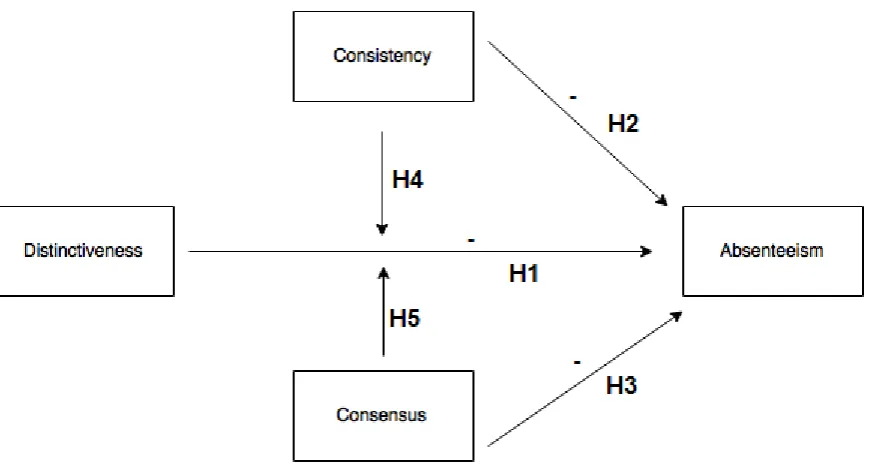
H1: A distinct HRM system negatively affects absenteeism.
Consistency of the HR system indicates that the system is coherent and repeatedly for all employees and that it creates the desired effectthrough all HR practices. By putting the right HR practices, to ensure that the practices have the intended effect and by propagating consistent HR messages, the HR system will be strengthened by its consistency that will lead to the perception of employees that the firm contributes to them by sending consistent messages.As a response to the firm the
employees will be less inclined to take the choice to be absent. Due to the fact that there are no examples of studies that directly treated consistency to absenteeism, absenteeism will be considered once again in a broader context as employee behavior. Sanders et al. (2008) and Bomans (2013) both found a relation between consistency and employee behavior in the form of affective commitment. As an addition to the focus on employee behavior, the concept of consistency could be compared with the concept of ‘role ambiguity’ due to the similarities of their meanings. Role ambiguity literally concerns the lack of clarity about expected behavior from a job or position which is a comparable with the description of consistency above. Therefore, empirical evidence about the statement that role ambiguity positively affects absenteeism found by Huff (1982) and more recently by Olivares-Faundez et al. (2014) will give an indication that a consistent HRM system might affect absenteeism. This ensures the following hypothesis:
H2: A consistent HRM system negatively affects absenteeism.
Consensus of the HRM system addresses the question if employees agree among each other about the effect of their behavior on the outcomes. This means that in the case of ‘internal alignment’ between the HR decision makers about the HRM messages that are going to be sent to the
15 This brings up the following hypothesis:
H3: A consensual HRM system negatively affects absenteeism.
2.4.1 Moderating effects
The assumption of a moderating effect implies that a number of characteristics of the HRM system strength do not directly affect absenteeism without the presence of another characteristic. According to Gomes et al. (2010),the characteristics consensus and consistency serve as antecedents of
distinctiveness. They claimed that distinctiveness is the key aspect of HRM system strength and the aspects of consistency and consensus have an influence on distinctiveness.
The fact that distinctiveness is brought forward as a condition for the performance is reasonable. Hence, the characteristics consistency and consensus do not directly affect the organizational performance when there are no perceptible practices that capture interest and attention of
employees (Kim et al. , 2011).Only when employees are able to observe the HR practices in the first place,will ensure that they have the opportunity to agree with the HRM messages or to perceive consistent messages. It is therefore essential that the HRM system is distinctivein the first
place.Regarding the relationship between consensus and distinctiveness there can be further looked at a few points. If the HR decision makers will agree on the transmitted messages, more workers will send similar communications about the HRM message. This increases the visibility of HR practices, which is a feature of distinctiveness. Moreover, consensus among HR decision makers promotes the formulation and implementation of an HR strategy that is tailored to the organization's strategy. Therefore, two main characteristics of distinctiveness, the relevance and legitimacy of the HRM system, will be fostered (Bowen &Ostroff, 2004). This brings up the following hypothesis:
H4: A consensual HRM system moderates the relationship between a distinct HRM system & absenteeism.
As stated by Bowen and Ostroff (2004), distinctiveness makes sure that the HRM system determines the social context for the behavior of employees; consistent HRM message increases the chances thatdesired behavior will be subjected by employees. In the case of communication and
implementation of HR practices that are implemented in a consistent manner throughout the entire organization, the visibility, clarity and relevance of the HRM system will be increased and it also promotes the creation of shared meanings about the HR system by employees (Bowen &Ostroff, 2004). This in turn will have a positive influence on workers who therefore will choose less likely to report themselves absent. This leads to the following hypothesis:
H5: A consistent HRM system moderates the relationship between a distinct HRM system& absenteeism.
2.4.2 Research model
On the basis of the evaluation of the literature, it can be concluded that according to the
16
17
3 Methodology
3.1 Introduction
Which research method was chosen and why? This question is answered in this chapter. In addition to that, the units of research are being described and it will dwell on the development of the measuring instruments. Finally, the scale analysis and control variables will be discussed.
3.1 Ernst & Young Mexico City
This research has been conducted at Ernst & Young in Mexico City. Ernst & Young is an international service company active in the field of accountancy and tax advisory. Ernst & Young is the umbrella name of an international network of member firms. EY Global Limited is based in London and ensures unity in the policies of all member companies and monitors the global quality of service. EY employs more than 175,000 employees worldwide and is based in about 150 countries.
Ernst & Young Mexico has got 19 offices throughout the country with more than 3500 employees. The office in Mexico City is the biggest division of the country with 2000 employees working in 10 departments. 4 of them are ‘client facing areas’ that are active within tax advisory, transactions, audit and other advisory services. The remaining departments are internal sections that consist of IT, HRM, education, finance and administration, marketing and clients & business development.
3.2 Research strategy and data collection
In order to examine the relationship between HRM system strength and absenteeism, a survey study was carried out due to the fact that this study aims to explain the extent of a particular phenomenon. Using a questionnaire, questions were asked in a systematic way to a number of employees.These questions measure opinions, motives, behavior or other characteristics of the respondents that will give an insight in HRM system strength. Using the answers the characteristics of a group of people could subsequently be mapped.This group, called respondents, is described in the form of indicators such as numbers, percentages or averages. The choice ofa survey as the data collection method for this studylies in the fact that it has a number of advantages.First of all, this method is suitable for collecting information in a short time with a lot of people. However, it does apply to the condition that the questions and answer alternatives are designed in a simple way. Unlike an interview for example,which is often used as questions need much explanationor further questioning is needed. Furthermore, with the aid of a written questionnaire mainly quantitative research can be conducted. The data from these observations are then suitable for statistical processing and analysis, this is essential due to the fact that the goal of this study is quantifying the extent of a probable relationship between HRM system strength and absenteeism. Examining an extent can solely be carried out with the aid of quantitative data. An interview often collects qualitative data; these are not usable for statistical processing.Finally, the written questionnaire has the advantage of
anonymity. This will barely lead to interviewer effectsand the likelihood of socially desirable answers is smaller.
3.3 Procedure and sample
18 potential respondents (104 employees) did actually participate. The fact that this study exclusively takes employee into account is related to the norm of reciprocity (social exchange theory) that addresses the relationship between the employer and his employee. According to this theory, this study expects that a strong HRM system affects leads to the perception of the organization caring about its employees and that this will be likely reciprocated by a lower rate of employee
absenteeism. Therefore, within this context employees must be examined. By surveying employees this study attempts to measure the perceptions of the HRM system, in order to compare it with their annual absence days. Prior to handing the questionnaires to the respondentsthey will be informed by the HR director about the reason of research, namely examining the relationship between HRM system strength and absenteeism. It will be emphasized that complete anonymity is guaranteed. The period of response is three weeks. After two weeks a first reminder will be sent, wherein is asked to kindly complete the questionnaire if they have not responded yet. The following week this procedure will be repeated as the last reminder.
The rates of absence per employee are obtained from the database of Ernst & Young Mexico.These statistics are recorded by name and will be linked in this manner to the outcome of the
questionnaire. The connection between the outcome of the questionnaire on the one hand and rates of absence on the other hand will be kept separated. This means that the information about the rate of absence per employee with respect to its degree of HRM system strength is not accessible for managers or superiors. The fact that the names of the employees are being taken into account is required because otherwise it is impossible to analyze the two variables at the individual level.
3.4 Measuring instrument
A questionnaire is compiled in order to measure how the various employees in a firm perceive the characteristics of HRM system strength. This questionnaire is based on the existing research
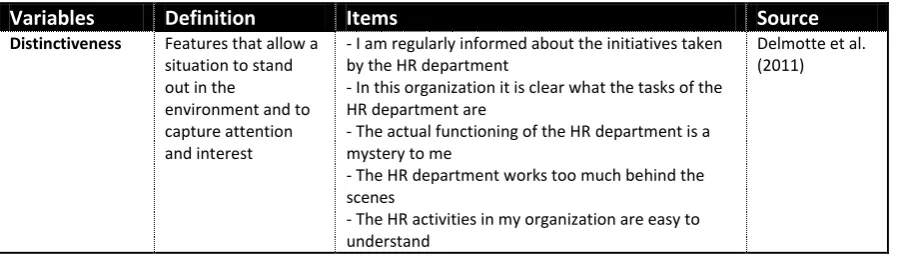
instrument ofDelmotte et al. (2011). HRM system strength is divided into three parts; distinctiveness, consistency and consensus (Bowen &Ostroff, 2004). Delmotte et al. (2011) generated a survey consisting of 27 questions that addresses all three parts of HRM system strength. This survey will be used in this study due to the fact that this survey is being used in a big range of studies on HRM system strength, which makes it possible to compare the output of this study with other studies that used the same operationalization. The items of the operationalization of HRM system strength, i.e. the process of defining the measurement of a phenomenon that is not directly measurable, are included in Table 2.
[image:19.595.66.516.638.767.2]The dependent variable, absenteeism, will be measured on the basis of data originating from a firm’s database that notes personal information of its employees like their annual days of absent. The number absent days per participating respondent will be queried from the relevant database.
Table 2 Operationalization of the variable "HRM system strength"
Variables Definition Items Source
Distinctiveness Features that allow a situation to stand out in the
environment and to capture attention and interest
- I am regularly informed about the initiatives taken by the HR department
- In this organization it is clear what the tasks of the HR department are
- The actual functioning of the HR department is a mystery to me
- The HR department works too much behind the scenes
- The HR activities in my organization are easy to understand
19
- I understand the HR strategy of my organization - The HR department gives understandable information on HR activities
- The HR department in this organization has a high status
- The HR department in this organization has enough power to manage
employees
- The HR department in this organization gets full support from top management
for HR activities
- I often wonder about the usefulness of the HR activities in our organization
- The HR department undertakes those actions that exactly meet my needs
- The HR activities in our organization help me to achieve my goals.
Consistency Establishment of an effect over time and modalities regardless of the form of
interactions
- The HR activities for employee appraisal succeed in encouraging the desiredbehavior.
- The HR activities add value to the functioning of our organization.
- There is a clear fit between HR promises and deliverables.
- There is a wide gap between intended and actual effects of HR initiatives
- The HR activities implemented in this organization sound good in theory, butdo not function in practice - HR policies in this organization are changed every minute
- In this organization there is a clear match between all HR messages
- There is a clear fit between all HR activities - The various HR initiatives send inconsistent signals
Delmotte et al. (2011)
Consensus There is an agreement among individuals’ views of the event effect
relationship
- HR and line management are clearly on the same wavelength
- Top management and HR professionals clearly share the same HR vision
- HR management is established by mutual agreement between HR professionals and line management
- Management commonly supports HR policy in our organization
Delmotte et al. (2011)
3.4.1 Scale
The questionnaire uses a ‘Likertscale’, it is often used in social sciences to measure abstract
concepts.A Likert scale consists of several statements (1 = strongly disagree) and (5 = strongly agree) on a subject in which the respondent can indicate whether he or she agrees with this statement. The final measurement of the abstract concept is created by adding the various items that relate to the same concept or topic.It is important that scales that are included in a questionnaire are reliable. A form of reliability is Cronbach's alpha(α), an internal consistency measure that can have a value between 0 and 1.This value indicates that the homogeneity is high enough to be able to count the items on a scale(Buuren,2003).Pallant (2007) argues that the Cronbach's alpha should ideally be higher than 0.7 in terms of reliability. The values of each variable’s Cronbach’s alpha are listed in Table 3. All variables have a value higher than 0.7and are therefore reliable.
3.4.2 Factor analysis
20 items (questions).The purpose of the factor analysis is to find the underlying, hypothetical variables. The outcomes of the factor analysis were, in the case of distinctiveness and consistency, not in conformity with the expectations of Delmotte et al.(2011). The analysis gave a 3 factor solution in the case of distinctiveness and a 2 factor solution in the case of consistency. On the other hand, the 1 factor solution in the case of consensus was an expected outcome regarding the literature of Delmotte et al. (2011). This means that the operationalization of HRM system strength seems not to be totally foolproof.
Table 3 Output Scale Analysis of the three independent variables
Variables Cronbach’s
alpha (α)
N of the items
Distinctiveness ,802 13
Consistency ,759 9
Consensus ,802 4
3.5 Data analysis
In order to analyze the collected data, SPSS (software for survey authoring and deployment) is used. The output of the online questionnaires were directly downloaded as an Excel-file and subsequently exported to SPSS. On the basis of the items (See Tabel 2) the variables Distinctiveness, Consistency and Consensus (HRM System Strength) were computed in order to analyze the hypotheses. Regression analysis is used to test the correctness of the hypotheses; this analysis shows whether there is a significant correlation between variables or not. With the aid of this analysis the
hypotheses will be solved which eventually will lead to an answer to the research question.
3.6 Control variables
Due to the fact that the phenomenon ‘absenteeism’ does not only have to be linked to HRM system strength, a number of control variables will be included in this study. Gender (m/f), age (in years), level of education and tenure (years of service of the individual employee) are included as control variables in the analysis, because of the fact that they can affect the results in this study. Age can be an important factor due to the fact that for instance baby boomers are generally more loyal towards their employer than millennials (Yu & Miller, 2005) which means that the choice to call in sick can be higher in the case of millennials which makes it an age-related issue. Furthermore, a relationship has repeatedly been reported between level of education on absenteeism (Jansen et al., 2006). Tenure can be relevant due to the fact that it may influence the worker’s rate of HRM system strength since a worker, who has been active for a longer time in the firm, has had more time to perceive the HRM system better. In addition, they can also feel more involved with the companywhich can lead to a lower rate of absenteeism. A dichotomous variable is included in order for the measurement of level of education (high educationreferring to a college or university degree, low education to not holding either).
21
4 Results
4.1 Introduction
This chapter presents the results that are retrieved from the statistical analysis of the data. The research model consists of 5 hypotheses that will be covered one by one within the following sub-chapters. The first three hypotheses will test whether there is a significant negative correlation between the three components of HRM system strength (Distinctiveness, Consistency & Consensus) on one side and absenteeism on the other side. The last two hypotheses will address the possibility of a moderating effect; they will test whether there the components consistency and consensus serve as contingencies for the effect of distinctiveness on absenteeism.
4.2 Results
4.2.1 Correlation analysis and descriptives
First of all, the relevant variables are examined with the aid of a ‘correlation analysis’ in SPSS. The type of correlations that are examined in this study in order to analyze the linear relationship between two interval/ratio variables is the Pearson’s correlation coefficient. This contains a value between -1 (perfectly negative correlation) and 1 (perfectly positive correlation), the higher the absolute value of r, the stronger the relationship. In addition, descriptive information about the variables is being presented.
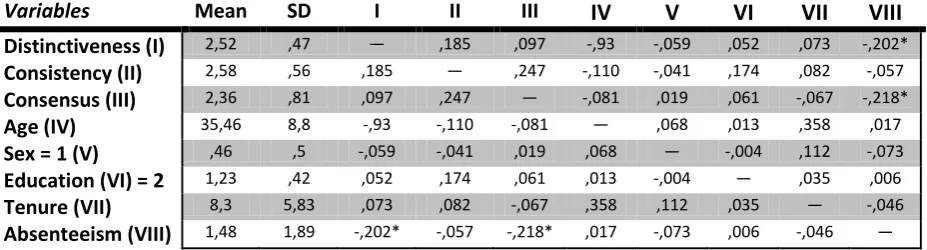
The descriptive statistics of the outcome of all the variables are being presented in Table 4. The average scores of distinctiveness, consistency and consensus are relatively low (2,52, 2,57 & 2,35 on a scale with a maximum of 5). The average age of the employees is around 35 and 54% of them is male. 77% of the participating employees finished a university/college and they averagely are active within this organization for around 8 years.
The results of the correlation analysis are being presented within the same table. It shows that there is a moderate negative significant correlation between distinctiveness and absenteeism and a moderate negative significant correlation between consensus and absenteeism. These results imply that when the perception of distinctiveness and consensus of the HR system increases, the
absenteeism will decrease. In the case of the perception of consistency of the HR system in its relation towards absenteeism one can analyze a less strong correlation that which cannot be classified as significant. The same counts for all of the four control variables (age, sex, level of education, tenure).
22
Table 4Results of the correlation analysis
Variables Mean SD I II III
IV
V
VI
VII
VIII
Distinctiveness (I) 2,52 ,47 — ,185 ,097 -,93 -,059 ,052 ,073 -,202*
Consistency (II) 2,58 ,56 ,185 — ,247 -,110 -,041 ,174 ,082 -,057
Consensus (III) 2,36 ,81 ,097 ,247 — -,081 ,019 ,061 -,067 -,218*
Age (IV) 35,46 8,8 -,93 -,110 -,081 — ,068 ,013 ,358 ,017
Sex = 1 (V) ,46 ,5 -,059 -,041 ,019 ,068 — -,004 ,112 -,073
Education (VI) = 2 1,23 ,42 ,052 ,174 ,061 ,013 -,004 — ,035 ,006
Tenure (VII) 8,3 5,83 ,073 ,082 -,067 ,358 ,112 ,035 — -,046
Absenteeism (VIII) 1,48 1,89 -,202* -,057 -,218* ,017 -,073 ,006 -,046 — N=104 *p<0.05
4.2.2 Multilevel regression analysis
23
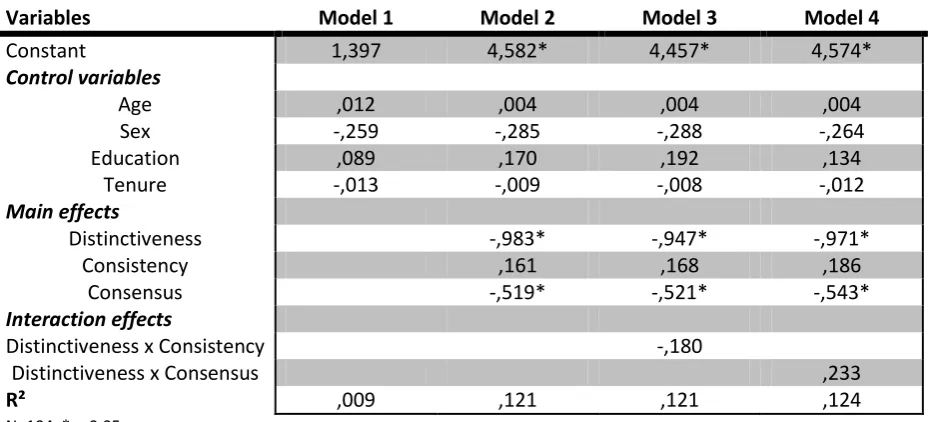
Table 5Results of the multilevel regression models of absenteeism
Variables Model 1 Model 2 Model 3 Model 4
Constant 1,397 4,582* 4,457* 4,574*
Control variables
Age ,012 ,004 ,004 ,004
Sex -,259 -,285 -,288 -,264
Education ,089 ,170 ,192 ,134
Tenure -,013 -,009 -,008 -,012
Main effects
Distinctiveness -,983* -,947* -,971*
Consistency ,161 ,168 ,186
Consensus -,519* -,521* -,543*
Interaction effects
Distinctiveness x Consistency -,180
Distinctiveness x Consensus ,233
R² ,009 ,121 ,121 ,124
N=104 *p<0.05
4.2.2.1 Hypotheses
Hypothesis 1 states that a distinct HRM system is negatively related to absenteeism. This probable inference has been tested with the aid of a linear regression analysis. The statistical results of this analysis can be found in Model 2 of Table 5. The statistical analysis shows a significant negative relation between the variables distinctiveness and absenteeism (t = -2,088, p<,05). With a reliability of 95% it can be said that if the perception of distinctiveness of the HR system increases, the
absenteeism on its turn will decrease. Therefore, hypothesis 1 is supported. Hypothesis 2 stated that a consistent HRM system is negatively related to absenteeism. The results that can be found in Model 2 of Table 5 do not show any form of a significance (negative) causal inference between a consistent HRM system and absenteeism. With the following statistical output of (t=-,579, p<,05) this means that hypothesis 2 is not supported and that it is not possible to conclude that a high degree of consistency of the HR system has a negative effect on absenteeism. Hypothesis 3 stated that a consensual HRM system is negatively related to absenteeism. The results that are lined out in Model 2 of Table 5 indicate a significant negative relation between consensus and absenteeism (t=-2,253, p<,05). This means that when the perception of consensus of the HR system increases, one can conclude with a reliability of 95%, that the rate of absenteeism will decrease.
25
5 Discussion
5.1 Discussion of results
The goal of this study was to analyze the impact of HRM system strength on absenteeism. A lot of research has been conducted into absenteeism, especially in relation with HRM. However, the content approach of HRM plays an essential role in these cases and there is paid little attention to the process approach of HRM. In order to generate new insights into absenteeism this study looks whether the perceptions of employees about the HR system has an influence on the rate of absenteeism. This could be a plausible assumption due to an aspect of the Social Exchange Theory (Blau, 1964); reciprocity. According to this theory, an HRM system that be classified as ‘strong’ can give a positive signal to its employees by providing them the perception that the organization cares about them. This particular kind of perception of the organization caring about its employees is likely to be reciprocated by a lower rate of employee absenteeism. With the aid of three hypotheses about the direct effects of distinctiveness, consistency and consensus (=HRM System Strength) on
absenteeism and two hypotheses on probable interaction effects of distinctiveness that operates as a moderator in the relationship of both consistency and consensus on absenteeism, this study tested the question to which content HRM system strength is related to absenteeism.
The results show a significant negative relationship between distinctiveness and absenteeism, just as it shows a significant negative relationship between consensus and absenteeism. In other words, if the perception of the employees about distinctiveness and consensus of the HR system increases, the absenteeism on its turn will decrease. Therefore, the hypotheses 1 and 3 are approved according to the assumption that was made on the basis of the concept of reciprocity. However, there is no relation found between consistency and absenteeism. This means that when the perception of employees about the consistency of the HR system either decreases or not, this will not affect the rate of absenteeism in any way. Despite the fact that there is a low positive correlation between consistency of the HR system and absenteeism, it is not possible to conclude that this is not a matter of coincidence beyond the fact that the correlation is not strong. A possible explanation for this result can be sought in the concept of ‘negative reciprocity’ (Cramer, 2002). This insight explains that a negative attitude or behavior will be most likely negatively reciprocated by the other actor of the interaction. Although this study does not involve the content of HRM, i.e. HR practices, the
implementation of these practices may play an essential role in the rejection of the relevant
hypothesis. When the implemented HR policy is consistently being perceived as negative and poor by the employees, they will most likely reciprocate in a negative way. A negative reciprocation of an employee towards its firm will, according to this theory, not have a negative effect on the rate of absenteeism.
An indication that further research is necessary to clarify this issue can be found in the factor analysis of this variable. This analysis measures whether the items that form a variable belong to the same ‘dimension’, in other words; if they measure the same phenomenon. The factor analysis of the variable consistency shows two different dimensions, which means that within consistency there is an extra component that measures something else about this variable. This could be a reason for the fact that consistency does not correlate with absenteeism.
26 consistency and consensus are being considered by employees as autonomous aspects that are not functioning as precedents of distinctiveness as opposed to the literature that suggests so. An explanation may be found in the content approach of HRM. The fact that the implementation of HR practices and policy is distinct does not say anything about the value of the content that is perceived by the employees. There may be a chance that employees indeed do distinguish the implemented practices but that they do not perceive it as sound policy. The consequences of such a plot would be a distinguishable but negatively consistent and consensual perception of the HR system. This means that consistency and consensus would not be precedents of distinctiveness. In order to gain more certainty on this matter, the content approach of HRM must be taken into account as well.
5.2 Implications& suggestions for future research
Theoretical implications
This study contributed to academic research in various ways. In the first place, a total new way of looking towards the problem of ‘absenteeism’ was being used and tested, namely the process approach of HRM. This gives new insights about the relationship between the process approach of HRM and absenteeism in particular. The results about distinctiveness and consensus in their relation towards absenteeism are a contribution to HRM-related research. This indicates that these two components of HRM system strength are related with employee behavior. This study has encountered that both distinctiveness and consensus of the HR system have got an influence on employee behavior. This implies that when employees perceive the HR system as more distinctive and consensual, their annual days of being absent will be significantly lower. On the other hand, consistency of the HR system does not correlate with employee behavior. There was no proof found for interaction effects, this means that the three features of HRM system strength can be seen as autonomous explanatory variables that do not affect each other. They can be present without being dependent on each other; they do not support each other in any way. These findings should be taken into account regarding further research on HRM system strength in its relation towards employee behavior.
The fact that consistency does not significantly correlate with absenteeism could be an indication that further research on the characteristics of HRM system strength is needed.
In order to learn more about the question if the context plays a role, firms/organizations from other industries could be taken into account. Other KPI’s like turnover or employee performance indicators can be used as dependent variables as well to test whether HRM system strength has a significant effect on more aspects of employee behavior.
The factor analysis of the three variables shows that further research is needed into the
operationalization of both distinctiveness and consistency; the items of these variables (Delmotte et al.,2011) show more dimensions, the same issue has already been addressed by Bomans (2013). This means that the operationalization of HRM system strength seems not to be totally foolproof. Further research into this subject could specify this diversity in dimensions within the variables.
Practical implications
27 the aid of this information, it may be possible to anticipate and intervene in particular cases of a high absenteeism rate.Managers can anticipate and intervene by responding and investing within the components of distinctiveness and consensus of the HR system.This can be accomplished by sending visible, understandable, legitimate and relevant messages to employeeswhereby the agreement among the senders of the messages is very important in order to foster the consensus (Delmotte et al., 2011), (Bowen &Ostroff, 2004), (Fiske &Taylor, 1991).
Consistency is unlikely to the other components not correlated to absenteeism, which means that the management can disregard consistency in the case of absenteeism reduction.
Being able to generate policy in order to attack absenteeism problems in a new way, namely with fostering the aspect of distinctiveness and consensus, might give added value for the HR department that needs to attack this problem. This will lead to a reduction of several costs like statutory sick pays, cost of covering nonattendance and loss of the production (Leaker, 2008), which will contribute to the overall performance of a firm.
5.3 Limitations
There are some limitations in this study. The sample of this research is derived from one single company in Mexico City. This could be a limitation in the case of generalization towards other firms because both the organizational culture of the firm and the national culture of Mexico may play a role in the input of the employees, Schuler et al. (1996) argued that the culture of a country is significantly related with the HRM policies and practices.
Although the used questionnaire was validated by calculating theCronbach's alpha, there are also downsides to survey research. Especially in the case of internal validity: the quality of the claims. Internal validity looks to the extent to which variables in social science research have a causal relationship with each otherand wherein, in general, research findings do not have to be attributed to so-called research artifacts. Within this study, a cross-section design, it is impossible to determine causality, due to the fact that an occurrence could have affected the results (Saunders et al., 2007). This could be problematic in the case of a reserve effect; which means that absenteeism may affect HRM system strength. When the rate of absenteeism is high, there could be a possibility that due to the fact that an employee is less present on the work floor he may be less likely to distinct and experience the HR policy which can affect its perception of the HR system.
There is also the risk of socially desirable answers, although the results will be made anonymous. Another limitation is the low response rate of 25%, this means that a majority of the potential respondents was not interested to participate in this survey. This could be an indication for a biased sample (Saunders et al., 2007).
5.4 Conclusions
This study attempted to examine the following question; ‘’to what extent can the degree of absenteeism within an organization be explained on the basis of HRM strength?”
The main goal of this research was to tackle the question to what extent the degree of absenteeism can be explained with the aid of HRM system strength. The conceptualization of HRM system strength consists of three characteristics, namely distinctiveness, consistency and consensus; these are treated autonomously in order to examine their influence on absenteeism. These variables have been linked to each other in the mind of the social exchange theory; an HRM system that be
28 its employees is likely to be reciprocated by a lower rate of employee absenteeism.
Two of the three characteristics of HRM system strength show a significant negative relation with absenteeism, namely distinctiveness and consensus. In other words, when an employee perceives the HR system as distinctive, the likelihood that his rate of absenteeism will decrease is significant. The same counts for an employee that perceives the HR system as consensual. In the case of employees that perceive the HR system as consistent, no significant relation has been found.
According to the results a very strong negative relation between distinctiveness and absenteeism and a strong negative relation between consensus and absenteeism can be found. On the other hand, consistency does not correlate with absenteeism at all which makes it impossible to take the three characteristics as a whole in order to draw conclusions about the extent of HRM system strength in its relation to absenteeism due to the fact that two characteristics do have got a strong influence on absenteeism and one not at all.
29
References
Allegro, J.T., & Veerman, T. (1992). Ziekteverzuim. In: P.J.D. Drenth, Hk. Thierry & Ch.J. de Wolff.
Nieuw handboek Arbeids- en Organisatiepsychologie 1053-1093.Houten: Bohn Stafleu van Loghum. Avey, J. B., Patera, J. L., & West, B. J. (2006). Positive psychological capital: A new lens to view absenteeism. Journal of Leadership and Organizational Studies, 13: 42– 60
Blau, P. M. (1964). Exchange and power in social life. New York: John Wiley.
Bomans, M. (2013) Unlocking the black box of HRM system strength: Explaining the link between HRM system strength and organizational members’ affective commitment within a Dutch home care organization.Essay University of Twente.
Bos-Nehles, A. &Bondarouk, T. (2012). How line management intentions Become employee
perceptions: Conceptualizing the role of frames in HRM system strength. Essay University of Twente. Bowen, D. E. & Ostroff, C. (2004). Understanding HRM-firm performance linkages: The role of “strength” of the HRM system.Academy of Management Review, 29, 203-221.
Buuren, H. van. (2003). Onderzoek de basis. Groningen/Houten: Wolters-Noordhoff.
Chen, Y-P., Hsu, Y-S. & Yip, F.W-K. (2011). Friends or rivals: Comparative perceptions of human resource and line managers on perceived future firm performance. The International Journal of Human Resource Management, 22 (8), 1703 – 1722.
Cole, M. S., Schaninger, W. S., & Harris, S. G. (2002).The workplace social exchange network.Group and Organization Management, 27, 142-167
Coyle-Shapiro, Jacqueline A-M.&Kessler, Ian (2002) Exploring reciprocity through the lens of the psychological contract: employee and employer perspectives.European Journal of Work and Organizational Psychology, 11 (1). 69-86. ISSN 1464-0643
Cramer, P. (2002). Defense mechanisms, behavior, and affect in young adulthood. Journal of Personality, 70, 104-126.
Dalton, D.R., &Mesch, D.J. (1991). On the extent and reduction of avoidable absenteeism: an assessment of absence policy provisions. Journal of Applied Psychology, 76, 810-817.
De Winne, S., Delmotte, J., Gilbert, C. & Sels, L. (2012). Comparing and explaining HR department effectiveness assessments: Evidence from line managers and trade union representatives. The International Journal of Human Resource Management, 1 – 27.
30 Elizabeth U. Cascio&Ebonya L. Washington, (2012).Valuing the Vote: The Redistribution of Voting Rights and State Funds Following the Voting Rights Act of 1965.NBER Working Papers 17776, National Bureau of Economic Research, Inc.
Frenkel, S.J., Li, M. &Restubog, S.L.D. (2012).Management, organizational justice and emotional exhaustion among Chinese migrant workers: Evidence from two manufacturing firms. British Journal of Industrial Relations, 50 (1), 121 – 147.
Gilbert, C., De Winne, S. & Sels, L. (2011). The influence of line managers and HR department on employees’ affective commitment.The International Journal of Human Resource Management, 22 (8), 1616 - 1635.
Gomes, J.F.S., Coelho, J.P., Correia, A. & Cunha, R.C. (2010).Development and validation of an instrument measuring the strength of the human resource management system.Spatial and Organizational Dynamics – Discussion Papers, 5, 24 - 41.
Guest, D.E. &Bos-Nehles, A. (2012).HRM and performance: The role of effective implementation.HRM and performance: Achievements and challenges. Chichester: Wiley-Blackwell.
Guzzo, R A, & Noonan, K A (1994). Human resource practices as communications and the psychological contract. Human Resource Management, 33(3), 447-462.
Haggerty, J. & Wright, P. (2009).‘Strong situations and firm performance: a proposed re-
conceptualization of the role of the HR function’, in A. Wilkinson, N. Bacon, T. Redman and S. Snell (eds), The Sage Handbook of Human Resource Management, London: Sage.
Homans, George C. (1961) Social Behaviour: Its Elementary Forms. New York: Harcourt, Brace & World, Inc
Huff, R.G.(1982). Role Conflict, Role Ambiguity, and Job Tenure and Their Relationship to Absenteeism.Orlando: University of Central Florida.
Huselid, M., Jackson, S. & Schuler, R. (1997).Technical and strategic Human Resource Management effectiveness as determinants of firm performance.Academy of Management Journal, 40(1), 171– 188.
Jansen, N. W. H., Kant, I., van Amelsvoort, L. G. P. M., Kristensen, T. S., Swaen, G. M. H., & Nijhuis, F. J. N. (2006). Work–family conflict as a risk factor for sickness absence.Occupational and
Environmental Medicine, 63(7), 488–494.
Kelley, H. H. (1967). Attribution theory in social psychology.In D. Levine (ed.), Nebraska Symposium on Motivation (Volume 15, pp. 192-238). Lincoln: University of Nebraska Press.
Khilji, S. & Wang, X. (2006). ‘Intended’ and ‘implemented’ HRM: The missing linchpin in strategic Human Resource Management research. International Journal of Human Resource Management, 17(7), 1171 – 1189.
31 Leaker, D. (2008) Sickness Absence from Work in the UK.Office of National Statistics, Vol. 2, No. 11, pp. 18-22
Meertens, R. W. & Grumbkow, von J.(1992). Sociale psychologie. Heerlen: Wolters-Noordhoff Nishii, L.H., Lepak, D.P. & Schneider, B. (2008). Employee attributions of the “why” of HR practices.Their effects on employee attitudes and behaviors, and customer satisfaction (CAHRS Working Paper #08-03). Ithaca, NY: Cornell University, School of Industrial and Labor Relations, Center for Advanced Human Resource Studies.
Olivares-Faúndez, V.E., Gil-Monte, P.R., Mena-Miranda, L., Jélvez-Wilke, C., &Figueiredo-Ferraz, H. (2014). Burnout y surelación con la ambigüedad de rol, conflicto de rol y absentismolaboral en trabajadores de la salud. TerapiaPsicológica, in press.
P.J.D. Drenth, Hk. Thierry, Ch.J. de Wolff (2012). Nieuw handboek arbeids- en organisatiepsychologie.Deventer: Van LoghumSlaterus.
Pallant, J. (2007). SPSS survival manual: A step by step guide to data analysis using SPSS for Windows (version 15). Sydney: Allen &Unwin.
Pereira, C.M.M. & Gomes, J.F.S. (2012). The strength of human resource practices and
transformational leadership: Impact on organisational performance. The International Journal of Human Resource Management, 23 (20), 4301 – 4318.
Philipsen, H. (1969). Afwezigheid wegens ziekte. Groningen: Rijksuniversiteit Groningen.
Sagie, A. (1998). Employee absenteeism, organizational commitment, and job satisfaction: Another look. Journal of Vocational Behavior, 52, 156-171.
Sanders, K., &Nauta, A. (2004).Social cohesiveness and absenteeism - The relationship between characteristics of employees and short-term absenteeism within an organization.Small Group Research, 35(6), 724-741.
Sanders, K., Yang, H. & Kim, S. (2012). The moderating effect of employees’ HR attribution on HRM – employee outcomes linkages.Academy of Management Annual Meeting, 1-38.
Saunders, M., Lewis, P. &Thornhill, A. (2007).Research Methods for Business Students (4th ed.).
Harlow: Prentice Hall
Schaufeli, W.B., Bakker, A.B. & Rhenen, W. van (2009). How changes in job demands and resources predict burnout, work engagement, and sickness absenteeism. Journal of Organizational Behavior, 30, 893-917
Takeuchi, N. & Takeuchi, T. (2013). Committed to the organization or the job? Effects of perceived HRM practices on employees’ behavioral outcomes in the Japanese healthcare industry.The International Journal of Human Resource Management, 24, 2089-2106.
32 Vroom, V.H. (1964).Work and motivation. New York: Wiley.
Wright, P. M. & Nishii, L. H. (2007).Strategic HRM and organizational behavior: Integrating multiple levels of analysis (CAHRS Working Paper #07-03). Ithaca, NY: Cornell University, School of Industrial and Labor Relations, Center for Advanced Human Resource Studies.