
A hybrid conjugate gradient method for optimization
problems
*
Xiangrong Li, Xupei Zhao
Department of Mathematics and Information Science, Guangxi University, Nanning, Guangxi, China; Received 14 October 2010; revised 18 November 2010; accepted 22 November 2010.
ABSTRACT
A hybrid method of the Polak-Ribière-Polyak (PRP) method and the Wei-Yao-Liu (WYL) method is proposed for unconstrained optimization pro- blems, which possesses the following proper-ties: i) This method inherits an important prop-erty of the well known PRP method: the ten-dency to turn towards the steepest descent di-rection if a small step is generated away from the solution, preventing a sequence of tiny steps from happening; ii) The scalar βk 0
holds automatically; iii) The global convergence with some line search rule is established for nonconvex functions. Numerical results show that the method is effective for the test prob-lems.
Keywords:Line Search; Unconstrained Optimization; Conjugate Gradient Method; Global Convergence
1. INTRODUCTION
We are interested to consider the unconstrained opti-mization problem
minn ,
x f x (1.1)
where f : n is continuously differentiable. It is
well known that there are many methods for solving optimization problems (see [24,26,28-32,34] etc.), where the conjugate gradient(CG) method is a powerful line search method because of its simplicity and its very low memory requirement, especially for the large scale opti-mization problems [22,23,27], which can avoid, like steepest descent method, the computation and storage of some matrices associated with the Hessian of objective functions. The following iterative formula is often used by the nonlinear CG method
1 , 0,1, 2,
k k k k
x x d k (1.2)
for (1.1), where xk is the current iterate point, k 0
is a steplength, and dk is the search direction designed
by
1, if k 1
, , if k = 0
k k k k
k
g d
d g
(1.3)
where k is a scalar which determines the differ-ent conjugate gradidiffer-ent methods [4,5,8,9,12,13,15,16,18, 20,21,25,33] etc., and gk is the gradient of f x( ) at the point xk. The well-known formula for k from the computation point of view is the following PRP method
1 1
2 ,
T
k k k
PRP k
k
g g g
g
(1.4)
where gk and gk1 are the gradients f x
k and
k 1
f x of f x( ) at the point xk and xk1,
respec-tively, and denotes the Euclidian norm of vectors. Throughout this paper, we also denote f x
k by fk.Polak and Ribèire [18] proved that this method with the exact line search is globally convergent when the objec-tive function is convex. Powell [19] gave a counter ex-ample to show that there exist nonconvex functions on which the PRP method does not converge globally even the exact line search is used. He suggested that k
should not be less than zero. Considering this suggestion, Gilbert and Nocedal [10] proved that the modified PRP
method max 0,
PRP
k k
is globally convergent
with the weak Wolfe-Powell (WWP) line search tech-nique and the assumption of sufficient descent condition. However, the global convergence of the PRP method is still open under the WWP line search rule.
Recently, Wei, Yao, and Liu(WYL) [21] propose a new conjugate gradient formula
1
1 1
2
k T
k k k
k WYL
k
k
g
g g g
g g
(1.5)
It is not difficult to deduce that
*This work is supported by China NSF grands 10761001 and Guangxi
X. R. Li et al. / Natural Science 3 (2011) 85-90 86
2
1 1
1 1 1 1
2 2
0
k
T k
k k k k k k
k k
WYL k
k k
g g
g g g g g g
g g
g g
is true. The numerical results show that this method is competitive to the PRP method for the test problems of [17]. Under the sufficient descent condition, this method is globally convergent with the WWP line search.
These observations make us know that the sufficient descent condition
2
, 0
T
k k k
g d c g c is a constant holds for all k0
(1.6) is very important to ensure the global convergence [1,2,10,14], and the scalar k 0 also plays a very important role [10,19]. This motivates us to propose a hybrid method combining the PRP method and the
WYL method. The hybrid method will possess some better properties of the PRP method and the WYL
method: (i) the tendency to turn towards the steepest descent direction if a small step is generated away from the solution, preventing a sequence of tiny steps from happening; (ii) The scalar k 0 holds automatically. The global convergence with the WWP line search of the presented method is established for nonconvex ob-jective function. Numerical results show that this given method is competitive to the PRP method and the WYL
method.
This paper is organized as follows. In the next section, the algorithm is stated. The global convergence is proved in Section 3, and the numerical results are re-ported in Section 4. The last section gives one conclu-sion.
2. ALGORITHM
Now we describe the given algorithm as follows. Here we call it Algorithm 1.
Algorithm 1 (The hybrid algorithm of the PRP
method and the WYL method)
Step 0: Choose an initial point 0 ,
0,1 . nx
Set d0 g0 f x
0 , : 0.k Step 1: If gk , then stop; Otherwise go to the next step.
Step 2: Compute step size k by some line search
rules.
Step 3: Let xk1xkk kd . If gk1 , then
stop.
Step 4: Calculate the search direction
1 1 ,
P W
k k k k
d g d (2.1)
where P W max
PRP, WYL
.k k k
Step 5: Set k: k 1, and go to Step 2.
Remark i) If xk1xk, we have gk1gk and
1
k k
g g which imply that PRP 0,
k
and WYL 0,
k
which means that P W 0
k
if a small step is
gener-ated for all k0. Thus the given method inherits the better property of the PRP method: the directions will turn out to be the steepest descent directions if the tiny steps from happening.
ii) By the definition of the new formula P W,
k
we
have
2 1
1 1
2
max ,
0
P W PRP WYL WYL
k k k k
k
k k k
k k
g
g g g
g g
3. THE GLOBAL CONVERGENCE
The following assumptions are often needed to prove the convergence of the nonlinear conjugate gradient methods (see [5,9,10,20,21] etc.).
Assumption 3.1 i) The function f x
has a lowerbound on the level set
0
n
x f x f x
,
where x0 is a given point and is bounded.
ii) In an open convex set 0 that contains , J is
differentiable and its gradient g is Lipschitz continuous, namely, there exists a constants L0 such that
, , 0.g x g y L x y x y (3.1)
3.1. The global Convergence with the Weak Wolfe-Powell Line Search
The weak Wolfe-Powell (WWP) search rule is to find a step length k such that
Tk k k k k k k
f x d f g d (3.2) and
T T,k k k k k
g x d d g (3.3)
where
0,1 2 , ,1 .
This line search tech-nique is often used to study the convergence of conju-gate gradient algorithms [6,27,34]. At present, the global convergence of the PRP method with the WWP line search is still open.Lemma 3.1 Suppose that Assumption 3.1 holds. Let the sequence
gk and
dk be generated byAlgo-rithm 1, T 0,
k k
by the WWP line search (3.2) and (3.3) Then the zoutendijk condition [34]
22 0
T k k
k k
g d
d
(3.4)holds.
Proof. By (3.3) and Assumption 3.1 ii), we have
21
1 T T ,
k k k k k k k
g d g g d L d
this means that
1
T 2,k g d L dk k k
which
to-gether with T 0,
k k
g d and (3.2) implies that
21 2
1
,
T k k
k k k
g d
f f
L d
summing up this inequality from k0 to , and us-ing Assumption 3.1 i), we can obtain this lemma. This completes the proof.
We will prove the global convergence of Algorithm 1 by contradiction. Then we assume that there exists a positive constant 0 such that
, 0.
k
g k (3.5)
Using (3.5) deduces a contradiction to obtain our con-clusion.
Similar to Lemma 3.3.1 in [6], based on Assumption 3.1, Lemma 3.1, the fact P W 0,
k
and (3.5), we can
get the following lemma.
Lemma 3.2 Let Assumption 3.1 hold and the se-quences
gk and
dk be generated by Algorithm 1.The sufficient descent condition (1.6) holds, and the
stepsize k is determined by (3.2) and (3.3). Suppose
that the inequalities (3.5) is true. Then we have dk 0 and
2
1 0
,
k k k
u u
where k
k k
d u
d
.
Proof. These two inequalities (1.6) and (3.5) imply that dk 0 is true, for otherwise gk 0, then
k k k
u d d is reasonable. Denote
1 1
1 1
, P W k
k
k k k
k k
d g
r
d d
By (2.1), for k0, we have
1 1 ,
k k k k
u r u
this combining with uk1 uk 1 shows that
1 1 1
k k k k k k k
r u u u u (3.6)
The inequality P W 0
k
implies that 0
k
is true, then it follows that from (3.6) and triangular inequality
1
1
1 1
1
1 1
2 .
k k
k k k k
k k k k k k
k
u u
u u
u u u u
r
(3.7)
By (1.6) and (3.4), we get
4
2 2
1
1 1
2
0 1 1
k
k k
k k k
g
r g
d
Which together with (3.5), we obtain
2 1 0 k k
r
By the above inequality and (3.7), we get this lemma. The proof is complete.
The following property (*) was introduced by Gilbert and Nocedal [10], which pertains to the k
under the
sufficient descent condition. The WYL formula also has this property. Now we show that this property (*) per-tains to our method.
Property (*). Suppose that
1 2
0 r gk r. (3.8) We say that the method has Property (*), if for all k, there exists constants b1 and 0 such that
k b
and
1 2
k k
s
b
Lemma 3.3 Let Assumption 3.1 hold and the se-quences
gk and
dk be generated by Algorithm 1.Then the new formula P W
k
possesses property (*). Proof. The result of this lemma is proved by the fol-lowing two cases.
Case i: we consider PRP k
By (3.1), we have
11 1
2 2
. .
T
k k
k k k
PRP k
k k
L g s
g g g
g g
(3.9)
From Assumption 3.1 i), then there exists a constant
1 0
M such that
1.
k
s M (3.10)
Let
2
2 1 1
max 2, 1
b Lr r M and 2
1 2b L 2
, it follows that
PRP
k b
X. R. Li et al. / Natural Science 3 (2011) 85-90 88
1 2 2
2 2 2
1 1
. 2 2 1
. 2 k k PRP k k k
L g s L L
s b g
Then the PRP formula PRP k
has this property (*).
Case ii: let us consider WYL k
. Denote Yk gk1
1 ,
k k k
g g g
by (3.1), we get
1 1 1 1 1 1 1 1 2 , k
k k k
k
k
k k k k
k
k k k k
k k k k
k
g
Y g g
g
g
g g g g
g
g g g g
g g g g
L s (3.11)
By (1.5), (3.11), (3.10) and (3.8) we have
1 2
1
2 2 2
1
. 2
,
T
k k k
WYL k k k
k k
g Y L s
g Y g g
(3.12)
let
2
2 1 1
max 2, 2
b L M and 2
1 2 2b L 2 ,
it follows that (3.12) and the definition of b and that 1
b
2 2
2 4
1 1
2 2 1
, and
2
WYL WYL
k k k
L L b s b
Thus, the formula WYL k
also has the property (*). Using the definition of the P W max
WYL, PRP
k k k
,
we conclude that the formula P W k
possesses the
property (*). The proof is complete.
By Lemma 3.3, similar to Lemma 3.3.2 in [6], it is not difficult to prove the following result. Here we only state it as follows, but omit the proof.
Lemma 3.4 (Lemma 3.3.2 in [6]) Let the sequences
gk and
dk be generated by Algorithm 1 and theconditions in Lemma 3.3 hold. If P W 0
k
and has
property (*), then there exists a constant 0 such that, for any N and any index k0 there is an
in-dex kk0 satisfying
, ,
2
k
k
where kk,
i N k i k: 1, si
, N de-notes the set of positive integers, and kk, denotes the numbers of elements in kk,.Finally, by Lemma 3.2 and Lemma 3.4, we present the global convergence theorem of Algorithm 1 with the
WWP line search. Similar to Theorem 3.3.3 in [6], it is not difficult to prove the result, here we also give the process of the proof.
Theorem 3.1 Let the sequence
g dk, k
begener-ated by Algorithm 1 with the weak Wolfe-Powell line
search and the conditions in Lemma 3.3 hold. Then
limkinf gk 0.
Proof. We will get this theorem by contradiction. Suppose that (3.5) is true, then the conditions in Lemma 3.2 and 3.3 hold. By Assumption 3.1 i), then there exists a constant 0 0 such that
0,
x x (3.13)
We also denote uidi di , then for all integers
,
l k l k , we have
1 1
1 1 1 1
.
l
l k i i
i k
l l
i k i k
i k i k
x x s u
s u u u
Taking the norm in both sides of the above equality, and using (3.13) we get
1 2 0 1 1 1
l l
i i i k
i k i k
s s u u
Let 8 0 be the smallest integer where
does not less than 8 0 . By Lemma 3.2, there exists
an index k0 such that
2 1 1 4 i i i k
u u
(3.14)On the other hand, by Lemma 3.3, there exists kk0
satisfying
,
2
k k
(3.15)
For all i
k k, 1
, by Cauchy-Schwarz inequal-ity and (3.14), we obtain
1
1 1 1
1
1 1 2 2
2 1 1 1 2 2 1 1 . 4 2 i
i k j j
j k i
j j
j k
u u u u
i k u u
By the above inequality, (3.15) and (3.13), we have
1
0 1 ,
1
2 ,
2 2 4
k
i k
i k
s k
Thus 8 0 , this contradicts with the definition
of . Therefore, the conclusion of this theorem is right. This completes the proof.
4. NUMERICAL RESULTS
The unconstrained optimization problems with the given initial points can be found at:
which were collected by Neculai Andrei. Since this new method is the hybrid method of the PRP method and the
WYL method, we test Algorithm 1 with the WWP line search and compare its performance with those of the
WYL [21] and the PRP [18] methods. The stop criteri-ons are given below: we stop the program if the inequal-ity g x
k is satisfied or the inequality
k
1
k
g x f xis satisfied, where 1.0 5.D All the codes were written in Fortran and run on PC with 2.60 GHz CPU
processor and 256 MB memory and Windows XP op-eration system. In the experiments, the parameters were chosen as 1.0 2, 1.0 1D D . The dimension of the test problems is from 500 to 5000. The detailed numerical results are listed on the web site
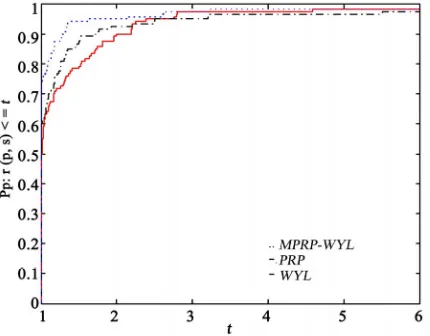
[image:5.595.65.280.527.695.2]In Figure 1, “WYL”, “PRP”, and “MPRP-WYL” stand for the WYL method, the PRP method, and the new method, respectively.
Figure 1 shows the performance of these methods relative to the iterative number of the function and gra-dient(NFN), which were evaluated using the profiles of Dolan and Moré [7]. It is easy to see that the
MPRP-WYL is predominant among these three methods
and the new method can solve about 99% of the test problems successfully. The PRP method is better than the WYL method for 1 t 1.2 and the WYL method is better than the PRP method for 1.2 t 6. Moreover, the PRP method solves about 98% of the test problems and the WYL method solve about 99% of the test prob-lems successfully, respectively. In a word, the given
Figure 1. Performance profiles of conjugate gradient me- thods in Table 1 (NFN).
method is competitive to the other two methods and the hybrid formula is notable.
5. CONCLUSION
This paper gives a hybrid conjugate gradient method for solving unconstrained optimization. The global con-vergence for nonconvex functions with the WWP line search is established. The numerical results show that the given method is competitive to the other standard conjugate gradient methods for the test problems.
For further research, we should study the convergence of the new algorithm under other line search rules. Moreover, more numerical experiments and testing en-vironments (such that [3]) for large practical problems should be done in the future.
REFERENCES
[1] Ahmed, T. and Storey, D. (1990) Efficient hybrid conju-gate gradient techniques. Journal of Optimization Theory
and Applications, 64, 379-394.
[2] Al-Baali, A. (1985) Descent property and global conver-gence of the Flecher-Reeves method with inexact line search. IMA Journal of Numerical Analysis, 5, 121-124.
[3] Bongartz, K.E., Conn, A.R., Gould, N.I.M. and Toint, P.L. (1995) CUTE: Constrained and unconstrained test-ing environments. ACM Transactions on Mathematical
Software, 21, 123-160.
[4] Dai, Y. (2002) A nonmonotone conjugate gradient algo-rithm for unconstrained optimization. Journal of Systems
Science and Complexity, 15, 139-145.
[5] Dai, Y. and Yuan, Y. (2000) A nonlinear conjugate gra-dient with a strong global convergence properties. SIAM
Journal on Optimization, 10, 177-182.
[6] Dai, Y. and Yuan, Y. (1998) Nonlinear conjugate gradi-ent methods. Shanghai Scigradi-entific and Technical Publish-ers, Shanghai.
[7] Dolan, E.D. and Moré, J.J. (2002) Benchmarking opti-mization software with performance profiles.
Mathe-matical Programming, 91, 201-213.
[8] Fletcher, R. (1997) Practical Method of Optimization, Vol I: Unconstrained Optimization. 2nd Edition, Wiley, New York.
[9] Fletcher, R. and Reeves, C. (1964) Function minimiza-tion bu conjugate gradients. Computer Journal, 7, 149-154.
[10] Gibert, J.C. and Nocedal, J. (1992) Global convergence properties of conugate gradient methods for optimization.
SIAM Journal on Optimization, 2, 21-42.
Mathe-X. R. Li et al. / Natural Science 3 (2011) 85-90 90
matical Programming, 78, 375-391.
[12] Hager, W.W. and Zhang, H.C. (2005) A new conjugate gradient method with guaranteed descent and an efficient line search. SIAM Journal on Optimization, 16, 170-192.
[13] Hestenes, M.R. and Stiefel, E. (1952) Method of conju-gate gradient for solving linear equations. Journal of
Re-search National Bureau of Standards, 49, 409-436.
[14] Hu, Y.F. and Storey, C. (1991) Global convergence re-sult for conjugate method. Journal of Optimization
The-ory and Applications, 71, 399-405.
[15] Li, G., Tang, C. and Wei, Z. (2007) New conjugacy con-dition and related new conjugate gradient methods for unconstrained optimization. Journal of Computational
and Applied Mathematics, 2, 523-539.
[16] Liu, Y. and Storey, C. (1992) Effcient generalized con-jugate gradient algorithms, part 1: theory. Journal of
Op-timization Theory and Applications, 69, 17-41.
[17] Moré, J.J., Garbow, B.S. and Hillstrome, K.E. (1981) Testing unconstrained optimization software. ACM
Transactions on Mathematical Software, 7, 17-41.
[18] Polak, E. and Ribiere, G. (1969) Note sur la xonvergence de directions conjugees. Rev. Francaise informat
Re-cherche Operatinelle, 3e Annee, 16, 35-43.
[19] Powell, M.J.D. (1984) Nonconvex minimization calcula-tions and the conjugate gradient method. Lecture Notes
in Mathematics, 1066, 122-141.
[20] Wei, Z., Li, G. and Qi, L. (2006) New nonlinear conju-gate gradient formulas for large-scale unconstrained op-timization problems. Applied Mathematics and
Compu-tation, 179, 407-430.
[21] Wei, Z., Yao, S. and Liu, L. (2006) The convergence properties of some new conjugate gradient methods.
Ap-plied Mathematics and Computation, 183, 1341-1350.
[22] Yu, G.H. (2007) Nonlinear self-scaling conjugate gradi-ent methods for large-scale optimization problems. The-sis of Doctor’s Degree, Sun Yat-Sen University.
[23] Yuan, G.L. (2009) Modified nonlinear conjugate gradient methods with sufficient descent property for large-scale optimization problems. Optimization Letters, 3, 11-21.
[24] Yuan, G.L. and Lu, X.W. (2008) A new line search method with trust region for unconstrained optimization.
Communications on Applied Nonlinear Analysis, 15,
35-49.
[25] Yuan, G.L. and Lu, X.W. (2009) A modified PRP con-jugate gradient method. Annals of Operations Research,
166, 73-90.
[26] Yuan, G.L., Lu, X.W. and Wei, Z.X. (2007) New two-point stepsize gradient methods for solving uncon-strained optimization problems. Natural Science Journal
of Xiangtan University, 29, 13-15.
[27] Yuan, Y. and Sun, W. (1999) Theory and Methods of Optimization. Science Press of China, Beijing.
[28] Yuan, G.L. and Wei, Z.X. (2009) New line search meth-ods for unconstrained optimization. Journal of the
Ko-rean Statistical Society, 38, 29-39.
[29] Yuan, G.L. and Wei, Z.X. (2008) The superlinear con-vergence analysis of a nonmonotone BFGS algorithm on convex objective functions. Acta Mathematica Sinica, 24, 35-42.
[30] Yuan, G.L. and Wei, Z.X. (2010) Convergence analysis of a modified BFGS method on convex minimizations.
Computational Optimization and Applications, 47,
237-255.
[31] Yuan, G.L. and Wei, Z.X. (2009) A Rank-One fitting method for unconstrained optimization problems.
Mathe-matica Applicata, 22, 118-122.
[32] Zhang, H.C. and Hager, W.W. (2004) A nonmonotone line search technique and its application to unconstrained optimization. SIAM Journal on Optimization, 14, 1043-1056.
[33] Zhang, L., Zhou, W. and Li, D. (2006) A descent modi-fied Polak-Ribiére-Polyak conjugate method and its global convergence. IMA Journal on Numerical Analysis,
26, 629-649.
[34] Zoutendijk, G. (1970) Nonlinear programming computa-tional methods. In: Abadie, J. Ed., Integer and Nonlinear
![5′′ (4 Methoxybenzylidene) 1′ (4 methoxyphenyl) 1′′ methyl 1′,2′,3′,5′,6′,7′,8′,8a′ octahydrodispiro[acenaphthylene 1,3′ indolizine 2′,3′′ piperidine] 2,4′′(1H) dione](data:image/gif;base64,R0lGODlhAQABAIAAAP///wAAACH5BAEAAAAALAAAAAABAAEAAAICRAEAOw==)