Int. J. Communications, Network and System Sciences, 2010, 3, 901-906
doi:10.4236/ijcns.2010.312123 Published Online December 2010 (http://www.SciRP.org/journal/ijcns)
Enhanced Euclid Algorithm for Modular Multiplicative
Inverse and Its Application in Cryptographic Protocols
Boris S. Verkhovsky
Computer Science Department, New Jersey Institute of Technology, University Heights, Newark, USA
E-mail: [email protected]
Received August 21, 2010; revised October 4, 2010; accepted November 16, 2010
Abstract
Numerous cryptographic algorithms (ElGamal, Rabin, RSA, NTRU etc) require multiple computations of modulo multiplicative inverses. This paper describes and validates a new algorithm, called the Enhanced Euclid Algorithm, for modular multiplicative inverse (MMI). Analysis of the proposed algorithm shows that it is more efficient than the Extended Euclid algorithm (XEA). In addition, if a MMI does not exist, then it is not necessary to use the Backtracking procedure in the proposed algorithm; this case requires fewer opera-tions on every step (divisions, multiplicaopera-tions, addiopera-tions, assignments and push operaopera-tions on stack), than the XEA. Overall, XEA uses more multiplications, additions, assignments and twice as many variables than the proposed algorithm.
Keywords:Extended-Euclid Algorithm, Modular Multiplicative Inverse, Public-Key Cryptography, RSA Cryptocol, Rabin Information Hiding Algorithm, ElGamal Encryption/Decryption, NTRU Cryptosystem, Computer Simulation, Low Memory Devices
1. Introduction
Elements of modular arithmetic are essential for pub-lic-key encryption algorithms such as the RSA crypto-graphic algorithm [1-3], and RSA with digital signature [4]; ElGamal cryptocol [5]; Rabin encryption/decryption scheme based on extraction of square roots [6]; NTRU cryptosystem [7]; and extensions of some of these algo-rithms in Gaussian arithmetic require computation of a modular multiplicative inverse (MMI) [8-10]. The MMI is also computed for cryptanalysis of public-key crypto-graphic protocols [11-13].
A new algorithm, called the Enhanced-Euclid A lgo-rithm (NEA),for modular multiplicative inverse (MMI) is described and validated in this paper.
Definition 1: Given relatively prime integers and , there exists an unique integer x such that
0
p
1
p
1 1 modp x p0
. (1)Then x is defined as the modular multiplicativeinverse of p1 modulo 0 or, for short, MMI.
The NEA finds for two relatively prime integers 0
and 1 an integer number x that satisfies the Equation
(1). And if and are not relatively prime, then
NEA finds a gcd( 0, 1). The Extended-Euclid a
lgo-rithm (XEA) also finds a MMI of modulo if and only if gcd( , ) = 1 [1,2,7].
p
p p
0
p p1
p
p p
1
p p0
0 1
This paper proves the validity of NEA and provides its analysis. The analysis demonstrates that NEA is faster than the Extended Euclid algorithm. Preliminary results of this paper are published in [8].
p
2. Basic Arrays and Their Properties
Let’s consider five finite integer arrays:
pi ; ci ; tk ; wk ; zk
(2) Definition 2: Let
pi and
ci be integer arraysdefined according to the following generating rules: Given two relatively prime integers p0 and p1 su
that p0 i1 while pi
ch
1 ,
p , for do 2
1: 1m
i i odpi; ci: pi1 pi.
p p (3)
Definition 3: Let
tk be an arbitrary integer arrayfor all ; let for initially specified 0 1 0
and 1 the following generating rules be defined for all
: 1
k w , w, z
1 1 2
:
k k k k
w wt w ;
and
1 1 2
:
k k k k
z zt z . (4) Proposition 1: Let’s define for k1
1 1
: k k
k
k k
w w
D
z z
. (5)
Then
1 11k
k
D D. (6)
Proof: Consider k and substitute in the left column
the values of k and defined in (4). After
simpli-fications we derive that D
w zk
1
k k
D D , which recursively
implies (6).
Proposition 2: Consider the integer arrays
tk ,, and (4)
wk
zkwhere w0: 1; : z0 0; : 1z1 .
Then
1 1 1 is a multiplicative inverse ofk k
z z
wk1
modulo k for every .
Proof: Indeed, since , then (5) implies that
w w1
1
D z1 1
1
k z
1 1 1
k
k k k k
w z z w z , (7)
or that
1 2
11 1 1 1 1 1
k k k k k
w z z z w z
Then from (7) it follows that
1
11 1 1 1 1 1
k k k k k
w z z w z
zk1,
i.e.,
1 1 1k k x z z .
Proposition 3: If for all 0 k r :
k r
t ck, and wk: prk, (8) then and are the initial values that generate the arrays
0
p p1
, , i ci
p
tk : cr k and
wk : prk
. Remark 1: Notice that
tk =
R i
c and
wk pi R,where the superscript R means that the arrays
ci1
k
z z
and are written in a reverse order.
piTheorem 1: For all k = 1,, r, is the inverse of modulo p.
1 1 k1
r k
Proof follows from Propositions 1-3.
p
Theorem 1 implies the following assertions: 1) if k is odd and z11,
then x:=zk> 0;
2) if k is even and z1 1,
then x:=zk< 0. In the latter case select
0
: k
x p z . (9)
3. Enhanced Euclid Algorithm for MMI
The proposed algorithm uses stack as a data structure, [2].
vars: r; L; M; S; t: all integer numbers; b: Boolean;
procedureForward:
0
:
L p ; M : p1; b: = 0; {r: = 0}; repeat t: L M; S: L Mt;
: 1 ; : 1 ;
b b r r (10)
push t {onto the top of the stack};
L: = M; M: = S; (11)
untilS = 1;
Remark 2: if S = 0, then ; therefore the MMI does not exist;
0 1
gcd p ,p t
procedure Backtracking:
S: = 0; M:
1b; {by (9) in the Theorem 1};repeat pop t {from the top of the stack};
L: = Mt + S; S:M M; :L; (12)
until the stack is empty;
outputx: = L; {if x < 0, then x: = x + 0}.
Remark 3: r is the height of the stack and is used be-low for analysis of the proposed algorithm.
p
4. Two Illustrative Examples
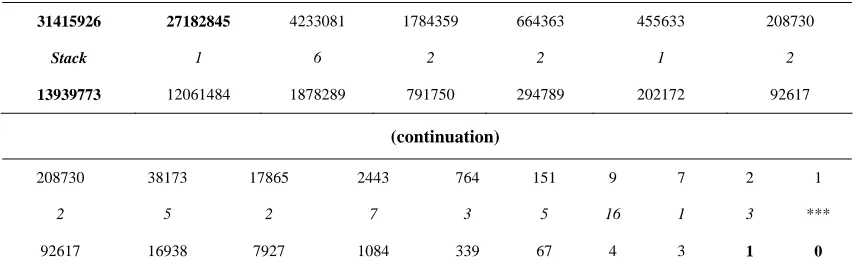
Let’s demonstrate how NEA finds a multiplicative in-verse x of 27,182,845 modulo 31,415,926. Table 1 be-low shows the computation of remainders in the upper row and stores the quotients in the middle row (the stack). Then the Backtracking procedure is used to com-pute from right to left until the stack is empty. The inputs and MMI are shown in bold, and the stack val-ues are in italics. Since the total number of steps (the height of the stack) is equal to fourteen (i.e., even), then x = 13,939,773.
Direct verification confirms that indeed 27182845 * 13939773mod 31415926 = 1. In the second numerical example we need to find the MMI z of 27,319,913 modulo 177,276,627 {see Table 2}. Since the height of the stack is odd, then
z = 177276627-34480855 = 142795772.
Direct computation verifies that z is indeed the MMI of 27319913, since
27319913 * 142795772 mod 177276627 = 1.
5. Complexity Analysis of MMI Algorithm
B. S. VERKHOVSKY 903
Table 1. Modular multiplicative inverse algorithm in progress.
31415926 27182845 4233081 1784359 664363 455633 208730
Stack 1 6 2 2 1 2
13939773 12061484 1878289 791750 294789 202172 92617
(continuation)
208730 38173 17865 2443 764 151 9 7 2 1
2 5 2 7 3 5 16 1 3 ***
92617 16938 7927 1084 339 67 4 3 1 0
Table 2. nd num al illus ion.
177276627 27319913 1 36 5 1
Seco eric trat
3357149 605615 33619 473
Stack 6 2 22 18 71 13 7 ***
34480855 5313808 2598007 117794 6539 92 7 1 0
ed as fo
pi and
ci
defin llows:1 1
1
:
k k k
d q q ; (13)
satisfy (3) and a
(14) Then (3) and (14) imply that
modpi
Hence both arrays and ar -creasing, and all term corres arrays
pi and
ci re defined as1:pi1p c qi i; k1:qk1q dk k i
p
1: 1
i i i i
p p p c pi1
pis of the
qkponding
e strictly de
cid
dk are positive er numDefinition 4:
an integ bers.
j s
x is a (s + 1)-dimensional ve consisting of the first s + 1 terms of a
ctor, n array
0, 1,..., j1, j,
x x x x i.e.,
:
0, ,..., ,
…,
1 1
j s s s
x x x x x .
Theorem 2: Consider
and
i 1;
ir
c p
; k ; k 1s d s q s
i 1 rp .
Let p0q0;
ci s dk s,j = l suc following in
i.e., for all j = 1,, s e ists at least one h that . Th or
al the
there x
js
l l
l 1 equalities hold: if 1 j l 1, then
c d en f
j j
p q
otherwise
j j
p q . (15)
Proof: Assuming that the stat
, it can also be demonstrated by
Consi
ement (15) holds for all induction that
1
i j
(15) also holds for i j. der
1 1 .
j j j j j j
j j
q q p p
q p p
j j
p
j
t d c
(16)
If j l 1
lows: if
, then else . Hence from (16) it fol
0
j
t 1
0
j
t
j l , then pjqj otherwise pjqj.
Since p0q0, then (14) holds for all js.
Q.E.D. nsider a f relatively prime
s an arr
Co pair o seeds p0 and p1
that generate ay
ci 1 rr
ir of relatively prime seeds p0 and q1 ge
. Consider also a
pa tha
an array
nothe t nerates
dk 1,1
s
ual to one. Let r and s be the number ofsteps
respectively to find MM e first and the second pair using either XEA or NEA. This mption implies that qs
i.e l its
eq
. such that
Is for th not al
assu te
required rms are
. Then by Theorem 2
i ks s
p q and 1
s s
p q . Hence rs.
Corollary: A pair of seeds, that for a given p0
re-quires the maximal number of steps for computation of a MMI rates an unary array of ., all
s in
i.e
, gene quotients,
component
ci 1r . Thus, as it follows )
an
from (3 low d (14), this pair of seeds must generate the fol ing array of integer numbers: p2: p0p1;p3:p1p2;;
2 1
: 1
r r r
p p p . It is easy to verify that this array is equivalent to the sequence of Fibonacci numbers
Fr2,Fr1,..., 4, 3, 2
In other words,for every i0,...,r pi: Fr 2
F F F .
i
, [14]. Remark 4: The pair p0Fr2; p F is
) a unary a
1 r1
rray f q
not the only one that generates a uotients and b) a decreasing integer array where the rth remainder eq
pairs of seeds hav o
uals one.
of the Lucas
3)
1
zero and negative indices are computed in acc dance with the formula: property for all non-negative integer numbers t and u:
1) p0Fr2tFr ; p1Fr1 tFr1 ; for t = 1
1; ;R i
p L 2 r 1
is a sequence mbers 1, 3, 4, 7, 11, 18,[15]; 2) p0 tFr2
1 t F
r1; t1;; L L
nu
1
p1tFr1 t Fr ; ;
p F tF t
2
0 r1 r 1; p1FrtFr1;
4) p0
1 t F
r2tFr2uFr;
1
p1 t Fr1tFr3uFr
Here the Fibonacci num
. bers with or
11m
m m
F F .
For all pairs, listed above, exactly r steps are required to find the MMI. However, all these pairs are special cases of a pair of seeds where
b; and Consider
0 r r1
p bF F and p1bFr1Fr2.
Therefore for all 0 i r
1
i r i r i
p bF F , pr1 pr 1.
1 5
v 2 and w
1 5
2.Using a z k r
-transform approach, we deduce that for all
0
k
5w w k
r k
p b v b v . (17)
Then for a large r
5 k 1k k 0
r k
p b v w w b v
since
1
v . (18)
The relation (18) implies that for a large r
0 5 1
r
p w b v w . (19)
Let
0
0
2
: max , , 2
b
z r p b r p
.
Therefore
p (20)0 0 0
logw 5 2 logw 1
z p v p
implies that the height of a stack satisfies the following inequality:
[8].
[image:4.595.83.509.663.719.2]Example 3: In this example (see
Table 3 illustrates the case where the height of the
sta in the Inequality
(2
Thus (20)
0 0
logw 1
r p p , (21)
the table below)
1
1919 mod 3105 1364.
Indeed, 1919 * 1364 mod3105 = 1.
ck is approaching the upper bound 1).
Remark 5: Although this upper bound is achievable if
0 1
p bFrFr and p1bFr1Fr2, for this pair of
inp
1
r
uts the MMI can be computed explicitly: indeed, it equals
1 Fr
.
Remark If in RSA public-key encryption [3],
p c
6:
, then c
100
0 10 r100 / log10wlog10 ; therefore
479 logc r .
housand emonstrate
ge
Over one t computer simulations d
that the avera height of the stack is actually almost 40
A)
modulo provided that gcd = 1, [2,7].
3 = g {there is n -ve
if = 1 return Y3 = gcd ); % smaller than the upper bound in (21).
6. Extended-Euclid Algorithm (XE
XEA also finds a multiplicative inverse of p1
0 0 1
1) Assign (X1, X2,X3):= (1, 0,p0); (Y1,Y2,Y3) (0,1,p1);
2) ifY3 = 0 returnX cd(p ,p1);
p (p ,p )
:=
0
rse}; 3) Y3
o in
(p0,
nv
1
p rse
else Y2 is the multiplicative i e ;
4) Q:X3Y3 ; (22)
5)
T T1, 2, 3 :T
X1QY X1, 2QY2,X3QY3
;(23)6)
X1,X2,X3 :
Y Y1, 2, 3Y
; (24)7)
Y Y1, 2, 3 :Y
T T1, 2, 3T
;7. Comparative analysis of NEA vs. XEA
for ard rocedure in (10), and Q in (22), respectively.
division, th
Table 3. {Worst-case space co
3105 1919 1186 733 9 7 2 1
(25)
8) goto 2.
Both algorithms require equal number of steps r computation of all quotients: values of t on the Forw p
In addition, NEA requires r more steps on the Back-tracking procedure to compute the values of L in (12).
Therefore each step of XEA requires one
ree multiplications, three long algebraic additions and ten assignments, see (22)-(25).
mplexity}: Size of stack.
453 280 173 107 66 41 25 16
Stack 1 1 1 1 1 1 1 1 1 1 1 1 1 3 ***
1364 843 521 322 199 123 76 47 29 18 11 7 4 3 1 0
B. S. VERKHOVSKY 905
XEA Yet in bo pro ures NEA uses one division, two multiplications, two long additions,
o stac ra , ( a nd ht
assign-n NEA I han XEA: uses ten variables. th ced
tw m
k ope tions push nd pop), a eig
ents, see (10)-(12). NEA uses four integer variables, one binary variable and, in addition,
logwp0
ofmemory to store the stack.
Notice that if a MMI does not exist, then there is no need to use the Backtracking procedure i . n this case NEA requires even fewer operations t one division, one multiplication, one addition, one push op-eration and five assignments per every step. Yet XEA still requires the same number of operations per step as in the case if a MMI does exist. Hence, overall XEA uses more multiplications, more additions, more assignments and twice as many variables than the proposed algorithm.
8. Average Complexity of XEA and NEA
both inputs are chosen randomly, then the If p0 and p1
probability that gcd
p0,p1
1 equals 26 [2]. Let us consider the following notations:
xea
w -worst-case specific complexity (per step) of XEA;
;
nea
w -worst-case specific complexity of NEA
xea
a -average-case specific complexity of XEA;
nea
a rage-case specific complexity of NEA; let ;
-ave
on,
mu ations
push a hen
; ; ; tm ta ts tst be time complexities of divisi d
ltipl t
ication, addition, assignment and stack oper nd pop respectively.
T
3 + 3 + 10 ;
xea d m a s
w t t t t (26) 2 +
wnea td tm 2 + 8 + 2 ;ta ts tst (27)
2
2
6
st
t 2 + 2 + 8 + 2 + + 5 + 1 6
nea d m a s
d m a s st
a t t t t
t t t t t
Notice that
(28)
xea xea
a w ; and
t
9) implies
d m a s s
t t t t t (29) Then (27)-(2 that
2 2
: xea nea 2 3 1.538 (30) R a a
9. Conclusions
nalysis of the proposed algorithm (NEA) for modular rse demonstrates that its execution
53.8% less time, than the execution
e ed K-bit level for ubl r on algo-rithm, where the inputs are integers on the interval
A
multiplicative inve quires on average re
of the Extended Euclid algorithm.
Theoretical analysis of space complexity of the En-hanced-Euclid algorithm shows that it requires relatively small bit-storage for its execution. This storage does not
xce a 2 a p ic-key enc ypti
0 and 1
p p
100 400
10 ,10 .
e y mode -Euclid algorithm
r implementation of encryption in low memory en
of this aper; and to A. Koripella for her assistance in running
. van Oorschot and S. A. Vanstone, “Handbook of Applied Cryptography,” CRC Press, Boca
] R. L. Rivest, A. Shamir and L. Adleman, “A Method for
On the other hand, computer simulations demonstrate that the average bit-storage is actually 40% smaller than 2K. Hence NEA can be executed if necessary by a cus-tom-built chip with relativ l st memory, [7]. This property of the Enhanced is especially useful fo
vironments such as smart or PC cards, cell phones, wearable computers and other integrated devices.
10. Acknowledgements
I express my appreciation to R. Rubino, J. Runnells, M. Sikorski, C. Washington and to anonymous reviewer for comments and suggestions that improved the style p
computer experiments.
11. References
[1] R. Crandall and C. Pomerance, “Prime Numbers: A Computational Perspective,” Springer, Berlin, 2001. [2] A. J. Menezes, P. C
Raton, 1997. [3
Obtaining Digital Signature and Public-Key Cryptosys-tems,” Communications of the ACM, Vol. 21, No. 2, 1978, pp. 120-126.
[4] B. Verkhovsky, “Overpass-Crossing Scheme for Digital Signature,” Keynote Address, Proceedings of
Interna-tional Conference on System Research, Informatics and
Cybernetics, Baden-Baden, 30 July-4 August 2001.
[5] T. ElGamal, “A Public-Key Cryptosystem and a Signa-ture Scheme Based on Discrete Logarithms,” IEEE Trans-
actions on Information Theory, Vol. 31, No. 4, 1985, pp.
469-472.
[6] M. Rabin, “Digitized Signatures and Public Key Func-tions as Intractable as Factorization,” Technical Report:
MIT/LCS/TR-212, MIT Laboratory for Computer Science,
Cambridge, 1979.
[7] J. Hoffstein, J. Pipher and J. H. Silverman, “An Introduc-tion to Mathematical Cryptography,” Springer, Berlin, 2008.
[8] B. Verkhovsky, “Multiplicative Inverse Algorithm and Its Complexity,” Proceedings of International Conference-
InterSYMP-99, Baden-Baden, July 1999, pp. 62-67.
[9] B. Verkhovsky, “Accelerated Cyber-Secure Communica-tion Based on Reduced EncrypCommunica-tion/DecrypCommunica-tion and In-formation Assurance Protocols,” Journal of Telecommu-
riza-International Journal of Communications,
Net-p. 1-8.
. 276-288.
ppendix
omputer experiments
decimal-digit long integers A and B were B;
dulo A was computed; in
[image:6.595.346.499.549.706.2]era
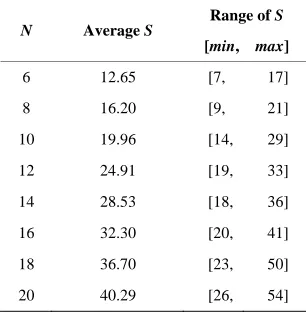
Table A1. Results of computer experiments.
Range of S [10] B. Verkhovsky, “Hybrid Authentication Cybersystem Based
on Discrete Logarithm, Entanglements and Facto tion,” International Journal of Communications, Network
and System Sciences, Vol. 3, No. 7, 2010, 579-584.
[11] B. Verkhovsky, “Generalized Baby-Step Giant-Step Al-gorithm for Discrete Logarithm Problem,” Advances in
Decision Technology and Intelligent Information Systems,
International Institute for Advanced Studies in Systems Research and Cybernetics, Baden-Baden, 2008, pp. 88- 89.
[12] B. Verkhovsky, “Integer Factorization: Solution via Al-gorithm for Constrained Discrete Logarithm Problem,”
Journal of Computer Science, 2009, Vol. 5, No. 9, 674-
679.
[13] B. Verkhovsky, “Potential Vulnerability of Encrypted Messages:Decomposability of Discrete Logarithm Prob-lems,”
work and System Sciences, Vol. 3, No. 8, 2010, pp.
639-644.
[14] R. B. McClenon, “Leonardo of Pisa and His Liber Quad-ratorum,” American Mathematical Monthly, Vol. 26, No. 1, 1919, p
[15] D. Harkin, “On the Mathematical Works of Francois- Edouard-Anatole Lucas,” Enseignement Mathematique, Vol. 3, No. 2, 1957, pp
A
C N Average S
) Pairs of N 1
generated randomly, where A > 2) Then MMI C of B mo
other words we found an integer C, for which holds BC modA = 1;
3) 125 experiments have been carried out for each value of N = {6, 8, 10,,18, 20};
4) The values of S (size of stack-storage) for each N were tabulated; (not shown in the Table A1).
5) The values of av ge S for every N and the range of S for each N are presented in the Table A1.
[min, max]
6 12.65 [7, 17]
8 16.20 [9, 21]
10 19.96 [14, 29]
12 24.91 [19, 33]
14 28.53 [18, 36]
16 32.30 [20, 41]
18 36.70 [23, 50]