http://www.scirp.org/journal/jss ISSN Online: 2327-5960 ISSN Print: 2327-5952
DOI: 10.4236/jss.2019.78025 Aug. 26, 2019 346 Open Journal of Social Sciences
Design and Application of Scratch Personalized
Learning Resources Based on VAK Learning
Style Theory—Take Q School for Example
Wei Zhong
Nanjing Normal University, Nanjing, China
Abstract
Students’ ability varies, learning habits, personality characteristics and learn-ing methods are also different in education and teachlearn-ing, which leads to the traditional teaching methods are difficult to adjust. And it is difficult to teach students in accordance with their aptitude, students’ learning is also lack of individuality and pertinence. And three themes of the contemporary educa-tion development are internaeduca-tionalizaeduca-tion, informaeduca-tionizaeduca-tion, personalized, in order to adapt to the trend of the Times, improve the efficiency of learning, let the students learn flexibly, promote their individual and comprehensive development. Based on the VAK learning style theory, this study designed Scratch learning resources to highlight personalization, so as to enable stu-dents to learn meaningfully and promote their personalized development.
Keywords
Scratch, VAK Learning Style, Personalized Learning Resources, Design, Application
1. Introduction
The arrival of the Internet age has brought new power to education and teach-ing. The emergence of micro-class, MOOC and flipped classroom has changed the classroom teaching mode and students’ learning mode. More and more re-sources are available for students to use, but junior high school students’ learn-ing is still class-based, and learnlearn-ing resources are generally provided by schools or teachers, lacking pertinence and autonomy. However, students’ learning ha-bits, learning methods and learning purposes are not the same, which is not conducive to the efficient and flexible learning of students. Although teachers
How to cite this paper: Zhong, W. (2019) Design and Application of Scratch Perso-nalized Learning Resources Based on VAK Learning Style Theory—Take Q School for Example. Open Journal of Social Sciences, 7, 346-361.
https://doi.org/10.4236/jss.2019.78025
Received: July 24, 2019 Accepted: August 23, 2019 Published: August 26, 2019
Copyright © 2019 by author(s) and Scientific Research Publishing Inc. This work is licensed under the Creative Commons Attribution International License (CC BY 4.0).
DOI: 10.4236/jss.2019.78025 347 Open Journal of Social Sciences
want students to reach their full potential, it is not realistic to tailor teaching methods to each student’s aptitude under the traditional teaching model. How-ever, reasonable educational resources should be able to help students learn, arouse students’ interest in learning, and enable students to have targeted, inde-pendent and efficient learning. Therefore, it is very important to design persona-lized learning resources in line with students’ physical and mental development. Internationalization, informatization and individuation have become three ma-jor themes in the development of contemporary education [1]. This study main-ly focuses on “individuation” and takes Scratch as an example to develop and design learning resources based on VAK learning style theory.
2. Research Status of Scratch Learning Resources
Through literature analysis and organization, the author found that Scratch re-search status can be divided into foreign rere-search status and domestic, and Hong Kong and Taiwan are the early introduction of Scratch in China, so China can be divided into Hong Kong and Taiwan and the mainland.
2.1. Foreign Research Status
There are abundant and in-depth researches on Scratch abroad. Scratch is main-ly used in two aspects. First, Scratch is used to help children (over eight years old) learn programs, so that children can express themselves, stimulate their in-terests and experience collective cooperation and develop creative thinking in the learning process. Second, Scratch is used to guide students who have no ba-sic knowledge to get started, so that they can feel that programming can be sim-ple and interesting and learn in a relaxed and sim-pleasant environment [2]. In addi-tion, Scratch websites established abroad are mature and well resourced, allow-ing users to share their own works anytime and anywhere. However, there are few studies abroad that apply Scratch to formal learning in school classrooms. Most of the studies focus on students’ programming ability, logical thinking ability and creativity [3].
2.2. Domestic Research Status
In 2008, Scratch was introduced into primary and secondary schools in Hong Kong, mainly to simplify students’ learning process and make classroom learn-ing more vivid and interestlearn-ing on the basis of learnlearn-ing creative technology, so as to promote the long-term development of creative education in Hong Kong [4]. In Taiwan, Scratch is much richer. The main research aspects include the impact of Scratch on students’ problem-solving ability, creativity and logical thinking ability by using experimental research and data analysis. For this purpose, Tai-wan has established a Scratch communication and learning website, where stu-dents can share their own works and interact with teachers and other stustu-dents
[5].
DOI: 10.4236/jss.2019.78025 348 Open Journal of Social Sciences
CNKI database, and found 5925 results. The main research contents include the following three aspects: first, in the classroom, Scratch was used as the learning content of information technology courses, and Scratch was simply taught to students. The second is to associate Scratch with “maker” and “maker educa-tion”. Some of them develop Scratch teaching materials in the background of maker, or design Scratch courses based on “maker education” [6]. Third, in oth-er disciplines, Scratch is used as an auxiliary tool to support teachoth-ers’ teaching and students’ learning. Through Scratch, lively learning resources are created to improve students’ learning efficiency and improve classroom effect [7].
By analyzing and summarizing the literature, there has been little research on Scratch learning resource design, let alone personalized learning resources. The reason may be that Scratch is not difficult to learn and easy to learn, but this does not deny its great value [8]. In particular, Scratch ranked among the top 28 programming languages in TIOBE in May 2019, which further indicates its high popularity and usage worldwide.
Through the analysis of the resources on the Internet, it is found that the online learning resources still have shortcomings, and different kinds of learning resources are relatively independent design [9]. Most learning websites are just like a database, lacking the analysis of students’ learning style and personality, and the personalized learning resources are almost blank. There are mainly two kinds of Scratch resources provided by Q school for students to learn Scratch: video tutorials on Scratch official website and text materials of traditional Chi-nese characters [10]. Besides, text materials still explain the knowledge points of old Scratch 1.4. At present, Q school is strengthening the construction of digital campus, paying more attention to Scratch teaching, and the learning effect and efficiency of students need to be improved. Q school is also looking for Scratch resources more suitable for students to learn.
3. Research Ideas and Methods
Based on the above status quo, the author will design Scratch learning resources that conform to the laws of physical and mental development of learners mainly according to the needs and characteristics of learners. In this design, persona-lized learning resources suitable for learners with different learning styles (Visu-al, Auditory and Operational) will be designed to make learners as the center and promote meaningful learning.
DOI: 10.4236/jss.2019.78025 349 Open Journal of Social Sciences
high school is different, so in the design of resources will pay attention to stu-dent’s body and mind law of development, strive to resources can conform to the students’ cognitive level, stimulate students’ interest, to meet the curiosity of students to promote students’ personal development. The content of the learn-ing resources is mainly to Scratch the basic operation of the study, the types of resources mainly have three: image text tutorials, video tutorials, web learning operation, corresponding to three types of learners in the VAK learning styles: visual, auditory, operation, so the platform must first provide learners with VAK learning style online testing, after the test of the choice of resources accordingly again, at the same time it is also the embodiment of the “personalized” in this design.
The main research method is questionnaire survey. The researcher will pro-vide the designed resources to the students of a class in the first grade of junior high school in Q school, and complete the relevant questionnaires after a period of study. The author mainly gets feedback from the questionnaire to understand the learning degree of the learning content, whether the learning efficiency has been improved, whether the platform interface is friendly and other related is-sues, and carries out reflection analysis and summary, and finally draws the con-clusion.
4. Scratch Personalized Learning Resource Design
The learning resources of this study are for the first year students in Q school. Through observation during the internship, the author found that students’ learning of knowledge was all completed in class, and few students took advan-tage of spare time to learn Scratch. However, information technology teachers provide students with unified learning resources in class, without considering the different learning characteristics of each student, and can only study accord-ing to the pace of teachers’ lectures, which is not conducive to the personalized development of students. Although the country has put forward the require-ments of promoting the comprehensive development of students, the current domestic classroom teaching is still not completely out of the shackles of tradi-tional teaching, and in the current educatradi-tional background, it is impossible to realize “one-to-one teaching” to teach students in accordance with their apti-tude. Therefore, the design and production of this resource should not only highlight individuality, but also ensure that students can understand and master knowledge points through classroom learning. In order to facilitate learners’ learning, the author will design and develop a website platform to collect three types of personalized resources on the platform, so as to improve the utilization rate of resources and learning efficiency.
4.1. Resource Design Principles
DOI: 10.4236/jss.2019.78025 350 Open Journal of Social Sciences
same, but the way of expression is different, so the common design principles mainly include the following three points:
4.1.1. Personalized
Mentioned before, this paper has pointed out the personalized learning re-sources, based on respecting students’ individual differences, cognitive differ-ence and body and mind law of development as the prerequisite, and on the ba-sis of certain after classifying students learning style theory, different types of learners choose different learning resources, improve the students’ interest in learning content, and thus for the more effective learning, promote students’ personalized development purposes [11].
The design of the resources mainly based on the theory of VAK learning style (Visual-Auditary-Kinesthetic learning styles), the learners are divided into three types: Visual, auditory, operation type (Kinesthetic), learning resources and the corresponding is divided into three types: image text, video tutorials, Scratch 2.0 web learning operation. Learners first conduct online test of VAK learning style on the platform, get their own learning style, and then choose the corresponding learning resources to start learning, so as to achieve personalization [12].
4.1.2. Learner-Centered
The new educational concept requires “learner-centered”. In the design of re-sources, students’ dominant position will be highlighted. As the master of the classroom, students use resources to study independently, while teachers’ re-sponsibility is to guide students to learn and think, and meanwhile, as the men-tor of students’ learning, help students solve problems. Teachers change the tra-ditional classroom lectures students mode of the lectures, students use design good resources for independent learning, understand and master the knowledge points, and carries on the corresponding operation training. In the process, stu-dents can communicate with each other, solve the problem, if you have not solve the problem, help teachers, teacher as a student for answering questions again.
4.1.3. Accord with Learners’ Cognitive Level
The design of this resource should be based on the actual situation of students. As an information technology course that does not require examination, stu-dents do not spend much time studying Scratch, mainly in the classroom [13]. Moreover, the first grade students are in the transitional period from concrete operation stage to formal operation stage, and have certain abstract thinking ability. Therefore, the design of resources should first ensure that students can understand and master relevant knowledge points in class, and the design of dif-ficulty should conform to students’ understanding level and the laws of physical and mental development
4.2. Resource Content Design
DOI: 10.4236/jss.2019.78025 351 Open Journal of Social Sciences
complete explanation of the operation of common function modules under the ten instructions, the content from simple to deep, step by step learning. Each class has three types of resources: visual, auditory, and operational (kinesthetic). Resources are classified on the platform, and learners can directly jump to the corresponding resources for learning after testing their learning styles. Among them, the picture text tutorial and video tutorial are both original design, web version operation learning is a built-in function of Scratch official website, and the whole platform is also original design.
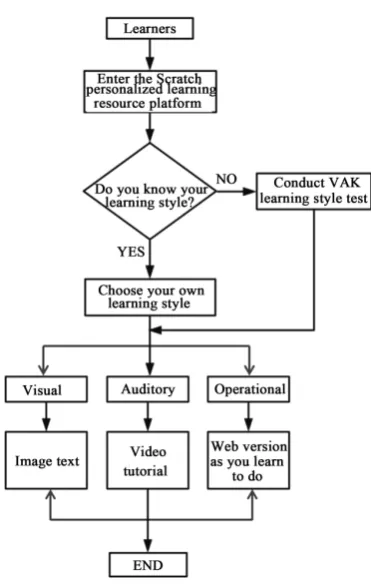
[image:6.595.279.465.414.707.2]Specific procedures: learners enter the Scratch personalized learning resource platform. If they know their own learning style, they can directly choose the corresponding resources to learn; otherwise, they will jump to the VAK learning style test page [14]. Learners get their own learning style after 24 questions, and then return to the home page to select the corresponding learning resources ac-cording to their own learning style. The results are visual, auditory, operational (kinesthetic), visual and auditory, visual and operational, auditory and opera-tional, and possibly a combination of all three. Visual learners mainly learn by reading image text materials, and auditory learners mainly use video for learn-ing. The aesthetic learners are also known as Kinesthetic learners, and then jump to Scratch 2.0 web page. Comprehensive learners, such as visual learners and au-ditory learners, can use image text materials and video for learning. They can choose only one of them, or they can use them crossingly. The overall content framework is shown in Figure 1.
DOI: 10.4236/jss.2019.78025 352 Open Journal of Social Sciences
4.3. Website Design Principles
The learning resources of this design will take the web page as the carrier. In or-der to make the platform better serve learners, the website and its resources will be designed and developed according to certain principles, mainly including:
[15].
4.3.1. Clear Theme
This website is Scratch personalized learning resource platform, content re-quirements design and production in strict accordance with the theme, the theme is clear, the web has strong interactivity, highlight the personalized de-sign, resources will be different kinds of learning resources are assigned to dif-ferent learning styles of learners use, improve the learning efficiency, and the content of the website are closely related topics, not creating relevant knowledge or other content.
4.3.2. Combine the Needs of Learners
Most of the students in grade one are between 12 and 14 years old. They are in the transitional period from children to young people. They like to pursue new things, and they still have children’s curiosity, inquisitiveness and activity. Therefore, the design of the website mainly reflects individuation. It takes learn-ers as the center and combines the specific needs of learnlearn-ers to provide learnlearn-ers of different learning types with learning resources in line with their own learning characteristics, learning habits and personality. Since learners mainly learn in class, the design of this platform and its resources should enable students to un-derstand and master knowledge points in class.
4.3.3. Uniform Style
On the design of the web is always adhere to the principle of the style is unified, mainly reflected in the structure of system, the respect such as colour is tie-in, page layout, specifically, on the structure of web page design, the layout of the page, text layout, the style of the picture has high uniformity, and on the colour collocation, there are five main use of color: blue (#199ED7), yellow (#E1A91A), green (#99CC00), purple (#C2479D), red (#BE1E2D), different functions of the main color page is different, the body of the website color matching.
5. Technical Implementation of Scratch Personalized
Learning Resource Platform
DOI: 10.4236/jss.2019.78025 353 Open Journal of Social Sciences
Scratch 2.0 web version, that is, the author integrates and designs the resources on the Internet according to the types of learners.
5.1. Platform System Function Realization
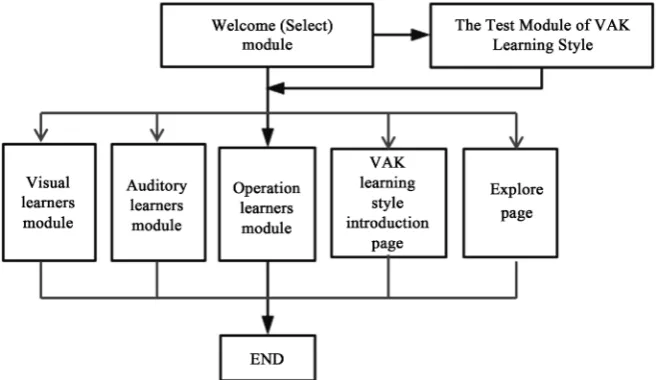
The whole platform exists in the form of a website, and learners can learn online directly after release. The author mainly USES Adobe Dreamweaver CS5 soft-ware to design and make the website, and its page layout and system functions are mainly realized by simple HTML and CSS, and the layout and functions of the whole website are relatively simple. Site consists of six modules, respectively is “welcome (select) module”, “online testing module”, “visual learners module”, “auditory learners module”, “operation learners module”, “navigation module”, including the navigation module is divided into “VAK learning style introduc-tion page”, “explore page”, “quesintroduc-tionnaire” page, each module has one or more web pages below and by linking jump is entered, the main functions of the plat-form framework is shown in Figure 2.
5.2. The Test Module of VAK Learning Style
[image:8.595.209.539.512.702.2]This module has only one page. If the learner does not know their own learning style, then skip to this page for online testing. Page content can be roughly di-vided into three parts, the first is a simple description of the test, the second part is the test instructions, the third part is 24 test questions. Each of these types has eight questions, arranged in a likert scale. There are five options for each ques-tion: always, usually, occasionally, rarely, never. The higher the score is, the more accustomed the learner is to the learning method. For example, visual > auditory > operation type, the type of learner is visual learner; if visual = audito-ry > operation type, the type of learner is visual and auditoaudito-ry. After the tester fills in and submits, its learning type will appear directly, and then the learner selects the corresponding learning resources according to the results.
DOI: 10.4236/jss.2019.78025 354 Open Journal of Social Sciences
5.3. Visual Learner Module
Visual learners prefer to receive Visual stimulation in the learning process, and the learning resources provided for them are self-made picture text written reading materials. When learners click “visual learner” on the home page, they will jump to the visual module, which has 9 pages in total. After the jump, the first page to enter is the visual learner course catalog page, which is the main page of the module. There are two main parts of the content, the first is a simple introduction to visual learners and to provide resources for them; The second is the course catalog, which is presented in the form of pictures. There is one pic-ture for each class. Click it to enter the study of course contents. Each course content page is mainly divided into three parts. The first is the effect gifs, which show the good project effects. Second, step directory, each step corresponds to an operation, click can directly jump to the corresponding specific operation; Third, the complete content of this lesson. The page of this module is also de-signed and produced with Adobe Dreamweaver CS5, and its content is produced in Adobe Photoshop CS5 to synthesize related images and text.
5.4. Auditory Learner Module
Auditary learners like to listen to the teacher and are accustomed to receiving sound stimulation. The learning resource provided for them is video self-made by the author. Learners in the home page, click on the “auditory learners”, will jump to auditory module, the module of a total of nine pages, after the jump into the above all are visual learners course catalog page, that is the main page of the module, its contents and related links is similar to the “visual learners”, eight other pages are respectively each lesson video.
5.5. Operational Learner Module
Operation learners (Kinesthetic) prefer to learn by hands-on experience, so it would jump directly to Scratch 2.0 web version
(https://scratch.mit.edu/projects/editor/?tip_bar=home), whose learning re-sources are from Scratch’s official website. The course content is the same with the other two types. Operational module only web page version of a page, on the front page select “operation learners” after the jump straight into the web ver-sion of the study, the main page is divided into two parts, the left side is the web version of the Scratch, the operating interface and offline client versions have the same function, learners will be directly used to make the project, the right can open a small window, embedded inside is curriculum resources, so that learners can operation to learn while I watched the resource, realize “synchronization”.
5.6. Navigation Module
DOI: 10.4236/jss.2019.78025 355 Open Journal of Social Sciences
learning and memorizing by “seeing”. They like to receive visual stimulation, like graphics, pictures and reading written materials. Therefore, visual learners are provided with learning resources combining text and pictures. Auditory learners prefer to receive sound stimulation and learn by “listening” in the learning process. They like to listen to teachers’ lectures. The learning strategies they usually choose are listening to lectures and listening to video and so on. Operational learners, also known as kinesthetic learners, prefer to learn through “physical” contact and hands-on practice, so the learning resources for opera-tional learners will jump directly to the web version of Scratch and learn through operation. “Explore” page is directed
(https://scratch.mit.edu/explore/projects/all) connected to the network, the page is also a Scratch under the official website of a page, here there are many Scratch users upload project and work, games, animation, stories, music, etc. , each work can jump to the application page, see the effect is how to implement, can also work for secondary revision, join your ideas and thoughts, it provides learners with the opportunity to learn more. The next step is “questionnaire survey”. Click it and jump directly to the questionnaire page. The author enters the con-tents of the questionnaire into the questionnaire star.
6. Analysis of Application Effect of Scratch Personalized
Learning Resources
This part mainly analyzes the application effect. The author provided the pre-pared resources to the students of class 2, grade 1 (48 students) and class 5, grade 1 (50 students) of Q school, and then the students filled in the questionnaire ac-cording to their own learning and experience (Appendix). The author mainly evaluates and reflects on the learning resources through the statistics and analy-sis of the questionnaire results. The author put the completed questionnaire on the platform, and the learners filled in the questionnaire directly online after learning, and finally received 88 valid questionnaires.
6.1. Analysis of Resource Content
Through sorting out and analyzing the questionnaire, it is found that 10.23% of the learners have never learned Scratch before, and 53.41% of them are just be-ginning to learn Scratch and only know a little basic operation. 97.73% of learn-ers believe that they have deepened their undlearn-erstanding of Scratch through learning on this platform and found a suitable way to learn Scratch. 97.73% of learners prefer this personalized learning method to previous classroom teach-ing. 96.59% of the learners think that they have increased their interest in learn-ing Scratch through this personalized learnlearn-ing platform.
DOI: 10.4236/jss.2019.78025 356 Open Journal of Social Sciences
main body of the classroom and learn independently. Teachers, as their mentors, guide students to learn. In this process, it is helpful for students to learn inde-pendently, pertinently and flexibly, and stimulate students’ interest in learning so as to promote their meaningful learning.
6.2. Analysis of Platform Design
In terms of the design and layout of the platform, learners are quite satisfied. 96.59% of learners think that the website is simple, friendly and efficient. Only 3.41% of learners believe that the content design of this resource does not meet their cognitive level. 96.59% of learners think that the page layout on the plat-form is simple and beautiful, which conplat-forms to their aesthetic level. Based on the analysis of the above data, learners are satisfied with the appearance of the platform, with strong interaction, simple and convenient operation, which is conducive to their learning.
6.3. Analysis of Learning Efficiency
96.59% of learners believe that the resources on this platform are conducive to their understanding and mastery of knowledge points. Only 2.27% of learners think that this platform has not improved their learning efficiency. 97.73% of learners believe that through learning on this platform, they can understand and master the knowledge points in class. Only 2.27% of learners think this persona-lized learning resource is not suitable for their own learning. 96.59% of the learners think that they have increased their interest in learning Scratch through this platform.
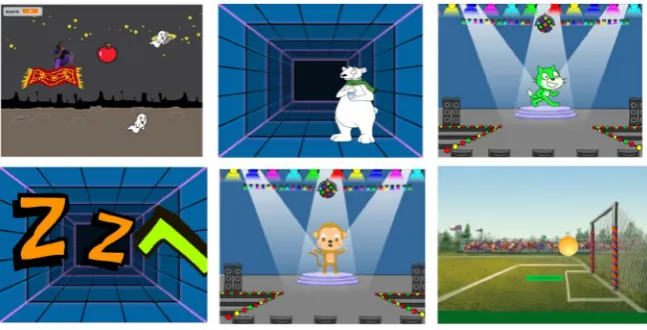
[image:11.595.211.535.544.709.2]Based on the analysis of the above data, the design of personalized resources has achieved the goal of improving students’ learning efficiency. The emergence of resources also alleviates teachers’ teaching tasks and makes teachers more targeted in preparing lessons. And students learn more flexibly and efficiently in the classroom. To sum up, the design of this resource is quite successful. After learning on the platform, learners will submit their own works, as shown in
Figure 3.
DOI: 10.4236/jss.2019.78025 357 Open Journal of Social Sciences
7. Summary and Prospect
This paper takes the students from Class 2 and Class 5 of Grade 1 of Q school as the research object, designs and implements the Scratch personalized learning resource platform by designing and integrating excellent learning resources on the Internet and combining the specific needs of the research object.
7.1. Platform Advantages
The author had a two-month internship in Q school before and had some un-derstanding of the previous classroom situation of learners. After learning with Scratch personalized learning resource platform, the author found through re-search that this platform has the following advantages compared with traditional teaching methods:
7.1.1. Improve Learners’ Interest in Learning
Whether through the author’s observation in class or the feedback from Q school teachers and students, it can be found that learners’ interest in learning is greatly improved by using this platform. As mentioned above, first-grade stu-dents are easy to accept new things, and are curious about new things and will-ing to explore. Therefore, different from the traditional classroom learnwill-ing mode, this platform stimulates their curiosity and thirst for knowledge, and their enthusiasm for creation increases accordingly. In the class, each student used the platform to study and created his own works. Some students submitted more than one work, and the learning atmosphere of the whole class was high.
7.1.2. The Concept of “Learner-Centered” Is Realized
In the process of learning, learners learn independently according to learning resources, students create freely in the whole class, and teachers are only the mentors and helpers of students. When learners encounter problems, they can use resources to repeat learning, or discuss independently. If they cannot solve the problems, teachers will explain them. In the process of using resources to learn, learners will also divergent thinking to create. Through observation, the author finds that learners enjoy the process of creation. Although the case con-tents provided are the same, the works created by students are different from each other. Some students increase their own ideas and ideas on the basis of the original, and constantly improve the works.
7.1.3. Conducive to Teachers’ Control and Management of Class
know-DOI: 10.4236/jss.2019.78025 358 Open Journal of Social Sciences
ledge. Therefore, this platform can meet the needs of students of different levels, so that teachers only need to solve the problems in students’ learning, and do not spend too much time to manage classroom discipline.
7.2. Research Prospects
Through the author’s research and practice, this research has achieved some positive results, but the design and application of personalized learning re-sources are still in the exploration stage, and there are still many aspects to be improved. Based on the actual situation of this study, the author thinks that the follow-up research can be carried out from the following aspects.
Firstly, there is no doubt to increase the sample size and practice time. In oth-er words, the platform will be put into more classes, so that the data obtained will be closer to the real situation and the conclusions will be more general and less individual. Secondly, big data technology can be used for comprehensive analysis and testing of learners to obtain more reliable results, so as to push per-sonalized learning resources to learners. The function of sharing works and communication can be added on the platform to provide a space for learners to display and stimulate their creativity.
The three major themes of contemporary education development are interna-tionalization, informatization and individuation, and the new educational con-cept also requires “student-centered”. Nowadays, personalized learning is rising and developing, and more and more research on it. The rise of personalized teaching provides the possibility for the emergence of new teaching mode, and also allows us to see more possibilities of education and teaching. Through this research, we find that making students the subject of learning and providing re-sources suitable for the development of students’ personality characteristics can not only stimulate their interest in learning but also help improve their learning efficiency. This fully proves that personalized learning can promote learners’ learning. But most research has been limited to textual descriptions, and very few have been successful. Therefore, there is still a long way to go for the re-search and practice of “personalized learning”, which requires more and con-stant practice and innovation. The arrival of the era of big data provides more possibilities for personalized learning. This design is just an attempt, hoping to develop more learning content on this basis in the future, build a more perfect personalized learning resource platform, bring greater convenience and benefits to students’ learning, and make students’ learning more free, flexible and perso-nalized.
Conflicts of Interest
The author declares no conflicts of interest regarding the publication of this paper.
References
DOI: 10.4236/jss.2019.78025 359 Open Journal of Social Sciences Teaching in Primary Schools. Shanghai Normal University, Shanghai.
[2] Wang, X.X. (2012) Application Research of Scratch in Program Design Teaching in Middle School under Network Environment. Southwest University, Chongqing. [3] Wang, B.L. (2015) Research on the Application of Scratch in Junior Middle School
Information Technology Teaching. Central China Normal University, Wuhan, 5. [4] Dong, J.W. (2016) Research on the Construction of Personalized Learning System.
East China Normal University, Shanghai, 4.
[5] Ma, Y. and Chen, Y.X. (2013) Construction of English Multimedia Network Inde-pendent Learning Model Based on VAK 3d Learning Style Theory. Education and
Teaching BBS, No. 117, 180-181.
[6] Li, G. and Jiang, Y.J. (2005) Theoretical Construction and Characteristic Analysis of Personalized Learning. Journal of Northeast Normal University, No. 3, 152-156. [7] Cao, X.M. and Zhu, Y. (2014) Research on Personalized Learning Platform from the
Perspective of Learning Analysis. Open Education Research, 20, 67-74.
[8] Yang, Y.Q. (2014) Construction of Personalized Learning Model for MOOC Learn-ers. China Audio-Visual Education, No. 329, 6-10.
[9] Li, B. and zhang, W.L. (2015) Construction of Push Service Model of Learning Re-sources in Intelligent Education. Journal of Distance Education, 33, 43-50.
[10] Wang, Q. (2015) Scratch Based Information Literacy Training of Middle School Students. Shaanxi Normal University, Xi’an.
[11] Jin, Y.J. (2014) Development, Research and Practice of School-Based Teaching Ma-terials in the Context of Makers. Shanghai Normal University, Shanghai.
[12] Liu, S. (2013) Chinese Teaching Design in Brunei Primary Schools from the Pers-pective of Differential Teaching. Northeast Normal University, Changchun. [13] Chang, Y.H. (2018) Research on Differential Teaching Design Based on Scratch
Expansion Course. Shanghai Normal University, Shanghai.
[14] Xu, X.X. (2019) Practical Exploration of Primary English Teaching Based on VAK Teaching Model. Learning Weekly, No. 19, 152.
[15] Shi, J.Y. (2019) User Experience Optimization of Web Interface Design. In: CPC Shenyang Municipal Committee, Shenyang People’s Government, International Academy of Production Engineering, China Institute of Mechanical Engineering, Eds., Papers of the 16th Annual Conference of Shenyang Science (Economic and
Social Science), CPC Shenyang Municipal Committee, Shenyang People’s
DOI: 10.4236/jss.2019.78025 360 Open Journal of Social Sciences
Appendix
Scratch Personalized Learning Resource Platform Use Questionnaire Dear classmates:
Hello!
First of all, thank you very much for using Scratch personalized learning re-sources platform for learning. The main purpose of this survey is to understand your learning situation using this platform and your satisfaction with learning resources. There are no right or wrong questions. Please fill in the true feelings of use. We will keep your information strictly confidential. Please feel free to fill in. Thank you very much.
1) Gender A. man B. woman
2) What is your learning style? A. Visual type
B. Auditory type C. Operational type D. Visual and auditory E. Visual and operational F. Auditory and operational G. Visual, auditory and operational
3) Have you ever studied Scratch before? How much did you learn? A. Learned it; familiar with Scratch, you can create your own works B. Learned; basic operations are all metropolitan.
C. Learned; just started, only a little bit. D. Not learned
4) Do you think the resources on this platform will help you understand and master the knowledge points?
A. is B. General C. no
5) Do you think this platform can improve your learning efficiency? A. is
B. General C. no
6) Through this study, do you know more about yourself and find a suitable way of learning?
A. is B. General C. no
7) Compared with the previous classroom teaching, do you like this persona-lized learning method?
DOI: 10.4236/jss.2019.78025 361 Open Journal of Social Sciences
B. General C. no
8) Does the design of resource content meet your cognitive level? A. is
B. General C. no
9) Has this learning resource design increased your interest in learning Scratch?
A. is B. General C. no
10) Is the operation on this platform simple, friendly and efficient? A. is
B. General C. no
11) Is the layout of the pages on this platform concise and beautiful, in line with your aesthetic level?
A. Yes B. General C. No
12) Through this platform, do you understand and master the knowledge of this lesson in class?
A. Yes B. General C. No
13) Do you think the personalized resources designed by this platform are suitable for you to learn?