Copyright © 2011 SciRes. JILSA
Insertion of Ontological Knowledge to Improve
Automatic Summarization Extraction Methods
Jésus Antonio Motta, Laurence Capus, Nicole Tourigny
Département D’Informatique et de Génie Logiciel, Université Laval, Québec, Canada. Email: [email protected], {laurence.capus, nicole.tourigny}@ift.ulaval.ca
Received May 30th, 2011; revised July 20th, 2011; accepted July 27th, 2011.
ABSTRACT
The vast availability of information sources has created a need for research on automatic summarization. Current methods perform either by extraction or abstraction. The extraction methods are interesting, because they are robust and independent of the language used. An extractive summary is obtained by selecting sentences of the original source based on information content. This selection can be automated using a classification function induced by a machine learning algorithm. This function classifies sentences into two groups: important or non-important. The important sen-tences then form the summary. But, the efficiency of this function directly depends on the used training set to induce it. This paper proposes an original way of optimizing this training set by inserting lexemes obtained from ontological knowledge bases. The training set optimized is reinforced by ontological knowledge. An experiment with four machine learning algorithms was made to validate this proposition. The improvement achieved is clearly significant for each of these algorithms.
Keywords: Automatic Summarization, Ontology, Machine Learning, Extraction Method
1.
Introduction
Research works on automatic summarization have greatly increased in recent years. Indeed, digital sources of in-formation have become increasingly available. When a user runs a query on Internet, she/he must choose among the retrieved documents those containing relevant infor- mation for her/him. The task becomes more difficult when the number of documents increase. An automated system able to ‘discover’ the essential information is one of the challenges of artificial intelligence, especially in natural language processing. In some cases, methods of machine learning based on symbols are used to tackle this problem.
Automatic summarization can be seen as a problem of transforming one or more documents in a shorter version with preserving information content [1]. The methods used are divided into two main approaches: extraction and abstraction, respectively surface methods and deep methods in a more linguistic viewpoint. A summary ob- tained by extraction is composed of a set of sentences selected from the source document(s) by using statistical or heuristic methods based on information entropy of sentences. The summarization process by extraction is a relevant alternative, robust and independent of language,
compared with the summarization process by abstraction [2]. An abstractive summary is obtained by semantic analysis in order to interpret the source text, and find new concepts to generate a new text that will be the summary. This method requires linguistic processing at a certain level [3]. In addition, a summary can be produced in a generic way to give a general idea of the contents of documents to be summarized. It can also be based on keywords supplied by the user. In this case, it will con- tain the most relevant information related to these key- words [4]. Automatic summarization process by abstrac- tion is usually decomposed into three steps: interpreta- tion of source document(s) to obtain representation, transformation of this representation, and production of a textual synthesis [5]. Both approaches have their advan- tages and drawbacks. For this research, we are only in- terested in automatic summarization process by extrac- tion and how to improve it.
total number of correct sentences) and precision (the number of correct sentences on the total number of se- lected sentences) [6]. Some methods use an ontology or ontological knowledge to analyze terms and relations [7]. More recently, other methods have been reported using machine learning algorithms for determining descrip- tions of concepts. These methods build a training set di- vided into two subsets: important sentences and non- important sentences [1]. This training set is next used to induce a classification function from the concepts de- scription. This function will serve to classify future sen- tences to produce new summaries. Generally in classifi- cation problems, the set of attributes is very large and entropic, with much noise and irrelevant attributes. The well-known underlying problem is named the curse of dimensionality [8]. Indeed, data too scattered do not fa- cilitate a good estimate, nor obtain good classification models. This problem is actually tackled by using heuris- tic methods based on linear approximations, which opti- mize the training set by reducing it or constructing a new smaller set from another series of attributes [9]. The ob- tained results so far, even if they have progressed, could be further improved.
In this paper, we propose to optimize the training set in an original way. We insert lexemes of ontological knowledge bases into the training set to form a concept- tual space, which will be used by the learning algorithm. Our hypothesis is that is possible to obtain a reinforced set, by using ontological knowledge to select or trans- form the characteristics of the set. We validated our hy- pothesis with four machine learning algorithms. We compared their performance by using various evaluation indicators. The obtained results showed that our solution improves the performance; it is then promising for the suite of this research. In Section 2, we will describe the solution proposed. In Section 3, we will present the con- ducted experimentation to validate our solution. In Sec- tion 4, we will conclude our paper by giving future work.
2.
Insert Ontological Knowledge in
Summary Extraction Process
Automatic summarization by extraction is a broad topic that uses different approaches, methods or techniques. It seems important at first to give our research framework, i.e. the process that we have considered and decided to improve. Then, we explain what we mean by the insertion of ontological knowledge and how this insertion fits into the summarization process. Finally, we give the evalua- tion methods that have allowed us to validate our hypo- thesis.
2.1.Summarization Process Considered
The different methods used for automatic summarization
by extraction can be grouped into three approaches: sta- tistical, enriched statistical and machine learning [5]. In this research work, we are interested especially in ma- chine learning approaches because the results obtained are relevant and promising. The key item of these ap- proaches lies on the choice of the training set and its op- timization, which will be used to induce the classification function for summarizing futures documents in function of information content. More precisely, the sentences of the documents are represented by vectors, which consti- tute an initial matrix [10-12]. This matrix corresponds to the training set. The induced classification function en-ables to classify sentences into two classes: class 1 for important sentences and class –1 for non-important tences. The summary will be then composed of the sen-tences of class 1. The crucial problem of this process is the fact that the sentences of this matrix are very entropic. It is necessary to optimize the matrix in order that it be- comes an efficient training set.
Although many efforts have been made to improve the quality of summaries obtained, thus approaching those achieved by humans, there are still gaps in terms of ac- curacy and precision of results. Moreover, most of the summaries obtained are built from a single document. The most evident explanation is that the problems of redundancy increases along with the number of docu- ments to be summarized.
The idea of our research work is then to propose a so-lution to better optimize the training set, i.e. the set of selected sentences forming the initial matrix needed for inducing the classification function. We wanted to find a solution more efficient, which do not need initially sum- maries already written to constitute the training set and can be applied on several documents to be summarized.
2.2.Insertion of Ontological Knowledge
Before inserting ontological knowledge, we identify the sentences of the document(s) to be summarized. Next, we apply a syntactic analysis and delete stop words. We then create a matrix E, formed of words by sentences. Each item of the matrix contains the value tf × idf of the word i in the sentence j. This discriminatory value is based on the Salton et al.’s formula [13], which evaluates the value of a term compared to a corpus of documents. We insert ontological knowledge to this matrix in order to obtain the new matrix E0. Our hypothesis lies on the
We elaborated an algorithm to insert ontological know- ledge that enables to find conceptual structures from on-tology, to compute their importance in an information viewpoint and introduce them in each term of the matrix. This algorithm gives lexemes in function of the words of sentences and inserts their semantic values to the matrix. The optimum lexemes have a factor that adds a semantic value to items of the matrix, improving its performance for classification. More precisely, the algorithm begins to do a search in the ontology by subject and verb. Next, it identifies the various concepts of each sentence by ana-lyzing different sub-trees of parts of the sentence. The sub-trees are built in function of semantic relations of hypernym and hyponym. The algorithm evaluates the various sub-trees and chooses the best one. To finish, it inserts the selected sub-tree in the training set. When all new components of the training sets are inserted we have a new conceptual space enriched.
After inserting ontological knowledge, we do different steps to obtain the final training set and then induce the classification function. First, we filter entropic attributes with algebraic methods. To obtain our new set, we used a similarity transformation matrix, which enables to find smaller and less redundant subsets of attributes. By ap- plying a transformation matrix to the matrices E and E0,
we identify principal components [8] and singular values [14] in order to reduce the entropy of the matrix and sort sentences in function their information content. The principal components of a matrix enable to identify groups of variables/words (principal component), greatly connected in the group, but without correlation between groups. The determining factor of this grouping is the variability, which represents the information or impor- tance. We can then choose the first sentences, with the greatest variability, as important sentences and the last ones as non-important.
In detail, we represent the matrix E (for singular val-ues for instance), by:
1 1
2 1 2
1 2 0 L 0
M 0 M M 0 L s
diag
n
n n
T
n
v s
v
E u u u
v
U V s s s
Each value si corresponds to the variability of each sentence in all sentences. This variability is correlated to the information content of each sentence. We associate the values si, the greatest to the smallest, with the corre- sponding words of the matrix. Next, we label the sen- tences that contain high values si as important (class 1) and those that contain low values si as non-important
(class –1). Finally, we use machine learning algorithm to induce the classification function, among those proposed by literature.
The induced classification function is able to differenti- ate sentences with much information (important) to sen- tences with insufficient information (non-important). So by applying the induced function on new documents, only the sentences containing the most important infor- mation are chosen to produce summaries.
2.3.Evaluation Method
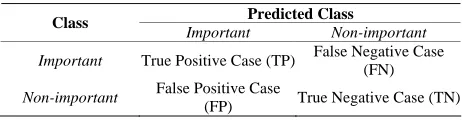
To evaluate our solution and verify its efficacy, we cre- ated a contingency table, named confusion matrix. The inputs of this table correspond to considered classes, knowing that these values are given after applying the classification function to the training set. As the training set is a binary set, we obtain Table 1 elaborated in func- tion of the two classes to be determined: important and non-important.
When the process of classification is finished, we identify four categories of sentences among all those analyzed:
TP: if the function predicts correctly a sentence la- beled as important;
TN: if the function predicts correctly a sentence la- beled as non-important;
FP: if the function predicts incorrectly a sentence la-beled as important;
FN: if the function predicts incorrectly a sentence la-beled as non-important.
We used the information given by Table 1 to obtain the values of three evaluation indicators known in auto- matic summarization, that are recall, precision and F- score, as well as ROC curves (Receiver Operation Char- acteristic) [15].
Recall (R) is the number of predictions TP divided by the true number of positive instances classified as posi- tives [6]. It informs about the capability of the classifica- tion function to identify a sentence as important when it is really important. The following formula enables to compute recall:
TP R
TP + FN
[image:3.595.308.539.656.716.2]Precision (P) corresponds to the number of predictions TP divided by the total number of instances classified as
Table 1. Confusion matrix used to evaluate efficacy.
Predicted Class Class
Important Non-important
Important True Positive Case (TP) False Negative Case (FN)
positives [6]. This indicator informs about the capability of the function to classify correctly a sentence according to all the sentences added to this category. It is computed with the following formula:
TP P
TP FP
Fscore corresponds to a harmonic average of recall and precision [6] and it is defined by:
R P 2
R P score
F
We also represented our results by using ROC curves. These graphs enable to represent all the pairs of values TPR (True Positive Rate) or sensitivity and FPR (False Positive Rate) or 1-specificity, resulting of a continuous variation of the observation points in the whole row of observed results [15]. By simple observation of these graphs, we obtain a qualitative comparison. When we apply each model to be evaluated on the training set, the curve placed on the top and to the left has the greatest accuracy. Likewise, the area under the curve indicates the success probability of the model by identifying a sentence as important. The ROC curves then give indica- tions on the accuracy of the classification model, as well as a unified criterion in the evaluation process. The men- tioned values are obtained by the following formulas:
TP sensitivy(TPR)
TP FN
TN
specificity(TNR) 1 FPR TN TP
FPR 1 specificity
FP FPR
FP TN
Recall, Precision and Fscore as well as ROC curves al-lowed us to evaluate the improvement rates obtained by our solution
3.
Experiment and Results
The experiment is conducted on a set of documents from Reuters Corpus [16], a news database that contains ap- proximately 11000 documents, classified into 90 currents events subjects and grouped into two sets, respectively named training and test. Each document contains on av- erage 120 words and 15 sentences. We chose a total number of 2000 documents for our experiment.
For the extraction of ontological knowledge, we used WordNet database [17], developed by Princeton univer- sity. This is a database oriented semantically with a very rich frame, greatly used in computational linguistic. It is
composed of words related to names, verbs, adjectives and adverbs. Words are organized into sets of synonyms named synsets, related by semantic relations of hy- pernym, hyponym, meronymy and holonomy. WordNet database thus contains 155287 words and 117659 syn- sets.
We also chose four machine learning algorithms greatly used. The first algorithm is named Support Vec- tor Machine [18]. It builds a hyper-plane in an n-dimen- sions space to classification, regression or other tasks. Intuitively, a good separation between classes is obtained when a hyper-plane has the greatest distance for all the nearest points of the training set. The second algorithm is a probabilistic classifier based on Bayes’ theorem, Baye- sian Classifier or Naïve Bayes[9], but with a great inde-pendence hypothesis. In other words, it assumes that the presence or absence of a characteristic is not related to the presence or absence of another characteristic. The third algorithm, Random Tree [19], realizes its classifica- tion by building a tree in which the total number of se- lected nodes is randomly chosen while being equal to:
2
log (attribute number 1)
Finally, the fourth algorithm is Multilayer Perceptron [20]. This is an artificial neuronal network with many layers. The activation function of each neuron is not lin- ear. This neuronal network can be used to identify line- arly inseparable classes. The function is learned from multilayers that are totally connected to each other.
The experiment conducted is composed of two parts. In the first part, we produced summaries by extraction from the chosen corpus without inserting ontological knowledge to the machine learning algorithm. We evalu- ated the obtained results for each algorithm in function of the evaluation methods given. In the second part, we produced summaries from the same corpus, this way by inserting ontological knowledge. We also evaluated the results obtained. By following, we present these results and discuss them.
3.1.Results for Recall, Precision and Fscore
We used methods of random subsampling (1/3 for the test set and 2/3 for the training set) and cross-validation (10 crossings). We also based on Tanagra software of Lyon University [21], Weka software of Waikato Uni- versity [22] and Orange software of Ljubljana University [23]. The two methods used gave similar results.
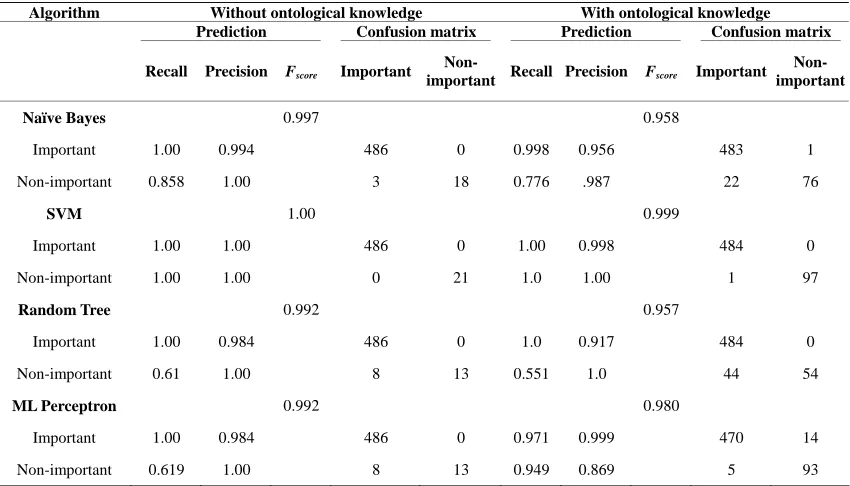
Tables 2 and 3 present the values of recall, precision and Fscoreas well as the confusion matrix for each of the four algorithms evaluated. In Table 2, the algorithms were applied to the training set obtained from principal
Table 2. Predictions and confusion matrix with principal components.
Algorithm Without ontological knowledge With ontological knowledge
Prediction Confusion matrix Prediction Confusion matrix
Recall Precision Fscore Important ImportantNon- Recall Precision Fscore Important importantNon-
Naïve Bayes 0.993 0.978
Important 1.00 0.986 488 0 0.994 0.964 480 18
Non-important 0.837 1.00 7 36 0.818 0.964 18 81
SVM 1.00 0.999
Important 1.00 1.00 488 0 1.00 0.998 483 0
Non-important 1.00 1.00 0 43 0.999 1.00 1 98
Random Tree 0.982 0.9521
Important 1.00 0.972 488 0 0.988 0.919 472 6
Non-important 0.674 1.00 14 29 0.579 0.905 42 57
ML Perceptron 0.993 0.983
Important 0.998 0.988 487 1 0.992 0.974 479 4
Non-important 0.861 0.974 6 37 0.869 0.956 13 86
Table 3. Predictions and confusion matrix with singular values.
Algorithm Without ontological knowledge With ontological knowledge
Prediction Confusion matrix Prediction Confusion matrix
Recall Precision Fscore Important
Non-
important Recall Precision Fscore Important
Non- important
Naïve Bayes 0.997 0.958
Important 1.00 0.994 486 0 0.998 0.956 483 1
Non-important 0.858 1.00 3 18 0.776 .987 22 76
SVM 1.00 0.999
Important 1.00 1.00 486 0 1.00 0.998 484 0
Non-important 1.00 1.00 0 21 1.0 1.00 1 97
Random Tree 0.992 0.957
Important 1.00 0.984 486 0 1.0 0.917 484 0
Non-important 0.61 1.00 8 13 0.551 1.0 44 54
ML Perceptron 0.992 0.980
Important 1.00 0.984 486 0 0.971 0.999 470 14
Non-important 0.619 1.00 8 13 0.949 0.869 5 93
training set was obtained from singular values. The val- ues are given for each part of the experiment, i.e. before inserting ontological knowledge and after inserting it.
By observing Tables 2 and 3, we note that perform-ances in terms of recall and precision are high. Naïve Bayes algorithm presents the greatest performance in the case of using principal components. Its performance is followed by the two other algorithms Support Vector
[image:5.595.86.511.372.615.2]Support Vector Machine algorithm continues to occupy the first place. The performance of MultiLayer Percep- tron algorithm is improved at the expense of those of Naïve Bayes algorithm.
3.2.Results for ROC Curves
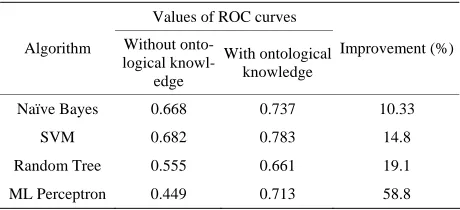
[image:6.595.57.287.483.588.2]In Table 4, we observe the AUC values (Area Under Curve) of each ROC curves, for each algorithm applied at a training set obtained from principal components. The results are given before and after inserting ontological knowledge. The last column indicates the relative im- provement obtained.
Table 5 gives the same values, but this way by con- sidering that the training set is obtained from singular values.
From the joint observation of Tables 4 and 5, we can say that the introduction of ontological knowledge in the training set, obtained using principal components or sin- gular values, increases the quality of all algorithms. For instance, we note an improvement of 58.8% and 19.1% for respectively MultiLayer Perceptron and Random Tree algorithms when using principal components. Sup- port Vector Machine and Naïve Bayes algorithms are improved of 14.8% and 10.33% respectively, when using singular values. The algorithm with the best performance is Support Vector Machine followed by Naïve Bayes, when using principal components. In the case of singular values are used, we also observe a very great improve- ment of the algorithm quality when the ontological knowledge is inserted. MultiLayer Perceptron algorithm obtains again the highest value with 27%. Support Vector
Table 4. Improvement when using principal components.
Values of ROC curves
Algorithm Without onto-logical
knowl-edge
With ontological knowledge
Improvement (%)
Naïve Bayes 0.668 0.737 10.33
SVM 0.682 0.783 14.8
Random Tree 0.555 0.661 19.1
[image:6.595.57.284.615.720.2]ML Perceptron 0.449 0.713 58.8
Table 5. Improvement when using singular values.
Values of ROC curves
Algorithm Without onto-logical
knowl-edge
With ontological knowledge
Improvement (%)
Naïve Bayes 0.683 0.820 20.06
SVM 0.673 0.811 20.51
Random Tree 0.697 0.740 6.17
ML Perceptron 0.589 0.748 26.99
Machine and Naïve Bayes algorithms occupy respect- tively the second and the third places with 20.5% and 20.1%. The best quality algorithm is Naïve Bayes fol- lowed by Support Vector Machine.
Table 6 shows a comparison of AUC values of each algorithm after inserting ontological knowledge, de- pending on whether the training sets are obtained from principal components or singular values.
Table 6 enables to estimate the difference of im- provement between a space based on principal compo- nents and another based on singular values. First, we observe that all algorithms studied improve their qualita- tive performance moving from a space of principal com- ponents to another of singular values. The greatest im- provement is obtained by Random Tree algorithm with 12% followed by Naïve Bayes with 11.3%. From this table, we also conclude that the two best algorithms and the most promising to extract summaries with spaces ontologically reinforced, among the four ones studied, are Naïve Bayes and Support Vector Machine.
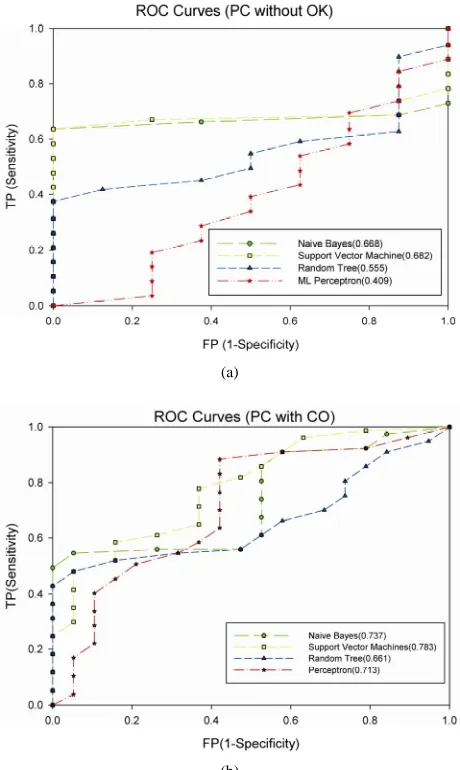
Figures 1 and 2 correspond to ROC curves obtained for each algorithm with training sets produced from principal components and singular values. In these two cases, the results are given without inserting ontological knowledge (1a), and with inserting ontological knowl- edge (1b).
As we already mentioned, the ROC curves offer a way of evaluating the quality of a classification algorithm in function of its capability to give good predictions. In our case, a good prediction corresponds to sentences classi- fied as important, that should take part of summary, and discriminated to non-important sentences.
In addition to the information obtained by Tables 4-6, careful observation of figures enables to identify the op-timum points of each algorithm, simply by placing the point at the highest position to the left. We also compare the accuracy between algorithms. For instance, if we want to compare Support Vector Machine algorithm when it reaches a little more than 90% of TP cases face to Random Tree algorithm then we see on the Figure 2(b) that Support Vector Machine algorithm has an appro- Table 6. Difference of improvement between using princi-pal components and using singular values.
Values of ROC curves Algorithm Principal
mponent
co s
Singular values
Improvement (%)
Naïve Bayes 0.737 0.820 11.30
SVM 0.783 0.811 3.60
Random Tree 0.697 0.740 12.00
[image:6.595.310.537.624.720.2](a)
(b)
Figure 1. (a) Principal components before inserting onto-logical knowledge; (b) Principal components after inserting ontological knowledge.
ximate FP rate of 37% and Random Tree algorithm has a rate of 70%.
The obtained results show a significantly improvement to the classification function after inserting ontological knowledge, whatever the machine learning algorithm used. More, these results give the two best algorithms. The Naïve Bayes and Support Vector Machine algo- rithms should be then applied to automatic summariza- tion with a training set produced from singular values and reinforced by ontological knowledge.
4.
Conclusions
There are still great opportunities for deepening and de- velopment research to find suitable methods for summa- rizing. In this paper, we studied the behaviour of four machine learning algorithms that induce classification
(a)
(b)
Figure 2. (a) Singular values before inserting ontological knowledge; (b) Singular values after inserting ontological knowledge.
[image:7.595.57.287.86.471.2] [image:7.595.308.539.89.481.2]tween important and non-important. The sentences dis- criminated as important constitute the future summary. Likewise, we observe that ontological knowledge pro- duces more great effects on the classifier quality, if the training set is obtained from singular values rather than from principal components. From this final analysis, we conclude that the two best algorithms that should be ap- plied to automatic summarization by extraction are Naïve Bayes and Support Vector Machine, from a set of singu- lar values reinforced by ontological knowledge.
As future work, we think that it would be interesting to evaluate the performance of classification algorithms on more reduced spaces, i.e. optimized by means of tech- niques different to those used in this experimentation. It would be also interesting to explore their behaviour on sets reinforced by ontological knowledge.
5.
Acknowledgements
The authors would thank Natural Sciences and Engi- neering Research Council of Canada (NSERC) for its financial support.
6.
References
[1] A. Sharan and H. Imran, “Machine Learning Approach for Automatic Document Summarization,” Proceedings of World Academy of Science, Engineering and Techno- logy, 2009, pp. 103-109.
[2] R. A. García-Hernandez, R. Montiel, Y. Ledeneva, E. Rendón, A. Gelbukh and R. Cruz, “Text Summarization by Sentence Extraction Using Unsupervised Learning,” Proceedings of the 7th Mexican International Conference on Artificial Intelligence: Advances in Artificial Intelli- gence, 2008, pp. 133-143.
[3] I. Mani and E. Bloedorn, “Machine Learning of Generic and User-Focused-Summarization,” Proceedings of the Tenth Conference on Innovative Applications of Artificial Intelligence, Menlo Park, 1998, pp. 821-826.
[4] J. Goldstein, “Evaluating and generating summaries using normalized probabilities,” Proceedings of the 22ndAnnual International ACM SIGIR Conference on Research and Development in Information Retrieval, New York, 1999, pp. 121-128. doi:10.1145/312624.312665
[5] K. S. Jones, “Automatic Summarising: The State of Art,” Information Processing and Management, Vol. 43, No. 6, 2007, pp. 1449-1481. doi:10.1016/j.ipm.2007.03.009
[6] R. R. Korfhage, “Information Storage and Retrieval,” Wiley, New York, 1997.
[7] L. Hennig, W. Umbrath and R. Wetzker, “An Ontology- Based Approach to Text Summarization,” IEEE/WIC /ACM Proceedings of the International Conference on Web Intelligence and Intelligent Agent TechnologyWork- shops, 2008, pp. 291-294.
[8] R. Bellman, “Introduction to Matrix Analysis,” McGraw- Hill, New York, 1997.
[9] M. Steinbach, “Introduction to Data Mining”, Pearson Education, Boston, 2006.
[10] M. Ikonomakis, S. Kotsiantis and V. Tampakas, “Text Classification Using Machine Learning Techniques,” Proceedings of the 9th WSEAS International Conference on Computers, Stevens Point, 2005, pp. 966-974.
[11] I. Mani, “Recent Development in Text Summarization,” Proceedings of the Tenth International Conference on Information and Knowledge Management, McLean, 2001, pp. 529-531.
[12] H. Xuexian, “Accuracy Improvement of Automatic Text Classification Based in Feature Transformation and Mul- ti-classifier Combination,” Proceedings of AWCC’2004, Zhenjiang, 2004, pp. 463-464.
[13] G. Salton and C. Buckley, “Term-Weighting Approaches in Automatic Text Retrieval,” Information Processing and Management, Vol. 24, No. 5, 1988, pp. 513-523. doi:10.1016/0306-4573(88)90021-0
[14] G. H. Golub, “Calculing the Singular Values and Pseudo- Inverse of a Matrix,” Journal of the Society for Industrial
and Applied Mathematics, Vol. 2, No. 2, 1965, pp.
205-224. doi:10.1137/0702016
[15] T. A. Lasko, J. G. Bhagwat, K. H. Zou and L. Ohno- Machado, “The Use of Receiver Operating Characteristic Curves in Biomedical Informatics,” Journal of Biomedi-cal Informatics, Vol. 38, No. 5, 2005, pp. 404-415. doi:10.1016/j.jbi.2005.02.008
[16] A. Saleh, “Reuters Corpus (Offered by Reuters News Agency),” 2004.
http://about.reuters.com/researchandstandards/corpus/
[17] C. D. Fellbaum, “WordNet (A Lexical Database for Eng-lish),” Princeton University, 1985.
http://wordnet.princeton.edu//
[18] V. Vapnik, “The Nature of Statistical Learning Theory,” Springer-Verlag, New York, 1995.
[19] R. Bellman, “Algorithms, Graphs and Computers”, Aca-demic Press, New York, 1970.
[20] F. Rosenblatt, “Principles of Neurodynamics: Perceptrons and the Theory of Brain Mechanisms,” Spartan Books, Washington DC, 1961.
[21] R. Rakotomalala, “Tanagra: Un Logiciel Gratuit Pour L’enseignement et la Recherche,” Proceedings of the EGC’2005 Conference, Amsterdam, 2005, pp. 697-702.
[22] G. Holmes, A. Donkin and I. H. Witten, “Weka (A Soft-ware Developed by Machine Learning Group),” Univer-sty of Waikato, 1994.
http://www.cs.waikato.ac.nz/ml/weka/