Techniques of Transmitting Beamforming to Control the
Generated Weights
Imen Sfaihi1,2, Noureddine Hamdi2, Ammar Bouallegue2
1The National school of engineering of Tunis (ENIT), El-Manar University, Tunis, Tunisia 2The communication System Laboratory (SysCom Lab) in ENIT, Tunis, Tunisia E-mail: [email protected],{Noureddine.Hamdi, ammar.bouallegue}@enit.rnu.tn
Received April 16, 2010; revised May 25, 2010; accepted June 29, 2010
Abstract
In this paper, we consider the limited feedback Transmitting Beamforming for (multiple in single out) MISO systems. In conventional techniques, all vectors of a large codebook (CB), used for the feedback of the quan-tized channel state information (CSI), are broadcasted to all users, in a guard period which is followed by data burst periods. Instead of transmitting a large number of codevectors, we thought to divide the CB into several sub-codebooks (SC) and the broadcast would be based on the switch between them. Accordingly, a good performance can be provided while minimizing the required feedback channel capacity applying some proposed techniques such as “the switched Sub Codebook (SSC)” and “the Fairness SSC (FSSC)”. To mini-mize the quantization error, we propose two other techniques. The first is based on making Transmit SSC vectors controlled by a rotation weight (RW) to obtain almost a zero correlation between the SSC vectors used for the selected spatial channels. The second is based on introducing “the Schmidt algorithm” to con-struct an orthonormal weights using the generated weights. These two proposed techniques increase the probability of the selection of the worst case user on his best codevector to make zero the angle between his couple codevector and channel response. To analyze and validate the performance of these proposed tech-niques, simulation results are presented.
Keywords:MISO, Beamforming, Limited Feedback, CSI, SSC, FSSC, RW-FSSC, SSC-Schmidt Algorithm
1. Introduction
In the last few years, Multiuser MISO systems also named as (Space Division Multiple Access) SDMA based on Limited Feedback Transmitting Opportunistic Beamform-ing (OBF) have been a lot of interests in recent research studies. The goal is to provide high system spectral effi-ciency [1] while reducing the complexity. Due to the con-straint of narrowband of the feedback channel, transmitting OBF on the broadcast channel with limited feedback has been widely studied in the literature as [2-4] and references therein.
Moreover, transmitting OBF is provided in the literature as a more practical design that ameliorates the performance of SDMA [5] and [6]. Each user selects the correspondent beamformer from the Beamforming CB. Therefore, we found many techniques to formulate the Beamforming CB vectors, for example: random orthonormal beamforming CB as proposed in [7-9] or transmitting beamforming
based on grassmannian line packing as described in [10] and [11].
This SDMA design can be combined with multiuser scheduling [5] and [6]. Therefore BS uses an algorithm to select the best pair index of user-CB vector that increases the system capacity such as: Max-rate [4] or sub-optimal algorithms as proposed in [12] where a selection is based on the best pair of user-beam vectors. In [13], an algorithm is proposed, known as semi-orthogonal user selection scheme. This algorithm is based on upper bounded tech-niques where the value of the SINR and the value of the error quantization are compared to predefined thresholds which are defined in [2-4].
Up to the moment, the generated CB vectors are trans-mitted to all users and then select the best pair CB vec-tor-user. After investigating these studies, we thought to reduce the complexity by introducing new techniques based on a score that measure frequency of access by using vectors in SC. Moreover, the second formulation of OBF CB vectors named Grassmanian method is the most
tical and near to the reality but the components of the OBF CB vectors are with non zero correlation. Consequently, the correlation between OBF CB vectors and the selected user channel is not null. Then, the interference level would be increased and then the system throughput decreases. Therefore, we thought to minimize the probability to make errors.
In this paper, we propose four new techniques of trans-mitting OBF at which the first technique is based on SSC applied to the Max-Rate scheduler with limited feedback system. The components of CB composed by N = 2B
vec-tors would be divided into nD SC. In [2-4], the N
compo-nents of the CB vectors are transmitted to all users at each time slot. This number is reduced in this proposal to N/nD
components of the CB that would be transmitted to all us-ers. Then, we minimize the complexity and respect the bandwidth of the feedback channel.
Besides, for the goal of providing fairness among users, we propose the second technique that is based on fairness SSC (FSSC). This proposal is the continuity of the SSC technique when we investigate and improve the SSC by introducing the proportional fair principle (PF) to switch the specific SC.
Moreover, we intend to meet the performance of the FSSC and to reduce the interference level at user receivers. Whereby, the correlation between OBF CB vectors is compared to predefined thresholds to make the specific rotation that minimize this correlation. Then, we put the threshold to a given value and at each transmission the value of correlation is controlled and compared to this threshold.
After this, we thought to use from the beginning an or-thonormal weights in transmitting OBF in order to reduce the interference level at user receivers. Whereby, the cor-relation between OBF CB vectors is converge to zeros by applying the Schmidt algorithm and construct the new or-thonormal OBF weights that give a zeros correlation be-tween the generated OBF CB vectors.
The remainder of this paper is organized as follows. Sec-tion 2 describes the system and channel models. In SecSec-tion 3, we present an overview of the design of different CB proposed in the literature. In section 4, we present an over-view of the CSI quantization. In section 5, we describe the different steps of the proposed techniques of transmitting OBF: SSC, FSSC, RW-FSSC and SSC-Schmidt algorithm. In section 6, we present the Max-Rate scheduler. In section 7, we analyze the system capacity of the proposed tech-niques and give the closed form of capacity. In section 8, we present a selection of simulation results.
2. System Model
We consider a MISO system with Mt antennas at the base
station (BS) and K users when each is equipped with one receive antenna. Each user has her own rate βk. It is
as-sumed that slow power control is employed to equally share the total transmitted power Pt on all transmit
an-tennas at the BS. Users symbols are loaded on transmit antennas using Beamforming, i.e. the BS assigns a Beamforming vector to each of up to Mt selected active
users.
The Beamforming vectors
M1ti i
W are obtained using a generated orthogonal unitary beamforming vectors as defined in [7-9] or using grassmannian line packing codebook as described in [2-4]. To solve the problem of limited resources allocated to the feedback channel, users estimate their CSI and feedback them in a quantized form on B bits to the BS through an uplink limited ca-pacity feedback (LCFB) channel. We denote by N = 2B
the number of CB vectors which is defined by
1, 2,..., N
CB W W W . At each time slot, the number of components that would be used in optimal side of the transmission is equal to the number of transmit antennas Mt.
It is assumed that transmit signals experience path loss, log-normal shadow fading, and multi-path fading. The CSI is measured by the vectors which represent the short term fading CSI on all branches from the BS to the kth
user assumed to be constant during a time slot. Accord-ing to the slow power control, 1) each entry of the vector hk is an independent and identically distributed complex
Gaussian random variable CN(0; 1) representing the short term fading; 2) the CSI experiences flat fading during each time slot, and varies independently over time slots.
We denote by hk(t) the channel vectors, Wi(t)
the
1
t
M
1
t
M CB, s(t) the transmitted symbol, nk(t)
the additive white Gaussian noise (AWGN) vector with distribution CN(0; N0/2) for each element, and yk(t) the
received signal. Then, the received signal for the consid-ered multi-user MISO system in the time slot t is repre-sented by
1
t
M
1
( ) t ( ) ( ) ( ) ( )
M H t
k k i i
i t
P
y t h t W t s t n t
M
k (1) According to Equation (1), the received signal for user k when using the Wi CB vector can be:,
1.. ,
( )
t
H H
t t
k i k i i k j j k
j M j i
t t
P P
y t h W s h W s n
M M
(2)Hence, the corresponding expression of the signal to interference plus noise ratio SINR for the kth user and the ith CB vector is expressed as follows:
2
, 2
1.. t,
H k i k i
H t
k j
j M j i t
h w SINR
M h w
P
2.1. The Statistical Distribution of the Signal to Interference Plus Noise Ratio
To simplify the Equation (3), we let H 2 i k i a h w ; i = 1, …, Mt. The SINR on the ith CB vector for user k given
in the Equation (3) can be rewritten as
,
1.. t,
i k i
t j j M j i t
a SINR M a P
(4) Consequently,, 1
1 1
t
i k i i M
t
m m
m m i t
a SINR M a a P
(5) Then, , i k i t i i t a SINR M b c P (6)where 1 and .
1
i
i m
m
b a
1 t M i m m i c a
Although, the random variables ai are of independent
2
distribution with two degrees of freedom. Note that the with different k are independent. Then the cumulative distribution function (CDF) of the largest SINR for user k denoted can be calculated in terms of the joint probability density function (PDF) of the largest one of Mt i.i.d
, k i SINR , k i SINR 2
random variables, denoted by fb a ci, ,i i
x y z, ,
, as [14]
,
1
0 0 0
, , , ,
t
t tk i
i i i
M i w x M z w P i
SINR
b a c
F x
f w y z dydzdw
(7)
After taking derivative with respect to x, the PDF of is given by
i k SINR ,
, / 1 0 0 , , , ,
t k ii i i
M i w i SINR
t b a c
t
F x
M
f w x P z w z dzdw
(8)
It was further shown in [14] that the joint PDF
, , , ,
i i i
b a c
f x y z is available in closed form, after some modifications as given by
2 , , 1 0 1 1 , ,1 2 ! 1 !
1
1
0; 1 ; .
i i i
t
t
i t
b a c t
t w y z
M i
j M i
t
j
t
w i y
M
f x y z M
i i M i
e U w i y
M i
z jy U z jy
j
y w i y z M i y
where U(.) denoted the Heaviside unit step function.
Remark:
If the largest SINR of the user k is the first component of the CB vectors then i = 1and the correspondent CDF is as given in [15]
,1 0 0 1, ,
t tk
M x P z
SINR a b
F x f y z dydz (10)
And
,1 0 0 1, ,
k t tSINR a b
t t
M M
f x P z f x P z z dz
(11) It was further shown in [15] that the joint PDF is avail-able in closed form, as given by
1, 1 2 0 , 2 ! 1 1 t t y z t a b t M j M t j Mf y z e
M M
z jy U z jy
j
(12)After replacing this expression in (24), the PDF of the largest SINR of the user k (SINRk,1) can be written as
,1 1 0 0 2 1 11 ! !
1 1 t k t t t M
t t t
SINR
j t t
M M
x z x P t
t
t
t
M M M
f x z
M j j P
M
jx z jx e
P M
U jx z jx dz
P
(13)3. Conventional Codebook Design
,
(9)According to the considered system model, we can give a description of the CB vectors design. At each time slot, Mt symbols of users are multiplied by Mt random
or-thonormal vectors wi Mt1 for i = 1, ..., Mt. Where wi’s are generated according to an isotropic distribution
[9] and [10] or are computed according to formulation described in [7]. This random orthonormal vectors are used to define a random CB. This CB vectors are gener-ated with zero correlation which is near to the reality since it require that the chanal is known at both transmit-ter and receiver.
4. CSI Quantization
Due to constraint of the bandwidth of feedback channel, each user just feeds back its maximum SINR quantized in B bits and the index of the corresponding codebook vec-tor. In [2] and [3], the random vector quantization (RVQ) method is applied for quantizing the CSI. The CB vec-tors
M1ti i
W are obtained using a generated orthogonal unitary beamforming vectors as defined in [7-9] or using grassmannian line packing codebook as described in [2-4,12]. At each time slot, each user identified by k se-lect his 'best' vector from the CB. For that, a quantization CB vector is selected as:
1
arg max
Mt j j
H
s k
W
i h Wj (14)
The quantization error is expressed as:
2
sin W His,
(15)In the literature, it is often assumed for simplicity that the feedback is without errors. Then, the quantization error δ should be converges to zero.
5. The Proposed Techniques of
Transmitting OBF
5.1. Design of SSC
For transmitting OBF, the CB vectors are used randomly such as in [2-4]. At each time slot, all of N components of CB are transmitted to all users. This is clearer in the previous step of quantization of CSI. Therefore, we pro-pose an idea that based on dividing the N components of CB vectors into nD SC to minimize the number of
com-ponents to be transmitted to all users at each time slot. Then, we define how to switch to a given SC at each time slot to increase the system capacity and give equal opportunity among users to the channel accesses. The switching is based by investigating user scores based on the historic use of each SC at a number of previous time slots. This would provide fairness among users.
The switching step is defined as follow:
1) The initialized matrix (Score zeros K n ( , D)) is updated at each time slot and would be used in the fol-lowing time slot:
( , )s s ( , ) 1s s
Score k i Score k i (16)
where ks is the index of each user among the Mt served
users and is is the index of each CB vector among the Mt
selected CB vectors of the SSC satisfying Equation (14). 2) At each time slot, we search the index of the user that has the worst capacity to give fairness among users
* min k
k C (17) 3) After, we search the index of the switched SC vec-tor that satisfies the following expression
* max ,
i
i Score k* i (18)
4) Finally, we update the matrix of Scores and com-pute the system capacity.
The most obvious benefit is to take consideration of the historic use of the CB vectors that will be represented by a score based on the user access frequency.
5.2. Design of FSSC
5.2.1. Fairness Criteria
In SSC, the idea to give fairness is derived and the se-lected score is that has the user with the worst capacity
min
k K C . If we apply this, we can assume that the
number of users to have the worst capacity can be large. Then, the selected user is chosen randomly and the same user can be chosen many times. Therefore, in our pro-posal design, the most obvious goal is to give fairness among users. And accordingly, we thought to an idea in basis on max-min schedulers introduced in previous work such as proportional fairness in [7] when all users have the equal chance to be served.
Now, we can suppose that each user has her own rate
βkand we propose in this technique to select the index of
the SC that has the minimum of the user’s capacity’s divided by the proportional componentkwhen kis expressed in the following sub section in (20). Then, we can assume that to select user with using
should be given most chance to users who can be served at the following time slot. Accordingly, the probability to choose the same user many times is minimized and this probability converges to zero. Moreover and according to the most aim of our proposal, we can talk about the index of Jain for fairness defined in [16] and expressed as follows
k/k
mi k Kn C
2
1 2
1
( )
( )
K k k
K k k
C t j
K C t
(19)
where is the system capacity of kth user and K is
the total number of users. We are going to present and to discuss this term in the simulation results to validate our scheme and their results.
( )
k
C t
5.2.2. FSSC Algorithm
a) Let βk the rate of user k.
b) Let the proportional components k as
1 k
K k
i i
(20)c) The score matrix is defined in the previous subsec-tion.
2) The Score matrix is updated at each time slot and should be used in the following time slot (the same in (16)).
3) At each time slot, we search the index of the user that has the worst of the capacity divided by αk to give
fairness among users
* min k
k K k
C k
(21)
4) After, we search the index of the fairness switched SC vector that satisfies the following expression
* max ,
i
i Score k*i (22)
5) Finally, we update the matrix of Scores and com-pute the system capacity.
The most obvious benefit is the use of an access con-trol based on PF constraint to provide the fairness access channel among users.
5.3. Design of RW-FSSC
In the literature, it is often assumed for simplicity that the feedback is without errors. Then, the quantization error expressed in (15) should converge to zero i-e the prob-ability to make errors should be converge to zero. But in reality, the use of grassmanian method to generate the OBF CB vectors when the components of OBF CB vec-tors are with not zero correlation should be make errors. Consequently, the correlation between OBF CB vectors using to select the user channel is not null. Therefore, we thought to control this value, compared with the value of threshold and make the rotation weight (RW).
The RW is consisting of the applying a rotation on the best codevector to make zero the angle between the cou-ple codevector and channel response. Then, the RW in-creases the probability of the selection of the worst case user and if this user is selected he would be assigned the best possible symbol rate.
The RW is consisting of three cases at which the value of the angle between the couple codevector and channel response defined as θ is compared with a specific values of thresholds that described as follows:
1) Let θmax the threshold: it is the maximum angle
be-tween the couple codevector and channel response and Wr the OBF codebook vectors after rotation.
2) Let
W Hi,
3) if max
4
Then Wr Wi
4) else if max max
4
Then
' exp max
2
r i
W W j
5) else if max
max
4
Then
' exp max
2
r i
W W j
6) else if max Then SNR = 0
5.4. Design of the Method that Introduce the Schmidt Algorithm
5.4.1. Schmidt Algorithm
Theorem: (Process of Gram-Schmidt)
Let {a1, ..., aN} a family of vectors linearly
independ-ent.
Then it exists a family of orthonormal vectors {q1, ..., qN}when for all i = {1, ..., N}, we have
V ect {a1, ..., ai} = V ect {q1, ..., qi}.
According to the process of Gram-Schmidt and to the SSC technique, we thought to introduce the Schmidt al-gorithm to construct a new orthonormal OBF CB vectors using the generated OBF CB vectors using one of the conventional CB designs and that used in the following step to select the user channel.
5.4.2. Steps of this Proposal Technique
On the first hand, we use one of the conventional CB design such as random orthonormal CB that have an iso-tropic distribution or the grassmanian method.
1) We denote by
Wi iN1 the generated OBF CB vec-tors2) We apply the Schmidt algorithm and we obtain the new orthonormal OBF CB vectors W1
And after, we use this new orthonormal OBF CB vec-tors W1 to quantize the CSI and use the SSC transmit
technique.
6. Max-Rate Scheduling
To maximize the system capacity, the technique of scheduling to share resources among active users is stu-died and applied. In this section, we describe the main idea of the Max-rate scheduling to select users. Accord-ingly, the selected Mt users to be served at each time slot
experiences peak level signal to interference plus noise ratio (SINR) expressed in (3). This can be expressed as:
,arg max
s
s k
k SINRk i (23)
where is is the index of the CB vectors selecting with the
R
k
correspondent time slot. We use the Max-rate scheduling because it gives the optimal performance and the aim is to investigate the resources with the most efficiently.
7. Capacity Analysis
According to the step of [14], the exact sum capacity expression for such scheme under consideration can be written as
2
0 log 1 ( )
t
SINC M x f x dx (24)
Based on the mode of assignment of one of the pro-posed techniques, we can assume that the largest SINR of different users are i.i.d and the correspondent PDF is given by
,1 ,1
1
( ) k ( )K ( )
SINR SINR SINR
f x KF x f x (25)
where and are the CDF and the PDF of the largest SINR for a particular user, given in (11) and (24) respectively. Then, the capacity can be written as
,1
k
SINR
F fSINRk,1
,1 ,11 2
0 log 1 ( ) ( )
k K kt SINR SINR
C M x KF x f x dx (26)
8. Simulation Results
In this section, the performances of the Max-rate sched-uler with limited feedback are evaluated using the SSC, FSSC, the RW-FSSC and SSC-Schmidt algorithm to control the generated CB (for grassmannian CB vectors) [8] in terms of system capacity. The number of active users K used for these simulations varies from 1 to 30; the number of SC nD is equal to 2, the time moving
win-dow T is of 200 and the feedback bits B is of 3.
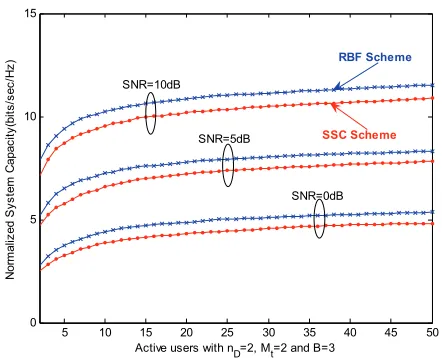
[image:6.595.312.533.78.257.2] [image:6.595.313.534.301.476.2]In Figure 1, we compare the sum capacity perform-ances of the “SSC” and the RBF techniques (random Max-rate scheme with LF such as in [2-5]).
Figure 2 illustrates the performance of the FSSC de-sign in terms of system capacity. These results are com-pared to the SSC technique.
Figure 3 plots the index of jain for fairness of these two techniques versus the number of active users K when the value of SNR = 20 dB. This figure shows the fairness degree of the capacity in FSSC and SSC techniques. We can conclude that FSSC and SSC provide respectively a quasi optimal (~1) and near optimal fair degree. This is explained by the number of users that have the same worst capacity can increase with the number of users.
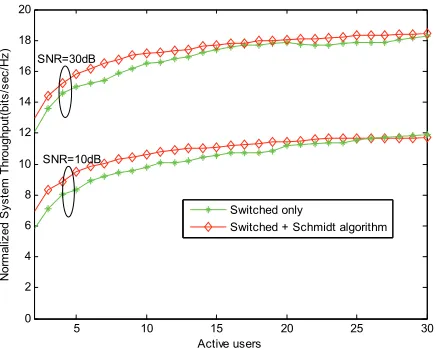
Figure 4 shows the performance of the RW-FSSC in terms of system capacity. These results are compared to the FSSC technique. Figure 5 shows the simulation re-sults of the system capacity of the SSC applying the Schmidt algorithm and SSC versus the number of active users.
In Figures 1, 2, 4 and 5, the simulation results of the
5 10 15 20 25 30 35 40 45 50
0 5 10 15
Active users with nD=2, Mt=2 and B=3
N
or
m
al
iz
ed
S
ys
tem
C
apac
ity
(bi
ts
/s
ec
/H
z)
SNR=10dB
SNR=5dB
SNR=0dB
RBF Scheme
SSC Scheme
Figure 1. System capacity of the SSC and OBF techniques vs. number of active users.
5 10 15 20 25 30
0 2 4 6 8 10 12 14 16 18 20
Active users with Mt=2, B=3 and nD=2
N
or
m
al
ize
d C
ap
aci
ty S
ys
te
m
(b
its/
se
c/
H
z)
SSC scheme
FSSC scheme
SNR=20dB
SNR=10dB
SNR=0dB
Figure 2. System capacity of the FSSC technique vs. num-ber of active users.
5 10 15 20 25 30
0 0.2 0.4 0.6 0.8 1
Active users with Mt=2, B=3 and nD=2
in
de
x o
f ja
in
f
or
f
air
ne
ss
Fairness switched Sub-Codebook Switched Sub-codebook
[image:6.595.312.533.520.697.2]2 4 6 8 10 12 14 16 18 20 0
5 10 15 20
Active users
N
or
m
al
iz
ed S
ys
tem
T
hr
ou
ghp
ut
(bi
ts
/s
ec
/H
z)
SNR=20dB
SNR=10dB
SNR=0dB
Scheme with RW
[image:7.595.61.283.72.253.2]Scheme without RW
Figure 4. System capacity of RW-FSSC vs. number of ac-tive users with variation of the average SNR.
5 10 15 20 25 30
0 2 4 6 8 10 12 14 16 18 20
Active users
N
or
m
al
iz
ed S
ys
tem
T
hr
oug
hpu
t(
bi
ts
/s
ec
/H
z)
Switched only
Switched + Schmidt algorithm SNR=30dB
SNR=10dB
Figure 5. System capacity of SSC-Schmidt algorithm vs. number of active users with variation of the average SNR.
system capacity of the proposed techniques are plotted with different values of average SNR. Since, we can see that the system capacity applying the proposed tech-niques is nearly independent of the number of active us-ers K. As can be seen from these figures, the difference between the curves of the transmit techniques is very small. In addition to that, the results of the proposed techniques are in good concordance and the system ca-pacity grows as the average SNR increases.
9. Conclusions
The system capacity of limited feedback using OBF CB vectors and applying one of the new proposed techniques for Max-rate technique has been analyzed in this paper to deal with the performance of the coherent transmitting OBF. The transmit antenna are assigned to different up to Mt users at each time slot to increase system capacity.
According to the simulation results, we can conclude that the FSSC technique for Max-rate give fairness among users for a lot of number of users and a good performance. Moreover, we can conclude that the tech-niques to control the generated weights applied the FSSC for Max-rate minimize the probability to make error and give fairness among a number of users and a good per-formance while reducing the complexity of generating the OBF CB vectors as SSC technique. Accordingly, we can see that the system capacity can be improved using our proposed techniques.
1
0. References
[1] A. F. Molish, M. Z. Win and J. H. Winters, “Capacity of Mimo Systems with Antenna Selection,” IEEE Trans- action on Wirelless Communications, Vol. 4, No. 4, 2005, pp. 1752-1772.
[2] K. Huang, R. W. Heath and J. G. Andrews, “Performance of Orthogonal Beamforming for Sdma Systems with Limited Feedback,” IEEE Transaction on Vehicular Technology, Vol. 58, No. 1, 2009, pp. 152-164.
[3] S. Zhou, Z. Wang and G. B. Giannakis, “Quantifying the Power Loss When Transmit Beamforming Relies on Finite Rate Feedback,” IEEE Transaction on Wirelless Communications, Vol. 4, No. 4, 2005, pp. 1948-1957. [4] R. Agarwal, C.-S. Hwang and J. Cioffi, “Opportunistic
Feedback Protocol for Achieving Sum-Capacity of the Mimo Broadcast Channel,” Proceedings IEEE 66th Vehicular Technology Conference, Baltimore, MD, 2007, pp. 606-610.
[5] T. Kim, R. W. Heath and S. Choi, “Multiuser MIMO Downlink with Limited Feedback Using Transmit-Beam Matching,” IEEE International Conference on Com- munication, Beijing, May 19-23, 2008, pp. 3506-3510. [6] J. L. Vicario, R. Bosisio, C. Anton-Haro and U.
Spagnolini, “Beam Selection Strategies for Orthogonal Random Beamforming in Sparse Networks,” IEEE Trans- actions on Wireless Communications, Vol. 7, No. 9, 2008, pp. 3385-3396.
[7] P. Viswanath, D. N. C. Tse and R. Laroia, “Opportunistic Beamforming Using Dumb Antennas,” IEEE Transaction on Information Theory, Vol. 48, No. 6, 2002, pp. 1277- 1294.
[8] B. Hassibi and T. L. Marzetta, “Multiple Antennas and Isotropically Random Unitary Inputs: The Received Signal Density in Closed Form,” IEEE Transaction on Information Theory, Vol. 48, No. 6, 2002, pp. 1473-1484. [9] M. Sharif and B. Hassibi, “On the Capacity of Mimo
Broadcast Channels with Partial Side Information,” IEEE Transaction on Information Theory, Vol. 51, No. 2, 2005, pp. 506-522.
[image:7.595.62.283.291.466.2]Beamforming for Multiple-Input Multiple-Output Wireless Systems,” IEEE Transaction on Information Theory, Vol. 49, No. 10, 2003, pp. 2735-2747.
[11] B. Clercks, Y. Zhou and S. Kim, “Practical Codebook Design for Limited Feedback Spatial Multiplexing,”
IEEE International Conference on Communications, Beijing, May 19-23, 2008, pp. 3982-3987.
[12] M. Trivallato, F. Boccardi and F. Tosato, “User Selection Schemes for MIMO Broadcast Channels with Limited Feedback,” IEEE Transaction on Vehicular Technology Conference, Dublin, April 2007, pp. 2089-2093.
[13] T. Yoo, N. Jindal and A. Goldsmith, “Multi-Antenna Broadcast Channels with Limited Feedback and User Selection,” IEEE Journal on Selected Areas in Com-
munications, Vol. 25, No. 7, 2007, pp. 1478-1491. [14] H.-C. Yang, P. Lu, H.-K. Sung and Y.-C. Ko, “Exact
Sum-Rate Analysis of MIMO Broadcast Channels with Random Unitary Beamforming Based on Quantized SINR Feedback,” IEEE International Conference on Communications, Beijing, China, May 19-23, 2008, pp. 3669-3673.
[15] Y.-C. Ko, H.-C. Yang, S.-S. Eom and M.-S. Alouini, “Adaptive Modulation with Diversity Combining Based on Output-Threshold MRC,” IEEE Transactions on Wireless Communications, Vol. 6, No. 10, 2007, pp. 3728-3737.