Typeset using LATEXtwocolumnstyle in AASTeX61
SIMULATING THE CORONAL EVOLUTION OF AR 11437 USINGSDO/HMI MAGNETOGRAMS
Stephanie L. Yardley,1 Duncan H. Mackay,1 and Lucie M. Green2
1School of Mathematics and Statistics, University of St Andrews, North Haugh, St Andrews, Fife, KY16 9SS, UK 2Mullard Space Science Laboratory, University College London, Holmbury St. Mary, Dorking, Surrey, RH5 6NT, UK
(Received August 28, 2017; Revised September 21, 2017; Accepted December 1, 2017)
Submitted to ApJ
ABSTRACT
The coronal magnetic field evolution of AR 11437 is simulated by applying the magnetofrictional relaxation technique of Mackay et al.(2011). A sequence of photospheric line-of-sight magnetograms produced bySDO/HMI are used to drive the simulation and continuously evolve the coronal magnetic field of the active region through a series of non-linear force-free equilibria. The simulation is started during the first stages of the active region emergence so that its full evolution from emergence to decay can be simulated. A comparison of the simulation results withSDO/AIA observations show that many aspects of the active region’s observed coronal evolution are reproduced. In particular, it shows the presence of a flux rope, which forms at the same location as sheared coronal loops in the observations. The observations show that eruptions occur on 2012 March 17 at 05:09 UT and 10:45 UT and on 2012 March 20 at 14:31 UT. The simulation reproduces the first and third eruption, with the simulated flux rope erupting roughly 1 and 10 hours before the observed ejections, respectively. A parameter study is conducted where the boundary and initial conditions are varied along with the physical effects of Ohmic diffusion, hyperdiffusion and an additional injection of helicity. When comparing the simulations, the evolution of the magnetic field, free magnetic energy, relative helicity and flux rope eruption timings do not change significantly. This indicates that the key element in reproducing the coronal evolution of AR 11437 is the use of line-of-sight magnetograms to drive the evolution of the coronal magnetic field.
Keywords: Sun: activity — Sun: corona — Sun: coronal mass ejections (CMEs) — Sun: evolution — Sun: magnetic fields — Sun: photosphere
Simulating the coronal evolution of AR 11437
1. INTRODUCTION
Coronal mass ejections (CMEs) are the largest erup-tive phenomenon in the Solar System, sending ∼1012 kg of magnetised plasma into interplanetary space at speeds up to a few 1000 km s−1. These eruptions are magnetically driven and approximately 1032ergs of free magnetic energy is initially built up in the non-potential coronal magnetic field. At the time of eruption a critical point is reached and equilibrium is lost, resulting in the energy stored being released as a CME (Forbes 2000).
Currently, all theoretical CME models involve the for-mation of a flux rope, which is composed of helical mag-netic field lines. However, the models differ in when the magnetic flux rope forms. One set of models requires the flux rope to be present prior to the eruption with CMEs being a result of an ideal instability or loss of equilibrium (Forbes & Isenberg 1991; T¨or¨ok & Kliem 2005;Kliem & T¨or¨ok 2006; Mackay & van Ballegooijen 2006a,b;van Ballegooijen & Mackay 2007). In the other scenario the flux rope forms in-situ, during the eruption, as a product of magnetic reconnection (Antiochos et al. 1999;Moore et al. 2001).
There is increasing observational evidence provided by soft X-ray and EUV emission in the corona that flux ropes form prior to the eruption of CMEs (Green & Kliem 2009;Green et al. 2011;Patsourakos et al. 2013). The first model of a flux rope was proposed byKuperus & Raadu (1974) and consisted of a filament embedded in a current sheet. This was advanced by van Balle-gooijen & Martens(1989) with a model that focuses on how the coronal field evolves in response to the shearing and convergence of photospheric magnetic field. These photospheric motions drive flux cancellation and associ-ated magnetic reconnection at the polarity inversion line (PIL), transforming the sheared magnetic arcade into a flux rope configuration.
As it is currently very difficult to measure the coronal magnetic field directly, an alternative approach, such as simulations or extrapolations of the photospheric netic field, must be used to infer the pre-eruptive mag-netic structure of CMEs. These numerical methods, which use observational constraints, rely on the corona being approximated as “force-free”. Therefore, the coro-nal magnetic field satisfies the force-free criterion of
j ×B = 0, where j = αB. The torsion parameter
α=α(r) is a scalar function that remains constant along field lines, but is allowed to vary as a function of posi-tion. Ifα= 0, this is the lowest energy case where the magnetic field is potential. While potential fields can provide an approximate description of the coronal mag-netic field, they cannot be used to model active regions or filaments as the free magnetic energy needed to drive
eruptions is not included. The most realistic description is provided by a non-linear force-free (NLFF) magnetic field whereα=α(r) is allowed to vary as a function of position.
A number of NLFF magnetic field methods have been recently developed. The techniques that are used to gen-erate NLFF magnetic fields can be split into two main categories: static or time-dependent models. Static models, which use a single fixed lower boundary condi-tion for the normal field component, either extrapolate the NLFF magnetic field into the corona using vector magnetograms (R´egnier et al. 2002;Schrijver et al. 2006;
Canou & Amari 2010; Jiang et al. 2014) or evolve the initial potential or LFF coronal field into a NLFF state. The latter approach uses the magnetofrictional method (Yang et al. 1986) to produce static NLFF magnetic field models at different snapshots during the evolution of an active region. This can be achieved by taking the po-tential field extrapolation of a magnetogram, setting the photospheric magnetic field to equal that found in the vector magnetogram (Valori et al. 2005) or by inserting a flux rope into the potential field (Bobra et al. 2008;Su et al. 2009;Savcheva et al. 2012). In both cases the coronal field is then relaxed to a NLFF state. Although these methods can produce a series of NLFF magnetic field models by changing the lower boundary condition, each model is independent and therefore cannot be used to study the dynamical, quasi-static evolution of the coro-nal magnetic field with time.
sim-AASTEX Coronal Evolution of AR 11437
ulated flux rope eruptions and the observed ejections in theSDO/AIA data will be compared. We also conduct a parameter study where non-ideal terms and an addi-tional injection of helicity are included in the simulation to determine how the results of the simulation vary.
The active region to be simulated in this study is AR 11437. The evolution of AR 11437 has previously been studied by Yardley et al. (2017), where 20 bipolar ac-tive regions were analysed in order to investigate the role of flux cancellation in the production of CMEs. They found that a combination of shear, convergence and can-cellation is required to build a pre-eruptive magnetic structure. This is consistent with the van Ballegooijen & Martens (1989) scenario. AR 11437 produced three eruptions during the time period studied. Two of the ejections occurred during the active region emergence phase, originating from an external PIL formed by the active region periphery and quiet Sun magnetic field. The final eruption occurred during the decay phase and was produced at the internal PIL of the active region. All three eruptions took place after flux cancellation had occurred either along the internal or external PIL. The three eruptions that were observed in the 193 ˚A SDO/AIA channel had no observable signatures in the white-light coronograph data, therefore it remains un-certain whether the material was ejected into interplan-etary space.
This paper is structured as follows. Section2describes the photospheric and coronal observations of AR 11437, Section3details the properties of the AR including the evolution of magnetic flux and tilt angle. Section4 out-lines the simulation method including the photospheric boundary conditions used. Section 5 gives the results and a comparison of the simulations when global pa-rameters are varied and finally Section 6 discusses the results and concludes the study.
2. OBSERVATIONS
2.1. Photospheric Magnetic Field Evolution
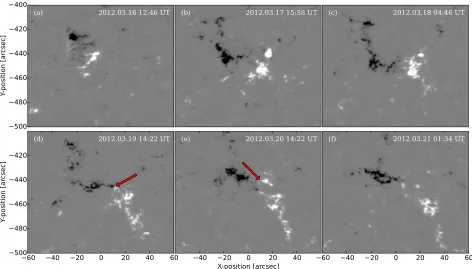
The photospheric magnetic field evolution of AR 11437 is studied during the time period beginning 2012 March 16 12:46 UT until 2012 March 21 01:34 UT using the 720 s data series (Couvidat et al. 2016) produced by the Helioseismic Magnetic Imager (HMI:Schou et al. 2012) on board theSolar Dynamics Observatory (SDO: Pesnell et al. 2012). The time period captures the full evolution of the AR allowing AR 11437 to be analysed from emergence to decay (see Figure1).
AR 11437 emerges on 2012 March 16 into the Sun’s southern hemisphere. The AR has a simple bipolar configuration where the polarities are initially aligned north-south (Figure1 (a)). The leading positive
polar-ity is further from the equator than the following po-larity, such that the bipole is anti-Joy’s Law. During the first two days of observations the AR remains in it’s emergence phase and rotates counter-clockwise. The ro-tation continues until the bipole is aligned east-west with a Hale orientation. This aspect of rotation has also been seen in flux emergence simulations (Syntelis et al. 2017, in prep). The region reaches its peak unsigned magnetic flux on 2012 March 17 at 15:58 UT (Figure1(b)), where the unsigned magnetic flux is defined as half the sum of the total positive and negative flux. The AR then enters its decay phase, starts to disperse and small-scale mag-netic features converge towards the internal PIL. This leads to flux cancellation along the PIL between March 17–19 (Figure1(b–d)). On 2012 March 18 the AR starts to exhibit a strong counter-clockwise rotation (Figure1
(d)). AR 11437 then crosses central meridian on 2012 March 19 at 09:00 UT. Small episodes of emergence are observed during the final two days of the evolution on 2012 March 19 at 10:00 UT and March 20 at 14:00 UT (red arrows in Figure1(d–e)). The AR continues to dis-perse until the leading positive polarity is more diffuse than the following negative polarity (Figure1(f)).
2.2. Coronal Evolution
The coronal evolution of AR 11437 is analysed us-ing EUV images taken by the Atmospheric Imagus-ing As-sembly (AIA:Lemen et al. 2012) on board SDO, which provides full-disk, high-resolution observations in three UV continuum wavelengths and seven EUV bandpasses. These observations have a spatial and temporal resolu-tion of 1.5” and 12 s, respectively. We focus on the 304 and 171 ˚A passbands, which are dominated by plasma emission at temperatures of approximately 0.05 and 0.6 MK.
There-Simulating the coronal evolution of AR 11437
Figure 1. The photospheric field evolution of AR 11437 as shown by a time sequence ofSDO/HMI LoS magnetograms from 2012 March 16–21. The white (black) contours represent the positive (negative) polarities corresponding to saturation levels of
±500 G. The red arrows indicate the two sites of small-scale flux emergence. The magnetograms have been de-rotated to disk centre (2012 March 19 at 09:00 UT).
fore, we will refer to these events as either eruptions or ejections rather than CMEs.
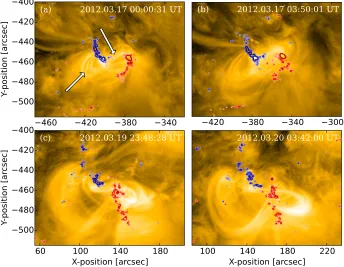
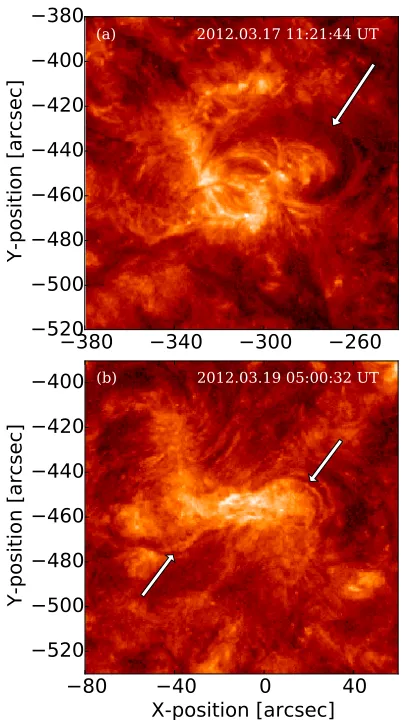
The first eruption occurs on 2012 March 17 at ap-proximately 05:09 UT when the dark loop system that is located to the west of the positive polarity sunspot erupts (Figure2 (b)). A filament is observed to form in 304 ˚A (white arrow in Figure3(a)) which erupts a few hours later on 2017 March 17 at approximately 10:45 UT. On 2012 March 18 the coronal loops slowly start to reform. Two filaments form in 304 ˚A located in the north-west and south-east of the AR (white arrows in Figure3(b)). In the coronal emission a J-shaped struc-ture becomes visible on 2012 March 19 (Figure 2 (c)). This structure, which is best observed in 171 ˚A, is not always seen. The J-shaped loops disappear and differ-ent loops that are part of the same structure become visible (Figure 2(d)). The third and final ejection from this region occurs on 2012 March 20 at 14:31 UT when the J-shaped loop system erupts and post-reconnection loops are observed.
3. AR PROPERTIES
The coronal field evolution of AR 11437 is simulated using a continuous time sequence of lower boundary con-ditions that are generated from photospheric LoS mag-netograms (as discussed in Section4.2). Before the
sim-ulations are carried out a clean-up process is applied to the magnetograms, which is described in Appendix
A. The cleaning procedure includes time-averaging, re-moval of low flux values and small magnetic features along with flux balancing. This is to remove quiet sun magnetic features whilst ensuring that the large-scale evolution of the AR is retained. This section describes the properties of AR 11437 that are derived from the cleaned magnetograms.
3.1. Magnetic Flux Evolution
AASTEX Coronal Evolution of AR 11437
Figure 2. The coronal evolution of AR 11437 observed using high-resolution 171 ˚A images taken from SDO/AIA. The LoS magnetic field from SDO/HMI is shown at a saturation of±100 G with the red (blue) contours corresponding to positive (negative) magnetic flux, respectively. The white arrows in panel (a) indicate the presence of non-potential coronal loops, which during the time period analysed evolve to become more sheared as seen in panel (b). In the later stages of the coronal evolution J-shaped loops are observed to develop, shown in panels (c) and (d).
to the solar limb and so this effect reverses when the AR crosses central meridian. While this effect exists the flux imbalance is small compared to the total flux throughout the time period considered.
AR 11437 emerges onto the disk on 2012 March 16 into a region of relatively evenly distributed quiet Sun posi-tive and negaposi-tive polarity magnetic field in the southern hemisphere. The magnetic flux continues to increase for the first two days of observations. During the flux emer-gence phase two eruptions occur on 2012 March 17 at 05:09 UT and 10:45 UT, which are represented by the green dashed lines in Figure 4. The region reaches a peak unsigned magnetic flux of 4.7 ×10²⁰ Mx on 2012 March 17 at 15:58 UT. The magnetic flux is observed to decrease between 2012 March 17 at 15:59 UT un-til 2012 March 19 03:11 UT as flux cancellation occurs along the internal PIL. Approximately, 1.3×10²⁰Mx of magnetic flux is cancelled, calculated using the cleaned magnetograms, which amounts to 27 % of the total un-signed AR magnetic flux. This can be compared to the results of a study byYardley et al.(2017), which found a total of 1.7 × 10²⁰ Mx is cancelled during this time period, amounting to 31 % of the total unsigned active region flux. The difference between these two values is due to the different clean-up processes that have been
applied to the magnetograms along with the area that is used to calculate the magnetic flux in each study. In the present study the magnetograms are treated with a number of processes including time-averaging, low flux removal and isolated feature removal. All processes are carried out so that the magnetograms can be used as lower boundary conditions in the coronal field simula-tions. In contrast, only smoothing is applied in the ob-servational study so that magnetic features that are not part of the active region are disregarded. Therefore, the only contribution to the calculation of magnetic flux is from the active region magnetic features. However, in the simulation the magnetic flux is calculated from the reduction in magnetic flux using the entire field of view of the magnetograms.
On 2012 March 19 at 10:00 UT and 2012 March 20 at 14:00 UT there are two small episodes of emergence at the internal PIL. Shortly after the final episode of flux emergence there is a third eruption at around 14:31 UT on 2012 March 20.
3.2. Tilt Angle
Simulating the coronal evolution of AR 11437
Figure 3. Filament formation in AR 11437 observed using high-resolution 304 ˚A images fromSDO/AIA. The filament that forms in the north-west of the AR, shown in panel (a), is observed to erupt but reforms after the eruption. Panel (b) shows that a second filament forms in the south-east of the active region, which extends out into the quiet Sun. The white arrows in both panels show the locations of the two filaments.
01:34 UT). The tilt angle of an active region is defined as the angle between the east-west direction on the Sun and the line that connects the centre of flux of the pos-itive and negative AR polarities. AppendixBdescribes how the tilt angle of the AR is calculated. Figure 5
shows that the evolution of the tilt angle before (red dashed line) and after (red solid line) the clean-up pro-cess is applied does not change.
[image:6.612.70.271.63.423.2]At the start of the emergence phase the AR polarities have a tilt angle of roughly 80◦as the line that connects the flux-weighted centres of the active region polarities is almost aligned north-south. As AR 11437 continues to emerge the polarities rotate counter-clockwise until the active region is aligned east-west with a tilt angle of
[image:6.612.326.560.356.510.2]Figure 4. Positive (red dot-dashed line), negative (blue dashed line) and unsigned (black solid line) magnetic flux of AR 11437 between 2012 March 16 12:46 UT and 2012 March 21 01:34 UT. The black dashed line is the absolute value of the flux imbalance of the AR as a function of time. The green dot-dashed lines show the times of the eruptions (E, 2012 March 17 05:09 UT, 2012 March 17 10:45 UT and 2012 March 20 at 14:21 UT) and the red dashed line represents the central meridian passage time (2012 March 19 at 08:00 UT).
Figure 5. The evolution of the tilt angle as a function of time for AR 11437. The red dashed (solid) line represents the raw (clean) tilt angle of the AR.
approximately 30◦on 2012 March 18. During the decay phase, the active region polarities rotate clockwise, with the tilt angle increasing to around 65◦ on 2012 March 20. On the final day of observations, when the mag-netic field is more dispersed, the active region begins to rotate counter-clockwise again and the tilt angle de-creases slightly. The variation of the tilt angle is due to the forces that are generated during the emergence and decay of the active region and are opposite in nature to that expected from differential rotation.
AASTEX Coronal Evolution of AR 11437
4.1. Coronal Field Evolution
The coronal magnetic field evolution of AR 11437 is simulated by using a magnetofrictional relaxation tech-nique to generate a continuous time series of NLFF mag-netic fields from a time sequence of photospheric LoS magnetograms. The method of magnetofrictional relax-ation was originally proposed byYang et al.(1986) and has since been successfully applied in numerous stud-ies of filaments (van Ballegooijen et al. 2000; Mackay & Gaizauskas 2003; Mackay & van Ballegooijen 2005,
2009), and magnetic flux rope formation (Mackay & van Ballegooijen 2006a; Gibb et al. 2014). As these simulations evolve the coronal magnetic field through a continuous series of NLFF equilibria, magnetic con-nectivity and flux are preserved. This allows the injec-tion of magnetic energy and helicity into the corona to be analysed. When using independent coronal field ex-trapolations this type of analysis is not possible as with independent extrapolations these quantities are not pre-served from one time to the next.
To analyse the coronal field evolution of AR 11437, we use the same coronal modelling technique asMackay et al. (2011). The evolution of the 3D magnetic field
B, where B = ∇ ×A, is governed by the induction equation,
∂A
∂t =v×B, (1)
where A is the magnetic vector potential and v is the magnetofrictional velocity. In the model, an artificial frictional term known as the frictional coefficient ν0, is included in the equation of motion, which under the force-free approximation (steady state, neglecting any external forces) reduces to
j×B−ν0v= 0, (2)
wherej=∇ ×B. Hence, the magnetofrictional velocity
v, can be expressed as
v= 1
ν0j×B, (3)
where the frictional coefficient takes the formν0=νB2. The magnetofrictional velocity acts to ensure that the magnetic field remains close to a force-free equilibrium as the field is perturbed via boundary motions. The frictional coefficient is set such that,ν = 3000 km2s−1, as this value has produced the best match between the simulated coronal field and the coronal observations in previous studies. A staggered grid is used in the compu-tations to calculate the variablesA,Bandj to second-order accuracy. The computational domain represents the solar corona and the bottom of the box represents
the photosphere. The lower boundary conditions are provided by the observed LoS magnetograms, which undergo various clean-up processes (see Appendix A), namely time-averaging, removal of isolated features and low flux values. Closed boundary conditions are used for the sides of the box whereas, the top of the domain may have either open or closed boundaries. If open bound-ary conditions are selected then the magnetograms need not be flux balanced. In contrast, if closed boundary conditions are used then the magnetograms have to be flux balanced to ensure that ∇ ·B = 0 is satisfied in the coronal volume. In this study, simulations are car-ried out using both open and closed top boundaries to determine the relative effect on the evolution of the coro-nal field (see Section 5.2). The generation of the lower boundary conditions and initial condition are discussed in the following section.
4.2. Photospheric Boundary Conditions and Initial Condition
To simulate the evolution of AR11437, 62 LoS magne-tograms from the HMI 720 s data series are used with a cadence of 96 minutes. The medium cadence represents a middle ground between the cadence available from cur-rent space-borne and ground-based missions and future instruments, which may have limited telemetry or tem-poral resolution. The magnetograms span a 4.5 day pe-riod around the central meridian passage of the AR and are cleaned using the clean-up process described in Ap-pendixA.
A number of simulations have been carried out with a variety of parameters and open or closed top boundary conditions as described in Section5.2. The simulations have a lower resolution than the LoS magnetograms as the 278×279 pixel magnetograms are interpolated onto a grid size of 2562. A continuous time sequence of lower boundary conditions are generated from the corrected magnetograms, which are designed to match the cleaned LoS magnetograms, pixel by pixel, every 96 minutes.
To model the coronal field evolution of AR 11437, the horizontal components (Axb, Ayb) of the magnetic vector
potential Aon the base corresponding to each magne-togram must be determined. This process is carried out as follows
1. Each of the observed LoS magnetograms,Bz(x, y, k)
for k= 1→62 are taken, where krepresents the discrete 96 minute time index.
2. The horizontal components of the vector potential
Aat the base (z= 0) are expressed in the form
Axb(x, y, k) =
∂Φ
Simulating the coronal evolution of AR 11437
Ayb(x, y, k) =−
∂Φ
∂x, (5)
where Φ is a scalar potential.
3. For each discrete time indexk, the following equa-tion
Bz=
∂Ayb
∂x −
∂Axb
∂y , (6)
then becomes
∂2Φ ∂x2 +
∂2Φ
∂y2 =−Bz, (7)
which is solved using a multigrid numerical technique (Finn et al. 1994; Longbottom 1998 and references therein). In the construction of Ax andAy from Bz in
the 2D plane identical boundary conditions are chosen from one time to the next based on the Coulomb gauge. This ensures that the change inAxandAyused to drive
the simulation is minimised within the Coulomb gauge. Full details and be found in the papers ofMackay & van Ballegooijen (2009); Mackay et al. (2011), based upon the paper of Finn et al.(1994). In the recent paper of
Yeates(2017) a new localised technique for determining the boundary condition at the level of the photosphere has been put forward. Future studies will consider the consequences of this.
By solving Equation7 for the scalar potential Φ, the horizontal components of the vector potential on the base (Axb, Ayb) can be determined for each discrete time
interval, 96 minutes apart. For a continuous time se-quence between each of the observed distributions to be produced, the horizontal components Axb and Ayb
are linearly interpolated between each time interval k
and k+ 1. The fields are interpolated using 500 in-terpolation steps. This effectively evolves the magnetic field from one observed photospheric field to the next. Through using this process, additional numerical tech-niques, such as local correlation tracking, are not re-quired as the horizontal velocity does not need to be determined. Furthermore, the removal of undesirable effects such as numerical overshoot or magnetic flux pile up at cancellation sites is not necessary as these numer-ical effects do not occur.
[image:8.612.322.561.66.302.2]Due to the numerical technique described above, there are two timescales involved in the evolution of the lower boundary condition. The first is the 96 minute timescale between observations, the second is a timescale of 11.52 s, introduced to produce the advection of the mag-netic polarities between observed states by interpola-tion, along with the relaxation of the coronal field. The process described above reproduces the cleaned LoS
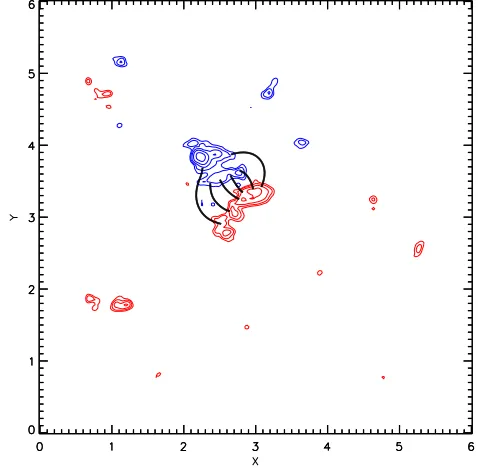
Figure 6. A selection of magnetic field lines (black) that illustrate the initial potential field condition. The red (blue) contours represent the positive (negative) photospheric mag-netic field.
magnetograms with a discrete time interval of 96 min-utes, providing a description of the magnetogram obser-vations that is highly accurate.
5. RESULTS
5.1. Magnetic Field Line Evolution
The evolution of the simulated coronal magnetic field will now be discussed for the simplest case where closed boundary conditions are used at the top of the computa-tional box. The results found for both open and closed top boundary conditions were very similar and will be discussed in Section 5.2. Therefore the nature of the upper boundary condition does not have a significant effect on the evolution of the field.
[image:8.612.62.293.69.222.2]sim-AASTEX Coronal Evolution of AR 11437
(a) (b)
(c) (d)
2012.03.16 23:59:57 UT 2012.03.17 04:47:58 UT
[image:9.612.160.460.57.367.2]2012.03.19 23:59:58 UT 2012.03.20 03:11:58 UT
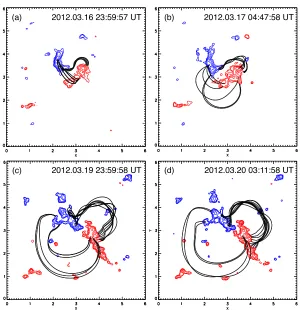
Figure 7. A series of field line plots taken from the simulation that roughly correspond to the timings of the AIA observations shown in Figure2. The positive and negative polarities are represented by the red and blue contours, respectively.
ulated magnetic field lines that are located along the in-ternal PIL in the north of the active region are S-shaped, indicating the presence of shear. A similar sheared fea-ture is also present in the coronal observations (see Fig-ure2(a)). While there is a good agreement between the observations and simulations there are however some dif-ferences. One key difference is that in the coronal emis-sion observations the S-shaped feature appears as one continuous structure that extends to the south of the active region with its eastern footpoint located at the periphery of the negative polarity. This is not the case for the simulation as the S-shaped structure only par-tially extends along the internal PIL and the endpoints are fixed in the center of the negative polarity sunspot. However, care must be taken in the direct comparison between the observed coronal loops and field lines as the loops may represent integrated structures along the LoS rather than single field lines. The simulated field lines that are located to the south of the S-shaped structure have a potential configuration, most likely due to using a potential field initial condition.
In panel (b) of Figure7 the S-shaped field lines have evolved into a flux rope configuration at the same lo-cation as the sheared coronal loops visible in Figure 2
(b). As found in the previous panel the simulated flux
rope does not extend as far south as the sheared coronal loops. The arcade field lines that are situated directly west of the simulated flux rope are in good agreement with the dark loop system present in the observations.
The rapid evolution of the magnetic field in the sim-ulation at this time suggests that the flux rope starts to rise and erupt between the current and previous time steps. Signatures of the eruption in the simula-tion include the deformasimula-tion of the flux rope and post-reconnection field lines forming below the rope. The magnetofrictional simulation does not capture the full dynamics of the eruption as the flux rope is confined in the low corona. The flux rope does not rise to the top of the box even when open top boundary conditions are used, suggesting that the eruption may be confined. The eruption takes place approximately 1 hour before the ejection of the dark loop system that is seen in the 171 ˚
tim-Simulating the coronal evolution of AR 11437
ings of the flux rope eruptions in the simulation and the observations of ejections will be discussed in the Section
5.2.1. Also, the field lines that are located in the south of the active region, below the flux rope, are now rela-tively similar to the loops seen in the coronal emission. Figure 7 panel (c) shows the flux rope three days after the first two eruptions are observed. The field lines of the simulated flux rope have grown in length resulting in a larger structure. This is consistent with the J-shaped loop structure observed in Figure2(c). The footpoints of the simulated flux rope that are rooted in the center of the negative polarity are shifted to the west and are closer to the internal PIL compared to the footpoints of the J-shaped loops in the 171 ˚A observations. The simulated loops in the south of the active region are in good agreement with the observations. In Figure7 (d) some of the footpoints of the simulated flux rope are situated further south, along the periphery of the posi-tive polarity magnetic field. This is consistent with the evolution of the J-shaped emission in the observations (Figure2(d)). At this time the simulated flux rope is in the process of erupting again. The eruption in the simu-lation occurs roughly 10 hours before the third eruption is observed (see Section5.2).
The simulated field lines in Figure7are in good agree-ment with the 171 ˚A observations. This suggests that by using the magnetofrictional relaxation technique of
Mackay et al. (2011) to produce a continuous time se-ries of NLFF magnetic fields, driven by photospheric LoS magnetograms, it is possible capture observable fea-tures of AR 11437. This is particularly true in the north of the active region where the formation, evolution and eruption of the simulated flux rope agrees well with the coronal observations. However, the field lines located in the south of the active region deviate from the observed coronal emission during the early phases of active region evolution. This deviation may be due to the choice of the initial potential condition and closed top boundary conditions. The discrepancy between the simulation and observations improves during the later stages of active region evolution. The effect of additional global param-eters, the initial condition and an open top boundary on the simulated coronal field are explored in Section5.2.
5.2. Parameter Study
In the simulation there are three additional terms that can be implemented by modifying the induction equa-tion as follows
∂A
∂t =v×B−ηj+ B
B2∇ ·(η4B
2∇α) +H, (8)
whereαis given by
α= B· ∇ ×B
B2 . (9)
The second term on the right-hand-side represents Ohmic diffusion, which simply originates from the re-sistive form of the induction equation, where η is the resistive coefficient.
The third term is known as hyperdiffusion (Boozer 1986; Strauss 1988; Bhattacharjee & Yuan 1995) and includes the coefficient of hyperdiffusion η4. Hyperdif-fusion is an artificial difHyperdif-fusion that is used to smooth out gradients present in the force-free parameter α, whilst allowing the conservation of total magnetic helicity (van Ballegooijen & Mackay 2007). The final term represents an additional injection of helicity at the photosphere. In particular, the injection of magnetic helicity could be due to torsional Alfv´en waves propagating into the corona from below the surface or as a result of small-scale vortical motions that are associated with granular or supergranular cells (Antiochos et al. 2013). This he-licity injectionH, can be expressed through the source term
H=−∇z(ζBz), (10)
where ζ is the helicity injection parameter and pa-rameterises the rate and scale of helicity injection at the photospheric surface. Helicity injection can introduce strongly sheared field when horizontal motions in the photosphere do not inject enough helicity into the coro-nal field. For a more detailed description and derivation of this term refer toMackay et al.(2014).
5.2.1. Magnetic Field Evolution
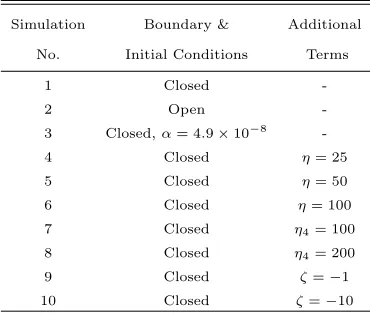
We now conduct a parameter study where the top boundary, initial condition and non-ideal terms are var-ied in the simulation. This is to analyse the effect that these conditions have on the coronal field evolution de-scribed in Section5.1. In total, ten simulations are per-formed (see Table1) using either closed or open bound-ary conditions. If the top boundbound-ary is closed a LFF initial condition can be used where the force-free pa-rameterαcan take a range of values between [-1.6, 1.6]
AASTEX Coronal Evolution of AR 11437
Table 1. Parameter Study
Simulation Boundary & Additional
No. Initial Conditions Terms
1 Closed
-2 Open
-3 Closed,α= 4.9×10⁻⁸
-4 Closed η= 25
5 Closed η= 50
6 Closed η= 100
7 Closed η4= 100
8 Closed η4= 200
9 Closed ζ=−1
10 Closed ζ=−10
Note—The boundary conditions, initial conditions and additional terms that are used to conduct the simulations. The top boundary conditions of the simulation can either be open or closed. Depend-ing on the boundary conditions the simulations can have either a potential or linear force-free initial con-dition where the force-free parameter αis given in units of m−1. Ohmic diffusion and helicity injection
are included using ηand ζ, which both have units of km2s−1, whereas, the coefficient of hyperdiffusion has units of km4s−1.
The comparison between the timings of the simulated flux rope eruptions to the ejections that occur in the ob-servations is now discussed. As previously stated, there are three eruptions that are observed to take place on 2012 March 17 at 05:09 UT, 2012 March 17 at 10:45 UT and 2012 March 20 at 14:31 UT. The first and second eruptions are less than 6 hours apart making it impos-sible for the simulation to disentangle them. Therefore, we focus on the timings of the first and third ejections only. Figure8 shows the time difference for each simu-lation between the eruptions of the simulated flux ropes and the observed eruptions. The time difference between the eruptions occurring in the simulations and the obser-vations is calculated by using the central time between the time step where the eruption has already occurred and the previous time step where there is no sign of eruption. Signatures of eruption in the simulation in-clude kinked shaped field lines and post-reconnection loops, which form underneath the field lines of the flux rope as it rapidly rises. This time is then compared to the time of the eruption in the observations.
For the first observed eruption, the flux rope in seven of the simulations erupts on 2012 March 17 at 04:00 UT. This is approximately 1 hour before the eruption in the observations and is within the time resolution of the photospheric boundary data. We note that when open boundary conditions are applied at the top
bound-Figure 8. The time difference in hours between the two flux rope eruptions that occur in the ten simulations and the eruptions seen in the 171 ˚A observations on 2012 March 17 at 05:09 UT (blue) and 2012 March 20 at 14:31 UT (green). As the flux rope eruptions occur between two time steps in the simulation the points represent the time difference taken between the observed eruptions and the central time between the two time steps. The error bars represent the error in time difference due to the resolution of the boundary data.
ary (Simulation 2) the simulated flux rope erupts in the same manner as in the closed case as it does not leave the computational box. This again suggests that this is a confined eruption. In the three remaining simulations, all of which use Ohmic diffusion, the flux rope erupts at 07:12 UT, 10:24 UT and 12:00 UT, which is roughly 2, 5 and 7 hours after the eruption in the observations, re-spectively. The latter times are due to Ohmic diffusion decreasing the rate of build up of twist in the flux rope. For the third and final eruption the flux rope in eight of the simulations erupts on 2012 March 20 at 04:00 UT, which is roughly 10 hours before the eruption in the observations. In the final two simulations the flux rope erupts at 00:48 UT on 2012 March 20 and 16:48 UT on 2012 March 19. This is approximately 13 and 21 hours before the observed eruption. In these simula-tions, where the time of the flux rope eruption deviates significantly from the other simulations, Ohmic diffusion is large taking values of 50 and 100 km2s−1, respectively.
5.2.2. Magnetic Energy
The total magnetic energy that is stored in the coro-nal field with time for each simulation is shown in Figure
[image:11.612.77.262.83.240.2]Simulating the coronal evolution of AR 11437
Figure 9. The evolution of total magnetic energy as a func-tion of time between 2012 March 16 12:46 UT and 2012 March 21 01:34 UT for the simulations in Table1. The red dashed line indicates when AR 11437 crosses central merid-ian (CM). The blue dashed and green dot dashed lines rep-resent the times of the simulated flux rope eruptions (FRE) and the eruptions in the observations (E), respectively.
flux due to emergence or cancellation the magnetic en-ergy increases/decreases accordingly. While the enen-ergy evolution follows a similar trend for each simulation the total magnetic energy is systematically higher than the potential field. This is due to small-scale convective mo-tions that evolve the magnetic elements at the photo-sphere and inject energy into the corona, causing the coronal field to become non-potential. For the simula-tions where Ohmic diffusion is incorporated the values of total magnetic energy are consistently lower.
5.2.3. Free Magnetic Energy
We also investigate the evolution of the free magnetic energyE, which is given by
E= 1 8π
Z
(B2−B2p)dτ, (11)
whereB is the magnetic field of the NLFF field sim-ulation and Bp is the potential magnetic field that is
extrapolated from the same boundary conditions as the simulated coronal field (Mackay et al. 2011). The evo-lution of the free magnetic energy with time for each simulation is shown in Figure10.
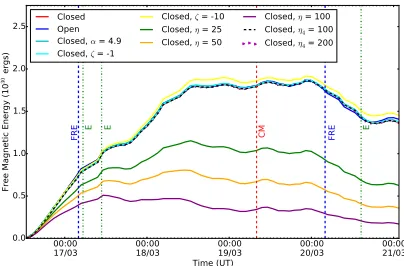
The general evolution of the free magnetic energy will now be discussed. A similar trend in the free magnetic energy is seen for all ten simulations, apart from the three simulations that include the Ohmic diffusion term, where the free magnetic energy is systematically lower. Initially, there is an increase of free magnetic energy corresponding to the emergence of flux and the counter-clockwise rotation of the bipole. The first simulated flux rope eruption occurs during this period. On 2012 March 18 at 11:12 UT the free magnetic energy reaches a max-imum value of ∼1.8 × 1030 ergs and remains roughly
Figure 10. The evolution of the free magnetic energy as a function of time for each simulation in Table1calculated between 2012 March 16 12:46 UT and 2012 March 21 01:34 UT. The red dashed line shows the central meridian (CM) passage of AR 11437. The blue dashed and green dot dashed lines represent the times of the simulated flux rope eruptions (FRE) and of the observed eruptions (E), respectively.
constant until 2012 March 20. This mostly corresponds to the decay phase of the AR when flux cancellation is taking place and the AR rotates clockwise. The free magnetic energy then starts to decrease and the erup-tion of the second simulated flux rope occurs. At the end of the evolution a small increase in magnetic flux occurs due to the emergence of a small bipole and the AR rotates counter-clockwise. This results in the small and final increase in the free magnetic energy.
The timings of the simulated flux rope eruptions coin-cide with changes in the evolution of the free magnetic energy. Around the time of the first simulated flux rope eruption the free magnetic energy is increasing. The rate at which the free magnetic energy increases slows after the first eruption has occurred. Similarly, the free magnetic energy starts to decrease prior to the eruption of the second simulated flux rope. This variation is more apparent in the rate of change of free magnetic energy, which is shown in Figure11. The rate of change of the free magnetic energy decreases by 9.2 × 1024 erg s−1 and 1.5 × 1025 ergs s−1 around the times of the first and second simulated flux rope eruptions, respectively. The decrease in the rate of change of free magnetic en-ergy around the timings of the eruption is small due to the evolution of the applied boundary and the continual injection of a Poynting flux at the base of the computa-tional box.
5.2.4. Relative Helicity
[image:12.612.341.543.63.196.2]dur-AASTEX Coronal Evolution of AR 11437
Figure 11. The rate of change of free magnetic energy as a function of time for closed boundary conditions (simulation 1 in Table1) between 2012 March 16 12:46 UT and 2012 March 21 01:34 UT. The red dashed line indicates when AR 11437 crosses central meridian (CM). The blue dashed and green dot dashed lines represent the timings of the simulated flux rope eruptions (FRE) and the eruptions in the observations (E), respectively.
Figure 12. Relative helicity evolution as a function of time between 2012 March 16 12:46 UT and 2012 March 21 01:34 UT. The red dashed line indicates when AR 11437 crosses central meridian (CM). The blue dashed and green dot dashed lines represent the timings of the simulated flux rope eruptions (FRE) and the eruptions in the observations (E), respectively.
ing the process of magnetic reconnection (Berger 1999). To study the injection and evolution of helicity in the simulations the relative helicityHR is calculated as
fol-lows
HR=
Z
(A·B)dτ−
Z
(Ap·Bp)dτ, (12)
where A is the magnetic vector potential and B is the magnetic flux density of the simulation (seeMackay et al. 2011). The vector potential and magnetic flux density of the potential field with the same normal field component and boundary conditions is given byApand
Bp, respectively. The evolution of the relative helicity
of the simulations is shown in Figure12.
The relative helicity in each simulation shows a sim-ilar evolutionary behaviour throughout the time period studied. At the beginning of the evolution the relative helicity for the majority of the simulations initially in-creases to∼2.3×1039Mx2as positive helicity is injected into the corona. For the case where the force-free pa-rameterα= 4.9×10⁻⁸ m−1the initial relative helicity is∼3.5×1039 Mx2 due to the LFF field initial condi-tion. While the value is initially higher it follows the same trend as the other simulations. By introducing an additional injection of helicity, particularly in the case
ζ= 10 km2s−1, the helicity increases as expected. For the majority of the simulations the helicity is positive during the first half of the evolution, which follows the hemispheric rule of positive helicity being dominant in the southern hemisphere Pevtsov et al. (1995). How-ever, once the active region crosses central meridian the helicity sign is negative. The evolution of helicity is very similar to that of the tilt angle suggesting that the dominant source of helicity injection is the large scale rotation of the active region.
6. SUMMARY & DISCUSSION
In this study, we have simulated the coronal evolution of AR 11437 during its entire lifetime, from emergence to decay (2012 March 16 12:46 UT to 2012 March 21 01:34 UT). The coronal field has been simulated using the magnetofrictional relaxation technique ofMackay et al.(2011) with SDO/HMI LoS magnetograms as lower boundary conditions. By applying this method it was possible to replicate the main coronal features and evolu-tion of the active region. Observaevolu-tions fromSDO/AIA show that the coronal field of the active region becomes sheared and three eruptions occur, two take place in the emergence phase and one in the decay phase. The simulation was able to reproduce the sheared coronal structure and two out of the three observed eruptions. We also conducted a parameter study to include global parameters such as Ohmic diffusion, hyperdiffusion and helicity injection in the simulation. The addition of these terms in the simulations does not effect the over-all coronal evolution. Therefore, the magnetofrictional relaxation technique ofMackay et al.(2011) using LoS magnetograms as lower boundary conditions is very ef-fective in simulating the coronal evolution of AR 11437 and its eruptions.
[image:13.612.71.274.307.441.2]discrepan-Simulating the coronal evolution of AR 11437
cies between the simulated field and coronal observations in the south of the AR. The simulated flux rope struc-ture does not extend as far south as the coronal loops. The deviation between the observations and simulation decreases with time and both are in good agreement dur-ing the later stages of evolution. This variation is most likely caused by the potential field initial condition of the simulation. These findings are very similar to that ofGibb et al.(2014), where the simulated field captures the formation and evolution of an active region sigmoid. During the emergence phase, AR 11437 rotates counter-clockwise and a dark loop system that is lo-cated to the west of the active region erupts on 2012 March 17 at 05:09 UT. The simulated flux rope at this location starts to rise and is found to erupt roughly 1 hour before the ejection of the dark loop system in the observations. As the dark loop system is located directly next to the flux rope in the simulation it could therefore be a part of this pre-eruptive structure. Signatures of eruption include the formation of kinked field lines and post-reconnection loops below the simulated flux rope as it rises. The evolution of the coronal field is driven with LoS magnetograms that have a cadence of 96 min-utes and therefore, the eruption occurs within the time resolution of the data. In the observations there are no white-light signatures associated with this eruption and when the simulated flux rope erupts it does not rise to the upper section nor leave the computational box even when open top boundary conditions are applied. In the AIA 171 ˚A observations there is an expansion of coronal loops and a small brightening. This suggests that the observed eruption could be confined or that only a partial eruption of the sheared structure occurs. A filament then forms and erupts on 2012 March 17 at 10:45 UT. The second eruption is not captured in the simulations as it occurs only 3 time steps (6 hours) after the previous eruption making it hard to distinguish.
As the active region enters its decay phase flux can-cellation occurs at the internal PIL. Approximately 1.3
×1020 Mx of magnetic flux cancels during a time pe-riod of 1.5 days. This amounts to 27 % of the peak active region flux being cancelled. The amount of flux cancelled is very similar to that found inYardley et al.
(2017) despite the difference in methods used to cal-culate the magnetic flux. This is also consistent with previous studies such as (Green et al. 2011;Baker et al. 2012;Yardley et al. 2016). The active region also rotates clockwise during this period. In the simulations the flux rope, which formed along the internal PIL, has expanded and grown in length, resulting in a larger structure that is consistent with the J-shaped structure in the coronal observations. The expansion and growth of the
sim-ulated flux rope provides additional evidence that the first eruption was likely to be confined. The large flux rope structure forms during the decay phase of the ac-tive region evolution suggesting that the process of flux cancellation and associated reconnection at the internal PIL was responsible. Hence, the evolutionary sequence of this structure is consistent with the model ofvan Bal-legooijen & Martens (1989). The final eruption of the simulated flux rope structure occurs roughly 10 hours before the eruption of the observed J-shaped coronal structure. Furthermore, the flux rope rises once again but does not leave the computational box.
When varying the boundary and initial conditions and including additional parameters such as Ohmic diffu-sion, hyperdiffusion and helicity injection in the simula-tions, the evolution of the coronal field does not change considerably. This suggests that a key element in re-producing the main evolutionary features of the active region is using the normal component of the magnetic field from LoS magnetograms to drive the simulations. However, when including Ohmic diffusion the simulated field has less twist than the other cases. This is expected as Ohmic diffusion acts to decrease poloidal flux in the simulation and therefore decreases the twist of the sim-ulated field.
For the majority of the simulations conducted the flux rope erupts roughly 1 and 10 hours before the first and third eruptions in the observations, respectively. The in-clusion and increased values of the Ohmic diffusion term causes the timings of the eruptions of the simulated flux rope to differ to the other cases. When Ohmic diffusion takes values of 25, 50 and 100 km2 s−1 the simulated flux rope erupts roughly 2, 5 and 7 hours after the first observed eruption, respectively. This is due to the fact that the flux rope structure is less twisted than in the other cases. For the final eruption, the simulated flux rope erupts roughly 13 and 21 hours before the observed eruption for η values of 50 and 100 km2 s−1. At this point in the simulation the flux rope twist is still small but the rope is more inflated compared to the other sim-ulations. The early eruption of the flux rope is due to the eruption taking place during the later stages of the simulation. This allows a continual build-up of stress to occur over a longer period as the simulation fails to capture the second observed eruption. When Ohmic dif-fusion is included the overlying field remains more po-tential, the restoring forces acting on the flux rope are weaker, and as a result, the eruption occurs even earlier in the simulation.
mag-AASTEX Coronal Evolution of AR 11437
netic energy were systematically lower for the simula-tions that included Ohmic diffusion. Initially, the free magnetic energy increases due to flux emergence. The rate of change of free magnetic energy is seen to decrease by 9.2×1024erg s−1but remains positive after the first simulated eruption. The free magnetic energy continues to increase after the emergence phase. This is due to the injection of energy through small-scale convective motions which inject a Poynting flux into the corona (Mackay et al. 2011). Finally, during the final eruption the rate of change of free magnetic energy decreases by -1.5×1025erg s−1as the energy overall decreases.
We also study the injection and evolution of the rel-ative helicity with time for each simulation. As for the free magnetic energy, the relative helicity shows the same trend in all ten simulations apart from in two cases that have consistently higher values of helicity. Firstly, in the case where a LFF field initial condition is used and the force-free parameterαis 4.9×10⁻⁸m−1. Secondly, when there is a large helicity injection of 10 km2 s−1. The helicity is initially increasing and positive, which agrees with the hemispheric rule that states positive he-licity dominates in the southern hemisphere (Pevtsov et al. 1995). The helicity then decreases and as the ac-tive region crosses central meridian becomes negaac-tive. This is because the active region rotates clockwise and the evolution of helicity follows the same trend as the evolution of the active region tilt angle. This suggests that active region rotation is a large source of helicity injection in the corona (Gibb et al. 2014).
In this study, we have used the magnetofrictional tech-nique of Mackay et al. (2011) to successfully simulate the coronal evolution of AR 11437 along with two out of three observed eruptions from the active region. This technique uses a time series ofSDO/HMI LoS magne-tograms as lower boundary conditions. When including additional global parameters such as Ohmic diffusion, hyperdiffusion and an injection of helicity the overall coronal evolution of the simulated field and eruption times did not change significantly. This shows that the technique ofMackay et al.(2011) only requires the nor-mal component of the magnetic field from LoS mag-netograms as lower boundary conditions to successfully reproduce the coronal evolution and the build-up to the eruption of an active region.
The authors would like to thankSDO/HMI and AIA consortia for the data, and also being able to browse data through JHelioviewer (http://jhelioviewer.org/). This research has made use of SunPy, an open-source and free community-developed solar data analysis pack-age written in Python (SunPy Community et al. 2015). S.L.Y. would like to acknowledge STFC for support via the Consolidated Grant SMC1/YST025. D.H.M. would like to thank STFC and the Levehulme Trust for finan-cial support. L.M.G. is grateful to the Royal Society for a University Research Fellowship and the Leverhulme Trust.
APPENDIX
A. MAGNETOGRAM CLEAN-UP PROCESS
This study used magnetograms taken from the 720s data series made available by the Helioseismic and Magnetic Imager (HMI) on board theSolar Dynamics Observatory (SDO). The full-disk LoS magnetograms are computed from filtergrams, which are recorded by the vector camera, have a pixel size of 0.5” and a noise level of 10 G. In total, 62 magnetograms are used with a 96 minute cadence during the time period beginning 2012 March 16 12:46 UT until 2012 March 21 01:34 UT. A cosine correction is applied to the magnetic field values to estimate the radial component of the magnetic field. Each magnetogram, which contains the corrected radialised field values, is de-rotated to account for area foreshortening effects at large centre-to-limb angles. Cut-out images are taken from the corrected and de-rotated magnetograms centred on the AR with a size of 278 ×279 pixels.
The cleaning procedure that will now be described is very similar to that inGibb et al. (2014). It is apparant in Figures1and3that the noise level is high in the raw magnetograms. This is particularly evident in the magnetograms taken during the early and late phase of the active region evolution when the distance from central meridian is large. To be able to use the magnetograms as boundary conditions in the simulation several clean-up procedures were applied. Firstly, time-averaging is applied to the magnetograms using a Gaussian kernel as follows
Ci=
P62
j=1exp(−[i−j]/τ) 2F
j
P62
j=1exp(−[i−j]/τ)2
, (A1)
whereCi represents theith cleaned frame and ranges from 1 to 62,Fj is thejth raw frame, andτ is the separation
Simulating the coronal evolution of AR 11437
[image:16.612.93.524.116.314.2]each of the cleaned frames is a linear combination of the 62 raw frames however, the two frames previous and after the current frame have the highest weighting. This procedure is used to retain large scale active region features and remove random noise.
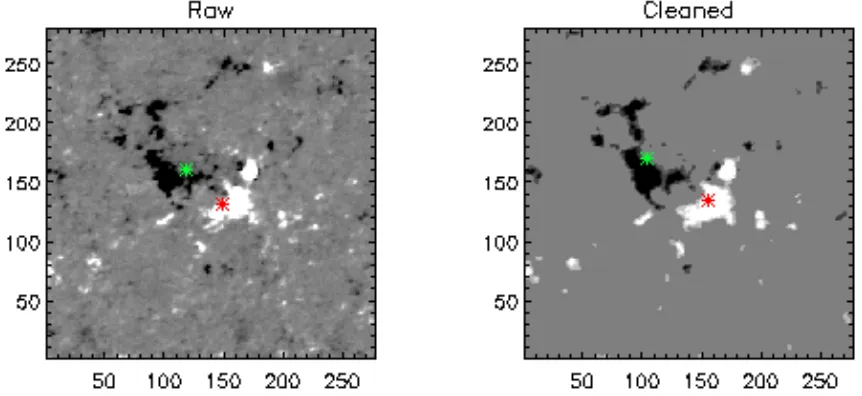
Figure 13. The raw and cleaned magnetograms for frame 15 of the simulation taken on 2012 March 17 at 15:59 UT when AR 11437 is at peak unsigned magnetic flux. The saturation levels of the magnetic field for both magnetograms is set to±100 G. The flux-weighted central coordinates for the positive (negative) polarity is represented by the red (green) asterisk.
In this study we are only interested in analysing the evolution of the large scale magnetic field of the active region and not small-scale features such as network elements or quiet Sun magnetic field. Therefore, small-scale isolated magnetic features are removed pixel-by-pixel by considering the eight nearest neighbours of each pixel. If less than four of the nearest neighbours had the same sign of magnetic flux then the flux value of that pixel would be set to zero. This means that as the pixels at the edges of the magnetograms had less than eight neighbouring pixels their values were also set to zero. Additionally, the pixels that had magnetic flux values that were below the threshold of 25 Mx cm−2 were assigned a value of zero as these pixels form part of the quiet Sun background magnetic field.
The final clean-up procedure was applied to ensure that the magnetograms were flux balanced. This procedure is required if the top boundary conditions of the simulation are closed. The magnetograms were flux balanced by calculating the signed magnetic flux of each frame. For each frame the pixels of non-zero value were counted and the signed magnetic flux was divided by this total. The imbalanced magnetic flux per non-zero valued pixel was subtracted from every pixel of non-zero value. No pixels changed sign during the procedure of flux balancing as the maximum correction was less than the threshold of 25 Mx cm−2. This was the threshold used to set the value of pixels that formed part of the background field to zero.
Figure 13shows the raw and cleaned magnetograms taken at the time of the peak unsigned magnetic flux of AR 11437 (2012 March 17 at 15:59 UT). The figure shows that the large scale magnetic features of the active region in the raw magnetogram are still present in the cleaned magnetogram but the small-scale magnetic features and noise has been removed.
Several clean-up procedures have been applied including time-averaging, isolated feature removal, low flux value removal, and flux balancing to produce a series of cleaned magnetograms that show a smooth, continuous photospheric field evolution. Using these magnetograms as photospheric boundary conditions makes it easier to simulate the evolution of the coronal magnetic field as random noise and small-scale magnetic features can cause numerical problems in the magnetofrictional simulation.
B. TILT ANGLE CALCULATION
AASTEX Coronal Evolution of AR 11437
r±=
Z
rB±dA
Z B±dA
, (B2)
whereris a position vector,±represents the positive and negative polarity flux, and A is the area. The angleθcan then be calculated by
θ= arctan (r
−−r+)y
(r−−r+)x
, (B3)
where thex,ysubscripts are the x and y components ofr±, respectively. This follows the method outlined inGibb et al.(2014) however, we take the tilt angle to be 180−θin this case following a similar definition toTian et al.(2001).
REFERENCES
Antiochos, S. K., DeVore, C. R., & Klimchuk, J. A. 1999, ApJ, 510 485
Antiochos, S. K. 2013, ApJ, 772, 72
Baker, D., van Driel-Gesztelyi, L. & Green, L. M. 2012, SoPh, 276, 219
Berger, M. A. 1999, Plasma Phys. Control. Fusion, 41, B167 Bhattacharjee, A., & Yuan, Y. 1995, ApJ, 449, 739
Bobra, M. G., van Ballegooijen, A. A., & and DeLuca, E. E. 2008, ApJ, 672, 1209
Boozer, A. H. 1986, J. Plasma Phys., 35, 133 Canou, A., & Amari, T. 2010, ApJ, 715, 1566
Couvidat, S., Schou, J., Hoeksema, J. T., et al. 2016, SoPh, 291, 1887
Finn, J. M., Guzdar, P. N., & Usikov, D. 1994, ApJ, 427, 475
Forbes, T. G., & Isenberg, P. A. 1991, ApJ, 373, 294 Forbes, T. G. 2000, J. Geophys. Res., 105, 23153 Gibb, G. P. S., Mackay, D. H., Green, L. M. et al. 2014,
ApJ, 782, 71
Green, L. M., D´emoulin, P., Mandrini, C. H., et al. 2003, SoPh, 215, 307
Green, L. M., & Kliem, B. 2009, ApJL, 700, L83
Green, L. M., Kliem, B., & Wallace, A. J. 2011, A&A, 526, A2
Jiang, C., Wu, S. T., Feng, X., & Hu, Q. 2014, ApJL, 786, L16
Kliem, B., & T¨or¨ok, T. 2006, Phys. Rev. Lett., 96, 255002 Kuperus, M., & Raadu, M. A. 1974, A&A, 31, 189 Lemen, J. R., Title, A. M., Akin, D. J., et al. 2012, SoPh,
275, 17
Longbottom, A. 1998, in ASP Conf. Ser. 150, IAU Colloq. 167: New Perspectives on Solar Prominences, ed. D. F. Webb, B. Schmieder, & D. M. Rust (San Francisco, CA: ASP), 274
Mackay, D. H., & Gaizauskas, V. 2003, SoPh, 216, 121 Mackay, D. H. & van Ballegooijen, A. A. 2005, ApJL, 621,
L77
Mackay, D. H. & van Ballegooijen, A. A. 2006a, ApJ, 641, 577
Mackay, D. H. & van Ballegooijen, A. A. 2006b, ApJ, 642, 1193
Mackay, D. H. & van Ballegooijen, A. A. 2009, SoPh, 260, 321
Mackay, D. H., Green, L. M., & van Ballegooijen, A. A. 2011, ApJ, 729, 97
Mackay, D. H., DeVore, C. R. & Antiochos, S. K. 2014, ApJ, 784, 164
Moore, R. L., Sterling, A. C., Hudson, H. S., & Lemen, J. R. 2001, ApJ, 552, 833
Patsourakos, S., Vourlidas, A., & Stenborg, G. 2013, ApJ, 764, 125
Pesnell, W. D., Thompson, B. J., & Chamberlin, P. C. 2012, SoPh, 275, 3
Pevtsov, A. A., Canfield, R. C., & Metcalf, T. R. 1995, ApJL, 440, L109
R´egnier, S., Amari, T., & Kersal´e, E. 2002, A&A, 392, 1119 Savcheva, A., Pariat, E., van Ballegooijen, A., Aulanier, G.,
& and DeLuca, E. 2012, ApJ, 750, 15
Schou, J., Scherrer, P. H., Bush, R. I., et al. 2012, SoPh, 275, 229
Schrijver, C. J., De Rosa, M. L., & Metcalf, T. R. et al. 2006, SoPh, 235, 161
Strauss, H. R. 1988, ApJ, 326, 412
Su, Y., van Ballegooijen, A., Lites, B. W. et al. 2009, ApJ, 691, 105
SunPy Community, Mumford, S. J., & Christe, S. et al. 2015, Computational Science & Discovery, 8, 014009 Syntelis, P. et al. 2017, in preparation
Tian, L., Bao, S., Zhang, H., & Wang, H. 2011, A&A, 374, 294
T¨or¨ok, T., & Kliem, B. 2005, ApJL, 630, L97
Valori, G., Kliem, B., & Keppens, R. 2005, A&A, 433, 335 van Ballegooijen, A. A., & Martens, P. C. H. 1989, ApJ,
Simulating the coronal evolution of AR 11437
van Ballegooijen, A. A., Priest, E. R., & Mackay, D. H. 2000, 539, 983
Mackay, D. H., & van Ballegooijen, A. A. 2006, ApJ, 641, 577
van Ballegooijen, A. A., & Mackay, D. H. 2007, ApJ, 659, 1713
Yang, W. H., Sturrock, P. A., & Antiochos, S. K. 1986, ApJ, 309, 383
Yardley, S. L. et al. 2017, ApJ, submitted
Yardley, S. L., Green, L. M., & Williams, D. R. 2016, ApJ,
827, 151
Yeates, A. R., Mackay, D. H., & van Ballegooijen, A. A.
2007, SoPh, 245, 87