A School-Based Intervention for Mental
Illness Stigma: A Cluster
Randomized Trial
Bruce G. Link, PhD,aMelissa J. DuPont-Reyes, PhD,bKay Barkin, BA,cAlice P. Villatoro, PhD,bJo C. Phelan, PhD,dKris Painter, PhDe
abstract
OBJECTIVES:To determine the effectiveness of a school-based curriculum, Eliminating the Stigma of Differences (ESD), in improving attitudinal and/or behavioral contexts regarding mental illness in schools and increasing the likelihood that youth seek treatment for mental health problems when needed.
METHODS:We conducted a cluster randomized trial in sixth-grade classes from 14 schools in 2011 and 2012 with follow-up at 6-month intervals through 24 months (2012–2015). Using a fully crossed 2323 2 factorial design, we compared ESD to a no-intervention control and to 2 comparator interventions: (1) contact with 2 young adults with a history of mental illness and (2) exposure to antistigma printed materials. We implemented interventions in classrooms in an ethnically and socioeconomically diverse school district. There were 416 youth who participated in the follow-up, and 312 (75%) of these participated for the full 2 years. Outcome measures were knowledge and positive attitudes, social distance from peers with mental illness, and mental health treatment seeking.
RESULTS:Youth assigned to ESD reported greater knowledge and positive attitudes and reduced social distance (Cohen’s d = 0.35 and 0.16, respectively) than youth in the comparator interventions and no-intervention groups across the 2-year follow-up. Youth with high levels of mental health symptoms were more likely (odds ratio = 3.51; confidence interval = 1.08–11.31) to seek treatment during follow-up if assigned to ESD than if they were assigned to comparator interventions or no intervention.
CONCLUSIONS:ESD shows potential for improving the social climate related to mental illnesses in schools and increasing treatment seeking when needed. ESD and interventions like it show promise as part of a public mental health response to youth with mental health needs in schools.
WHAT’S KNOWN ON THIS SUBJECT:Attitudes toward mental illness develop early in life; youth with mental health problems encounter bullying, and only small proportions of those with mental health problems receive treatment. Limited evidence suggests that short-term improvements in preadolescents’knowledge and attitudes are possible. WHAT THIS STUDY ADDS:A cluster randomized, school-based intervention implemented in a multiethnic community sample shows that an antistigma curriculum intervention improves knowledge and attitudes, reduces exclusionary tendencies, and leads youth with mental health problems to seek treatment in a 2-year longitudinal follow-up study.
To cite:Link BG, DuPont-Reyes MJ, Barkin K, et al. A School-Based Intervention for Mental Illness Stigma: A Cluster Randomized Trial.Pediatrics. 2020;145(6):e20190780 a
Department of Sociology, School of Public Policy, University of California, Riverside, Riverside, California;bLatino Research Institute, The University of Texas at Austin, Austin, Texas;cMental Health Connection of Tarrant County,
Fort Worth, Texas;dDepartment of Sociomedical Sciences, Mailman School of Public Health, Columbia University, New York, New York; andeSchool of Social Work, University of Texas Arlington, Arlington, Texas
A long tradition of research has examined stigma toward people who develop mental illnesses,1pointing to how such stigma can harm social relations, lower self-esteem, and block entry into mental health treatment.2–5With respect to the experience of young people, stigma potentially contributes to problems such as large proportions of youth with mental health problems not receiving treatment for those problems,6,7experiencing bullying and exclusion,8,9and rising suicide rates among young people in the United States.10The stigmatizing attitudes that may contribute to these problems begin early in life, and schools are important contexts in which mental health problems are experienced and stigma is
enacted.11–14Schools are also a powerful socializing institution and confer knowledge, attitudes, and beliefs about a host of circumstances youth will confront as they grow and develop. It follows that a response to problems of mental illness stigma might be usefully implemented in school settings and that such a response might increase knowledge, improve attitudes, reduce exclusion, and help youth with mental health problemsfind their way to treatment. The current study assesses the effectiveness of mental illness stigma interventions in a 2-year longitudinal follow-up study of sixth-grade youth attending school in a multiethnic school district in Texas.
Few studies have sought to intervene early, address stigma, and advance knowledge and attitudes that might facilitate treatment seeking. Six studies of preadolescents15–20 implemented curricula designed to reduce stigma. Three included control groups,16,18,20 and 3 included follow-ups of 6 weeks to 4 months
postintervention.16,19,20None assessed treatment-seeking behaviors, and none assessed students beyond 4 months.
Comprehensive reviews of the larger
number of studies of high school students point to the need for studies with longer follow-up, measures of treatment-seeking behaviors, and comparison of multiple
interventions.21,22
We conducted a multipronged intervention with randomization of intervention arms to sixth-grade classes. Intervention modalities included the following: (1) a curriculum intervention,
Eliminating the Stigma of Differences (ESD), which was our primary intervention of interest; (2) a contact intervention; and (3) saturation of classrooms with antistigma printed materials. These interventions were fully crossed with a no-intervention control. In a previous report, we examined short-term effectiveness on youth attitudes and beliefs and found that the curriculum intervention improved mental health knowledge and attitudes.23
Although useful, previous studies leave critical questions unanswered. First, evidence about the
sustainability of beneficial changes is lacking because previous studies had relatively short or no follow-up. Second, no evidence exists concerning changes in treatment seeking among youth in need. The current analysis provides such evidence by assessing knowledge and attitude change at 6, 12, 18, and 24 months
postintervention. This longitudinal design also allows for an evaluation of whether the interventions changed treatment-seeking behaviors among youth who experienced mental health problems. The racial, ethnic, and socioeconomic diversity of the study sample also allowed us to determine if intervention effects differed across social groupings.
METHODS
Study Design
The study was conducted in an urban school district in Texas with
randomization of interventions to schools. All interventions were administered by physical education teachers, who are responsible for the district-wide sixth-grade health curriculum. The superintendent of schools sent letters to principals within the district introducing the study; 16 principals agreed to participate. Schools were ranked according to performance on statewide standardized examinations and were combined to create relatively equal scoring pairs of schools that were then randomly assigned in blocks of 2 to the 8 cells of the fully crossed design by the study team (Supplemental Table 3). Before the study began, 2 schools dropped out for nonstudy-related reasons. Because the 2 schools were large in size, the study was repeated during a second academic year with a new set of sixth-grade students in 5 of the smaller participating schools because they were demographically similar to the lost schools.23The interventions assigned to the lost schools were randomly allocated to these replacement schools. No one at the schools knew of their assigned intervention arm before deciding to participate. All sixth-graders in participating schools were eligible, and students were excluded if they did not receive parental consent and give their assent for participation. The institutional review boards of Columbia University Herbert and Florence Irving Medical Center and My Health My Resources of Tarrant County, the county’s local mental health authority, approved the study.
Interventions were cluster randomized to schools because individual randomization was not practical and would not reflect the way the interventions would be delivered if adopted for widescale use. Additionally, cluster
students in the same school about the interventions they received.
Participants and Procedures
The study included a previously published,23in-school pre-post assessment (Phase I) and longitudinal follow-up (Phase II) with in-home assessments at 6, 12, 18, and 24 months postintervention (2012–2015). On initial contact with research staff and before randomization, parents and
participants were able to consent and assent to Phase I only or to Phase I and Phase II. In Phase I, 751 of the 1252 invited (60%) students agreed to participate, and 721 completed such participation. Of the 751, 484 (64.4%) agreed to participate in both Phase I and Phase II (Supplemental Table 4 includes Phase II
participation rates by demographic and other variables). Of those agreeing to Phase II, 416 (87%) completed at least 1 assessment in Phase II; 99% of Phase II participants (n= 412) participated at 6 months, 89% (n= 370) participated at 12 months, 81% (n= 338) participated at 18 months, and 75% (n= 312) participated at 24 months. Because of the nature of the interventions, neither teachers nor participants were blinded to the interventions received. Follow-up assessments were self-administered on laptop computers in each participant’s home. The Phase II sample (N = 416) was, on average, 11.5 years old, and 56% were girls. Forty-four percent self-identified as Latino, 22.4% as African American, 26.3% as white, and 7.4% as other, results that correspond relatively closely to the ethnic distribution in the population of the schools we studied at the time of recruitment (49.7% Latino, 19.9% white, 21.7% African American, and 8.7% other race and/or ethnic groups).24Parent or guardian educational attainment was 17% less than high school, 59% high school graduate or some college, and 23% college graduate,figures that
correspond relatively closely to population estimates of the city where our study was conducted (15.8% less than high school, 55.5% high school or some college, and 28.8% college graduate).25
We assessed the possibility of selective attrition after intervention assignment among participants who agreed to Phase II and found no statistically significant differences by age, sex, race and/or ethnicity, social desirability bias, intervention group assignment, preintervention
attitudes, primary language spoken at home, or parent or guardian
educational attainment between those who eventually participated (n= 416) and those who did not (n= 68; Supplemental Tables 5 and 6).
Interventions
We tested ESD against comparator interventions and a no-intervention group control. Each intervention was developed to correspond with how it might actually be implemented in school settings rather than to achieve an equal balance of time devoted to each.
Curriculum
ESD is a 3-module, 3-hour curriculum delivered within 1 week, with each module involving a didactic component, group discussion, and homework exercises. Module 1 addresses the bases on which others are judged to be different; the definition, causes, and consequences of stigma; ways to end stigma; an overview on the definition,
description, causes, and treatments of mental illness; and barriers to treatment seeking. Modules 2 and 3 address specific mental disorders, including attention-deficit/ hyperactivity disorder, anxiety disorders, depression, schizophrenia, and bipolar disorder and include content that stimulates empathy (Supplemental Table 7). A video with an explanation of the curriculum’s purpose and a walkthrough to help
teachers with its presentation was provided. Fidelity was reliably assessed by study staff and found to be generally high when using a 60–item measure based on 2 existing tools with good psychometric properties.23
Contact
Two young adults, 1 man and 1 woman, with histories of
hospitalization for bipolar disorder each prepared and delivered a 10-minute in-class presentation about their experiences, which was then followed by a group discussion moderated by teachers. Guided by previous research, the presentations were constructed to moderately disconfirm stereotypes of mental illness.26
Printed Materials
Teachers displayed posters in classrooms for 2 weeks and provided students with bookmarks that referred to people with mental illnesses in terms of the individuals’ personal traits and abilities rather than language that labels people as “mentally ill.”
Measures
All outcome measures were administered at each wave of data collection (preintervention, 3 weeks postintervention, and then 6, 12, 18, and 24 months postintervention). Question wording and descriptive frequencies are found in
Supplemental Tables 8 through 10.
Knowledge and Positive Attitudes (a= .78) is a 21-item measure adapted from Wahl et al16assessing youth knowledge about and attitudes toward mental illness. High scores indicate greater knowledge and more positive attitudes.
collaborator on a school project.16 High scores indicate a greater desire for social distance.
Mental health treatment seeking was assessed by asking whether youth had taken medicine for a mental health problem or talked to a therapist or counselor about a mental health problem (coded“1”if either or both, coded“0”if neither).
A self-reported mental health symptoms checklist (a= .87) uses 21 stem questions from the National Institute of Mental Health Diagnostic Interview Schedule for Children (DISC), Version IV27to identify youth with a high probability of needing professional mental health treatment (Supplemental Table 11). Youth endorsing two-thirds or more of the symptoms either at the beginning of the study (average of pretest and post-test scores) or at the end (average of the 18-and 24-month scores) were categorized as having high
probability of need; 18.5% of youth met these criteria.
Control variables are sex, age, a 6-item scale of social desirability bias,28,29self-identified race and/or ethnicity, parent or guardian educational attainment, and the primary language spoken at home.
Analysis
We assessed clustering of (1) youth within classrooms and (2) follow-up assessments within youth using intraclass correlation coefficients. Clustering by classroom was modest with intraclass correlation
coefficients for each outcome,10% (knowledge and attitudes 0.094, social distance 0.081, and treatment seeking 0.019). Clustering of occasions within youth was
substantial and is addressed by using generalized estimating equations (GEEs).30Because we found preintervention differences between cluster randomized intervention groups on some variables
(Supplemental Table 12), we control for preintervention values of the dependent variable and other potentially important covariates.
In analyses of knowledge and attitudes and social distance, we show effects for each of the intervention groups separately and test for interactions between interventions in our fully crossed design. If no significant interactions between interventions were found, only the main effects of each intervention with dummy codes (1 = receiving intervention; 0 = not receiving intervention) are presented. For mental health treatment seeking, for which the number of cases in the
relevant high-symptom group is relatively small (n= 77), we simply compare youth receiving and not receiving the curriculum.
We also assess whether intervention effects persist by examining
interactions between intervention and time period. Finally, we explore whether interventions are significantly more or less effective for groups, defined by preintervention attitudes and sociodemographic factors.
Missing data are addressed by using multiple imputation via chained equations in Stata 15.1 (Stata Corp, College Station, TX).31Twenty-five data sets were imputed and
recombined by using Rubin’s rules.32 Results presented imputed values for covariates but not dependent variables. Sensitivity analyses that used (1) complete cases and (2) an imputation of all variables, including dependent variables, resulted in similar conclusions (Supplemental Tables 13 through 15).
RESULTS
Does the Curriculum Intervention Improve Knowledge and Attitudes and Reduce Social Distance?
We found no significant 3- or 2-way interactions between interventions and therefore present results
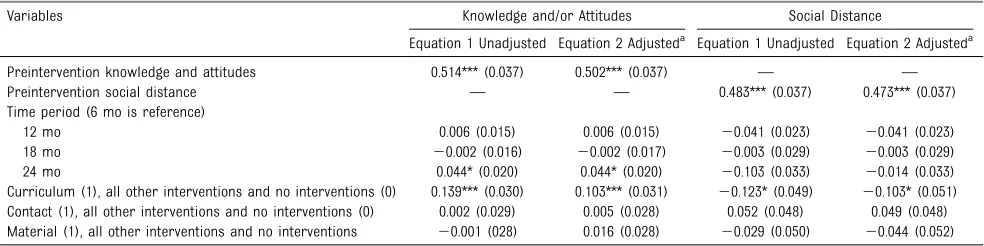
TABLE 1Multiple Linear Regression (GEEs) Showing the Effect of Preintervention Levels of the Outcome Variable, Time Period and Curriculum, Contact, and Materials Interventions on Knowledge and Attitudes and Social Distance: Regression Coefficients and Robust SEs (n= 416 Youth;n= 1432 Observations for Knowledge and Attitudes;n= 1428 Observations for Social Distance)
Variables Knowledge and/or Attitudes Social Distance
Equation 1 Unadjusted Equation 2 Adjusteda Equation 1 Unadjusted Equation 2 Adjusteda
Preintervention knowledge and attitudes 0.514*** (0.037) 0.502*** (0.037) — — Preintervention social distance — — 0.483*** (0.037) 0.473*** (0.037) Time period (6 mo is reference)
12 mo 0.006 (0.015) 0.006 (0.015) 20.041 (0.023) 20.041 (0.023)
18 mo 20.002 (0.016) 20.002 (0.017) 20.003 (0.029) 20.003 (0.029)
24 mo 0.044* (0.020) 0.044* (0.020) 20.103 (0.033) 20.014 (0.033)
Curriculum (1), all other interventions and no interventions (0) 0.139*** (0.030) 0.103*** (0.031) 20.123* (0.049) 20.103* (0.051) Contact (1), all other interventions and no interventions (0) 0.002 (0.029) 0.005 (0.028) 0.052 (0.048) 0.049 (0.048) Material (1), all other interventions and no interventions 20.001 (028) 0.016 (0.028) 20.029 (0.050) 20.044 (0.052)
—, not applicable.
aAdjusted for child age, sex, race and/or ethnicity, social desirability score, caregiver education, and whether English was the main language spoken in the home.
showing the main effects. Table 1, Equation 1 shows the effect of each intervention while controlling for time period and preintervention values of the dependent variable. Neither the contact nor the materials intervention was significant for either dependent variable. Exposure to the curriculum intervention is associated with a significant increase in
knowledge and attitudes (b = 0.139;
P,.001; Cohen’s d 0.35) and a significant decrease in social distance (b =20.123;P,.05; Cohen’s d 0.16). Equation 2 shows that the curriculum remains significantly associated with both knowledge and
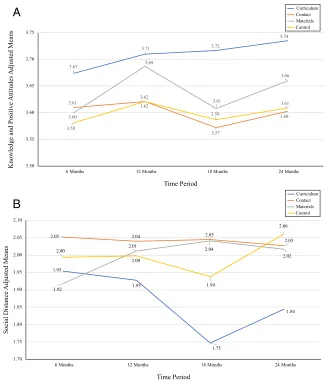
attitudes and social distance when controlling for covariates. Figure 1 shows means adjusted for
covariates calculated for each dependent variable at each time period and indicates that the curriculum intervention is both beneficial (higher knowledge and attitudes and lower social distance) and enduring in its effect over the study period.
Do Curriculum Effects on Knowledge and Attitudes and Social Distance Vary by Youth Attributes?
We assessed interactions between assignment to the curriculum and preexisting attitudes, social
desirability bias, sex, age, race and/or ethnicity, and parent or guardian educational attainment on knowledge and attitudes and social distance. Of the 16 interactions examined, 1 was significant: Latino youth did not experience curriculum-associated reductions in social distance (Supplemental Fig 4). We found no significant interaction between the curriculum and race and/or ethnicity on knowledge and attitudes or treatment seeking and no significant interaction between the curriculum and any of the other variables examined.
Does the Curriculum Intervention Lead Youth With High Symptom Levels to Seek Treatment?
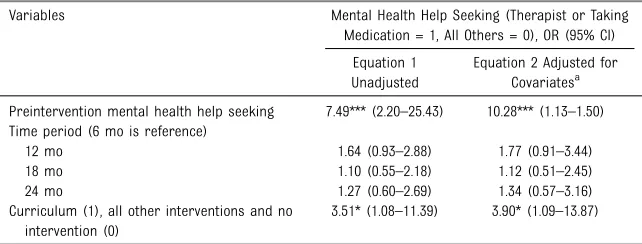
Table 2 compares youth with high symptom levels assigned to the curriculum with youth with high symptom levels who were not assigned to the curriculum. As expected, preintervention mental health treatment seeking is significantly associated with treatment seeking postintervention. Importantly, whether before adding covariates (odds ratio [OR] = 3.51; confidence interval [CI] = 1.08–11.39)
or after doing so (OR = 3.90; CI = 1.09–13.87), assignment to the curriculum is associated with increased odds of mental health treatment seeking. Because postintervention treatment seeking could representfirst-ever treatment seeking, a continuation of treatment seeking, or return to treatment seeking, supplementary analyses examined curriculum effects for these outcomes separately (Supplemental Table 16) and found ORs that were similar in magnitude to those reported above but that were not statistically significant because of
FIGURE 1
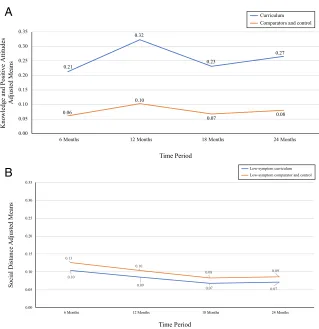
smaller sample sizes. We found no evidence of interaction between curriculum assignment and time period. Figure 2 shows predicted probabilities of treatment seeking, with youth with high symptom levels assigned to curriculum being much more likely to experience treatment seeking than youth with high symptom levels assigned to comparator interventions or no intervention.
In contrast, we found no significant effect of the curriculum intervention on treatment seeking in youth with fewer symptoms. A test of the interaction (not shown) revealed that the effect of curriculum assignment was significantly different in the high-as opposed to the low-symptom group. Figure 2 shows predicted probabilities in the lower-symptom group and indicates no effect of the curriculum in relation to comparator interventions and the no-intervention control.
DISCUSSION
We examined whether a school-based antistigma curriculum intervention targeted early in the life course might improve the context in which mental health problems are experienced, increasing knowledge, improving
attitudes, and inducing treatment seeking when mental health problems are present. The results generally support an impact of the ESD curriculum in achieving these goals. Youth assigned to the curriculum intervention experienced significantly increased knowledge and more positive attitudes toward mental illness and reported significantly reduced social distance from youth with mental illness. Because our study is unique in that it is a cluster randomized design among
preadolescent youth with 2-year follow-up, we cannot make direct comparisons to effect sizes achieved in other studies. However, a meta-analysis of mental health stigma interventions among adults and adolescents (not preadolescents) reported average effect sizes for randomized studies to be smaller than ours (0.21 for attitudes and knowledge and 0.10 for social distance).33Additionally, participants in the ESD intervention were substantially more likely to seek treatment for mental health problems if they experienced them than were youth in other intervention groups or control group, afinding that, to our knowledge, has not previously been addressed in
stigma-intervention research.
A unique aspect of our design was the 2-year follow-up, which revealed that intervention effects did not
appreciably dissipate over that period. Additionally, with 1 exception (Latino youth with respect to social distance), there were no significant differences in the effectiveness of the curriculum intervention by race and/ or ethnicity, sex, educational level of caregivers, or youth preintervention attitudes.
We found no effect of the contact intervention, although contact has often been shown to be the most effective way to change attitudes. A potential explanation is that contact is not as effective in youth, a possibility that is supported by a meta-analysis showing diminished effects of contact compared with educational interventions in adolescents.33
Our study is limited by its use of self-reported data for both attitudes and treatment-seeking behaviors. Our use of self- rather than interviewer-administered survey instruments and our ability to control for social desirability bias somewhat mitigate our concerns about reporting bias. Because treatment seeking is self-reported by the youth participating, we were not able to acquire details about the type or adequacy of treatment. Loss to follow-up, which is a common problem for longitudinal studies, is another limitation. Somewhat reassuring was the
finding of no significant differences between those successfully
followed and those lost to follow-up, the correspondence between our achieved sample and the population from which they were drawn in terms of race and/or ethnicity and socioeconomic status, and our multiple sensitivity analyses implemented to address missing values. Despite matching schools on test scores, our cluster randomization of classrooms resulted in preintervention differences between groups on some baseline characteristics, TABLE 2Logistic Regression (GEE) Showing the Effect of the ESD Curriculum Intervention on
Treatment Seeking for Mental Health Problems Among Youth With High Symptom Levels (n= 77 Youth;n= 275 Observations)
Variables Mental Health Help Seeking (Therapist or Taking Medication = 1, All Others = 0), OR (95% CI)
Equation 1 Unadjusted
Equation 2 Adjusted for Covariatesa
Preintervention mental health help seeking 7.49*** (2.20–25.43) 10.28*** (1.13–1.50) Time period (6 mo is reference)
12 mo 1.64 (0.93–2.88) 1.77 (0.91–3.44) 18 mo 1.10 (0.55–2.18) 1.12 (0.51–2.45) 24 mo 1.27 (0.60–2.69) 1.34 (0.57–3.16) Curriculum (1), all other interventions and no
intervention (0)
3.51* (1.08–11.39) 3.90* (1.09–13.87)
aAdjusted for child age, sex, race and/or ethnicity, social desirability score, caregiver education, and whether English was
the main language spoken in the home. *P,.05.
leading us to adjust for covariates and preintervention measures of dependent variables. Although diverse in terms of race and/or ethnicity and parental education, our study is limited in generalizability
because it was conducted in 1 school district in Texas.
Our study joins a handful of others that have intervened with
preadolescent students and shown
positive effects on knowledge and attitudes. We added a substantially longer follow-up and included measures of treatment-seeking behaviors in an intervention designed to be relatively easily disseminated. Our study, in combination with other studies, suggests strongly that youth can be positively influenced at a relatively young age, fostering changes in mental health attitudes and behaviors that last, as our study has shown, for at least 2 years. Although we cannot know from the data in hand, we might expect that if interventions were delivered annually in every sixth-grade class, the context experienced by people with mental illness could improve even more, a possibility that future research might examine. We do know that negative attitudes toward mental illnesses and the exceptionally large percentage of people who experience but do not receive treatment for such illnesses are problems that have been with us for a long time. Interventions such as ESD represent a partial but positive response to this public mental health challenge.
ABBREVIATIONS
CI: confidence interval DISC: Diagnostic Interview
Schedule for Children ESD: Eliminating the Stigma of
Differences
GEE: generalized estimating equation
OR: odds ratio
This trial has been registered at www.clinicaltrials.gov (identifier NCT03597048). Deidentified individuals’participant data will not be made available.
DOI:https://doi.org/10.1542/peds.2019-0780 Accepted for publication Dec 3, 2019
Address correspondence to Bruce G. Link, PhD, School of Public Policy, University of California, Riverside, Interdisciplinary South 4133, 900 University Ave, Riverside, CA 92521. E-mail: [email protected]
PEDIATRICS (ISSN Numbers: Print, 0031-4005; Online, 1098-4275). Copyright © 2020 by the American Academy of Pediatrics
FIGURE 2
FINANCIAL DISCLOSURE:The authors have indicated they have nofinancial relationships relevant to this article to disclose.
FUNDING:Supported by the National Institute of Mental Health (grant 1 R01 MH095254-01; to Drs Link and Painter [coprincipal investigators]). Funded by the National Institutes of Health (NIH).
POTENTIAL CONFLICT OF INTEREST:The authors have indicated they have no potential conflicts of interest to disclose.
REFERENCES
1. Link BG, Stuart H. On Revisiting Some Origins of the Stigma Concept as It Applies to Mental Illnesses. In: Gaebel W, Rössler W, Sartorius N, eds.The Stigma of Mental Illness-End of the Story?New York, NY: Springer International; 2017: 3–28
2. Corrigan PW, Watson AC. Understanding the impact of stigma on people with mental illness.World Psychiatry. 2002; 1(1):16–20
3. Link BG. Understanding labeling effects in the area of mental disorders: an assessment of the effects of
expectations of rejection.Am Sociol Rev. 1987;52(1):96–112
4. Pescosolido BA, Martin JK, Long JS, Medina TR, Phelan JC, Link BG.“A disease like any other”? A decade of change in public reactions to schizophrenia, depression, and alcohol dependence.Am J Psychiatry. 2010; 167(11):1321–1330
5. Yanos PT.Written-Off: Mental Health Stigma and the Loss of Human Potential. Cambridge, United Kingdom: Cambridge University Press; 2018
6. Avenevoli S, Swendsen J, He JP, Burstein M, Merikangas KR. Major depression in the national comorbidity survey-adolescent supplement: prevalence, correlates, and treatment.J Am Acad Child Adolesc Psychiatry. 2015;54(1): 37–44.e2
7. Merikangas KR, He JP, Burstein M, et al. Service utilization for lifetime mental disorders in US adolescents: results of the National Comorbidity Survey-Adolescent Supplement (NCS-A).J Am Acad Child Adolesc Psychiatry. 2011; 50(1):32–45
8. DuPont-Reyes MJ, Villatoro AP, Phelan JC, Painter K, Link BG. Patterns of aggressive behaviors across mental health in sixth graders.J Interpers Violence. 2018;886260518793991
9. Leary MR, Kowalski RM, Smith L, Phillips S. Teasing, rejection, and violence: case
studies of the school shootings.
Aggress Behav. 2003;29(3):202–214
10. Stone DM, Simon TR, Fowler KA, et al. Vital signs: trends in state suicide rates - United States, 1999–2016 and circumstances contributing to suicide -27 states, 2015.MMWR Morb Mortal Wkly Rep. 2018;67(22):617–624
11. Green JG, McLaughlin KA, Alegría M, et al. School mental health resources and adolescent mental health service use.J Am Acad Child Adolesc Psychiatry. 2013;52(5):501–510
12. Ndetei DM, Mutiso V, Maraj A, Anderson KK, Musyimi C, McKenzie K. Stigmatizing attitudes toward mental illness among primary school children in Kenya.Soc Psychiatry Psychiatr Epidemiol. 2016; 51(1):73–80
13. Wahl OE. Children’s views of mental illness: a review of the literature.
Psychiatr Rehabil Skills. 2002;6(2): 134–158
14. Wahl O, Susin J, Lax A, Kaplan L, Zatina D. Knowledge and attitudes about mental illness: a survey of middle school students.Psychiatr Serv. 2012; 63(7):649–654
15. Watson AC, Otey E, Westbrook AL, et al. Changing middle schoolers’attitudes about mental illness through education.
Schizophr Bull. 2004;30(3):563–572
16. Wahl OF, Susin J, Kaplan L, Lax A, Zatina D. Changing knowledge and attitudes with a middle school mental health education curriculum.Stigma Res Action. 2011;1(1):44–53
17. Desocio J, Stember L, Schrinsky J. Teaching children about mental health and illness: a school nurse health education program.J Sch Nurs. 2006; 22(2):81–86
18. Pitre N, Stewart S, Adams S, et al. The use of puppets with elementary school children in reducing stigmatizing attitudes toward mental illness.J Ment Health. 2007;16(3):415–429
19. Spagnolo AB. Examining the Effects of Anti-stigma Messages on the Attitudes of Early Adolescents [doctoral dissertation]. Newark, NJ: University of Medicine and Dentistry of New Jersey; 2009
20. Ventieri D, Clarke DM, Hay M. The effects of a school-based educational intervention on preadolescents’ knowledge of and attitudes toward mental illness.Adv Sch Ment Health Promot. 2011;4(3):5–17
21. Mellor C. School-based interventions targeting stigma of mental illness: systematic review.Psychiatr Bull (2014). 2014;38(4):164–171
22. Salerno JP. Effectiveness of universal school‐based mental health awareness programs among youth in the United States: a systematic review.J Sch Health. 2016;86(12):922–931
23. Painter K, Phelan JC, DuPont-Reyes MJ, Barkin KF, Villatoro AP, Link BG. Evaluation of antistigma interventions with sixth-grade students: a school-basedfield experiment.Psychiatr Serv. 2017;68(4):345–352
24. Arlington Independent School District. Student data reports. Available at: https://www.aisd.net/district/about/ student-data/. Accessed July 8, 2019
25. US Census Bureau. Selected characteristics of the native and foreign-born populations, Arlington Texas. American Community Survey 2012: 5-year Estimates. Available at: https://data.census.gov/cedsci/table?q= Arlington%20Texas%202012&g= 1600000US4804000&hidePreview=fa lse&table=S0501&tid=ACSST5Y2012. S0501&y=2012&vintage=2012&layer= place&cid=DP05_0001E&lastDisplaye dRow=60&mode=. Accessed January 20, 2020
27. Shaffer D, Fisher P, Lucas CP, Dulcan MK, Schwab-Stone ME. NIMH Diagnostic Interview Schedule for Children Version IV (NIMH DISC-IV): description, differences from previous versions, and reliability of some common diagnoses.J Am Acad Child Adolesc Psychiatry. 2000;39(1): 28–38
28. Baxter SD, Smith AF, Litaker MS, et al. Recency affects reporting accuracy of
children’s dietary recalls.Ann Epidemiol. 2004;14(6):385–390
29. Crandell VC, Crandell VJ, Kratkovsky W. A child’s social desirability scale.
J Consult Clin Psychol. 1965;29(1): 27–36
30. Liang KY, Zeger SL. Longitudinal data analysis using generalized linear models.Biometrika. 1986;73(1):13–22
31. Azur MJ, Stuart EA, Frangakis C, Leaf PJ. Multiple imputation by chained
equations: what is it and how does it work?Int J Methods Psychiatr Res. 2011;20(1):40–49
32. Rubin DB.Multiple Imputation for Nonresponse in Surveys. New York, NY: John Wiley & Sons; 2004
DOI: 10.1542/peds.2019-0780 originally published online May 20, 2020;
2020;145;
Pediatrics
and Kris Painter
Bruce G. Link, Melissa J. DuPont-Reyes, Kay Barkin, Alice P. Villatoro, Jo C. Phelan
Trial
A School-Based Intervention for Mental Illness Stigma: A Cluster Randomized
Services
Updated Information &
http://pediatrics.aappublications.org/content/145/6/e20190780 including high resolution figures, can be found at:
References
http://pediatrics.aappublications.org/content/145/6/e20190780#BIBL This article cites 26 articles, 1 of which you can access for free at:
Subspecialty Collections
al_issues_sub
http://www.aappublications.org/cgi/collection/development:behavior Developmental/Behavioral Pediatrics
following collection(s):
This article, along with others on similar topics, appears in the
Permissions & Licensing
http://www.aappublications.org/site/misc/Permissions.xhtml in its entirety can be found online at:
Information about reproducing this article in parts (figures, tables) or
Reprints
DOI: 10.1542/peds.2019-0780 originally published online May 20, 2020;
2020;145;
Pediatrics
and Kris Painter
Bruce G. Link, Melissa J. DuPont-Reyes, Kay Barkin, Alice P. Villatoro, Jo C. Phelan
Trial
A School-Based Intervention for Mental Illness Stigma: A Cluster Randomized
http://pediatrics.aappublications.org/content/145/6/e20190780
located on the World Wide Web at:
The online version of this article, along with updated information and services, is
http://pediatrics.aappublications.org/content/suppl/2020/05/19/peds.2019-0780.DCSupplemental Data Supplement at:
by the American Academy of Pediatrics. All rights reserved. Print ISSN: 1073-0397.