Performance evaluation of a Sewage Treatment Plant Based
on Sequential Batch Reactor Technology
Mohd. Faraz Khan
1, Hina Khan
2 1M.Tech Student,Department of Environment Science & Engineering
Indian Institute of Technology (Indian School of Mines) Dhanbad 826004
Jharkhand, India
2
Young Professional, Bureau of Indian Standards
, Bahadur Shah Zafar Marg, New Delhi, Delhi 110002
ABSTRACT
The Sequential Batch Reactor (SBR) is one of the potential options for treatment of industrial wastewater. SBR is a
fill-and draw, system for aerobic and anaerobic wastewater treatment. In industrial wastewater wide variety of
both, inorganic and organic, pollutants are present in the effluents which include oil, greases, metallic wastes,
suspended solids, phenols, toxins, acids, dyes, colors, etc., several of which are not readily susceptible to
degradation and therefore creating a dilemma during disposal. SBR is one of the latest options for the treatment of
industrial wastewater. They are uniquely suited for wastewater treatment applications characterized by low or
intermittent flow conditions. Operations and Maintenance (O&M) costs associated with an SBR system may be
similar to a conventional activated sludge system. The overall working of the SBR is in five steps, fill, react, settle,
decant, and idle. The process modification is very easy due to the amenable nature of the SBR. The cycles, hydraulic
retention time (HRT), sludge retention time (SRT) can be changed and hence it provides wide scope for treatment
that is too in a single reactor which is a most advantageous factor. SBRs are also used as pre or post-treatment
prospects along with other treatment facilities successfully.
Keywords-:
Activated Sludge Process
,
Sequencing Batch Reactor,Wastewater treatment
I.
INTRODUCTION
simultaneously in separate tanks, whereas in SBR operation the processes are carried out sequentially in the same tank .4
Water reuse is an engaging strategy that can significantly add to water conservation in areas experiencing from water scarcity or overconsumption. This enables the use of reclaimed water for particular purposes, which depending upon the application, requires various levels of treatment. Sewage Treatment is applied to reuse treated water.
To limit pollution of the natural environment, biological treatment, using Activated sludge process has been the common treatment process for sewage.
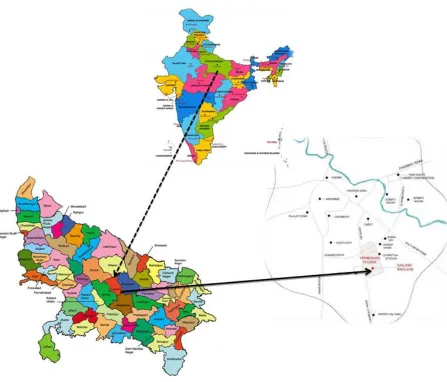
Fig. 2: Satellite Imagery of the Vrindavan Yojana STP
TABLE 1
:- Dimensions of STP units installed at the Vrindavan Yojana
S.No. Description Size(mm) Quantity
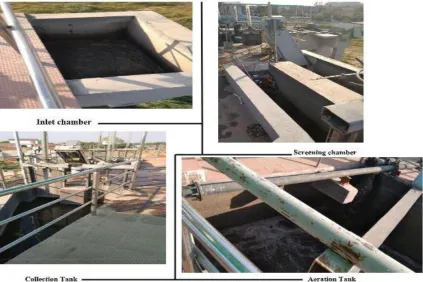
1. Screen Chamber 800×500 1
2. Collection Tank 2100×3650 1
3. Aeration Tank 1 and 2 3500×3650 2
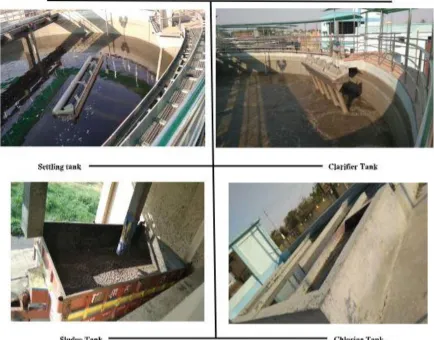
4. Settling Tank 2800×2800 1
5. Clarifier Water Tank 1800×2400 1
6. Sludge holding Tank 1800×1800 1
7. Sludge drying Beds 1100×1100 2
Ⅱ MATERIAL
AND METHOD
The experimental method for this task includes lab analysis carried out in the Environmental Chemistry lab of Integral University Lucknow, Department of Civil Engineering, site visit to the STP, collection of sample of inlet and outlet samples, during my study have been collected from STP based on SBR technology located at sector-6, Vrindavan Yojana, Lucknow. Samples from the inlet & outlet chamber of the STP during the period from January 2019 to May 2019 were gathered. Samples were analyzed for various parameters like Turbidity, BOD, COD, TSS, and on the basis on the result, the performance of STP was assessed.
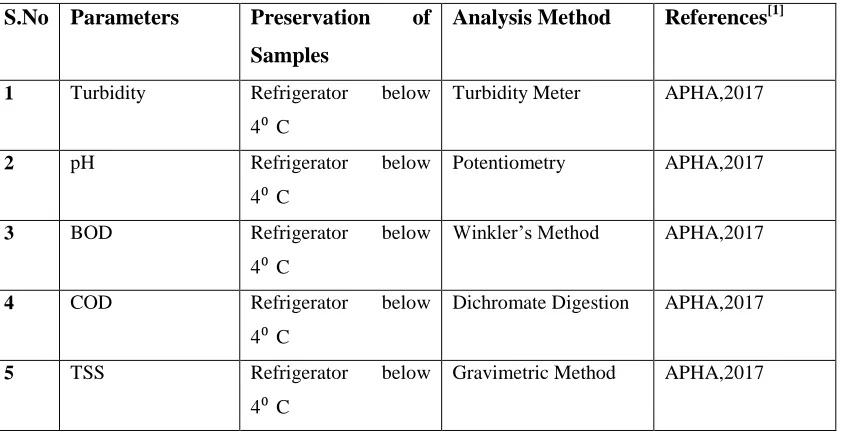
TABLE 2-: Details of some physicochemical parameters of STP with SBR Technology
S.No Parameters
Preservation
of
Samples
Analysis Method
References
[1]1 Turbidity Refrigerator below
4⁰ C
Turbidity Meter APHA,2017
2 pH Refrigerator below
4⁰ C
Potentiometry APHA,2017
3 BOD Refrigerator below
4⁰ C
Winkler’s Method APHA,2017
4 COD Refrigerator below
4⁰ C
Dichromate Digestion APHA,2017
5 TSS Refrigerator below
4⁰ C
Gravimetric Method APHA,2017
There are five stages in the treatment process:
1. Fill
2. React
3. Settle
4. Decant
5. Idle
Figure 3. Process Cycle of a Sequential Batch Reactor5
Ⅱ
.1 TECHNOLOGY DESCRIPTION
Typically the SBR system is consists of a separate tank, where all operations are carried out (Figure 1). The series of operation is divided into five discrete periods: (a) fill, (b) react (aeration), (c) settle, (d) draw, and (e) idle, which complete the whole cycle. The cycle of each SBR system undergoes one or more cycle during a day.
(a)Fill-: The fill process is where the reactor is filled with wastewater between a low water level & a high water level. Fill could occur under mixed, unmixed, aerated or unaerated conditions. The time of fill depends on the capacity of each reactor, the number of parallel reactors in operation, & the variations in the wastewater flow rate.7 (b) React-:The react phase begins once fill is complete. It includes mixing & aeration (dissolved oxygen (DO)>2 mg/l). In this phase, no influent flow into SBR aeration & sludge could be wasted , Aeration process serves to nitrify ammonia, oxidize organic carbon, & promote uptake of phosphorus in the sludge, while unaerated conditions support denitrification of nitrite & nitrate.
(d) Draw-: The goal of the draw is to remove treated water from the reactor
(e) Idle-: Provide time for one reactor to complete its full cycle before switching to another SBR cycle [3]
Ш RESULTS AND DISCUSSION
Colmenarejo et al., (2006) determined the general efficiency indicator to compare overall performance of the different plants in terms of average TSS, COD, and BOD3 removal efficiencies. The pH of waste water impacts a significance effects on rate of microbiological growth, pH (basic) after the structure of enzymes and stop growth. Favorable range of pH is 6.5 - 8.57.
Experimental determinations of STPs based on SBR Technology symbolize that Turbidity, BOD, COD & Total Suspended Solids (TSS), removal efficiencies were calculated to be 89.81%, 94.1%, 90.46%, 96.11%, respectively. According to Environmental protection rules 1986 [Schedule vi] published in CPCB report August 2013, treated effluent is safe against disposal on land and used in irrigation. Discharge of the final effluent from the Sewage Treatment Plant may not cause health risks or any major environmental problems.
Table 3-: Analysis of some physicochemical parameters at inlet & outlet of STP with SBR Technology
Date of
Sampling 1. pH 2.BOD3(mg/l) 3.COD(mg/l) 4.TSS(mg/l) 5.Turbidity
IN OUT IN OUT IN OUT IN OUT IN OUT
15/1/2018 7.24 6.69 276 7 365.18 28.14 359 11 1282 112
15/5/2018 7.94 7.26 275 25 425.12 48.27 425 20 1358 158
%Removal 8.07 94.1 90.46 96.11 89.81
Ⅳ
CONCLUSION
The performance of SBRs is typically comparable to conventional activated sludge systems and depends on system design and site specific criteria. Depending on their mode of operation, SBRs can achieve good BOD and nutrient removal. For SBRs, the BOD removal efficiency is generally 85 to 95 percent.4
[1}APHA (2017),Standard methods of testing water and wastewater,23rd Edition American Public Health Association,Washington DC
[2]Ronald L. Antonie (2011). Troubleshooting the Sequencing Batch Reactor. John Wiley &
Sons. ISBN 9781118058220. Retrieved 27 February 2018.
[3]Sequencing Batch Reactor Process: Simultaneous Removal of BOD, Nitrogen and Phosphorus from Wastewater ,S.K. Maiti Indian School of Mines, Centre of Mining Environment, Dhanbad-826 O04
[4]Metcalf & Eddy, Inc. Wastewater Engineering: Treatment, Disposal, Reuse.3rd edition. New York: McGraw Hill [5] Thalis Environmental Services [email protected]
[6]Colmenarejo et al., (2006)Evaluation of municipal wastewater treatment plants with different technologies at Las
Rozas, Madrid (Spain)