POLICY STATEMENT
Drinking Water From Private Wells
and Risks to Children
Committee on Environmental Health and Committee on Infectious Diseases
ABSTRACT
Drinking water for approximately one sixth of US households is obtained from private wells. These wells can become contaminated by pollutant chemicals or pathogenic organisms and cause illness. Although the US Environmental Protec-tion Agency and all states offer guidance for construcProtec-tion, maintenance, and testing of private wells, there is little regulation. With few exceptions, well owners are responsible for their own wells. Children may also drink well water at child care or when traveling. Illness resulting from children’s ingestion of contaminated water can be severe. This policy statement provides recommendations for inspec-tion, testing, and remediation for wells providing drinking water for children.
Pediatrics2009;123:1599–1605
INTRODUCTION
Approximately 15% to 20% of households in the United States obtain their water
from private wells.1Private wells are not subject to federal regulations of the US
Environmental Protection Agency (EPA) or those of the Navajo Nation (which has its own EPA) and are minimally regulated by states. Coliform contamination of
home private wells in Iowa in the 1990s was as high as 27%.2According to the
Centers for Disease Control and Prevention, there were 31 waterborne disease outbreaks reported in the United States in 2005–2006, the latest years for which
data are published.3Twenty of the outbreaks were from drinking water, of those,
8 were groundwater sources, usually private wells. Those caused illness in 458
people. The etiology of 5 of the outbreaks is known: 1 wasCampylobacter, 3 were
norovirus, and 1 was Hepatitis A. Waterborne illness is undoubtedly underrecog-nized and underreported.
GROUNDWATER AND WELLS
Groundwater is water below the topsoil and above impervious bedrock. When groundwater collects in and saturates relatively porous fractured bedrock and soil, it is said to be in an aquifer. The water table is a depth below which the soil and fractured bedrock (ie, the aquifer) is saturated with water. The water table can vary from season to season and year to year. For a well to produce water reliably, it must be deep enough so that water can be pumped from the aquifer under virtually all weather conditions. Aquifers are recharged from above by precipitation and runoff.
WELL TYPES
Dug wells usually are shallow holes, 10 to 30 ft deep, lined with rock, brick, tile, or concrete, with a pump in a nearby pump house or in the dwelling. Dug wells usually are relics on older home sites. They are easy to contaminate and unreliable in most of the United States.
For driven wells, pipe is driven through gravel or sandy soil. These wells also tend to be shallow, usually approximately 50 ft deep; the pump is installed at the top of the well or in the dwelling. Driven wells are still relatively easy to contaminate because of their shallowness but can be installed rapidly and inexpensively if the geologic conditions are right. Dug wells and driven wells are often the water source at camps or vacation homes.
Drilled wells are 100 to 400 ft deep and reach bedrock. Most drilled wells have an electric submersible pump at the bottom. Because the water has been filtered by soil on the way down and is relatively safe from contamination while in the aquifer, water from these deeper wells is less likely to be contaminated.
www.pediatrics.org/cgi/doi/10.1542/ peds.2009-0751
doi:10.1542/peds.2009-0751
All policy statements from the American Academy of Pediatrics automatically expire 5 years after publication unless reaffirmed, revised, or retired at or before that time.
This document is copyrighted and is property of the American Academy of Pediatrics and its Board of Directors. All authors have filed conflict-of-interest statements with the American Academy of Pediatrics. Any conflicts have been resolved through a process approved by the Board of Directors. The American Academy of Pediatrics has neither solicited nor accepted any commercial involvement in the development of the content of this publication.
Key Words
water, drinking water, well, well water, private well, groundwater, nitrate, waterborne disease
Abbreviation
EPA—Environmental Protection Agency
PEDIATRICS (ISSN Numbers: Print, 0031-4005; Online, 1098-4275). Copyright © 2009 by the American Academy of Pediatrics
COMPOSITION OF WELL WATER
Chemicals
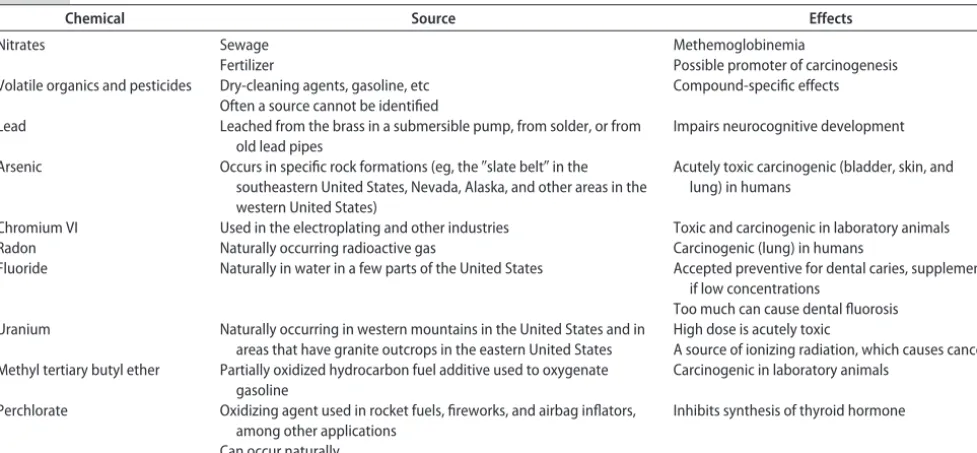
The chemical composition of well water varies with re-gion, underlying geologic formation, and environmental contamination and can be harmful, beneficial, or merely undesirable. For example, some fluoride is desirable in drinking water, whereas iron is undesirable. Many other chemicals, some of them potentially toxic, can contam-inate well water, with their presence or absence attrib-utable to naturally occurring geologic factors or disper-sion from industry, farms, or business (Table 1). The presence of nitrates is particularly problematic for
in-fants.4The most commonly occurring pollutant
chemi-cals are volatile organics and pesticides, which may be
identifiable in more than one third of US wells,5albeit
mostly at concentrations below federal public water standards.
Many commercial sources will measure water hard-ness and concentrations of iron and manganese. Cal-cium and magnesium carbonate make water hard. Hard water is not toxic, but it may require treatment to pre-vent precipitation from clogging pipes and causing other problems, such as coating electric hot water heater ele-ments and causing them to burn out. Manganese and iron can appear as rust-colored to black flecks and can stain clothing, plumbing, and fixtures. So-called iron and manganese bacteria can grow in such water and form visible black slimy colonies of microorganisms, sometime clogging pipes and faucets.
Microorganisms
Microorganisms, including bacteria, viruses, fungi, and parasites, can contaminate the ground water that sup-plies wells (Table 2). The major source of these organ-isms is fecal material from animals and humans. Ana-lyzing well water at its point of use for “total coliforms”
is the commonest way of detecting fecal contamination of the water. Where available, testing for fecal coliforms
and/orEscherichia colimay be performed as a combined
assay with total coliforms and used for the annual bac-terial testing. The absence of coliforms is good but not absolute evidence that significant fecal contamination is not present. Samples that contain any coliforms should be retested to determine if they are fecal coliforms; spec-imens that test positive should be examined for the
presence ofE colior other pathogens.
Much of the information describing the pathogens that can be present in well water has been obtained from investigations of waterborne outbreaks. In the United States, most waterborne outbreaks are associated with noncommunity water systems, chiefly private or
com-munal wells.3
MITIGATION
Bacterial
If test results confirm bacterial contamination, the water system must be treated. The first approach is to inspect the well to make sure that there are no structural defects that may have fostered the contamination. “Shock chlo-rination,” using concentrations of chlorine that are 100
TABLE 1 Relevant Chemicals in Well Water
Chemical Source Effects
Nitrates Sewage Methemoglobinemia
Fertilizer Possible promoter of carcinogenesis
Volatile organics and pesticides Dry-cleaning agents, gasoline, etc Compound-specific effects Often a source cannot be identified
Lead Leached from the brass in a submersible pump, from solder, or from old lead pipes
Impairs neurocognitive development
Arsenic Occurs in specific rock formations (eg, the⬙slate belt⬙in the southeastern United States, Nevada, Alaska, and other areas in the western United States)
Acutely toxic carcinogenic (bladder, skin, and lung) in humans
Chromium VI Used in the electroplating and other industries Toxic and carcinogenic in laboratory animals
Radon Naturally occurring radioactive gas Carcinogenic (lung) in humans
Fluoride Naturally in water in a few parts of the United States Accepted preventive for dental caries, supplement if low concentrations
Too much can cause dental fluorosis Uranium Naturally occurring in western mountains in the United States and in
areas that have granite outcrops in the eastern United States
High dose is acutely toxic
A source of ionizing radiation, which causes cancer Methyl tertiary butyl ether Partially oxidized hydrocarbon fuel additive used to oxygenate
gasoline
Carcinogenic in laboratory animals
Perchlorate Oxidizing agent used in rocket fuels, fireworks, and airbag inflators, among other applications
Inhibits synthesis of thyroid hormone
Can occur naturally
TABLE 2 Pathogenic Microorganisms Found in Well Water
Bacteria Viruses Parasites
Escherichia coli, including O157:H7 Norovirus, sapovirus Giardia intestinalis Salmonellaspecies Rotavirus Cryptosporidium Shigellaspecies Enteroviruses Cyclospora Campylobacter jejuni Hepatitis A and E Microsporidia Yersinia enterocolitica Isospora Mycobacterium
avium-intracellulare
to 400 times the amount found in municipal water sup-plies, should be performed initially. This can be per-formed by the homeowner using household bleach (many Web sites [eg, www.water-research.net/shock welldisinfection.htm] have instructions), but consulta-tion with the health department or other experienced individuals is advisable before the first time.
Most other treatment measures require the service of a trained home water-treatment professional. If bacterial contamination persists despite efforts at continuous dis-infection, natural or structural factors may be present that may not be under the control of the well owner. This may require that the well be closed and a new well be drilled. A certified well contractor should fill or seal the contaminated well.
Chemical
Chemical contaminants are approached by investigating the possibility that the contamination exists on the homeowner’s or on an adjacent homeowner’s property, such as from agricultural application of nitrogen-con-taining fertilizers, pesticide application, or fuel tanks. If the water supply cannot be remediated further and the well is still contaminated or the chemicals in question are naturally occurring, then it is possible to filter out or treat for virtually any chemical or biological
contami-nant.6However, treatment can become complex and/or
expensive and can require meticulous or professional maintenance.
Because there are no standards for private wells for many contaminants of concern, those seeking a specific concentration to indicate potability have little choice but to apply the same standards that municipalities do under the Safe Drinking Water Act amendments of 1996 (Pub L No. 104 –182 [for the current list of drinking water contaminants, see www.epa.gov/safewater/mcl.html]). Municipalities regard water that is persistently above these federal standards as not potable. Nonetheless, well owners or home occupants are under no obligation to apply this same standard to their well water.
RECOMMENDATIONS FOR PEDIATRICIANS
1. Pediatricians should ask whether a family drinks wa-ter from a private well at home, on vacation, when traveling, in child care, or other locations where they might drink water. This is particularly important for families with an infant. Families with children of high school age or younger should follow the algorithm in Appendix 1. A description of the tests and some ra-tionale for their use is provided as follows.
Routine Testing
A. Purchase of a New Home With a Well
The builder should provide the results of coliform, ni-trate, inorganic (total dissolved solids, iron, magnesium, calcium, chloride), fluoride, radon, and lead testing. If the well was shock-chlorinated after drilling, it should be retested for coliforms after some period of time as
rec-ommended by the local health department or agricul-tural extension agent. Have the builder or agent provide a site plan with the well, its water lines, and the septic tank and field.
B. Purchase/Rental/Lease of an Existing Home With a Well
Recommend including the well and septic field in any general inspection. If this cannot be performed, families should arrange for well inspection and testing as de-scribed in 1A and have the septic tank located and in-spected to determine if it needs to be pumped. If there are filters, softeners, or other devices in the water-supply lines, determine from the seller or landlord what they are treating.
C. Vacation Homes, Camps, etc
A vacation home or camp with a shallow well and no other water source should be tested each season, if pos-sible. If not, consider bottled water for infants or anyone with a compromised immune system. For a short stay, it may be safer and more convenient to use bottled water for drinking and cooking for everyone. Boiling water and filtration systems on the tap can reduce the risk of acquiring microorganisms from the untested well water. Boiling water means that the water must be brought to a full boil for 1 to 3 minutes, but recommendations vary and local advice should be sought. Filtration will allow
viruses and possibly someGiardia cysts through.
Test kits are available for coliforms and nitrate, but it is difficult for the consumer to judge the accuracy and quality control for each product. Thus, for families with an infant, for whom it is crucial to know that the nitrate concentration is below 10 mg/L, home testing is inad-visable.
D. Child Care and School
Child care in rural and suburban areas can be in a setting where the water comes from a private well. Parents should inquire about the child care center’s water source if they have any doubt. If the water comes from a well, parents should ask whether the well has been regularly and recently tested for nitrate and coliforms and what the results were. If recent results are not available, in-fants should be given bottled water until the well is shown not to have excessive nitrate concentrations.
E. Scheduled Testing
Every spring, the well should be examined to make sure that there are no mechanical problems. Well water should be tested annually for coliforms and nitrates. Testing more than once per year may be warranted in the following special situations: (1) someone in the household is pregnant or nursing; (2) there are unex-plained illnesses in the household; (3) neighbors find a dangerous contaminant in their well water; (4) there is a change in the odor or taste of the well water; (5) there is a chemical spill in proximity of the well; or (6) there was a significant repair or replacement in the well.
Rou-tine testing forGiardia andCryptosporidiumorganisms is
(filtering very large volumes of water) and expense. However, in the following situations, it may be prudent to test for these parasites: (1) members of family have
developed gastrointestinal disease attributable toGiardia
and/or Cryptosporidium species; (2) the well is at the
bottom of a hill and/or is shallow (vulnerable to runoff); or (3) the well is in a rural area where animals graze. The
risk factors for E coli O157:H7 are similar to those for
GiardiaandCryptosporidiumspecies. So when these
situ-ations exist, vigilance should be maintained for E coli
O157:H7 contamination and/or clinical symptoms. Much information about potential for contamination is local lore, so national sources of information about drinking water, such as the EPA Web site, repeatedly advise contact with local experts. Thus, the time of an-nual testing for nitrates and coliforms is a reminder to check with the health department about any water-quality problems that have emerged.
Occasional Testing
F. New Infant
A new infant or a child younger than 1 year in the home should prompt testing if the yearly test has indicated any fluctuation in nitrate concentrations or has never been performed. Even a breastfed infant may need water at some time, and boiling does not remove and can con-centrate nitrate.
G. Damage or Disturbance to the Well
If a new submersible pump is installed or the well integ-rity is compromised, such as by a falling tree, a vehicle collision, a flood, or a cut to the water line during landscaping, the well should be tested and, if necessary, shock-chlorinated.
H. Sentinel Illnesses
Every episode of gastroenteritis does not require well testing or an investigation of the cause of the illness. However, if multiple individuals become ill with gastro-enteritis, if the gastroenteritis is recurrent, or if a patho-gen causing the gastroenteritis is a bacteria or parasite that may have been present in the well water as a result of fecal contamination, then well testing for pathogens is indicated. Any occurrence of methemoglobinemia in an infant consuming well water requires testing the well water for nitrate. An elevated blood lead concentration in a child living in a home built after 1978, or a persis-tently elevated blood lead concentration, requires testing for lead in well water. At some point in the evaluation of unusual or cryptogenic illness, the possibility of contam-inated well water should be considered. For a list of symptoms associated with various well contaminants,
see the work by Wagenet et al6
2. Fluoride is an accepted preventive for dental caries, and if a child’s drinking water contains little or none, then supplements (available as drops or chewable tablets) are necessary. The American Academy of Pe-diatrics recommends no fluoride supplementation be-fore 6 months of age; from 6 months to 3 years of age,
children (including those who are breastfed) require fluoride supplementation if the water has a fluoride concentration of less than 0.3 ppm. Supplementation from 3 to 16 years of age is recommended where drinking water fluoride concentrations are less than
0.6 ppm.7To avoid dental fluorosis, water with
fluo-ride concentrations greater than 2 ppm should not be consumed by children younger than 9 years.
3. Become familiar with well water considerations in your area. Advocate for water safety practices that will protect the health of children.
RECOMMENDATIONS TO GOVERNMENT
1. Local governments should provide access to informa-tion about local groundwater condiinforma-tions. Recommen-dations for testing should be easily available with a telephone call or a Web-page visit. If water contam-ination becomes a public health issue, then multiple means of alerting and informing the public should be considered. In areas where agricultural land is being developed, paved, or put to any new use, local gov-ernments should consider mailing or using some other active means of getting their policies and rec-ommendations concerning well testing to homes with permitted wells and the possibility of being affected by the new use.
2. Tests determined to be necessary for the safety and health of the families drinking well water should be convenient and, if possible, free or inexpensive (see Appendix 2 for current costs).
3. Community wells that serve just enough households to be regulated are sometimes exempted from testing that is required of larger systems. Although this may be appropriate, it should not be routine, and adequate local data should justify any exemption.
4. For housing that has drinking water supplied by a private well, states should require testing for coli-forms, nitrate, fluoride, and any contaminant of local concern when a dwelling is sold, and the results should be made available to the buyer before closing.
COMMITTEE ON ENVIRONMENTAL HEALTH, 2008 –2009
Helen J. Binns, MD, MPH, Chairperson Joel A. Forman, MD
Catherine J. Karr, MD, PhD Kevin Osterhoudt, MD, MSCE Jerome A. Paulson, MD James R. Roberts, MD, MPH Megan T. Sandel, MD James M. Seltzer, MD Robert O. Wright, MD, MPH
LIAISONS
Elizabeth Blackburn, RN
US Environmental Protection Agency Mark Anderson, MD
Sharon Savage, MD
National Cancer Institute *Walter J. Rogan, MD
National Institute of Environmental Health Sciences
CONSULTANT
N. Beth Ragan
STAFF
Paul Spire
COMMITTEE ON INFECTIOUS DISEASES, 2008 –2009
Joseph A. Bocchini, Jr, MD, Chairperson Henry H. Bernstein, DO
John S. Bradley, MD *Michael T. Brady, MD Carrie L. Byington MD Penelope H. Dennehy, MD Margaret C. Fisher, MD Robert W. Frenck, Jr, MD Mary P. Glode, MD Harry L. Keyserling, MD David W. Kimberlin, MD Walter A. Orenstein, MD Lorry G. Rubin, MD
FORMER COMMITTEE MEMBERS
Robert S. Baltimore, MD Julia A. McMillan, MD
LIAISONS
Beth Bell, MD, MPH
Centers for Disease Control and Prevention Robert Bortolussi, MD
Canadian Paediatric Society Richard D. Clover, MD
American Academy of Family Physicians Marc A. Fischer, MD
Centers for Disease Control and Prevention Richard L. Gorman, MD
National Institutes of Health R. Douglas Pratt, MD
Food and Drug Administration Jennifer S. Read, MD
National Institutes of Health
Bruce Gellin, MD
National Vaccine Program Office Jeffrey R. Starke, MD
American Thoracic Society Jack Swanson, MD
Committee on Practice Ambulatory Medicine
EX OFFICIO
Carol J. Baker, MD
Red BookAssociate Editor Sarah S. Long, MD
Red BookAssociate Editor Larry K. Pickering, MD
Red BookEditor
CONSULTANTS
Edgar O. Ledbetter, MD H. Cody Meissner, MD
STAFF
Jennifer Frantz, MPH
*Lead authors
REFERENCES
1. US Environmental Protection Agency. Private drinking water wells. Available at: www.epa.gov/safewater/privatewells/ index2.html. Accessed April 1, 2008
2. Kross BC, Hallberg GR, Bruner DR, Cherryholmes K, Johnson JK. The nitrate contamination of private well water in Iowa.
Am J Public Health.1993;83(2):270 –272
3. Yoder J, Roberts V, Craun GF, et al. Surveillance for waterborne disease and outbreaks associated with drinking water and water not intended for drinking–United States, 2005–2006. MMWR Surveill Summ.2008;57(SS09):39 – 62
4. Greer FR, Shannon M; American Academy of Pediatrics, Com-mittee on Nutrition, ComCom-mittee on Environmental Health. In-fant methemoglobinemia: the role of dietary nitrate in food and water.Pediatrics.2005;116(3):784 –786
5. Squillace PJ, Scott JC, Moran MJ, Nolan BT, Kolpin DW. VOCs, pesticides, nitrate, and their mixtures in groundwater used for drinking water in the United States.Environ Sci Technol.2002; 36(9):1923–1930
6. Wagenet L, Mancl K, Sailus M.Home Water Treatment.Ithaca, NY: Natural Resource, Agriculture, and Engineering Service; 1995. NRAES-48
APPENDIX 1 Flowchart for Testing Well Water Well water? Infrequent travel, vacation, camping, visiting relatives
Always or usually
home or child care
Never
public water systems or community water systems serving
>25 people or >15 households
Bottled water
regulated by FDA
Private water wells
no state (or federal) regulations except in New Jersey
Public or private community water systems <25 people or <15
households no state (or federal) regulations except in New Jersey National Primary Drinking Water Regulations (NPDWR) and maximum contaminant levels (MCLs)
regulated by EPA
Community water system may perform annual/regular testing
New well Previously tested well
s t s e t l a u n n A s t s e t e n il e s a B Well changes requiring repeat of annual tests Household changes or conditions requiring repeat of baseline tests Conditions or nearby activities requiring testing Secondary (nonhealth) tests Conditions or
nearby activities Test for Total coliform bacteria (with
bacteria count) Iron Tota lcolfiormbacteira
Dormant well and/or
plumbing Pregnant mom
Recurring unexplained
gastrointestinal illness Coliform bacteria Illness s e t a r ti N e s e n a g n a M s e t a r ti N
Changes, damages or repairs to well or
plumbing Nursing infant
Household plumbing
contains lead pH, lead, copper Plumbing infant d e f -a l u m r o F ll e w t a e ri f r o g n i d o o l F e t a fl u S ) t s e t w a r d t s ri f ( d a e
L Corrosion of pipes,
plumbing Corrosion, pH, lead
s s e n d r a H e d ir o u l
F At sale/purchase of home with well
Immune system– depressed household
members
Radon in indoor air or
region is radon rich Radon Geology Arsenic Total dissolved solids (TDS) At moving into rental or leased home with well Children <18 y old Coal or other mining operations Metals, pH, corrosion "Local lore"
refer to local experts (ie, health department, agricultural extension) for conditions requiring testing
If prior well test results
unknown Nearby areas of intensive agriculture Nitrate, pesticides, coliform bacteria Location
Gas drilling operations Chloride, sodium, barium, strontium
Dump, junkyard, landfill, factory, gas station, or dry-cleaning operation
Volatile organic compounds (VOCx), total
dissolved solids, pH, sulfate, chloride, metals Chemical or fuel spill
nearby compounds (VOCx) Volatile organic
Test results Failure of onsite sewage/septic Coliform bacteria, nitrate, E coli Odor of gasoline or fuel oil,
and near gas station or buried fuel tanks
Volatile organic
compounds (VOCx) Odor, smell
s s a P li a
F Objectionable taste or smell Hydrogen sulfide, corrosion, metals Coliform:
boil water 5 min before drinking
or use bottled water
Secondary
contaminants Test for Fix problem
(do repairs) then shock chlorination
Nitrates: use bottled water
Return to annual testing
Salty taste and seawater or a heavily salted roadway
nearby
Chloride, total dissolved solids, sodium Taste
Scaly residues, soaps
don’t lather Hardness Hardness Test again
Water appears cloudy,
frothy, or colored Color, detergents Appearance Stained plumbing fixtures,
laundry Iron, copper, manganese Stains Repeated failures
Rapid wear of water
treatment equipment pH, corrosion Water treatment Water softener needed to
treat hardness Manganese, iron Reverse-osmosis
treatment Bottled water Home chlorination
c
b
a a
aTesting at sale/purchase of home is required by law in state of New Jersey.
APPENDIX 2 Well Water Tests, Recommended Frequency, and Approximate Costs
Test Frequency Approximate Costs,
2006 $
Annual tests Annually 30
Total coliform bacteria Nitrate
Common inorganic test battery 25
Fluoride Chloride Hardness
Copper Every 3–5 y
Iron pH Manganese Uranium
Arsenic 10
FHA/VA loan for new well; additional 1-time tests 10
Color Turbidity
Odor Every 3–5 y
Sodium
Lead (first draw) (1-time test free for FHA/VA loans) Every 10 y for homes built before 1985 15, stand-alone lead test
Additional⬙more thorough⬙1-time tests 25
Zinc Cadmium Detergents
Miscellaneous individual tests 15 each
Nitrate, chloride, hardness, copper, iron, pH, manganese, color, turbidity Fluoride, sodium, detergents, conductivity, total solids, ammonia nitrogen Arsenic, barium, cadmium, chromium, lead, silver, selenium, uranium Organic compound tests
Volatile petroleum screen (gasoline, MTBE), in water 60
Volatile petroleum screen (gasoline, MTBE), in soil 80
Diesel organics and fuel oil 140
Volatile organics screen (especially solvents, degreasers) 135
Semivolatiles organic screen (including wood preservatives) 200
Semivolatiles organic screen plus chlordane, PCBs, and toxaphene 275
PCBs 150
Chlorinated acids: herbicides screen 200
Carbamate pesticides 125
Radiologic tests
Radon in water 25
Radon in air 20
Radon in air (long-term)⬙␣track⬙ 25
Gross␣(radioactivity in water; does not test for radon) Every 5–10 y 55
Gross 55
Radium (if gross␣⬎5 pCi) 195
Radium 228 (only) 150
Gamma 50
DOI: 10.1542/peds.2009-0751
2009;123;1599
Pediatrics
Committee on Environmental Health and Committee on Infectious Diseases
Drinking Water From Private Wells and Risks to Children
Services
Updated Information &
http://pediatrics.aappublications.org/content/123/6/1599 including high resolution figures, can be found at:
References
http://pediatrics.aappublications.org/content/123/6/1599#BIBL This article cites 5 articles, 2 of which you can access for free at:
Subspecialty Collections
sub
http://www.aappublications.org/cgi/collection/environmental_health_
Environmental Health
ntal_health
http://www.aappublications.org/cgi/collection/council_on_environme
Council on Environmental Health
ous_diseases
http://www.aappublications.org/cgi/collection/committee_on_infecti
Committee on Infectious Diseases
http://www.aappublications.org/cgi/collection/current_policy
Current Policy
following collection(s):
This article, along with others on similar topics, appears in the
Permissions & Licensing
http://www.aappublications.org/site/misc/Permissions.xhtml in its entirety can be found online at:
Information about reproducing this article in parts (figures, tables) or
Reprints
DOI: 10.1542/peds.2009-0751
2009;123;1599
Pediatrics
Committee on Environmental Health and Committee on Infectious Diseases
Drinking Water From Private Wells and Risks to Children
http://pediatrics.aappublications.org/content/123/6/1599
located on the World Wide Web at:
The online version of this article, along with updated information and services, is
by the American Academy of Pediatrics. All rights reserved. Print ISSN: 1073-0397.