Shared Care: A Quality Improvement
Initiative to Optimize Primary Care
Management of Constipation
Daniel Mallon, MDa,b, Louis Vernacchio, MD, MScb,c,d, Emily Trudell, MPHd, Richard Antonelli, MD, MSb,c, Samuel Nurko, MD, MPHa,b, Alan M. Leichtner, MD, MHPEda,b, Jenifer R. Lightdale, MD, MPHa,b,e
abstract
BACKGROUND:Pediatric constipation is commonly managed in the primary caresetting, where there is much variability in management and specialty referral use. Shared Care is a collaborative quality improvement initiative between Boston Children’s Hospital and the Pediatric Physician’s Organization at Children’s (PPOC), through which subspecialists provide primary care providers with education, decision-support tools, pre-referral management recommendations, and access to advice. We investigated whether Shared Care reduces referrals and improves adherence to established clinical guidelines.
METHODS:We reviewed the primary care management of patients 1 to 18 years old seen by a Boston Children’s Hospital gastroenterologist and diagnosed with constipation who were referred from PPOC practices in the 6 months before and after implementation of Shared Care. Charts were assessed for patient factors and key components of management. We also tracked referral rates for all PPOC patients for 29 months before implementation and 19 months after implementation.
RESULTS:Fewer active patients in the sample were referred after
implementation (61/27 365 [0.22%] vs 90/27 792 [0.36%],P= .003). The duration of pre-referral management increased, and the rate of fecal impaction decreased after implementation. No differences were observed in
documentation of key management recommendations. Analysis of medical claims showed no statistically significant change in referrals.
CONCLUSIONS:A multifaceted initiative to support primary care management of
constipation can alter clinical care, but changes in referral behavior and pre-referral management may be difficult to detect and sustain. Future efforts may benefit from novel approaches to provider engagement and systems
integration.
Constipation is a common diagnosis encountered by pediatric primary care providers (PCPs), accounting for 3% of ambulatory visits, and is a frequent reason for referral to pediatric gastroenterologists, representing 10% to 25% of gastroenterology (GI) clinic visits.1,2Guidelines for the
management of constipation in the primary care setting have been published and updated by the North
American Society for Pediatric Gastroenterology, Hepatology, and Nutrition (NASPGHAN) in 1999, 2006, and 2014, and consistently endorsed by the American Academy of Pediatrics.1,2Currently, it remains unclear if constipation guidelines are being adopted by PCPs or having an impact on standardizing its
management. One report suggested the vast majority of North American
aDivisions of Gastroenterology, andcGeneral Pediatrics, Boston
Children’s Hospital, Boston, Massachusetts;bDepartment of Pediatrics, Harvard Medical School, Boston, Massachusetts;
d
Pediatric Physicians’Organization at Children’s, Brookline, Massachusetts; andeDivision of Pediatric Gastroenterology,
University of Massachusetts Memorial Children’s Medical Center, Worcester, Massachusetts
Dr Mallon helped design the assessment of this initiative, designed data collection instruments, performed data collection and analysis, and drafted and revised the initial manuscript; Drs Vernacchio, Nurko, Leichtner, and Lightdale also helped conceptualize the initiative, designed the assessment of the initiative, reviewed and edited data collection instruments, and reviewed and revised the manuscript; Dr Antonelli helped conceptualize the initiative, and reviewed and revised the initial manuscript; Ms Trudell performed data collection and analysis, performed bio-statistical analysis, and reviewed the manuscript; and all authors approved thefinal manuscript as submitted. Dr Mallon’s current affiliation is Division of Gastroenterology, Hepatology and Nutrition, Cincinnati Children’s Hospital Medical Center, Cincinnati, Ohio. www.pediatrics.org/cgi/doi/10.1542/peds.2014-1962
DOI:10.1542/peds.2014-1962 Accepted for publication Dec 18, 2014 Address correspondence to Daniel Mallon, MD, Division of Gastroenterology, Boston Children’s Hospital, 300 Longwood Ave, HU-G, Boston, MA, 02115. E-mail: [email protected] PEDIATRICS (ISSN Numbers: Print, 0031-4005; Online, 1098-4275).
pediatricians were unaware of the 1999 guidelines 4 years after publication.3
There is evidence that much variability exists in pediatric subspecialty use in general4,5and in the management of pediatric constipation specifically.3,6Efforts to ensure effective primary care may reduce specialty care utilization and enhance value.7There are few studies, however, evaluating the impact of quality improvement interventions on referral rates or pre-referral management in pediatric patients, and none specifically for constipation.8–10Recent adoption of accountable care organizations and global payments11provides incentive for primary and specialty care providers to collaborate and facilitate integrated management of commonly referred conditions, including constipation.
Within the Pediatric Physicians’ Organization at Children’s (PPOC), an independent practice network affiliated with Boston Children’s Hospital (BCH), GI is one of the medical specialties to whom patients are most often referred, with 15% of PPOC referrals for constipation. In turn, constipation was selected as a target diagnosis to pilot a quality improvement initiative developed between the PPOC and BCH entitled
“Shared Care,”with the specific goal of improving collaboration with subspecialists at BCH, while
empowering PCPs to offer high-value care for chronic and commonly referred conditions. This initiative was multimodal and included a collaboratively developed management algorithm, phone and e-mail advice lines, and didactic education. Our primary outcome measure was the rate of referral, determined by the proportion of PPOC patients with new visits to gastroenterologists for constipation over time. As secondary outcomes, we also sought to identify the impact of Shared Care on demographic
characteristics, disease severity, and pre-referral management of children referred to GI subspecialists for constipation.
METHODS
Setting
The PPOC is an independent practice association of more than 80 private pediatric primary care practices consisting of more than 200 PCPs. Characteristics of the 70 PPOC practices that were active during the entire period of this initiative are shown in Table 1. BCH GI is
a hospital-based pediatric GI practice that includes more than 40 physicians and 3 nurse practitioners who see patients at the main hospital campus as well as satellite clinics in the Boston metropolitan area. The Children’s Hospital Integrated Care Organization is an entity that includes the PPOC and BCH subspecialty physicians, facilitates payer contracting, and supports performance monitoring and improvement.
Development of the Constipation Management Algorithm
PPOC providers were surveyed for preferences regarding decision-support tools and other resources. Physician representatives from the
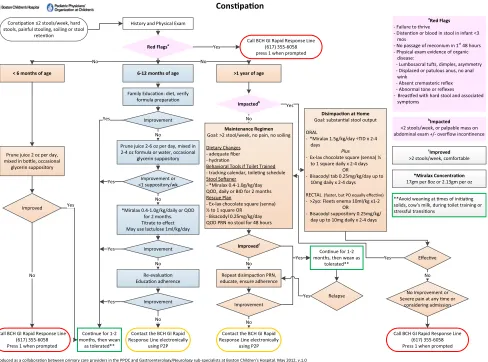
PPOC and BCH GI and nonphysician project managers from the Children’s Hospital Integrated Care Organization collaborated to develop a standard management algorithm (Fig 1), establish synchronous and asynchronous pre-referral advice lines, and create electronic medical record (EMR) order sets
incorporating management recommendations. Representatives developed the algorithm by adapting the 2006 NASPGHAN guidelines to local practice preferences. Both the NASPGHAN guidelines and the Shared Care algorithm emphasize (1) identifying constipation by careful history and physical examination, (2) recognizing redflags that may suggest etiologies apart from functional constipation, (3) identifying and treating fecal impaction, and (4) ensuring
adherence to a maintenance regimen that includes dietary and behavioral interventions, in addition to laxative medications. Both the PPOC Shared Care algorithm and the most current NASPGHAN guidelines, which were published after the study period, de-emphasize laboratory investigations before referral (eg, thyroid studies and tests for celiac disease). Small differences between the Shared Care algorithm and the most current NASPGHAN guidelines include
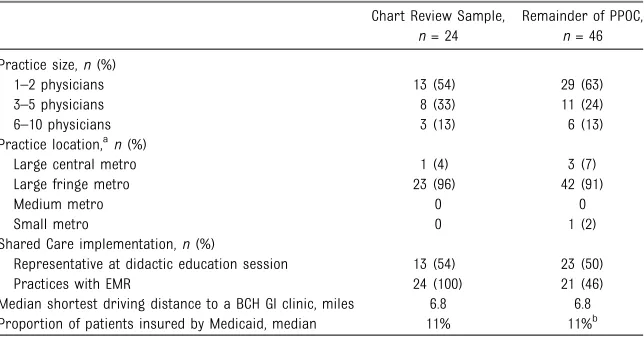
TABLE 1 Characteristics of PPOC Practices
Chart Review Sample,
n= 24
Remainder of PPOC,
n= 46 Practice size,n(%)
1–2 physicians 13 (54) 29 (63)
3–5 physicians 8 (33) 11 (24)
6–10 physicians 3 (13) 6 (13)
Practice location,an(%)
Large central metro 1 (4) 3 (7)
Large fringe metro 23 (96) 42 (91)
Medium metro 0 0
Small metro 0 1 (2)
Shared Care implementation,n(%)
Representative at didactic education session 13 (54) 23 (50)
Practices with EMR 24 (100) 21 (46)
Median shortest driving distance to a BCH GI clinic, miles 6.8 6.8 Proportion of patients insured by Medicaid, median 11% 11%b Metro, metropolitan county.
specific suggestions for medications and dosages, and inclusion of BCH-specific contact information for advice and referral.
Education and Decision Support Tools
The Shared Care constipation algorithm (Fig 1) was sent
electronically to all providers and in print to all practices, and was embedded as a linked document in the PCP’s EMR for point-of-care access. Advice lines consisted of a Rapid Response pager line to the lead nurse for BCH GI and a secure e-mail portal using P2Popen, accessed within the PCPs’EMR, eClinicalWorks (Westborough, MA). E-mails were answered within 1 to 2
business days by a single GI fellow (DM) with assistance from one attending (JRL). The algorithm and information about advice lines were distributed at the 2013 PPOC annual member meeting, which also featured a didactic talk followed by question-and-answer session from a BCH gastroenterologist who specializes in GI motility and who is a standing member of the NASPGHAN constipation guideline committee (SN). To measure rate and variability of presentation of referrals, we monitored referral rates to BCH GI for constipation and emergency
department (ED) visit rates for constipation at 6-month intervals, as well as use of Rapid Response pager and P2Popen e-mail.
Measures
Of 70 practices in the PPOC active during the study period, 50 used a common EMR that allowed chart review. We selected a convenience sample by making an alphabetic list of those 50 practices by name and reviewing the charts of patients referred from thefirst consecutive 24. We analyzed records of patients 1 to 18 years old who had a new
ambulatory visit to BCH GI during the 6-month periods before and after implementation of Shared Care, and were assigned a primary or
secondary diagnosis of constipation, fecal impaction, encopresis, or irritable bowel syndrome, constipation type (International
Classification of Diseases, Ninth
Conspaon
Conspaon ≤2 stools/week, hard stools, painful stooling, soiling or stool
retenon
History and Physical Exam
Red Flagsa
6-12 months of age < 6 months of age
No
>1 year of age No
Yes
Family Educaon: diet, verify formula preparaon
Improvement
Prune juice 2-6 oz per day, mixed in 2-4 oz formula or water, occasional
glycerin suppository No
Improvement or <1 suppository/wk
*Miralax 0.4-1.0g/kg/daily or QOD for 2 months. Titrate to effect May use lactulose 1ml/kg/day
No Improvement Re-evaluaon Educaon adherence No Improvement No
Connue for 1-2 months, then wean
as tolerated** Yes
Prune juice 2 oz per day, mixed in bole, occasional
glycerin suppository
Improved
No
Impactedb
Disimpacon at Home Goal: substanal stool output
ORAL
- *Miralax 1.5g/kg/day ÷TID x 2-4 days
Plus
- Ex-lax chocolate square (senna) ½ to 1 square daily x 2-4 days
OR
- Bisacodyl tab 0.25mg/kg/day up to 10mg daily x 2-4 days
RECTAL (faster, but PO equally effecve) - >2yo: Fleets enema 10ml/kg x1-2
OR - Bisacodyl suppository 0.25mg/kg/
day up to 10mg daily x 2-4 days
No Improvement or Severe pain at any me or
considering admission Maintenance Regimen
Goal: >2 stool/week, no pain, no soiling
Dietary Changes - adequate fiber - hydraon
Behavioral Tools if Toilet Trained - tracking calendar, toileng schedule Stool Soener
- *Miralax 0.4-1.0g/kg/day QOD, daily or BID for 2 months Rescue Plan
- Ex-lax chocolate square (senna) ½ to 1 square OR
- Bisacodyl 0.25mg/kg/day QOD PRN no stool for 48 hours
No
Improvedc
Yes
Repeat disimpacon PRN, educate, ensure adherence
No
Improvement
No
Connue for 1-2 months, then wean as
tolerated** Relapse Yes Yes a Red Flags - Failure to thrive
- Distenon or blood in stool in infant <3 mos
- No passage of meconium in 1st 48 hours - Physical exam evidence of organic
disease:
- Lumbosacral tus, dimples, asymmetry - Displaced or patulous anus, no anal
wink
- Absent cremasteric reflex - Abnormal tone or reflexes - Breased with hard stool and associated
symptoms
b
Impacted <2 stools/week, or palpable mass on abdominal exam +/- overflow inconnence
c
Improved >2 stools/week, comfortable
**Avoid weaning at mes of iniang solids, cow’s milk, during toilet training or stressful transions
Yes
Call BCH GI Rapid Response Line (617) 355-6058 press 1 when prompted
Call BCH GI Rapid Response Line (617) 355-6058 Press 1 when prompted
Contact the BCH GI Rapid Response Line electronically
using P2P
Call BCH GI Rapid Response Line (617) 355-6058 Press 1 when prompted Contact the BCH GI Rapid
Response Line electronically using P2P
*Miralax Concentraon 17gm per 8oz or 2.13gm per oz
Effecve Yes No Yes Yes Yes
This algorithm is designed only to assist physicians and other healthcare professionals in idenfying indicators of and responses to a parcular medical condion. It does not provide guidance for other medical condions, nor does it substute for a physician’s or other healthcare professional’s independent decision-making and ju dgment. Like any printed material, it may become out-of-date over me. Reference herein to specific medicaons and/or products does not represent an endorsement of such medicaons and/or products. Boston Children’s Hospital does not warrant or assume any legal liability or responsibility for the accuracy, completeness, or usefulness of this algorithm.
Produced as a collaboraon between primary care providers in the PPOC and Gastroenterology/Neurology sub-specialists at Boston Children’s Hospital. May 2012, v.1.0
© Children’s Hospital Integrated Care Organizaon
FIGURE 1
Revision[ICD-9] codes 307.7, 560.32, 564.0, 564.01, 564.02, 564.09, 564.1). Cases were excluded if the patient (1) had been seen by a gastroenterologist within the past 2 years, (2) had a history of abdominal surgery except appendectomy, or (3) had a comorbid condition known to cause
constipation (eg, cysticfibrosis, spina bifida).
A referral rate was calculated by dividing the number of these new visits to GI by the mean monthly total of all active PPOC patients of the selected practices. PCP charts, including demographic information and all notes for visits, telephone encounters, referral letters, specialty consultations, and hospital reports were reviewed. We noted
documentation of patient factors expected to affect referral decisions, including demographic information, historical and physical indicators of constipation, clinical assessments, and parental requests for referral. We also recorded indicators of disease severity and adverse clinical events, including fecal incontinence, fecal impaction, and ED visits for
constipation or abdominal pain. Fecal impaction was defined as hard stool palpable on abdominal or rectal examination, inability to pass stool for more than 2 days, or fecal incontinence. We calculated the duration of pre-referral management from the date of thefirst presentation to the PCP with a complaint leading to referral and the date of the GI visit.
Key management recommendations were noted for any visit or phone encounters. Dietary
recommendations included any mention of general healthful diet, fruit,fiber, or hydration. Behavioral recommendations included any mention of daily toilet-sitting, tracking or incentive systems, or exercise. Any osmotic laxative, such as polyethylene glycol 3350 or prune juice, and any stimulant laxative (eg, senna or bisacodyl) counted toward documentation of
recommending use of a laxative. Our criteria for disimpaction included any short-term (,1 week) use of osmotic laxative at a higher dose than baseline or subsequent therapy, rectal suppository, or enema. We also tracked whether laboratory
investigations were obtained before referral.
We also assessed initial management by the BCH GI provider by reviewing the BCH EMR related to each patient’s GI visits to assess documentation of diagnostic and therapeutic
interventions. Specifically, we tracked whether the GI provider’s
recommendations were consistent with both the Shared Care algorithm and NASPGHAN guidelines. Our hypothesis was that those patients who received care from the GI provider that was limited to the Shared Care algorithm may not have required referral.
Medical Claims Data
To evaluate a larger pool of patients over a longer period as a secondary outcome, we analyzed paid medical claims from 2 large not-for-profit commercial insurers in
Massachusetts, which include approximately 25% of the entire PPOC patient population, for new visits to any subspecialist for constipation, by using the same primary or secondary ICD-9 codes as those used in the chart review sample. For comparison with secular referral trends, we performed analogous analyses of referrals to other subspecialists for common diagnoses that are often comanaged by PCPs and specialists, such as heart murmur, chest pain, and asthma, but were not part of a Shared Care program to reduce referrals.
Analysis
Pre- and postimplementation referral rates were compared by using a 2-samplet-test. Mean age for each group was compared by Wilcoxon rank-sum test. Frequencies for individual patient characteristics and
documentation recommendations were compared byx2analysis.
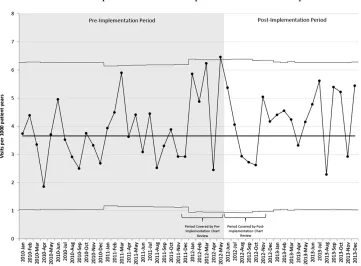
For medical claims data, we used statistical process control charting methodology to analyze trends in monthly referral rates over time. Monthly rates of new visits to subspecialists were plotted on a U-chart by using the time period from January 2010 through May 2012 to set the centerline and upper and lower control limits (63 SDs). Postimplementation monthly visit rates were analyzed to identify special cause points (statistically significant deviations from baseline) as outlined by standard process control rules.12
This project was determined by the institutional review board to meet our institution’s definition of quality improvement and was therefore exempt from institutional review board approval.
RESULTS
Participation
All 206 PPOC primary care providers in 70 practices received the algorithm and supporting 1-page provider handout. Sixty-eight (33%) of 206 providers, representing 36 (51%) of 70 practices, attended the in-person presentation with question-and-answer session. Early monitoring showed slow uptake of Rapid Response pager and P2Popen e-mail advice lines, which prompted site visits by program personnel to increase awareness of the program among PPOC practices. In the postimplementation period, the Rapid Response pager line was contacted 53 times by a PPOC office and, of those, 7 contacts (13%) pertained to constipation. The P2Popen e-mail line received 4 e-mails from PPOC providers for pre-referral advice, and none pertained to constipation.
Chart Review
urban/rural classification,13payer distribution, proximity to a BCH GI clinic site, and attendance of the didactic educational session (Table 1). Demographic and clinical information for patients referred from the 24 selected PPOC practices in both 6-month periods are shown in Table 2. There were no significant differences between the patients in the 2 periods with regard to median age; gender; or documentation of abdominal pain, fecal incontinence, parental request for referral, or symptoms, signs, or assessment of constipation by the PCP. Fewer patients had fecal impaction after implementation. A smaller proportion of patients were referred to BCH GI (61/27 365 [0.22%] vs 90/27 792 [0.36%],P= .003), and the average duration of PCP management before referral increased by more than 3 months after implementation (10.5 vs 6.9 months,P= .03). No significant differences were found in the proportions of patients with documentation of individual or combinations of key
recommendations (Figure 2). The initial BCH GI management was consistent with the Shared Care algorithm for a similar proportion of patients in each group (37/90 [41.1%] pre- vs 26/61 [42.6%] postimplementation). The most common way GI providers deviated from the Shared Care algorithm was recommending a scheduled (rather than“as-needed”) stimulant laxative
(28/90 [31%] pre- vs 19/61 [31%] postimplementation).
Medical Claims Data Analysis
The U-chart of monthly rates of new visits to subspecialists for
constipation is shown in Figure 3. The data show no measurable change in referral rate that meets process control rules. No significant
differences were seen in referral rates to subspecialists for heart murmur, chest pain, or asthma (data not shown).
DISCUSSION
Our data demonstrate that a quality improvement project aimed at improving the care of pediatric constipation in the primary care setting resulted in a decrease in referrals to gastroenterologists in the 6-month period after implementation. Analysis of medical claims over
a longer period corroborates
a decrease in the referral rates in the 6 months after implementation, but does not show measurable change in referral patterns over a longer period. This is in contrast to similar
experience the PPOC has had in lowering referrals for adolescent idiopathic scoliosis, where a similar educational initiative resulted in a 20% reduction in referrals that was sustained for well over a year.8As one possible explanation for differences in outcomes between these initiatives, we note that scoliosis is a simpler construct with objective data to use to gauge the necessity of referral (ie, scoliometer reading and Cobb Angle), whereas constipation involves more complex physical and
behavioral components and lacks a straightforward objective measure of severity.
Importantly, results of our chart review show that PCPs managed patients for a longer period before making a referral once our quality improvement program was
implemented. Our observations that ED visits for constipation did not increase and that fecal impaction was less common in the
postimplementation period suggest patients were not adversely affected by delaying referral. We also investigated whether improved pre-referral management might have skewed the referral population to include more severely affected patients; however, we found that
0% 20% 40% 60% 80% 100%
Diet, Behavior, Laxative and Cleanout PRN
Diet and Behavior Behavior, Laxative, and Cleanout PRN
Laxative and Cleanout
Laxative
% patients
Management recommendations documented by PCP prior to referral
Pre-Shared Care Post-Shared Care
FIGURE 2
Impact of Shared Care on pre-referral management recommendations for patients whose PCP documented constipation. No statistically significant differences were observed in documentation of individual or selected combinations of recommendations. PRN, as needed for documented symptoms or signs of impaction.
TABLE 2 Demographic and Clinical Characteristics for Patients Included in Structured Chart Review
Patient Characteristic Before Shared Care,
n= 90
After Shared Care,
n= 61
P
Median age, y 8.2 6.7 .15
Male gender, % 47 46 .92
Abdominal pain, % 71 70 .93
Fecal incontinence, % 16 23 .25
PCP-documented constipation, % 77 70 .40
Parental request for subspecialty referral, % 7 15 .10 Laboratory tests obtained before referral, % 60 48 .13
ED visit for constipation, % 17 13 .55
rates of fecal incontinence among referred patients did not increase, and rates of fecal impaction were actually lower in the postintervention period. We therefore hypothesize that this improvement may reflect an enhanced capability for PCPs to manage patients with constipation before the development of fecal impaction.
We did not observe a significant change in the rate of documentation of individual key management recommendations by PCPs. Our
findings suggest either that PCPs changed their management but did not document the changes, or that there were other influences apart from our algorithm that may have led to decreased referrals and longer duration of PCP management. It is possible that PCPs optimized therapy within each category of
recommendation (eg, more detailed behavioral counseling, more effective laxative dosing, and more effective cleanouts) but did not document their recommendations any differently.
PCPs may have provided handouts or referred patients to educational Web sites, such as healthychildren.org or GIKids.org, which were included in the 1-page handout. We noted that relatively few PCPs documented dietary and behavioral interventions, which may have been more
frequently discussed than documented.
Our results should be taken in the context of several study limitations. First, charts of patients whose constipation was managed in the primary care setting without a referral to GI were not reviewed, leaving any identifiable differences in their clinical presentation, disease severity, or management
undiscovered. Our data suggest that identifying those patients would be difficult; overall, only 52% of patients with constipation diagnosed by a pediatric gastroenterologist had been assigned a constipation-related diagnosis code by their PCP and only 74% of referred patients’PCP charts had any documentation of history,
examination, radiography, or assessments to suggest constipation. Although we facilitated use of decision-support tools by embedding an order set as well as a link to the algorithm within the EMR, we lacked a mechanism to track order set usage and access rate of the linked
document, and are therefore unable to assess whether these tools had an impact on management. Our date of implementation occurred near the end of a typical school year (June 1), which raises the possibility that seasonality may play a part in patient presentation and/or referral
utilization. We tried to account for seasonality in referral rate with our longer term medical claims data, which did not show any special cause effect at any time, including changes in seasons.
We hope that the increase in duration of management by PCPs was due to successful management and improved symptoms, but we
recognize there may be other factors that may have affected the timing of FIGURE 3
referral. Because of frequent absence of documentation of the decision to refer and the variable documentation that accompanied referrals in the PCP or BCH chart, we considered the most important factor in the timing of the GI visit to be the decision by the PCP or family to seek specialist care. Although parental requests for referral were infrequent and equivalent in the pre- and postimplementation groups, we recognize they may not always be documented and are likely very important in a PCP’s decision to refer.
Another limitation of our study is the possibility that our educational interventions, which consisted of passive dissemination of the
algorithm and 1-page explanation and a didactic session attended by one-third of the organization’s PCPs, were insufficient to substantially alter practice patterns in the long term. A review of the literature on educational interventions to change physician referral behavior reveals mixed results. One systematic review of interventions to improve specialty referrals showed that passive dissemination of locally developed referral guidelines does not lead to change in quantity or quality of referrals.9
In addition, studies of more intensive educational experiences to optimize specialty referral utilization have had conflictingfindings. In one study, monthly workshops with an orthopedic specialist reduced referrals from PCPs.14However, 2 other workshop-based interventions led to unintended increased referrals.15In another systematic review, interventions that included specialist“outreach,”structured management sheets, or computerized decision support tools led to
decreased referrals.10One emerging model for continuing medical education is Spaced Education, which incorporates online, interactive educational games, and has been shown to improve adherence to guidelines and improve clinical outcomes.16,17 These studies and our experience suggest that local quality improvement programs aimed to change referral behavior are feasible but require effective guideline dissemination, clinical-decision support tools, and effective physician education.
Our data indicate that a multifaceted initiative to support pediatric PCPs in managing constipation in the primary care setting can alter patterns of clinical care, but changes in referral
behavior and pre-referral
management, if present, are difficult to detect and sustain. Our next steps will feature more engaging and sustained educational interventions to improve familiarity with the algorithm. Improved subspecialty referral utilization is supported by programs that include PCPs collaborating with subspecialists to generate clinical decision-support tools, but changes in referral behavior and pre-referral management may be difficult to sustain. Future efforts to optimize subspecialty referral rates may benefit from continued collaboration, novel approaches to education, and improved systems integration.
ACKNOWLEDGMENTS
We thank Jessica Kerr and Tsegaselassie Workalemahu for additional biostatistical assistance; Jonathon Modest, Sabrina
Cannistraro, and Nora Boukus for their help with data acquisition and project leadership; BCH leadership for their support of the project; and PPOC representatives to the Shared Care Constipation Algorithm committee for collegial help constructing the algorithm.
FINANCIAL DISCLOSURE:The authors have indicated they have nofinancial relationships relevant to this article to disclose.
FUNDING:Internal funding for this program was provided by Boston Children’s Hospital and the Pediatric Physicians’Organization at Children’s. Dr Nurko is supported by National Institutes of Health grant K24DK082792A. Funded by the National Institutes of Health (NIH).
POTENTIAL CONFLICT OF INTEREST:The authors have indicated they have no potential conflicts of interest to disclose.
REFERENCES
1. North American Society for Pediatric Gastroenterology, Hepatology and Nutrition. Evaluation and treatment of constipation in children: summary of updated
recommendations of the North American Society for Pediatric Gastroenterology, Hepatology, and Nutrition.J Pediatr Gastroenterol Nutr. 2006;43(3):405–407
2. Tabbers MM, DiLorenzo C, Berger MY, et al. Evaluation and treatment of functional constipation in infants and children: evidence-based
recommendations from ESPGHAN and
NASPGHAN.J Pediatr Gastroenterol Nutr. 2014;58(2):258–274
3. Focht DR III, Baker RC, Heubi JE, Moyer MS. Variability in the management of childhood constipation.Clin Pediatr (Phila). 2006;45(3):251–256
4. Forrest CB, Glade GB, Baker AE, Bocian AB,
Kang M, Starfield B. The pediatric primary-specialty care interface: how pediatricians refer children and
adolescents to specialty care.Arch
Pediatr Adolesc Med. 1999;153(7):705–714
5. Vernacchio L, Muto JM, Young G, Risko W.
Ambulatory subspecialty visits in a large
pediatric primary care network.Health
Serv Res. 2012;47(4):1755–1769
6. Philichi L, Yuwono M. Primary care:
constipation and encopresis treatment
strategies and reasons to refer.
7. Starfield B, Shi L, Macinko J. Contribution of primary care to health systems and health.Milbank Q. 2005;83(3):457–502
8. Vernacchio L, Trudell EK, Hresko MT, Karlin LI, Risko W. A quality improvement program to reduce unnecessary referrals for adolescent scoliosis.
Pediatrics. 2013;131(3). Available at: www.pediatrics.org/cgi/content/full/131/ 3/e912
9. Akbari A, Mayhew A, Al-Alawi MA, et al. Interventions to improve outpatient referrals from primary care to secondary care.Cochrane Database Syst Rev. 2008;(4):CD005471
10. Faulkner A, Mills N, Bainton D, et al. A systematic review of the effect of primary care-based service innovations on quality and patterns of referral to
specialist secondary care.Br J Gen Pract. 2003;53(496):878–884
11. Song Z, Safran DG, Landon BE, et al. The
‘Alternative Quality Contract,’based on a global budget, lowered medical spending and improved quality.Health Aff (Millwood). 2012;31(8):1885–1894
12. Carey RG.Improving Healthcare With Control Charts: Basic and Advanced SPC
Methods and Case Studies. Milwaukee,
WI: ASQ Quality Press; 2003
13. Ingram DD, Franco SJ. 2013 NCHS urban-rural classification scheme for counties.
Vital Health Stat 2.2014;(166):1–73
14. Vierhout WP, Knottnerus JA, van OOij A, et al. Effectiveness of joint consultation sessions of general practitioners and
orthopaedic surgeons for
locomotor-system disorders.Lancet. 1995; 346(8981):990–994
15. Jones RH, Lydeard S, Dunleavey J. Problems with implementing guidelines: a randomised controlled trial of consensus management of dyspepsia.
Qual Health Care. 1993;2(4):217–221
16. Kerfoot BP, Kearney MC, Connelly D, Ritchey ML. Interactive spaced education to assess and improve knowledge of clinical practice guidelines:
a randomized controlled trial.Ann Surg. 2009;249(5):744–749
17. Kerfoot BP, Turchin A, Breydo E, Gagnon D, Conlin PR. An online spaced-education game among clinicians improves their patients’time to blood pressure control: a randomized controlled trial.Circ
Cardiovasc Qual Outcomes. 2014;7(3):
DOI: 10.1542/peds.2014-1962 originally published online April 20, 2015;
2015;135;e1300
Pediatrics
Alan M. Leichtner and Jenifer R. Lightdale
Daniel Mallon, Louis Vernacchio, Emily Trudell, Richard Antonelli, Samuel Nurko,
Management of Constipation
Shared Care: A Quality Improvement Initiative to Optimize Primary Care
Services
Updated Information &
http://pediatrics.aappublications.org/content/135/5/e1300
including high resolution figures, can be found at:
References
http://pediatrics.aappublications.org/content/135/5/e1300#BIBL
This article cites 15 articles, 5 of which you can access for free at:
Subspecialty Collections
http://www.aappublications.org/cgi/collection/gastroenterology_sub Gastroenterology
sub
http://www.aappublications.org/cgi/collection/quality_improvement_ Quality Improvement
e_management_sub
http://www.aappublications.org/cgi/collection/administration:practic Administration/Practice Management
following collection(s):
This article, along with others on similar topics, appears in the
Permissions & Licensing
http://www.aappublications.org/site/misc/Permissions.xhtml
in its entirety can be found online at:
Information about reproducing this article in parts (figures, tables) or
Reprints
http://www.aappublications.org/site/misc/reprints.xhtml
DOI: 10.1542/peds.2014-1962 originally published online April 20, 2015;
2015;135;e1300
Pediatrics
Alan M. Leichtner and Jenifer R. Lightdale
Daniel Mallon, Louis Vernacchio, Emily Trudell, Richard Antonelli, Samuel Nurko,
Management of Constipation
Shared Care: A Quality Improvement Initiative to Optimize Primary Care
http://pediatrics.aappublications.org/content/135/5/e1300
located on the World Wide Web at:
The online version of this article, along with updated information and services, is
by the American Academy of Pediatrics. All rights reserved. Print ISSN: 1073-0397.