Vol.4 No.2 | June-2014 ISSN:1839 - 0846
An Evaluation of the Business Practices of Entrepreneurs of
UMkhanyakude District Municipality
Makhosi Khumalo – Mbonambi
Graduate of the Regent Business School, Durban, South Africa
Lee - Ann Inderpal
Manager of Institutional Research, and Dissertation Supervisor Regent Business School, Durban, South Africa
Anis Mahomed Karodia (PhD)
Professor, Senior Academic and Researcher, Regent Business School, Durban, South Africa
ABSTRACT
Unemployment and poverty in South Africa still pose a great challenge. While the country is suffering from the effects of unemployment and poverty, certain areas such as Umkhanyakude District Municipality are more affected than other areas of South Africa. The citizens of Umkhanyakude District Municipality have over the years attempted various means of creating wealth such as starting their own businesses. Their attempts are not always a success as they lack crucial skills of operating successful businesses.
Keywords: Unemployment, Poverty; Evaluation; Business Practices; Entrepreneurs; Behaviour; Activities;
District; Municipality; Environment
INTRODUCTION
During the Absa Small Business Roundtable conference which was held in Johannesburg, in November 2010, it was mentioned that the small business failure rates in the first two years are as high as 63%. This is a concern for every entrepreneur as it illustrates a very high failure rate during the starting phase of businesses (Roberts, 2010).
Umkhanyakude District Municipality is one of the municipalities in rural areas where a major portion of the people are illiterate and unemployed (Umkhanyakude District Municipality IDP, 2011/2012). This is reflected hereunder in Figure 1.1
Figure 1.1 Levels of education diagram
46%
15%
1%
18%
12%
4%
0% 10% 20% 30% 40% 50%
No Schooling Some Primary Complete Primary Some Secondary Grade 12 Higher
Source: Umkhanyakude District Municipality IDP (2011/2012:83).
LITERATURE REVIEW
A clear emphasis on the promise of growth, expansion and long term gain is evident in the latter definition. This is the reason attributed to small businesses that are aimed at the survival of the owner that cannot be deemed as an entrepreneurial venture” (Mazubane, 2009: 8).
Total Entrepreneurial Activity
South Africa’s Total Entrepreneurial Activity (TEA) of 9.1% in 2011 is lower than the other emerging economies’ and is below an average when compared to other efficiency-driven economies. TEA is a measure that is used to determine a number of entrepreneurial activities; it calculates the percentage of the country’s working age population who are attempting to start their own businesses. The following graph illustrates the TEA of South Africa from year 2005 to year 2011.
Figure 2.1 South Africa’s TEA rates
0.00% 1.00% 2.00% 3.00% 4.00% 5.00% 6.00% 7.00% 8.00% 9.00% 10.00%
2005 2006 2008 2009 2010 2011
Source: GEM South Africa (2011)
The TEA rate increased annually from 5.2% in 2005 to 7.8% in 2008. The decrease in 2009 was due to the recession in 2009. The increase from 5.9% in 2009 to 8.9% in 2010 is credited to the FIFA world cup whereby approximately 5,979,510 small businesses were in existence which was a huge increase compare to approximately 2.2 million in 2006. Source: GEM South Africa, 2011. Rwigema et al (2010) state that despite the promises made by AsgiSA there has been a very slow progress regarding matters.
RESEARCH METHODOLOGY
The study is supported by literature and data such that its objectives are optimized and recommendations or interferences are made for implementation.
Target Population
The target population for this study was the five municipalities namely, Umhlabuyalingana, Jozini, The Big 5 False Bay, Hlabisa and Mtubatuba. There are approximately 1000 micro enterprises within these municipalities.
Limitations of the Research
RESULTS, DISCUSSION AND INTERPRETETION OF FINDINGS
Response Rate
The sample consisted of 125 participants and there was 100% return rate.
Demographics
Business Industry/ Type
Figure 4.1 Type of businesses owned by respondents
Business Type
1%
4% 4%
6%
9%
64%
2% 3%3%
1% 3%
Bookkeeping Clothing Cons truction Décor
Electrical s ervices Food
Mobile vendor Retail trade Stationery
Telecom m unication Trans port
The respondents were entrepreneurs owning different types of businesses, the majority of whom were small shop owners/ tuck shop owners which amounted to 64% of the respondents, followed by mobile vendors with 9% contribution. Mobile vendors include clothing businesses that are moved from one place to another especially to the areas where the South African Social Security Agency (SASSA) grants pay-outs are made. Transport business formed 6% of the survey. This includes the bakkies/ vans that are used to transport people and goods from shopping areas to their homes. Construction and food businesses formed 4% each into the survey. Clothing, electrical and décor formed 3% of the survey each. Stationery formed 2% and bookkeeping and telecommunication contributed 1% each.
Age
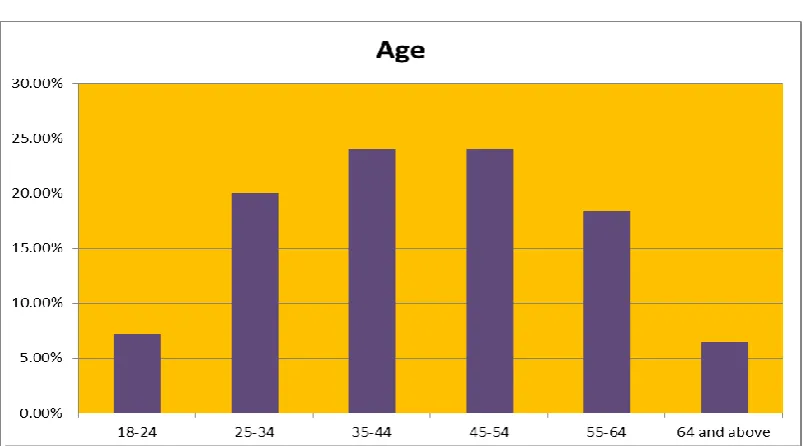
The findings as depicted in figure 4.2. Illustrate that the highest number of respondents were between the age of 35 and 44 years who formed 26.67% of the survey, followed by 24.67% of respondents between 45 and 54 years.
Ages between 55 and 64 as well as ages between 25 and 34 formed 18% and 16.67% respectively.
Gender
Figure 4.3 Gender of respondents
Gender
Male 73% Female
27%
Figure 4.3. above illustrates that the male respondents formed 73% and female respondents formed 27% of the survey. Although the IDP (2011/12) states that there is a slight imbalance regarding male to female ratio, with females being more than males; females account for about 55% whereas males are about 45% of the District’s population, the survey revealed that the number of males in business is higher than that of females.
Highest level of education
Figure 4.4 Respondents’ highest level of education
29.3 3%
18.6 7%
26.0 0%
6.67 %
10.6 7%
8.67 %
0.00 %
0.00% 5.00% 10.00% 15.00% 20.00% 25.00% 30.00%
Level of Education
None Grade 1-5 Grade 6-7 Grade 8-9 Grade 10-12 Tertiary Post graduate
education. Tertiary education category with a rate of 8.67% included respondents with diplomas and bachelors degrees. None of the respondents possessed post graduate qualifications.
Trading years
Figure 4.5 Respondents’ number of trading years in current business
0-1 years
2-5 years
5-10 years
Over 10 years 9.33%
23.33%
31.33%
36.00%
0.00% 5.00% 10.00% 15.00% 20.00% 25.00% 30.00% 35.00% 40.00%
Number of Trading Years
The above figure reveals that 36% of the respondents have been in current business for over 10 years, while 31.33% have been in current business for 5 to 10 years. 23.33% of respondents have been in the current business for 2 to 5 years and 0 to 1 year; formed 9.33% of the respondents.
Previous business failures
Figure 4.6 Number of previous business venture failures that the respondents encountered previously
None
1-2
3-4
5 and above
26.67%
44.00%
19.33%
10.00%
0.00%
5.00%
10.00%
15.00%
20.00%
25.00%
30.00%
35.00%
40.00%
45.00%
Previous Business Failures
Importance of Research
Research prior to initiating the business
Figure 4.7 Conducted research prior to initiating business
3.20%
21.60% 23.20%
40.80%
11.20%
0.00% 5.00% 10.00% 15.00% 20.00% 25.00% 30.00% 35.00% 40.00% 45.00%
Strongly Agree
Agree Neutral Disagree Strongly Disagree Conducted Research
Figure 4.7.reveals that 3.2% of the respondents strongly agreed that they conducted research prior to starting businesses, 21.60% of the respondents agreed. 23.20% of the respondents neither agreed nor disagreed to conducting research while 40.8% disagreed to conducting research prior to starting their businesses respectively and 11.2% strongly disagreed.
Business plan
Figure 4.8 A business plan is a critical tool for ensuring the success of a business venture
0.80%
12.00%
41.60%
39.20%
6.40%
0.00% 5.00% 10.00% 15.00% 20.00% 25.00% 30.00% 35.00% 40.00% 45.00%
Strongly Agree
Agree Neutral Disagree Strongly Disagree
Business Plan is Critical
Clear business plan in place
Figure 4.9 I have a clear business plan in place to ensure the success of my business
0.80% 0.80% 0.00%
98.40%
0.00% 0.00%
10.00% 20.00% 30.00% 40.00% 50.00% 60.00% 70.00% 80.00% 90.00% 100.00%
Clear Business Plan in Place
Strongly Agree Agree Neutral Disagree Strongly Disagree
Figure 4.9 indicates that a combined 1.6% of the respondents agreed that they have a clear business plan in place. The analysis also indicated that 98.40% of the respondents do not have clear business plans in place.
Monitoring of business performance
Figure 4.10 I monitor my business performance (budgets, sales, purchases etc)
1.59%
23.02%
38.10%
32.54%
4.76%
0.00% 5.00% 10.00% 15.00% 20.00% 25.00% 30.00% 35.00% 40.00%
Business Performance Monitoring
Strongly Agree Agree Neutral Disagree Strongly Disagree
Small business bank loans
Figure 4.11 Awareness of small business bank loans
2.40%
26.40%
12.80%
52.80%
5.60%
0.00% 10.00% 20.00% 30.00% 40.00% 50.00% 60.00%
Aware of Business Bank Loans
Strongly Agree Agree Neutral Disagree Strongly Disagree
Figure 4.11 depicts that 52.80% of the respondents disagreed that that they are aware of the loans provided by the banks to small businesses, followed by 26.40% who agreed to the statement. 12.80% were neutral to the statement while 5.60% and 2.40% strongly disagreed and strongly agreed correspondingly to the statement.
Government grants (BBSDP)
Figure 4.12 Awareness of government grants (BBSDP)
8.00% 71.20%
12.80% 6.40%
1.60% 0.00%
10.00% 20.00% 30.00% 40.00% 50.00% 60.00% 70.00% 80.00%
Aware of Business Governement Grants
Strongly Agree Agree Neutral Disagree Strongly Disagree
Causes of Business Failure
Physical infrastructure
Figure 4.13 Physical infrastructure
30.40%
54.40%
10.40%
4.80%
0.00% 0.00%
10.00% 20.00% 30.00% 40.00% 50.00% 60.00%
Physical Infrastructure
Percentage 30.40% 54.40% 10.40% 4.80% 0.00%
Strongly agree Agree Neutral Disagree Strongly disagree
Figure 4.13 illustrates that a combined rate of 84.80% of the respondents agree that physical infrastructure is one of the causes of business failures. A rate of 10.40% were neutral and 4.8% disagreed that physical infrastructure is one of the causes of business failures.
Unsupportive community
Figure 4.14 Unsupportive community
7.20%
22.40%
15.20%
38.40%
16.80%
0.00% 5.00% 10.00% 15.00% 20.00% 25.00% 30.00% 35.00% 40.00%
Strongly agree
Agree Neutral Disagree Strongly
disagree
Unsupportive Community
Poverty/ Unemployment of the community members
Figure 4.15 Poverty/ Unemployment
Strongly
agree Agree Neutral Disagre
e Strongly disagree 30.40%
34.40%
16.00%
12.80%
6.40%
0.00% 5.00% 10.00% 15.00% 20.00% 25.00% 30.00% 35.00%
Poverty/ Unemployment
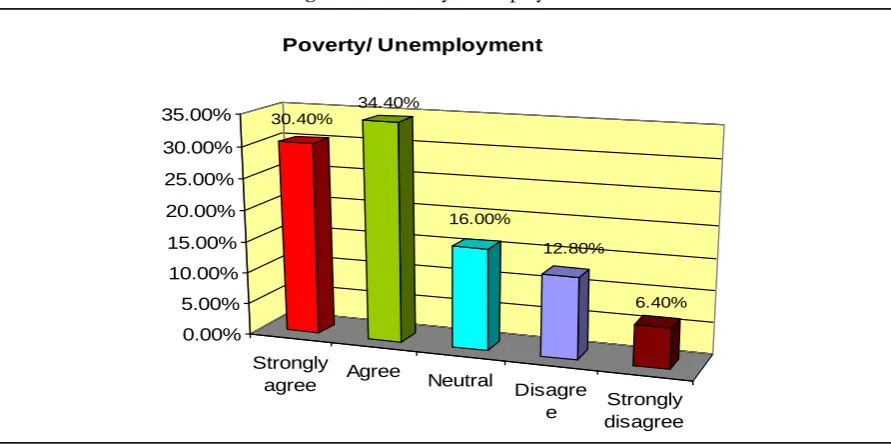
Figure 4.15 reveals that while a rate of 30.4% of the respondents strongly agreed and 34.4% agreed that poverty/ unemployment is the cause of business failure, 16% were neutral to the statement, 12% disagreed with the statement while 6.4% strongly disagreed.
Unavailability of government support through training and development Figure 4.16 Unavailability of government support
Strongly
agree Agree Neutral
Disagree
Strongly disagree 4.00%
12.80%
27.20%
41.60%
14.40%
0.00% 5.00% 10.00% 15.00% 20.00% 25.00% 30.00% 35.00% 40.00% 45.00%
Unavailability of government support
Unavailability of funds to start/ support the business
Figure 4.17 Unavailability of funds
24.80%
55.20%
16.80%
3.20% 0.00% 0.00%
10.00% 20.00% 30.00% 40.00% 50.00% 60.00%
Strongly agree
Agree Neutral Disagree Strongly disagree
Unavailability of Funds
Figure 4.17 illustrates that 24.8% and 55.2% of the respondents strongly agreed and agreed respectively to the statement that the unavailability of funds results in business failure; 16.8% of the respondents were neutral about the statement, 3.2% disagreed with the statement. There were no respondents that strongly disagreed with the statement.
Crime Rate
Figure 4.18 Crime Rate
7.20%
34.40%
25.60% 27.20%
5.60%
0.00% 5.00% 10.00% 15.00% 20.00% 25.00% 30.00% 35.00%
Crime Rate
Strongly agree Agree Neutral Disagree Strongly disagree
Unavailability of professionals
Figure 4.19 Unavailability of professionals
20.00% 35.20%
30.40%
9.60%
4.80%
0.00% 5.00% 10.00% 15.00% 20.00% 25.00% 30.00% 35.00% 40.00% Unavailability of Professionals
Strongly agree Agree Neutral Disagree Strongly disagree
Figure 4.19 illustrates that 4.8% and 9.6% of the respondents strongly agreed and agreed respectively that the unavailability of professional’s results in business failures while 30.4% were neutral about the statement. 35.2% and 20% of respondents disagreed and strongly disagreed to the statement correspondingly.
Management Functions
4.6.1. Importance of the management functions
Figure 4.20 Management functions
Importance of the financial management proficiencies
Figure 4.21 Financial management proficiencies
The above illustration demonstrates respondents’ response to the importance of bookkeeping skills, financial statements preparation and budgeting skills in their business. 2% of the respondents stated that bookkeeping skills are most important for the business, 33% stated that these skills are important, 28% were neutral, 25% stated that these skills are less important while 13% stated that they are not important.
Importance of the marketing management skills Figure 4.22. Marketing management skills
Importance of other entrepreneurial skills
Figure 4.23 Other entrepreneurial skills
The above figure illustrates the ratings that the respondents provided on the importance of the above entrepreneurial skills.
Ten percent of the respondents indicated that leadership is most important in business, 19% stated that it is important, 38% of the respondents were neutral about the statement, 26% indicated that it is less important and 8% indicated that leadership is not important. Entrepreneurs place little importance in leadership as a necessary skill for business.
Importance of personal characteristic skills
The above figure illustrates the respondents’ ratings concerning the importance of personal characteristic skills.
Twenty three percent of the respondents indicated that it is most important to be optimistic, 29% indicated that it is important, 33% were neutral about the statement, 13% indicated that being optimistic is less important and 2% indicated that it is not important.
Control was rated by 45% of the respondents as most important, 36% rated it as important and 19% were neutral about the statement. None of the respondents indicated that control is less important or not important.
Other Management and Business Functions
Frequency of management meetings
Figure 4.25 Management meetings
The above figure illustrates the frequency of holding of management meetings. There were no respondents that stated that they hold management meetings very often, 1% of the respondents stated that they hold management meetings often, 6% were unsure about the statement, 8% stated that they seldom hold management meetings and 86% stated it was very seldom for them to hold management meetings.
Frequency of engagements with external consultants
The above illustration reveals that there were no respondents that stated that they engage with external consultants very often, 2% of respondents stated that they engage with external consultants often. There were no respondents who were neither unsure about the statement nor stated that they seldom engage external consultants. 97.6% of the respondents stated that they very seldom engage external consultants in their business operations.
Attendance of owner training courses
Figure 4.27 Owner training courses
The above figure illustrates the attendance of owner training courses by the respondents.
Attendance of staff training courses
Figure 4.28 Staff training courses
CONCLUSIONS AND RECOMMENDATIONS
Findings from the Study
Findings from the study are discussed in two sections below namely; key findings from the literature review and key findings from primary research.
Key Findings from the Literature Review
The key findings from the literature review are as follows:
Most business owners come from non-business professional environment and thus do not have the critical business skills required to successfully operate the business. This results in the inability of management to plan, acquire funds, read business environment factors, and to operate the business both effectively and efficiently (Aardt et al, 2010).
Rwigema & Venter (2008) argue that while it is true that many entrepreneurs start businesses with no or minimal education, a sound education (whether formal or business skills) is crucial to every entrepreneur. It assists in reinforcing natural talent, anchors entrepreneurial instincts and points the entrepreneurs into the right direction. Entrepreneurship requires formalised knowledge of functional aspects such as marketing, purchasing, supply chain management and finance. Education can be in different forms including skills training, and experience.
MacKillop (2009) states that even experienced entrepreneurs can still fail due to lack of management skills and mismanagement of resources because they tend to make bad decisions in critical situations. Small businesses are competitive in nature and are therefore vulnerable to small errors.
Unlike people in the urban areas, people in rural areas do not readily acquire the skills and trainings that would enable them to grow their businesses or counter attack poverty. They are usually extremely cautious, they lack the risk taking motivation, they tend to avoid anything that has a failure possibility and they lack future orientation (Singh et al, 2007).
Jesselyn, Groenewald, Mitchell, Nayager, van Zyl and Visser, (2007) states that an entrepreneur needs to establish professional support. This provides advice, information, support and feedback on their plans and performance.
Stephenson and Thurman (2007), state that one of the causes of business failures is the entrepreneurs’ weak marketing efforts. Entrepreneurs tend to focus on what is occurring inside the business as opposed to what is occurring in the industry and the surroundings. Entrepreneurs who are too inner-focused often become complacent and thus become less competitive.
The findings per primary research also indicated that the entrepreneurs are not aware of any available government support. Terblance et al., (2010) states that The Department of Trade and Industry (DTI) offers a guardianship to small businesses. It also provides a variety of support programmes to entrepreneurs. Entrepreneurs however have to be prepared to search for suitable programmes.
According to Aart et al (2010), the government support is available to all South African entrepreneurs and some of the programmes such as Black Business Supplier Development Fund (BBSDP) were formulated to be utilised by specifically entrepreneurs in rural areas. The support includes skills training and development, support regarding general business ideas, and financial support (Aart et al, 2010).
Entrepreneurs also indicated that infrastructure is one of the causes of business failures. UMkhanyakude District Municipality IDP, (2008/2009) state that the lack of infrastructure places the entrepreneurship in a disadvantaged position as it is generally difficult to move goods from one place to another. There is also a high level of limitation to resources and information for entrepreneurs and or small businesses with illiteracy also creating barriers to entry in the formal business arena for entrepreneurs and operating of the businesses in a professional manner.
Rural businesses face transportation challenge mostly due to the population which is widely scattered and distances to large national markets may be considerable (Smallbone and Welter, 2006).
The primary research findings also indicated that the unsupportive communities contribute to business failures. Forster (2001:1) further states that while it is true that entrepreneurship fundamentally relies on individuals to be creative and take risks, community support is a cornerstone for success, and thus should always be taken seriously by both entrepreneurs and communities. Communities can contribute in creating a supportive culture at each step of the entrepreneurship way.
While rural communities do value hard work and individualism, they often become so sceptical to support or welcome any changes and risks that entrepreneurs may introduce. The environment that does not value innovation discourages entrepreneurship (Forster, 2001).
The primary research findings indicated that entrepreneurs do not place much significance in planning activities. Aardt et al, (2010) argue that certain entrepreneurs do not fully equip themselves and ensure that they are rational enough to start a successful business prior to starting a business. By failing to conduct a feasibility study entrepreneurs do not understand the suppliers, customers and the environment that they intend to operate in.
MacKillop (2009), states that many small businesses believe that strategic planning is for larger organisations and most engage in informal strategic planning. It is argued by MacKillop (2009) that strategic planning assists businesses in providing direction on the achievement of their goals.
Key findings from the primary research
The key findings from the primary research is identified and presented in order of the research questions and are as follows:
Research revealed that 29.33% of the respondents have no education; 18.67% have lower primary school education and 26% have higher primary education. 6.67% have grade 9 and 10.67% possess high school education. 8.67% of the respondents possess diplomas and bachelor’s degrees. None of the respondents possessed post graduate qualifications.
Respondents amounting to 4.8% and 9.6% strongly agreed and agreed respectively that the unavailability of professional’s results in business failures while 30.4% were neutral about the statement. 35.2% and 20% of respondents disagreed and strongly disagreed to the statement correspondingly.
Two percent of the respondents stated that bookkeeping skills are most important for the business, 33% stated that these skills are important, 28% were neutral, 25% stated that these skills are less important while 13% stated that they are not important.
Two percent of respondents believed that financial statements are most important in business, 26% stated that financial statements are important while 2% was neutral about the statement. Another 32% and 19% stated that financial statements are less important and not important, respectively.
Two percent of the respondents stated that budgeting skills are most important in business, 28% stated that budgeting skills are important while 31% were neutral about the statement. Another 38% stated that budgeting skills are less important and 1% stated that budgeting skills are not important.
Respondents believe that selling is the most important of all marketing management skills as 80% indicated that selling is most important and 20% indicated that it is important. There were no respondents who were neutral about the statement, who indicated that it is less important and none indicated that selling was not important.
Seven percent of the respondents stated that customer relationship is most important, 27% stated that it is important, 50% were neutral about the statement, 14% indicated that customer relationship is less important in operating a business and 1% indicated that it is not important.
The knowledge of market was rated by 29% of the respondents as most important, 46% as important, 19% of the respondents were neutral about the statement and 6% rated knowledge of market as less important. None of the respondents rated knowledge of market as not important.
Ten percent of the respondents indicated that leadership is most important in business, 19% stated that it is important, 38% of the respondents were neutral about the statement, 26% indicated that it is less important and 8% indicated that leadership is not important. Entrepreneurs place little importance in leadership as a necessary skill for business.
In relation to motivation, 18% of the respondents indicated that it is most important, 29% indicated that is it important, 19% were neutral about the statement, 30% indicate that motivation is less important and 4% stated that it is not important. Data generated that motivation is also of least importance to respondents.
Communication skills were rated by 9% of the respondents as most important, 16% as important, 54% were neutral about the statement, 7% rated communication skills as less important and another 5% rated it as not important. Data gathered that only 25% of the respondents place significance in communication skills.
Listening was rated by 2% of the respondents as most important, 9% rated listening as important, 58% were neutral about the statement, 31% indicated that they believe listening is less important. There were no respondents that rated listening as not important. The respondents do not believe that listening skills are of importance in operating a successful business. Only 11% agreed that listening skills are important.
Personal relations was rated by 10% of the respondents as most important, 32% rated it as important, 43% of the respondents were neutral about the statement, 14% indicated that personal relations is less important in business and 1% indicated that it is not important. The respondents indicated that they place little significance in personal relations.
Negotiation was rated by 37% of the respondents as most important, 46% as important, 16% were neutral about the statement and 1% indicated that negotiation is less important. None of the respondents indicated that negotiation was not important. Unlike the other skills in this category, respondents place much significance in the importance of negotiation.
Ethics in business were rated by 2% of the respondents as most important,10% rated it as important, 61% were neutral about the statement, 18% indicated that ethics are less important in business and 9% indicated that ethics are not important in business operation.
Respondents amounting to 23% indicated that it is most important to be optimistic, 29% indicated that it is important, 33% were neutral about the statement, 13% indicated that being optimistic is less important and 2% indicated that it is not important.
Having a vision in business was rated by 8% of the respondents as most important, 39% rated it as important, 40% were neutral about the statement, 11% rated it as less important and 2% indicated that having a vision is not important.
Being persistent was rated by 22% of the respondents as most important, 38% rated it as important, 26% were neutral about the statement, 14 % rated it as less important and 1% indicated that being persistent is not important.
Risk tolerance was rated by 2% of the respondents as most important, 10% rated it as important, 57% were neutral about the statement, 26% indicated that risk tolerance is less important and 6% indicated that it is not important.
Resistance was rated by 17% of the respondents as most important, 43% indicated that it is important, 31% were neutral about the statement, 8% rated resistance as less important and 1% indicated that resistance is not important.
Control was rated by 45% of the respondents as most important, 36% rated it as important and 19% were neutral about the statement. None of the respondents indicated that control is less important or not important.
Only 2% of respondents stated that they engage with external consultants often while 97.6% of the respondents stated that they very seldom engage external consultants in their business operations.
None of the respondents indicated that they attend owner training courses very often or often. There were also no respondents who were neutral about the statement. 1.6% of the respondents indicated that they seldom attend owner training courses and 98.4% of the respondents indicated that they attend the course very seldom.
None of the respondents indicated that they attend courses very often or often. There were no respondents that were neutral about the statement. Survey revealed that 0.85 of the respondents seldom attend staff training courses and 99.2% attend training course very seldom.
The findings revealed that 52% of the respondents disagreed that that they are aware of the loans provided by the banks to small businesses, followed by 26.40% who agreed to the statement. 12.80% were neutral to the statement while 5.60% and 2.40% strongly disagreed and strongly agreed correspondingly to the statement.
Respondents amounting to 79.20% disagreed that they are aware of the government grants, followed by 12.80% who were neutral about the statement. 6.40% agreed while 1.60% strongly agreed that they are aware of these grants.
Respondents amounting to 84.80% agreed that physical infrastructure is one of the causes of business failures. A rate of 10.40% were neutral and 4.8% disagreed that physical infrastructure is one of the causes of business failures.
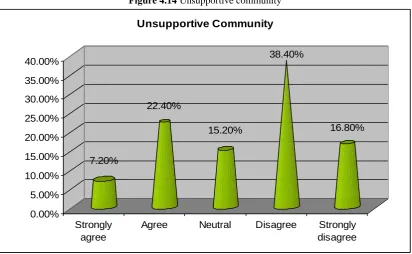
The findings revealed that 7.2% of the respondents strongly agreed that unsupportive community is one of the causes of business failures while 22.4% of the respondents agreed to the statement. 15.2% of the respondents were neutral to the statement, 38.4% disagreed and 16.8% strongly disagreed that unsupportive community is one of the causes of business failures.
The research revealed that 64.8% of the respondents agreed that poverty/ unemployment is the cause of business failure, 16% were neutral to the statement, 12% disagreed with the statement while 6.4% strongly disagreed.
The data gathered revealed that 4% and 12.8% of the respondents strongly agree and agree respectively to the statement that unavailability of government support is the cause of business failure; 27.2% were neutral about the statement. Another 41.6% disagreed with the statement while 14.4% strongly disagreed. A large number of respondents did not attribute business failures to the lack of support from the government.
Respondents amounting to 3.2% strongly agreed that they conducted research prior to starting businesses, 21.60% of the respondents agreed. 23.20% of the respondents neither agreed nor disagreed to conducting research while 40.8% disagreed to conducting research prior to starting their businesses respectively and 11.2% strongly disagreed.
Only 12.80% of the respondents agreed that a business plan is a critical tool for ensuring the success of the business and 41.60% were neutral. The analysis also revealed that while 39.20% disagreed that the business plan is a critical tool for ensuring success of a business venture, 6.40% strongly disagreed.
The research revealed only 1.6% of the respondents agreed that they have a clear business plan in place while 98.40% of the respondents do not have clear business plans in place.
The data gathered revealed that 24.61% of respondents stated that they do monitor their business performance. The respondents who neither agreed nor disagreed were 38.10%. A percentage of 32.54 disagreed while 4.76% strongly disagreed to monitoring their business performance.
One percent and twelve percent of the respondents states that planning is most important and important correspondingly in conducting business. 42% of respondents were neutral about planning while 39% and 6% stated that that planning is less important and not important in conducting business, correspondingly.
Five percent of the respondents stated that organising is most important in business, 22% of respondents believed it is important, 34% was neutral about the statement while another 34% and 5% stated that it is less important and not important respectively.
There were no respondents that stated that they hold management meetings very often, 1% of the respondents stated that they hold management meetings often, 6% were unsure about the statement, 8% stated that they seldom hold management meetings and 86% stated it was very seldom for them to hold management meetings.
Recommendations
Skills and training
It is recommended that government agencies branches be within rural areas. These agencies would educate rural entrepreneurs, provide them with skills trainings and also provide these enterprises with the entrepreneurial information and resources that they require.
Challenges of rural environment
The lack of infrastructure places the entrepreneurship/ businesses in a disadvantaged position as it is generally difficult to transport goods from one place to another. There is also a high level of limitation to resources and information for entrepreneurs and or small businesses with illiteracy also creating barriers to entry in the formal business arena for entrepreneurs and running of the businesses in a professional manner (Umkhanyakude District Municipality IDP, 2008/2009).
Planning activities prior to starting a business
The entrepreneurs should visit nearby government agencies such as the Small Enterprise Development Agency (SEDA) in Richards Bay to equip themselves with knowledge and resources required in order to successfully operate a business. They should be open to learning and teach themselves to adjust to the changes and developments in entrepreneurship.
Areas for Further Research
A similar study could be performed in other rural areas of KwaZulu Natal or South Africa.
The study could be conducted to focus more on daily activities that the entrepreneurs perform in order to ascertain what the causes of business failures are.
A similar study could be extended to the government to obtain their point of view on the support that they provide to the rural areas.
CONCLUSION
The findings of the study clearly indicate that a large number of entrepreneurs of Umkhanyakude District Municipality neither possess the necessary business related skills that they require to operate their businesses nor place great significance in these skills. The findings also revealed that there are challenges faced by these entrepreneurs which result from the rural environment that they operate their business within. The entrepreneurs are not aware of numerous support programmes that are available for small businesses and businesses in rural areas, including support from the government. The scarce resources, lack of information and ignorance in relation to the entrepreneurial skills required remains a major problem for the Umkhanyakude Dirtsictict Municiplity entrepreneurs.
NOTE: The principal author of this manuscript presented this dissertation in 2013, to the Regent Business School, Durban, South Africa, for the award of the Master of Business Administration Degree (MBA). Th study was supervised by Lee Ann Inderpal, academic and the paper was edited by Professor Anis Mahomed Karodia. Both are attached to the Regent Business School, Durban, South Africa.
Kindly note that the entire references is not cited in this article.
REFERENCES
1. Foster, N. (2001). Entrepreneurship in rural communities: An emerging strategy presents opportunities and challenges. Communit Dividend (Publication), November 2001, p.1.
2. Hlongwa, M. (2003). Umkhanyakude Led Report [online]. Available from
http://led.co.za/sites/led.co.za/files/umkhanyakude_led_report.pdf [Accesses 20 July 2013]
3. MacKillop, K. (2009). Top Ten Start-up Mistakes...That Almost Always Lead to Business Failure. Home Based Working Moms [online], November 2009, Canada. Available from: http://local.hbwm.com/Top_Ten_Startup_Mistakes_That_Almost_Always_Lead_to_Business_Failure_ Holt_MI-r1346666-Holt_MI.html [Accessed 10 May 2012]
4. Mazumbane, E. M. (2009). A strategic Entrepreneurial Model to develop females for tourism related business. South Africa: Nelson Mandela Metropolitan University Business School.
5. Phelps, R.P., Sadoff, R.H., Warburton, E.C. and Farrara, L. (2005). A Guide to Research in Music Education 5th Edition. UK: Scarecrow Press, Inc.
6. Roberts, J. (2010). Small business failure rate 63% in first two years. Business LIVE (Publication), November 2010, p. 1.
7. Rwigema, H. and Venter, R. (2008). Advanced Entrepreneurship. South Africa: Oxford University Press Southern Africa (Pty) Ltd.
8. Smallbone, D. and F. Welter (2006), Conceptualising Entrepreneurship in a Transition Context, International Journal of Entrepreneurship and Small Business, 3(2), p. 190-206.
9. South African Government Information (2008). Small Business Development [online]. Available from www.info.gov.za [Accessed 15 August 2012]
10. South African Government Information (2011). Accelerated and Shared Growth Initiative of South Africa [online]. Available from www.info.gov.za/AsgSA [Accessed 15 August 2012]
11. Titus, S. (2007). Key Reasons Why Small Businesses Fail. Journal of Business Support Americas, p. 3- 6.
12. Umkhanyakude District Municipality. (2008/2009). Integrated Development Plan. South Africa: Mkhuze Office.
13. Umkhanyakude District Municipality. (2011/2012). Integrated Development Plan. South Africa: Mkhuze Office.
14. Van Aardt, A., van Aardt C., Bezuidenhout, S. and Mumba, M. (2010). Entrepreneurship and New Venture Management. South Africa: Oxford University Press Southern Africa (Pty) Ltd.