Original Research Article
Completeness of informed consent in supporting national standard
accreditation of patient and family rights 5 hospitals at Ropanasuri
surgical special hospital in Padang
Yastori*
INTRODUCTION
Ropanasuri Surgical Special Hospital is a hospital that consists of several surgical services including orthopedic, oncology, urology, digestive, medical rehabilitation and chemotherapy services. Based on the specifics of surgery at this hospital, it is necessary to analyze the completeness of the files, especially the informed consent files needed for each surgical procedure.
Informed consent is an agreement or patient’s approval for medical efforts that will be carried out by the doctor against him, after the patient gets information from the doctor about medical efforts that can be done to help him accompanied by information about all possible risks.2
Completeness of informed consent is needed to support accreditation of national standards for hospital accreditation through patient and family rights (PFR)
ABSTRACT
Background: Completeness of informed consent is one indicator in supporting the accreditation of national hospital standards through the assessment of patient and family rights (PFR) assessment standards 5. In the health service process, informed consent can also be used as evidence and has a strong legal value in the form of a sheet of paper containing the doctor’s explanation about the diagnosis of the disease and the actions that will be performed on the patient.
Methods: This research uses descriptive method with a qualitative approach. The population used was the entire patient medical record file in 2018, which was 3.093 medical record files. Sampling was done by random sampling using a formula according to Notoatmodjo for the calculation of the number of samples and obtained 355 files of medical records. Data processing using Microsoft Excel computer programs. For observing the completeness of the standard rights of patients and families using national standards for hospital accreditation.
Results: Based on the analysis of 355 medical record files at Ropanasuri specialty hospital it is known that 296 pieces of informed consent were filled in with a percentage of 83.38%, 59 sheets of informed consent were incomplete with a percentage of 16.62%. The results showed the greatest incompleteness found in filling the informed consent items of witness signatures of 2.81%, providing information on the completeness of filling the doctor's identity by 2.54% and the name of the witness 1.70% on filling the authentication.
Conclusions: 296 pieces of informed consent were filled in with a percentage of 83.38%, 59 sheets of informed consent were incomplete with a percentage of 16.62%.
Keywords: Informed consent, PFR 5, Quality of service
Department of Medical Record and Health Information Management, Apikes Iris, West Sumatera, Indonesia
Received: 30 September 2019
Revised: 11 October 2019
Accepted: 16 October 2019
*Correspondence:
Dr. Yastori,
E-mail: [email protected]
Copyright: © the author(s), publisher and licensee Medip Academy. This is an open-access article distributed under the terms of the Creative Commons Attribution Non-Commercial License, which permits unrestricted non-commercial use, distribution, and reproduction in any medium, provided the original work is properly cited.
Assessment Standard 5 Director-General of Health Ministry of Health of the Republic of Indonesia NO. HK.00.06. 3.5 00788 about the combined hospital accreditation commission.3 In this study, researchers took data at a specialized surgical hospital and researchers observed all the completeness of informed consent in each surgery such as orthopedic services, oncology, urology, digestive, medical rehabilitation and chemotherapy services.
Informed consent is needed to support accreditation of national hospital accreditation standards through PFR Assessment Standards 5 Accreditation is the process of assessing the extent to which hospitals have implemented standards where accreditation is an acknowledgment from the government given to hospitals that meet the standards set by the Director-General YanMed Depkes RI NO. HK.00.06. 3.5 00788 about the combined hospital accreditation commission.2 In this study, researchers took data at a specialized surgical hospital and researchers observed all the completeness of informed consent in each surgery such as orthopedic services, oncology, urology, digestive, medical rehabilitation and chemotherapy services.
Based on the description above it can be seen that the purpose of this study is to analyze and find out the complete picture of informed consent of the surgical procedure in supporting the accreditation of National Standards for PFR 5 hospital in Ropanasuri Hospital, Padang. Accuracy in filling informed consent can affect the quality of medical record files which has implications for improving the quality of service and hospital accreditation.
METHODS
This research was conducted at Ropanasuri Surgical Special Hospital, West Sumatra from February to August 2019. This study used was a descriptive method with a qualitative approach. The population is the overall object
of research.3 The population used was the entire surgical patient medical record file in 2018, namely 3,093 medical record files. The sample is part of the population that can be considered to represent and reflect the state of the population. This sampling procedure is random sampling. Sampling was carried out using a formula according to Notoatmodjo and 355 medical records were obtained.1 The data collection technique used is the observation method that is direct observation of the medical record file and direct interview to the medical record officer. Data processing was done using Microsoft Excel computer programs.
RESULTS
Comprehensive analysis of informed consent
Based on the Table 1 about filling in patient identification in the informed consent form at Ropanasuri Surgical Hospital in 2018, it is known that all data on the patient’s identity are 100% completely filled.
Table 1: Completeness of filling in patient identity.
No. Data
Completeness
Yes No N % N % 1 Medical record number 355 100 - -
2 Patient’s name 355 100 - -
3 Date of entry 355 100 - -
4 Age 355 100 - -
5 Gender 355 100 - -
6 Address 355 100 - -
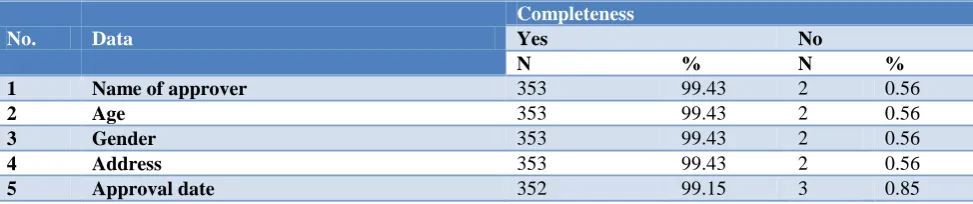
Based on Table 2 it can be seen that for filling the patient's family identity (the approver) for the name of the approver, age, sex, complete address with a percentage of 99.43% and only 0.56% incompleteness on each item. On the item approval date there are 3 files that are not filled in with a percentage of 0.85%.
Table 2: Completeness of filling in the patient's family identity (approver).
No. Data
Completeness
Yes No
N % N %
1 Name of approver 353 99.43 2 0.56
2 Age 353 99.43 2 0.56
3 Gender 353 99.43 2 0.56
4 Address 353 99.43 2 0.56
5 Approval date 352 99.15 3 0.85
Based on Table 3, it can be seen that for filling the identity of the doctor who gave the action, it was completed, 353 with a percentage of 99.44%. Whereas for information providers there are 9 incomplete files with a percentage of 2.54%.
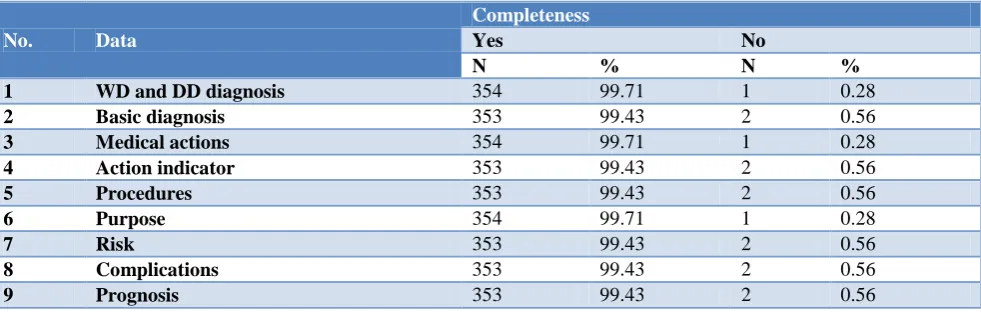
Based on Table 4 it can be seen that the percentage for completeness of the type of action is 99.71% complete.
is 99.71%. In addition, it can also be seen that for the overall data filling type of information the percentage of completeness of the filling is above 90% and it can be
interpreted that the data filling in the type of information at the Ropanasuri surgical special hospital in Padang is very good.
Table 3: Complete completion of doctor’s identity.
No. Data
Completeness
Yes No
N % N %
1 Doctor of actor 353 99.44 2 0.56
2 Provider of information 346 97.46 9 2.54
Table 4: Completeness of action type filling.
No. Data
Completeness
Yes No
N % N %
1 Action type 354 99.71 1 0.28
Table 5: Complete completion of information type.
No. Data
Completeness
Yes No
N % N %
1 WD and DD diagnosis 354 99.71 1 0.28
2 Basic diagnosis 353 99.43 2 0.56
3 Medical actions 354 99.71 1 0.28
4 Action indicator 353 99.43 2 0.56
5 Procedures 353 99.43 2 0.56
6 Purpose 354 99.71 1 0.28
7 Risk 353 99.43 2 0.56
8 Complications 353 99.43 2 0.56
9 Prognosis 353 99.43 2 0.56
Table 6: Completion of filling authentication.
No. Data
Completeness
Yes No
N % N %
1 Doctor’s name 354 99.71 1 0.28
2 Doctor’s signature 354 99.71 1 0.28
3 Name of patient or guardian 353 99.43 2 0.56
4 Patient or guardian's signature 354 99.71 1 0.28
5 Witness's name 349 98.30 6 1.70
6 The witness's signature 345 97.18 10 2.81
Based on Table 6 it can be seen that for the highest percentage filled with complete data on the doctor’s name items, the doctor’s signature and the patient/guardian’s signature is 99.71%. Whereas for the witness’ signature there were 10 files with a percentage of 2.81% which were not signed by the witness.
To support quality health services and produce precise and accurate information, of course, it must be supported by the completeness of data on each medical record form
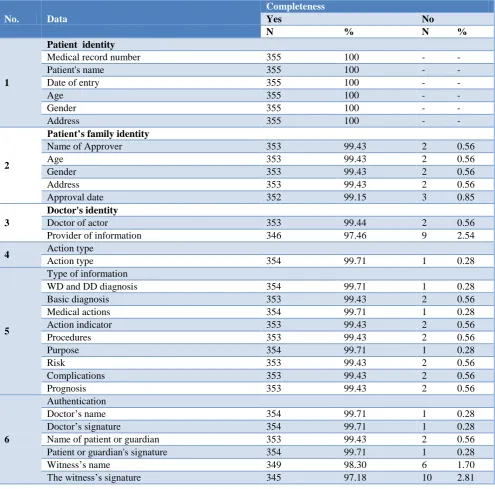
Table 7: Completeness review.
No. Data
Completeness
Yes No
N % N %
1
Patient identity
Medical record number 355 100 - -
Patient's name 355 100 - -
Date of entry 355 100 - -
Age 355 100 - -
Gender 355 100 - -
Address 355 100 - -
2
Patient’s family identity
Name of Approver 353 99.43 2 0.56
Age 353 99.43 2 0.56
Gender 353 99.43 2 0.56
Address 353 99.43 2 0.56
Approval date 352 99.15 3 0.85
3
Doctor's identity
Doctor of actor 353 99.44 2 0.56
Provider of information 346 97.46 9 2.54
4 Action type
Action type 354 99.71 1 0.28
5
Type of information
WD and DD diagnosis 354 99.71 1 0.28
Basic diagnosis 353 99.43 2 0.56
Medical actions 354 99.71 1 0.28
Action indicator 353 99.43 2 0.56
Procedures 353 99.43 2 0.56
Purpose 354 99.71 1 0.28
Risk 353 99.43 2 0.56
Complications 353 99.43 2 0.56
Prognosis 353 99.43 2 0.56
6
Authentication
Doctor’s name 354 99.71 1 0.28
Doctor’s signature 354 99.71 1 0.28
Name of patient or guardian 353 99.43 2 0.56
Patient or guardian's signature 354 99.71 1 0.28
Witness’s name 349 98.30 6 1.70
The witness’s signature 345 97.18 10 2.81
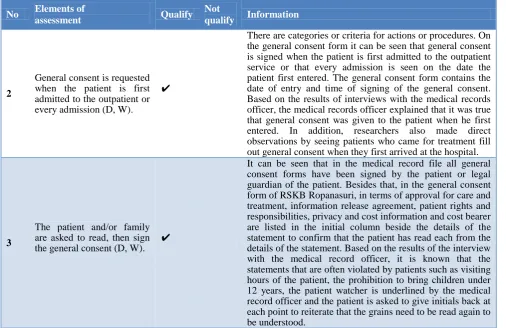
Table 8: Results of analysis of PFR assessment standards 5.
No Elements of
assessment Qualify
Not
qualify Information
1
There are regulations regarding general consent and documentation in the patient's medical record beyond actions that require special informed consent (R).
✔
The regulations used are based on the Decree of the Hospital Director
No: 014/DIRUT/I/2016
Regarding the Management and Implementation Policy of Ropanasuri Surgical Hospital Special Medical Records which explains about the patient or family giving consent for the release of medical record information to outside parties (hospital, insurance, etc.) in general consent (general consent).
No Elements of
assessment Qualify
Not
qualify Information
2
General consent is requested when the patient is first admitted to the outpatient or every admission (D, W).
✔
There are categories or criteria for actions or procedures. On the general consent form it can be seen that general consent is signed when the patient is first admitted to the outpatient service or that every admission is seen on the date the patient first entered. The general consent form contains the date of entry and time of signing of the general consent. Based on the results of interviews with the medical records officer, the medical records officer explained that it was true that general consent was given to the patient when he first entered. In addition, researchers also made direct observations by seeing patients who came for treatment fill out general consent when they first arrived at the hospital.
3
The patient and/or family are asked to read, then sign the general consent (D, W).
✔
It can be seen that in the medical record file all general consent forms have been signed by the patient or legal guardian of the patient. Besides that, in the general consent form of RSKB Ropanasuri, in terms of approval for care and treatment, information release agreement, patient rights and responsibilities, privacy and cost information and cost bearer are listed in the initial column beside the details of the statement to confirm that the patient has read each from the details of the statement. Based on the results of the interview with the medical record officer, it is known that the statements that are often violated by patients such as visiting hours of the patient, the prohibition to bring children under 12 years, the patient watcher is underlined by the medical record officer and the patient is asked to give initials back at each point to reiterate that the grains need to be read again to be understood.
Table 9: Results of analysis of HPK assessment standards 5.1.
No Elements of
assessment Qualify
Not
qualify Information
1
There are clearly defined regulations regarding specific consent (informed consent) (R).
✔
There is a regulation that refers to the Regulation of the Minister of Health of the Republic of Indonesia
No. 290/MENKES/PER/III/2008
Regarding approval of medical measures which explains the general provisions, approvals and explanations who are entitled to give consent, provisions in special situations, rejection of medical action, responsibility, guidance and supervision.
2
The DPJP explains
information on the actions to be taken and if necessary can be assisted by trained staff (D, W).
✔
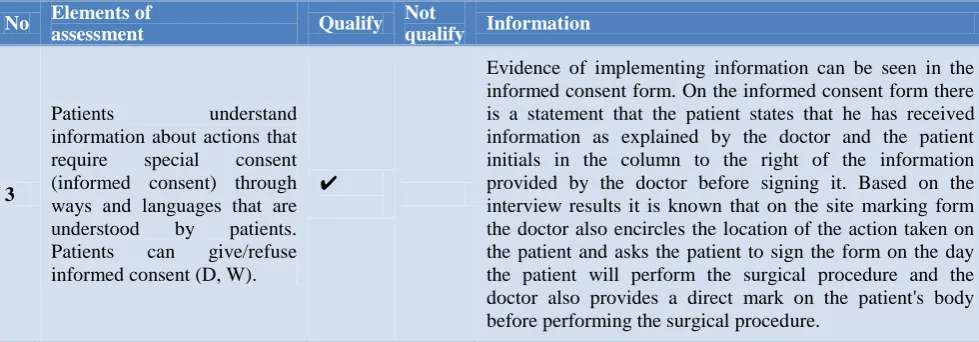
It can be seen that in the informed consent the doctor's statement has stated what medical action will be taken, an indication of the action, procedures, goals, risks, complications, prognosis, alternatives and risks, other things (above things) correctly and clear and provide opportunities to ask questions and or discussions accompanied by a doctor's signature.
On the informed consent sheet it is also explained that before signing the patient's and or family's informed consent, the patient already understands the need and benefits of the action as well as an explanation of success. The signing of the informed consent was witnessed by one of the family members and one of the nurses at Ropanasuri Hospital. In addition there is also a signing on site marking by the patient and the DPJP when they are about to carry out a surgical procedure which is circled in the part to be operated on and the patient is asked to sign it and is also marked directly on the patient's body part. In addition, marking is done directly on the patient's body so that the patient knows with certainty the location of the action to be given to his body.
No Elements of
assessment Qualify
Not
qualify Information
3
Patients understand
information about actions that require special consent (informed consent) through ways and languages that are understood by patients. Patients can give/refuse informed consent (D, W).
✔
Evidence of implementing information can be seen in the informed consent form. On the informed consent form there is a statement that the patient states that he has received information as explained by the doctor and the patient initials in the column to the right of the information provided by the doctor before signing it. Based on the interview results it is known that on the site marking form the doctor also encircles the location of the action taken on the patient and asks the patient to sign the form on the day the patient will perform the surgical procedure and the doctor also provides a direct mark on the patient's body before performing the surgical procedure.
Table 10: Results of the analysis of PFR assessment standards 5.2.
No Elements of assessment Qualify Not
qualify Information
1
There are regulations regarding special consent (informed consent) that must be obtained before
surgery or invasive
procedures, before
anesthesia (including
sedation), use of blood and blood products, and other high-risk treatment (R).
✔
There is a regulation that refers to the Regulation of the Minister of Health of the Republic of Indonesia
No. 290/MENKES/PER/III/2008
Regarding approval of medical measures which explains that in Chapter I, Article I in paragraphs 4 and 5 regarding invasive action is a medical action that can directly affect the integrity of the patient's body tissues and medical actions that contain high risks are medical actions that are based on a certain probability level, can result in death or disability. In addition, in Chapter 2 Article 3 Point 1, which explains that every medical action that contains a high risk must obtain written approval signed by the right to give consent.
2
There is evidence of the implementation of special
consent (informed
consent) that must be obtained before surgery or
invasive procedures,
before anesthesia
(including sedation), the use of blood and blood products, and other high-risk treatment (D, W).
✔
There are special approval forms such as the transfuse action consent form, prior informed consent/invasive procedure, anesthesia form
.
3
The hospital compiles a list of all treatments or actions or procedures that require special approval (informed consent) (D, W).
✔ There is no list of all treatments or actions or procedures that require special approval.
4
The identity of the DPJP and the person who helps provide information to the patient and family is recorded in the patient's medical record (D, W).
✔
Table 11: Results of analysis of PFR assessment standards 5.3.
No
Elements of
assessment
Qualify Not
qualify Keterangan
1
There are regulations in accordance with the laws and regulations that establish the process and who signs special consent (informed consent) if the patient is incompetent (R).
✔
There is a regulation that refers to the Regulation of the Minister of Health of the Republic of Indonesia
No. 290/MENKES/PER/III/2008
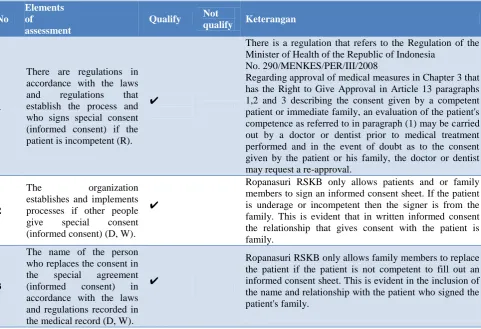
Regarding approval of medical measures in Chapter 3 that has the Right to Give Approval in Article 13 paragraphs 1,2 and 3 describing the consent given by a competent patient or immediate family, an evaluation of the patient's competence as referred to in paragraph (1) may be carried out by a doctor or dentist prior to medical treatment performed and in the event of doubt as to the consent given by the patient or his family, the doctor or dentist may request a re-approval.
2
The organization
establishes and implements processes if other people give special consent (informed consent) (D, W).
✔
Ropanasuri RSKB only allows patients and or family members to sign an informed consent sheet. If the patient is underage or incompetent then the signer is from the family. This is evident that in written informed consent the relationship that gives consent with the patient is family.
3
The name of the person who replaces the consent in the special agreement (informed consent) in accordance with the laws and regulations recorded in the medical record (D, W).
✔
Ropanasuri RSKB only allows family members to replace the patient if the patient is not competent to fill out an informed consent sheet. This is evident in the inclusion of the name and relationship with the patient who signed the patient's family.
DISCUSSION
The biggest incompleteness in filling the signature item approval information was 2.81%, the information provided in the completeness section for filling in the doctor's identity was 2.54%, and the voter’s name 1.70% in filling the authentication. The results showed that the completeness of the informed consent in Ropanasuri surgical specialty hospitals was very good based on the percentage of the informed consent sheets that were filled in with a percentage of 83.38% and 16.62% incomplete informed consent sheets. More than half of the approval information sheets were filled in completely. Research on informed consent was previously carried out by Aisyah, about the factors that caused the incompleteness of filling out an informed consent sheet for eye surgery at the eye hospital Dr. YAP Yogyakarta and obtained 95 sheets of complete informed consent with a percentage of 38.13%, 49 sheets incomplete with a percentage of 19.41% and 107 sheets not filled with a percentage of 42.43% of the 251 files developed.6 Based on interviews and observations of factors causing incompleteness in human resources, namely doctors and nurses. Most of the doctors who were operating visited doctors, doctors who relied on nurses, lower awareness of doctors to complete, less activity of nurses to complete, improved nurse communication with doctors.
Informed consent is interpreted in the legal tradition as grounded in and justified by the moral principle of respect for autonomy. However, in the legal context, informed consent is not precisely about how best to respect autonomy or to enable autonomous decision making. Legal language is oriented more toward specific (correlative) rights and duties that are derived from principles than towards the principles themselves. Thus, in case law the justification for informed consent is couched in rights language the patient's right to self-determination and the primary concern of the law is to prescribe the duties that devolve upon physicians so that this right be protected.7
Explanation regarding informed consent that must contain a diagnosis, procedure for medical treatment, the purpose of medical treatment, alternative other actions and risks, risks and complications that may occur along with the prognosis have been contained in Law No. 29 of 2004.10 It was also explained in the Republic of Indonesia
Minister of Health Regulation no.
290/MENKES/PER/III/2008 article 7 paragraph 3 which outlines the actions of medicine at least covering the diagnosis and procedure of medical action, the purpose of the medical action taken, alternative other actions and risks, risks and complications that may occur, the prognosis for the action conducted and estimated financing.11
Completed informed consent helps support accreditation of national hospital accreditation standards because it is found in the PFR 5 standard for namely in PFR 5.2 and PFR 5.3. In this study, researchers observed all standards ranging from PFR 5.1 to PPA 5.3 to add information relating to the completeness of the medical record file and because it was incorporated in the power purchase agreement (PPA) standard 5. PPA standard 5 explains the existence of regulations regarding general agreement and documentation in the medical record. Patients outside the action that requires separate informed consent. General consent is requested when the patient is first admitted to the outpatient or every admission. The patient and/or family are asked to read, then sign the general consent.5 In this study, the results obtained that for filling the patient's identity filled completely, that is 100%, this is in line with the Republic of Indonesia Ministerial Regulation No. 129 of 2008 that a complete medical record is a medical record that has been filled out in less than 24 hours after outpatient services or after inpatients are allowed to go home with a 100% filling standard.
CONCLUSION
296 pieces of informed consent were filled in with a percentage of 83.38%, 59 sheets of informed consent were incomplete with a percentage of 16.62%. The greatest incompleteness found in filling the informed consent items of witness signatures of 2.81%, providing information on the completeness of filling the doctor's identity by 2.54% and the name of the witness 1.70% on filling the authentication.
ACKNOWLEDGEMENTS
The author thanks the Directorate of Research and Community Service, the Directorate General of Research and Development Strengthening, Ministry of Research, Technology and Higher Education, Indonesia. The author thanks the Director of the Padang Ropanasuri Special Surgery Hospital Dr. Thomas Darwin and medical record officers. The author would like to thank Fairuz Tridania
Anum, Maisyarah, and Ridwan Alfa Rizi as the data collection team in the field.
Funding: The study was funded by the Directorate of Research and Community Service, the Directorate General of Research and Technology Strengthening, Ministry of Research, Technology and Higher Education, Indonesia Fiscal Year 2019
Conflict of interest: None declared
Ethical approval: The study was approved by the Institutional Ethics Committee
REFERENCES
1. Notoatmodjo. Health Research Methodology. Jakarta: Rineka Cipta; 2010.
2. Komalawati V. The role of informed consent in therapeutic transactions. Bandung: Citra; 2002. 3. Arikunto S. Research procedure: a practice
approach. Revised Edition. Jakarta: PT Rineka Cipta; 2002.
4. Herfiyanti L. 2015. Completeness of informed consent surgical actions supporting JCI Standard HPK 6 Orthopedic Patients. Indonesian Health Information Management Journal. Central Java: APTIRMIKI and PORMIKI.
5. National Hospital Accreditation Commission. National Edition Hospital Accreditation Standards I; 2017.
6. Aisyah S. Factors That Cause Completeness in Filling in the Informed Consent Sheet for Eye Surgery at the Hospital. Eyes "DR. YAP "Yogyakarta. Yogyakarta: Gadjah Mada University; 2013.
7. Faden RR, Beauchamp TL. A History and Theory of Informed Consent. New York: Oxford University Press; 1986.
8. Andhani W, Anton K. Analysis of Coding Accuracy Produced by Coder in Ungaran District Hospital. J Health Res. 2016;5(1):35-9.
9. The Republic of Indonesia Health System Review. Decree of the Minister of Health of the Republic of
Indonesia Number 129/MENKES/SK/II/2008
concerning Minimum Service Standards for Hospitals.
10. Law of the Republic of Indonesia No. 29 of 2004 concerning Medical Practice.
11. Regulation of the Minister of Health of the Republic of Indonesia Number 290/MENKES/PER/III/2008 concerning Approval of Medical Measures.