Infogain Publication (Infogainpublication.com) ISSN : 2454-1311
Development of Silver Nanoparticles Incorporated
Antimicrobial Food Packaging Paper Derived
from Corn Cob
Amit Kumar Yadav
1, Dorcus Masih
2, Sanjeet Kumar
31,3M.Tech Food Technology (Food Process Engineering), Department of Food Process Engineering, Vaugh School of
Agricultural Engineering and Technology, Sam Higginbottom Institute of Agricultural Engineering and Technology, Allahabad , U.P., India
2Assistant Professor, Department of Food Process Engineering, Vaugh School of Agricultural Engineering and Technology, Sam
Higginbottom Institute of Agricultural Engineering and Technology, Allahabad , U.P., India
Abstract— Food packaging material was developed from
corn cob pulp that is a potential source of non-wood fibre. Corn cob was soaked in 6% NaOH solution in the ratio of (1:6) that is 1 part grain less corn cob and 6 part NaOH solution. Alkali treatment disrupts cell-wall by dissolving hemicellulose, lignin and silica by hydrolyzing uronic and acetic acid esters and by swelling cellulose. After 24 hours the soaked mixture was taken and cooking was done at temperature of 120oC for 80 minute till gel like structure form and corn cob give paste and soapy texture like structure. After cooling washing was done to remove waste liquor that was followed by pulping to make paper.Studies have focused on developing food packaging material that is paper incorporated with silver nanoparticles in the ratio of10 mg per 100 ml of pulp. Developed paper has significantly reduced the presence of E.coli and Bacillus subtilis in wrapped food sample. The resulting pulp from corn cob was used for paper making and the papers obtained were tested for their mechanical properties; grammage (81) g/m2, thickness (0.199) mm, stiffness (65-70) Taber, tearing strength (MD 39, CD 41) mN for paper incorporated with AgNPs.
Overall, antimicrobial packaging shows promise as an effective method for the inhibition of certain bacteria in foods, but barriers to their commercial implementation continue to exist.
Keywords— AgNPs, Antimicrobial packaging, Bacillus subtilis, Corn cob, E. coli, Paper, Pulp.
I. INTRODUCTION
The conventional paper is derived from wood that is the paper industry is mainly depending upon forest resources, as a result deforestation take place to meet the availability
of raw material for paper making industry. It is broadly accepted that the deforestation causes environmental pollutions and global warming. In recent year, people have placed a high emphasis on forest preservation and rational use of forestry and agriculture residues.Wood is the major raw material for the global pulp and paper industry. Some non-woods are still used, however, especially in China and other Asian countries. At the present time, the most common non-wood fibre is straw. This material accounts for 46 percent of total production, followed by bagasse (14 percent) and bamboo (6 percent). Other non-wood fibres, such as cotton, hemp, sisal, and kenaf, are also becoming more important in the manufacture of pulp and paper
(Atchison, 1995). New developments in food packaging
Infogain Publication (Infogainpublication.com) ISSN : 2454-1311
being made from non-wood materials such as papyrus, hemp and textile rags. With the development of technologies for isolating pulp from wood, it resulted in abandoning paper making from many non-wood materials. Since then, it has been cheaper to produce pulp and paper from wood. However, to date the trend is reversing from wood as the major source of pulp for paper making to non-wood materials such as agricultural food crop residues, grasses, shed tree leaves, fibrous shells of fruits and others. This is due to the fact that the supply of wood for pulp is decreasing as a result of deforestation in most part of world, more especially in Uganda while the non-wood materials are more available and can readily be regenerated after a short period (Kamogaet al. 2013).Thus the use of corn cob for pulp and paper production and incorporation of silver nanoparticles for antimicrobial properties of paper is investigated in this study.
II. METHODOLOGY
2.1 Materials, reagents, strains:
Fresh samples of corn were collected from local vegetable market of Allahabad. It was cleaned to remove sand or soil after that raw material was stored at room temperature in dark to avoid moisture evaporation.Orange peel was purchased from local vendor and washed with normal water to remove dust particles then made peeling with hand and cut the peel in small size of 1- 2 cm.
Fig. 1: Sample of chipped corn cob
Silver nitrate (Qualigens Fine Chemicals, Navi Mumbai), Sodium hydroxide pellets (RFCL Ltd., Gujrat, India), Sulphuric acid (RANKEM).Antibiotic Ampicillin disc (Himedia). All the chemicals used in present study wereof analytical grade commercially available.TheE. coli and
Bacillus subtiliscells used in the present study were
collected from Department of Microbiology & Fermentation Technology, SHIATS (Allahabad, India).
2.2 Silver nanoparticle synthesis:
For synthesis of silver nanoparticles 50 ml of silver nitrate solution of 1 mM concentration was taken in a conical flask and added 5 ml of orange peel extract to above. Then stirred it in magnetic stirrer (MicrotechMedicraft) at 60 ̊C and observed that after 5 min. color has been changed to light yellow then after some time changed to dark yellow which
indicated formation of silver nanoparticles that was confirmed using UV-Vis spectrophotometer.
2.3 Development of antimicrobial paper using grain less corn cob pulp:
Grain less corn cobs (GLCC) was chopped into small pieces (1-2 cm) with sharp knife and collected 181.2gm. These pieces were placed in hot air oven (MicrotechMedicraft, Model- ATC-222) to dry at 40oC for 20 hours (or) may take Sundry for 24 hours depending upon the facilities. After drying GLCC has been found to be 61.7 gm.
To degrade the lignin from the GLCC, 6% NaOH solution (RANKEM, Grade –AR) has been prepared. To prepare the solution, 60 grams of sodium hydroxide pellets were dissolved slowly in 1000 ml distill water at room temperature. 1 molar H2SO4 was prepared to add during
pulping for pH adjustment. The 500ml volume beaker was taken in which dry chopped cob pieces were taken and 6 % NaOH was added in the ratio of (1:6) i.e. one part dry GLCC and six part sodium hydroxide solution. The complete mixer was kept at room temperature for 24 hours for soaking. After 24 hours the soaked mixture was taken and cooking was done at temperature of 120oC for 80 minutes using hot air oven (MicrotechMedicraft) till gel like structure form and GLCC form paste and soapy texture like structure.After cooling the paste at room temp. was washed with tap water and filter by using old carry bag made of cellulosic material and fibre was collected and minced in mixer for one minute to form fine consistency solution, now pulp ready for using in paper moulding.The volume of 100ml pulp was mixed with 10% of filler and 10mg silver nanoparticles solution. The solution was stirred for 1 hour on magnetic stirrer (MicrotechMedicraft) for uniform mixing. Then solution was poured in tray which holds only pulp. Paper sheets were formed using a handmade paper mould and deckle. Then it was kept for 10 hours at room temperature in dark. Pressing was done by keeping 2 blocks of tiles nearly 2-3 kg. Then it is removed after 5 hours and paper was dried at 350C for 8 hours while keeping paper in between board, to avoid shrinkage.
Infogain Publication (Infogainpublication.com) ISSN : 2454-1311
(b)
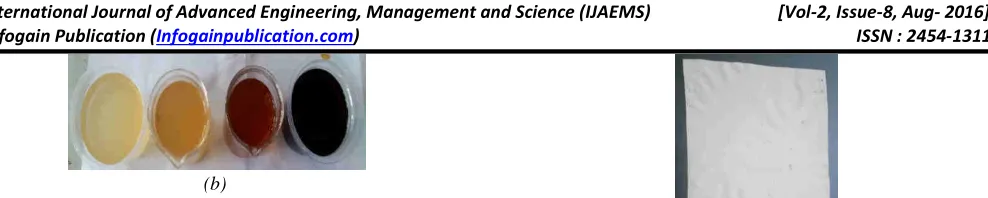
Fig. 2: (a) Unbleached corn cob pulp (b) Waste liquor
2.4 Preparation of media for microbial growth:
For culturing of Bacillus and E.coli bacteria, Nutrient Agar (RANKEM, AR grade) was prepared and sterilized in autoclave. The culture used for testing was revived in nutrient broth and kept for 12hours in shaker incubator before use. Sample from paper were taken and cut into small disc shaped and UV treated for 10 minutes to avoid any microbes due to handling. For reference Antibiotic Ampicillin disc (Himedia) was taken. Plates were swabbed with Bacillussubtilis and E.coli with concentration of 0.01 at 600nm using UV-Vis. Spectrophotometer (Microtechvenus). Disc were spotted and kept at 37o C for 24 hours in incubator.
2.5 Paper Characterization: 2.5.1 Testing of tearing strength
Tearing strength of paper was determined by Tearing Strength Tester (Emeldorf Type) (Techno-India).
2.5.2 Testing stiffness
Stiffness of paper was determined by Stiffness Tester (Taber Type) (Techno India, Roorkee, U.K., Model-TI/TS/ED/126).
2.5.3 Grammage Testing
It also called density of the paper. Sample with equal dimension of 5*5 cm2 was taken in triplicate and each was weigh.
Formula:
Grammage = weight of the sample paper/area of the sample paper (g/m2)
2.5.4 Thickness Testing
Thickness of the paper was measured using digimatic micrometer (Mitutoyo Corporation, Model-293-821) with range of 0 to 25 mm+/- 0.0001 accuracy.
III. RESULT AND DISCUSSION
3.1 Development of antimicrobial paper:
Paper intended for packaging of food materials has been developed by taking the fibre from non-wood agro waste material i.e. grain less corn cob pulp.
Fig. 3: Developed antimicrobial paper
The pH of the pulp maintained near or little above the value of 7. This helps in stabilizing the silver nanoparticles adding in the pulp. To increase the strength of the paper filler pulp (waste paper) is mixed at 10% ratio. The developed paper is observed to be light yellowish, since there are no bleaching agents are added in pulp.Silver nanoparticles incorporated paper has slightly yellowish color compared to normal paperas it was not bleached. Color of the paper was found light yellow below pH 7 and color darkens as pH rises above 7, it was observed dark yellowish.
Table 1: Physico-chemical parameters of developed paper from corn cob pulp
Parameters Normal Paper
Cob derived paper
Thickness 0.111mm 0.199 mm Grammage 75 g/m2 81 g/m2
Tearing Strength
MD 38 , CD 42mN
MD 39 , CD 41mN Stiffness
(bending)
52-60 Taber (avg.)
65-70 Taber (avg.) Appearance White Yellowish to
Brownish Bleaching Yes No Smoothness Smooth Less smooth
pH 7.2 7.4
3.2 Antimicrobial activity of the paper:
The antimicrobial property of the developed paper was completed by antibiotic disc diffusion method. The samples were taken in duplicates and small disc were prepared and treated with ultra violet light for 20 minutes as to avoid any fungal or other microbial attached to surface while handling. The two strains were selected i.e. E.coli and
Bacillussubtilisand studied for antimicrobial property. The
Infogain Publication (Infogainpublication.com) ISSN : 2454-1311
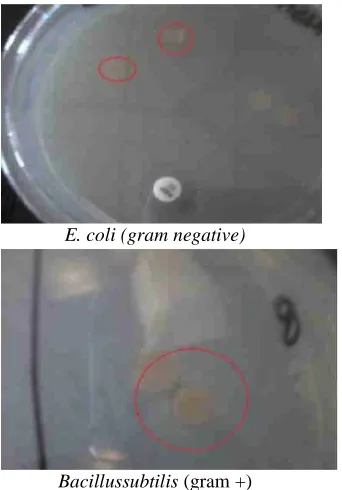
nanoparticles solution tested i.e. 2, 4, and 8 mg.These showed clear zone of inhibition. As shown in Fig.4, But the result was negative for Bacillus subtilis. 10mg silver nanoparticles incorporation showed positive result for both gram positive and negative strain. As shown in Fig.5.These are common bacteria in food products.
E.coli(gram negative)Bacillus subtilis(gram +) Fig. 4: Samples containing 2 mg of silver nanoparticles per
100 ml of pulp slurry showing zone of inhibition
E. coli (gram negative)
Bacillussubtilis (gram +)
Fig.5:Samples containing 10 mg of silver nanoparticles per 100 ml of pulp slurry showing zone of inhibition with E.coli
and Bacillus subtilis
The antimicrobial activity of the silver nanoparticles towards E.coli was found to be more sensitive, as very less quantity of silver nanoparticles (4mg/100ml pulp) showed the formation of zone of inhibition. While gram positive
Bacillus subtilis was resistant at concentration of (4
mg/100ml pulp), it showed zone of inhibition at higher concentration (10 mg/100 ml pulp).So for the development
of antimicrobial paper 10 mg of silver nanoparticles was used which showed clear zone of inhibition.
IV. CONCLUSION
The results obtained from this study have shown that corn cob is suitable non wood raw material for papermaking. The study shows the utilization agro waste material like corn cob. The physical properties like grammage, tearing strength, bending etc. were found to be nearly equal to normal paper. The antimicrobial activity was found positive for both gram negative and positive with concentration of 10 mg in 100gm of pulp solution.Thus, we concluded that the developed packaging material incorporated with silver nanoparticles gave good response for their antimicrobial purpose.
V. ACKNOWLEDGEMENT
I express my deep sense of gratitude to my advisor Er. DorcusMasih, Assistant professor, Dept. of Food Process Engineering, V. S. A. E. T., SHIATS, Allahabad, India for guiding me from start to success of this project showing keen interest to its final completion.
REFERENCES
[1] Atchison, J.E. (1995). Twenty five years of global
progress in non-wood plant fibre pulping -historical highlights, present status and future prospects. In:
Proceedings, Tappipulping conference (Book 1), pp.
91-101. Tappi Press, Atlanta, GA, USA.
[2] Caulfield, D.F. and D.E. Gunderson (1988).Paper
Testing and Strength Characteristics, TAPPI proceedings of the 1988 Paper Preservation
Symposium (1988): 31-40.
[3] Cho, K.-H.P., J-E.; Osaka, T. & Park, S.G. (2005).The study of antimicrobial activity and
preservative effects of nanosilver ingredient, ElectrochimicaActa, 2005. 51: p. 956-960.
[4] Fabrega, Julia (2009). Silver nanoparticle impact on
bacterial growth: effect of pH, concentration, and organic matter. Environmental science &technology, 43.19 7285-7290.
[5] Iturriaga L., Olabarrieta I., De Marañón I. M. (2012). Antimicrobial assays of natural extracts and
their inhibitory effect against Listeria innocua and fish spoilage bacteria, after incorporation into biopolymer edible films, Int. J. Food Microbiol. 158, 58–64. [6] Kamoga Omar Lwako M., Byaruhanga Joseph K.,
Infogain Publication (Infogainpublication.com) ISSN : 2454-1311
Pulp Manufacture from Non Wood Plant Materials,
International Journal of Chemical Engineering and Applications, Vol. 4, No. 3.
[7] Kim, Jun Sung (2007). Antimicrobial effects of silver
nanoparticles. Nanomedicine: Nanotechnology, Biology and Medicine 3.1: 95-101.
[8] Leuthold, Douglas A., and Mark A. Leuthold (1996). Method of dry separating fibers from paper
making waste sludge and fiber product thereof. U.S. Patent 5,527,432.
[9] Manal A. Awad, Awatif A. Hendi, Khalid M. O. Ortashi, Dalia F. A. Elradi, Nada E. Eisa, Lamia. A. Al-lahieb, Shorog. M. Al-Otiby, Nada M. Merghani and Abdelelah A. G. Awad (2014). Silver
nanoparticles biogenic synthesized using an orange peel extract and their use as an anti-bacterial agent,
International Journal of Physical Sciences. Vol. 9(3),
pp. 34-40.
[10]Nacdonald, R. G.; Frantelin, J. N. (1969). Pulp and
Paper Manufacture, Paper Making and Paperboard Making, Vol. III. McGraw-Hill Book Company: New
York, 1969.
[11]R.W. Hurter, and F. A. Riccio (1998). Why CEOS
don’t want to hear about nonwoods—or should they? In: Tappi Proceedings, ANonwood Fiber Symposium, Atlanta GA, USA, pp. 1–11.
[12]Suppakul P., Milty J., Sonneveld K., Bigger S. W. (2003). Active packaging technologies with an
emphasis on antimicrobial packaging and its applications, J. Food Sci. 68, 408–420.
[13]TAPPI Standards: Regulations and Style Guidelines
(Revised 2013)
[14]Wannapeera, Songklanakarin (2008). Product yields
and characteristics of rice husk, rice straw and corncob during fast pyrolysis in a drop-tube/fixed-bed reactor,
J. Sci. Technol. 30 (3), 393-404.
[15]Willian M. da Silva, Caio Barros, LjubicaTasic (2015). Synthesis of silver nanoparticles using orange
peel extracts and their antimicrobial activity.XXIII
Congresso de IniciaçaoCientifica da UNICAMP.
[16]Xiao, B., Sun, X.F. and Sun R-C (2001). Chemical,
structural, and thermal characterizations of alkali-soluble lignin and hemicelluloses, and cellulose from maize stems, rye straw, and rice straw. Polymer