Improving Capacity and Coverage for Multirate
Soft Handoffs in WCDMA Cellular Systems
S.Tamilselvan
Department of Electronics & Communication Engineering, Pondicherry Engineering College,Pondicherry -605014
:
[email protected] Dr. K.ManivannanDepartment of Electrical & Electronics Engineering, Pondicherry Engineering College,Pondicherry -605014
Email: [email protected]
---ABSTRACT--- The paper proposes joint power and rate assignment algorithm (JPRA) to deal with multirate soft handoffs in mixed size Wideband Code Division Multiple Access (WCDMA) cellular systems. The JPRA algorithm is designed in a co-operative two-phased process. The JPRA algorithm contains a link proportional power allocation scheme and an evolutionary computing rate assignment method to determine an appropriate allocation of transmission power and service rate for multirate SHOs. It can achieve good power balancing among cells. LPPA is a multi-site transmission mechanism, which distributes the power in proportion to link qualities between a SHO user and all base transceiver stations (BTS) in its active set. ECRA method performs optimal rate allocation for multi-rate SHO users.
Keywords:WCDMA, transmission power, soft handoff, multirate, cellular system, base station
--- Date of Submission: May 11, 2009 Revised: July 07, 2009 Accepted: November 12, 2009
---
I. INTRODUCTION
S
oft Handoff is one of the most important features in multirate wideband code division multiple access cellular systems. Base Transceiver stations often consume more power to serve SHO users than that to serve nonhandoff (NHO) users. Thus the total power resource in each BTS is confined and shared between SHO and NHO users. This raises an issue of tradeoffs between coverage and capacity. Hence a strategy of joint power allocation (PA) and rate assignment (RA) for multirate SHOs plays an important role for downlink radio resource management in multirate WCDMA cellular systems.Many literatures discussed the topic of joint PA and RA for all users in the cellular system in the sense of global optimization problem. However, possible combinatorial numbers of solutions are too large to be tractable for downlink optimal resource allocation, and the complexity would be greatly increased when taking multirate SHOs into account. Moreover, plenty of publications ever addressed the issue of downlink PA for HO in the CDMA cellular system. A conventional site-selection diversity transmission (SSDT) scheme was proposed in (6). It provided transmission diversity by dynamically selecting one BTS with best link quality in the active set. However, due to the constraint of maximum link power, SSDT sometimes could not afford enough power required for multirate HO users. Also, since SSDT is a single-site transmission mechanism, it may choose a wrong link during the active set selection, resulting in wasting more power for HOs. The advantage of the power-saving
characteristic for SSDT would disappear in the mixed-size environment. None of the downlink PA schemes for HO users considered a maximum constraint of link power and multiple data rates in a mixed-size cellular system.
rates for multirate SHO users obtained by LPPA, formulates the joint PA and RA issue to be an integer and discrete optimization problem, where the sum of the allocated rate for multirate SHO users can be maximized, under a predefined total power constraint for SHOs in each cell. It is well known that conventional optimization methods can hardly cope with problems with integer and discrete variables, whereas evolutionary computing methods are very efficient for these problems to reduce the searching complexity.
In the meantime, a new multiquality balancing PA (MQBPA) algorithm for NHO users with multiple service rates is also developed. With the MQBPA algorithm, each BTS can allocate the power required for each NHO user based on the ratio of the user’s received interference to the link quality. Previous works for quality balancing PA technique were studied only for a single service rate with unique required signal quality. On the other hand, a multirate removal (MRV) algorithm is proposed to pick out a user, who consumes system resource most, to reduce its service rate or even block, it when the system resource is insufficient.
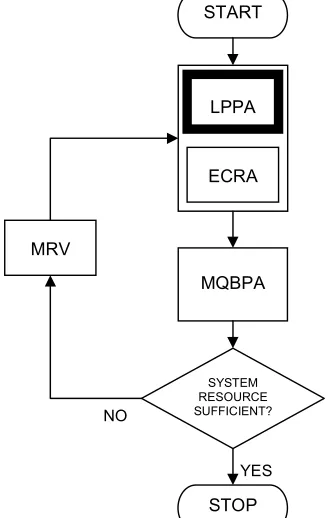
Fig. 1. System operation of downlink power and rate allocations
II. SYSTEM OPERATION
The system operation of downlink power and rate allocations for mixed-size WCDMA cellular systems is shown in Fig. 1. A BTS allocates power to HO users first, based on the new JPRA algorithm, and then to NHO users, which is based on the MQBPA algorithm. If the system resource is insufficient to support all users with allocated rates in their required signal qualities, an MRV algorithm is activated to release system resources by reducing the users’ service rates or even suspending the users’ transmission, and the system operation is executed again. In the multirate WCDMA mixed-size cellular system, the received
interference of user j served by BTS i, which is denoted by Ii.j, is
(
)
,
1
, ,i j i i j k k j k i
I
α
PL
P L
η
ο≠
= −
+
∑
+
(1)where α is the orthogonality factor, Pi is the downlink total transmission power of cell i, Li,j is the link quality from cell i to user j, which includes effects of both pathloss and shadowing, and ηo is the background noise. Note that the first and second terms in (1) denote intracell and intercell interferences, respectively, in which the first term is caused by imperfect orthogonality of spreading codes. Each user is with service rate r, where voice users are with single rate r = rv and data users are with one of M kinds of data service rates.
The received bit-energy-to-noise ratio (Eb/No) of user j with service rate r in BTS i, which is denoted by γi.j(r), must be larger than or equal to the required signal quality, which is denoted by γ*(r). With allocation power q
i,j(r) from BTS i to user j, γi,j(r) can be expressed as
, ,
,
,
( ).
. ( )
( )
i j i ji j
i j
q
r L G r
r
I
γ
=
………(2)
where G(r) = W/r is the processing gain and W is the frequency bandwidth. Assume there are Nv voice HO users and Nd data HO users in the system. For each SHO user h with service rate r, its received Eb/No, γh(r), can be obtained, if using the maximum ratio combining method to combine signals from all serving BTSs in active set Dh,
,
( )
( )
h
h i h
i D
r
r
∈
γ
=
∑
γ
……….(3)
where rh(r) ≥ γ*(r). The active set of each user h is determined according to an SHO algorithm, which has SHO threshold η. If the strength difference between the received pilot signals of the original cell and a target cell is less than or equal to η, the target cell would be added as an active member in action set Dh.
III. JPRA ALGORITHM
The problem of the joint PA and RA for multirate SHOs is here defined as a constrained combinatorial optimization problem with an objective to maximize the total throughput of multirate SHOs, under the constraints of that the total power allocated to SHO users in each cell should be bounded by a maximum value, the power allocated to each SHO user from a cell of its active set is limited by an upper bound, and the received bit-energy-to-noise ratio of each SHO user must not be less than its requirement of signal quality. We define the total throughput of multirate SHO to be the sum of the allocated rate for the multirate SHO data users, excluding the service rate of SHO voice user, which is constant. Also, for clarity, denote the allocation rate r for SHO data user h as (rd)h, (rd)h {r1d, . . . , rM d }, and the rate vector for all multirate SHO data users by R = [(rd)1, . . START
LPPA
MQBPA
SYSTEM RESOURCE SUFFICIENT?
STOP MRV
ECRA
. , (rd)h, . . . , (rd)Nd ]. Then, the optimization problem is mathematically formulated by
*
1
arg max
d( )
N d h R h
R
r
=
=
∑
(4)
subject to constraints for r {rv, r1d, . . . , rMd }
µ
, 1( )
v d N Ni h i
h
q
r
Q
+
=
≤
∑
,
1
≤ ≤
i N
b(5)
$
,
( )
i j iq
r
≤
q
,
i D
∈
h(6)
*
( )
( )
h
r
r
γ
≥ γ
,
∀
h
(7)
where
Q
µ
i is the maximum value of total allocation power of cell i for SHOs,q
$
i is the upper bound of the PA to SHO user h from cell i, and Nb is the numbers of BTSs in the system. We propose a novel JPRA algorithm to efficiently solve the above optimization problem. The JPRA algorithm is mainly composed of the LPPA scheme, which determines all possible qi,j(r) under the constraints of (6) and (7), and the ECRA method, which searches for R* of (4) under the constraint of (5). In this joint PA and RA for SHO users, power balancing can be accomplished among cells.IV. LPPA SCHEME
The LPPA scheme is an iterative algorithm to determine the transmission power required for SHO user h, qh(r), and how much amount of qh(r) would be from cell i in its active set Dh, qi,h(r), under the constraint of the maximum link power,
q
$
i, i Dh, as stated in (11). The resultant qi,h(r) is proportional to the link quality between the BTS i Dh and the SHO user h [3]. That is, qi,h(r) = qh(r) ×ϖ
i h, , where,
i h
ϖ
is the weighting factor of the required transmission power for the link between BTS i and user h. We set, i h
ϖ
by , , , h i h i h i h i DL
L
∈ϖ =
∑
(8)
Basically, the link proportional strategy for PA is to let the active link with better link quality contribute more power than those with weaker link qualities. If the required transmission power of one link violates the constraint of the maximum link power, LPPA will compensate the required power through other links by using an iterative method to redistribute qh(r) to all serving BTSs to satisfy the required signal quality. The iteration is to try to accomplish the power balance among mixed-size cells. Also, the resultant signal quality of user h with service rate r should not be less than its required signal quality γ h (r), as stated in (7);
otherwise, the qh(r) should be adjusted by a tuning factor
φh, which is given by
*
( )
( )
h h hr
r
γ
φ
γ
=
(9)
Besides, it is noteworthy that due to the constraint of the maximum link power, there exists a forced termination situation for SHO whenever SHO users cannot obtain the required signal quality even though all active links are allocated with maximum link power. If the SHO user is forced to be terminated, qi,h(r) of each link i in active set Dh is reset to zero. It is proven that the LPPA scheme is convergent in [3]. Here, the LPPA scheme will calculate all PA combinations of qi,h(r), 1 ≤ h ≤ Nv + Nd, 1 ≤ i ≤ Nb and r {rv, r1d, . . . , rMd }, for the joint PA and RA problem described in (4)–(7). Here, only the determination of qi,h(r) for an arbitrary SHO user h with rate r {r1
d, . . . , rMd } is stated. In the following, we brief the LPPA scheme, and the steps involved in it. The details can be found in [1].
[The LPPA Scheme]
Step 0: [Initialize service rate r for SHO user h]
• IF SHO user h is with voice service, THEN set r = rv. ELSE Set r = rmd and m = 1 for SHO user h is with data service.
Step 1: [Exam the SHO feasibility]
• Set φh = 1.0.
• Allocate maximum link power
q
$
ifor each active links i.• Calculate received signal quality γh(r) based on (2), (3).
• IF γh(r) > γ (r), THEN goto Step 2.
ELSE IF γh(r) = γ (r), THEN set qi,h(r) =
q
$
i, i∈
Dh, and goto Step 6.ELSE IF r = rv or r = r1d, THEN SHO user h is forced to terminate such that qi,h(r)=0, i
∈
Dh, DONE.ELSE goto Step 6.
Step 2: [Initialize power settings]
• Initialize required transmission power qh(r) for SHO user h by qh(r) =
$
h
i D ∈
q
i∑
.Step 3: [Calculate weighting factor
ϖ
i h, ]• Obtain weighting factor
ϖ
i h, for the transmission power from BTS i in Dh to SHO user h, based on Li,h by (8).Step 4: [Calculate allocation power qi,h(r)]
Determine the power that BTS i in Dh allocates to SHO user h, qi,h(r), by (10)
Step 5: [Compute received Eb/No and tuning factor φh]
• Compute the corresponding γh(r) based on (2) and (3), and set tuning factor φh based on (9). Step 6: [Check Stop Criterion]
IF φh
≠
1.0, THEN let qh(r) = φh × qh(r) and goto Step 2.ELSE IF r rd and r
≠
rMd , THEN m = m + 1, r = rmd and goto Step 1. ELSE DONE.
V. SIMULATION RESULTS
Fig.2: Averaged forced termination probability of SHO
Fig.3: Total handoff throughput versus the number of data users per cell
Fig.2 shows the average forced termination probability of SHO under different traffic loads. The gain of LPPA over SSDT comes from the PA strategy for SHO. It can be seen
that, when the traffic load is light, LPPA achieves less average forced termination probability of SHO than SSDT. When the traffic load is heavy, LPPA performs worse than SSDT. The reason is that higher interferences are induced by the multisite transmission mechanism than by the single-site transmission mechanism for HOs. The finite total power resource of the BTS may be insufficient to support more HO users at heavy load situations.
Fig.3 shows the total HO throughput versus different number of data users. It is found that LPPA has higher throughput than SSDT because of the multisite transmission mechanism.
VI. CONCLUSION
An efficient power allocation to the SHO users is done using the LPPA scheme, which is achieved using the optimization of the tuning factor approximately to unity. Thus a user who has more signal quality is optimized to the required signal quality and the user with less signal quality is tuned to required signal quality. This process is repeated until the resources (total BTS power) are exhausted. When the resource is insufficient the Multirate Removal Algorithm is initiated. This increases the system performance and system reliability.
An essential performance measured here is the HO forced termination probability, which indicates the service continuity and the effectiveness of the cell’s service coverage. It is evaluated by counting the proportion of SHO users that are terminated by the system due to insufficient power resource for SHOs temporarily.
The future work in this paper involves the evaluation of the ECRA algorithm, which completes the JPRA scheme for the SHO users. An MQBPA scheme is then simulated for NHO users. Fine-tuning of the entire system is achieved using the MRV algorithm.
REFERENCES
[1]. C. Y. Liao, L. C. Wang, and C. J Chang, “A joint power and rate assignment algorithm in mixed-size WCDMA cellular systems,” in Proc. ACM IWCMC, Vancouver, BC, Canada, Jul. 2006, pp. 833–838. [2]. D. I. Kim, E. Hossain, and V. K. Bhargava, “Downlink
joint rate and power allocation in cellular multirate WCDMA systems,” IEEE Trans. Wireless Commun., vol. 2, no. 1, pp. 69–80, Jan. 2003.
[3]. C. Y. Liao, L. C. Wang, and C. J Chang, “Power allocation mechanisms for downlink handoff in the CDMA system with heterogeneous cell structures,” ACM/Kluwer WINET, vol. 11, no. 5, pp. 593–605, Sep. 2005.
[5].S. L. Kim, Z. Rosberg, and J. Zander, “Combined power control and transmission rate selection in cellular networks,” in Proc. IEEE VTC—Fall, Amsterdan, The Netherlands, Sep. 1999, pp. 1653– 1657.
[6].H. Furukawa, K. Hamabe, and A. Ushirokawa, “SSDT—Site selection diversity transmission power control for CDMA forward link,” IEEE J.Sel. Areas Commun., vol. 18, no. 8, pp. 1546–1554, Aug. 2000.
Authors Biography
S.Tamilselvan received M.Tech degree from Pondicherry Engineering College, Pondicherry, India in Electronics and Communication Engineering, BE in Electronics and Communication Engineering from St.Joseph’s College of Engineering, Chennai, India. His current research interests are in Mobile and Distributed Computing, wireless communication systems, etc. Currently he is doing Ph.D in the area of wireless communication in department of ECE, Pondicherry Engineering College.