Original Research Article
Assessment of vaccine management in cold chain points of Jashpur and
Sarguja districts of Chhattisgarh
Nitin H. Kamble, Daneshwar Singh*, Harshal G. Mendhe, Kiran Makade
INTRODUCTION
India’s immunization programme is the largest in the world, with annual cohorts of around 26.7 million infants and 30 million pregnant women.1,2 Immunization is a crucial component of the public health services. Immunization prevents illness, disability and death from vaccine-preventable diseases including diphtheria,
hepatitis B, measles, mumps, pertussis, pneumonia, polio, rotavirus diarrhoea, rubella and tetanus etc. and improve quality of life in the population Immunization currently averts an estimated 2 to 3 million deaths every year.3 Immunization is acknowledged among the most cost-effective and highest health impact interventions. In India, full immunization coverage continues to be sub-optimal, standing at a mere 62% at the national level.4 There are many states where full immunization coverage
ABSTRACT
Background: It has been observed that besides intensification of routine immunization, more strategic interventions are essential to strengthen the different aspects of immunization services like cold-chain management and monitoring/supportive supervision. The present study was considered as a part of ongoing UNICEF funded project on Supportive Supervision of Routine Immunization in Jashpur and Sarguja districts undertaken by the Department of Community Medicine, GMC Rajnandgaon with the objectives to assess the status of cold chain equipment and logistics management practices, knowledge and practice of cold chain handler (CCHs) about cold chain equipment and logistics management.
Methods: A cross-sectional facility based study was conducted from August 2017 to February 2018. Among 18 cold chain points (CCPs), 9 from Jashpur and 9 from Sarguja district were considered for analysis using structured questionnaires provided by UNICEF.
Results: In 83.33% CCPs cold chain technician or annual maintenance contract/computer-mediated communication service provider visit for preventive maintenance in the last 4 months. Vaccine CCHs carries out the daily and weekly planned preventive maintenance as per the checklist in 83.33% CCPs during our visit. In all CCPs iced line refrigerator (ILR) and deep freezer (DF) were placed as per specified guidelines. In 66.66% CCPs there was documentation of monthly review of temperature records. In all CCPs visited standard vaccine and logistics stock/issue registers were available.
Conclusions: Most of the components of cold chain and logistics management practices were satisfactory while there is a gap in other components which needs to be improved by means of ongoing project of strengthening of SSRI in both districts.
Keywords: Cold chain, Vaccine CCHs, CCPs, Cold chain equipment, ILRs, DFs
Department of Community Medicine, Bharat Ratna Late Shree Atal Bihari Vajpayee Memorial Medical College, Rajnandgaon, Chhattisgarh, India
Received: 24 July 2019
Revised: 28 November 2019
Accepted: 07 December 2019
*Correspondence:
Dr. Daneshwar Singh,
E-mail: [email protected]
Copyright: © the author(s), publisher and licensee Medip Academy. This is an open-access article distributed under the terms of the Creative Commons Attribution Non-Commercial License, which permits unrestricted non-commercial use, distribution, and reproduction in any medium, provided the original work is properly cited.
is less than 50%. On the other hand there are states having coverage above the national. Immunization coverage in Chhattisgarh has never been abysmal but the improvement is rather insignificant over the years. Fully immunized children coverage rate as perNational Family Health Survey (NFHS-3) (2005-06)- 48.7%, District Level household Survey-3 (2007-08)- 59.3% and further improves to 76.4% NFHS-4 (2015-16).5,6 In order to realize the full benefits of immunization, coverage of vaccination has to be increased and more importantly potent vaccines should reach the beneficiaries for which cold chain maintenance is crucial.1,2 Cold chain and vaccine management is a key driver of immunization program. Availability of vaccines does not necessarily translate into vaccination. Inadequate supervision and management is one of the frequently identified barriers for keeping up the consistently high vaccination coverage.7 The cold chain remains a greatly vulnerable point for national immunization program. In order to achieve the complete advantages of immunization, potent vaccines should reach the beneficiaries for which cold chain maintenance is crucial.8 A well-managed cold chain will increase the proportion of effective vaccines that are administered, reduce vaccine wastage and limit adverse event following immunization. Hence, the cold chain system requires attention for effective vaccination programme. The consequence of this failure caused life for patients, increased costs for providers and damage to public confidence in immunizations. The present study has been conducted with the aim to assess vaccine management which occurred in the cold chain point. With this back ground, this study was carried out with the objective of evaluating the cold chain practices, with particular reference to assessing the availability of cold chain equipment, vaccine storage practices, monitoring of cold chain and knowledge regarding vaccine storage amongst the cold chain handlers (CCHs) in urban health centers of Jashpur and Sarguja districts of Chhattisgarh.
METHODS
A cross-sectional facility based study was conducted in the Jashpur and Sarguja districts of Chhattisgarh. The study was a part of a project of strengthening Routine Immunization program in association with UNICEF Chhattisgarh. The authors were monitors in this project.
Study settings
The evaluation of the vaccine management for routine immunization programme was conducted at selected cold chain points (CCPs) of Jashpur and Sarguja districts of Chhattisgarh, India.
Study period
Study was undertaken from the month of August 2017 to February 2018 for a period of six months.
Study unit
Participants in this study were the vaccine CCHs (VCCH). The CCPs of the entire health centre’s of the district was included. List of all CCPs in area constituted the sampling frame. Using simple random sampling technique 18 CCP’s were sampled.
Study tool
A predesigned and pretested checklist was used to collect the data.
The data collection tools was developed as per norms and standard for Government of India, Immunization Program.9 The pre-test was done in Urban Health Training Centre (UHTC) of Government Medical College, Rajnandgaon (Chhattisgarh).
Data collection and procedure
The ethical approval from the ethical committee was taken prior to start the study. Prior permission was obtained from the district immunization officer to include the health centers for the study. The visits were conducted as a part of team work for Routine Immunization Supportive Supervision program. Data collection was done by single observer to avoid any inter observer bias. The CCPs were visited by the investigators and the investigators were imparted training for the assessment before initiation of these activities. The physical verification of the available cold chain equipments was done and their functional status was also examined during each visit by the investigators. The information was collected from CCHs and medical officer in charge for routine immunization of the respective cold chain system at health centers. The information was evaluated on the basis of important aspects related to the cold chain system. These components were related with status of cold chain system, routine micro-plan, status of all cold chain equipment and their maintenance, temperature monitoring practices, vaccine storage practices and logistics management, recording and reporting system and waste disposal activities. Storage practices of vaccines and diluents were also assessed on the recommendation about placement of heat and freeze sensitive vaccines, returned partially used and unused vaccine vial under open vial policy. The CCHs available during the visit were interviewed to assess their training and knowledge regarding cold chain. The questionnaire included questions on information of the respondent related to knowledge regarding management of the cold chain including equipment maintenance, temperature monitoring and vaccine management.
Variables
management. Variable about equipment maintenance include correct placement of iced line refrigerator (ILR), deep freezer (DF), cold boxes and ice packs in the CCP, display of contingency plan and latest standard job aids in center. Variables related to temperature monitoring include availability of standard temperature log books, thermometers in each cold chain equipment (CCE), correct demonstration of temperature by VCCH, daily twice recordings of temperature and documentation of monthly review of temperature records. Variables about vaccine management includes availability of upto date standard vaccine and logistic stock registers, correct storage of vaccine inside ILR and in basket, knowledge of VCCH about ice pack conditioning.
Statistical analyses
The relevant data was collected, checked for completeness and correctness, compiled using MS Excel
and analyzed using IBM SPSS Statistics for Windows, Version 22.0. Armonk, NY: IBM Corp. Statistical tools applied were percentages, proportions. Each completed questionnaire was coded on pre-arranged coding to minimize errors.
RESULTS
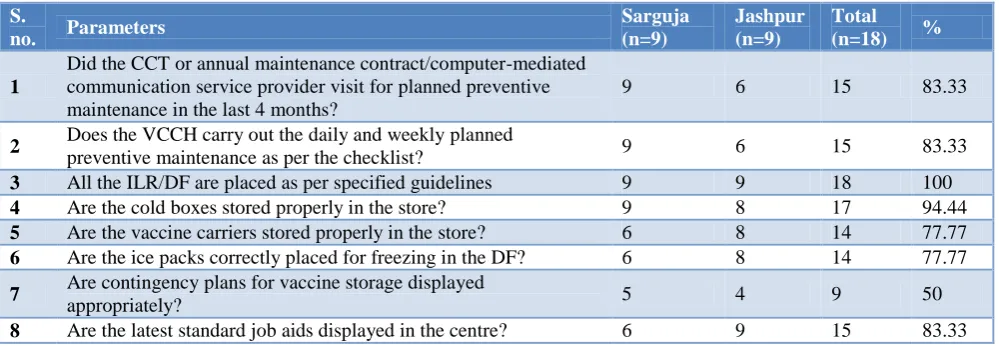
Table 1 show that in all CCPs ILR and DF is placed as per guidelines. Contingency plan for vaccine storage displayed in half of the CCPs only. Latest standard job aids displayed in 15 CCPs out of 18. Vaccine carriers and ice packs correctly placed in 14 CCPs out of 18 (77.77%). Table 2 shows that twice daily recordings and correct temperature reading from thermometer have done in all CCPs. In 2/3rd CCPs there is documentation of monthly review of temperature records.
Table 1: Equipment maintenance.
S.
no. Parameters
Sarguja (n=9)
Jashpur (n=9)
Total (n=18) %
1
Did the CCT or annual maintenance contract/computer-mediated communication service provider visit for planned preventive maintenance in the last 4 months?
9 6 15 83.33
2 Does the VCCH carry out the daily and weekly planned
preventive maintenance as per the checklist? 9 6 15 83.33
3 All the ILR/DF are placed as per specified guidelines 9 9 18 100
4 Are the cold boxes stored properly in the store? 9 8 17 94.44
5 Are the vaccine carriers stored properly in the store? 6 8 14 77.77
6 Are the ice packs correctly placed for freezing in the DF? 6 8 14 77.77
7 Are contingency plans for vaccine storage displayed
appropriately? 5 4 9 50
8 Are the latest standard job aids displayed in the centre? 6 9 15 83.33
Table 2: Temperature monitoring.
S.
no. Parameters
Sarguja (n=9)
Jashpur (n=9)
Total (n=18) % 1 Are there dedicated functional thermometers for each functional CCE? 9 9 18 100
2 Are there dedicated standard temperature log books for each installed
CCE? 8 9 17 94.44
3 Is twice daily recordings (holidays*) complete and up to date for the last 3
months? 9 9 18 100
4 Is there documentation of monthly review of temperature records? 4 8 12 66.66
5 Can the VCCH correctly demonstrate temperature reading from the
thermometer? 9 9 18 100
Table 3: Vaccine management.
S.
no. Parameters
Sarguja (n=9)
Jashpur (n=9)
Total (n=18) %
1 Does the CCP have standard vaccine and logistics stock/issue
registers? 9 9 18 100
2 Are the registers completely filled and up to date? 8 9 17 94.44
3 Is there documented evidence of physical stock verification of
S.
no. Parameters
Sarguja (n=9)
Jashpur (n=9)
Total (n=18) % 4 Are the vaccines correctly stored in the ILR 9 9 18 100
5 Are the vaccines kept in the basket in the ILR? 9 9 18 100
6 Does the CCE contain only UIP vaccines and diluents? 8 8 16 88.88
7 Is there any open vaccine vial stored in the ILR without date and
time mentioned on it? 0 0 0 0
8 Can the VCCH correctly demonstrate ice pack conditioning? 9 9 18 100
9 Is there adequate space available for conditioning of icepacks? 8 9 17 94.44
10 Is there any vaccine kept in the deep freezer? 0 0 0 0
In Table 3, all CCPs vaccines were correctly stored in basket in ILR. No vaccine was kept inside deep freezer and no open vaccine vial found without date and time mentioned on it. Adequate space was available for conditioning of ice packs nearly in all CCPs.
DISCUSSION
Immunization is one of the most cost effective strategy in reducing childhood morbidity and mortality.10 Immunization has to be sustained as a high priority to further reduce the incidence of all vaccine preventable diseases. Cold chain and vaccine management is one of the essential components for improving quality of immunization services.12 The room should be provided with racks or almirah for storing vaccine logistics and records or registers or stationary.1 In present study it was observed that all 18 (100%) CCPs had dedicated space/room for cold chain. In a similar study Sinha et al reported that among all CCPs visited only 40% had dedicated space/room.13 Ice packs are key components of cold chain for vaccine storage and transport. The water should be filled only up to the level of mark on the side and cork should be tight so that there is no leakage.2 In 77.77% CCPs (14 out of 18) ice packs correctly placed for freezing in DF in our study. In a study by Mallik it was found that half of CCP icepacks were correctly placed.14 In a similar study Gupta et al observed the correct placement of ice packs inside DF (in crisscross manner) was found in only 66.66% CHCs.15Ashish et al in their study found that Ice packs were stacked on the floor of the deep freezer horizontally in a crisscross manner in only one- third (35%) of the health centers.16In all CCPs (18 out of 18) ILR and DF were placed as per specified guidelines. In a study by Mallik, it was found that in half of CCPs, ILR and DF were placed 10 cm away from the wall and in 25% CCPs, ILR and DF were kept on wooden platform.14 Careful attention to storage and handling is essential to ensure optimal potency of vaccines to maximize the resulting efficacy of vaccination.17 Temperature of ILR/DF used for storage of vaccines must be recorded twice daily. The ILR and DF each should have separate thermometer and temperature record book.2 In present study in all CCPs (18 out of 18) dedicated functional thermometers for each functional CCE was available and twice daily recordings including holidays of each installed cold chain equipment was complete and up to date for the last 3 months in 100%
CCPs (18 out of 18). A study conducted by Naik et al, found that in all 20 Urban Health Center of Municipal Corporation of Surat, temperature was being recorded twice a day for both deep freezer and ILR.16 Temperature chart with two entries per day was maintained in 72% government urban dispensaries in Delhi.18 In a similar study done by Biradar et al at Bijapur Karnataka found that only 76.1% health center, functional thermometer were placed inside every ILRs and DFs.19 A study done by Govani et al in all urban health centers of Ahmadabad Municipal Corporation revealed that in 85% ILR and 83% DFs, functional thermometers were properly placed.20 In 94.44% CCPs (17 out of 18) dedicated standard temperature log books for each installed CCE was available in this study which is equal to study done by Rao et al observed 94.2% centers.21 The findings in our study was more than that what Mallik et al (60%), Samath et al (65%) and Sachdeva et al (71.87%) found in their studies.14,23,18 In a study Sanghavi et al observed that temperature log book was not properly maintained in some primary health care.23In current study, in all CCPs (18 out of 18) vaccines correctly stored in the ILR and all vaccines are kept in the basket in the ILR. In another study, vaccines were arranged according to temperature sensitivity in ILR in 70% health centers.16 Freeze sensitive vaccines were stored correctly in 62.5% health facility only.18 The purpose of the study was to provide supportive supervision and monitoring of routine immunization. It is a process of improving work performance of helping staff. It is a two way communication and builds team approach that facilitates problem solving.
Limitations
If periodic follow-up supervision of CCEs and VCCH’s in the health centers’ is done, then it will throw light on adoption of suggested corrective measures which will pave way towards further improvement.
CONCLUSION
both the districts. Therefore, there is a need to well-designed regular supportive supervision and training that supported with practical demonstrations to monitor the system. Also, possibilities must be explored to assess the level of cold chain monitoring daily immunization sessions and outreach program.
Recommendations
The gaps in cold chain and logistics management practices can be filled by adopting holistic approachand fixing accountability. There should be training and retraining of VCCH’s at regular interval withcontinuous supportive supervision.
Funding: No funding sources Conflict of interest: None declared
Ethical approval: The study was approved by the Institutional Ethics Committee
REFERENCES
1. Handbook for vaccine and cold chain handlers, Department of Health and Family Welfare, Ministry of Health and Family Welfare Government of India. 2nd ed. 2016
2. Ministry of Health and Family Welfare, Government of India. Immunization handbook for medicalofficers. WHO, 2016. Available at: http://www.searo.who.int/india/publications/immuni zation_handbook2017/en/. Accessed on 15 July 2019.
3. Guidelines on how to maintain vaccine cold chain. Available at: https://www.moh-ela.gov.sg/ela/ content/Vaccine_Cold_ Chain.pdf2005. Accessed on 10 April 2019.
4. Immunization coverage: Fact Sheet (WHO). Available at: www.who.int /mediacentre /factsheets/fs378/en/. Accessed on 15 July 2019. 5. NFHS-4– National Family Health Survey Available
at: http://rchiips.org/NFHS/pdf/NFHS4/CT_Fact Sheet.pdf. Accessed on 18 April 2019.
6. District Level Household and Facility Survey 2007– 08. Available at: http://www.rchiips.org/pdf/rch 3/state/India.pdf. Accessed on 18 April 2019. 7. Djibuti M, Gotsadze G, Zoidze A, Mataradze G,
Esmail LC, Kohler JC. The role of supportive supervision on immunization program outcome –a randomized field trial from Georgia. BMC Int Health Hum Rights. 2009;9(1):11.
8. Centers for Disease Control (CDC), USA. CDC’s Advisory Committee on Immunization Practices, American Academy of Pediatrics (ACIP) General Recommendations on Immunization. Available at: www.cdc.gov/vaccines/pubs/vac-mgtbook.html. Accessed on 15 July 2019.
9. Ministry of Health and Family Welfare, Government of India. Immunization handbook for medicalofficers. WHO, 2016. Available at: http:/
/www.searo.who.int/india/publications/immunizatio n_handbook2017/en/. Accessed on 15 July 2019. 10. Park K. Park’s Textbook of Preventive and Social
Medicine. 23rd ed. Jabalpur: M/S Banarsidas Bhanot Publishers; 2015: 103-109.
11. Handbook for vaccines and cold chain handlers. Department of Health and Family Welfare, Ministry of Health and Family Welfare Government of India; 2011.
12. Sinha A, Verma A, Chandrakar A, Khes S. Evaluation of cold chain and logistics management practice in Durg district of Chhattisgarh: pointer from Central India. Int J Comm Med Pub Health. 2017;4(2):390-5.
13. Mallik S, Mandal PK, Chatterjee C, Ghosh P, Manna N, Chakrabarty D, et al. Assessing cold chain status in a metro city of India: an intervention study. Afr Health Sci. 2011;11(1):128-33.
14. Gupta A, Gupta R. Study of Cold Chain Practices at Community Health Centers of Damoh District of Madhya Pradesh. National J Community Med. 2015;6(4):528-32.
15. Naik A, Rupani M. Evaluation of Vaccine Cold Chain in Urban Health Centers of Municipal Corporation of Surat City, Western India. Int J Prev Med. 2013;4(12):1395-401.
16. Bankole AM, Olusegun KK, Marian NB, Godswill I, Adebowale OA, Lukeman AJS, et al. The impact of health facility monitoring on cold chain management practices in Lagos, Nigeria. J Public Health Epidemiol. 2010;2(4):78-81. 9
17. Sachdeva S, Datta U. Status of vaccine cold chain maintenance in Delhi, India. Indian J Med Microbiol. 2010;28:184-5.
18. Biradar SM, Biradar MK. Evaluation of Vaccine Storage Practices in Primary Health Cen-tres of Bijapur District of Karnataka. Int J Pharm Bio Sci. 2013;4(4):1290-3.
19. Govani KJ, Sheth JK. Evaluation of Temperature Monitoring System of Cold Chain at all Urban Health Centres (UHCs) of Ahmedabad Municipal Corporation (AMC) area. J Indian Assoc Prevent Social Med. 2015;6(1):41-5.
20. Rao S, Naftar S, Unnikrishnana B. Evaluation, awareness, practice and management of cold chain at the primary health care centers in coastal South India. J Nepal Paediatric Societ. 2012;32(1):19-22. 21. Samant Y, Lanjewar H, Parker D, Block L, Tomar
G, Stein B. Evaluation of the cold-chain for oral polio vaccine in a rural district of India. Public Health Rep. 2007;122(1):112-21.
22. Sanghavi M. Assessment of routine immunization program at primary health centre level in Jamnagar district. National J Med Res. 2013;3(4):319-23.