784 | 2019 | ISSUE 4 | VOLUME 14 © 2019 University of Alicante
Physical education classes improve foot function
in high-school students using technological tools
NICOLA LOVECCHIO1,2 , LAURA PAPINI1, ROBERTO CODELLA1,2, ANTONIO LA TORRE1,2
1School of Sport Science, University of Study of Milan, Italy
2Department of Biomedical Science for Health, University of Study of Milan, Italy
ABSTRACT
The aim of this study was the evaluation of a coordinative and plyometric training program on the functionality of foot in high school students. The use of modern technologies tools was used to made attractive the didactic
approach. Sixty–three students were freely recruited and randomly divided into Training Group and Control
Group. Training group consisted in plyometrics, balance and strength exercises while the control’s remained
off-training. Subjects were tested for balance ability, reactive-strength and dynamic-ground-contact using high technology tool. The TG significative improved the balance ability performance by 68% while CG remained unchanged. The reactive-strength index revealed a 13% gain in training group although this increase resulted not significantly different from control. The dynamic-ground-contact performance revealed in TG only a tendency of decreasing. A specific training program affected the functionality of foot even if the application of stimulus was time restricted. Moreover, the use of technologies verified an interesting use of tools in school context that could involve students proactively. Keywords: Training program; Physical education; Balance; Reactive strength; Technologies.
1Corresponding author. School of Sport Science, Department of Biomedical Science for Health, Università degli Studi di Milano.
Via Mangiagalli 31, 20133 Milano, Italy. https://orcid.org/0000-0003-4115-0833 E-mail: [email protected]
Submitted for publication October 2018 Accepted for publication December 2018
Published December 2019 (in press January 2019)
JOURNAL OF HUMAN SPORT & EXERCISE ISSN 1988-5202 © Faculty of Education. University of Alicante
doi:10.14198/jhse.2019.144.07
Cite this article as:
Lovecchio, N., Papini, L., Codella, R., & La Torre, A. (2019). Physical education classes improve foot function in high-school students using technological tools. Journal of Human Sport and Exercise, 14(4),
VOLUME 14 | ISSUE 4 | 2019 | 785 INTRODUCTION
The foot is the segment that supports the entire weight of the body. It is located at the base of the antigravity control system (tonic-postural system) and plays a crucial role during the preservation of standing position and in walking/run/jump actions. In this perspective. this human anatomical segment is embedded with a large number of proprioceptive receptors (front part of the heel. head of the metatarsals. hallux and lumbrical muscles; Gribble, Tucker & White, 2007) and it consists of 26 bones (Neumann, 2002; Winter, 1990). Moreover, feet are an important element for balance control (along all phases of human growth; Winter, 1990), in damping action during landing (i.e. heel contact during gait; Neumann, 2002) and in high performance during sport activities (sprints, long distance race, jumps and rotations during throws) in which the mechanism of the stretch shortening cycle is particularly appreciable. Despite the important role of the global joint system of foot/ankle in sport action or in daily living activity; exercise-interventions are often avoided during training session or physical education (PE) classes: in particular, in occidental countries (Hardman, 2008). Indeed. during PE classes seem to be tedious or without substantial benefit the applications of specific exercises to improve the efficiency of foot/ankle and often the proposals of teachers
are largely focused on activities including popular sports disciplines (Hardman, 2008).Thus, variations in
didactic would become useful both to improve PE classes and proprioceptive sensitivity in young (Neumann, 2002; Winter, 1990).
In the same time, the modern approach to physical activities is influenced by a large use of wearable device (also in amatorial practioners; Cook, Ng, Gargiulo, Hindmarsh, Pitney, Lehmann, & Hamilton, 2018) while the sport training is full performed, since for a long time, with the assistant of modern technologies (Dellasera, Gao, & Ransdell, 2014). Moreover, it should not be forgotten that young students are very common user of technologies with high compliance for software routines and screen output.
In point of this, the original idea of the authors was the union of these two actual statements: the possibility to use modern technological tools to make attractive the PE classes, in particular during analytic exercise as the foot ground-stimulation, athletic routines or proprioceptive stimulus.
Thus, the aim of this study was to focus on a specific foot physical stimulation in school context. In particular, we firstly wanted to explore whether foot function could be improved through specific PE exercises program. The second endpoint evaluated the possible adoption of high technological instruments during ordinary PE classes.
MATERIALS AND METHODS
Participants
During PE classes, 63 high school male students (age:14-15 years; height: 172±0.1 cm; weight: 61.7 ± 9.7 kg; BMI= 20.7 ± 2.4 kg/m2) were freely recruited for the study. After the explanation of all procedures and the
involved risks, an informed consent was obtained from all students and their parents (or legal guardians). In particular, all students were informed that the involvement in the study could be interrupted at any time.
786 | 2019 | ISSUE 4 | VOLUME 14 © 2019 University of Alicante
Measures
One week before the data collection all participants underwent a session of familiarization with the testing procedures. At baseline and upon completion of the exercise program; all students underwent to three different tests (one in: the balance ability (BA), the reactive strength index (RSI) and dynamic ground contact (DC)) to evaluate static and dynamic foot functions.
Balance ability
One Leg Balance test (test–retest reliability coefficient of 0.994; Springer, Marin, Cyhan, & Roberts, 2007; Panta, Arulsingh, Raj, Sinha, & Rahman, 2000). Subjects were asked to stand barefoot on their dominant lower limb (Sadeghi, Allard, Prince, & Labelle, 2000) with the other one raised and parallel to the ground, for a maximal period of time. The hands were on hips and the eyes closed. The trials ended when the subject either: opened eyes, moved his hand/arms, pivoted foot on the ground, moved the raised foot toward or away from the standing leg or touched the floor. The test procedure was repeated 3 times and each one-leg standing time was recorded (in seconds).
Reactive strength index
Stiffness Jumps battery (Weineck, 2009) (ICC > 0.9; Ebben & Petushek, 2010; Markwick, Bird, Tufano, Seitz, & Haff, 2015). This test consisted of seven jumps in which subjects were instructed to maximize jump height and minimize ground contact time with the knee in full extension. Jump height (cm) and contact time (sec)
was recorded by Optojump - Microgate system (Microgate S.r.l – Bolzano, Italy). All participants performed
three trials as indicated by Flanagan and Comyns (2008).
Dynamic ground contact (DC)
This measure was obtained by using the modular series of photocells of Optojump (intraclass correlation coefficients relative to high speed video-camera close to 0.86; Ammann, Taube, & Wyss, 2016) arranged along a 40-m lane. Subjects were asked to run, at their maximum speed, through the experimental lane as the electronic system recorded the ground contact time (in seconds) between 30 to 35 m. Each participant
repeated the test twice (3’ min of rest between trials).
Procedures
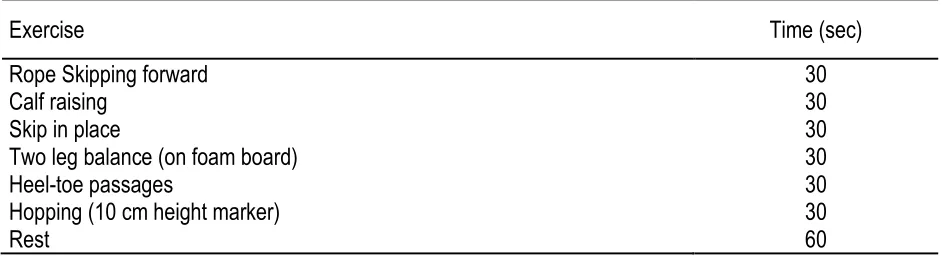
After the first assessment subjects were randomly divided in two groups depending on the school-cohorts size according to the numerosity of the classes: Training Group (TG. n = 37; weight = 62.6 ± 8.11 kg; height = 173 ± 0.08 cm) and Control Group (CG. n = 26; weight = 60.5 ± 11.71 kg. height = 172 ± 0.08 cm). The TG exercise protocol consisted in plyometrics, balance and strength exercises (see Table 1).
Table 1. Chart summarizing the exercises of the training protocol. The circuit was repeated four times.
Exercise Time (sec)
Rope Skipping forward 30
Calf raising 30
Skip in place 30
Two leg balance (on foam board) 30
Heel-toe passages 30
Hopping (10 cm height marker) 30
VOLUME 14 | ISSUE 4 | 2019 | 787
All physical exercises were performed in the first part of the PE classes for about 15 minutes and arranged in a six restless stations of circuit training (30-sec performance per station). TG subjects repeated the circuit training four times with 60-sec rest between the repetitions. A total of 12 sessions throughout a 6-week period were performed with no more than 2 -3 consecutive days without exercise.
The CG-subjects did not follow specific training as they assisted the teacher in organising the equipment and tools required for the following activities. After the 15-minute protocol, all students resumed their regular classes according to the annual plan of didactics.
The protocol was carried out during the first two months of scholastic year (Sept-Oct 2017). All procedures were conducted in accordance with the ethical standards presented in the Declaration of Helsinki as revised in 1983.
Data analysis
For BA the mean of three repetitive trials was calculated (Lovecchio, Zago, Perucca, & Sforza, 2017). For RSI test the values of the first and seventh jumps of each battery were eliminated (avoiding task adaptations) to keep five values of ground contact time and jump height. Thereafter the mean was calculated (Flanagan & Comyns, 2008). Data were hence pooled together to determine the Reactive Strength Index (RSI) as proposed by Flanagan and Comyns (2008). This index equals to the ratio between the jump height and the contact time (measured in cm/seconds).
During DC trials the minimum contact time was taken into account.
Statistical Analysis
Descriptive statistics (mean and standard deviations) and percentage differences between pre-training and post-training were calculated.
Shapiro Wilk test was used to verify the normality distribution of each collected data while the 2-way (two x
two design) analysis of variance (ANOVA) for repeated measures was used to determine statistical
differences.
In case of significant differences a post hoc analysis (Tukey-Kramer) was computed to verify the influence of each factor (groups, session).
Significance for all tests was set at alpha level of 5%. All calculations were performed using SPSS v 14.0.
RESULTS
At baseline no differences were found between groups for all tests and anthropometric characteristics (p>0.05).
The TG, on average, significative improved their BA performance (p<0.05) about 68% (7 sec) while CG remained substantially unchanged (p>0.05; Figure 1).
788 | 2019 | ISSUE 4 | VOLUME 14 © 2019 University of Alicante
Figure 1. Balance Ability before and after training program in TG and CG group.
Figure 2. Reactive Strength Index before and after training program in TG and CG group.
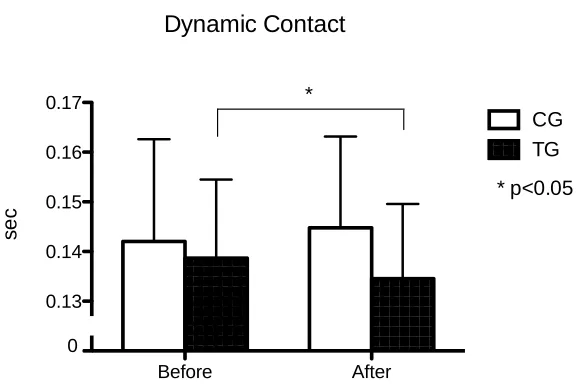
The results in DC trials revealed a dissimilar trend: the TG decreased the contact time (3%; p<0.05) while the CG increased it (2,1%; Figure 3).
Two-way ANOVA (Table 2) revealed significant differences between group after training (DC test); session and interaction (BA and RSI test).
Balance Ability
Before After
5 10 15 20 25 30
(s
e
c
)
CG TG *
* p<0.05
0
Reactive Strength Index
Before After
1.5 2.0 2.5 3.0
(A
.U
.)
CG TG *
* p<0.05
VOLUME 14 | ISSUE 4 | 2019 | 789
Figure 3. Dynamic Contact before and after training program in TG and CG group.
Table 2. Repeated measures 2-way ANOVA for BA, RSI and DC data.
Group Session Group x Session
df F p df F p df F p
BA 1 0.204 0.652 1 27.794 <0.0001* 1 8.524 0.004*
RS 1 2.488 0.117 1 7.392 0.007* 1 5.552 0.019*
DC 1 7.061 0.008* 1 0.249 0.618 1 1.788 0.183
Note: * significant differences; p<0.05
Thus, the post hoc analysis indicated significant differences in BA test after training in TG (p<0.01), in RSI test after training for both between-group (p= 0.032) and within TG (p<0.01); in DC after training between TG and CG (p = 0.008).
DISCUSSSION
The present results revealed the feasibility of a scholastic training program on TG subjects. Hereby, BA – as
an index of foot function in static condition – resulted to be improved in TG, suggesting that a structured
stimulation of balance (Zago et al., 2015) is doable during an exiguous number of PE classes. The lack of statistical significant differences between TG and CG in post–training results might confirm this hypothesis (Figure 1). Indeed Granacher et al. (2010) obtained improvements on balance ability and height jump on high school students after 16 training sessions.
Another positive effect of training program was found on foot dynamic function studied with the analysis of
RSI and DC test. In particular, similar increase in RSI after a 4 – weeks plyometric training program was
observed in 12 and 15 years old boys (Lloyd et al., 2011) and in 13 years old soccer player (no significant differences; Meylan & Malatesta, 2009) while improvements in sprint ability (20 m sprint) and agility (T agility test) were found by Poomsalood et al. (2015). Later on, Kotzamanindis (2006) showed improvements in
running performance (30 meter sprint) in prepuberal boys after 60 – 100 plyometric jumps per session. These
Dynamic Contact
Before After
0.12 0.13 0.14 0.15 0.16 0.17
s
e
c
CG TG *
* p<0.05
790 | 2019 | ISSUE 4 | VOLUME 14 © 2019 University of Alicante
finding could be explained with an increased tolerance of musculotendon unit to the eccentric load during hopping and by a greater stretch–reflex contribution with inhibition of Golgi tendon organs (Voigt et al., 1998). Thus, following these positive performance effects and as suggested by Lloyod et al. (2011), also in school context adolescents could perform plyometric activity gaining technical experience for high load training session.
This study determined a good PE practice suitable for school context and student abilities. Skill coordination exercise and plyometric training program affected the functionality of foot even if the application of stimulus was time restricted, that means during a narrow experimental timeline of only 12 sessions.
Moreover, this brief protocol verifies an interesting use of technological equipment in school context and that training program could be introduced during PE classes according to national government recommendations. Simultaneously, students could monitor their motor skills and progresses by means of an objective and immediate measuring-tool.
Various and ‘technological’ activities could stimulate students for an active participation during PE classes
as well as they could enhance their motor skills during adolescence age.
CONCLUSION
The current study determined a good PE practice, suitable for school context and student abilities. Skill coordination exercise and plyometric training program affected the functionality of foot even if the application of stimulus was time restricted, that means during a narrow experimental timeline of only 12 sessions.
Our results are very encouraging because young students obtained important improvements in the function, of a segment often locked in boots or in lace-up high-top shoes, in less than 180 effective minutes of training. Considering the characteristics of the skills implicated (reactive strength and reaction time), the percentages of improvement earned were very substantial.
The positive impact of digital user-friendly technologies and tools (i.e. mobile apps) has been extensively verified in cardiorespiratory fitness training (Rospo et al., 2016) and in a multi-faceted taxonomy of diabetes self-management (Wu et al., 2017). However, to the best of our knowledge, these technologies are primarily addressed to adults limiting their implementation to the adolescents and/or young subjects in school didactics. On the other hand, strategies to improve learning are envisaged in school context although playful technologies are limited (Ghorbani & Ghazvini, 2016). Thus, we believe that this brief protocol contemplates an interesting use of technological equipment (chronometer, photoelectric cell and mathematical software) that makes the didactics more attractive to young students. In addition, the manageability of a simple but controlled approach improved the learning experience and multiplied the potentiality of the didactic proposals in school context.
In accordance with national government recommendations, we introduced a training program during PE classes in which students were able to monitor their motor skills and progresses by means of an objective and immediate measuring-tool.
‘Technological’ activities could vary teacher’s proposals and stimulate students for an active participation
VOLUME 14 | ISSUE 4 | 2019 | 791 REFERENCES
Ammann, R., Taube, W., & Wyss T. (2016). Accuracy of PARTwear Inertial Sensor and Optojump Optical Measurement System for Measuring Ground Contact Time During Running. J Strength Cond Res,
30(7):2057-63. https://doi.org/10.1519/JSC.0000000000001299
Cohen, J. (1988). Statistical power analysis for the behavioral sciences. 2nd Ed. Hillsdale, NJ: Erlbaum. Cook, A.J., Ng, B., Gargiulo, G.D., Hindmarsh, D., Pitney, M., Lehmann, T., & Hamilton, T.J.
Instantaneous VO2 from a wearable device. Med Eng Phys, 17, S1350-4533(18)30006-7.
Dellaserra, C.L., Gao, Y., & Ransdell, L. (2014). Use of integrated technology in team sports: a review of opportunities. challenges. and future directions for athletes. J Strength Cond Res, 28(2):556-73.
https://doi.org/10.1519/JSC.0b013e3182a952fb
Ebben, W.P., Petushek, E.J. (2010). Using the reactive strength index modified to evaluate plyometric
performance. J Strength Cond Res, 24(8):1983-7. https://doi.org/10.1519/JSC.0b013e3181e72466
Flanagan, E.P., & Comyns, T.M. (2008). The use of contact time and the Reactive Strength Index to
optimize fast stretch – shortening cycle training. Strength Cond J, 30(5): 32 – 38.
https://doi.org/10.1519/SSC.0b013e318187e25b
Ghorbani, A. & Ghazvini, K. (2016). Using paper presentation breaks during didactic lectures improves learning of physiology in undergraduate students. Adv Phys Educ, 40(1):93-7.
https://doi.org/10.1152/advan.00137.2015
Granacher U. Gollhofer A. Kriemler S. (2010). Effects of balance training on postural sway. leg extensor
strength and jumping height in adolescents. Res Q Exerc Sport, 81(3): 245 – 251.
https://doi.org/10.1080/02701367.2010.10599672
Gribble, P.A., Tucker, W.S., & White, P.A. (2007). Time-of-day influences on static and dynamic postural control. J Athl Train, 42(1): 35-41.
Hardman, K. (2008). Physical education in schools: A global perspective. Kinesiol, 40(1): 5-28.
Kotzamandisis, C. (2006). Effect of plyometric training on running performance and vertical jumping in
prepubertal boys. J Strength Cond Res, 20(2): 441–445.
Lloyd, R., Hughes, M., Oliver, J., & Williams, C.A. (2011). The effects of 4 – weeks of plyometric traininig
on reactive strength index and leg stiffness in male youths. J Strength Cond Res, 26(10): 2812 –
2819. https://doi.org/10.1519/JSC.0b013e318242d2ec
Lovecchio, N., Zago, M., Perucca, L., Sforza, C. (2017). Short term repeatability of stabilometric
assessments. J Mot Behav, 49(2): 1 – 6. https://doi.org/10.1080/00222895.2016.1152225
Markwick, W.J., Bird, S.P., Tufano, J.J., Seitz, L.B., & Haff GG. (2015). The intraday reliability of the Reactive Strength Index calculated from a drop jump in professional men's basketball. Int J Sports
Physiol Perform, 10(4):482-8. https://doi.org/10.1123/ijspp.2014-0265
Meylan, C., & Malatesta, D. (2009). Effects of in – season plyometric training within soccer practice on
explosive actions of young players. J Strength Cond Res, 23(9): 2605 – 2613.
https://doi.org/10.1519/JSC.0b013e3181b1f330
Neumann, D.A. (2002). Kinesiology of the Musculoskeletal System. 2nd Ed. London: Mosby.
Panta, K., Arulsingh, W., Raj, J.O., Sinha, M., & Rahman, M. (2015). A study to associate the Flamingo Test and the Stork Test in measuring static balance on healthy adults. Foot Ankle Online J, 8(3):1-4.
Poomsalood, S., & Pakulanon, S. (2015). Effects of 4 – week plyometric training on speed. agility and leg muscle power in male università basketball players: a pilot study. Kasetsart J. (Soc. Sci), 36: 598
792 | 2019 | ISSUE 4 | VOLUME 14 © 2019 University of Alicante
Rospo, G., Valsecchi, V., & Bonomi, A.G., Thomassen, I.W., van Dantzig, S., La Torre A. et al. (2016). Cardiorespiratory Improvements Achieved by American College of Sports Medicine's Exercise Prescription Implemented on a Mobile App. JMIR Mhealth Uhealth, 23;4(2):e77.
Sadeghi, H., Allard, P., Prince, F., & Labelle, H. (2000). Symmetry and limb dominance in able-bodied
gait: A review. Gait Posture, 12(1):34– 45. https://doi.org/10.1016/S0966-6362(00)00070-9
Springer, B.A., Marin, R., Cyhan, T., Roberts, H., & Gill, N.W. (2007). Normative values for the Unipedal Stance Test with eyes open and close. J Geriatric Phys Ther, 30(1): 8 -15.
https://doi.org/10.1519/00139143-200704000-00003
Voigt, M., Chelli, F., & Frigo C. (1998). Changes in the excitability of soleus muscle short latency stretch
reflexes during human hopping after 4 weeks of hopping training. Eur J Appl Physiol, 78(6): 522 –
532. https://doi.org/10.1007/s004210050455
Weineck, J. (2009). Optimales Training. (16th Ed). Balingen (D): Spitta Verlag GmbH & Co. Winter, D. (1990). Biomechanics and Motor Control of Human Movement. New York: Wiley.
Wu, Y., Yao, X., Vespasiani, G., Nicolucci, A., Dong, Y., Kwong, J., et al. (2017). Mobile App-Based Interventions to Support Diabetes Self-Management: A Systematic Review of Randomized Controlled Trials to Identify Functions Associated with Glycemic Efficacy. JMIR Mhealth Uhealth,
5(3):e35. https://doi.org/10.2196/mhealth.6522
Zago, M., Mapelli, A., Shirai, Y.F., Ciprandi, D., Lovecchio, N., Galvani, C. et al. (2015). Dynamic balance
in elite karateka. J Electromyogr Kinesiol, 25 (6): 894-900.
https://doi.org/10.1016/j.jelekin.2015.10.002