International Journal of Applied Information Systems (IJAIS) ISSN : 2249-0868 Foundation of Computer Science FCS, New York, USA
Volume 5 - No. 3, February 2013 - www.ijais.org
Modelling and Self-organizing in Mobile Wireless
Sensor Networks: Application to Fire Detection
Elie Tagne Fute
Systems and Transportation Laboratory University of Technology of Belfort-Montbliard
University of Dschang Yaounde, 20269, Cameroon
Belfort, 90010, France
Emmanuel Tonye
Electronic and Signal Treatment Laboratory University of Yaounde I
Yaounde, 8390, Cameroon
ABSTRACT
This paper describes the design of a system for wildfire moni-toring incorporating wireless sensors. A wireless sensor network (WSN) is a complex system. In complex systems, multiple as-pects interact and influence each other. A vast number of entities are present in the system. Traditional modelling and simulation techniques fail to capture interactions between loosely coupled aspects of a complex system. This paper also describes a mod-elling approach of the mobile WSN based on Holonic Multi-Agent paradigm (Holonic Multi-Multi-Agent Systems (HMAS)). The holonic model has the characteristics of scalability and robust-ness. The approach of modelling used is organizational and it uses four basic concepts: Role, Interaction, Organization and Ca-pacity. This paper mainly presents the formulation problem of fire detection. An application is made to the patrolling task and the detection and avoidance of the obstacles during moving of the mobile sensor.
General Terms:
Sensor, multi-agent, organization, role, interaction, capacity, fire, forest fire, bush fire
Keywords:
Wireless sensor network, mobile sensors, patrolling, agent, multi-agent system, holon, fire detection
1. INTRODUCTION
Wireless sensor networks have been attracting many research ef-forts during the past few years. Sensor networks, usually com-posed of a few sinks and a quantity of inexpensive and small sen-sor nodes, have been deployed in a variety of applications such as habitat monitoring, forest fire detection, etc. Satellite-based monitoring is a popular method to detect forest fire now [10, 14]. But the long scan period and low resolution of satellites restrict the effectiveness of the satellite-based forest fire detection [17]. Moreover, satellites usually cannot forecast forest fires before the fire is spread uncontrollably. In this paper, we explore the use of wireless sensor network technology in real-time forest fire de-tection. We describe the design of a system for wildfire moni-toring incorporating wireless sensors. Fire behavior can change rapidly based on a variety of environmental conditions such as temperature, relative humidity, and wind. Moreover, these envi-ronmental conditions can differ signifiantly between topograph-ical features such as elevation and aspect. Hence, the ability to accurately monitor these environmental conditions over a wide area becomes of paramount importance. Our goal is to deploy the sensors, with the aim of detecting the fire instead. This study is composed of sensors regarded as autonomous entities to collabo-rate in order to ensure their goal. Not having an idea of where the
fire will trigger, we employ a strategy patrol sensor. This pres-ence of obstacles in the environment requires the use of an ap-propriate model for avoiding obstacles. For this, we propose a force-based model. The MAS (Multi-Agents System) approach lends itself well to these types of problems because it has a set of autonomous components that manage their own resources and then to work together to achieve their goal. Our approach is or-ganizational, mostly based on concepts or notions of roles and interactions between roles. The remainder of this paper is orga-nized as follows. Section 2 describes the related work. Section 3 describes the problem description, section 4 presents the fire and network models for forest fire detecting by an organizational ap-proach, section 5 presents the self-deployment by force control and the simulation results. A part of simulation results will be shown in section 6. Finally, section 7 concludes this paper.
2. RELATED WORK
There do not exist many works relative for the event’s detec-tion using mobile wireless sensor networks. We got intersested in the state of art of other technics to detect events. Most ex-isting forest-fire detection systems rely on the satellite imagery. MODIS provides global daily forest fire products based on the satellite imagery [14]. Here, events are detected by using the image analysis. We explore the use of wireless sensor network technology in real-time forest fire detection. In [3], the system is composed of environmental sensors collecting temperature, rel-ative humidity and barometric pressure with an on-board GPS unit attached to a wireless network mote. The motes communi-cate with a base station, which communicommuni-cates the collected data to software running on a database server. In this case, authors use the fixed sensors to collect data. [4, 12] designed and im-plemented a Mobile Agent in a Wireless Sensor Network. The itineraries are planned on a powerful computer by a genetic algo-rithm. In addition, authors suited their solution to generate Agilla mobile agents. [1] developed a forest-fires surveillance system in South Korea Mountains. The Forest-Fires Surveillance Sys-tem (FFSS) developed consists of WSNs, middleware and web application. The middleware program and the web application analyze the collected data and information. The FFSS is able to detect the heat. It let to know early alarm in real time when the forest-fire occurs.
3. PROBLEM DESCRIPTION
Mobile wireless sensors are here used to ensure a dynamic cov-erage of forest areas in order to detect and control wildfires.
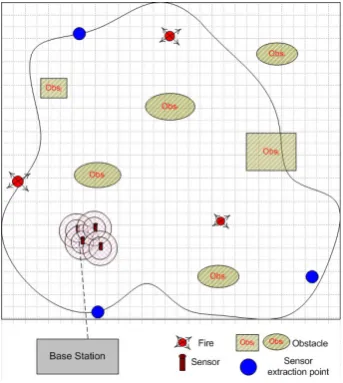
3.1 Environment Description
lo-Fig. 1. A typical environment to patrol
cated all around the environment. Sensors that reach their critical energy capacity have to reach a recovery place, so that they can be picked up and then reused after their battery have been filled up again.
Coordination can be ensured by one or several sink nodes. Sink nodes are heavily equipped sensors that gather information from other sensors and communicate this information to a base sta-tion. The base station merges all the information received and can send new orders to the sink. The sink node then can commu-nicate these orders to the appropriate sensors.
Detecting wildfires in a forest consists in performing a patrolling task. Patrolling using a mobile wireless sensor network can be divided into two stages. First, sensor nodes are deployed in the environment at a given location. Secondly, they elaborate a for-mation around a sink node and then start to patrol in the search of fire areas, by maintaining the formation. Indeed, a formation ensures that all the mobile sensors will be able to communicate to each other if it is necessary. Once a fire source is detected by a sensor node, it sends a warning to its sink node, that transmits it to the base station that can finally warn the firefighters. To better help the firefighters, the patrolling sensors can reoganize them-selves to follow the fire expansion.
3.2 Sensor Model
A mobile sensor node is made up of several components: a sens-ing unit, aprocessing unit, atransceiver unit, a power unit, a
location finding systemand amobilizer. Sensing units are usu-ally composed of sensors (e.g. thermal, visual, infrared, radio...) and analog to digital converters (ADCs). The analog signals per-ceived by the sensors are converted to digital signals by the ADCs. Digital signals are then used by the processing unit to make the sensor node collaborate with the other sensor nodes to fulfill the assigned tasks. The transceiver unit (e.g. a radio frequency device) enables a sensor to communicate with other nodes in the network. The power unit supplies current to the other sensor components. It is the most important unit since the lifetime of a sensor network depends on the lifetime of the power resources of each sensor node. Most of the sensor network per-ception tasks and routing techniques require the knowledge of location with high accuracy, provided by the location finding system. Finally, mobile sensors can move in their environment using a mobilizer.
The position of each moving sensor node is dependent on its in-teractions with the other sensor nodes and obstacles. Each sensor node is characterized by an occupation radiusroccthat represents
the surface it takes on the ground and it can perceive the
obsta-Fig. 2. A sensor model
cles within its perception radiusrperand the other nodes within
its communincation radiusrcom(figure 2).
In the next two subsections, the mathematical frameworks of the patrolling task and the energy conservation task are described.
3.3 Mathematical framework of the patrolling task
The patrolling problem is usually specified formally as in [11, 2, 9, 8]. Let the graphG = (V, E)where V is the set of nodes andE the edges. The domaine to patrol is generally defined by the graphG. Let’s considerpsensor agents to visit the nodes of the graph at regular intervals. At the initial time, each of thepagents are located on one node ofV.
Solving the patrolling problem consists in elaborating a multi-agent graph coverage strategyπ. Such a strategy must optimize one or several given quality criteria [9].
π={π1· · ·πp}is made up of thepindividual strategiesπiof
each agenti. Let’s define an individual strategy by:
πi:
(N→V
πi(j+ 1) =x with(πi(j), x)∈E
πi(j)denoting thej-th node visited by the agenti
It is commonly admitted that a relevant patrolling strategy is one that minimizes, for each node, the time span between two visits to the same node.
Several criteria have been devised in [11, 6, 8] in order to evalu-ate the quality of a multi-agent patrolling strevalu-ategyπafterTtime steps (orcycles) of simulation. All of them are based on the no-tion ofInstantaneous Node Idleness(INI).
The INIIi,t(π)of a nodeiat timetfollowing the multi-agent
pa-trolling strategyπis the number of time steps this node remained unvisited. By convention, at the initial instant,Ii,0(π) = 0, ∀i= 1,2,· · ·,|V|for anyπ.
At a given instantt,GIt(π)is theInstantaneous Average Graph Idleness(IGI) when following the multi-agent patrolling strategy
π, i.e.:
GIt(π) =
1
|V| X
i∈V Ii,t(π)
Similarly theInstantaneous Worst Graph IdlenessW It(π)is the
highest INI encountered sincettime steps of simulation when following the multi-agent patrolling strategyπ, i.e.:
W It(π) = max i∈V Ii,t(π)
A multi-agent patrolling strategy π can be evaluated after T
International Journal of Applied Information Systems (IJAIS) ISSN : 2249-0868 Foundation of Computer Science FCS, New York, USA
Volume 5 - No. 3, February 2013 - www.ijais.org
AIT(π) or theworst idleness W IT(π). The average idleness
denotes the mean of the IGI over theT simulation cycles, i.e.:
AIT(π) =
1
T T
X
t=1
GIt(π)
Theworst idlenessis the highest INI observed during theT-time steps of the simulation, given by the following equation:
W IT(π) = max
t=1,2,...,T maxi∈V Ii,t(π)
For both equations,T is the elapsed time until the last sink has reached its critical energy capacity. This critical energy capacity must allow it to perform two important tasks: send its more re-cent data to the base station and reach the nearest recovery place. Detecting wildfires implies several assumptions. First the envi-ronment to patrol will be represented by a regular grid, as the one shown in figure 1. Thus each node of the patrolling graph will be linked by at most eight other nodes. Secondly, ensuring that a fire will not declare itself above a given time limit implies that sen-sors follow a multi-agent patrolling strategyπ∗ that minimizes
the worst idleness criteria, i.e.:
π∗=argminπ∈ΠW IT(π)
whereΠis the set of the possible multi-agent patrolling strate-gies.
3.4 Mathematical framework of the energy conservation task
Detecting wildfires as long as possible requires that the mobile sensors are able to patrol while minimizing their energy con-sumption.
The amount of the energy consumed by a sensoriat timetwhen following a multi-agent patrolling strategyπis dependent of sev-eral elements and can be defined by the following equation:
Ei,t(π) =E comp i,t (π) +E
com i,t (π) +E
perc i,t (π) +E
loc i,t(π)
where:
—Ei,tcomp(π)is the energy consumed by the computations car-ried out between the timest−1andt,
—Ecom
i,t (π)is the energy consumed by the communications
per-formed between the timest−1andt,
—Ei,tperc(π)is the energy consumed by the perception system between the timest−1andt,
—Eloc
i,t(π)is the energy consumed by the locomotion system
between the timest−1andt.
All the terms of this equation refer to energy consumptions and they are expressed in Watt/hour.
Hence the minimization of the energy consumed by the network of mobile sensors requires that they follow the best multi-agent patrolling strategyπ∗
, i.e.:
π∗=argminπ∈Π max
t=1,2,...,T i=1max,2,...,p Ei,t(π)
whereΠis the set of the possible multi-agent patrolling strate-gies andT is the elapsed time until the last sink has reached its critical energy capacity.
4. APPLICATION TO FIRE DETECTION
The objective is to model the problem in terms of organizations, roles, capacities and interactions. CRIO [7] introduces four basic concepts: Role, Interaction, Organization and Capacity. A role is an abstraction of a behavior or a status in an organization. An interaction links two roles in a way that an action in the first role produces a reaction in the second. An organization is de-fined by a set of roles and their interactions. A capacity is a pure
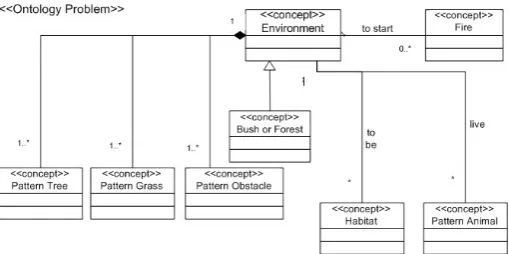
Fig. 3. Ontology model related to the forest/bush fire problem
description of a know-how. A role may require that individuals playing it have some specifics capacities to properly behave as defined. The notion of capacity was introduced to control and exploit these additional behaviors, emerging from roles interac-tions, by considering an organization as able to provide a capac-ity. It describes what an organization is able to do [13]. From these concepts an agent is specified as an active communicative entity, which plays roles. An agent may be associated to one or more roles and a role may be played by one or more agents.
4.1 Fire Problem Modelling
The main objective is to detect fires and transmit the alert data for rapid intervention. Thus, making the monitoring of forest or bush fire, can give to perform the following sub-objectives:
—Targeting the area to monitor —Identifying areas of high sensitivity —Deploying a group of sensors
—Registering data and routing to the central site —Identifying the fire sources during patrol
—Sending alerts and location data to the central site if detected fire
—Calling intervention teams immediately upon receipt of fire alarms
—Tracking the evolution of fire triggered
—Controlling the surrounding areas to a source of fire
We present an ontology model related to the forest or bush fire problem. In figure 3, an ontology model related to the fire prob-lem using UML profiles for class diagram is presented.
4.2 WSN Problem Modelling
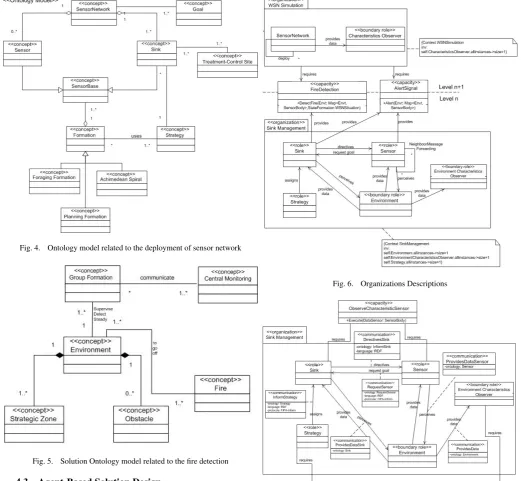
The problem domain is dedicated to the description of a prob-lem independently of a specific solution. We present in figure 4, an ontology model related to the deployment of wireless sensor network.
We present in figure 5, a fragment of solution ontology model. After an ontology model, we must model the problem in terms of organizations, roles, capacities and interactions. Each role is as-sociated with a set of concepts in the ontology, usually a subset of those associated with his organization. By using ”Boundary Roles”, the scope of application and the border between the sys-tem and its environment are refined. We have two large organiza-tions: WSN Simulation and Sink Management. The organization WSN Simulation is responsible for deployment at macro level, and observation network properties. While the organization Sink Management is responsible for achieving the goal specified in the original. Our study will focus on the latter.
Fig. 4. Ontology model related to the deployment of sensor network
Fig. 5. Solution Ontology model related to the fire detection
4.3 Agent-Based Solution Design
After modelling the problem in terms of organizations and roles the objective is, now, to provide a model of the agent society in terms of social interactions and dependencies between entities involved in the solution. Figure 7 shows the communications between roles in Sink Management organization. In organizing Sink Management, we have eight interactions. Three of them, are now modeled by conversations, others are represented by com-munications. The figures 8 and 9 below show the refinement of the plan behavior of rolesSinkandSensorrespectively, these be-haviors are transcribed in the form of statechart.
A holon is a self-similar structure composed of holons as sub-structures. A hierarchical structure composed of holons is called a holarchy [15, 5]. The Holonic Organization (HO) represents the organization of a single super-holon at a specific level in the holarchy [16]. The concept of Holon is specialized from the Agent [13]. This definition of holon integrates the production of holonic aspects, the approach being described as organizational. The holonic aspect considers how members organize and man-age the super-holon. A specific organization, called Holonic
or-Fig. 6. Organizations Descriptions
Fig. 7. Communications between roles in Sink Management organiza-tion
ganization, is defined to describe the management of a holon and its structure. Depending on the level of abstraction, a super-holon can be considered as an atomic entity (at level n) or as an orga-nization of holons (at level n-1) [13]. In multiagent systems, the vision of holons is much closer to the one that MAS researchers have of Recursive or Composed agents. A holon is thus a self-similar structure composed of holons as sub-structures and the hierarchical structure composed of holons is called a holarchy. Figure 10 presents our holarchy structure.
4.4 Implementing Solution Domain
International Journal of Applied Information Systems (IJAIS) ISSN : 2249-0868 Foundation of Computer Science FCS, New York, USA
Volume 5 - No. 3, February 2013 - www.ijais.org
Fig. 8. Statechart of Sink role in Sink Management organization
Fig. 9. Statechart of Sensor role in Sink Management organization
Fig. 10. Holarchy structure
solution. This part is thus dependent on the chosen implementa-tion and deployment platform. Figure 11 presents our model implementing solution. It is an extension of Janus model imple-mentation.
5. SELF-DEPLOYMENT BY FORCE CONTROL
Figure 12 shows a sensor agent with a representation of :
—Its communication area (radiusrcom),
—Its area of perception (radiusrper),
—Its zone of occupation on the ground (radiusrocc),
—Obstacles and other sensors located in the areas of communi-cation or perception.
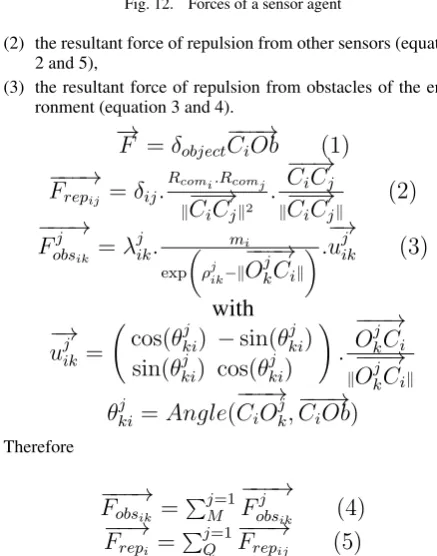
The behavior of a sensor (respectively a group of sensors) is based on three forces:
(1) the attraction force towards the goal, (equation 1),
Fig. 11. Solution architecture
Fig. 12. Forces of a sensor agent
(2) the resultant force of repulsion from other sensors (equation 2 and 5),
(3) the resultant force of repulsion from obstacles of the envi-ronment (equation 3 and 4).
−
→
F
=
δ
object−−−→
C
iOb
(1)
−−−→
F
repij=
δ
ij.
Rcomi.Rcomj
k
−−→
C
iC
jk2.
−−→
CiCj
k
−−→
C
iC
jk(2)
−−−→
F
obsjik
=
λ
j
ik
.
miexp
ρjik−k
−
−−
→
O
jkCi
k.
−
→
u
jik(3)
with
−
→
u
jik=
cos(
θ
j
ki
)
−
sin(
θ
j ki)
sin(
θ
jki) cos(
θ
jki)
!
.
−
−−
→
O
kjCi
k
−
−−
→
O
kjC
ikθ
jki=
Angle
(
−
C
−−
iO
→
j k,
−−−→
C
iOb
)
Therefore
−−−→
F
obsik=
Pj=1
M
−−−→
F
obsjik
(4)
−−→
Frep
i=
Pj=1
Q
−−−→
Frep
ij(5)
M is the number of points of impact on an obstacle localized in the perception area. Q is the number of agents localized in the communicational area. Since the agent is in motion, we determine the characteristic of his movement by equation 6 :
−→
F
Hi=
Pk=1
3
−
→
F
ik=
−−−→
F
object+
−−−→
F
obsik+
−−→
F
repi=
Fig. 13. Motion and detection of the obstacles
Fig. 14. Motion and avoidance of the obstacles
Fig. 15. Worst and instantaneous idleness plots
An application of the force to detect and to avoid the obstacles is presented in figure 13 and 14 respectively. The force model defined allows to properly detect and avoid the obstacles by the sensors during their motion. The simulations show that by using this force model, the mobiles sensors detect and avoid very well the obstacles and other sensors considered like obstacles.
6. EXPERIMENTAL RESULT
Figure 15 presents evolution of the worst and instantaneous idle-ness.
Fig. 16. Energy consumption
Figure 16 presents the plot of the energy consumption. From the curves in figure 16, the communications require more energy than the other tasks of sensors. In terms of energy consumption, we have respectively perception, locomotion and computations. consumption, we have respectively perception, locomotion and computations.
7. CONCLUSION
In this paper, we proposed Forest-Fire Detection System based on Wireless Sensor Networks using an organizational approach. Firstly the problem was formulated, then it was modelled using the role concept. An ontology model related to the deployment of mobile wireless sensor networks was also presented. To avoid the obstacles in the environment, a force-based model was used since we had shown that this model detects obstacles with effec-tiveness and efficiency. The values of Idleness of environment and energy consumption by sensors and Sink were evaluated.
8. REFERENCES
[1] S. Byungrak, Yong sork Her, and K. Jung-Gyu. A Design and Implementation of Forest-Fires Surveillance System based on Wireless Sensor Networks for South Korea Moun-tains. InIJCSNS International Journal of Computer Sci-ence and Network Security, Vol.6 No.9B, 2006.
[2] Y. Chevaleyre. Theoretical Analysis of the Multi-Agent Pa-trolling Problem. InIAT, 2004.
[3] D. M. Doolin and N. Sitar. Wireless sensors for wildfire monitoring. InProceedings of the SPIE, Vol.5765, pages 477–484, 2005.
[4] Chien-Liang Fok. Efficient Fire Detection and Tracking Using Mobile Agents in a Wireless Sensor Network. In
MURI ONR 3-Year Review, Baltimore, 2004.
[5] E. T. Fute, F. Lauri, A. Koukam, and E. Tonye. The Cov-erage Problem in Wireless Sensor Networks by Holonic Multi-agent Approach. InInternational Journal of Com-puting and ICT Research, IJCIR, ACM, ISSN 1818-1139 (Print), ISSN 1996-1065 (Online), Vol.3, No.1, pages 32– 41, 2009.
International Journal of Applied Information Systems (IJAIS) ISSN : 2249-0868 Foundation of Computer Science FCS, New York, USA
Volume 5 - No. 3, February 2013 - www.ijais.org
[7] A. Nicolas Gaud.Systmes Multi-Agents Holoniques : De L’analyse L’implantation. PhD thesis, Universit de Tech-nologie de Belfort-Montbliard, 2007.
[8] Arnaud Glad.Etude de l’auto-organisation dans les algo-rithmes de patrouille multi-agent fondes sur les phromones digitales. PhD thesis, Universit Nancy 2, 2011.
[9] F. Lauri and A. Koukam. A Two-Step Evolutionary and ACO Approach for Solving the Multi-Agent Patrolling Problem. InWCCI, Hong-Kong, China, 2008.
[10] Z. Li, S. Nadon, and J. Cihlar. Satellite detection of Cana-dian boreal forest fires: development and application of the algorithm. InInternational Journal of Remote Sensing, Vol.21, no.16, pages 3057–3069, 2000.
[11] A. Machado, G. Ramalho, J. D. Zucker, and A. Drogoul. Multi-Agent Patrolling : an Empirical Analysis of Alterna-tives Architectures. InProc. of 3rd MABS, pages 155–170, 2002.
[12] D. Massaguer. Multi Mobile Agent Deployment on Wire-less Sensor Networks. InUniversity of California, Irvine,
2005.
[13] C. Massimo, Gaud Nicolas, S. Galland, V. Hilaire, and A. Koukam. A Holonic Metamodel for Agent-Oriented Analysis and Design. InIndustrial Applications of Holonic and Multi-Agent Systems: Holonic and Multi-Agent Sys-tems for Manufacturing, pages 237–246, 2007.
[14] MODIS. Moderate-resolution Imaging Spectroradiome-ter. InMODIS, 2008. http://modis.gsfc.nasa.gov/index.php, visited the 02 july 2008.
[15] S. Rodriguez, V. Hilaire, and al. A Formal Holonic Frame-work with Proved Self-Organizing Capabilities. InWorld Scientific, 2007.
[16] S. Rodriguez, V. Hilaire, and A. Koukam. Toward a Methodological Framework for Holonic multi-agent sys-tems. InESAW’03, 2003.