Original Research Article
Prevalence and factors affecting early initiation of breastfeeding
in rural areas of Dibrugarh district, Assam
Monmohan Borah, Jenita Baruah*, Rupali Baruah, Manjit Boruah
INTRODUCTION
World Health Organization (WHO) recommends early or timely initiation of breastfeeding, specifically within 1 hour of birth due its survival benefits for the newborn.1 Initiation within 1 hour is seen to have reduced neonatal mortality by 19.1-22%whereas delay doubles the risk of neonatal mortality.2,3 Early initiation protects the newborn from sepsis, pneumonia, diarrhoea and hypothermia, and mothers from risk of postpartum haemorrhage.4,5 It also facilitates sustained breastfeeding.4 Despite its extraordinary benefits to mother and child only 43 percent of the world’s newborns are put to the
breast within one hour of birthwith only 44.6% of Indian mothers practicing it.6,7
Among the indicators developed by WHO and UNICEF, ‘proportion of children born in the last 24 months who were put to the breast within one hour of birth’ an indicator for early initiation of breastfeeding, is included as a core indicator for assessing IYCF practices.8
The present study is an attempt to estimate the prevalence of early initiation of breastfeeding in rural areas of Dibrugarh, district Assam and to determine the factors affecting early initiation of breastfeeding in rural areas of Dibrugarh, district Assam.
ABSTRACT
Background: Early or timely initiation of breastfeeding, specifically within 1 hour of birth has benefits for survival
and beyond and it is recommended by the World Health Organization. Breastfeeding initiation after the first hour of birth doubles the risk of neonatal mortality. The present study has been conducted to estimate the prevalence and determine the factors affecting early initiation of breastfeeding in rural areas of Dibrugarh, district, Assam.
Methods: Community based cross sectional study from May 2017 to April 2018 among mothers having children in
the age group 0 to 23 months in the rural areas of Dibrugarh district. The sample size calculated for the study was 360 children.
Results: The results were analyzed for 334 children. Prevalence of early initiation of breastfeeding was found to be
54.8%. On multivariate regression analysis the occupation and education of mothers, number of antenatal checkup visits, type of delivery and religion were found to be independently associated with early initiation of breastfeeding.
Conclusions: This study reveals that the early initiation of breast feeding is lower in rural areas of Dibrugarh district.
The findings clearly highlight the importance of imparting health education to family members and mothers right from antenatal period on infant and child feeding practices.
Keywords: Early initiation of breast feeding, Infant and young child feeding practices, Antenatal check up
Department ofCommunity Medicine, Assam Medical College and Hospital, Dibrugarh, Assam, India
Received: 09 March 2019
Accepted: 16 April 2019
*Correspondence: Dr. Jenita Baruah,
E-mail: [email protected]
Copyright: © the author(s), publisher and licensee Medip Academy. This is an open-access article distributed under
the terms of the Creative Commons Attribution Non-Commercial License, which permits unrestricted non-commercial use, distribution, and reproduction in any medium, provided the original work is properly cited.
METHODS
The community based cross sectional study was conductedfrom May 2017 to April 2018 in the rural areas of Dibrugarh district in Assam, India, having a population of nearly 1.3 million with almost equal proportion of male and female population.9 All children in the age group of 0-23 months were included in the study. Children with congenital malformations like cleft lip, cleft palate and children who were very sick were excluded from the study. A multistage sampling was done to identify the villages and a sample size of 360 children was taken.
The sample size (n) was calculated by using the formula, n=z2pq/d2, p=65% (as per NFHS-4 data on early initiation of breast feeding in Assam) d = relative error of 8% and non response rate of 10%.10 A sample size of 356 was obtained. For equal distribution among 30 clusters, this was rounded off to 360.
Sampling design:Multi stage random sampling was done
(Figure 1).
Stage 1: 6 blocks in Dibrugarh district, out of which 2 blocks (Lahowal and Borboruah) were randomly selected.
Stage 2: 30 villages were selected by probability proportional to size (PPS) from the list of all villages of the two blocks.
Stage 3: In the selected village, list of all the children below 2 years was prepared with the help of frontline health workers.
Ethical clearance was obtained from the Institutional Ethics Committee (H) of Assam Medical College and Hospital, Dibrugarh before initiation of the study. The mothers of the children of age 0 to 23 months were briefed regarding the purpose of the study and their consent for voluntary participation was obtained. The variables included were the socio-demographic profile of the study participants, family characteristics, parental characteristics, sex of the child, antenatal care and delivery related factors associated with early initiation of breastfeeding along with associated factors. Early
initiation of breastfeeding was defined as putting the newborn to the breast within one hour of birth.
Data was collected by interview method using a pre-designed and pre-tested semi-structured proforma. The data was entered and analyzed using SPSS version 21. Qualitative variables were summarized as frequency, proportions and association was observed by Bivariate analysis and multivariable logistic regression. Unadjusted Odds Ratios and Adjusted Odds Ratios (UOR, AOR) were computed for each explanatory variable to determine the strength of association and to control the confounders. The p≤0.2 was taken as a cut-off point to select eligible variables for the multiple logistic regression analysis. Appropriate test of significance was done wherever necessary and p<0.05 was considered statistically significant.
Figure 1: Sampling design.
RESULTS
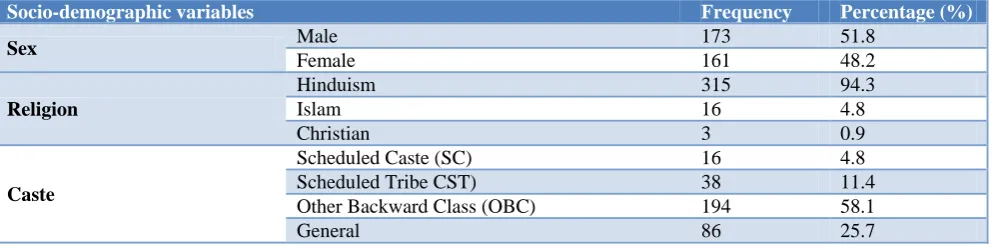
Mothers of only 334 children gave their consent for participation in the study. Majority of study participants were Hindus (94.3%), OBC (58.1%), belonged to joint family (66.5%) and cultivators (62.3%). Majority of mothers were educated up to secondary level and or above (68.5%), had 4 or more numbers of antenatal visits to health care centres (91.3%), had hospital delivery (83.5%) by normal vaginal mode (75.7%) (Table 1). The prevalence of early initiation of breastfeeding was found to be 54.8%.
Table 1: Socio-demographic profile of the study participants.
Socio-demographic variables Frequency Percentage (%)
Sex Male 173 51.8
Female 161 48.2
Religion
Hinduism 315 94.3
Islam 16 4.8
Christian 3 0.9
Caste
Scheduled Caste (SC) 16 4.8
Scheduled Tribe CST) 38 11.4
Other Backward Class (OBC) 194 58.1
General 86 25.7
Socio-demographic variables Frequency Percentage (%)
Type of family Nuclear 112 33.5
Joint 222 66.5
Occupation of father
Homemaker -- --
Cultivator, agricultural labourer, tea garden
labourer, others 208 62.3
Government employee and business 126 37.7
Occupation of mother
Homemaker 279 83.5
Cultivator, agricultural labourer, tea garden
labourer, others 35 10.5
Government employee and business 20 6.0 Education of father
None or below primary 56 16.8
Primary completed 49 14.7
Secondary and above 229 68.5
Education of mother
None or below primary 71 21.3
Primary completed 34 10.2
Secondary and above 229 68.5
Socio-economic status as per modified B G Prasad
Classification November 2017
Upper 50 14.9
Upper middle 38 11.4
Middle 71 21.3
Lower middle 148 44.3
Lower 27 8.1
ANC visits < 4 visits ≥ 4 visits 29 8.7
305 91.3 Place of delivery
Home delivery 17 5.1
Government hospital 279 83.5
Private hospital 38 11.4
Type of delivery Normal delivery 253 75.7
Caesarean section 81 24.3
Table 2: Family characteristics associated with early initiation of breastfeeding (n=334).
Variables
Early initiation of breastfeeding
U-OR 95% CI P value
Yes No
N % N % LL UL
Religion Hinduism 179 56.8 136 43.2 Ref -- -- --
Others 4 21.05 15 78.95 0.20 0.06 0.62 0.005
Caste
SC 12 75 4 25 2.48 0.74 8.33 0.139
ST 17 44.7 21 65.3 0.67 0.31 1.44 0.309 OBC 107 55.1 87 44.9 1.02 0.61 1.69 0.937 General 47 54.6 39 45.4 Ref -- -- --
Type of family Nuclear 69 61.6 43 38.4 1.52 0.96 2.42 0.076
Joint 114 51.3 108 48.7 Ref -- -- --
Socioeconomic status
I 28 56 22 44 1.01 0.39 2.61 0.970
II 16 42.1 22 57.9 0.58 0.21 1.57 0.286 III 36 64.7 35 35.3 0.82 0.33 2.00 0.667 IV 88 59.4 60 40.6 1.17 0.51 2.68 0.704
V 15 55.5 12 44.5 Ref -- -- --
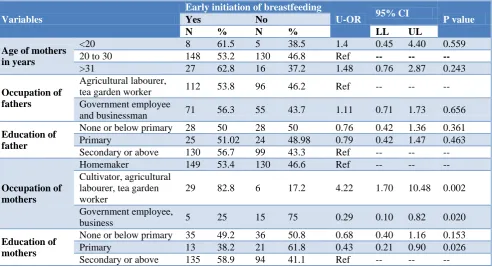
Religion, occupation and education of the mothers, number of visits for antenatal check up and type of delivery were significantly associated with early initiation of breastfeeding. Early initiation of breast feeding was significantly more in Hindus (p=0.005) (Table 2), in mothers having occupation of cultivation ((p=0.002), and with higher education level (Table 3). Early initiation of the breast feeding was significantly more in mothers who
had 4 or more visits to the health care centres ((p=0.003) (Table 4).
Table 3: Parental characteristics associated with early initiation of breastfeeding (n=334).
Variables
Early initiation of breastfeeding
U-OR 95% CI P value
Yes No
N % N % LL UL
Age of mothers in years
<20 8 61.5 5 38.5 1.4 0.45 4.40 0.559 20 to 30 148 53.2 130 46.8 Ref -- -- -- >31 27 62.8 16 37.2 1.48 0.76 2.87 0.243 Occupation of
fathers
Agricultural labourer,
tea garden worker 112 53.8 96 46.2 Ref -- -- -- Government employee
and businessman 71 56.3 55 43.7 1.11 0.71 1.73 0.656 Education of
father
None or below primary 28 50 28 50 0.76 0.42 1.36 0.361 Primary 25 51.02 24 48.98 0.79 0.42 1.47 0.463 Secondary or above 130 56.7 99 43.3 Ref -- -- --
Occupation of mothers
Homemaker 149 53.4 130 46.6 Ref -- -- -- Cultivator, agricultural
labourer, tea garden worker
29 82.8 6 17.2 4.22 1.70 10.48 0.002 Government employee,
business 5 25 15 75 0.29 0.10 0.82 0.020 Education of
mothers
None or below primary 35 49.2 36 50.8 0.68 0.40 1.16 0.153 Primary 13 38.2 21 61.8 0.43 0.21 0.90 0.026 Secondary or above 135 58.9 94 41.1 Ref -- -- --
Table 4: Child’s sex, Antenatal care and delivery related factors associated with early initiation of breastfeeding (n=334).
Variables
Early initiation of breastfeeding
U-OR 95% CI P value
Yes No
N % N % LL UL
Sex of the child Male 94 54.3 79 45.7 Ref -- -- --
Female 89 55.3 72 44.7 1.04 0.67 1.60 0.863 ANC
visits
<4 8 27.6 21 72.4 0.28 0.12 0.66 0.003
≥4 175 57.3 130 42.7 Ref
Place of delivery
Home 10 58.8 7 41.2 1.42 0.44 4.54 0.545 Govt. hospital 154 55.2 125 44.8 1.23 0.62 2.42 0.547 Private hospital 19 50 19 50 Ref -- -- -- Type of
delivery
Normal 155 61.2 98 38.8 Ref -- -- -- Caesarean section 28 30.2 53 69.8 0.33 0.19 0.56 <0.0001 Table 5: Factors associated with early initiation of breastfeeding - logistic regression analysis.
Variables Adjusted
odds ratio
95% CI
P value
LL UL
Caste
SC 2.92 0.83 10.19 0.092
ST 0.82 0.36 1.85 0.635
OBC 1.48 0.77 2.84 0.230
General Ref -- -- --
Type of family Nuclear 1.68 0.98 2.885 0.056
Joint Ref -- -- --
Occupation of mother
Government service, business 0.30 0.10 0.92 0.035 Agricultural labourer, tea garden worker etc 5.11 1.83 14.24 0.002
Homemaker Ref -- -- --
Education of mother
None or below primary 0.46 0.23 0.90 0.023
Primary completed 0.23 0.09 0.56 0.001
Secondary completed or above Ref -- -- --
Variables Adjusted odds ratio
95% CI
P value
LL UL
Number of ANC visits
<4 0.19 0.07 0.50 0.001
≥4 Ref -- -- --
Type of delivery
Caesarean section 0.28 0.15 0.53 0.000
Normal Ref -- -- --
Religion Other religions 0.15 0.04 0.54 0.004
Hindu Ref -- -- --
DISCUSSION
Prevalence
In this study, 54.8% of the mothers breastfed their children within one hour of birth which is slightly higher than the global prevalence of 42% (UNICEF 2018) and also the national prevalence i.e. 44.6% as per rapid survey on children (RSOC) 2013-14but was much lower in comparison to the prevalence in Assam RSOC 2013-14 (72.9%) and NFHS- 4 (65% ) respectively.6,7,10,11 In Ethiopia, Setegn et al observed that the prevalence of early initiation of breast feeding was lower among rural population that was due to lack of awareness, delay in intervention of health care worker and low educational level.12 The present study was carried out among the rural population of the district which may be one of the reasons for lower prevalence of early initiation.
Radwan et al found that initiation of breastfeeding was influenced by mother’s age and education.13
However in our study we did not find any significant association between mother’s age and early initiation of breastfeeding
Education
In the present study the initiation of breast feeding within one hour of birth was found to be significantly higher among mothers with secondary level of education in comparison to education of primary level or below. This was also observed by Setegn et al, Subedi et al, and Patel et al.12,14,15 Setegn et al in their study in eastern Ethiopia found that the mothers who were counselled/advised on breastfeeding on postnatal visit were about 52% more likely to initiate breastfeeding within the first hour of delivery.12 In the present study probable reason for more numbers of educated women initiating breast feeding in comparison to the mother with lower level of education or illiterate may be due to awareness about the benefits of early initiation.
Mode of delivery
Hassan et al, Shukla et al, Albokhary et al, and Yilmaz et al observed that initiation of breast feeding was delayed in newborn delivered by caesarean section.16-19 Albokhary et al, observed that delay seen in initiation of breast feeding among women who have given birth by
caesarean section was due to tiredness (90.0%) and pain (86.7%) whereas Awi et al.19,20 found it to be due to routine labour ward practices such as cleaning of the newborn and weight/length measurement and appointment of breastfeeding-trained delivery assistant during caesarean section had decreased the delay. In the present study there was significant delay in initiation of breast feeding among women who gave birth by caesarean section. The delay was probably due to pain and tiredness associated with the operation or due to routine practices.
Antenatal check up
In this study it was found that early initiation of breastfeeding was significantly higher among mothers who had 4 or more antenatal clinic visits. This was also observed by Patel et al and Mathew et al, who found that timely first suckling was higher in women who had more antenatal clinic visit.15,21
CONCLUSION
The prevalence of early initiation of breastfeeding in the study area was 54.8%, which is lower compared to the state level. Among the different factors studied; occupation and education of mothers, number of antenatal checkup visits, type of delivery and religion were the determinant factors for higher chance of timely initiation of breastfeeding.
Limitation of the study
Data was collected by interview method, which was entirely based on the memory of the participant.
Funding: No funding sources Conflict of interest: None declared
Ethical approval: The study was approved by the Institutional Ethics Committeeof Assam Medical College and Hospital, Dibrugarh
REFERENCES
1. WHO. Breastfeeding-early initiation: World Health Organization; 2012. Available at: http://www.who. int/elena/titles/early_breastfeeding/en/. Accessed 5 April 2018.
breastfeeding among Nepalese mothers: further analysis of Nepal Demographic and Health Survey, 2011. International Breastfeeding J. 2014;9:21. 3. Khan J, Vesel L, Bahl R, Martines JC. Timing of
breastfeeding initiation and exclusivity of breastfeeding during the first month of life: Effects on neonatal mortality and morbidity—a systematic review and meta-analysis. Matern Child Nutr. 2015;19:3.
4. Oddy WH. Breastfeeding in the first hour of life protects against neonatal mortality. J Pediatr. 2013;89(2):109–11.
5. Debes AK, Kohli A, Walker N, Edmond K, Mullany LC. Time to initiation of breastfeeding and neonatal mortality and morbidity: a systematic review. BMC Public Health. 2013;13(3):19.
6. UNICEF. United Nations Children's Fund. 2018 Available at: https://data.unicef.org/topic/nutrition/ infant-and-young-child-feeding/. Accessed on 7 August 2018.
7. Government of India. Rapid Survey on Children 2013-2014 India Fact Sheet., Ministry of Women and Child Development Government of India; 2016. 8. World Health Organisation. Indicators for assessing infant and young child feeding practices: conclusions of a consensus meeting held 6–8 November 2007 in Washington D.C., USA. Washington D.C.: Dept. of Child and Adolescent Health and Development; 2008. Report No.: ISBN 978 92 4 159666 4.
9. Govt. of India. Census. Census Commissioner of India, Ministry of Home Affairs; 2011.
10. Government of India. National Family Health Survey (NFHS-4). Mumbai: International Institute for Population Sciences (IIPS) and ICF, Ministry of Health and Family Welfare; 2018 Assam.
11. Government of India. Rapid Survey on Children 2013-14 Assam Fact Sheet., Ministry of Women and Child Development Government of India; 2016. 12. Setegn T, Belachew T, Gerbaba M, Deribe K, Deribew A, Biadgilign S. Factors associated with exclusive breastfeeding practices among mothers in Goba district, south east Ethiopia: a cross-sectional study. Int Breastfeeding J. 2012;7(1):17.
13. Radwan H. Patterns and determinants of breastfeeding and complementary feeding practices
of Emirati Mothers in the United Arab Emirates. BMC Public Health. 2013;13:171.
14. Subedi N, Paudel S, Rana T, Poudyal AK. Infant and Young Child Feeding Practices in Chepang Communities. JNHRC. 2012;10(21):141-6.
15. Patel A, Badhoniya N, Khadse S, Senarath U, Agho KE, Dibley JM. Infant and young child feeding indicators and determinants of poor feeding practices in India: Secondary data analysis of National Family Health Survey 2005–06. Food Nutr Bull. 2010;31(2):314-33.
16. Hassan AA, Taha Z, Ahmed MAA, Aziem A, Ali AAA, Adam I. Assessment of initiation of breastfeeding practice in Kassala, Eastern Sudan: a community-based study. International Breastfeeding J. 2018;13:34.
17. Shukla M, Tyagi S, Agarwal M. Infant and young child feeding practices of mothers attending immunisation clinic at a tertiary care hospital of Lucknow. IAIM. 2016;3(1):13-7.
18. Albokhary AA and James JP. Does cesarean section have an impact on the successful initiation of breastfeeding in Saudi Arabia? Saudi Med J. 2014;35(11):1400–3.
19. Yılmaz E, Öcal FD, Yılmaz ZV, Ceyhan M, Kara OF, and Küçüközkan T. Early initiation and exclusive breastfeeding: Factors influencing the attitudes of mothers who gave birth in a baby-friendly hospital. Turk J Obstet Gynecol. 2017;14(1):1–9.
20. Awi DD, Alikor EA. Barriers to timely initiation of breastfeeding among mothers of healthy full-term babies who deliver at the University of Port Harcourt Teaching Hospital. Niger J Clin Pract. 2006;9(1):57-64.
21. Mathew AC, Philip DM, Benny JK, Dhanya C, Manju TM, Ramesh S, et al. Factors associated with timely initiation of breastfeeding: a hopital based study. Asian Apacific J Health Sci. 2018;5(3):318-24.
Cite this article as: Borah M, Baruah J, Baruah R,