Original Research Article
Study of determinants of contraceptive practices and impact
assessment of counselling on acceptance of contraception
in tribal area of Rajasthan, India
Medha Mathur
1, Piyush Parmar
2*, Navgeet Mathur
3INTRODUCTION
India with a population of over 1.28 billion (2015) is the most populous country in the world, next to China. The Indian population which was about 340 million in 1947 has gone up to 680 million in 1981 implying just doubling of our population in 34 years. As per 2011 census the size of Indian population has increased to 1210 million. It is estimated that the Indian population will reach 1400 million by 2026. The size of Indian population by 2050 will be 1600 million. By 2025 Indian population will exceed that of China and India will be the
most populous country in the world.1 Surprisingly, India has only 2.4 per cent land area of the world and its population share is almost 17.5 percent of world population. Hence the burden of population on land is very high.1
Among the social groups in India, the tribes are the most socioeconomically-deprived groups, with low literacy and poor economic and living conditions.2 Tribal population in India constitutes 8.2% of the total population of the country. According to the National Family Health Survey (2005-2006), scheduled tribes in
ABSTRACT
Background: Unmet need of family planning affects the society by uncontrolled population explosion. Tribal population being socioeconomic deprived group requires special attention for contraceptive needs. This study was planned to study the determinants of contraceptive practices and impact of intervention in the form of counselling over the family planning acceptance behaviour.
Methods: This community based longitudinal study was conducted for duration of six months in selected areas of Udaipur district, by two stage sampling method. Baseline data was collected followed by counselling of non-users of contraception and later on collection of post intervention data for comparison.
Results: Out of total 422 study subjects, 193 (45.7%) were contraceptive users and 229 (54.3%) were non-users. All the participants had knowledge about permanent method (100%) of sterilization followed by barrier methods (62%). Non-users of contraception were counselled and their practices improved significantly (p<0.001) afterwards.
Conclusions: The knowledge of family planning methods is present inadequately among tribal and non-tribal eligible couples and actual practice of contraceptive use is lacking which requires efforts of health workers thorough counselling to change their attitude towards adoption of family planning practices.
Keywords: Unmet need, Family planning, Tribal
1
Department of Community Medicine, 3Department of General Medicine, Geetanjali Medical College and Hospital, Udaipur, Rajasthan, India
2
Department of Community Medicine, Zydus Medical College and Hospital, Dahod, Gujarat, India
Received: 09 April 2019
Revised: 18 May 2019
Accepted: 29 May 2019
*Correspondence:
Dr. Piyush Parmar,
E-mail: [email protected]
Copyright: © the author(s), publisher and licensee Medip Academy. This is an open-access article distributed under the terms of the Creative Commons Attribution Non-Commercial License, which permits unrestricted non-commercial use, distribution, and reproduction in any medium, provided the original work is properly cited.
India have higher total fertility rate (3.12) than other social groups.2
Family planning, which is a measure to decide the size of the family, helps the individuals or couples to plan for their family based on their physical and socio-economic resources. It is a practice which helps them to avoid unwanted births, to regulate interval between pregnancies, to decide on time of birth, to determine the number of children, etc. Apart from population control, it has relevance for socio-economic development as well as sustained health of the people. Better socioeconomic condition and family planning are complementary to each other.
Unmet need for family planning includes the proportion of currently-married women who are neither in menopause nor had hysterectomy nor are currently pregnant and who do not want any more children or want more children after two years or later and are currently not using any permanent or temporary methods of family planning. The women who are not sure about whether and when to have the next child are also included in unmet need for family planning. Unmet need is further categorized into ‘unmet need for spacing’ and ‘unmet need for limiting’ on the basis of temporary and permanent method respectively.2 In India currently, unmet need for family planning has lowered to 12.9% from 13.9% in last decade as per NFHS-4, with a minimal decrease amongst rural population 13.2%. State of Rajasthan registered marked decrease from 15.7% to 12.3% of unmet need of family planning, whereas district of Udaipur has unmet need of family planning of 12.5% in rural areas.3
Use of contraceptives amongst females of age 15-49 years of age as per NFHS-4 is 53.5% in India and 51.7% in rural India.3
The social implication of non-adoption of family planning includes poverty, illiteracy, unemployment and many antisocial activities. The remedial measure for many of these antisocial activities is family planning which aims to have children by choice rather than by chance. Apart from terminal permanent methods of vasectomy and tubectomy there are large number of temporary, non-terminal methods like barrier methods, intrauterine devices, hormonal methods, post conception methods and others.
Present study analysed the pattern of family planning practices followed by tribal and non-tribal eligible couples in tribal area of Udaipur district of Rajasthan and gives an enhanced view unmet need for family planning to policy makers for further interventions in this area.
Objectives
To assess knowledge of contraceptives and its usage amongst tribal and non-tribal eligible couples in tribal area of southern Rajasthan.
To find the factors for non-adoption of family planning methods by eligible couples of study population.
To impart education regarding family planning methods to eligible couples who are not using any method.
To assess the impact of education by analysing change in behaviour of eligible couples regarding family planning practices.
METHODS
Current study was a community based longitudinal study which was conducted for six months (February 2018 to August 2018) of duration. Study was conducted at selected villages of Kurabad block of Udaipur district. Villages and eligible couples were selected by two stages random sampling method
Sample size calculation based on current use of family planning method according to NFHS-4, at district Udaipur Rajasthan in tribal area (47.2%) was done considering 95% level of significance.4,5
n = (1.96)2pq/l2*
n = 3.84 × (0.47×0.53) / (0.05)2 n = 382.6 ≈ 383
i.e. sample size of 383 eligible couples.
*n is sample size; p is prevalence of current use of family planning method; q is equal to (1-p); l is the allowable error.
Total of 422 eligible couples were included in the study considering 10% excess of sample size, assuming loss to follow up and drop out of study subjects.
Inclusion and exclusion criteria: Selected eligible couples in study area who agreed to give consent for the study were included, while those couples where married female was either less than 15 years or more than 49 years of age and couples who had undergone permanent method of sterilization were excluded from the study.
Study was conducted under 3 phases: Phase I (Baseline data collection): Selected eligible couples were subjected to preformed and pre-validated structured questionnaire after taking written informed consent through interview technique. The data collected in this phase consist of demographic details including age of respondents,
literacy level, socioeconomic class (Revised
regarding family planning measures through a structured family planning module. Phase III (Impact assessment): After 12 weeks of family planning education (intervention) to the eligible couples, they were reassessed for changes in family planning practices.
Study tool was a preformed and pre-validated questionnaire structured as per the Interviewer’s manual used in NFHS-4 and it was adopted to collect information from selected eligible couples. Same questionnaire was used by investigators to assess the couples after intervention (education about family planning measures) regarding adoption of family planning practices.
Two stage random sampling: A list of all the villages in the selected block was obtained and selection of village was done by simple random sampling technique. Detailed list of all the eligible couples was obtained from ASHA of the selected villages; data was collected by trained health workers through house to house survey, using one to one interview technique. Data was collected and compiled in Microsoft Excel worksheet. Analysis of the data was done using SPSS version 16.0 and Epi INFO statistical software.
Descriptive analysis was done by using frequencies, mean, standard deviation and correlation coefficients. For bivariate analysis, association was established using Chi square test and pre and post-test analysis was conducted using Paired ‘t’test.
RESULTS
Total of 422 eligible couples were included in the study. All the respondents were females. Out of total, 173 (40.9%) respondents were tribal while 249 (59.1%) were
non-tribal. Mean age of women was 29.9 (±7.5) years and age range between 18 to 42 years.
Figure 1: Contraceptive usage among the study participants.
Out of total 422 study subjects, it was found that 193 (45.7%) were using contraceptive and 229 (54.3%) were non-contraceptive users. Out of 193 users, 94 (48.7%) were tribal and 99 (51.3%) were non-tribal, while 132 (57.6%) tribal respondents and 97 (42.4%) non-tribal respondents out of 229 non-contraceptive users (Figure 1).
It was found that three fourth of participants were lying in age group of 18 to 25 years. Males (78%) were more literate as compared to the females (60%) among both tribal as well as tribal subjects. Almost 80% of non-tribal study subjects were lying in class I, II or III as per socioeconomic classification in contrast to tribal group (16%). Regarding type of family it was found that 58% of couples were living in joint type of family and nearly 37% had 2 live issues.
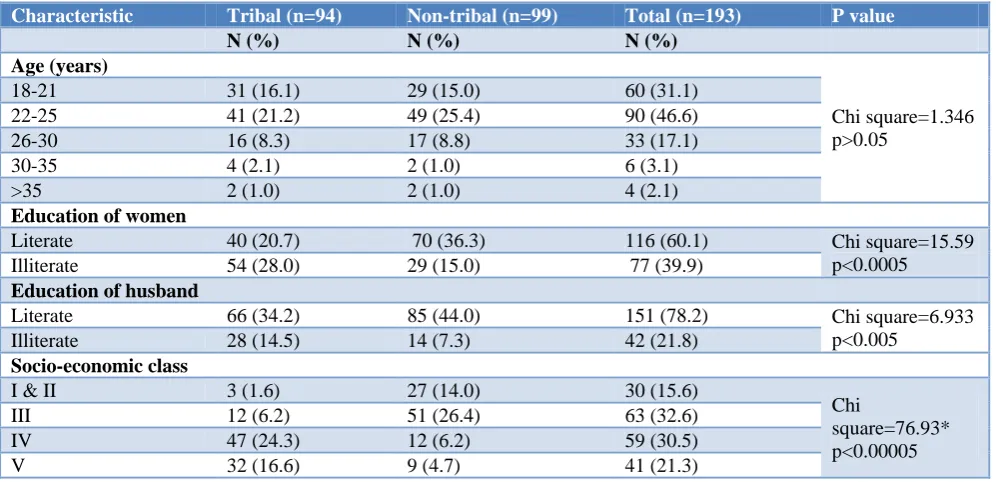
Table 1: Contraceptive use in tribal and non-tribal respondents in relation to socio- demographic profile (n=193).
Characteristic Tribal (n=94) Non-tribal (n=99) Total (n=193) P value
N (%) N (%) N (%)
Age (years)
Chi square=1.346 p>0.05
18-21 31 (16.1) 29 (15.0) 60 (31.1)
22-25 41 (21.2) 49 (25.4) 90 (46.6)
26-30 16 (8.3) 17 (8.8) 33 (17.1)
30-35 4 (2.1) 2 (1.0) 6 (3.1)
>35 2 (1.0) 2 (1.0) 4 (2.1)
Education of women
Literate 40 (20.7) 70 (36.3) 116 (60.1) Chi square=15.59
p<0.0005
Illiterate 54 (28.0) 29 (15.0) 77 (39.9)
Education of husband
Literate 66 (34.2) 85 (44.0) 151 (78.2) Chi square=6.933
p<0.005
Illiterate 28 (14.5) 14 (7.3) 42 (21.8)
Socio-economic class
I & II 3 (1.6) 27 (14.0) 30 (15.6)
Chi
square=76.93* p<0.00005
III 12 (6.2) 51 (26.4) 63 (32.6)
IV 47 (24.3) 12 (6.2) 59 (30.5)
V 32 (16.6) 9 (4.7) 41 (21.3)
Characteristic Tribal (n=94) Non-tribal (n=99) Total (n=193) P value
N (%) N (%) N (%)
Religion
Hindu 88 (45.6) 87 (45.1) 175 (90.7%) Chi square=1.877
p>0.05
Muslims and others 6 (3.1) 12 (6.2%) 18 (9.3%)
Type of family
Nuclear 31 (16.1) 50 (25.9) 81 (42.0) Chi square=6.08
p<0.05
Joint 63 (32.6) 49 (25.4) 112 (58.0)
Number of living children
0 4 (2.1) 7 (3.6) 11 (5.7)
Chi
square=10.87* p<0.05
1 17 (8.8) 32 (16.6) 49 (25.4)
2 33 (17.1) 38 (19.7) 71 (36.8)
>2 40 (20.7) 22 (11.4) 62 (32.1)
*with Yate’s correction.
Table 2: Sources of knowledge about contraceptive methods (multiple response) (n=193).
Tribal Non tribal Total P value
Media: TV and radio 82 105 187
Chi square=1.352 p>0.05
Health worker 57 76 133
Hospital / doctor 21 38 59
Relatives/ neighbour 32 41 73
Total 192 260 452
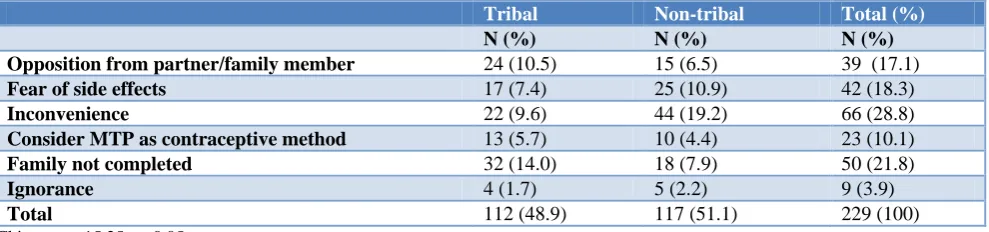
Table 3: Reasons for not using contraceptive methods among non-users (n=229).
Tribal Non-tribal Total (%)
N (%) N (%) N (%)
Opposition from partner/family member 24 (10.5) 15 (6.5) 39 (17.1)
Fear of side effects 17 (7.4) 25 (10.9) 42 (18.3)
Inconvenience 22 (9.6) 44 (19.2) 66 (28.8)
Consider MTP as contraceptive method 13 (5.7) 10 (4.4) 23 (10.1)
Family not completed 32 (14.0) 18 (7.9) 50 (21.8)
Ignorance 4 (1.7) 5 (2.2) 9 (3.9)
Total 112 (48.9) 117 (51.1) 229 (100)
Chi square=15.25; p<0.05.
Table 4: Comparison of knowledge regarding family planning before and after counselling sessions (n=213).
Mean (±SD) before family planning counselling
Mean (±SD) after family
planning counselling P value
39.5 (±1.5) 59.6 (±2.4) Paired ‘t’ test =103.6, p<0.001
Association of demographic characters of study subjects who were using contraceptives were found to be non-significant in relation to age of respondents and religion. Education of both men and women, type of family, socioeconomic class and number of living children had significant association with contraceptive usage (Table 1).
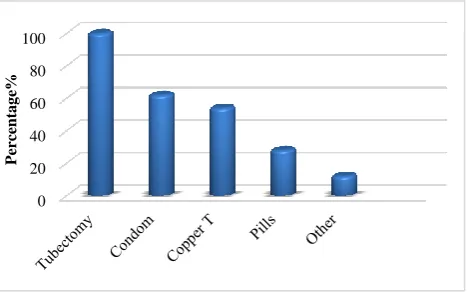
In Figure 2 the knowledge of study participants regarding contraceptive methods has been displayed. All the females were aware of tubectomy (100%) as permanent method of sterilization, followed by barrier method (condom specifically) (62%), copper T (54%), oral combined pills (28%) and other methods (12%).
Major sources of knowledge about contraceptives (Table 2) were media, health workers, through hospital or doctors, relatives or neighbours etc.
Among tribal subjects’ major reasons for non-usage of contraception were ‘family not completed’ and ‘opposition from partner/ family members’ while in non-tribal group main reason for non-usage were ‘inconvenience’ and ‘fear of side effects’ (Table 3).
of 12 weeks these subjects were again contacted and post-test was taken. It was found that out of 229, 16 subjects were lost to follow up (10 out of 132 in tribal and 6 out of 97 in non-tribal participants). Table 4 showing statistically significant improvement in the knowledge of 213 study participants regarding family planning after health education and family planning counselling sessions. This implies that there was statistically significant improvement in the knowledge regarding family planning after health education and family planning counselling sessions.
Figure 2: Diagram depicting knowledge of contraceptive methods among participants (multiple
responses) (n=422).
DISCUSSION
Current study was done in rural areas of Rajasthan which are accommodating both migrated tribal and non-tribal population to explore the knowledge about family planning methods and practices. In present study total 422 participants were included and three fourth were in age group of 18 to 25 years.
In present study it is documented that all the women knows atleast one method of contraception and that is permanent method but the knowledge regarding the temporary method of contraception is low. Among temporary method women had knowledge about condom followed by copper T, pills and other methods (like emergency contraceptives, coitus interrupts etc).
In a study done by Ghike in Maharashtra there was statistical significant difference between the tribal and nontribal woman according to their educational status.8 This study noted that in case of woman even if she is not literate than also contraceptive acceptance is high but if husband is not literate than it adversely affects the acceptance of contraceptive method, which matches with the results of current study.
Current study found that the religion is statistically not significant that means the religion don’t affect the acceptance of contraceptive method in either tribal or nontribal group. This study also noted that as the number
of children increases the use of contraceptive methods also increases and this is also statistically significant.
Another study by Prusty conducted in selected low performing states of India in context to family planning and compared the values at all India basis stated that knowledge of any method of contraception was prevalent in almost all (97% tribal and 99.4% non-tribal married women) which is in consensus with the findings of current study.2 Findings of knowledge of permanent methods (98.4%) in comparison to temporary methods (77.4%) of family planning are more among fertile females as suggested in study by Prusty is in agreement with current study. Reason for not using contraception was attributed to self-resistance by above mentioned study while current study quoted resistance from partner as the most common reason, this difference may be due to cultural differences of the regions.2
Source of knowledge regarding family planning are mainly health workers and media as reported in a study by Singh conducted in Uttar Pradesh and current study supports the similar findings.9 The above findings reveal that the issue of low usage of contraceptives is widespread irrespective of regional barriers.
CONCLUSION
India is still struggling with high population rise and awareness regarding family planning methods and motivation for practicing it is the first step in achieving the goal of stable population. The knowledge of contraceptive methods is not adequate amongst eligible couples and non-practice is also prevailing which can be overcome by efforts of health workers through one to one counselling and motivation. This study documents the beneficial effects of intervention in the form of such health education sessions in changing the practices of contraceptive usage among eligible couples by improving their knowledge and understanding towards family planning. These findings may be useful in addressing the problem both at grass root level and at the level of policy makers.
Funding: No funding sources Conflict of interest: None declared
Ethical approval: The study was approved by the Institutional Ethics Committee
REFERENCES
1. Govt. of India (2012), Census 2011, Provisional Population Report, Office of the Registrar General and Census Commissioner India, Ministry of Home Affairs, 2011.
2. Prusty RK. Use of contraceptives and unmet need for family planning among tribal women in India and selected hilly states. J Heal Popul Nutr. 2014;32(2):342–55.
0 20 40 60 80 100
Perc
entag
3. International Institute of Population Sciences, Mumbai. National Family Health Survey -4 Woman (2015-16). Ministry of Health & Family welfare; Government of India, New Delhi; 2016.
4. International Institute of Population Sciences, Mumbai. National Family Health Survey -4 India FS (2015-16). Ministry of Health & Family welfare; Government of India, New Delhi; 2016.
5. International Institute of Population Sciences, Mumbai. National Family Health Survey -4 Udaipur FS (2015-16). Ministry of Health & Family welfare; Government of India, New Delhi; 2016.
6. Government of India. Census 2011 Provisional Population Totals. 2012: 123–158. Available at: http://censusindia.gov.in/2011-prov-results/data_ files/mp/07Literacy.pdf. Accessed on 2 February 2019.
7. Sharma R. Revised Kuppuswamy’s socioeconomic status scale: Explained and updated. Indian Pediatr. 2017;54(10):867–70.
8. Ghike S, Joshi S, Bhalerao A, Kawthalkar A. Awareness and Contraception Practices among Women — An Indian Rural Experience. J SAFOG. 2010;2:19–21.
9. Singh A, Singh KK, Verma P. Knowledge, attitude and practice GAP in family planning usage: an analysis of selected cities of Uttar Pradesh. Contracept Reprod Med. 2016;1(1):20.