Original Research Article
A study on knowledge, attitude and practice about organ donation
among college students in Telangana state
Parepalli Vinay Kumar, Kishore Y. Jothula*
INTRODUCTION
Transplantation is transfer or engraftment of human cells, tissues or organs from a donor to a recipient with the aim of restoring the functions of the body.1 Organ transplantation dates back to the early 1900‟s where cornea were donated by the relatives of a dead person. Later on, as years passed by, there was transplantation between twins, from diseased and brain dead individuals.2 The change of disease pattern from communicable to non-communicable or chronic diseases leading to end stage organ damage has led to the increase in the requirement of organ transplantation. Organ donation saves hundreds of lives all over the world in cases such as accidents, severe burns, end stage diabetes, kidney disease, etc. Organ transplantation is the most preferred
of treatment modality of an end stage organ disease and failure.3
The present statistics of the organs available for transplantation is tabulated in Table 1. Though the quality of organ transplantation has improved, the organ transplantation rate in India is only 0.26 per million.4 Such a low rate of transplantation is due to the lack of knowledge, awareness and various misconceptions and religious myths in the society. It is a known fact that this low rate of transplantation leads to illegal trade of organs. We would need 1100 organ donors (or 2200 kidneys, 1100 hearts, 1100 livers, 1100 pancreas and 2200 eyes) to increase the rate to 1 per million from the current trend. This rate would mostly take care of current demand for organs.5 According to WHO, the second most important
ABSTRACT
Background: The change of disease pattern from communicable to non communicable or chronic diseases leading to
end stage organ damage has led to the increase in the requirement of organ transplantation. Though the quality of organ transplantation has improved, the organ transplantation rate in India is 0.26 per million. Such a low rate is due to the lack of knowledge and misconception about organ donation.
Methods: A pre-tested, semi-structured questionnaire was prepared, participants were chosen at random from the study population, they were interviewed with the questionnaire and their responses were computed and analysed.
Results: In this study population, all of them knew about organ donation. The study shows that 62.7% of the students have adequate knowledge about organ donation. 67% of them would like to donate organs in future and 85% were willing to motivate their family to be an organ donor.
Conclusions: The present rate of organ transplantation would be improved only when the society is educated with the knowledge, uncover the myths and misconceptions. It is also important that the organizations as to where and how to approach for the donation is known to all. Media being a powerful weapon of the generation can be a great tool to reach the society.
Keywords: Organ donation, Donor card, Organ transplantation, Jeevandan
Department of Community Medicine, Kamineni Institute of Medical Sciences, Telangana, India
Received: 25 March 2019
Accepted: 06 May 2019
*Correspondence:
Dr. Kishore Y. Jothula,
E-mail: [email protected]
Copyright: © the author(s), publisher and licensee Medip Academy. This is an open-access article distributed under the terms of the Creative Commons Attribution Non-Commercial License, which permits unrestricted non-commercial use, distribution, and reproduction in any medium, provided the original work is properly cited.
cause of death between 5 to 29 years is road traffic accidents and if these could be diagnosed as brain dead as soon as possible, their organs could bring back life to many needy people.6
Table 1: Statistics of organs available for transplantation as of 2018 in India.4
Organs
Demand for trans-plantation
Available for trans-plantation
Percent of organs available (%)
Kidney 21,000 5,000 28.8
Liver 2,00,000 750 0.37
Heart 5,000 70 1.4
Cornea 2,00,000 50,000 25
To overcome the lack of awareness about organ donation, the government and many non-governmental organizations have been initiating many community educational programs so as to motivate people to enroll as donors. Few of the schemes and organizations are Jeevandan (Andhra Pradesh and Telangana State), Mohan Foundation (Tamil Nadu). The government of India has formulated few rules to regulate organ donation and transplantation, also to reduce the misuse of organs under The Transplantation of Human Organs Act, 2014.
As students are the future of tomorrow this study is to know about the knowledge, attitude and practice of the college students regarding for organ donation, to bring awareness and in turn motivate them and their family members to become donors..
METHODS
Study design: Cross Sectional Study.
Study period: January, 2018 to March, 2018.
Study setting
Two pharmacy colleges located in the field practice area of the medical college in Telangana state.
Sample size
205 (by using formula 4pq/l2, p=87%)8
Sampling method
Simple random sampling method was followed to select students from all the four years of the two pharmacy colleges (50 each from 1st, 2nd and 3rd year and 55 from final year).
Study tool
A semi-structured questionnaire was prepared and suitable modifications were made after administering in a
pilot study. The questionnaire consists of the demographic information and a series of 30 questions to assess the knowledge, source of information, attitude, practices and barriers for organ donation.
Method of data collection
Permission from the head of the institutes was obtained and each of the chosen students was interviewed individually after taking their consent. The importance of this study was explained and ensured that confidentiality of the participant‟s responses.
Analysis
A score was given to each question and a total for each participant was calculated. A participant scoring greater than 50% was considered to have adequate knowledge about organ donation. Data was analyzed using Microsoft Excel and SPSS Statistical Package version 22.
RESULTS
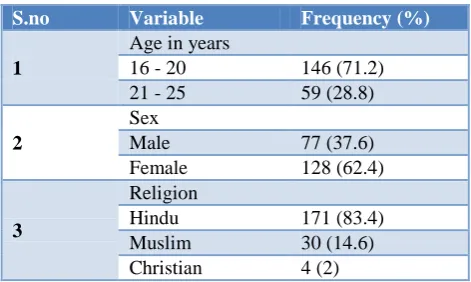
Of the 205 study participants, 77 (37.6%) were boys and 128(62.4%) were girls with the age range of 16 years to 25 years. Majority (83.4%) of the subjects were Hindus followed by Muslims (14.6%) and Christians (2%) (Table 2).
Table 2: Distribution of subjects according to age, sex and religion (n=205).
S.no Variable Frequency (%)
1
Age in years
16 - 20 146 (71.2) 21 - 25 59 (28.8)
2
Sex
Male 77 (37.6) Female 128 (62.4)
3
Religion
Hindu 171 (83.4) Muslim 30 (14.6) Christian 4 (2)
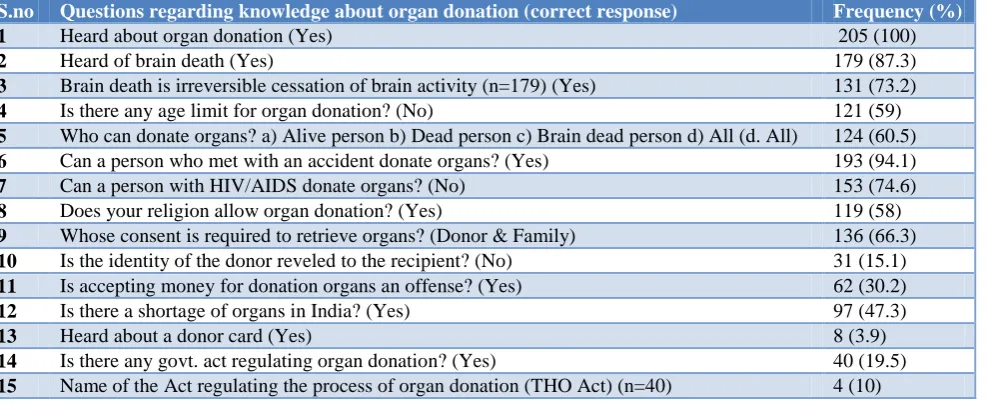
reduce the rate of organ trafficking, but only 10% of them
know it is known as “Transplantation of Human Organs Act, 2014” (Table 3).
Table 3: Knowledge about organ donation (n=205).
S.no Questions regarding knowledge about organ donation (correct response) Frequency (%)
1 Heard about organ donation (Yes) 205 (100)
2 Heard of brain death (Yes) 179 (87.3)
3 Brain death is irreversible cessation of brain activity (n=179) (Yes) 131 (73.2)
4 Is there any age limit for organ donation? (No) 121 (59)
5 Who can donate organs? a) Alive person b) Dead person c) Brain dead person d) All (d. All) 124 (60.5)
6 Can a person who met with an accident donate organs? (Yes) 193 (94.1)
7 Can a person with HIV/AIDS donate organs? (No) 153 (74.6)
8 Does your religion allow organ donation? (Yes) 119 (58)
9 Whose consent is required to retrieve organs? (Donor & Family) 136 (66.3)
10 Is the identity of the donor reveled to the recipient? (No) 31 (15.1)
11 Is accepting money for donation organs an offense? (Yes) 62 (30.2)
12 Is there a shortage of organs in India? (Yes) 97 (47.3)
13 Heard about a donor card (Yes) 8 (3.9)
14 Is there any govt. act regulating organ donation? (Yes) 40 (19.5)
15 Name of the Act regulating the process of organ donation (THO Act) (n=40) 4 (10)
Table 4: Attitude and practices towards organ donation (n=205).
S.no Questions regarding attitude and practices towards organ donation (Response) Frequency (%)
1 Are you willing to donate your organ(s) (Yes) 139 (67.8)
2 Do you have donor card ? (n=139) (Yes) 8 (5.7)
3 If you do not have a Donor Card are you willing to apply for one? (n=131) (Yes) 40 (30.5)
4
To whom will you donate organs? (n=139)
Only Family Members 11 (7.9)
Only to People I Know 34 (24.4)
Anyone 75 (53.9)
Cannot Decide now 19 (13.6)
5 Will you accept money in return of donating organs (n=139) (No) 111 (79.85)
6 Did any of your family members donate organs (Yes) 32 (15.6)
7 Will you motivate your family members to donate organs (Yes) 160 (78)
8 Will you support your family Members if they are willing to become an organ donor (Yes) 176 (85.9)
9 Do you think awareness about organ donation should be made a part of school education
(Yes) 169 (82.4)
Table 5: Reasons for not donating organs (n=66).
S.no Reasons for not donating organs Frequency (%)
1 Fear of organs being misused after retrieval from the body 30 (45.4)
2 Religious issues 18 (27.2)
3 The donated organ may be transplanted to a person who had committed some sin and instead
of being punished he/she would be rewarded with a new life 1 (1.5)
4 Restrictions from the Family 12 (18.1)
Table 6: Expectations of the students from organ donation (n=139).
S.no Expectations of the students from organ donation Frequency (%)
1 Gifting a new life to a person 55 (39.5)
2 Earn respect in the family and society 30 (21.5)
3 Honoring god and religion 15 (10.7)
4 Clearance of my past sins 25 (17.9)
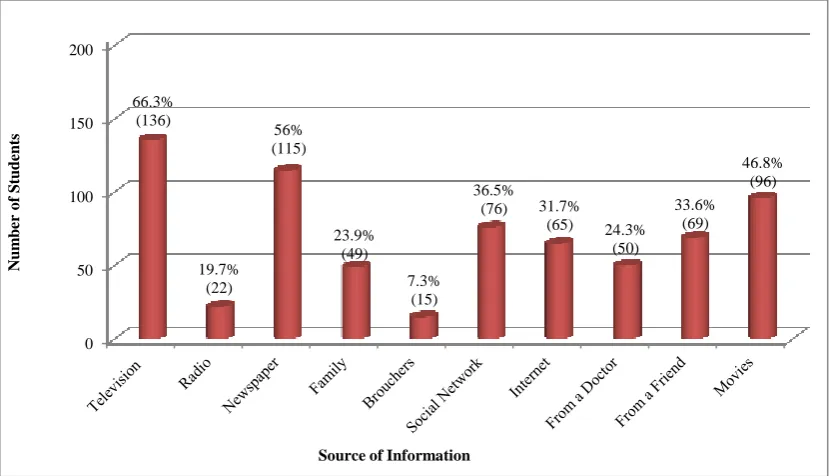
Figure 1: Bar chart showing the different sources from where the participants heard about organ donation (n=205).
Most (67.8%) of the participants would like to donate organs in future and only 5.7% of them have got donor card and 53.9% of the subjects are willing to donate to anyone. Majority (78%) of the participants were willing to motivate their family to be an organ donor and 82.4% were found to be positive to include topic on organ donation in school curriculam (Table 4).
The most common reasons for not donating organs was found to be fear of organs being misused after retrieval from the body (45.4%) followed by Religious issues (27.2%) (Table 5).
The most common reasons for donating organs was found to be gifting a new life to a person (39.5%) followed by earning respect in the family and society (21.5%) (Table 6).
It was observed that the major sources of information to the participants about organ donation were television (66.3%) followed by newspaper (56%) and movies (46.8%) (Figure 1).
DISCUSSION
Organ donation and transplantation has risen in the need for the treatment of non-communicable diseases whose prevalence has been in a rise in the recent times. The shortage of availability of organs for this purpose has raised the need for improving the awareness to donate organs in the society warding off their myths and misconceptions. In this cross-sectional study, it turns out that 100% of the participants have heard term organ donation which was similar to the study done on medical students by Jothula et al (100%) and study done on
college of commerce students by Shah et al (87.5%).7,8 Media is said to be the best mode to get in touch with the society and students in this study have heard about organ donation mostly from television(66.3%) and newspapers (56%). Similar results have been found in a study conducted on patients and their attendants in the out-patient department of Dr. DY Patil Medical College, Pune by Vaishalay et al.9
A study conducted by Khalil et al showed that television drama helps in propagation about health information and organ donation.10 Use of internet and social media is on a rise in this generation, hence it plays an important role in raising awareness about organ donation among people. The present study showed that 31.7% of participants have gained information from internet and 37% from social media, which was similar to the findings of Shah et al.8 Family too helps in gaining knowledge, in the present study 15.6% of participants said that some of their family members have been a donor, 23% knew about donation from their family and 85.9% revealed that they will support their family members to donate organs. In a study conducted by Morgan et al, it was found that discussion among the family members spreads awareness, unmask myths and boost positive attitude.11 Health care workers are always in contact with the society, 28% knew about organ donation through the doctors, similarly in a study conducted by Annadurai et al 34% of his participants have heard about organ donation from health care workers.12
The organ trafficking is in a rise in the recent times, 42% of the participants in this study knew that the donated organs were being sold at very high prices in the market which is leading to death of poor and needy patients. In 0
50 100 150 200
66.3% (136)
19.7% (22)
56% (115)
23.9% (49)
7.3% (15)
36.5% (76) 31.7%
(65) 24.3% (50)
33.6% (69)
46.8% (96)
N
u
m
b
er
o
f
S
tu
d
en
ts
the present study, among the participants who did not want to become a donor, 45.4% gave a reason of “Fear of Organs being misused”, a similar figure was observed in a study done by Jothula et al and Vaishalay et al.7,9 In regard to the above statement made, another question was asked about the act formulated to regulate the transplantation, 19% knew that there is some act regarding transplantation but only 10% named the Act as “Transplantation of Human Organs Act 2014”. There is a government scheme named “Jeevandan” regarding Transplantation of Organs started by Andhra Pradesh state prior to 2014, only 3.9% respondents knew about it, on the contrary at least 41% knew about it in the study conducted by Jothula et al.7 Few other studies showed that the pattern of knowledge about legislative regulations about organ transplantation and government schemes (or organisations) was 73% by Sucharitha et al, 78% by Dardevessis et al, 72% by Dasgupta et al.13-15
The present study showed that most (67.8%) of participants were willing for organ donation which was similar to the findings of Shah et al (62%).8 There were varied results observed in few other studies about willingness, 43% by Vaishaly et al, 53% by Sucharitha et al, 73% by Annadurai et al and 47% in rural Kerala by Manojan et al.9,12,13,16 People always have expectations from the person to whom they donated. The participants‟ responses to the question about expectation in return were that they get „Satisfaction‟ from the service, „Earn Respect‟, „Clear Past Sins‟, „Gift a new Life‟, „Honour God and Religion‟ and only 10.7% were expecting money. 53.9% of the participants who were willing to become a donor in the future would donate to anyone irrespective of the situation and the person but 7.9% to the family, 24.4% to close people and remaining were unable to decide to whom to donate, on the contrary Annadurai et al found that 75% were willing to donate, 43% by Vaishaly et al, 35% by Dasgupta et al, and 62% by Shah et al.8,9,12,15
Though 67.8% of the participants are willing to become donors only 30.5% of them actually were willing to sign up for a donor card, the reason behind being lack of awareness about how and where to apply for one, similar presentation was observed by Shah et al.8
CONCLUSION
Organ transplantation is a boon to people suffering from end stage organ disease due to chronic non communicable diseases, as the statistics suggest the transplantation rates increase only when there is a rise in the rate of donation which would occur only when the society is adequately provided with knowledge about the facts and uncover the myths regarding organ donation. In this study though people know about organ donation and have a positive attitude towards organ donation, but they have no idea how, where and whom to approach. This shows the lack of communication between the organizations and society. During recent days media
(television and newspaper), internet and social media are playing main role to diffuse the knowledge to the society, promotion of organ donation and helping to increase the rate of donation.
ACKNOWLEDGEMENTS
The authors were grateful to all the students who had participated in the study.
We thank interns and postgraduates of Department of community medicine, KIMS, Narketpally for their cooperation in data collection.
Funding: No funding sources Conflict of interest: None declared
Ethical approval: The study was approved by the Institutional Ethics Committee
REFERENCES
1. World Health Organization, Transplantation (Online), Available at: http://www.who.int/topics/ transplantation/en/. Accessed on 14 March 2018. 2. Timeline of Historical Events and Significant
Milestones, Facts and Terms (Online), Available at: www.organdonor.gov. Accessed on 14 March 2018. 3. Filho MA, Ramalho H. Attitudes and awareness regarding organ donation in the western region of Sao Paulo, Transplant Proc. 1995;27:1835.
4. Organ Donation Rate in India, Organ Donation Facts and Figures, Available at: http://www.organ india.org/make-a-pledge/. Accessed on 14 March 2018.
5. Organ Donation and Transplantation – Tribulations and Triumphs – An Indian Perspective (Online), Available at: http://www.mohanfoundation.org/ organ-donation-transplant-resources/tribulations-triumphs-indian-perspective.asp. Accessed on 14 March 2018.
6. Jeevandan (Cadaver Transplantation) Available at: http://jeevandan.gov.in/PDF's/JeevandanBook.pdf. Accessed on 14 March 2018.
7. Jothula KY, Sreeharshika D. Study to assess knowledge, attitude and practice regarding organ donation among interns of a medical college in Telangana, India. Int J Community Med Public Health. 2018;5(4):1339-45.
8. Shah R, Patel A, Ramanuj V, Solanki N. Knowledge and Attitudes about Organ Donation among commerce college students. National J Community Med. 2015;6(4):533-5.
9. Vaishaly K, Rathod H, Paranjape VM, Kanaskar N, Shevade S, Survase K, et al. Awareness regarding body and organ donation amongst the population of an urban city in India. NUJHS. 2015;5(4):51-5. 10. Kalil GE, Rintamaki LS. A televised
11. Morgan SE, Miller JK. Beyond the organ donor card: the effect of knowledge, attitudes, and values on willingness to communicate about organ donation to family members. Health Commun. 2002;14:121–34.
12. Annadurai K, Mani K, Ramasamy J. A study on knowledge, attitude and practices about organ donation among college students in Chennai, Tamil Nadu. Progressing Health Sci. 2013;3(2):59-65. 13. Sucharitha ST, Siriki R, Dugyala RR, Mullai,
Priyadarshini, Kaavya, et al. Organ donation: Awareness, attitudes and beliefs among undergraduate medical students in South India. Natl J Res Community Med 2013;2:79-148.
14. Dardavessis T, Xenophontos P, Haidich AB, Kiritsi M. Knowledge, Attitudes and Proposals of Medical
Students Concerning Transplantations in Greece Int J Prev Med. 2011;2(3):164–9.
15. Dasgupta A, Shahbabu B, Sarkar K, Sarkar I, Das S, Das MK, et al. Perception of Organ Donation among Adults: A Community Based Study in an Urban Community of West Bengal. Sch J App Med Sci. 2014;2(6):2016-21.
16. Manojan KK, Raja RA, Nelson V, Beevi N, Jose R. Knowledge and Attitude towards Organ Donation in Rural Kerala. Acad Med J India. 2014;2(1):25-7.