Original Research Article
A study on animal bites and envenomings in rural Varanasi:
a community based cross-sectional study
Neeti Purwar
1*, Kalpana Kumari
2, Anshu Singh
1, Seetha R. Nagesh
1INTRODUCTION
A research on various animal bites conducted among rural population in Tamil Nadu showed that 71% of animal bites were caused by bite of dogs followed by cats. Proportion of animal bites like monkey bites and rat bites are 4% and other animal bites were caused by bites of snakes, scorpions, millipedes and centipedes.1
Rabies, which is caused by Lyssavirus type-1 of the family Rhabdoviridae is an acute, highly fatal viral
disease of the central nervous system. Those who are susceptible to rabies are warm blooded animals including human beings.2
WHO conducted a national multi-centric rabies survey in 2003, the annual incidence of animal bites was 1.7 percent and it was more in rural areas (1.8%) and children (2.6%). It also observed that the high proportion (39.5%) of bite victims did not wash their wounds with soap and water.3
ABSTRACT
Background: Animal bites are major public health issues in children and adults worldwide. The most important bites are by dogs, cats and monkeys that may cause rabies. Globally, approximately 60,000 annual deaths occur from rabies. Another important bite is by snakes. In India, approximately 94,000–1,25,000 deaths occur by snake bites annually. Therefore, we undertook this study to estimate the incidence of animal bites and to determine the treatment seeking behaviour of victims of animal bites.
Methods: It is a cross-sectional study conducted in Bariyasanpur village of Chiraigaon block of Varanasi district. A total of 2039 individuals above one year of age were covered by surveying 342 households out of 437 households. Pre-tested structured schedule was used to find out the incidence of animal bites/ envenomings and treatment seeking behaviour among study subjects during the last one year.
Results: The incidence of animal bites/envenomings for the study population in the past one year was 35.31/1000 population. Proportion of the bites by dogs was 51.4% (37/72) followed by scorpions 23.6% (17/72), rats 11.1% (8/72), snakes 11.1% (8/72), monkeys 1.4% (1/72) and jackals 1.4% (1/72). Immediately after the bites, 28 subjects (38.9%) went to faith healers. Only 70.8% took treatment for animal bites at appropriate health facility.
Conclusions: From this study, we found a high incidence of dog bite cases and poor treatment seeking behaviour. Probably poor awareness about the animal bites/envenomings could be the main reason for improper management practices. It is a matter of concern for policy planners.
Keywords: Animal, Bites, Envenomings, Rabies, Incidence
Department of Community Medicine, 1School of Medical Sciences and Research, Greater Noida, 2Institute of Medical Sciences, Varanasi, Uttar Pradesh, India
Received: 27 September 2018
Revised: 02 November 2018 Accepted: 03 November 2018
*Correspondence:
Dr. Neeti Purwar,
E-mail: [email protected]
Copyright: © the author(s), publisher and licensee Medip Academy. This is an open-access article distributed under the terms of the Creative Commons Attribution Non-Commercial License, which permits unrestricted non-commercial use, distribution, and reproduction in any medium, provided the original work is properly cited.
Those who are susceptible to rabies are warm blooded animals including human beings.
Around 18,000 to 20,000 cases of rabies occur annually in India and country accounts for 36% of the world’s deaths from the disease.4
Mainly people of lower socio-economic status and children between the ages of 5 and 15 years are affected with this fatal disease. Indian children often play near stray dogs, roam freely and sharing their food with them, which results in frequent dog bites.
In one study, most children who were victims of dog bite were unaware of the status of being bitten and their parents ignored the attacks or simply treated the wounds by applying indigenous products like turmeric etc. Only few parents sought medical advice but with delay.5
Thus community awareness on the management of animal bites is lacking. So, it is important to know the epidemiology, pattern and treatment seeking behaviour among victims of animal bites so that effective strategy can be made to control rabies and to reduce the mortality among the cases of animal bites.
Objective
To estimate the incidence of animal bites and to determine the treatment seeking behaviour of victims of animal bites.
METHODS
A cross-sectional study was conducted in Bariyasanpur Village of Chiraigaon Community Development Block of Varanasi District. It is the field practice area of Department of Community Medicine, Institute of Medical Sciences, Banaras Hindu University. Data was collected for 3 months in 2016. There are 437 households in the village, 342 households were surveyed covering a population of 2039 individuals above one year of age.
Tools and technique
Pre-tested structured schedule was used to find out the incidence of animal bites and envenomings among study subjects during the last one year. In each household, it was asked if there is any person above one year of age who had animal bite in last one year. If victim was not present at the time of visit then the appropriate time for their availability was asked to contact him/her. History was taken from parents in case the child was unable to answer.
Victims of animal bites were asked about the type of animal, site of bite, frequency of bite, vaccination status of animal, whether animal was pet or stray/street/wild, treatment taken or not. Socio-demographic profile of study population and treatment seeking behaviour among
those who were bitten by animals were also recorded. This study was approved by ethical committee of institute.
Inclusion criteria
Inclusion criteria were study subjects above one year of age and subjects who were willing to participate.
Exclusion criteria
Exclusion criteria were households where door was locked; households where only child or person who was not able to tell about the animal bite among household members in last one year was present at the time of visit and we were not able to contact within next 3 visits to any adult member or a person who was able to tell about the animal bites among household members.
Data analysis
The data of study subjects was collected and entered in MS Excel 2013. SPSS (Statistical Package for Social Sciences) software trial version 21 was used for statistical analysis. Percentage, proportion and annual incidence were used. To study the association of socio-demographic characteristics with animal bites, chi square statistics was used. A p<0.05 was considered statistically significant.
RESULTS
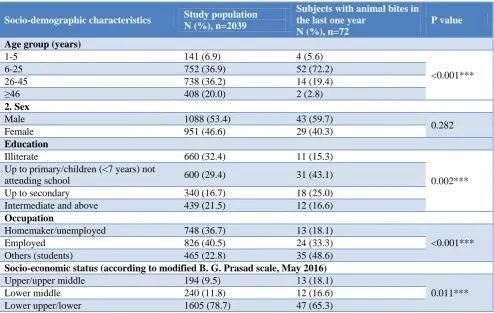
Approximately one-third (36.9%) of the study population belonged to the age group between 6-25 years and majority (72.2%) of the subjects with animal bites/ envenomings in the last one year were significantly related to the age group of 6-25 years. 5.6% of the subjects with animal bites were in the age group of 1-5 years.
There were 53.4% males and 46.6% females in the study population and 59.7% of the subjects with animal bites/ envenomings were males. About one-third of the study subjects were illiterate followed by up to primary education or children (<7 years) not attending school.
Cases of animal bites/envenomings were significantly higher in the category who were educated up to primary or children of age less than 7 years, who were not attending school (43.1%).
40.5% of the study subjects were employed followed by homemaker/unemployed (36.7%) and students (22.8%). Cases with animal bites/envenomings were significantly higher among students (48.6%).
Table 1: Socio-demographic characteristics of the study population.
Socio-demographic characteristics Study population
N (%), n=2039
Subjects with animal bites in the last one year
N (%), n=72
P value
Age group (years)
1-5 141 (6.9) 4 (5.6)
<0.001***
6-25 752 (36.9) 52 (72.2)
26-45 738 (36.2) 14 (19.4)
≥46 408 (20.0) 2 (2.8)
2. Sex
Male 1088 (53.4) 43 (59.7)
0.282
Female 951 (46.6) 29 (40.3)
Education
Illiterate 660 (32.4) 11 (15.3)
0.002*** Up to primary/children (<7 years) not
attending school 600 (29.4) 31 (43.1)
Up to secondary 340 (16.7) 18 (25.0)
Intermediate and above 439 (21.5) 12 (16.6)
Occupation
Homemaker/unemployed 748 (36.7) 13 (18.1)
<0.001***
Employed 826 (40.5) 24 (33.3)
Others (students) 465 (22.8) 35 (48.6)
Socio-economic status (according to modified B. G. Prasad scale, May 2016)
Upper/upper middle 194 (9.5) 13 (18.1)
0.011***
Lower middle 240 (11.8) 12 (16.6)
Lower upper/lower 1605 (78.7) 47 (65.3)
Table 2: Distribution and site of animal bites and envenomings in the last one year.
Number (%) Annual incidence (per 1000)
Distribution of animal bites/envenomings
Dog 37 (51.4) 18.15
Monkey 1 (1.4) 0.49
Snake 8 (11.1) 3.92
Scorpion 17 (23.6) 8.34
Jackal 1 (1.4) 0.49
Rat/mouse 8 (11.1) 3.92
Site of animal bites/envenomings
Lower limb 36 50.0
Upper limb 29 40.3
Back 4 5.5
Face/neck 2 2.8
Genital area 1 1.4
The overall annual incidence rate of animal bites/ envenomings was 35.31 per 1000 population. Proportion of the bites/envenomings by dogs was 37/72 (51.4%) followed by scorpion 17/72 (23.6%), rats/mouse 8/72 (11.1%), snakes 8/72 (11.1%), monkeys 1/72 (1.4%) and jackals 1/72 (1.4%). Among the subjects with snake bite, one died. Most (86%) of the animal bites were of wild/street/stray variety. It was found that the most common site of animal bite/ envenoming was lower limb (50%) followed by upper limb (40.3%), back (5.5%), face/neck (2.8%) and genital area (1.4%) (Table 2).
Table 3: Treatment seeking behaviour after animal bites/ envenomings.
Number Percentage (%)
1. Immediate action taken after animal bites/ envenomings
Went to faith healers 28 38.8
Went to doctor 15 20.8
Washed wound with soap and water 10 13.9
Washed wound only with water 7 9.7
Home remedies 4 5.6
Applied dettol and savlon 4 5.6
Killed biting animal 3 4.2
Did nothing 1 1.4
2. Duration of wound washing with soap and water
5 minutes 6 60.0
10 minutes 4 40.0
3. Subjects have taken treatment for animal bites/envenomings
Yes 51 70.8
No 21 29.2
4. Time taken for treatment after animal bites/envenomings
Within 30 minutes 10 19.6
30 minutes- 1 hour 2 3.9
1-6 hour 11 21.6
6-12 hour 6 11.8
>12 hour 22 43.1
5. Preferred place of treatment
Government hospital 36 70.6
Private hospital 15 29.4
6. Preferred pathy of treatment
Allopathy 47 92.2
Ayurveda 4 7.8
Table 4: Status of tetanus and anti-rabies vaccination and anti-venom injection.
Status of tetanus vaccination (n=51) Number Percentage (%)
No/ they had not been vaccinated in previous 5 years of animal bites 5 9.8
Yes 46 90.2
They had been vaccinated in previous 5 years of animal bites 0 0
Status of anti-rabies vaccination (n=39) Yes (n1=33; 84.6%) No (n2=6; 15.4%)
Dog 31 6
Monkey 1 0
Jackal 1 0
Status of anti-venom injection (n=8) Yes No
4 (50.0%) 4 (50.0%)
Approximately more than two-third (51/72) of the subjects with animal bites/envenomings had taken treatment for the same. Only 19.6% (10/51) of cases went for the treatment within 30 minutes. Majority (70.6%) of the cases, who took treatment, went to government hospital and most (92.2%) of the cases preferred allopathy for the treatment (Table 3).
Most (90.2%) of the study subjects who had taken treatment received tetanus vaccination. More than three-fourth (84.6%) of the subjects who had rabid animal bite
received anti-rabies vaccination and half of the subjects with snake bite received anti-venom injection (Table 4).
DISCUSSION
were below 25 years and 40.58% of them were males.1 Santra et al found in their study that 57.8% of animal bite victims were males, this is consistent with our finding.7 Sudarshan et al and Ghosh and Pal also reported that animal bites were more frequent in males than females.3,8 This may be found due to the fact that adult males are more likely to go for outdoor work.3,7
This study found that animal bites/envenomings cases were higher (58.4%) in those who were less educated (illiterate, children less than 7 years who were not attending school and cases educated up to primary level). A study by Venkatesan et al in rural district of Tamil Nadu, India also found the similar observation that in comparison with graduates, dog bites were significantly higher among illiterates and those who went to school only.9
Our study showed that 33.8% of the subjects with animal bites/envenomings were employed and 48.6% of them were students. Occupation was significantly associated with animal bites/envenomings. About two-third (65.3%) of the victims belonged to lower upper and lower class and socio-economic status was significantly associated. Venkatesan et al found that occupation such as farming and daily wage labourer were significant risk factor.9 Sudarshan et al observed that majority (75%) of bite victims belonged to poor and low income group.3 In Sangeetha et al animal bite/envenoming cases were found maximum in students (34.78%), unskilled worker (31.89%) and those belonging to lower upper and lower socio-economic status (50.73%).1 Santra et al reported that majority (80.4%) of the individuals belong to lower upper and lower socio-economic status according to modified B G Prasad scale 2013.7
The present study showed that overall annual incidence of animal bite/ envenoming was 35.31/1000 population. Most common animal bite was dog bite followed by scorpion sting. Venkatesan et al also reported the similar finding that most common biting animal was dog followed by scorpion. The overall period prevalence of bites in their study was 81.8/1000 population.9 Sangeetha et al, Kine and Supe and Sudarshan et al also found that most common biting animal was dog.1,3,6
Most common site of animal bite/ envenoming was lower limb followed by upper limb, this finding is consistent with Varsharani et al, Ghosh and Pal also reported that main site of bite was lower limb. This may be attributable to the fact that upper and lower extremities are most approachable of human body for an animal.8,10
Present study found that 38.8% of the victims went to faith healers and 5.6% of them used home remedies. Only 13.9% of the subjects with animal bite/envenoming washed their wounds with soap and water. Santra et al reported that 3.9% of the subjects went to faith healers.7 Wash of the site of bite with soap and water was practiced only by 1/3rd of the victims in Ghosh and Pal.8
A study by Sharma et al in Rural district of Pune observed that practice of washing wound with soap and water was done in 23.5% of the subjects. 31.3% of the subjects applied turmeric, lime, chili etc.11 In Sangeetha et al, 26% of the victims used chili powder, coffee powder, lime stone etc. and 40% of the victims washed their wounds with soap and water.1
Our study found that 70.8% of the animal bite/ envenoming victims had taken treatment. Majority (70.6%) of the cases who had taken treatment went to government hospital. 84.6% of the cases with rabid animal bites, took anti-rabies vaccination and 50% of the cases with snake envenomation took anti-snake venom injection. In Venkatesan et al, 59.4% of rabid animal bite cases had anti-rabies vaccination and only 9.4% of the cases with snake envenomation took anti-snake venom injection.9
CONCLUSION
From this study, we found a high incidence of dog bite cases and poor treatment seeking behaviour. Incidence of scorpion sting was also very common in the study area. A significant proportion of the animal bite victims went immediately to faith healers. Probably poor awareness about the animal bites could be the main reason for improper management practices. It is a matter of concern for policy planners.
Therefore, people living in rural areas should be educated about different types of animal bites and envenomings, its probable consequences and the health facility available in the area for the management of specific animal bites.
Knowledge about the importance of immediate washing of the wound with soap and water after rabid animal bites, anti-rabies vaccination, anti-snake venom injection and preventive measures for rabid animal bite, scorpion sting, snake envenomation and rate bite should be given to the people.
Funding: No funding sources Conflict of interest: None declared
Ethical approval: The study was approved by the Institutional Ethics Committeeof the Institute of Medical Sciences, Banaras Hindu University, Varanasi, UP, India REFERENCES
1. Sangeetha S, Sujatha K, William RF. An
epidemiological study of animal bites among rural population in Tamil Nadu, India. International J Community Med Public Health. 2016;3(6):1413-8. 2. Park K. Epidemiology of communicable diseases.
Park’s text book of Preventive and Social Medicine.
24th edition. Jabalpur: Banarsidas Bhanot
Publishers; 2017: 294.
3. Sudarshan MK, Mahindra BJ, Madhusudana SN,
An epidemiological study of animal bites in India: Results of a WHO sponsored national multi-centric rabies survey. J Communicable Dis. 2006;38(1):32-9.
4. Dutta JK. Human rabies in India: epidemiological features, management and current methods of prevention. Trop Doct. 1999;29:196-201.
5. Knobel DL, Cleaveland S, Coleman PG, Fèvre EM,
Meltzer MI, Miranda ME, et al. Re-evaluating the burden of rabies in Africa and Asia. Bull World Health Organ. 2005;83:360-8.
6. Kinge KV, Supe AC. Epidemiology of animal bite cases reported to anti-rabies vaccination OPD at a tertiary-care hospital, Nagpur. Int J Med Sci Public Health. 2016;5(8):1579-82.
7. Santra S, Lahiri SK, Ray TG. Determinants of animal bite and practices following bite among the victims attending a block primary health centre of west Bengal. Int J Health Sci Res. 2015;5(8):24-7. 8. Ghosh A, Pal R. Profile of Dog Bite Cases in an
Urban Area of Kolkata, India. Natl J Community Med. 2014;5(3):321-4.
9. Venkatesan M, Dongre AR, Kalaiselvan G. An
Epidemiological Study of Animal Bites and Envenomings in a Rural District of Tamilnadu, India. Online J Health Allied Scs. 2014;13(4):4. 10. Varsharani KV, Chinte LT, Jadhav YU. Cultural
practices among animal bite cases of government medical college, Latur. Int Med J. 2014;1(2):61-4. 11. Sharma AL, Bhuvar PA, Bhavalkar JS, Pawar SN.
Profile of management of animal bite cases among rural population in district Pune, Maharashtra. Indian J Public Health. 2007;51:62–3.
Cite this article as: Purwar N, Kumari K, Singh A, Nagesh SR.A study on animal bites and