Original Research Article
A study on prevalence of hypertension and its relationship with
overweight and obesity in adolescents and young adults, Nizamabad city
G. Chethan Raj
1, Syam Sundar Junapudi
2*
INTRODUCTION
Malnutrition is rapidly growing problem worldwide, particularly malnutrition resulting in obesity is pandemic universally. Lack of physical activity and sedentary lifestyle after invention of electronic gadgets is responsible for overweight and obesity. The consequence of obesity is an alarming increase not only in adults, but also in children. Previous studies have documented that hypertension may begin in adolescence, perhaps even in childhood.1,2 Clinical studies have already confirmed a strong association between obesity and hypertension,
with visceral obesity being the most important risk factor.3 Various mechanisms such as activation of the renin-angiotensin-aldosterone system, oxidative stress, sympathetic overdrive, chronic vascular inflammation and endothelial dysfunction, lead to structural changes such as thickening of the intima and media of the vessel wall in the development of hypertension. Obesity is one of the main factors, in addition to family history of hypertension, contributing to increase in the prevalence and rate of diagnosis of hypertension in children and adolescents. The consequence of adolescent obesity was reported in a study which showed that BMI greater than the 75th percentile in adolescence usually lead to an ABSTRACT
Background: The overall imbalance between unhealthy diet intake and physical activity leads to obesity which contributes to high blood pressure and high cholesterol. It is multi factorial disease and changes in the levels of blood pressure and blood lipids differ by age sex and race and are influenced by body fat and dietary patterns. These risk factors need to be monitored and evaluated in childhood and adolescents. So identifying and modifying the risk factors in early age reduces the incidence in adolescents and adult. Prevalence of hypertension varies across countries and states. The prevalence of hypertension in India is reported as ranging from 10 to 30.9%. The objective of the present study is to observe the prevalence hypertension among study population and to study contributing factors for hypertension among study population.
Methods: A cross sectional study done on 100 adolescents and young adults of both sexes in the age group 17 to 25 years from 2 degree colleges randomly selected in Nizamabad city, Telangana, India.
Results: In the present study population 52 were males and 48 were females, 22 students belongs to rural area and 78 belongs to urban area, pre-hypertension and hypertension was found 8% in both age groups. Overweight and obesity (>25) was found 7% in 17-19 age group and 9% in 20-25 age group. Pre-hypertension and hypertension was found among 10% of alcoholics.
Conclusions: The result of our study concluded that there is increasing prevalence of hypertension with increase in age and is associated with overweight and obesity.
Keywords: Hypertension, Overweight, Obesity
Department of Community Medicine, Government Medical College, Nizamabad, India
Received: 31 May 2019
Revised: 10 August 2019
Accepted: 12 August 2019
*Correspondence:
Dr. Syam Sundar Junapudi, E-mail: [email protected]
Copyright: © the author(s), publisher and licensee Medip Academy. This is an open-access article distributed under the terms of the Creative Commons Attribution Non-Commercial License, which permits unrestricted non-commercial use, distribution, and reproduction in any medium, provided the original work is properly cited.
increased risk of death from cardiovascular disease in adulthood.
Overweight and obesity indicate a weight greater than what is considered healthy. Obesity has reached epidemic proportions; over two thirds of adults are overweight or obese. We need to know more about the causes of obesity and then we need to change the ways we treat it. When obesity is accepted as a chronic disease it will be treated like other chronic diseases such as diabetes and high blood pressure. The treatment of obesity cannot be a short term “fix” but has to be an ongoing lifelong process. If it is not treated it promotes increase in blood pressure at early age there by leading to several cardiovascular problems.
The overall imbalance between unhealthy diet intake and physical activity leads to obesity which contributes to high blood pressure and high cholesterol. It is multi-factorial disease and changes in the levels of blood pressure and blood lipids differ by age, sex and race and are influenced by body fat and dietary patterns. These risk factors need to be monitored and evaluated in childhood and adolescents. So identifying and modifying the risk factors in early age reduces the incidence in adolescents and adult. Prevalence of hypertension varies across countries and states. The prevalence of hypertension in India is reported as ranging from 10 to 30.9%.
Objectives
The objective of the present study is to observe the prevalence hypertension among study population and to study contributing factors for hypertension among study population.
METHODS
A cross sectional study was done on 100 adolescents and young adults of both sexes in the age group 17 to 25 years from 2 degree colleges randomly selected in Nizamabad city, Telangana, India. Study was conducted from 01June 2017 to 01September 2017. Approval for the study from Institutional Ethical Committee was taken before initiating study. Pre-designed and pre-tested questionnaire was used. Students who are giving consent were included in this study students suffering with chronic illness and not giving consent were not included in this study. Total 100 students were included in this study. Age, gender, race/ethnicity, height, weight, address, and a checklist of risk factors and the risk factors like elevated BMI, family history of hypertension, smoking and alcohol consumption were included in the questionnaire. All anthropometric measurements were taken. Height and weight was measured using respective instruments. Height was measured without any footwear. Weight was measured without any footwear and with minimal clothing. BMI was calculated by taking persons
meters (kg/m2). And as per WHO definition of overweight and obesity, students were identified as overweight and obese if BMI is more than 25 and 30 respectively.
Subjects were made comfortable and they will be explained about procedure to alleviate anxiety. Brachial artery BP was recorded on seated participants after they had rested 5 min by using mercury sphygmomanometer. The systolic blood pressure was determined by the onset of the “tapping” korotkoff-1 sound and the diastolic at its disappearance (korotkoff-5). Students were considered hypertensive if systolic blood pressure is more than or equal to 141mm of Hg and diastolic blood pressure is more than equal to 91mm of Hg. Pre-hypertension was considered if systolic blood pressure is between 121 and 140 mm of Hg and diastolic blood pressure is between 81 and 90 mm of Hg. Students found to have hypertension on 1st visit were contacted to undergo 2nd set of BP measurements at least 4 weeks later. Three further sets of readings were taken on 2nd visit or 4weeks later after 1st measurement. The pre-stated norms were then use to conclude the presence or absence of hypertension.
Subjects were divided into 2 groups based on their age i.e., 17-19 year’s age group (adolescent) and 20-25 years age group (young adults) and their frequencies of overweight, obesity and pre-hypertension and hypertension were compared. Data analysis was done with EpiInfo 7 (CDC Atlanta).
RESULTS
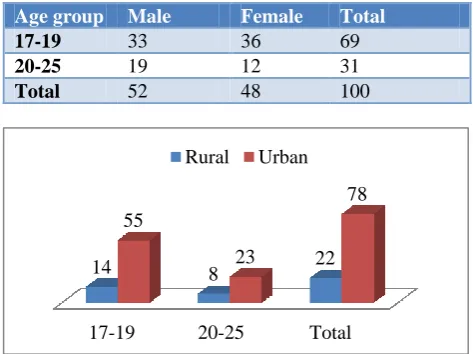
In this study out of 100 participants, 52% were males and 48% were females, male predominance is seen. 69% participants are in the age group of 17-19 and 31% were in 20 to 25 age group. More participants were in the age group of 17-19.
Table 1: Age and sex wise distribution of study population (n=100).
Age group Male Female Total
17-19 33 36 69
20-25 19 12 31
Total 52 48 100
Table 2: Area wise distribution of study population. 17-19 20-25 Total
14 8 22
55
23
In this study out of 100 participants 22% students belongs to rural area and 78% belongs to urban area, urban predominance is there. In the 17 to 19 gar group 14% belongs to rural area and 55% urban area. In the 20-25 age group 8 belongs to rural and 23% belongs to urban area.
Table 3: Prevalence of pre-hypertension and hypertension among study population (n=100).
Age
group Normotension
Pre-hypertension and
hypertension
Total
17-19 61 8 69
20-25 23 8 31
Total 84 16 100
p=0.0699; x2=2.24.
In this study 84% students were normotensive and 16% students were pre-hypertensive and hypertensive. When compared normotensive and pre-hypertensive, hypertensive in both age groups it was statistically significant.
Table 4: Prevalence of overweight and obesity among study population (n=100).
Age group
Normal weight (<25)
Overweight and obesity (>25)
Total
17-19 62 7 69
20-25 22 9 31
Total 84 16 100
p=0.209; x2=4.359.
In the present study overweight and obesity (>25) was found 7% in 17-19 age group and 9% in 20-25 age group. 84% were normal weight and 16% were overweight and obesity (>25).
Table 5: Prevalence of pre-hypertension and hypertension among males and females of study
population (n=100).
Sex Normotension
Pre-hypertension and
hypertension
Total
Male 39 13 52
Female 45 3 48
Total 84 16 100
P=0.0098; x2=5.208.
In this study when we compared prevalence of pre-hypertension and pre-hypertension among males and females, pre-hypertension and hypertension found 13% in males and 3% in females, male predominance is seen.
In this study when we compared prevalence of overweight and obesity among males and females, overweight and obesity was found 10% males and 6% females.
Table 6: Prevalence of overweight and obesity among males and females of study population (n=100).
Sex
Normal weight (<25)
Overweight and obesity (>25)
Total
Male 42 10 52
Female 42 6 48
Total 84 16 100
P=0.26; x2=0.415.
In this study when we compared between alcohol consumption and blood pressure, pre-hypertension and hypertension was found among 10% of alcoholics.
Table 7: Relationship between alcohol consumption and blood pressure among study population (n=100).
Alcohol Normotension
Pre-hypertension and
hypertension
Total
Yes 16 10 26
No 68 6 74
Total 84 16 100
p=0.0008; x2=11.02.
In this study when we compared between alcohol consumption and BMI, overweight and obesity (>25) was found 7% of alcoholics, 9% were non alcoholics.
Table 8: Relationship between alcohol consumption and BMI among study population (n=100).
Alcohol Normal weight (<25)
Overweight and obesity (>25)
Total (n=100)
Yes 19 7 26
No 65 9 74
Total 84 16 100
p=0.0765; x2=2.117.
Table 9: Relationship between physical activity and blood pressure among study population (n=100).
Regular
exercise Normotension
Pre-hypertension and
hypertension
Total
Yes 41 6 47
No 43 10 53
Total 84 16 100
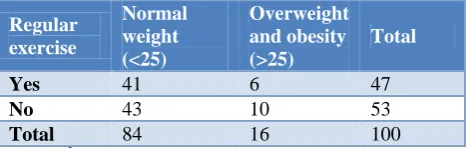
In this study when we compared physical activity and blood pressure, pre-hypertension and hypertension was found among 10% who are not doing regular exercise.
Table 10: Relationship between physical activity and BMI among study population (n=100).
Regular exercise
Normal weight (<25)
Overweight and obesity (>25)
Total
Yes 41 6 47
No 43 10 53
Total 84 16 100
p=0.29; x2=0.31.
In this study population when we compared relationship between physical activity and BMI overweight and obesity (>25) was found 10% who are not doing regular exercise.
DISCUSSION
In the present study population 52 were males and 48 were females, 22 students belongs to rural area and 78 belongs to urban area, pre-hypertension and hypertension was found 8% in both age groups. Similar study was done by Singh et al on prevalence of hypertension in Gujarati school going and adolescents in Anand district, and their prevalence of prehypertension and hypertension was10.8% and 9.2% respectively.4 A study by Drukteinis et al on American Indian adolescents from New York by found higher prevalence of hypertension (15%) and prehypertension (35%) when compared to our study.5 The difference may be due to difference in life style, dietary patterns, and physical activity between the two populations. In the study by Burke et al also has recommended serial measurement to reduce the effect of regression to mean and increase predictive values.6
The present study results are differ with studies conducted by Din-Dzietham et al. High blood pressure trends in children and adolescents in national surveys, Munter et al.7 Trends in blood pressure among children and adolescents, Gupta et al, normal blood pressure and evaluation of sustained blood pressure and evaluation of sustained blood pressure elevation and Verma et al, obesity and hypertension.8-10
Soudarssanane et al from India also gives same opinion of increase in hypertension with increase in age.11 In their study on adolescent and young adults, they found a significant increasing trend of BP was seen only among males. We found almost similar observation. Overweight and obesity (>25) was found 7% in 17-19 age group and 9% in 20-25 age group.
Pre-hypertension and hypertension found 13% in males and 3% in females. Studies in the past have demonstrated that age appropriate blood pressure values tend to be
more among boys than girls throughout childhood and adolescents.12
In the present study overweight and obesity was found 10% males and 6% females, pre-hypertension and hypertension was found among 10% of alcoholics, overweight and obesity (>25) was found 7% of alcoholics, pre-hypertension and hypertension was found among 10% who are not doing regular exercise. Overweight and obesity (>25) was found 10% who are not doing regular exercise. The prevalence rates of overweight and obesity in our study were 6% and 10%. Similar study done in rural area of Bangalore in college students found prevalence of overweight and obesity to be 6.1% and 7.2% respectively.13 The present study found significant rise of hyper-tension with obesity in both the sex groups, around 100% of obese students in our study had hypertension and none of obese students had prehypertension. Around 33.33% of overweight students had prehypertension and 16.66% of students who were overweight had hypertension. This association also demonstrated in many studies.14,15 The Framingham study also showed increased prevalence of obesity in subjects with hypertension as well as increase in BP in established obesity.16 Many studies from India had similar observations.10 Similar observations were also reported among adolescent population in Hungary and France and such association in early childhood with rise in systolic blood pressure alone was reported by British cohort.17 Obesity is a major risk factor for various disorders including angina, diabetes mellitus, osteoarthritis, and hyperlipidemia that result in morbidity and mortality. Today about 70 % of deaths occur in India because of cardiovascular pathologies.18 Even a small increase in BMI of high risk individual can increase mortality by several fold, therefore it is very essential to start the preventive measures early in life i.e., in preventive childhood and adolescence. Our data of prevalence of obesity and hypertension can help to initiate preventive measures.
CONCLUSION
The result of our study concluded that there is increasing prevalence of hypertension with increase in age and is associated with overweight and obesity. Children and adolescents should be considered as priority population for interventional strategies. Prevention may be achieved through physical activity and diet control. There is an urgent need for initial prevention and treatment of obesity in children. Obesity, family history of hypertension is risk factors for adolescent hypertension. Findings of our study suggest a need for larger population based studies to accurately estimate the prevalence and risk factors for hypertension among adolescents and young adults in our country.
Funding: The funding was provided by ICMR Conflict of interest: None declared
REFERENCES
1. Falkner B. National high blood pressure education program working group on high blood pressure in children and ado-lescents. The Fourth Report on the diagnosis, evaluation and treatment of high blood pressure in children and adolescents. Paediatr. 2004;114:555-75.
2. McNiece KL, Poffenbarger TS, Turner JL, Franco KD, Sorof JM, Portman RJ. Prevalence of hypertension and pre-hypertension among adolescents. J Pediatr. 2007;150(6):640-4.
3. Hall JE. The kidney, hypertension, and obesity. Hypertension. 2003;41(3):625-33.
4. Verma V, Singh SK. Prevalence of hypertension in Gujarati school going children and adolescents in Anand district. Nat J Community Med. 2012;3(3):452-7.
5. Drukteinis JS, Roman MJ, Fab-sitz RR, Lee ET, Best LG, Russell M, et al. Cardiac and systemic hemodynamic characteristics of hypertension and prehypertension in adolescents and young adults. Circulation. 2007;115:221-7.
6. Burke GL, Cresanta JL, Shear CL, Miner MH, Berenson GS. Cardiovascular risk factors and their modification in children. Cardiol Clin. 1986;4:33-6. 7. Dzietham RD, Liu Y, Bielo MV, Shamsa F. High Blood pressure trends in children and adolescents in national surveys, 1963 to 2002. Circulation. 2007;116(13):1488-96.
8. Munter P, He J, Cutler JA, Wildman RP, Whelton BK. Trends in blood pressure among children and adolescents. JAMA. 2004;291:2107-13.
9. Gupta AK, Ahmed AJ. Normal blood pressure and evaluation of sustained blood pressure and evaluation of sustained blood pressure elevation. Indian Pediatr. 1990;27:33-42.
10. Verma M, Chhatwal J, George SM. Obesity and hypertension. Indian Pediatr. 1994;1:1065-9.
11. Soudarssanane M, Mathanraj S, Sumanth M, Sahai A, KarthigeyanM. Tracking of blood pressure among ado-lescents and young adults in an urban slum of Puducherry. Indian J Community Med. 2008;33:107-12.
12. Jackson LV, Thalange NK, Cole TJ. Blood pressure centiles for Great Britain. Arch Dis Child. 2007;92:298-303.
13. Varadappa ST, Kumar PS, Gaboraiah PG, Raju RMN, Subbanna LY. Prevalence of obesity among college students in rural area of Bangalore. Nat J Community Med. 2014;5(1):42-5.
14. Falkner B, Gidding SS, Ramirez-Garnica G, Wiltrout SA, West D, Rappaport EB. The relationship of body mass index and blood pressure in primary care pediatric patients. J Pediatr. 2006;148(2):195-200.
15. Ostchega Y, Carroll M, Prineas RJ, McDowell MA, Louis T, Tilert T. Trends of elevated blood pressure among children and adolescents: data from the National Health and Nutrition Examination Survey 1988-2006. Am J Hypertens. 2009;22(1):59-67 16. Dannenberg AL, Garrison RJ, Kennel WB.
Incidence of hypertension in the Framingham study. Am J Public Health. 1998;78:676-9.
17. Hardy R, Wadsworth ME, Langenberg C, Kuh D. Birth weight, childhood growth and blood pressure at 43 years in a British birth cohort. Int J Epidemiol. 2004;33:121-9.
18. World Health Organization. Preventing chronic diseases: a vital investment. World Global Report. Geneva: World Health Organization; 2005.