Secure Data Transmission Using Hop-By-Hop Routing Algorithm
S. P. Gayathri*, K. SusmithaDepartment of Computer Science, Sakthi College of Arts and Science for Women, Oddanchatram, Dindigul, Tamil Nadu, India
ABSTRACT
This paper is an enhancement of existing spatial reusability-aware single-path routing (SASR) and any path routing to use Hop by Hop Message authentication scheme for ensuring data confidentiality. We Propose Secure Spatial Reusability-Aware Routing with Enhanced Secure Data Transmission using Hop-by-Hop Routing Algorithm. In the existing paper, the system investigated two kinds of routing protocols, including single-path routing and any path routing. The task of a single-path routing protocol is to select a cost minimizing path, along which the packets are delivered from the source node to the destination node, but it failed to consider shortest path and issues in it. The most vital way to prevent malicious, unauthorized and corrupted messages from being transmitted/ forwarded in Multi-hop wireless networks is message authentication technique. Most of the existing systems have several limitations to incorporate in Multi-hop wireless networks, which includes high computational cost and several communication overheads are available in it, which also leads to lack of scalability and resilience to node compromise attacks. We propose a system with enabling verification model in the intermediate nodes and thus our model permits any node to transmit an infinite number of messages without adversity of the threshold problem. We prove that our system is efficient and more useful to check the shortest path with lowest cost than the existing system models.
Keywords: Routing, Wireless Network, Protocol Design.
I.
INTRODUCTIONNetworks have attracted much research attention due to the capabilities including, fault tolerance, self configuration and scalability [1]. A wireless network is a multi-hop wireless network that consists of a large number of wireless devices, such as mesh routers which relay packets through wireless channels, mesh gateways which are connected with a wired network to the Internet and mesh end users. Wireless networks have seen phenomenal growth due to their unique ability to self-heal and self-organize, while providing robust and reliable solutions for applications that require low data rate, long battery life and high reliability. One of the major concerns in ad hoc wireless networks is reducing node energy consumption. Recent studies provide designing
schemes to reduce the operation expenditure or energy consumptions of mobile networks towards providing green mobile networks [2].
The limitation of energy availability has become one of the most critical issues in multi-hop wireless networks, and it motivates extensive research efforts towards power-efficient routing and topology control. Using multipath routing instead of a single path has been shown to be able to provide better reliability and quality of service (QoS) [3].
transmitted using other paths. Due to the wireless nature, reaching a destination node located out of the coverage range of the sender node requires a multi-hop communication strategy, where each node has to cooperate with the other ones to form a path and acts as relay for packet transmission. In this scenario, the instability of the topology due to link or node failures could result in disconnected routes [5].
A set of links or nodes could be shared between many path and any failure occur could affect these paths, which might results in consuming user’s energy in sending packets without knowing the existence of any failure in his path. Thus, the existence of multiple paths (primary and protection path) provides a recovery for saving user energy, where user’s requests can be still carried by the use of the protection paths provided through the network. The ability of multipath routing schemes in providing a better QoS in transferring multimedia applications such as voice, video and data, has been proved in a number of previous studies, such as in [6].
So in this work to provide an energy efficient multipath scheme, we try to avoid using the interfered paths at the same time, in other words, we will choose some links to be part of the primary path and the other links that interfere with them to be part of the protection path. Our second observation is that a primary path and its protection path will never transmit at the same time. Therefore, instead of using a link in an insulating region, we plan to use the links which are interfered with the links on a primary path for protection. This is the first work that considers using network interference to improve the connection accommodation in wireless mesh networks [7].
Routing in wireless networks with dynamic traffic, i.e., users’ requests have random arrival times, which is different than the static network routing which was studied, where all traffic demands were given in advance. For each coming request we need to provide
two disjoint paths (one primary path and one protection path) to satisfy the request, Each primary path will be reserved for a specific user request. On the other hand, each protection path is reserved (not actively used) for a request in the case of failure in the primary path [8].
It is possible to use a same link to protect multiple primary paths if some criteria are satisfied. For example, if we assume single-link (single-node) failure in a network, then one link can be used to protect multiple active paths as long as they are link-disjoint (node-link-disjoint). We denote such ability to protect multiple paths as reusability of a protection link. To the best of our knowledge, this work is the first to discuss the reusability of protection links in wireless mesh networks. Reusability of a path to provide protection for multiple users’ requests will reduce energy consumption in the network, where by using a single path multiple times; we will consume energy from a small number of nodes, compared to that when we assign each primary path a specific protection path. Moreover, reusability of protection paths, will increase the number of free links in the network, and since the nodes on those links are not active (not participating in any primary or protection paths) they can be put into a sleep mode for energy saving purposes [9].
The remainder of this paper is organized as in the following sections. We will describe the related works in Section I. Section II will present the proposed work. In Section III, consist experimental results and discussion. Finally, a brief conclusion will be given in Section IV.
II.
PROPOSED WORKdestination. Otherwise the data packets are blocked. The task of a single-path routing protocol is to select a cost minimizing path, along which the packets are delivered from the source node to the destination node. In spatial reusability of wireless signals fade during propagation. On the same channel two links are free of interference can transmit at the same time. Specifically, we considered the tradeoff between spatial reuse and data rate, and proposed a decentralized power and rate. Control mechanism works for higher network capacity. It aims to achieve optimum carrier sensing range for better throughput maximization. The conceptual architecture of proposed system is given in Figure 1.
Figure 1. Conceptual Architecture of the Proposed System
A. The goals of our proposed model are:
Reduce Delay: The delay need to reduce in multipath routing because backup routes are identified during route discovery.
Load Balancing: The traffic distribution is not equal the network of all links. In some links and bottlenecks when traffic along with multiple routes can spread it can form alleviate congestion in it.
Reliability and Fault Tolerance: The original idea behind using multipath routing approach in WSN was to provide path resilience and
reliable data transmission. It can cause benefits from the availability of alternative paths to salvage its data packets from node or link failures until a sensor node cannot forward its data packets from node or link failures in the fault tolerance domain.
Maximized Successful ratio: Our goal is to maximize the successful ratio active routing scheme need to design for maximizing success ratio.
The routing protocols are defined into two processes, single path routing protocols and any path routing protocols. The single path routing protocols is countered by Expected Transmission Count Metric (ETX). In our work the probability of data transmission rates from node i to node j. Hence, the probability of packet transmission is given as:
(1) Where, Tdata indicates the packet transmission time;
T ack indicates acknowledgment of packets;
Tij indicates the expected time for delivering the
packets among the nodes.
Likewise, anypath routing contain set of forwarder nodes Fi, that retrieves the number of transmissions from node i as,
(2)
B. Spatial Reusability aware Single path Routing Protocols
The major target of the single path routing protocols is to select the best paths from the set of available paths which alternatively incurs low costs.
The steps involved in single path routing systems are:
Input: Path p, cost of the path link (Tij) and
link graph G= (P, E).
Initially, the available links are organized in descending order.
Computing the link delivery time for the
available paths I as: (3)
∑ (4)
Consider each path in link graph model G= (V, E) where V is the links and E is the interferences.
Likewise, the non-interfering sets I is computed
as E= {(i,j), (i’,j’)}
We obtain the optimal non-interfering paths with affordable costs.
C. Spatial Reusability aware Anypath Routing Protocols
The role of the anypath routing protocols for spatial reusability is to achieve better packet delivery with minimized cost factor. The steps involved are the:
Input: Network Graph G = (N, E) that contain source node and destination node.
The cost of the distance is given by C= (Ci)
where i€Q with forwarder lists F= (Fi) where i€Q.
When the derived node cost is lower, the destination node is at reachable position.
III.
RESULTS AND DISCUSSIONOur results showed that the AODV-DM scheme has the lowest satisfied ratio due to hiding most of the edges that lied within the insulating region of the primary path. On the other hand, the SAAR scheme has a lower satisfied ratio compared to that of the SSAAR scheme because using the common nodes concept made it hard to find many disjoint paths.
Figure 2. cost calutating by the metic of Expected Transmission Count(ETX).
Increasing the area size while having the same number of nodes will decrease the number of edges in a graph, this can affect the performance of the tested schemes where it can be seen that, by having less number of edges, due to the increase in the area size, we can satisfy less number of requests. For example, with our proposed SSAAR scheme in an area of size 1.000 m by 1,000 m we satisfied 303 request, while in a 2,500 m by 2,500 m area size we can satisfy 53 requests.
Also these results are better compared with the results of SAAR and AODVDM schemes. These results show that, in average, our schemes consume less time to satisfy a coming request than SAAR and AODV-DM schemes in most cases, where the AODVDM scheme consumes much time forming the insulating region, while the SAAR scheme consumes much time finding multiple path using the set of common nodes.
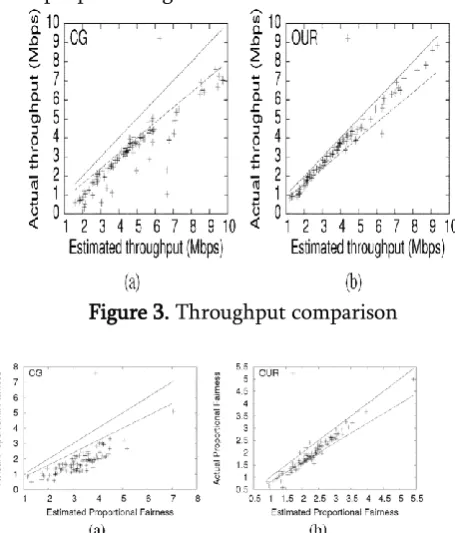
Figure 3. Throughput comparison
Figure 4. Actual versus estimated proportional fairness
scheme, since we are considering embracing interference and protection links reusability, we can satisfy more requests than that in SAR and AODVDM. The results also showed that because AODV-DM hide all the edges that interfere with the primary or the protection path, it might hide most of the links in the network, so it can be seen from the figure that AODV-DM can satisfy less number of requests. And also by increasing the number of nodes within the same area size, using AODV-DM scheme will lead to a drop in the satisfied ratio, by hiding more number of interfered edges in the graph.
IV.
CONCLUSIONIn this work, we presented secure spatial reusability-aware routing with enhanced secure data transmission using hop-by-hop routing algorithm that dynamically optimizes for routing, scheduling, and simple network coding for wireless networks. We introduced k-tuple coding, a generalization of pair wise network coding, and provided the SSAAR, which is throughput optimal subject to the k-tuple coding constraint. We have shown achievable coding gain on simple scenarios, provided simulation results for more complex scenarios, and gave an upper bound on k-tuple coding gain for all possible scenarios. Our main conclusion is that pair wise coding provides most of the benefit of k-tuple coding for the scenarios considered. We evaluated the SSAAR via packet simulation and LP evaluation for pair wise and 3-tuple coding. Due to the topology and traffic structure required for k-tuple coding operations, we expect limited additional gain from increasing code size k on random topologies. Note that the reduced complexity in computing weights for pair wise coding becomes significant for larger networks. We observe that the Frame policy yields greater coding gains under 2-hop interference than under 1-hop interference. Future work of interest includes decentralized scheduling, suboptimal scheduling with reduced complexity, and full system implementation.
V.
REFERENCES[1]. Akella, S. Seshan, R. Karp, and S. Shenker." Selfish behavior and stability of the internet: Game-theoretic analysis of TCP," In Proceedings of the Special Interest Group on Data Communication, Pittsburgh, PA, August 2002.
[2]. L. Anderegg and S. Eidenbenz. "Ad hoc-VCG: a Truthful and Cost-Efficient Routing Protocol for Mobile Ad Hoc Networks With Selfish Agents," In Proceedings of the Ninth International Conference on Mobile Computing and Networking ,San Diego, CA, Sep. 2003.
[3]. N. Ben Salem, L. Buttyan, J. P. Hubaux, and M. Jakobsson. "A charging and rewarding scheme for packet forwarding in multi-hop cellular networks," In Proceedings of the Fourth ACM Symposium on Mobile Ad Hoc Networking and Computing, Annapolis, MD, Jun. 2003.
[4]. S. Buchegger and J.-Y. Le Boudec. "Nodes bearing grudges: Towards routing security, fairness, and robustness in mobile ad hoc network," In Proceedings of the Tenth Euromicro Workshop on Parallel, Distributed and Network-based Processing Islands, Spain, Jan. 2002.
[5]. S. Buchegger and J.-Y. Le Boudec. "Performance analysis of the CONFIDANT protocol (Cooperation of nodes: fairness in dynamic ad-hoc networks)," In Proceedings of the Third ACM Symposium on Mobile Ad Hoc Networking and Computing, Lausanne, Switzerland, Jun. 2002.
[7]. L. Buttyan and J. P. Hubaux. "Stimulating cooperation in self-organizing mobile ad hoc networks," ACM Journal for Mobile Networks, special issue on Mobile Ad Hoc Networks, summer 2002.
[8]. S. Eidenbenz, V. S. A. Kumar, and S. Zust. "Equilibria in topology control games for ad hoc networks," In Proceedings of the 2003 Joint Workshop on Foundations of Mobile Computing, pp. 2-11], 2003.
[9]. S. Eidenbenz, G. Resta, and P. Santi. "Commit: A sender-centric truthful and energy-efficient routing protocol for ad hoc networks with selfish nodes," In Proceedings of 5th IEEE International Workshop on Algorithms for Wireless, Mobile, Ad Hoc and Sensor Networks, Apr. 2005.