http://www.ijcmph.com pISSN 2394-6032 | eISSN 2394-6040
Original Research Article
Study of the knowledge regarding reproductive health among the
second PUC students from the colleges of Bangalore city
Margaret Menzil, Deepa L. N.*
INTRODUCTION
The twentieth century began with approximately 1.6 billion human beings in the world and with an increase of 96 million people per year, will end with over 6 billion people. Nearly 50% of this population is constituted by female. India has one of the world’s largest populations of teenagers over 23 million, representing over 26% of the total in the world. According to UNICEF, there are 243 million adolescents comprising 20% of the total population of India and their numbers are expected to increase over time.1,2
According to analysis by World Bank and WHO, reproductive ill-health accounts for over 30% of overall burden of diseases and disability among women, compared to only 12% for men.3 The onset of menstruation is one of the most important changes occurring among the girls during the adolescent years. The first menstruation (menarche) occurs between 11 and 15 years with a mean of 13 years.4 Menstruation is still regarded as something unclean or dirty in India. The reaction to menstruation depends upon awareness and knowledge about the subject.
Adolescence is a period of increased risk-taking and therefore they are susceptible to behavioural problems
ABSTRACT
Background: According to an analysis by the World Bank and WHO, reproductive ill-health accounts for over 30% of the overall burden of disease and disability among women, compared with 12% for men. Reproductive health of adolescent girls is crucial since it determines the health of future generations to come. With this in background we conducted a study to find out the difference in the knowledge among the science and the non-science students and to find the relationship between the knowledge scores regarding the reproductive health with respect to select variables.
Methods: A cross sectional study was done during July 2004 and January 2005, on 600 girl students (300 each from science and non-science stream) using a pre validated self administered questionnaire amongst II PUC students.
Results: 68% science students knew that RTIs can be caused by unhygienic conditions, bacterial infections, STDs and unsafe abortions when compared to only 28% non-science students who knew the cause of RTIs. 64% Science students knew that the predominant routes of HIV transmission is unsafe sex, unsterilized instruments, contaminated blood transfusion, infected mother to child as compared to only 42% non-science students.74% science students knew that STDs can be prevented by use of condoms as compared to only 44.3% non-science students.
Conclusions: The science students were found to be more knowledgeable than the non-science students.
Keywords: Science students, Non-science students, Reproductive health, STD/RTI, Knowledge
Department of Community Medicine, East Point College of Medical Sciences and Research Centre, Bengaluru, Karnataka, India
Received: 18 April 2018
Revised: 04 May 2018
Accepted: 05 May 2018
*Correspondence:
Dr. Deepa L. N.,
E-mail: [email protected]
Copyright: © the author(s), publisher and licensee Medip Academy. This is an open-access article distributed under the terms of the Creative Commons Attribution Non-Commercial License, which permits unrestricted non-commercial use, distribution, and reproduction in any medium, provided the original work is properly cited.
and reproductive health problems at the time of puberty which is of major concern. According to the National Family Health Survey-3 data, 2.7% boys and 8% girls in India reported sexual debut before the age of 15 years.5
Reproductive health of adolescent girls is crucial since it determines the health of future generations to come. Major components of reproductive ill-health among them include the menstrual hygiene related problems, consequences of early marriage, unsafe abortions, high risk behavior, lack of awareness about contraception and reproductive health issues, RTIs/STIs including HIV/AIDS and non-consensual sex. These issues could be addressed by focusing on raising awareness about reproductive health issues, making the adolescent health services friendly and accessible and encouraging their active involvement in all these.6 Effective methods of contraception and STDs’ prevention are available, but not to all sexually active humans.6
Knowledge about contraception is important for young students as un-planned pregnancies can be prevented and dire consequences of unsafe abortions and STDs could be avoided.7 Awareness of the extent and consequences of reproductive ill health has increased over the past decade but it’s not uniform in all regions. Majority of adolescents still do not have access to information and education on sexuality, reproduction, and sexual and reproductive health and rights, nor do they have access to preventive and curative service. Providing adolescents with access to seek information education and services is thus the main challenge for future programs.8
Questions asked to a few college girls regarding reproductive health only brought shy smiles or sheer indifference. Understanding the health problems related to menstruation among adolescent girls, their awareness about pregnancy and reproductive health will help us in planning programmes for this vulnerable group. With this in mind we undertook a study amongst the II P.U.C students with the objectives; to find out the difference in the knowledge among the science and the non-science students and to find the relationship between the knowledge scores regarding the reproductive health with respect to select variables.
METHODS
The study was done in Bangalore colleges. This was done during July 2004 to January 2005. The total number of P.U. colleges in Bangalore (North and South) is 270. Out of which the only female colleges are 38. The 38 colleges were listed alphabetically and 10 colleges were selected by simple random sampling method. From the selected colleges the list of non-science and science students were collected and arranged in an order. From this arranged list, 300 students from the Science group and 300 from the Non-Science were selected using simple random sampling method.
Necessary permission was obtained from the college authorities prior to the study. The purpose of the study was explained to the students and all the students who consented to participate were asked to fill the pretested, validated and semi structured questionnaire.
A pilot study was done on 60 students, 30 from each stream using a semi structured, self administered questionnaire. The study instrument was standardized after the pilot study and the same was used for collection of data for the main study. Steps in assigning the sigma weight for standardization, was based on the standard guidelines.9
Statistical analysis
The data was entered in excel spread sheet and analysed using open EPI info. It was expressed in percentages and proportions. For quantitative data χ2
test was used for analysis and for qualitative data ‘t’ test and ANOVA was used.
Sample size
After the standardisation of the study instrument, the sample size was estimated based on the instrument values using the formula, ( )( )( ) at 1% level of significance (99% confidence level) and taking allowable error of 2. The mean score was ̅ = 166.87 and standard deviation = 10.71.
Sample size n, z (Standard Normal Deviate) = 2.58, (Standard deviation) = 10.71, Allowable error E = 2
( )( )( ) ( )( )( )
Taking into consideration (non response and incomplete response) the final sample size was decided to be 300 from each stream (Science and Non-science).
RESULTS
In the present study, majority of the study population (63.3%) fall in the age group of 17 years and 25.5% of them were in the age group of 18 years. This corresponds to the expected age for any II PUC student. The mean age of menarche was 13.64 years (range between 8 yrs to 17 yrs) in this study. About 81.3% of the Science students had attained menarche by 14 years, as compared to only 68.3% who had attained menarche by 14 years, among the non-science students.
Table 1: Distribution of study population based on socio economic status.
Socio economic status *
Non-Science Science Total
Frequency Percentage (%) Frequency Percentage (%) Frequency Percentage (%)
I Upper class 10 3.30 143 47.66 153 25.50
II Upper middle 123 41.00 83 27.66 206 34.33
III Lower middle 129 43.00 64 21.33 193 32.16
IV Upper lower 38 12.66 10 3.33 48 16.00
Total 300 100.00 300 10.00 600 100.00
*According to Kuppuswamy’s classification.
Table 2: Distribution of the study population, based on the period of acquiring knowledge on menarche.
Gained knowledge about menarche
Non – Science Science
Total (%)
Number Percentage (%) Number Percentage (%)
Before menarche 102 34.00 73 24.33 175 (29.17)
After menarche 198 66.00 227 75.66 425 (70.83)
Note: =6.78; DF=1; p<0.05.
Table 3: Distribution of the study population with respect to their knowledge on menstruation and menstrual hygiene.
Knowledge questions Non-science Science Chi
square DF P value
No. % No. %
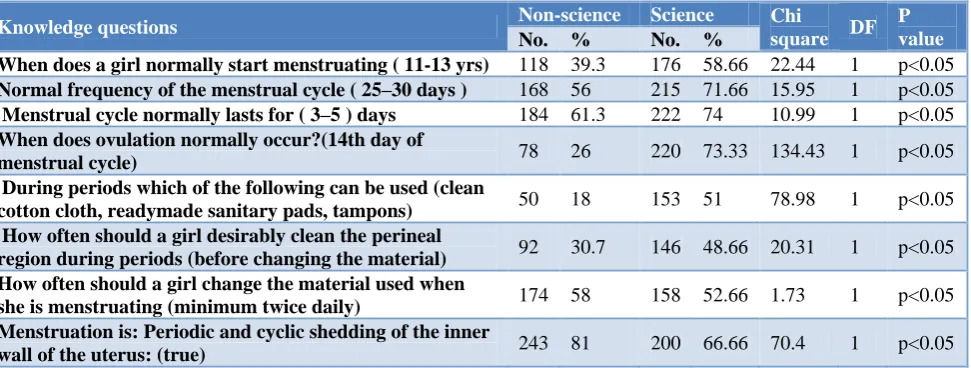
When does a girl normally start menstruating ( 11-13 yrs) 118 39.3 176 58.66 22.44 1 p<0.05
Normal frequency of the menstrual cycle ( 25–30 days ) 168 56 215 71.66 15.95 1 p<0.05
Menstrual cycle normally lasts for ( 3–5 ) days 184 61.3 222 74 10.99 1 p<0.05
When does ovulation normally occur?(14th day of
menstrual cycle) 78 26 220 73.33 134.43 1 p<0.05
During periods which of the following can be used (clean
cotton cloth, readymade sanitary pads, tampons) 50 18 153 51 78.98 1 p<0.05 How often should a girl desirably clean the perineal
region during periods (before changing the material) 92 30.7 146 48.66 20.31 1 p<0.05 How often should a girl change the material used when
she is menstruating (minimum twice daily) 174 58 158 52.66 1.73 1 p<0.05 Menstruation is: Periodic and cyclic shedding of the inner
wall of the uterus: (true) 243 81 200 66.66 70.4 1 p<0.05
Note: The questions, correct answers and the number of students who have answered them have been indicated.
Table 2 shows that majority of the students both among the non-science (66%) and the Science (75.6%) have come to know about menarche only at the time of attaining or after attaining menarche. Among the non-science students 34% had knowledge of menarche before menarche as compared to only 24.3% of the science students and this difference was found to be significant.
Both science and non-science students had good knowledge on menstrual cycle though most of the non-science students (about 60%) were not aware about the normal age at menarche. Asked if clean cotton cloth, readymade sanitary pads or tampons could be used for periods more Science students (51%) knew that all could be used as compared to only (16%) among the Non-Science students. The difference in knowledge among the two groups was found to be statistically significant (Table 3).
Overall knowledge of science students on cause and prevention of STIs and transmission of HIV was better compared to non-science students (Table 4).
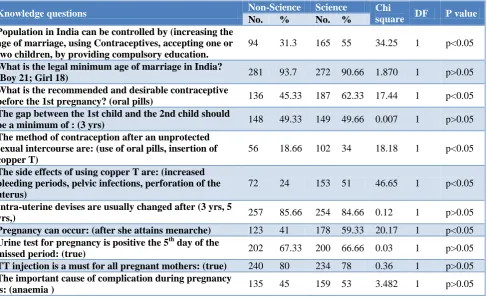
In our study the science students knew well about vasectomy and tubectomy, complications of unsafe abortion, effects of copper T insertion and about relation
between pregnancy, menstruation and ovulation
compared to non-science students. It was also found that non science students were equally aware of the time / gestational age and place where abortions are done (Table 5).
Table 4: Distribution of the study population with respect to their knowledge on STI / RTI.
Knowledge questions Non-Science Science Chi
square DF P value
No. % No. %
The following helps in the prevention of STD:
(condoms) 133 44.33 222 74 54.64 1 p<0.05
A STD can be got by: from any male/female) 206 20.33 180 60 98.21 1 p>0.05
RTI can be caused by: (un-hygienic conditions, STDs,
unsafe abortions) 84 28 205 68.33 100.52 1 p<0.05
Predominant route of HIV transmission is: (unsafe sex, unsterilized instruments, contaminated blood
transfusion, infected mother to child)
125 41.66 192 64 29.5 1 p<0.05
Methods to prevent HIV are: (faithful sex partner) 211 70.33 249 83 13.45 1 p<0.05
HIV does not spread through: (shaking hands,
mosquitoes, eating with HIV patients, swimming pools) 107 35.66 190 63.33 45.93 1 p<0.05 A HIV mother can breast feed her child: (false) 155 51.66 109 36.33 14.31 1 p<0.05
HIV infection is definitely a STD (true) 247 82.33 239 79.66 0.69 1 p>0.05
Safe sex is use of condoms before every sexual act: (true) 224 74.66 226 75.33 3.56 1 p>0.05
The most common reproductive tract infection is white
discharge: (true) 189 63 206 68.66 20.14 1 p>0.05
The most common form of anaemia is nutrition
anaemia: (true) 222 74 184 61.33 10.99 1 p<0.05
A lump in the breast is definitely cancerous: (false) 138 46 152 50.66 1.31 1 p>0.05
Condoms help in the prevention of the following: (cancer of the cervix, STD, HIV, urinary tract infections)
212 70.66 238 79.33 6.05 1 p<0.05
Masturbation means: (stimulating oneself to sexual
arousal by playing with one’s own genital/sex organs 101 33.66 131 43.66 6.82 1 p<0.05
Note: The questions, correct answers and the number of students who have answered them have been indicated.
Table 5: Distribution of the study population with respect to their knowledge on family planning, pregnancy and population control.
Knowledge questions Non-Science Science Chi
square DF P value
No. % No. %
Population in India can be controlled by (increasing the age of marriage, using Contraceptives, accepting one or two children, by providing compulsory education.
94 31.3 165 55 34.25 1 p<0.05
What is the legal minimum age of marriage in India?
(Boy 21; Girl 18) 281 93.7 272 90.66 1.870 1 p>0.05
What is the recommended and desirable contraceptive
before the 1st pregnancy? (oral pills) 136 45.33 187 62.33 17.44 1 p<0.05 The gap between the 1st child and the 2nd child should
be a minimum of : (3 yrs) 148 49.33 149 49.66 0.007 1 p>0.05
The method of contraception after an unprotected sexual intercourse are: (use of oral pills, insertion of copper T)
56 18.66 102 34 18.18 1 p<0.05
The side effects of using copper T are: (increased bleeding periods, pelvic infections, perforation of the uterus)
72 24 153 51 46.65 1 p<0.05
Intra-uterine devises are usually changed after (3 yrs, 5
yrs,) 257 85.66 254 84.66 0.12 1 p>0.05
Pregnancy can occur: (after she attains menarche) 123 41 178 59.33 20.17 1 p<0.05
Urine test for pregnancy is positive the 5th day of the
missed period: (true) 202 67.33 200 66.66 0.03 1 p>0.05
TT injection is a must for all pregnant mothers: (true) 240 80 234 78 0.36 1 p>0.05
The important cause of complication during pregnancy
Knowledge questions Non-Science Science Chi
square DF P value
No. % No. %
Tubectomy done on (women only) 106 35.33 190 63.33 47.1 1 p<0.05
Vasectomy done on (male only) 79 26.33 120 40 12.64 1 p<0.05
Vasectomy and tubectomy are permanent methods of
contraception: (true) 203 67.66 138 46 28.7 1 p<0.05
Which one of the following is irreversible? (vasectomy) 112 37.33 152 50.66 10.82 1 p<0.05
After tubectomy the menstruation stops: (false) 143 47.66 152 50.66 0.54 1 p>0.05
The complications of unsafe abortions are: (infections,
infertility, uterine perforations, incomplete abortions) 61 20.33 180 60 98.21 1 p<0.05 Abortions are safe only when done before: (12 weeks of
pregnancy) 212 70.66 197 65.66 1.73 1 p>0.05
Unsafe abortions lead to death of the mother: (true) 255 75 196 65.33 31.08 1 p<0.05
Abortions are to be done only by a qualified and
registered practitioner: (true) 241 80.33 230 76.66 1.19 1 p>0.05 Repeated abortion is a definite risk to the mother: (true) 255 85 205 68.33 23.3 1 p<0.05
Note: The questions, correct answers and the number of students who have answered them have been indicated.
Table 6: Knowledge scores of the non-science and science students.
Group Mean SD
Non-Science (n=300) 27.44 7.17
Science ( n=300) 34.56 8.43
Note: t=11.136; p<0.001.
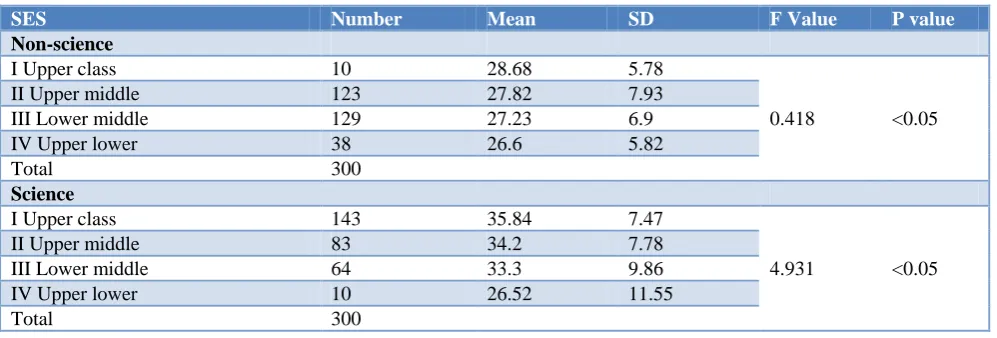
Table 7: Knowledge scores within the study groups (each stream) with respect to the socio economic status.
SES Number Mean SD F Value P value
Non-science
I Upper class 10 28.68 5.78
0.418 <0.05
II Upper middle 123 27.82 7.93
III Lower middle 129 27.23 6.9
IV Upper lower 38 26.6 5.82
Total 300
Science
I Upper class 143 35.84 7.47
4.931 <0.05
II Upper middle 83 34.2 7.78
III Lower middle 64 33.3 9.86
IV Upper lower 10 26.52 11.55
Total 300
Table 8: Knowledge scores between the study groups with respect to the socio-economic status.
Study population Class- I (Number) Mean± SD t – value DF P value
Non–science 10 28.65±5.78 2.96 598 p<0.05
Science 143 35.84±7.47
Class II (Number )
Non-science 123 27.82±7.93 5.706 598 p<0.05
Science 83 34.20±7.78
Class III (Number)
Non-science 129 27.23±6.90 4.963 598 p<0.05
Science 64 33.30±9.86
Class IV (Number)
Non-science 38 26.60±5.82 0.03 598 p>0.05
Science 10 26.52±11.55
Note: SES: socio – economic status.
The mean knowledge score of class I is highest among both the groups and it is least in class IV among both the groups. The difference in the mean knowledge scores between SES I&IV, SES II&IV and SES III&IV was found to be significant (Table 7).
The difference in mean knowledge scores between SES I of non-science and SES I of science students, SES II of the non-science and SES II of science students, SES III of non-science students and SES III of science students is statistically significant. But the difference in the mean knowledge scores between SES IV of non-science and SES IV of science students is not statistically significant (Table 8).
This implies that the SES IV has an influence on the mean knowledge scores not only within the Science group but also between both the groups.
DISCUSSION
This study has tried to assess the knowledge on reproductive health among adolescent girls. Our study found that mean age at menarche was 13.64 yrs and more number of science students (81.3%) attained menarche by the age of 14 yrs compared to non-science students (68.3%). This may be attributed to the difference in socio economic status of the two groups. About 50% of science students belonged to upper class compared to only 3% of non-science students in upper class. This observation is consistent with other studies done in various parts of country.10, 11
A study done in urban and rural Kerala found that lower menarcheal age in urban area was attributed to socio-economic status.12 The age at menarche and its inverse relationships with the socio economic status is a fairly consistent finding.13 Unlike our study and many other studies another study done in Bangalore city by Shanbhag et al has shown that more number of girls (66.9%) from BPL families had attained menarche as compared to APL families (53.5%).4
The present study showed that majority of the study population has come to know about menarche and menstruation only around the time of menarche (70.83%) and not before menarche (29.17%) (Table 2). Even though menstruation is a natural and universal phenomenon, only few parents openly talk about this with daughters. In a study on school and college girls it was found that majority of the girls received information regarding menarche and menstruation at or around menarcheal age. Only 8% received information before menarche occurred.14This is similar to many studies done in various parts of country.15
In one of the study only 37.4% in rural area and 48.7% in urban area had prior knowledge on menstruation (before
participants were aware about menstruation before menarche and the most important sources of the information were mothers.17
Our study showed that (Table 4) 68% Science students knew RTIs can be caused by unhygienic conditions, bacterial infections, STDs and unsafe abortions when compared to only 28% non-science students. It was also observed about 64% science students knew that the predominant route of HIV transmission as compared to only 42% non-science students and 74% knew that STDs can be prevented by use of condoms as compared to only 44.3% non-science students.
Less than 30% of the girls were aware of contraceptives in a study done in Pune.18 The overall knowledge regarding reproductive health awareness was poor in 77.2%, average in 13.7% and good only in 9% of the respondents in the same study.18
It is a general impression that the Science students know more about the issues like contraception, menstruation and other topics related to reproductive health. The Science text books cover most of these topics and do cover it adequately. It therefore was not a surprise that they have scored more in the knowledge section compared to the non-science students.
Overall there was poor knowledge among pre-university going girls about menstruation, contraception, STD’s
(including HIV/AIDS), pregnancy, abortion and
reproductive health; is an issue of concern. As the level of knowledge was comparatively better among science students over non-science students, incorporating reproductive health related topics in all the text books irrespective of the streams or at incorporating at high school level itself should be thought of seriously. Presence of a health counselor within the campus all the time who is approachable to students to discuss health issues without hesitation may help in raising the awareness level.
ACKNOWLEDGEMENTS
We thank teachers and all the students for participating in the study.
Funding: No funding sources Conflict of interest: None declared
Ethical approval: The study was approved by the Institutional Ethics Committee
REFERENCES
1. UNICEF State of World's Children, 2011
2. Mittal K, Goel M. Knowledge regarding reproductive health among urban adolescent girls of Haryana. Indian J Community Med. 2010;35:529. 3. Waddell AL. Achieving reproductive health for all.
The role of WHO. Available at:
http://apps.who.int/iris/bitstream/handle/10665/6371 7/WHO_FHE_95.6.pdf?sequence=1. Accessed on 11 April 2018.
4. Shanbhag D, Shilpa R, D’souza N, Josephine P,
Singh J, Goud BR. Perceptions regarding
menstruation and practices during menstrual cycles among high school going adolescent girls in resource limited settings around Bangalore city, Karnataka, India. Int J Collaborative Res Internal Med Public Health. 2012;4(7):1353-62.
5. Sivagurunathan C, Umadevi R, Rama R,
Gopalakrishnan S. Adolescent health: Present status and its related programmes in India. Are we in the right direction? J Clin Diagn Res. 2015;9:LE01‑6. 6. Adolescent sexual and reproductive health in India:
Challenges and opportunities. Available at https://www.researchgate.net/publication/29031383 6_Adolescent_sexual_and_reproductive_health_in_I ndia_Challenges_and_opportunities. Accessed on 9 April 2018.
7. Gollakota S, Mylavarapu RS, Padmavathi K. A Study of Awareness of Reproductive Health among College Students of Visakhapatnam and Padmavathi K. J Dental Med Sci. 2015;14(2)54-9.
8. Kotecha PV, Patel S, Baxi RK, Mazumdar VS, Misra S, Modi E, et al. Reproductive health awareness among rural school going adolescents of Vadodara district. Indian J Sex Transm Dis. 2009;30:94-9.
9. Garrett Henry E. Statistics in psychology and education. 4th edition, Vakils Feffer and Simons Ltd; Bombay.
10. Sadana R. Measuring reproductive health: review of
community-based approaches to assessing
morbidity. Bull World Health Organization. 2000;78(5):640-54.
11. Qamra SR. Mathas Deodhar SD. A study of relationship between physical growth and sexual maturity in girls. Ind Peds. 1991;28:265-72.
12. Madhavan S. Age at menarche of South Indian girls belonging to the states of Madras and Kerala. Indian J Med Res. 1965;53(7):669.
13. Vaughan JP, AbouZahr C. Reproductive health: widening horizons. Bull World Health Organization. 2000;78(5):569.
14. Gurmeet MP. Onset of menarche in girls in Ludhiana. IJP. 1989;23:263-5.
15. Hegde K, Desai P, Hazra M. Adolescent menstrual patterns. Journal of Obstetrics and Gynecology India. 1990;40:269-74.
16. Rani GS, Rao BB. Study on reproductive health awareness among adolescent girls in urban and rural field practice areas of Osmania Medical College. Int J Current Res Rev. 2015;7(18):15.
17. Thakre SB, Thakre SS, Reddy M, Rathi N, Pathak K, Ughade S. Menstrual hygiene: knowledge and practice among adolescent school girls of Saoner,
Nagpur district. J Clin Diagnos Res.
2011;5(5):1027-33.
18. Shankar P, Dudeja P, Gadekar T, Mukherji S. Reproductive health awareness among adolescent girls of a government school in an urban slum of Pune City. Med J DY Patil Univ. 2017;10:133-7.