A Study on Face Recognition Technique based on
Eigenface
S. Ravi, Ph.D.
Department of Computer Science,
School of Engineering and Technology
Pondicherry University, Pondicherry, INDIA
Sadique Nayeem
Department of Computer Science,
School of Engineering and Technology
Pondicherry University, Pondicherry, INDIA
ABSTRACT
Artificial Face Recognition is one of the popular areas of research in Image processing. It is different from other biometric recognition because faces are complex, multidimensional and almost all human faces have a similar construction. Out of many issues some of the most important issues associated with facial recognition are the type, format and composition (different background, variant illumination and different facial expression) of the face images used for the recognition. Different approaches use the specific databases which consist of single type, format and composition of image. Thus, these approaches lack the robustness. So, in this paper an comparative study is made for four different image databases with the help of basic Eigenface PCA face recognition technique.
General Terms
Face RecognitionKeywords
Principal Component Analysis (PCA), Eigenface.
1.
INTRODUCTION
The face plays a major role in our social interaction in conveying identity and emotion. The human ability to recognize faces is outstanding. Human can recognize thousands of faces learned throughout their lifetime and identify familiar faces at a glance even after years of separation. The ability is quite robust, despite large changes in the visual stimulus due to viewing conditions, expression, aging, and distractions such as glasses or changes in hairstyle. Computational models of faces have been an active area of research since late 1980s, for they can contribute to the theoretical insights and also to the practical applications, such as image and film processing, criminal identification, security systems, and human-computer interaction, etc. However, developing a computational model of face recognition is quite difficult, because faces are complex, multidimensional, and subject to change over time.
2.
ARTIFICIAL FACE RECOGNITION
Generally, there are three phases for artificial face recognition system, mainly face representation, face detection, and face identification.
Face representation is the first step in artificial face recognition and it deals with the representation and modeling of faces. The representation of a face determines the successive algorithms of detection and identification. In the entry-level recognition, a face class should be characterized
by general properties of all the faces whereas in the subordinate-level recognition, detailed features of eyes, nose, and mouth have to be assigned to each individual face. There are different approaches for face detection, which can be classified into three categories: template-based, feature-based, and appearance-based.
measure is used as an indicator of the ―faceness‖. The result obtained by calculating the distance from the face space at every point in the image is called as ―face map‖. Low values signify the presence of a facial region in the given image. Face recognition is the third step in artificial face recognition and it is performed at the subordinate-level. Each face in the test database is compared with each face in the training face database and then classified as a successful recognition if there is a match between the test image and one of the face images in the training database. The classification process may be affected by several factors such as scale, pose, illumination, facial expression, and disguise.
The problem created by the scale of a face can be dealt with rescaling process. In PCA approach, the scaling factor can be found out by multiple attempts. The idea behind it is to use multi-scale eigenfaces, in which a test face image is compared with eigenfaces at a number of scales. Tthe image will appear to be near face space of only the closest scaled eigenfaces. The test image is scaled to multiple sizes and the scaling factor that results in the smallest distance is used to face space.
The different pose is caused by the change in the viewpoint or head orientation. There are different recognition algorithms which deal with different sensitivities to pose variation. Recognition of faces with different illuminance conditions is one of the challenging problems in face recognition. The same person, with the same facial expression, and seen from the same viewpoint, will look like a different person with different lighting conditions. Two approaches, the fisherface space approach [6] and the illumination subspace approach [8], have been proposed to handle different lighting conditions.
Another problem in face recognition is the Facial expression of the facial image used for face recognition as there will be a change in the face geometry and poses a greater challenge for face recognition.
The common problem with the face recognition is the Disguise. Human being uses different accessories to adorn the outlook. In addition, the use of glasses, different hairstyle, and makeup changes the appearance of a face may pose another problem to face recognition [9]. Most of the research work so far is going with dealing with these problems.
3.
RECOGNITION USING PRINCIPLE
COMPONENT ANALYSIS (PCA)
In 1991, M. Turk and A. Pentland [5] have proposed an method to face recognition using an information theory approach of coding. Decoding the face images may give insight into the information content of face images that emphasizes the significant local and global ―features‖. Such features may or may not be directly related to our perceptive idea of face features such as the eyes, nose, lips, and hair. A simple approach that is used to extract the information contained in a face image captures the deviation in the collection of face images which are independent of any judgment of features, and use this information is used to encode and compare individual face images.
The main aim of the principle component analysis method is to find the principal components of the distribution of faces, or the eigenvectors of the covariance matrix of the set of face images. The eigenvectors obtained is considered as a set of
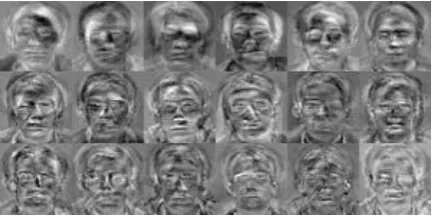
features that characterize the variation in the face images. Each image location contributes more or less to each eigenvector, so that the eigenvector can be displayed as a kind of ghostly face called an eigenface. Some of the eigenface obtained from Essex face database -'face94' are shown in Figure 1.
Figure 1: Eigenfaces of Essex face database -'face94'
In the training data base, each face image can be represented exactly in terms of a linear combination of the eigenfaces. The number of possible eigenfaces is equal to the number of face images in the training set. Even though there are eigenface, one few will be considered for the recognition purpose. The ―best‖ eigenfaces whose eigenvalues are the larger will be considered and rest of the eigenfaces will be thrown away. The primary reason for using fewer eigenfaces is computational efficiency. The most meaningful M eigenfaces span an M-dimensional subspace—―face space‖—of all possible images. The eigenfaces are essentially the basis vectors of the eigenface decomposition.
A collection of face images can be approximately reconstructed by storing a small collection of weights for each face and a small set of standard pictures. Therefore, if a multitude of face images can be reconstructed by weighted sum of a small collection of characteristic images, then an efficient way to learn and recognize faces might be built on the characteristic features from known face images and to recognize particular faces by comparing the feature weights needed to (approximately) reconstruct them with the weights associated with the known individuals.
The principle component analysis approach used for face recognition involves the following initialization operations: 1. Acquire a set of training images.
2. Calculate the eigenfaces from the training set, keeping only the best M images with the highest eigenvalues. These M images define the ―face space‖. As new faces are experienced, the eigenfaces can be updated.
3. Calculate the corresponding distribution in M -dimensional weight space for each known individual (training image), by projecting their face images onto the face space.
Having initialized the system, the following steps are used to recognize new face images:
1. Given an image to be recognized, calculate a set of weights of the M eigenfaces by projecting it onto each of the eigenfaces.
2. Determine if the image is a face at all by checking to see if the image is sufficiently close to the face space. 3. If it is a face, classify the weight pattern as either a
known person or as unknown.
the milestone work of M. Turk and A. Pentland [5]. So, skipping the details about eigenface calculation and its use in classification, we directly go for the implementation of eigenface technique for face recognition.
4.
IMPLEMENTATION
The Eigenface approach is implemented here to check to see it is producing better results for four face databases that are currently used in research, in particular face recognition.. Firstly, all the images for the training were kept in the training set and the images for the testing were kept in the testing set. After construction of the training set and the testing set the following procedure was followed:
1. Create database
a. Load the training image file.
b. Construct the 2D matrix from 1D matix vector. c. Reshape 2D image into 1D image vector. 2. Eigenface Calculation
a. Calculate the mean
b. Calculate the deviation of each image from the mean.
c. Calculate the covariance matrix.
d. Sort and eliminate the eigenvalue which is less than the threshold value.
e. Calculate the eigenvector of covariance matrix. 3. Recognition
a. Project the entire centered image into the face space.
b. Read the test image.
c. Extract the PCA features from the test image. d. Calculate Euclidean distance between the projected
test image and projection of all centered training image.
e. Select the image with least Euclidean distance.
5.
FACE RECOGNITION FIELD AND
APPLICATION
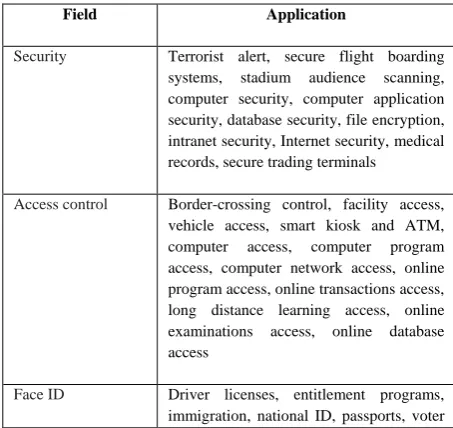
In recent time face recognition has been utilized in many field and its application has been developed in many phase of life. The following tabulation gives the brief idea of application of face recognition.
Table 1. Field and Application of Face Recognition
Field Application
Security Terrorist alert, secure flight boarding systems, stadium audience scanning, computer security, computer application security, database security, file encryption, intranet security, Internet security, medical records, secure trading terminals
Access control Border-crossing control, facility access, vehicle access, smart kiosk and ATM,
computer access, computer program
access, computer network access, online program access, online transactions access, long distance learning access, online examinations access, online database access
Face ID Driver licenses, entitlement programs, immigration, national ID, passports, voter
registration, welfare registration
Surveillance Advanced video surveillance, nuclear plant
surveillance, park surveillance,
neighborhood watch, power grid
surveillance, CCTV control, portal control
Smart cards Stored value security, user authentication
Law enforcement Crime stopping and suspect alert, shoplifter recognition, suspect tracking and investigation, suspect background check, identifying cheats and casino undesirables,
post-event analysis, welfare fraud,
criminal face retrieval and recognition
Face databases Face indexing and retrieval, automatic face labeling, face classification
Multimedia management
Face-based search, face-based video
segmentation and summarization, event detection
Human computer interaction (HCI)
Interactive gaming, proactive computing
Others: Antique photo verification, very low bit-rate image & video transmission, etc.
6.
IMAGE DATABASE
A number of algorithms have been proposed for the face recognition and these algorithms have been tested for different databases. Many of these face databases are publicly-available and contain face images with a wide variety of poses, illumination angles, gestures, face occlusions, and illuminant colors. But these images have not been adequately annotated due to which their usefulness for evaluating the relative performance of face recognition algorithms is quite limited. For example, many of the images in existing databases are not annotated with the exact pose angles at which they were taken. Following are description of some of the face databases.
6.1
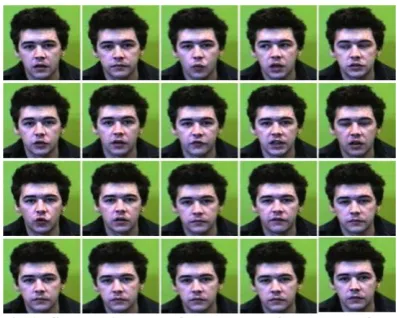
Essex face database -'face94'
Fig 2: Sample images of one person from Essex face database.
6.2
The Indian Face Database
This database contains images of 61 distinct subjects with eleven different poses for each individual of male and female. All the images have a bright homogenous background and the subjects are in an upright, frontal position. For each individual, the following pose for the faces are included: looking front, looking left, looking right, looking up, looking up towards left, looking up towards right, looking down. In addition to variation in pose, images with four emotions – neutral, smile, sad/disgust – are included for each individual. The files are in JPEG format. The size of each color image is 640x480 pixels [12]. As an example, images corresponding to one individual are shown in the figure 3:
Fig 3: Sample images from Indian face database.
6.3
Yale Database
The Yale Face Database contains 165 grayscale images in GIF format of 15 individuals. There are 11 images per subject, one per different facial expression or configuration: center-light, with and without glasses, happy, left-center-light, with /without glasses, normal, right-light, sad, sleepy, surprised, and wink [13]. As an example, images corresponding to one individual are shown in the figure 4:
Fig 4: Sample images from Yale database.
6.4
FACE 1999
This face image dataset was collected by Markus Weber at California Institute of Technology. It consists of 450 frontal face images of 25 unique people with different lighting, expressions and backgrounds. The images are in JPEG format and each of 896 x 592 pixels [14]. As an example, images corresponding to one individual are shown in the figure 5:
Fig 5: Sample images from face 1999 database.
6.5
ORL Database (now, AT&T - The
Database of Faces)
These face images were taken between April 1992 and April 1994 in the lab. There are ten different images of each of 40 distinct subjects. For some subjects, the images were taken at different times, varying the lighting, facial expressions (open / closed eyes, smiling / not smiling) and facial details (glasses / no glasses). All the images were taken against a dark homogeneous background with the subjects in an upright, frontal position (with tolerance for some side movement). The files are in PGM format and the size of each image is 92x112 pixels, with 256 grey levels per pixel [15]. As an example, images corresponding to one individual are shown in the figure 6:
Fig 6: Sample images from ORL database.
6.6
AR database
This face database was created by Aleix Martinez and Robert Benavente in the Computer Vision Center (CVC) at the
Fig 7: Sample images from AR database.
6.7
UMIST
It was created by Daniel B. Graham, with a purpose of collecting a controlled set of images that vary pose uniformly from frontal to side view and it consists of 564 grayscale images of 20 people of both sexes and various races. (Image size is about 220 x 220 pixels with 256-bit grey-scale.) Various pose angles of each person are provided, ranging from profile to frontal views [17]. It is now know as Sheffield. As an example, images corresponding to one individual are shown in the figure 8:
Fig 8: Sample images from UMIST database.
7.
RESULT
In this paper, the basic PCA face recognition technique has been implemented and tested with four different databases whose description is given in the table 2:
Table 2: Database used in experiment Name of
database
Image format
Image size Image type
IFD jpg 110X75 Color
Face94 jpg 90X100 Color
Yale gif 320X243 Grey
Face 1999 jpg 300X198 Color
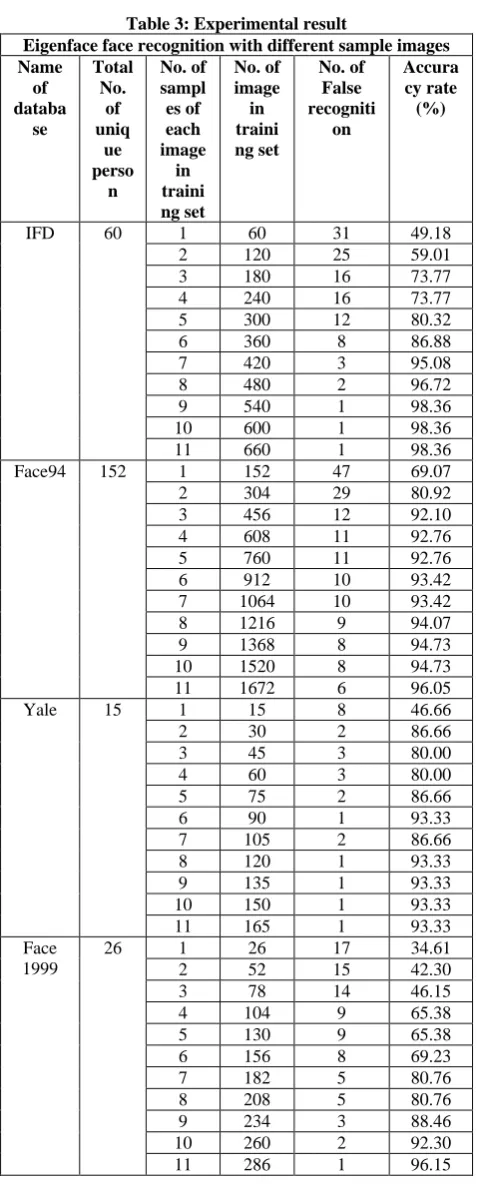
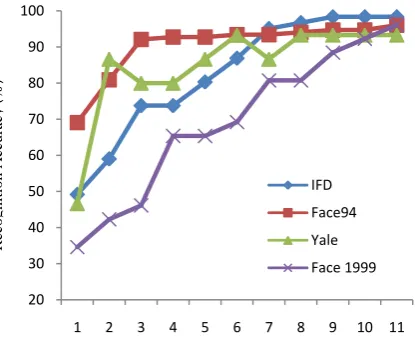
The experiment was carried out using MATLAB R2008a with different number of samples kept in the training set. The test images were kept in the testing set. Both sets were loaded and test image was provided for the recognition. The experimental result is given in the table 3:
Table 3: Experimental result
Eigenface face recognition with different sample images Name
of databa
se
Total No.
of uniq
ue perso
n
No. of sampl
es of each image
in traini ng set
No. of image in traini ng set
No. of False recogniti
on
Accura cy rate (%)
IFD 60 1 60 31 49.18
2 120 25 59.01
3 180 16 73.77
4 240 16 73.77
5 300 12 80.32
6 360 8 86.88
7 420 3 95.08
8 480 2 96.72
9 540 1 98.36
10 600 1 98.36
11 660 1 98.36
Face94 152 1 152 47 69.07
2 304 29 80.92
3 456 12 92.10
4 608 11 92.76
5 760 11 92.76
6 912 10 93.42
7 1064 10 93.42
8 1216 9 94.07
9 1368 8 94.73
10 1520 8 94.73
11 1672 6 96.05
Yale 15 1 15 8 46.66
2 30 2 86.66
3 45 3 80.00
4 60 3 80.00
5 75 2 86.66
6 90 1 93.33
7 105 2 86.66
8 120 1 93.33
9 135 1 93.33
10 150 1 93.33
11 165 1 93.33
Face 1999
26 1 26 17 34.61
2 52 15 42.30
3 78 14 46.15
4 104 9 65.38
5 130 9 65.38
6 156 8 69.23
7 182 5 80.76
8 208 5 80.76
9 234 3 88.46
10 260 2 92.30
11 286 1 96.15
as image format, image size and image type is concerned; the eigenface technique can work in all cases.
Figure 9: Recognition Accuracy
8.
CONCLUSION
In this paper, Eigenface PCA face recognition technique has been implemented and examined with four different face databases. The experimented result shows that around ten images per person gives better result for face recognition. But in real time scenario, collecting and storing these images for training set are not easy task. So, there is an urgent need to work and get high accuracy recognition rate for single image per person problem.
9.
REFERENCES
[1] R. Chellappa, C. L. Wilson, and S. Sirohey, 1995, Human and machine recognition of faces: A survey,
Proc. of IEEE, volume 83, pages 705-740.
[2]. P. N. Belhumeur, J. P. Hespanha, and D. J. Kriegman, 1997, Eigenfaces vs. fisherfaces: Recognition using class specific linear projection, IEEE Trans. Pattern Analysis
and Machine Intelligence, 19(7):711-720.
[3]. A. S. Georghiades, D. J. Kriegman, and P. N. Belhumeur, 1998, Illumination cones for recognition under variable lighting: Faces, Proc. IEEE Conf. on Computer Vision and Pattern Recognition, pages 52-59. [4] S. A. Sirohey, 1993, Human face segmentation and
identification, Technical Report CAR-TR-695, Center for Automation Research, University of Maryland, College Park, MD.
[5] M. Turk and A. Pentland, 1991, Eigenfaces for recognition, Journal of Cognitive Neuroscience, vol.3, No.1
[6] Sirovich, L. and Kirby M., Low dimensional procedure for the characterization of human faces, Journal of the Optical Society of America A, 4(3), 519-524.
[7] A. Samal and P. A. Iyengar, 1992, Automatic recognition and analysis of human faces and facial expressions: A survey, Pattern Recognition, 25(1): 65-77.
[8] Athinodoros S. Georghiades, David J. Kriegman and Peter N. Belhumeur, Illumination cones for recognition
under variable lighting: Faces, Center for Computational Vision and Control.
[9] Caifeng Shan, Shaogang Gong, Peter W. McOwan, 2009, Facial expression recognition based on Local Binary Patterns: A Comparative Study, Image and Vision Computing 27, 803-816.
[10] A. Pentland and T. Choudhury, Feb. 2000, Face recognition for smart environments, Computer, Vol.33 Iss.2.
[11] Essex face database -face94, University of Essex, UK, http://cswww.essex.ac.uk/mv/allfaces/index.html [12] Vidit Jain, Amitabha Mukherjee, 2002, The Indian Face
Database,
http://vis-www.cs.umass.edu/~vidit/IndianFaceDatabase/
[13] Yale Database,
http://cvc.yale.edu/projects/yalefaces/yalefaces.html [14] FACE 1999,
http://www.vision.caltech.edu/html-files/archive.html
[15] ORL Database,
http://www.cl.cam.ac.uk/research/dtg/attarchive/facedata base.html
[16] AR database,
http://rvl1.ecn.purdue.edu/~aleix/aleix_face_DB.html
[17] UMIST Face Database,
http://www.sheffield.ac.uk/eee/research/iel/research/face
Dr. S. Ravi received his B.E degree in Computer Technology and Informatics from Institute of Road and Transport Technology (IRTT), Erode affiliated to Bharathiar University, Coimbatore, India in 1989, M.Tech degree in Computer and Information Technology from Centre for Information Technology and Engineering, Manonmaniam Sundaranar University, Tirunelveli, in 2004 and Ph.D degree in Computer and Information Technology from Centre for Information Technology and Engineering, Manonmaniam Sundaranar University, Tirunelveli, in 2010.
He has worked as an Associate Professor in the Department of Computer Science, Cardamom Planters’ Association College, Bodinayakanur from 1990. He has worked as an Associate Professor in Centre for Information Technology and Engineering of Manonmaniam Sundaranar University, Tirunelveli from 2008. He is now working as Assistant Professor in the Department of Computer Science, School of Engineering and Technology, Pondicherry University, Pondicherry from 2011 to till date. His research interests include Digital Image Processing, Face Detection and Face Recognition, Machine Vision and Pattern Recognition.He has published 47 research papers (22 - International Journals, 14 - IEEE International Conferences, 10 - International Conferences and 4 - National Conferences,). He is a member of the IEEE from 2006.
Sadique Nayeem has received his Bachelor of Technology Degree in Computer Sc. & Engineering from Biju Patnaik University of Technology (BPUT), Rourkela, India in 2009. He is currently pursuing his Master of Technology degree in Computer Science and Engineering in Department of Computer Science from the School of Engineering and Technology, Pondicherry University, Puducherry, India. . His research interests include Face recognition, Genetic Algorithm and Holographic Memory.
20 30 40 50 60 70 80 90 100
1 2 3 4 5 6 7 8 9 10 11
IFD
Face94
Yale Face 1999
Number of samples
Reco
g
n
itio
n