Identification of soybean genotypes with high
stability for the Brazilian macro-region 402
via biplot analysis
E.U. Ramos Junior1, R.L. Brogin2, V.P.C. Godinho3, F.J.E. Botelho4, F.D. Tardin5 and P.E. Teodoro6
1Embrapa Soja, Sinop, MT, Brasil 2Embrapa Soja, Vilhena, RO, Brasil 3Embrapa Rondônia, Vilhena, RO, Brasil 4Embrapa Rondônia, Porto Velho, RO, Brazil 5Embrapa Milho e Sorgo, Sinop, MT, Brazil 6Departamento de Ciências Agrárias,
Universidade Federal de Mato Grosso do Sul, Chapadão do Sul, MS, Brasil
Corresponding author: F.D. Tardin E-mail: [email protected]
Genet. Mol. Res. 16 (3): gmr16039786 Received July 28, 2017
Accepted August 29, 2017 Published September 27, 2017
DOI http://dx.doi.org/10.4238/gmr16039786
Copyright © 2017 The Authors. This is an open-access article distributed under the terms of the Creative Commons Attribution ShareAlike (CC BY-SA) 4.0 License.
ABSTRACT. Biplot analysis has often been used to recommend genotypes from different crops in the presence of the genotype x environment interaction (GxE). The objective of this study was to verify the association between the AMMI and GGE biplot methods and to select soybean genotypes that simultaneously meet high grain yield and stability to the environments belonging to the Edaphoclimatic Region 402, from Soybean Cultivation Region 4 (Mid-West), which comprises the Center North and West of Mato Grosso, and the southern region of Rondônia. Grain yield of 12 soybean genotypes was evaluated in seven competition trials of soybean cultivars in the 2014/2015
for recommending genotypes with adaptability and yield stability. The methods were complementary regarding the recommendation of the best genotypes. The AMMI analysis recommended MG/BR46 (Conquista) (G10) widely for all environments evaluated, whereas the BRY23-55012 (G9) and BRAS11-0149 (G2) were the most indicated genotypes by the GGE biplot method. However, the methods were concordant as to Porto Velho (PV1) environment that contributed least to the GxE interaction.
Key words: AMMI; GGE biplot; Genotype x environment interaction;
Glycine max
INTRODUCTION
Brazil is currently the world’s second largest producer of soybean, behind only the United States. This crop occupied, in the 2016/2017 harvest, an area of 33.85 million hectares, which totaled a production of 113 million tons, with average grain yield of 3338 kg/ha. In Mato Grosso, the largest national producer, this crop occupied an area of 9.32 million hectares, with a production of 30.5 million tons, with average grain yield of 3273 kg/ha (CONAB, 2017).
In Brazil, soybean is grown in several states, especially in the Midwest and South. Due to the great territorial extension of the country, different edaphoclimatic conditions are common among most of these sites. Besides, soybean has peculiarities, because it responds to the length of the day, which may interfere with its development depending on the latitude in which it is cultivated. In this sense, efforts are expended in the genetic breeding of the crop, aiming to establish cultivars adapted to the cultivation region (Mundstock and Thomas, 2005). As a way of validating new cultivars, since 1981, the Ministry of Agriculture, Livestock and Food Supply established the Brazilian System of Evaluation and Recommendation of Cultivars, and this has been improved, arriving at the way it was regionalized and how the value for cultivation and use assays of soybean lines were established. Mid-West region is formed by the Soybean Cultivation Macro-Region 4, where the Edaphoclimatic Region (REC) 402 comprises the Central North and West regions of Mato Grosso, as well as the southern region of Rondônia (Kaster and Farias, 2011).
This factor contributes to the occurrence of genotype x environment interaction (GxE),
defined as the differential response of genotypes as a function of the environmental gradient. GxE interaction is one of the major bottlenecks of plant breeding, because it causes difficulties
in recommending genotypes for a group of environment and/or region.
In the literature, there are several methodologies to investigate the GxE interaction,
defined as the differential response of genotypes as a function of environmental variation (Cruz
et al., 2014). Recently, two methodologies have been gaining prominence and are widely used by researchers: the AMMI model proposed by Gauch and Zobel (1988) and the GGE biplot model developed by Yan et al. (2000). Both analyses, based on biplot graphs, represent a data matrix.
The GGE biplot model jointly analyzes the effect of genotypes (G) with the effect of the GxE interaction, while the AMMI model separates G from the GxE interaction and, in
the final step of the analysis, biplot graphs are built for the two methodologies. However, this
selecting representative and discriminating environments and indicating genotypes more adapted
and stable to specific environments. On the other hand, the AMMI analysis can be used with efficiency in the identification of special environmental conditions for the farm (selection of
cultivation sites) and superior average performance genotypes (Gauch et al., 2008).
The objective of this study was to verify the association between the AMMI and GGE biplot methods and to select soybean genotypes that simultaneously meet high grain yield and stability to the environments of the Central North and West regions of Mato Grosso and the southern region of Rondônia, known as REC 402.
MATERIAL AND METHODS
Seven competition trials of soybean cultivars were conducted in the 2014/2015 crop, whose soil and climatic characteristics are shown in Table 1. Experimental design was a randomized block design with 12 genotypes (BRAS10-0022, BRAS11-0149, BRS7481, BRS8581, BRSMG752S, BRSMG753C, BRSMG772, BRSMG812CV, BRY23-55012, BR46 (Conquista), TMG132RR, and TMG4182), with four replicates. Experimental unit consisted of four rows of 5.0 m long, spaced 0.50 m, and with a density of 15 plants/m. In each experimental unit, grain yield was evaluated in the two central rows, correcting the moisture to 13% and transforming to kg/ha.
Table 1. Characteristics of the seven environments belonging to REC 402 evaluated.
Environments Abbreviation Altitude (m) Latitude Longitude Sowing time Castanheiras CA1 234 11°33'57'' 61°55'33'' 11/21/2014 Castanheiras CA2 234 11°33'57'' 61°55'33'' 12/12/2014 Nova Mutum NM 480 13°50'14'' 55°41'44'' 11/14/2014
Porto Velho PV1 87 08°47'34'' 63°50'53'' 11/25/2014 Porto Velho PV2 87 08°47'57'' 63°51'02'' 12/10/2014
Vilhena VI1 607 12°47'16'' 60°05'35'' 11/06/2014 Vilhena VI2 607 12°47'16'' 60°05'35'' 12/02/2014
Grain yield data were submitted to analysis of individual variance, considering the
effect of treatments as fixed and the other effects as random. It was found that the relationship
between the largest and the smallest mean square error (MSE) of the individual analysis of variance did not exceed the 7:1 ratio, thus allowing the joint analysis of the trials (Banzatto and Kronka, 2006). Subsequently, data were submitted to the adaptability and stability analysis through AMMI and GGE biplot methodologies.
To AMMI biplot analysis, we considered effects of genotypes and environments as
fixed and the model according to Equation 1:
ij ij jk n
1
k k ik
j i
ij
μ
g
a
λ
γ
α
ρ
ε
Y
(Equation 1)
where Yij is the mean response of the i-th genotype (i = 1,2, ..., G genotypes) at j-th environment (j = 1,2, ..., E environments); μ is the overall mean of the trials; gi is the i-th genotype effect; aj is the j-th environment effect; λk is the k-th singular value (scalar) of the original interaction
column vector of the GE matrix; αjk is the element corresponding to the j-th environment at
k-th singular line vector of the GE matrix; ρij the noise associated with the term (ge)ij of the classical i genotype with j environment interaction;
ε
ij is the mean experimental error.The GGE biplot model used is represented by Equation 2:
1 1 1 2 2 2
ij j i j i j ij
Y
−
y
=
y
ε ρ
+
y
ε ρ
+
ε
(Equation 2)where yij represents the mean yield of the population of i order in the environment of j order; yj is the overall mean of genotypes in the j environment; y1εi1ρj1 is the first principal component
(PC1); y2εi2ρj2 is the second principal component (PC2); y1 and y2 are the eigenvalues associated
with IPCA1 and IPCA2, respectively; ε1 and ε2 are the values of PC1 and PC2, respectively, of
the i genotype; ρj1 and ρj2 are the values of PC1 and PC2, respectively, for the j environment;
and εij is the error associated with the i-th genotype and j-th environment (Yan et al., 2000). Data analysis was performed using the Agricolae and GGEBiplotGui packages implemented in the R software (R Development Core Team, 2014).
RESULTS AND DISCUSSION
Joint analysis of variance (Table 2) revealed a significant effect of genotypes (G), environments (E), and GxE interaction (P ≤ 0.01), which indicates contrasts between the
environments and the occurrence of differential genotype performance over the environments. The presence of GxE interaction can be attributed to predictable factors such as soil type, pest and disease management, and unpredictable factors such as precipitation, temperature, and
humidity in each environment. This can be confirmed by observing the characteristics of each
environment (Table 1), which show differences regarding altitude, latitude, and longitude, as well as the climatic effects of precipitation and temperature provided by the different sowing times in the same place. Similar results were obtained by Carvalho et al. (2002), Silva and Duarte (2006), Rangel et al. (2007), and Peluzio et al. (2008), which also observed the presence of a GxE interaction for soybean yield in different regions of Brazil. The existence of the GxE interaction suggests the need to use adaptability and stability analysis since edaphoclimatic
factors are the ones that most influence the adaptability and stability of soybean genotypes.
Table 2. Summary of the joint analysis of variance for grain yield of 12 soybean genotypes evaluated in 7 environments belonging to REC 402, Brazil.
*Significant at 1% probability by the F-test.
Sources of variation Degrees of freedom Mean square
Blocks/Environments 21 186,939.14
Genotypes (G) 11 1,324,716.84*
Environments (E) 5 23,157,770.87*
GxE 66 413,091.20*
Error 231 116,791.61
Coefficient of variation (%) - 14.78
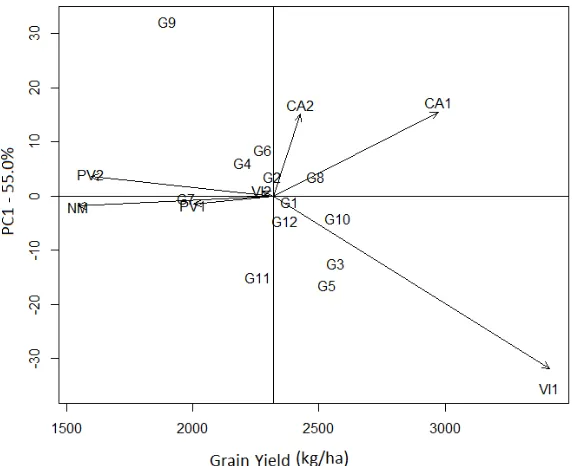
most contributed to GxE interaction, being the most unstable (Figure 1) because it presents the highest score (in absolute values) in the interaction axis. The genotypes BRAS10-0022 (G1), BRAS11-0149 (G2), BRSMG772 (G7), BRSMG812CV (G8), MG/BR46 (Conquista) (G10), and TMG4182 (G12) were the most stable because they have the smallest coordinate for the PC1 axis. Among these, G10 achieved a performance above the overall mean (Table 3), demonstrating wide adaptation to all environments, and can be recommended for the set of environments evaluated.
Figure 1. AMMI biplot for main effects and GxE interaction for grain yield of 12 soybean genotypes evaluated in 7 environments belonging to REC 402, Brazil.
Table 3. Means of grain yield (kg/ha) of 12 soybean genotypes for each tested environment and overall mean of genotypes and environments1.
1Environments detailed in Table 1.
The environment constituted by the first sowing time in Vilhena (VI1) is the most
unstable (greater score magnitude in the PC1 axis), whereas the environments Nova Mutum (NM) and the two sowing times in Porto Velho (PV1 and PV2) are considered the most stable due to their lower coordinates for the PC1 axis. Environmental stability has great practical relevance for breeding programs, as it reports on genotype ordering reliability in a testing
environment, regarding the classification for the tested environment means.
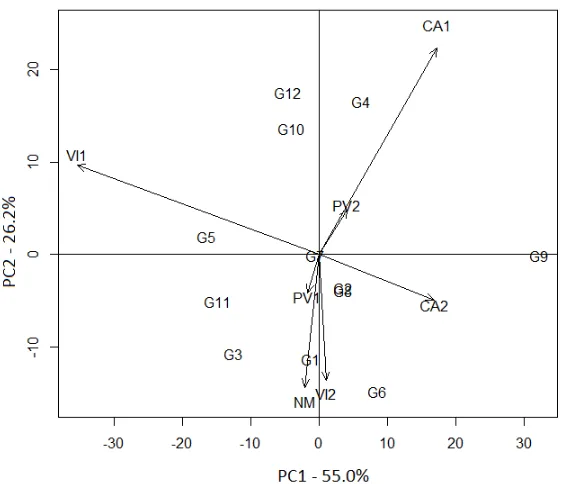
Figure 2 (AMMI2 biplot) allows identifying specific interactions between genotypes
and environments and shows the stability zone that corresponds to the intercession point of
the zero scores of the first and second interaction principal components (central region of the
biplot). Genotypes and environments close to each other in any area of the graph represent
a specific adaptation to the environment (Gauch and Zobel, 1988). In this context, specific
interactions were observed between genotype BRAS10-0022 (G1) and the environments NM and VI2.
Figure 2. AMMI2 biplot for the first principal component of the interaction (PC1) x second principal component
of the interaction (PC2) for grain yield of 12 soybean genotypes evaluated in 7 environments belonging to REC 402, Brazil.
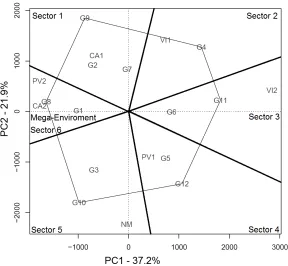
Karimizadeh et al., 2013). The vectors from the biplot center (0; 0), perpendicular to the polygon sides, divided the graph into six sectors. Similar results were observed by Mattos et al. (2013), who when evaluating the shoot yield of sugarcane genotypes via GGE biplot methodology observed the graph division into six sectors.
Figure 3. Sectors and mega-environments obtained by the GGE biplot model for grain yield of 12 soybean genotypes evaluated in 7 environments belonging to REC 402, Brazil.
According to Yan and Rajcan (2002), mega-environments are those sectors that contain two or more similar environments regarding soil-climatic conditions. It is possible to verify in Figure 3 that the environments PV2 and CA2 were the only ones that formed a mega-environment, where the genotype BRSMG812CV (G8) obtained means above the overall mean of these sites (Table 3). It is important to highlight here the difference between the methods used
for the specific GxE interaction, in addition to the most similar environments. These results
suggest that AMMI and GGE biplot methods can be used in a complementary way.
By the GGE biplot method, grain yield and genotype stability were evaluated from the average environmental coordination (AEC) expressed in Figure 4. Yang et al. (2009) emphasize that the greater the genotype projection in the AEC ordinate axis, the greater the genotype instability, representing a greater interaction with the environments. In this sense, the genotypes BRY23-55012 (G9) and BRAS11-0149 (G2) stood by phenotypic stability
projections, represented by the arrow in the center of the concentric circles (Yan and Rajcan, 2002). Although this genotype is another representative model, it is used as a reference for evaluating the genotypes.
Figure 4. Mean versus stability according to the GGE biplot model for grain yield of 12 soybean genotypes evaluated in 7 environments belonging to REC 402, Brazil.
Figure 5 shows the relationship between grain yield and the stability from the vectorial viewpoint of the environments by GGE biplot analysis, where the environments are connected by vectors with the origin of the biplot. In environments with small vectors, yield stability
is high (Yang et al., 2009). Thus, the first sowing time in Porto Velho (PV1) contributed less
Figure 5. Classification of 12 soybean genotypes evaluated in 7 environments belonging to REC 402 according to
GGE biplot model.
Conflicts of interest
The authors declare no conflict of interest.
ACKNOWLEDGMENTS
Research supported by grants from Embrapa (Empresa Brasileira de Pesquisa
Agropecuária) and CNPq (National Counsel of Technological and Scientific Development).
F.D. Tardin is the recipient of a research fellowship from CNPq.
REFERENCES
Banzatto DA and Kronka SN (2006). Experimentação agrícola. 4a. ed. FUNEP, Jaboticabal.
Carvalho CGP, Arias CAA, Toledo JFF, Almeida LA, et al. (2002). Interação genótipo x ambiente no desempenho produtivo da soja no Paraná. Pesqui. Agropecu. Bras. 37: 989-1000. https://doi.org/10.1590/S0100-204X2002000700013
CONAB. Companhia Nacional de Abastecimento (2017). Acompanhamento de safra brasileiro - grãos: Oitavo levantamento, maio 2017 - safra 2016/2017. Companhia Nacional de Abastecimento Brasília. Available at [http:// www.conab.gov.br/OlalaCMS/uploads/arquivos/17_05_12_10_37_57_boletim_graos_maio_2017.pdf]. Accessed May 22, 2017.
Cruz CD, Carneiro PCS and Regazzi AJ (2014). Modelos biométricos aplicados ao melhoramento genético. 3a. ed. Editora UFV, Viçosa.
Gauch HG, Jr. and Zobel RW (1988). Predictive and postdictive success of statistical analyses of yield trials. Theor. Appl. Genet. 76: 1-10. PubMedhttps://doi.org/10.1007/BF00288824
Gauch HG, Piepho HP and Annicchiarico P (2008). Statistical analysis of yield trials by AMMI and GGE: Further considerations. Crop Sci. 48: 866-889. https://doi.org/10.2135/cropsci2007.09.0513
Karimizadeh R, Mohammadi M, Sabaghni N, Mahmoodi AA, et al. (2013). GGE biplot analysis of yield stability in multienvironment trials of lentil genotypes under rainfed condition. Not. Sci. Biol. 6: 256-262.
Kaster M and Farias JRB (2011). Regionalização dos testes de Valor de Cultivo e Uso e da indicação de cultivares de soja: terceira aproximação. Embrapa Soja, Londrina. Documentos •••: 330.
Mattos PHC, Oliveira RA, Bespalhok Filho C, Daros E, et al. (2013). Evaluation of sugarcane genotypes and production environments in Paraná by GGE biplot and AMMI analysis. Crop Breed. Appl. Biotechnol. 13: 83-90. https://doi. org/10.1590/S1984-70332013000100010
Mundstock CM and Thomas AL (2005). Soja: fatores que afetam o crescimento e o rendimento de grãos. Evangraf/ UFRGS, Porto Alegre.
Peluzio JM, Fidelis RR, Giongo P, Silva JC, et al. (2008). Adaptabilidade e estabilidade de cultivares de soja em quatro épocas de semeadura no sul do Estado do Tocantins. Ceres 55: 34-40.
R Development Core Team (2014). R: a language and environment for statistical computing. R Foundation for Statistical Computing, Vienna. Available at [http://www.R-project.org].
Rangel MAS, Minuzzi A, Braccini AL, Scapim CA, et al. (2007). Efeito do genótipo, ambiente e da interação no rendimento de grãos e nos teores de proteína de cultivares de soja. Acta Sci. Agron. 29: 351-354. https://doi. org/10.4025/actasciagron.v29i3.280
Silva WCJ and Duarte JB (2006). Métodos estatísticos para estudo de adaptabilidade e estabilidade fenotípica em soja. Pesqui. Agropecu. Bras. 41: 23-30. https://doi.org/10.1590/S0100-204X2006000100004
Yan W and Rajcan I (2002). Biplot evaluation of test sites and trait relations of soybean in Ontario. Crop Sci. 42: 11-20.
PubMedhttps://doi.org/10.2135/cropsci2002.1100
Yan W, Hunt LA, Sheng QL and Szlavnics Z (2000). Cultivar evaluation and mega-environment investigation based on the GGE Biplot. Crop Sci. 40: 597-605. https://doi.org/10.2135/cropsci2000.403597x