Original Research Article
Assessment of prevalence and knowledge, attitude and practice of
tobacco consumption among school going adolescent boys in urban field
practice area of medical college: a cross-sectional study
Dhananjay Kumar Singh
1, Priyanka Kesarwani
2*, Shivani Sinha
3, Vipul Kant Singh
1INTRODUCTION
Tobacco use is a major worldwide public health problem. Tobacco use is one of the chief preventable causes of death and illness in the world.1 Tobacco is estimated to have killed 100 million people in the 20th century & continues to kill 5.4 million people every year and this figure is expected to rise to 8 million per year by 2030, 80% of which will occur in the developing country.2,3 It
has been estimated that an average of 5.5 minutes of life is lost for each cigarette smoke.4
According to the WHO estimates, 194 million male and 45 million women use tobacco in smoked or smokeless forms in India.5,6 Indians form the second largest consumer of tobacco and consume it in smoked forms like Bidis, Cigarettes, Cigars, Cheroots, Chuttas, Dhumti, Pipe, Hooklis, Chillum Hookah or smokeless form like
ABSTRACT
Background: Tobacco abuse is one of the biggest curses that modern society has come across. It is not confined to any one country or region alone, but has widely afflicted the globe. The most susceptible time for initiating use of tobacco in India is adolescence and early adulthood, ages 15-24 years while some start as young as 10 years. Approximately 55,500 adolescent start using tobacco every day in India, joining the 7.7 million young people under the age of 15 who already use tobacco on a regular basis.
Methods: It is a community based cross-sectional study conducted among school going adolescent boys of urban field practice area of medical college during July to September 2017. Data was collected through pretested semi-structured self -administered questionnaire given to students by the investigators. Data collected were analyzed using statistical package for social sciences (SPSS) 17 software.
Results: The prevalence of ever use of tobacco was 17.5% among school going adolescent boys in urban field practice area. In the present study it was observed that 174 (95.1%) adolescent boys had knowledge regarding hazards of tobacco. 110 adolescents (60.1%) had knowledge that passive smoking was harmful.
Conclusions: The study suggests that the prevalence of tobacco consumption was high among school going adolescent boys in urban field practice area of medical college. The knowledge of students regarding harmful effects of tobacco was not adequate. Attitude and practice regarding tobacco consumption is also not satisfactory.
Keywords: Tobacco, Urban, Knowledge, Attitude, Practice
Department of Community Medicine, 1Heritage Institute of Medical Sciences, Varanasi, 2Autonomous State Medical College Society, Basti, Uttar Pradesh, India
3Department ofCommunity Medicine, Indira Gandhi Institute of Medical Sciences, Patna, Bihar, India
Received: 02 April 2019
Revised: 22 April 2019
Accepted: 23 April 2019
*Correspondence:
Dr. Priyanka Kesarwani,
E-mail: [email protected]
Copyright: © the author(s), publisher and licensee Medip Academy. This is an open-access article distributed under the terms of the Creative Commons Attribution Non-Commercial License, which permits unrestricted non-commercial use, distribution, and reproduction in any medium, provided the original work is properly cited.
Paan (betel quid) with tobacco, paan masala with tobacco areca nut and slaked lime preparations, Manipuri tobacco, Mawa, Khaini, chewing tobacco, snus, gutkha.7-9
In India tobacco use is estimated 0.8 million deaths annually.10 Nearly 2200 Indians die each day of tobacco– related diseases.11 Although there is a health warning on every packet of cigarettes in India indicating that smoking is injurious to health, these warnings are illegibly printed. On the other hand, attractive and catchy tobacco advertisements are very common. Thus, the use of tobacco products including cigarettes is increasing in the country. Mostly the youth and adolescents are more attracted towards tobacco n its products.12 The term "adolescent" refers to individuals between the ages of 10-19 years. The most susceptible time for initiating use of tobacco in India is adolescence and early adulthood, ages 15-24 years while some start as young as 10 years.13 Approximately 55,500 adolescent start using tobacco every day in India, joining the 7.7 million young people under the age of 15 who already use tobacco on a regular basis.14
The prevention of tobacco use in young Indians where deviation from healthy behaviours often occurs appears as the single greatest opportunity for preventing non-communicable diseases in the world today as it is home to one sixth global population.15 The early age of initiation underscores the urgent need to intervene and protect this vulnerable group from falling prey to this addiction. The risk of tobacco use is highest among those who start early and continue its use for a long period.16 Schools provide a route for communicating with a large proportion of young people, and school-base programs for smoking prevention have been widely developed and evaluated.17 Even though ill effects of tobacco are well known it continues to be one of the main habits forming and abuse substance.18 Government has taken many steps to reduce prevalence of tobacco consumption by creating awareness by using mass media, putting messages on the tobacco products, putting ban on smoking in public places and increasing the tax on tobacco products. But still the prevalence tobacco consumption tends to remains high.19 Determinants of tobacco use among youth may be socio-demographic factors like age, sex, state, region, socio-economic status like urban city, and environmental factors as use by parents, friends or school teachers, exposure to media, advertisements, and other factors are low awareness regarding tobacco hazards and behavioral intention to use.20
The overwhelming majority of smokers begin using tobacco before they reach adulthood. Among those young people who smoke, nearly one quarter smoke their first cigarette before they reached the age of ten. Several factors increase the risk of youth smoking. These include tobacco advertisement and promotion, easy access to tobacco products, and low prices.21
Smokers who have taken up the habit in adolescence and continue to smoke regularly have a 50% chance of dying from tobacco-related disease. Half of those persons will die in middle age, thereby losing nearly 22 years of normal life expectancy. With prolonged smoking, smokers have a death rate about three times higher than non-smokers at all ages, starting from young adulthood. Presently, about four million people worldwide die yearly from tobacco-related diseases, i.e., one death every eight seconds. If current trends continue, there will be one death every three seconds by 2030.22
Objectives of the study
To study prevalence of tobacco consumption among school going adolescent boys in urban area
To study socio demographic profile of school going adolescent boys in urban area
To assess knowledge, attitude, and practice regarding tobacco consumption among school going adolescent boys.
To give recommendations in order to decrease tobacco consumption in school going adolescent boys.
METHODS
self-administered questionnaire. Informed verbal consent from the school authority was obtained after explaining the purpose of the study. The anonymous self-administered questionnaire was distributed to the students of selected classes after explaining the purpose of the study and the instructions to fill in the questionnaire. Considering the sensitivity of the issue, the school authority was requested not to be present in the class during the filling in of the questionnaire. One-class period (approx. 45 min) was provided to fill in the questionnaire. Students were assured that the information they provided would remain confidential and thus were encouraged to be truthful in their responses. They were informed that their participation was completely voluntary and they could quit at any time.
Inclusion criteria: Male students from 8, 9, 10th standard those who agreed to participate in study were included in the study.
Exclusion criteria: Exclusion criteria were male students who were not willing to participate in the study.
Statistical analysis: Data collected were tabulated, coded and analysed using statistical package for social sciences (SPSS) 17.0 software. Chi-square test was used to test the significance of difference between two proportions. For all the test, p value <0.05 was considered significant.
RESULTS
In the present study it was observed that maximum students 71 (38.8%) belonged to class 9th standard. Maximum study subjects were Hindu 80 (43.7%) followed by Buddhist 52 (28.4 %). It was observed in the present study that majority of study subjects were from general category 87 (47.5%) followed by SC category 52 (28.4%). Most of the study participants belonged to nuclear family 113 (61%). In the present study it was observed that maximum parents were undergraduate 90 (49.2%) followed by postgraduate 46 (25.1%). The present study showed that majority (43.7%) of the study participants got INR 21-50 per week followed by INR 0-20 (32.8%).
The prevalence of ever use of tobacco was 17.5 % among school going adolescent boys in urban field practice area of medical college. Overall smokeless tobacco use (11.4%) was higher than smoking type (6.0 %) in school going adolescent boys.
In the present study it was observed that 174 (95.1%) adolescent boys had knowledge regarding hazards of tobacco. 110 (60.1%) had knowledge that passive smoking was harmful. It was observed in the present study that 102 (55.7%) participants had knowledge about warning signs on tobacco product.
From the above table it is seen that 96.9% of tobacco ever user had knowledge regarding tobacco hazards. 94.7% of
never user had knowledge of tobacco hazards. The difference of knowledge about hazards of tobacco use among tobacco ever user and never user was not statistically significant.
Table 1: Socio demographic characteristics of study subjects.
Characteristics Frequency Percentage (%)
Grade
VIII 56 30.6
IX 71 38.8
X 56 30.6
Religion
Hindu 80 43.7
Buddhist 52 28.4
Others 51 27.9
Caste
General 87 47.5
OBC 30 16.4
SC 52 28.4
ST 14 7.7
Type of family
Joint 70 39.0
Nuclear 113 61.0
Parent literacy level
Illiterate 2 1.1
Primary 5 2.7
Secondary 40 21.9
Undergraduate 90 49.2 Postgraduate 46 25.1
Pocket money (weekly) INR
0-20 60 32.8
21-50 80 43.7
51-100 39 21.3
>100 4 2.2
Table 2: Prevalence of never use and ever use of tobacco among male students.
Tobacco use Frequency Percentage (%)
Ever use 32 17.5
Never use 151 82.5
Total 183 100
Table 3: Prevalence of tobacco use among male students according to type of tobacco.
Type of tobacco Frequency
(N)
Percentage (%)
Smoking
Cigarette 9 4.9
6.0
Bidi 2 1.1
Smokeless
Khaini 7 3.8
11.5 Gutkha 12 6.6
Other
(Masheri) 2 1.1
No 151 82.5 82.5
Table 4: Knowledge of school going adolescent boys about various aspect of tobacco.
Knowledge Frequency Percentage (%)
Hazards of tobacco use
Yes 174 95.1
No 9 4.9
Total 183 100
Passive smoking
Harmful 110 60.1
Not harmful 40 21.9 Don’t know 33 18.0
Total 183 100
Warning signs on tobacco product
Know 102 55.7
Don’t know 81 44.3
Total 183 100
In the present study it was observed that 55.7% study subjects strongly agree with the health warning on the
tobacco products followed by 41.5% subjects who agreed and 2.7% who disagree. It was observed that 65.5 % adolescents got influenced by father followed by 19.7% who got influenced by mother and 14.8% to both. It was observed that 56.3% got influenced by tobacco habits of friends. 75.4% adolescents were influenced by pro-tobacco advertisements.
Table 5: Knowledge of health hazards of tobacco use among male adolescent students according to tobacco
use.
Knowledge of
tobacco hazards
Tobacco use
Ever user (%) Never user (%)
Yes 31 143
96.9 94.7
No 1 8
3.1 5.3
Total 32 151
100 100
Urban- Fisher test– 0.266; P= 0.9999.
Table 6: Attitude of study subjects regarding tobacco consumption.
Frequency Percentage (%)
Concerned about health warning on tobacco products
Strongly agree 102 55.7
Agree 76 41.5
Disagree 5 2.7
Adolescents who got influenced by parents tobacco consumption
Father 120 65.5
Mother 36 19.7
Both 27 14.8
Adolescents who got influenced by friends tobacco consumption habit
Yes 103 56.3
No 75 41.0
Don’t Know 5 2.7
Concern about pro tobacco advertisements
Yes 138 75.4
No 45 24.6
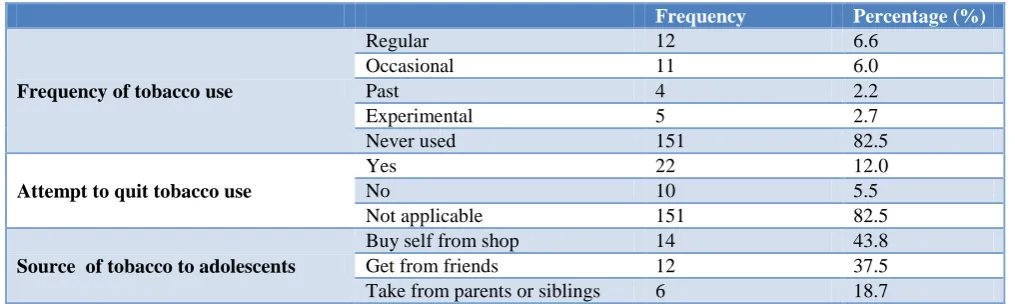
Table 7: Practice of tobacco users regarding tobacco consumption.
Frequency Percentage (%)
Frequency of tobacco use
Regular 12 6.6
Occasional 11 6.0
Past 4 2.2
Experimental 5 2.7
Never used 151 82.5
Attempt to quit tobacco use
Yes 22 12.0
No 10 5.5
Not applicable 151 82.5
Source of tobacco to adolescents
Buy self from shop 14 43.8
Get from friends 12 37.5
Take from parents or siblings 6 18.7 In the present study it was observed that among users, 12
(6.6%) were regular user and 11 (6%) were occasional users. 4 (2.2%) were past users and 5 (2.7%) were experimental user.
DISCUSSION
Through this study, an attempt has been made to look at some important Epidemiological aspects of tobacco use in the school going adolescent boys in urban area. Tobacco use varies considerably from region to region within the country and there was lack of studies done exclusively to provide the prevalence & patterns of tobacco use in this region. The present study looked at the prevalence of tobacco consumption along with knowledge, attitude & practice in school going adolescent boys in urban field practice area of medical college. Because of existence of strong correlation of local socio-cultural characteristics with tobacco use, an attempt was made to study the role of various socio-demographic factors associated with tobacco use.
Lastly, to provide information on awareness and prevailing mind set among tobacco users male adolescent students in this region, it looked at the very important determinants of tobacco use i.e. knowledge of health hazards of tobacco use among tobacco users and their attitude towards quitting the tobacco habit.
In this study it was found that the mean age was as young as 15 year (S.D±1) and most of the adolescent boys were in the age 14,15,16,17 years. In similar study conducted by Soni et al observed that the age of the respondents ranged from 14 to 18 years.23 In another study conducted Awasthi et alshows that 31.3%, 31.5%, 37.2% students were in the 8th, 9th, 10th grade respectively.24 More than 90 per cent of the students belonged to Hindu families in study conducted by Narain et al.25 Finding of this study almost similar to finding of present study. In a study study conducted by Soni et alshows three-fourths of the respondent belonged to a joint family and the remaining were part of a nuclear family.23 Finding of this study was contrast to our study finding. Prevalence of tobacco use in present study was 17.5%. India GYTS conducted a school-based survey of students in grades 8, 9 and 10 in 2009 reported that 14.6% of students currently use any form of tobacco and the prevalence of tobacco use only in boys was 19.0%.26 Findings of this study was similar to our study.Biswas et al reported that knowledge regarding harmful effects of tobacco was nearly similar among both ever users 170 (84.5%) and non-users 225 (88.9%).27 Finding of this study is similar to present study.
CONCLUSION
Through this study, an attempt has been made to look at some important aspects of tobacco use in the school going Adolescent boys in urban area. Tobacco use varies considerably from region to region within the country and there was lack of studies done exclusively to provide the prevalence and patterns of tobacco use in this region. The present study looked at the prevalence of tobacco consumption in school going adolescent boys in urban
slum. Because of existence of strong correlation of local socio-cultural characteristics with tobacco use, an attempt was made to study the role of various socio-demographic factors associated with tobacco use. Lastly, to provide information on awareness and prevailing mindset among tobacco users male adolescent students in this region, it looked at the very important determinants of tobacco use i.e. knowledge of health hazards of tobacco use among tobacco users and their attitude towards quitting the tobacco habit.
Limitations
The study has the possibility of slightly under reporting the prevalence of tobacco use because some students may not disclose the tobacco habit.
Generalizability of the results may also be questionable due to non-inclusion of adolescent girl students.
Recommendations
Keeping in mind the magnitude of the tobacco problem the following recommendations are suggested to tackle the multifaceted problem of tobacco mortality and morbidity.
Peer group and parental history of tobacco use influences tobacco use among school students hence this indicates that tobacco prevention intervention should essentially begin with the family. In all parents teachers meeting the consequences of tobacco use to be explained to the parents with specially reference to influences of their tobacco use on their children.
Information, education and communication activities to raise the public awareness to address the problems arising out of lack of awareness.
Policy to reduce the agricultural production of tobacco and to restrict the growth of tobacco industry in a phased manner.
To involve the community, health institutions and non-governmental organisatioms actively in in tobacco control.
Effective implementation of laws like protection of non-smokers from second hand smoke (SHS) and prohibition of sale to minors.
Smoking and tobacco use be prohibited within the school premises and appropriate penalty be recommended for in disciplines, if possible unauthorised vendor selling tobacco in any form be prevented from trading outside the premises through competent authority.
To provide tobacco cessation services by establishing tobacco cessation clinics (TCC) in all health institutions.
The teachers, medical and paramedical staff should give importance for health education on tobacco.
and subsequent management and the referral system for counselling of school students indulging in tobacco use establishing to nearest health centre of school, alternatively trained psychologist may be hired for monthly counselling services with reference to tobacco use.
Lessons on tobacco should be included in educational curriculum at all levels.
Policy to regulate the contents in the tobacco products, especially, the nicotine and tar content. Ingredients are to be disclosed.
A comprehensive ban on tobacco advertisement, promotion and sponsorship.
To keep a track of trends in tobacco use by regular community surveys and among specific groups, especially, the youth and women and create a forum for regional and global tobacco surveillance and exchange of information.
Mobilization of tobacco non-users in motivating adolescent students to prevent initiation and quitting tobacco use would help to create a supportive environment.
Lastly, overall development of the weaker sections of the community should be given priority as they are more likely to be worst affected by the tobacco use.
Funding: No funding sources Conflict of interest: None declared
Ethical approval: The study was approved by the Institutional Ethics Committee
REFERENCES
1. World report on the global tobacco epidemic, The MPOWER package, Geneva: World Health Organization; 2008.
2. Gupta VM, Sen P. Tobacco: The addictive slow poison. Indian J Public Health. 2001;45:75-81. 3. Sinha DN, Gupta PC, Pedenekar MS. Tobacco use
in rural area of Bihar, India. Indian J Community Med. 2003;25:167-8.
4. WHO. Tobacco in SEAR: A health challenge. WHO, SEAR, New Delhi.
5. Quarterly Newsletter (2009). National Institute of Health & Family Welfare, 11, 2 April – June. 6. Jaitly T, Sen S. Time to the clock: Editorial in
Health for the million. 2003;29(2):87-8.
7. Reddy KS, Arora M. Tobacco use among children in India: A burgeoning epidemic. Indian J Pediatric. 2005;42:757-61.
8. Mukherjee K, Hadaye RS. Gutkha consumption & its determination among secondary school male students. Indian J Comm Med. 2006;31:177. 9. Mackay J, Eriksen M. The tobacco atlas. Available
at: http://www5.who.int/tobacco/page.cfm?sid=84. WHO.2002. Accessed on 20th February 2003. 10. WHO. Leave the pack behind, World No Tobacco
Day, 31st May 1999, WHO report, WHO.
11. WHO. Tobacco- Health Facts. Fact sheet number 221. April 1999. Available at: http://www.who.int/ inf-fs/en/fact221.html. Accessed on 20th February 2003.
12. World report on the global tobacco epidemic, The MPOWER package, Geneva: World Health Organization; 2009.
13. Jayant K, Notani PN, Gulati SS, Gadre VV. Tobacco usage in school children in Bombay, India. A study of knowledge, attitude and practice. Indian J Cancer .1991;28(3)139-47.
14. Dongre AR, Deshmukh PR, Murali N, Garg B, Tobacco consumption among adolescents in rural Wardha: Where and how tobacco control should focus its attention? Indian J Cancer. 2008;45(3):100-6.
15. Makwana NR, Shah VR, Yadav S. A Study on Prevalence of Smoking and Tobacco Chewing among Adolescents in rural areas of Jamnagar District, Gujarat State. JMSR. 2007;1(1):11-4. 16. Muttappallymyalil J, Divakaran B, Thomas T,
Sreedharan J, Jeesha. Prevalence of Tobacco Use Among Adolescents in North Kerala, India. Asian Pacific J Cancer Prev. 2010;13(11):5883-6.
17. Ravishankar TL, Nagarajappa. Factors attributing to initiation of tobacco use in adolescent students of Moradabad, (UP) India. Indian J Dent Res. 2009;20(3):143-6.
18. Majumdar R, Raje SS, Dandekar A. Socio demographic factors associated with tobacco use in rural Maharashtra. Med J Dr. D.Y. Patil University. 2013;6(2)
19. Surani NS, Shroff HP. Mass Media Exposure to Tobacco Messages among Secondary School Children in Mumbai. Indian J Public Health. 2012;56(2)
20. Ramakrishna GS, Sharma P, Thankappan KR. Tobacco Use among Medical Students in Orissa. National Med J India. 2005;18:285-99.
21. Jacbson B. Smoking & Health:A new generation of Campaigners. British Med J. 1983;2(287):483-4. 22. Singh V, Pal HR, Mehta M, Dwivedi SN, Kapil U.
Pattern of Tobacco Use Among School Children in National Capital Territory. Indian J Pediatr. 2007;74(3):1013-20.
23. Soni P, Raut DK. Tobacco Use among School Students in National Capital Territory of Delhi. J Alcoholism Drug Depend. 2013:1:120
24. Awasthi S, Jha SK, Rawat CMS, Pandey S, Swami SS. Correlates of tobacco use among male adolescents in schools of Haldwani, Nainital. Health Population Perspec Issues. 2010;33(1):42-9.
26. Global Youth Tobacco Survey (GYTS) India, 2009. 27. Biswas AK, Sarkar J. Tobacco use among urban
school boys of Paschim Midnapore, India. JMPA. 2010;60(9):786-9.
Cite this article as: Singh DK, Kesarwani P, Sinha S, Singh VK.Assessment of prevalence and knowledge, attitude and practice of tobacco