Original Research Article
Compliance of anti-rabies vaccine among dog bite victims in an urban
slum of Chennai: a cross sectional study
Shivasakthimani R.*, Vinoth Gnana Chellaiyan D., Ravivarman G., Murali R.
INTRODUCTION
Among infectious diseases, Rabies has the highest case fatality rate.1 The major burden of rabies is attributable to dog-mediated transmission of rabies, threat more than 3.3 billion people.2 Globally 26,400 – 61,000 deaths occur due to rabies every year of which 95% are due to dog bite. Amongst most developing countries, Rabies prevalence is noted more among the poor and vulnerable population and is rarely reported and notified.
To overcome the burden of disease and management, the World Health Organization (WHO) recommended wound categorization primarily for undelayed care.1 In addition
to wound categorization and wound management, anti-rabies vaccine is required for incapacitating the virus. The intramuscular anti-rabies vaccine consists of ‘Essen’ regimen - one dose 0, 3, 7, 14 and 28 days and ‘Zagreb’ regimen 0, 7 and 21 days in which two doses are administered on the first day and one dose on other days. In India, since 2006, intradermal anti rabies vaccine has been implemented with updated Thai Red Cross regimen which consists of vaccine on 0, 3, 7 and 28 days.1
A crucial step to curb this disease is adhering to regimen dates and completing the post exposure prophylaxis vaccines. Poor compliance of vaccine leads to mortality due to rabies disease. Therefore, the present study
ABSTRACT
Background: Among infectious disease, rabies has the highest case fatality rate. The major problem of rabies is attributable to its dog-mediated transmission which is an impending threat to more than 3.3 billion people. Poor compliance of vaccine increases the mortality rate due to rabies. The present study attempts to ascertain pattern of dog bite and compliance to post exposure prophylaxis.
Methods: This cross sectional study was carried out in Primary Health Centre in an urban slum of Chennai in Tamil Nadu. The study included 301 dog bite victims residing in urban slum with wound categories II & III (as per WHO). A pretested, semi-structured questionnaire was used for data collection. Data was analysed with SPSS-IBM (version 21.0). Chi-square test was applied.
Results: Mean (SD) age of study participants was 28 (±16.3) years. Males were 176 (58.5%) and females were 125 (41.5%). Among the bites, pet dog bites were 140 (46.5%), and stray dog bites were 161 (53.5%). Majority of the bites 161 (53.5%) were unprovoked, category II bites were 216 (28.2%).Compliance up to 3 dose was found in 213 (70.8%). Association was found between site of the dog bite and compliance of anti- rabies vaccine (p=0.021).
Conclusions: Despite the availability of costless vaccines in public health care system, the compliance rate is only moderate. Health education about the vaccination after dog bite needs to be imparted among the community to reduce the rabies related mortality rate.
Keywords: Rabies, Anti-rabies clinic, Compliance to anti-rabies vaccine
Department ofCommunity Medicine, Chettinad Hospital & Research Institute, Chennai, Tamil Nadu, India
Received: 10 January 2018
Accepted: 19 February 2018
*Correspondence:
Dr. Shivasakthimani R.,
E-mail: [email protected]
Copyright: © the author(s), publisher and licensee Medip Academy. This is an open-access article distributed under the terms of the Creative Commons Attribution Non-Commercial License, which permits unrestricted non-commercial use, distribution, and reproduction in any medium, provided the original work is properly cited.
attempts to ascertain pattern of dog bite and compliance to post exposure prophylaxis.
Objectives
1. To study the pattern of dog bites among urban slum
population.
2. To measure the compliance of anti-rabies vaccine
regimen among dog bite victims.
METHODS
This cross sectional study was carried out in Primary Health Center (PHC) located near Semmancherry urban slum, which is an urban field practice area of Chettinad Hospital and Research Institute (CHRI). Data collection period was from May 2016 to April 2017. The study included patients who were permanent residents of the urban slum attending anti rabies clinic of PHC. Dog bite victims with wound category II & III (as per WHO) were included in the study (Table 1).
Table 1: Categories of contact with suspect rabid animal and recommended prophylaxis.1 Categories
Category I
Touching or feeding animals, licks on intact skin. No post-exposure
prophylaxis is required.
Category II
Nibbling of uncovered skin, minor scratches or abrasions without bleeding. Vaccine should be administered.
Category III
Single or multiple transdermal bites or scratches, licks on broken skin, contamination of mucous membrane with saliva from licks and exposure to bats. Vaccine and Immunoglobulin should be administered
The study excluded persons who received 1st two doses of ARV in any other hospital. Based on previous studies done in a similar urban setting, the compliance of ARV was found to be 76.5%.3 This compliance rate was used for sample size calculation and the total sample size was 301. A pretested, semi-structured questionnaire was used for data collection. The post exposure prophylaxis was given to dog bite victims as per Thai Red Cross (TRC) regimen. A dose of 0.1ml in 2 sites intradermally on days 0, 3, 7, and 28. Victims who missed or discontinued 2nd, 3rd and 4th dose were considered as non - compliance victims (excluding the person who discontinued vaccine after 3 dose and the bitten dog was alive and healthy for 10 days after bite).1 Victims who did not come to ARV clinic for subsequent dose were visited at their homes and
checked for compliance. Approval from Institutional
Ethical Committee was obtained. Data was analyzed using SPSS-IBM (Statistical Package for Social Sciences
categorical variables. P value of less than 0.05 was considered significant.
RESULTS
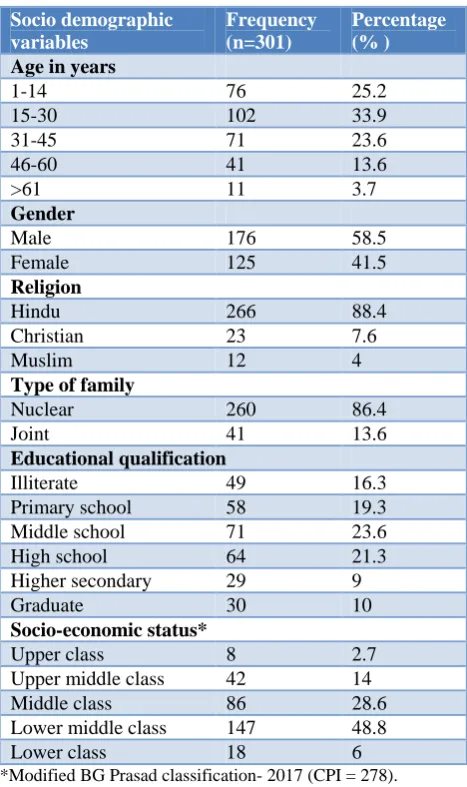
Among the study participants, the mean age was 28 years (±16.3). Males were 176 (58.5%) and females were 125 (41.5%). The ratio between male to female was 1.4:1. With regard to religion, 266 (88.4%) participants were Hindus, 12 (4%) were Muslims. Forty nine study participants (16.3%) were illiterates. According to BG Prasad Socio-economic scale, majority 147 (48.80%) were in lower middle class, only few participants belonged to lower class 18 (6%) and upper class were 8 (2.70%) (Table 2).
Table 2: Socio demographic profile of study participants.
Socio demographic variables
Frequency (n=301)
Percentage (% )
Age in years
1-14 76 25.2
15-30 102 33.9
31-45 71 23.6
46-60 41 13.6
>61 11 3.7
Gender
Male 176 58.5
Female 125 41.5
Religion
Hindu 266 88.4
Christian 23 7.6
Muslim 12 4
Type of family
Nuclear 260 86.4
Joint 41 13.6
Educational qualification
Illiterate 49 16.3
Primary school 58 19.3
Middle school 71 23.6
High school 64 21.3
Higher secondary 29 9
Graduate 30 10
Socio-economic status*
Upper class 8 2.7
Upper middle class 42 14
Middle class 86 28.6
Lower middle class 147 48.8
Lower class 18 6
*Modified BG Prasad classification- 2017 (CPI = 278).
missed the fourth dose were aware that the dog was alive after 10 days and thus skipping the fourth dose. Hence, the overall compliance of anti - rabies vaccine in our study was 70.8% (Table 4).
Table 3: Compliance of ARV among study participants (n=301).
Number of doses received
Frequency (n=301)
Percentage (% )
First dose 301 100
Second dose 228 75.7
Third dose 213 70.8
Fourth dose 166 55.1
Table 4: Reasons for missing ARV dose as per schedule (n=135).
Reasons for missing ARV dose
Frequency (n=135)
Percentage (% )
Loss of wages (work
absenteeism) 56 41.4
Forgotten dates 48 35.6
Interferes with school
timing(children) 31 23
Total 135 100
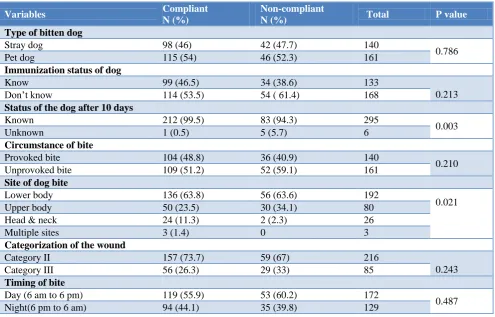
212 (99.5%) knew the status of bitten dog and 1 (0.5%) didn’t know the status of the dog among those who were compliant (χ2 =8.660, p=0.003). The proportion of participants who knew the status of bitten dog was higher in compliant group than Non-compliant. Among the compliant participants, 24 (11.3%) were bitten in the head & neck 50 (23.5%) were bitten in the upper body, 136 (63.8%) were bitten in the lower limb, 3(1.3%) had been bit in the multiple sites of the body (χ2=9.714, p=0.021). Among the participants who were compliant, 98 (46%) were bitten by stray dogs, 115 (54%) were bitten by pet dogs (χ2
=0.074, p=0.786). Among those who were compliant with the ARI regimen, immunization status of the dog were known in 99 (46.5%) and not known in 114 (53.5%) (χ2 =1.553, p=0.213). There was no association between categorization of the wound and compliance of ARV. (χ2 =1.364, p=0.243) (Table 5).
Among the participants who were compliant, 70 (32.9%) were children and 143 (67.1%) were adults. The association between compliance of ARV and age was not statistically significant (χ2=1.815, p=0.178). There was no association between compliance of ARV and socio demographic factors like gender, religion, type of family, education, socio-economic status (Table 6).
Table 5: Association between pattern of dog bite and compliance of ARV (n=301).
Variables Compliant
N (%)
Non-compliant
N (%) Total P value
Type of bitten dog
Stray dog 98 (46) 42 (47.7) 140
0.786
Pet dog 115 (54) 46 (52.3) 161
Immunization status of dog
Know 99 (46.5) 34 (38.6) 133
0.213
Don’t know 114 (53.5) 54 ( 61.4) 168
Status of the dog after 10 days
Known 212 (99.5) 83 (94.3) 295
0.003
Unknown 1 (0.5) 5 (5.7) 6
Circumstance of bite
Provoked bite 104 (48.8) 36 (40.9) 140
0.210
Unprovoked bite 109 (51.2) 52 (59.1) 161
Site of dog bite
Lower body 136 (63.8) 56 (63.6) 192
0.021
Upper body 50 (23.5) 30 (34.1) 80
Head & neck 24 (11.3) 2 (2.3) 26
Multiple sites 3 (1.4) 0 3
Categorization of the wound
Category II 157 (73.7) 59 (67) 216
0.243
Category III 56 (26.3) 29 (33) 85
Timing of bite
Day (6 am to 6 pm) 119 (55.9) 53 (60.2) 172
0.487
Table 6: Association of compliance of ARV with socio demographic profile (n=301).
Variable Compliant
N (%)
Non-compliant
N (%) Total P value
Age
Children 70 (32.9) 22 (25) 92
0.178
Adult(≥18 years) 143 (67.1) 66 (75) 209
Gender
Male 130 (61) 46 (52.3) 176
0.161
Female 83 (39) 42 (47.7) 125
Religion
Hindu 185 (69.5%) 81 (30.5%) 266
0.421
Christian 18 (78.3%) 5 (21.7%) 23
Muslim 10 (83.3%) 2 (16.7%) 12
Type of family
Nuclear 185 (86.9) 75 (85.2) 260
0.708
Joint 28 (13.1) 13 (14.8) 41
Education
Literate 182 (85.4) 70 (79.5) 252
0.207
Illiterate 31 (14.6) 18 (20.5) 49
Socioeconomic status
Higher SES* 99 (46.5) 37 (42) 136
0.482
Lower SES** 114 (53.5) 51 (58) 165
*Higher SES- Class I, Class II and Class III,** Lower SES- class IV and class V (According to BG Prasad).
DISCUSSION
In the present study 75.7% received second dose of ARV, 70.8% completed third dose of anti - rabies vaccine and 55.1% completed the fourth dose. A study on compliance
of ARV by Vinay et alreported that 59.8% received all 4
doses.4 Our study finding were comparable with study conducted by Malkar et al which reported 42.81% of their participants completed the schedule.5 The highest dropout of 4th dose were seen in all the studies, including our study.
In current study population, 25.9% second dose of ARV, 3.3% of them missed third dose, 15.7% of the participants missed the fourth dose of ARV. These observation were comparable with study conducted by Malkar et al which reported that 82.97% received second dose of ARV, 70.7% received three dose of anti-rabies vaccine, 46.17% completed four dose of anti-rabies vaccine.5
In the present study, 46.5% were bitten by stray dog. Most of the participants (55.80%), were not aware of immunization status of the biting dog.18.90% of the bitten dog were immunized. This finding was comparable with the study done by Bharathy et alin Chennai which reported that 47% were bitten by stray dog.6 Another
study by Seenivasan et alreported that 21.4% of the dog
were immunized.7 We observed in our study that 46.50%
of the bites happened were due to provocation. In a previous study by Trivedi et al 24.1% of the bite happened in provoked circumstance.8
the dogs. Similarly, Ghosh et al showed that 62.69% of the bitten sites were in the limbs.9 Domple et alobserved that 53.8% of the site of bite marks in the lower limbs. In our study category II dog bite were higher.3 Contrary to this finding category III cases reported were 89.4% by Trivedi et aland 71.50% by Patel et al.10,11
In this study, the most common place of dog bite was in the streets (33.6%) and 42.9% the bite happened at night time. This may be due to inadequate illumination. A
study by Marathe et alshowed 51.5% of the bite occurred
in streets and 11.4% occurred during night.12 Dog related factors viz. fate of the dog and site of dog bite were associated with compliance of ARV. These findings were similar to study conducted by Malkar et al.5
In the present study, dog bite was observed in all the age group with children being more vulnerable (30.5%).
Ghosh et aland Shah et alfound that 16.13% and 25.2%
of the more susceptible to dog bites were found in children.13,14 Males were found to be higher because of their mobility due to occupation. Bharathy et al and Marathe et al also described that males were more commonly affected than female.6,12
previous studies by Anandaraj et al in Karnataka where 33.3%were in lower middle class, 31.3% were in middle class.14
CONCLUSION
Compliance of ARV in our study was 70.1%. The major reason of poor compliance among victims was lack of awareness. Children were affected more. Night time (6 pm to 6 am) was more common time for bitten because of inadequate illumination. Health education about the vaccination after dog bite needs to be imparted among the community to improve the compliance rates.
Funding: No funding sources Conflict of interest: None declared
Ethical approval: The study was approved by the Institutional Ethics Committee
REFERENCES
1. Expert Consultation on Rabies,
Weltgesundheitsorganisation, editors. WHO Expert Consultation on Rabies: second report ; [Geneva from 18 to 20 September 2012]. Geneva: WHO; 2013: 139.
2. Shankaraiah R, Rajashekar R, Veena V,
Hanumanthaiah AN. Compliance to anti-rabies vaccination in post-exposure prophylaxis. Indian J Public Health. 2015;59(1):58.
3. Domple V, Doibale M, Sonkar V, Aswar N,
Khadilkar H, Jain S. Treatment compliance of self-reported dog bite cases attending outpatient department of Tertiary Care Hospital, Maharashtra. Int J Med Public Health. 2015;5(4):297.
4. Ranganathan AK. Socio-demographic
characteristics affecting compliance to intra dermal rabies vaccination at anti rabies clinic in a government tertiary care hospital in Karnataka. J Evol Med Dental Sci. 2013;2(37):7090-5.
5. Malkar V, Joge U. A study of compliance of animal
bite victims to 4 dose intradermal schedule of anti-rabies vaccine and factors affecting it. Int J Community Med Public Health. 2015;2(2):156.
6. Bharathy S, Gunaseelan L. A Cross Sectional Study
to Understanding Demographics of Dog Bite Victims Attending Anti Rabies Ward in Chennai City, Tamil Nadu India. Adv Anim Vet Sci. 2017;5(2):78–82.
7. Seenivasan P, Caroline Priya K, Vijayalakshmi M,
Saravanakumar P, Jegatheesh SK. Anti-rabies vaccination coverage among patients attending outpatient department in a Tertiary care hospital in Tamil Nadu. Int J Med Appl Sci. 2014;3(1):253–60.
8. Trivedi R, Kumar S, Saxena M, Niranjan A, Kumar
M. Epidemiological trends and practices of animal bite victims presenting to the OPD, district & medical college hospital, India. Int J Health Sci Res. 2015;5(12):14–20.
9. Jain M, Prakash R, Garg K, Jain R, Choudhary M. Epidemiology of animal bite cases attending anti-rabies clinic of a Tertiary Care Centre in Southern Rajasthan. J Res Med Dent Sci. 2015;3(1):79.
10. Trivedi R, Kumar S, Saxena M, Niranjan A, Kumar
M. Epidemiological trends and practices of animal bite victims presenting to the OPD, district & medical college hospital, India. Int J Health Sci Res. 2015;5(12):14–20.
11. Patel S, Toppo M, Lodha R. An epidemiological
study of animal bite cases in a tertiary care center of Bhopal city: A cross-sectional study. Int J Med Sci Public Health. 2017;6(3):1.
12. Marathe N, Kumar S. Epidemiological study of
animal bite victims in Central India: a cross sectional institutional study. Int J Community Med Public Health. 2016;78–82.
13. Ghosh A, Pal R. Profile of dog bite cases in an urban area of Kolkata, India. Natl J Community Med. 2014;5(3):321–4.
14. Anandraj R, Balu PS. Compliance to anti rabies
vaccine and animal bite management practices in a rural area of Davangere, Karnataka, India. Int J Community Med Public Health. 2016;170-3. 15. Seenivasan P, Caroline Priya K, Vijayalakshmi M,
Saravanakumar P, Jegatheesh SK. Anti-rabies vaccination coverage among patients attending outpatient department in a Tertiary care hospital in Tamil Nadu. Int J Med Appl Sci. 2014;3(1):253–60.
16. Chinnaian S. Taboos Related to Dog Bite in an
Urban Area of Kancheepuram District of Tamil Nadu, India. J Clin Diagn Res. 2015;9(7):11-4.
Cite this article as: Shivasakthimani R, Vinoth
GCD, Ravivarman G, Murali R.Compliance of