Prospective Analysis of Wooden Frames
Tiago Tomielo
University of Caxias do Sul, Brazil
Maria Emilia Camargo University of Caxias do Sul, Brazil
Angela Isabel dos Santos Dullius Federal University of Santa Maria, Brazil
Angela Pelegrin Ansuj
Federal University of Santa Maria, Brazil
Marta Elisete Ventura da Motta University of Caxias do Sul, Brazil
Ademar Galelli
University of Caxias do Sul, Brazil
Abstract
This study aims to build future scenarios for the identification of strategic alternatives of production and development for companies producing northern municipalities of wooden frames of Rio Grande do Sul. The research is characterized as exploratory, mixed approach, using Method of Grumbach, from Puma software for the construction of prospective scenarios through brainstorming techniques to survey the variables together companies, and Delphi technique for obtaining consensus among experts. The research context corresponded to micro Sananduva, Brazil, including nine companies and six selected experts that intentionally. The ten final events were migrating to other sectors, rising cost of raw materials, availability raw materials, the price charged, increased interest rates, rising cost of labour, market acceptance, environmental legislation, the level used and competitive technology. Sixty-four scenarios have been generated, and most of the events were concentrated in Group I represents a major threat to the sector, with a high percentage of probability. The most likely trend scenarios present unfavourable developments within and outside the area of competence of companies in the sector, which repeats for a history of difficulty to be faced by companies. The main threats frames sector are related to competition; changes in environmental legislation; lack of skilled labour and new market entrants. The results show that the method can contribute to the formulation of future strategies to industry peers.
Keywords: Prospective Scenarios. Wood Frames. Grumbach Method.
1.INTRODUCTION
In the context of business, the fierce competitiveness, the intense technological transformation, the short life of the products and the requirements of customers, have raised the level of competitive advantage, requiring that companies develop strategies that enable charting new pathways and conquer other spaces. This reality makes extend the importance of prospecting, namely, vision or future trend, recognizing the need to understand the different possibilities and the unpredictability of the future in order to improve the activities and promote the development organizational (TADEU and SILVA, 2013).
The technique of prospective scenarios is considered an important intelligence tool to organizational development, being able to assist in obtaining information about the environment in order to subsidize the elaboration of strategies to achieve the future imagined.
(MORITZ and PEREIRA, 2005).
The technique of prospective scenarios is considered an important intelligence tool to organizational development, being able to assist in obtaining information about the environment in order to subsidize the elaboration of strategies to achieve the future imagined (MORITZ and PEREIRA, 2005).
The prospective studies are useful in decision-making, defining the broad lines of action, strategies and policies of the Organization, proposition in addition to facilitate priority setting from the identification and choice of the most promising areas of activity (ZACKIEWICZ and SALLES-FILHO, 2001).
In view of this importance, the present study focuses on the design of prospective scenarios for the sector of wood frames that have undergone major impacts due to current market changes. Corresponds to one of the branches of industrial timber forest context, characterized by being a secondary processing industry if worth of carpentry and joinery for a final product, basically internal and external Windows and doors. The wood has occupied a prominent role in the manufacture of frames, but was gradually losing space by the introduction of new materials such as aluminium, steel and PVC (polyvinyl chloride) (INO et al., 2003).
Especially in the northern region of the State of Rio Grande do Sul, the wooden frame was always representative for local economies. However, there has been a progressive decrease of production, combined with common market difficulties, shortage of labor, environmental and other problems that have threatened the survival of many companies.
From these difficulties highlight the relevance of this study as a way to enable a future look about the sector and the possible scenarios to be faced, providing information for companies and strategic design for decision making. The methodology proposed by Grumbach for building scenarios, assumes that it is vital that organizations use-if the competitive intelligence, seeking solid evidence, based on questions and joint discussions as a way to use the information to your favor (MARCIA and GRUMBACH, 2002).
So, the problem was: what prospective scenarios in the area of production and development can be found for the companies in the sector of wooden frames?
The main objective sought to define prospective scenarios for identifying strategic alternatives of production and development for companies in the sector of wood frames of municipalities in the North of Rio Grande do Sul, Brasil.
2. THEORETICAL REFERENCE 2.1 Wooden Frames
Are casings of buildings components such as doors and Windows that have as the connection and integration of function spaces and people. The doors have to allow entry or exit of people and protect internal environment of natural agents. Already the Windows keep the functions of natural ventilation and lighting and interior environmental protection, is the heat or cold, noise, rain and wind (FERNANDES, 2004).
With the technological development of other materials, wood began to suffer competition, but is still considered a noble material in the manufacture of frames. In Brazil, the wood used in the production of frames is found mainly in the Amazon region, although the major manufacturers keep their industrial installations in the South of the country (REMADE MAGAZINE, 2005).
Guella and Sattler (2004) point out that wood as a raw material for the manufacture of casings is a material that has a lot of qualities. However, it becomes relevant to rationalization of the entire production process, to achieve a quality competitive with other materials such as PVC and aluminum.
In the Brazilian scenario, the new opening systems in alternative materials, such as aluminum, absorbed much of the market, taking the timber market to invest heavily in quality. Despite this, the wood continues to be recognized by the incomparable aesthetics and casings are currently subject to the same functional requirements that the aluminum Windows. However, to become more competitive, the industry must invest in new technologies, design and good workmanship improving your competitiveness conditions on other materials (MASSETTO et al., 2008).
2.2 Strategy and Foresight
The formulation of strategies related to the planning of prospective scenarios, since the prospect may be a means for the development of strategies based on future models (SOUZA and TAKAHASHI, 2012).
Oliveira and Forte (2010) point out that the use of prospective scenarios is a suitable tool for the definition of strategies, since it helps organizations understand the strategic implications of uncertainty. With the construction of multiple scenarios, a company can explore, systematically, the possible consequences of these uncertainties to their strategic options.
For strategic planning, the scenarios are image constructions of alternate futures, each internally consistent and having relevance beyond a certain likelihood of occurrence. Represent criteria and measures for the preparation of the future of the company. The uncertainties of surveyed environments are the work tools used in scenarios to investigate the various possible paths of future (CAMARGO, 2005).
Thus, it is important to consider that the scenarios are not predictions of the future, but the articulation of future possibilities for the business environment, important for adequacy and testing strategies (TADEU and SILVA, 2013).
The scenario analysis is an important method for the analysis of the future of enterprise environments, differed from most other approaches to future predictions firstly because evaluates quality and from the contextual description and second because attempts to identify a game of possibilities and plausible instances. The prospect of scenarios offers more than a prediction, using narrative and approaches that seek to identify what will happen in the future (SCHNAARS, 1987).
There are three types of scenarios. The possible are those that the human mind can imagine; the achievable are likely to occur and which takes into account the situation of the future; and the desirable in any part of the possible, but not always achievable (MARCIAL and GRUMBACH, 2008). So, the desirable and feasible scenarios are under the possible scenarios, however your occurrence is restricted.
Following the vision of Godet and Durance (2008), the strategic foresight, with their trends and risks, challenges the strategy, placing itself as an anticipation of the action service. That means prospecting assists in formulation and successful organizational strategy. Therefore, for this study, the strategy is related to the prospective view, and the study of the scenarios becomes a tool that helps in the identification of the factors and tendencies that must be considered in the process of elaboration and development of organizational strategies.
2.3 Methods of Construction of Scenarios
The preparation of scenarios is developed from methodologies based on various techniques that can be used to enhance strategic thinking through the development of a vision for the future "(MARCIAL and GRUMBACH, 2008).
The supporting techniques for the construction of scenarios are classified by Zackiewicz and Salles-Filho (2001) in three groups: formal, informal and quantitative. The structured interviews are formal, morphological analysis, discussions arranged on predetermined questions, Delphi, cross-impact analysis, construction and analysis of scenarios. The informal are basically unstructured discussions, like "workshops". The trend extrapolations are quantitative, computer modelling and growth curves, Delphis modified to generate quantitative assessments, among others. It is appropriate to point out that more than one technique can be used in the same study, depending on your stage and its goals. Whereas the method of Grumbach, the object of this study involves just Brainstorming techniques, Delphi and cross-Impacts.
Brainstorming is a technique of group work in which the intention is to produce as much as possible for a given problem. The purpose is the stimulation of the imagination and the emergence of ideas. The process relies heavily on the experience of the Advisor, and adjusting the relevant participants, do not suffer criticism, designate someone to write down the ideas and instil in the participants the importance of their contributions (MARCIAL and GRUMBACH, 2008).
Already the Delphi method offers a practical development, consisting of interrogating the Group of participants, through a series of questionnaires, individually, to identify and generate information of growing consensus. To meet various specialists for providing their opinions, there are several factors, including psychological, that affect the consensus. Some participants may have greater clarity in their considerations, be more persuasive, have better arguments, without reason. For this, the Delphi method works by preventing the experts gather. All communication is done through a coordinator or moderator (CAMARGO, 2005).
In the design of Godet and Durance (2008), one of the advantages of Delphi is to get a consensus at the end of the questionnaires, although not always mean convergence and coherence. Also, the information collected during the investigation of the events, trends or determining breaks for future developments of the problem studied, is rich and abundant. Finally, this method can be used both in the field of management, economics, technology, as in the social sciences in General.
On the method of cross-Impacts, whose foundations were laid in the late 60, originate in the works of enrichment of investigation techniques, to determine probabilities simple Delphi and conditional odds and events, as well as the probabilities of combinations, taking into account the interactions between events and/or hypotheses. The purpose of these methods is not only present to decision-makers the most believable scenarios, but also examine combinations of hypotheses that have been excluded a priori (GODET and DURANCE, 2008).
In this sense, Marcial and Grumbach (2008) highlight that the method of cross-Impacts encompasses a family of techniques that aim to assess the influence that the occurrence of a given event would have on the probability of occurrence of other events. Among these techniques highlighting the application of Bayes ' theorem to the cross-Impacts, enabling the analysis of impacts as conditional probabilities and the issue of inconsistencies.
2.4 Method of Grumbach
analysis of scenarios that evolved into a system of development of forwarding strategic planning based on perspective scenarios (BRAINSTORMING, 2010).
The method of Grumbach involves four main phases. The definition phase of the problem is a conceptual step, in that a particular authority of the company is called Strategic Decision-maker. At this point are highlighted the purposes of prospective study and determined the extent of the system to be reviewed, establishing the time frame in which you will work. Still in the first phase is the diagnosis of the problem, identifying external and internal variables of the system in question, and the understanding of the origins and causes of the current situation (MARCIAL and GRUMBACH, 2008).
The second phase involves research and development strategic diagnosis, being the responsibility of the control group. In this step are identified and evaluated the opportunities and threats, the strengths and weaknesses and all the variables involved in the environmental analysis. Evaluates the construction of alternatives for the future through two stages: the stage of understanding and design stage, where the facts of future carriers identified and exogenous agents (MARCIAL and GRUMBACH, 2008).
In the third phase, the analytical part of the process is carried out, involving actions of understanding, conception and evaluation of the results. In the understanding subphase, the Control Group describes the research performed and the results obtained with the listing of all the main endogenous and exogenous facts related to the organization. The subphase of conception is also directed to the Control Group, where they should list the future facts and then carry out the brainstorming that will be the basis for the creativity of the analysts so that they can see what events may arise in the future. The subphase of the evaluation includes the various expert consultations, both to seek convergence of opinions and to fill the matrix of cross-impacts. This phase involves the first to sixth consultation of the experts, the selection of definitive events and the last consultation of experts with the definition of cross-impacts (MARCIAL and GRUMBACH, 2008).
Therefore, in the last phase the Delphi methods are used and the Crusaders. The Delphi method is responsible for checking the probability of occurrence of an event according to the view of the experts, and Cross Impacts experts opine about the influence of events on the occurrence of the other. However, before using the method of cross-Impacts should identify the definitive events through Multicriteria analysis techniques, which help decision making when multiple criteria are involved. It is suggested that you not exceed 15 preliminary events so that later, this number is reduced to a maximum of 10 final events, which will generate a total of 1,024 (210) scenarios (MARCIAL and GRUMBACH, 2008).
The method Grumbach is system computerised Brainstorming Web, which integrates the Puma Web, the Lynx, the Jaguar, the Web and Web risk Scenario. The software allows processing the researched variables together with the experts, through brainstorming, whereas for obtaining consensus among the experts. Also, Delphi method will be used, followed by the application of the method of Cross Impacts (BRAINSTORMING, 2015).
The interpretation of the scenarios is a fundamental step of the method, with three scenarios being highlighted: a) most likely, that the system places at the top of the list of possible scenarios; b) scenario of trend, that corresponds to the projection of past events on the future path to be covered by the organization; and c) an ideal scenario, which contemplates all positive occurrences and disregards negative ones from the point of view of the strategic decision maker (MARCIAL and GRUMBACH, 2008).
The most likely scenario is the scenario that is most likely to occur. The ideal scenario, in turn, is defined as one that contemplates the positive events determined by the strategic decision maker, not contemplating negative events.
The optimistic exploratory scenario contemplates a series of positive occurrences, however, not as much as the ideal. The trend scenario is one that projects past events on the path that the organization will go through, in this scenario if experts do not identify trend breakdowns, it may confuse it with the most likely scenario. Finally, the pessimistic exploratory scenario is defined as one that encompasses a series of negative occurrences and can be considered as the worst possible hypotheses that may occur (MARCIAL and GRUMBACH, 2008)
3. METHODOLOGICAL PROCEDURES
The study was carried out in municipalities in the northern region of the State of Rio Grande do Sul, especially the Sananduva microregion. The estimated population is 59,202 inhabitants (IBGE, 2010) and the total area of 3,067,573 km². It is made up of eleven municipalities: Barracão, Cacique Doble, Ibiaçá, Machadinho, Maximiliano de Almeida, Paim Filho, Sananduva, Santo Expedito do Sul, São João da Urtiga, São José do Ouro and Tupanci do Sul, Brazil.
For this study, the Grumbach Method was used for the construction of prospective scenarios, following the Brainstorming techniques for the survey of the variables with the companies of the window sector, in addition to the Delphi technique to obtain consensus and matrix of cross-impacts.
The convergence of data was carried out from the development of the methodology proposed by Grumbach, and also involved the documentary inventory with industry data collection of frames, as well as a survey of perceptions of managers of companies in the sector and also specialists in the area.
Data collection involved primary and secondary data. The secondary data were obtained from the companies. To obtain the primary data, a questionnaire was developed based on the Delphi method and the Brainstorming techniques that were applied to the nine entrepreneurs and the six specialists.
The variables analysed were: data on competitiveness; productivity, quality, market analysis; economic variables. Already the quantitative data were analysed by descriptive statistics and percentage. Also, Software was used Puma, considered the support for the construction of prospective scenarios from the Method Grumbach.
4. CONSTRUCTION OF PROSPECTIVE SCENARIOS 4.1 Definition of Preliminary Events
For the definition of preliminary events were carried out research among the entrepreneurs, as well as direct observations and informal conversations, seeking to check the main variables that interfere in the wooden frames and the favourable events or unfavorable, both domestic and external environment. This step consisted in the Brainstorming, and preliminarily defined 19 (nineteen) events, as shown in Table 1.
Table 1 - Preliminary Events
Item Discrimination Item Discrimination
1 Increase in the cost of labor 10 Increase in interest rate
2 Availability of labor 11 Market acceptance
3 Increase in the cost of raw material 12 Competition 4 Raw material availability 13 Delivery price
5 Tradition of company name 14 Return of the business 6 Quality end product 15 Environmental legislation
7 Launch of new products 16 Trade barriers
8 Means of marketing 17 Technological level used
9 Exchange variation 18 Infrastructure conditions 19 Migration to other sectors Source: Research data (2016)
From the answers of the experts, the Puma ® provides, based on the methodology of Grumbach, ten definitive events that can generate up to 1,024 possible scenarios, which corresponds to 210.
4.2 Application of the Delphi Method and Definition of Final Events
The second step consisted in the application of the Delphi method, with the participation of experts, which evaluated the preliminary events and the categorized from three factors: probability, relevance and self-assessment.
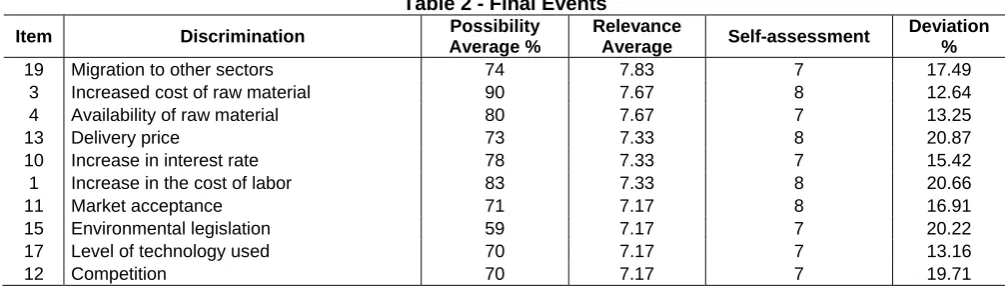
In the probability the response option varies from 0% to 100% for the event to occur, considering the time span of five years. Regarding pertinence, the answers vary from 1 to 9 about the relevance of the event, and in the self-assessment it is also from 1 to 9, where in this option the specialist highlights his / her level of knowledge about the event in an individualized way (BLOIS, 2006). Table 2 shows the definitive events, the order being established from the indicators of average pertinence.
Table 2 - Final Events
Item Discrimination Possibility
Average %
Relevance
Average Self-assessment
Deviation %
19 Migration to other sectors 74 7.83 7 17.49
3 Increased cost of raw material 90 7.67 8 12.64
4 Availability of raw material 80 7.67 7 13.25
13 Delivery price 73 7.33 8 20.87
10 Increase in interest rate 78 7.33 7 15.42
1 Increase in the cost of labor 83 7.33 8 20.66
11 Market acceptance 71 7.17 8 16.91
15 Environmental legislation 59 7.17 7 20.22
17 Level of technology used 70 7.17 7 13.16
12 Competition 70 7.17 7 19.71
Each one of the final events is described below:
1) Migration to other sectors: the occurrence of this event is related to the fact that the companies have difficulties in staying in the market squares and already have the machinery and equipment, can migrate to other sectors such as, for example, of bespoke furniture.
2) Increased the cost of raw material: the occurrence of this event could compromise the production, as it will add new costs to products, hindering competition, especially with other materials such as aluminium.
3) Availability of raw material: The occurrence of this event is related to the fact that wood originates from nature and even those derived from reforestation areas may have their availability threatened over time. 4) Price: the occurrence of this event can influence sales and competitiveness of wood frames to competitors. 5) Increase in interest rates: the occurrence of this event can be harmful especially to the civil construction
industry, which uses a lot of lines of credit.
6) Increase in the cost of Labor: the occurrence of this event can be associated with the fact that labor shortages could endear this cost, reflecting on all the wooden frames, in order to be an essential factor in the process.
7) Market acceptance: the occurrence of this event is related to the fact that wood is a noble material that the market is still open to this type of material.
8) Environmental Legislation: the occurrence of this event can be a differentiator for companies that can add value and certification of products. On the contrary, can harm those who still do not act in accordance with the law.
9) Level of technology used: the occurrence of this event is related to the need of the sector to improve its activities, investing in new systems, models and equipment, for the purpose of adding quality and modernity to the production system and to the final product.
10) Competition: the occurrence of this event extends the difficulties of the frames, once new competitors, acting from other raw materials, can further the wood segment.
4.3 CROSS-IMPACT MATRIX 4.3.1 Motor skills and dependence
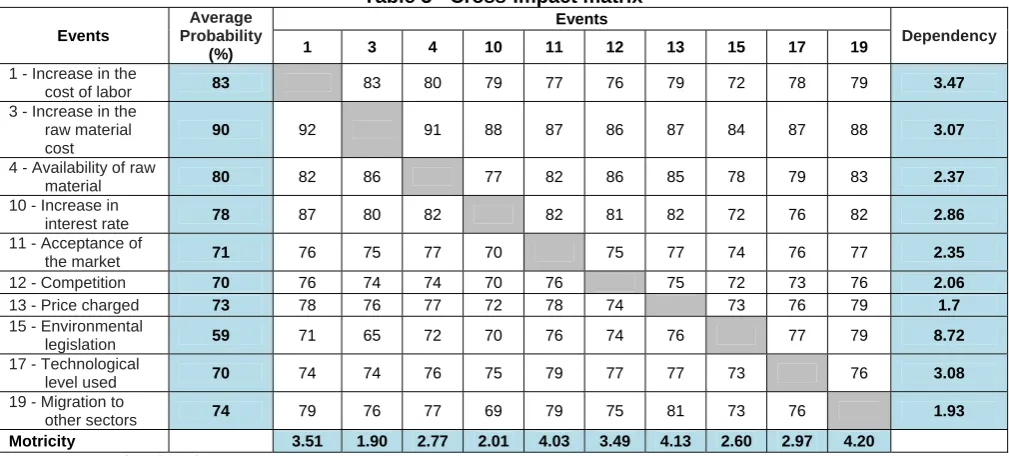
The cross-impact matrix is composed of columns and lines that cross from the ten definite events. The empty spaces of the intersection were filled by the experts, as determined by Grumbach Method. Automatically the software generates the matrix, along with the data of the motor, dependence and the average probability. The sum of the values contained in the columns generates the motricity numbers of each event. In the result of the lines, the value of its dependence.
It is important to point out, as Camargo (2005, 58) points out, that "the greater the degree of motor function of an event, the more influence it will have on others, and therefore an important event. The greater the degree of dependency, the more it will be influenced by the others, and the least important to be monitored. "
In Table 3 the array of cross-impacts of the study. It is observed that the most influential events in the context being studied are: migration to other sectors, price and market acceptance. Already the most dependent of the other events are: environmental legislation, rising cost of labor and technological level used.
Table 3 - Cross-Impact matrix
Events
Average Probability
(%)
Events
Dependency
1 3 4 10 11 12 13 15 17 19
1 - Increase in the
cost of labor 83 83 80 79 77 76 79 72 78 79 3.47 3 - Increase in the
raw material cost
90 92 91 88 87 86 87 84 87 88 3.07
4 - Availability of raw
material 80 82 86 77 82 86 85 78 79 83 2.37
10 - Increase in
interest rate 78 87 80 82 82 81 82 72 76 82 2.86 11 - Acceptance of
the market 71 76 75 77 70 75 77 74 76 77 2.35 12 - Competition 70 76 74 74 70 76 75 72 73 76 2.06
13 - Price charged 73 78 76 77 72 78 74 73 76 79 1.7
15 - Environmental
legislation 59 71 65 72 70 76 74 76 77 79 8.72 17 - Technological
level used 70 74 74 76 75 79 77 77 73 76 3.08 19 - Migration to
other sectors 74 79 76 77 69 79 75 81 73 76 1.93
Motricity 3.51 1.90 2.77 2.01 4.03 3.49 4.13 2.60 2.97 4.20
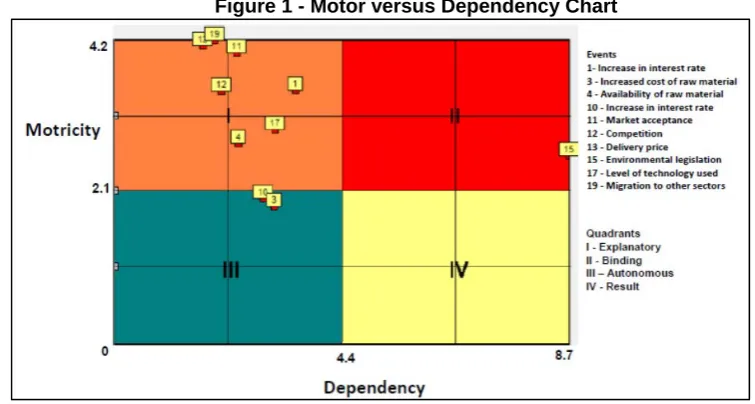
The cross-impact matrix generated by Puma originates a Motricity chart versus dependence "that allows you to verify the relevance, performance and the implications of each variable in the system" (CAMARGO. 2005, p. 74).
This chart aims to divide the 10 definitive events in 4 quadrants that appear in the same plan. The events are presented in the explanatory variables, autonomous, and results. As Carneiro et al. (2011). the explanatory variables have the remain of the conditioning system attribute. The link connecting the explanatory variables with the result. Autonomous variables are not decisive for the system and may be excluded from the analysis without major consequences; and the result is explained by the explanatory variables or call.
Figure 1 shows the graph generated by Puma for the study of the scenarios between the companies of wooden frames. It is verified that the majority of the events is in the quadrant of the explicative variables: 1 - Increase of the cost of the workmanship. 4 - Availability of raw material. 11 - Acceptance of the market. 12 - Competition. 13 - Price practiced. 17 - Technological level used. 19 - Migration to other sectors.
Among the link variables only the event: 15 - Environmental legislation
And in the autonomous variables the events: 3 - Increase in the cost of the raw material and 10 - Increase of the interest rate.
Figure 1 - Motor versus Dependency Chart
Source: Research data (2016)
4.4. Generation of scenarios
The next step of the Grumbach Method involved the generation of the scenarios. With the ten events. the Puma generated 64 scenarios. being arranged in decreasing order of the relative probability of occurrence. being the events characterised by their Occurrence (Oc) or non-occurrence(Noc). Table 4 shows the first fifteen scenarios generated by the software, considering that together they account for approximately 50% of the total occurrence probability of the scenarios
Table 4 - Scenarios generated - partial sample (fifteen first events
Scenarios probability
(%)
Events
1 3 4 10 11 12 13 15 17 19
Scenario 1 13.260 Oc Oc Oc Oc Oc Oc Oc Oc Oc Oc
Scenario 2 8.504 Noc Oc Oc Oc Oc Oc Oc Oc Oc Oc
Scenario 3 3.450 Oc Noc Oc Oc Oc Oc Oc Oc Oc Oc
Scenario 4 2.791 Noc Noc Oc Oc Oc Oc Oc Oc Oc Oc
Scenario 5 2.597 Oc Oc Oc Oc Oc Oc Oc Oc Oc Noc
Scenario 6 2.496 Oc Oc Oc Oc Oc Noc Oc Oc Oc Oc
Scenario 7 2.354 Oc Oc Oc Oc Oc Oc Noc Oc Oc Oc
Scenario 8 2.249 Oc Oc Oc Oc Noc Oc Oc Oc Oc Oc
Scenario 9 2.011 Oc Oc Oc Oc Oc Oc Oc Oc Noc Oc
Scenario 10 1.912 Oc Oc Oc Noc Oc Oc Oc Oc Oc Oc
Scenario 11 1.774 Oc Oc Oc Oc Oc Oc Oc Noc Oc Oc
Scenario 12 1.689 Noc Oc Oc Oc Oc Oc Oc Oc Oc Noc
Scenario 13 1.686 Oc Oc Noc Oc Oc Oc Oc Oc Oc Oc
Scenario 14 1.676 Noc Oc Oc Oc Oc Noc Oc Oc Oc Oc
Scenario 15 1.582 Noc Oc Oc Oc Oc Oc Noc Oc Oc Oc
Considering the first three scenarios. it is observed that in scenario 1. all events occur. in scenario 2 only event 1 - Labor cost increase does not occur and in scenario 3 only event 3 - Cost factor increase does not occur.
4.4.1 Interpretation of scenarios
It is at the moment of interpretation that the most probable scenario. the ideal scenario and the trend scenario are described as described by Marcial and Grumbach (2008. pp. 151-152):
Most probable scenario: this is the description of the evolution of the scene that composes the current conjuncture to the conformation of another scene, hypothetical at the end of the time horizon defined for the work. Which according to the invited experts is, according to the current conditions, the one of greater probability of occurrence.
Ideal scenario: is the one in which favourable events occur and unfavourable events do not occur.
Trend scenario: this is likely to occur if trends are not disrupted that is if the course of events remains the same as in the present moment.
Table 5 highlights the interpretation of the scenarios for the timber framing sector. From the definition of the most probable scenario were evaluated the occurrences or non-occurrences within the ideal and trend scenario. The software defines the group in which each event fits as well as aspects related to pertinence. motor and probability.
The O / I variables (outside / inside) of the company area were filled by the companies' ability to act in the events. It is observed that the majority of the events present a probability higher than 80%, being that at this moment the software generates the probability of occurrence of the considered event, independently of the focused scenario. It is the sum of the probabilities of occurrence of all the scenarios in which that event occurs (BRAINSTORMING. 2010).
Table 5 - Interpretation of the prospective scenarios for the sector
Events +Prov. Ideal Tend. Grupo O/I Pert. Motr. Prob.
1 - Increase in the cost of labor Oc Noc Oc I F 7.33 3.51 60.70%
3 - Increase in the raw material cost Oc Noc Oc I F 7.67 1.90 79.55%
4 - Availability of raw material Oc Noc Oc I F 7.67 2.77 86.48%
10 - Increase in interest rate Oc Noc Oc I F 7.33 2.01 85.74%
11 - Acceptance of the market Oc Oc Noc III F 7.17 4.05 82.94%
12 - Competition Oc Oc Oc IV F 7.17 3.49 81.94%
13 - Price charged Oc Oc Noc III D 7.33 4.13 81.79%
15 - Environmental legislation Oc Oc Oc IV F 7.17 2.60 87.26%
17 - Technological level used Oc Noc Oc I D 7.17 2.97 85.01%
19 - Migration to other sectors Oc Noc O I D 7.83 4.20 81.05%
Source: Research data (2016)
Oc = Occurrence / Noc = Non-occurrence
Marcial and Grumbach (2008) highlight the differences and characteristics between the groups that define the prospective scenarios:
- Group I (Strong Threat): The Event indicated by the Most Likely Scenario is different from that indicated in the Ideal and is equal to that seen in the Trend. If the Ideal Scenario indicates the desirable events, that is. favourable to the institution. those that, in the Most Likely, point in the opposite direction, should be considered as unfavourable. Moreover, this degree of unfavorability will be even greater when the Trend Scenario indication equals that of the Most Likely.
- Group II (Moderate Threat): The Event indicated by the Most Likely Scenario is different from that indicated in the Ideal and also that seen in the Trend. Here the unfavorability persists. Although somewhat attenuated given a "good" tendency, so that the event equals the Ideal, although without disregarding the possibility of "more" tendency ruptures
- Group III (Moderate Opportunity): The Event indicated by the Most Likely Scenario is equal to that indicated in the Ideal. but different from that seen in the Trend. By employing inverse reasoning. these events must be considered favourable. keeping in mind. However. that a "bad" tendency has been identified in the opposite direction, although here too trend ruptures may occur. Which, in this case would be "good."
From this classification, the interpretation of the prospective scenarios for the window frames sector was delineated as follows:
Most of the events were concentrated in Group I. which poses a substantial threat to the sector and includes: 1 - Increased labor costs. 3 - Increased raw material costs. 4 - Availability of raw materials. 10 - Increase in the interest rate. 17 - Technological level used and 19 - Migration to other sectors.
No event was included in Group II, In Group III. the following events were highlighted: 11 - Acceptance of the market and 13 - Price practised. representing a moderate opportunity for the sector. Also. in Group IV were included the events: 12 - Competition and 15 - Environmental legislation. representing great opportunities to the sector
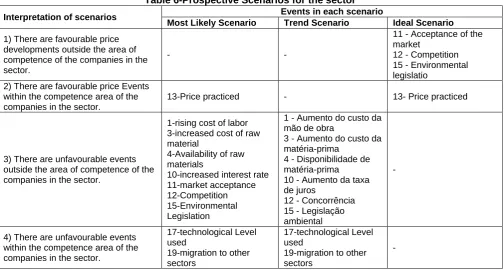
In table 6 are defined the events in each scenario. Considering the favourable or unfavourable events within and outside the area of competence of the companies in the sector of wood frames. Events can be considered as strategic issues, or possible future occurrences, external companies, which tend to have a significant impact on the ability to achieve their goals. Can be a result of opportunities and/or strengths. generating favourable events as much as you can due to threats and/or weaknesses, resulting in adverse events (BRAINSTORMING. 2010).
Table 6-Prospective Scenarios for the sector
Interpretation of scenarios Events in each scenario
Most Likely Scenario Trend Scenario Ideal Scenario
1) There are favourable price developments outside the area of competence of the companies in the sector.
- -
11 - Acceptance of the market
12 - Competition 15 - Environmental legislatio
2) There are favourable price Events within the competence area of the companies in the sector.
13-Price practiced - 13- Price practiced
3) There are unfavourable events outside the area of competence of the companies in the sector.
1-rising cost of labor 3-increased cost of raw material
4-Availability of raw materials
10-increased interest rate 11-market acceptance 12-Competition 15-Environmental Legislation
1 - Aumento do custo da mão de obra
3 - Aumento do custo da matéria-prima
4 - Disponibilidade de matéria-prima 10 - Aumento da taxa de juros
12 - Concorrência 15 - Legislação ambiental
-
4) There are unfavourable events within the competence area of the companies in the sector.
17-technological Level used
19-migration to other sectors
17-technological Level used
19-migration to other sectors
-
Source: Research data (2016)
Table 6 construction was performed from the interpretation of the expert group. based on the results presented by Puma. It turns out that most of the events is between the adverse events outside the area of competence of the companies in the sector, requiring attention in relation to these threats, as part of the external environment, where organizations have very limited conditions acting. Two events are considered unfavorable in the area of competence, which includes the technology used and the migration to other sectors. These events can also be assessed from the perspective of market opportunity, not negative anyway. because the improvement of technology, despite requiring investment, can be an ally of development. Similarly. the migration to other sectors, such as furniture, can be an interesting market opportunity and capable of generating new perspectives to frames.
5. FINAL CONSIDERATIONS
The prospective scenarios found for the companies of the sector of timber frames show a greater propensity to events considered unfavourable outside and within the area of competence of the company. including the rising cost of labor. rising cost of raw material. the availability of raw material. increased interest rate. market acceptance. competition and environmental legislation. as well as issues related to the technology used and the migration to other sectors. such as furniture manufacturing.
It should be noted that an important limitation is related to the number of participating companies. It should be noted that many companies in the region under review closed in recent years. others have changed and others did not want to participate. which limited participation and generated results fall short of what was expected initially to this work. Another relevant limitation related to specialists. because the region has no professional or researcher specializing in the squares. Regional universities and municipal bodies also do not have information about the industry. which may have affected the results.
Thus. future studies are suggested as a way to broaden the debate about the relationship between perspective scenarios and the formulation of strategies that can contribute to the development of economic sectors. such as the wooden frames. which over time. are realizing falls and breaks in your field of business. It is important that new research can be conducted on the subject. and the evaluation of the limitations found in this study must be considered in order to conduct new studies of scenario. using the method of Grumbach.
Another suggestion is the realization of the study of scenarios in sectors where companies of wooden frames have migrated in recent years. as is the case with the furniture. This sector is more organized with associations and other regulatory bodies. able to present relevant data and can enable the generation of pertinent information to the reality of the companies. In addition. it is expected that new research may use the methodology presented. as well as expand the discussion about the importance of prospecting in the generation of information for the delineation of strategic planning since the own method of Grumbach enables guiding data generation and to assist in the formulation of the strategy for companies and industries as a whole
REFERENCES
BLOIS. H. D. (2006). Proposta de um modelo de integração entre cenários prospectivos e a dinâmica de sistemas através de uma agência de desenvolvimento para o setor calçadista. Tese de Doutorado. Universidade Federal de Santa Catarina. Florianópolis. Brazil.
BORNHOLDT. W. (2005). Governança na empresa familiar: implementação e prática. Porto Alegre: Bookman.
005). Método Grumbach de gestão estratégica. Rio de Janeiro. RJ. 2010. Disponível em: http://www.mpba.mp.br/cge/publicacoes/instrumentos/aplicacao_metodo_ grumbach.pdf. Acesso em: 04 mai. 2015.
Método Grumbach de gestão estratégica. Disponível em:
http://www.brainstormingweb.com.br/publicacoes.brain. Acesso em: 04 mai. 2015.
CAMARGO. O. (2005) Uma contribuição metodológica para planejamento estratégico de corredores de transporte de carga usando cenários prospectivos. Florianópolis: UFSC/Centro Tecnológico. 2005.
CAMARGO. M. E.; PRIESNITZ FILHO. W.; SILVA. J. L. S.; MALAFAIA. G. C.; CRUZ. M. R.; MOTTA. M. E. V. (2014). Construção de cenários prospectivos em sistema agroalimentar de Vacaria. Rio Grande do Sul. Brasil.
Agroalimentaria. v. 20. n. 38. p. 137-149.
CARNEIRO. F. S. A.; RODRIGUES. M. V.; RODRIGUES. G.; BARRETO. L. R.; SAMPAIO. C. B. P. (2011). Método de criação de cenários prospectivos para o ensino superior brasileiro na visão da engenharia de produção. XXXI Encontro Nacional de Engenharia de Produção. Belo Horizonte.
FERNANDES. A. G. (2004). Esquadrias residenciais de madeira: contextualização de variáveis para otimização de projetos. Dissertação de Mestrado. Universidade Federal do Rio Grande do Sul. Porto Alegre.
FEPAM - Fundação Estadual de Proteção Ambiental Henrique Luiz Roessler - RS. Licenciamento ambiental (2016). Disponível em: http://www.fepam.rs.gov.br/central/ licenciamento.asp. Acesso em: 24 jan. 2016.
GODET. M.; DURANCE. P. (2008). Prospectiva estratégica para as empresas e os territórios. Cadernos do LIPSOR. GUELLA. A.; SATTLER. M. A. (2004). Esquadrias residenciais em madeira: contextualização de variáveis para
otimização de projetos. I Conferência Latino-Americana de Construção Sustentável e X Encontro Nacional de Tecnologia do Ambiente Construído. São Paulo. julho.
INO. A.; SHIMBO. I.; SOUZA. A. J. D. S. (2003). Otimização do processo de fabricação de esquadrias de madeira no centro produtor da região Sul e desenvolvimento de janelas de baixo custo para habitação social. Coletânea Habitare. v.2. Inovação. Gestão da Qualidade & Produtividade e Disseminação do Conhecimento na Construção Habitacional. p. 422-451.
MARCIAL. E. C.; GRUMBACH. R. J. S. (2008). Cenários prospectivos: como construir um futuro melhor. 5. ed. Rio de Janeiro: FGV.
MASSETTO. L. T.; HAITO. R. O.; BERNARDES. M.; SABBATINI. F. H.; BARROS. M. B. (2008). Análise do mercado de esquadrias no Brasil baseada em aspectos de desempenho. XII Encontro Nacional de Tecnologia do Ambiente Construido - ENTAC. Fortaleza.
OLIVEIRA. O. V.; FORTE. S. H. A. C. (2010). O uso de cenários prospectivos na formulação da estratégia: uma aplicação na indústria bancária brasileira. VII Convibra Administração – Congresso Virtual Brasileiro de Administração.
REMADE. Revista da Madeira. Esquadrias: uso da madeira na produção de portas e janelas. ed. 91. agosto/2005. Disponível em: http://www.remade.com.br/br/revistadamadeira_ materia.php?num=775&subject=... Acesso em: 20 jan. 2016.
SCHNAARS. S. P. (1987). How to develop and usescenarios. Long Range Planning. v. 20. n. 1. p. 101-114.
SOUZA. I. D. S.; TAKAHASHI. V. P. (2012). A visão de futuro por meio de cenários prospectivos: uma ferramenta para a antecipação da inovação disruptiva. Future Studies Research Journal. São Paulo. v.4. n.2. p. 102-132. Jul./Dez.
TADEU. H. F. B.; SILVA. T. M. (2013). Simulação de cenáriospara o planejamento estratégico empresarial. Caderno de Ideias FDC. Nova Lima.
ZACKIEWICZ. M.; SALLES-FILHO. S. (2001). Technological foresight: um instrumento para política científica e tecnológica.