Opinion of the Magistrates of the Labor Sphere
Regarding the Appointment, Quality and
Relevance of Expert Reports
Tânia Carissimi Fochezatto, University of Caxias do Sul, Brazil
Marta Elisete Ventura da Motta University of Caxias do Sul, Brazil
Alice Munz Fernandes
Federal University Rio Grande do Sul, Brazil
Maria Emilia Camargo University of Caxias do Sul, Brazil
Ademar Galelli
University of Caxias do Sul, Brazil
Beatriz Lúcia Salvador Bizotto University of Caxias do Sul, Brazil
Abstract
The accounting expert is the set of technical-scientific procedures intended to bring to the decision-making body evidence necessary to subsidize the fair settlement of the litigation or finding of fact, by means of the accounting expert's report and / or expert opinion. The objective of this study was to analyze the perception of the Magistrates, the Labor Court of Bento Gonçalves, Caxias do Sul and Farroupilha, Brazil in relation to the appointment of the accounting expert, the quality of the reports and their contribution in judicial decisions. For that, a quantitative-qualitative, exploratory and descriptive research was carried out, through a survey applied to the Magistrates of these Varas. The results obtained demonstrated that curriculum analysis, professional experience and constant improvement and completion of courses consist of relevant factors for inclusion in the list of experts and future appointments. It was also verified that, regarding the quality of the reports, the Magistrates are satisfied with the works currently presented, but they have suggested improvements regarding clarity, security, objectivity and compliance with deadlines. For future investigations, it is recommended to replicate this research in other Labor Courts as well as the analysis of the perception of the Experts regarding their collaboration in the decision-making process of the Magistrates.
Keywords: Accounting Skills. Forensic Report. Expert.
1. INTRODUCTION
The forensic accounting appears as a relevant area of accounting, in which the expert must possess, in addition to the legal condition, technical ability, moral integrity and responsibility to exercise the profession (BLEIL; SANTIN, 2008; MAGALHAES et al., 2009). With a view to this, the forensic accounting is understood as "that held within the procedural procedures of the judiciary, for determination, request or need of their active agents and takes place according to specific legal rules" (ALBERTO, 2009, p. 3 ), especially in relation to forensic accounting Labor Court.
Forensic accounting market is expanding, especially in the labor area. According to data of the Superior Labor Court (TST), the number of cases to be judged by each Magistrate rises annually, going from 16,620 processes in 2012 to 22,229 in 2014. In Caxias do Sul, between 2010 and 2015, has registered the maximization of 87.5% in the number of labor filed claims (DEMOLINER, 2016). Thus, it appears that the growth in the number of lawsuits can influence the market expertise as it provides performance opportunities for professional accounting, primarily related to labor issues.
2. THEORETICAL REFERENCE
2.1. Accounting Period
The word skill, according to Moura (2007) is from from the Latin peritia, meaning a type of evidence, science, knowledge, experience, skill and knowledge. According to Samuel (2009), the forensic accounting in Brazil was included for the first time for debate before an event of class in the I Brazilian Congress of 1924 accounting. It was at this event that concluded collectively about the need for formalization of judicial expertise, whose work would be assigned to the members of the privately spoken about Cameras claim to assign to the boards of accounting, when created, the supervision of the work of the expert.
The Civil Procedure Code (CPC) of 1939 established vague rules about expertise. On 27 May 1946, with the advent of Decree-Law No. 9,295/46, were created the Federal Accounting Council (CFC) and the regional councils and regulated the profession of accountant, and institutionalized-if the forensic accounting. With Bankruptcy legislation, Decree No. 45/7,661, with amendments of the law n° 4,983/66, in their arts. 63, item VI; 93, § 1; 169, item VI; 211 and 212, subparagraphs I and II, were established forensic accounting rules, assigning to the counter to the expert. With the CPC in 1973, Law n° 5,869/73, by means of modifications that have been carried out by complementary laws, is that was established clear legislation and applicable to judicial expertise (MAGALHÃES et al., 2009).
According to Alberto (2007), the forensic accounting appears as a tool of observation, proof or demonstration of the veracity of the facts related to the patrimony. The Brazilian accounting Standard established by TP 01 CFCNBC, forensic accounting, of 27 February 2015, conceptualizes forensic accounting as being the set of technical-scientific procedures that provide subsidies for the just decision making, through a report and/or expert technical advice.
2.2. Accounting Expert and Pericial Award
NBC PP 01 – forensic accounting, of 27 February 2015, defines Expert as being "counter, regularly registered in Regional Accounting Council, holding the expert activity personally and connoisseur, by their qualities and experiences, field tested ". According to Hoog (2003), expert is set as the top level professional, specializing in tax-accounting matters, appointed by the Judge, which reveals acts and facts pertinent to assets, and serves as a scientific support, that is, it is the "technological eye" of the magistrate.
The expert report is the materialization of the work developed by the expert appointed, in which exposes the observations and studies that have been carried out and the conclusions on the facts submitted to your consideration (TRAVASSOS; ANDRADE, 2010). Is the report that constitutes the forensic work with regard to exposure and documentation, especially as the express expert opinion on the issues raised in the questions. The report is the forensic documentation, documenting the facts, operations performed and the conclusions that the expert obtained properly reasoned. (MAGALHÃES et al., 2009).
Alberto (2009) notes that the report is the result of visible material every effort perquiritório, intellectual and professional investigative. According to Sá (2009), the forensic accounting report appears as a technological piece that contains reviews of accounting expert on questions are formulated and which require your announcement. So, the CPC establishes the requirements that must be met in order for the preparation of the expert report, namely: the object display expertise, technical analysis carried out by the expert, the method employed and conclusive answer to all the questions submitted by the magistrate.
3. METHODOLOGICAL PROCEDURES
The survey was classified as qualitative and quantitative compared the approach to the problem. With regard to purpose, this was an exploratory and descriptive, since it aims to maximize the familiarity of the researcher in relation to the problem of research, as well as describes the characteristics of a given population (GIL, 2010).
As for the technical procedures, performed a survey with cross section, whose respondents were the magistrates of sticks of Bento Gonçalves and Caxias do Sul, Farroupilha, Brazil, counties located in the State of Rio Grande do Sul, Brazil. As a tool for data collection, we used a semi-structured questionnaire adapted from Silverio and Zolet (2009) and Silveira et al. (2013). Thus the questionnaire applied was composed of 30 (thirty) issues that comprised the characterization of the respondent's profile, procedures for inclusion of experts counters, the criteria of expert reports and the collaboration of reports on decision making.
Thus, the responses were measured by using a likert-type scale of 5 (five) points, depending on the degree of agreement/disagreement. There were also two "open" questions about the new features and improvements of the forensic work supplied to Sticks. The questionnaire was delivered directly at the registry of the sticks of Bento Gonçalves, composed of 2 (two) sticks, Caxias do Sul, composed of 6 (six) sticks and Ragamuffin, composed of single stick. The results presented are based on the answers obtained by 10 (ten) magistrates respondents, representing the non-probabilistic sample of this research. The application of the questionnaire took place in the months of April and May 2016.
facilitated through the software Statistical Package for the Social Scienses (SPSS) version 20. For your time, both qualitative issues were analyzed using content analysis, which according to Bardin (2011), minimises the amount of collected material, through the categorization of results.
4. PRESENTATION AND ANALYSIS OF RESULTS
With regard to the profile of the respondents, there was a predominance of males (60%), as well as the age group between 41 and 50 years (60%). It should be noted that there was no magistrate search participant under the age of 30 years. As for the usual procedure for registration on the list of experts of the sticks, the preference for delivery option of Curriculum Vitae on request with interview with judge Rod holder and/or Director was, by 40% of respondents.
For your time, the single procedure of request for inclusion in the roster of experts, upon request, with delivery of Curriculum Vitae on the rod, was also singled out by 30% of respondents. Have the option of third party indication/indication of other Sticks was chosen by 40% of respondents. Only one of the judges surveyed pointed as usual procedure the request for inclusion by delivering curriculum via e-mail.
It was noted the relevance of the curriculum presented and professional experience for purposes of appointment of experts, being chosen exclusively for 5 (five) of judges surveyed, representing 50% of the sample. The other options, such as area of expertise and specialization of the expert, corresponded to 20%, third recommendation, also scored 20%, in conjunction with other options and already know the work of the expert, featured 10%.
In this respect, in study by Neves Júnior and Medeiros (2015), whose respondents they were magistrates of Counties of the State of Rio de Janeiro, it was found that the curriculum contributes 37.03% as one of the factors used for the choice of experts as auxiliaries of the Judgment. Be entered in the register system experts contributed 77.77% TJRJ, quality in work with 62.96% and specificity of the subject being treated corresponded to 48.14%. In order to demonstrate, from the moment that the expert has been properly included in the roster of experts, which the criterion is commonly used for appointments, drew up the Table 1.
Table 1 - Criteria used for the selection of the Expert to be appointed
Criteria for nomination Percentage (%)
Sweepstakes or random distribution 20
Time of actions on the Stick 10
Type of work presented
Time of actions on the rod and the determination of the judge
40 10 Other/Scale
Not responded
10 10 Source: search results (2016).
In this respect, the present research also finds support in study by Neves Júnior and Medeiros (2015), where he questioned the judges about the variables that contribute to the maintenance of the experts in the sticks where they operate, 100% of respondents replied that the efficiency of the report produced is responsible for the maintenance of appointments. The technical ability and mastery of the subject featured 81.48%, the trust of fingertips magistrate's expectations with 17% and punctuality in the delivery of services accounted for 16%.
With regard to the number of registered accounting experts in the sticks, it was found that only 10% of the respondents have in their records to 3 experts, 30% said they had of the 4 5 experts, 30% claimed to have 6 to 10 of experts and the remaining 30% claimed to have over 11 registered experts. On the other hand, as with experts acting appointees, 40% of respondents claimed to be on their Sticks up 3 experts, 50% said that experts who work and are 4 to 7 appointed experts and 10% say the experts acting appointees are over 12.
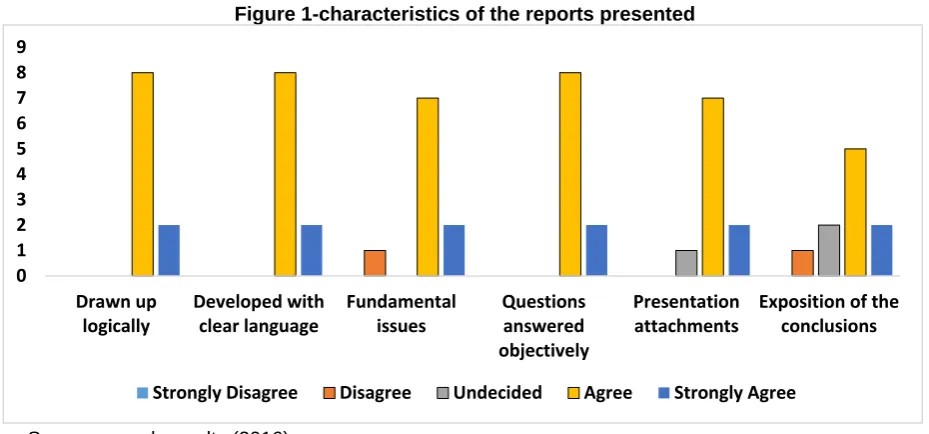
With regard to the graduation of experts appointed, 90% of respondents stated that they have a degree in Accounting and 10% say that have a degree in economics. Have professional experience in forensic accounting offices to professional registration purposes by the roster of experts, assumed importance for 80% of the respondents. Similarly, the participation of the expert in courses in your training area and other areas is important for 80% of the respondents. With regard to expert reports presented, as a logical form of development, developed sequentially, which makes the understanding of the subject in question and other relevant criteria to provide subsidies to the decision-making process of the magistrate, presents the Figure 1.
Figure 1-characteristics of the reports presented
Source: search results (2016).
As for the elucidation of issues with presentation of ramming and rationale, research demonstrates satisfaction by 90% of the respondents. The study by Neves Júnior et al. (2014) with judges of the State of Rio Janeiro demonstrated, in questioning similar to 60% of the respondents generally the reports offer reasoned answers, 20% answered always and 17% responded. The accounting expert reports showed that the expert has full knowledge of the facts that are being demanded as well as they are able to achieve their goals and clarify the questions are proposed. Thus, it was found that there is virtually unanimous agreement of the respondents, as shown in Figure 2.
Figure 2 - Knowledge of matter defendant and contribution to decision-making
Source: search results (2016).
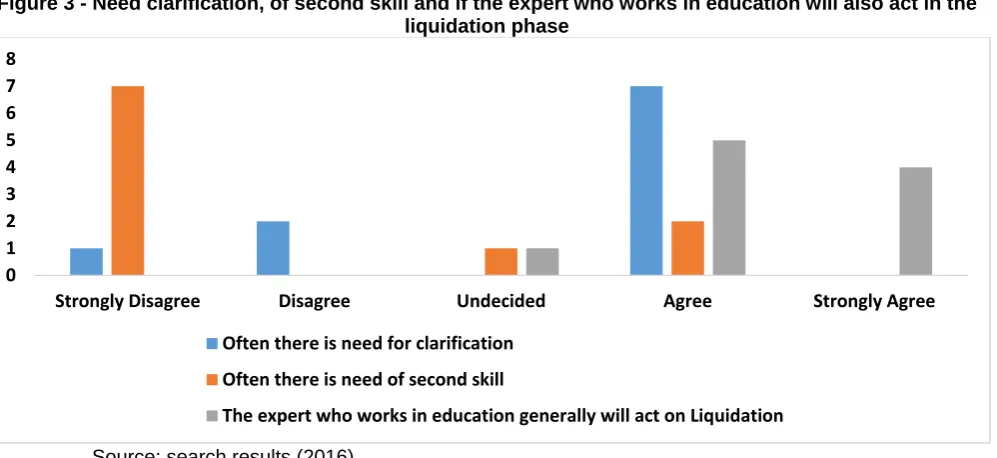
The results of this research, therefore, reinforce earlier studies, as performed by Neves Júnior et al. (2014) and Ribas (2014), that the expert report accounting it is important tool for decision-making of the magistrates. As for the question about the need for clarification on the content of expert reports, either at the request of the parties or at the request of judges, 70% of those surveyed responded that often the request request for clarification.
Regarding the need for a second forensic accounting, due to omissions or lack of clarification, only 20% of respondents stated that there is such a need, what comes to confirm that the reports presented generally account for proposed issues reaching your goals. And when it comes to work satisfactorily, it is noticed that the expert who was appointed and served in the statement is the same professional appointed to conduct the winding sentence.
Questioned about the calculations of liquidation of sentence, the judges were unanimous in stating that they have clarity in presentation and ease of understanding. In this respect, it was found that the experts are reaching the point of nomination, that second Zanna (2005) is to introduce the quantification of rights sentenced, i.e. What is expected from the expert in the Justice's work is to provide clear calculations, simple,
0 1 2 3 4 5 6 7 8 9
Drawn up
logically Developed withclear language Fundamentalissues Questionsanswered objectively
Presentation
attachments Exposition of theconclusions
Strongly Disagree Disagree Undecided Agree Strongly Agree
0 1 2 3 4 5 6 7 8 9
Demonstrate full knowledge of the facts demanded Reach the objectives Contribute to decision making Settlement calculations are clear and easy to understand
easily understood by lay people and you are correct to point, labor, social security, claims relating to the guarantee fund for length of service (FGTS) and quantify the withholding tax for Revenue Brazil's Federal (IRPJ).
Therefore, the role of the expert accountant in the Labour Process is to introduce the quantification of rights that were sentenced. Figure 3 indicates the frequency of the need for clarification of second skill, as well as the incidence of appointment the same expert who served near the settlement statement.
Figure 3 - Need clarification, of second skill and if the expert who works in education will also act in the liquidation phase
Source: search results (2016).
As regards the presentation of expert reports within the time designated by the judges, 70% of the respondents agree that the works are delivered on time. To 30% of them, the reports have not been submitted within the time limit. In this sense, the study of Fernandez et al. (2012) found the same percentage of satisfaction as to the observance of the deadlines for these professionals. In this respect, it is important to note that NBC PP 01, establishing the criteria inherent in the role of the accountant provided Expert, provides that compliance with the deadlines set by the judge appears as one of the requirements to be observed by the expert with regard to zeal Professional in carrying out the work.
Deadlines is related directly to the planning of expertise, in accordance with the provisions laid down in item 31 (c) NBC TP 01, since the experts shall provide conditions for the work to be completed within the time limit set. As pointed out by Samuel (2009), a work plan depends on in addition to the full knowledge of the case and all the facts that motivate the task, prior surveys and data for examination, the determination of the period or time for the execution of tasks and the delivery report or opinion by elaborate schedules prior to verifying the feasibility of carrying out the work in a timely manner.
How to setting the fees accounting expert, it was found that 70% of respondents stated that the fees are determined by the judge and for 50% of them considered the complexity of the work performed, as well as the form of presentation of the work. Such results are set out in Table 1.
Table 1 – Way of fixing the accounting expert fees
Way of fixing fees accounting expert Percentage (%)
By arbitration judge 40
For arbitration of the Judge and depending on the complexity of the work performed and the manner of presentation
Depending on the complexity of the work performed and the manner of presentation Table of fees previously set by Rod
30 20 10
Source: search results (2016).
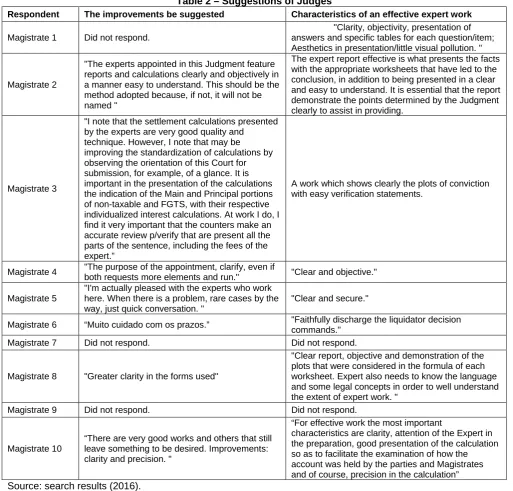
In this sense, resembles the survey study by Flores et al. (2012), where it found that 85% of surveyed, to consist of predominant factors for the arbitration of the expert fees, complexity, time spent, and the quality of work. The results tabulated in this study are complemented by observations made by magistrates in two open questions, where they performed suggestions and remarks about the subject. Was requested to the magistrates to demand improvements in education Reports and Calculations of liquidation of Sentence based on expert
0 1 2 3 4 5 6 7 8
Strongly Disagree Disagree Undecided Agree Strongly Agree
Often there is need for clarification Often there is need of second skill
work presented. They were also asked to describe the characteristics of an effective expert work. In table 2, the analysis were presented.
Table 2 – Suggestions of Judges
Respondent The improvements be suggested Characteristics of an effective expert work
Magistrate 1 Did not respond.
"Clarity, objectivity, presentation of answers and specific tables for each question/item; Aesthetics in presentation/little visual pollution. "
Magistrate 2
"The experts appointed in this Judgment feature reports and calculations clearly and objectively in a manner easy to understand. This should be the method adopted because, if not, it will not be named "
The expert report effective is what presents the facts with the appropriate worksheets that have led to the conclusion, in addition to being presented in a clear and easy to understand. It is essential that the report demonstrate the points determined by the Judgment clearly to assist in providing.
Magistrate 3
"I note that the settlement calculations presented by the experts are very good quality and
technique. However, I note that may be improving the standardization of calculations by observing the orientation of this Court for submission, for example, of a glance. It is important in the presentation of the calculations the indication of the Main and Principal portions of non-taxable and FGTS, with their respective individualized interest calculations. At work I do, I find it very important that the counters make an accurate review p/verify that are present all the parts of the sentence, including the fees of the expert.”
A work which shows clearly the plots of conviction with easy verification statements.
Magistrate 4 "The purpose of the appointment, clarify, even if
both requests more elements and run." "Clear and objective." Magistrate 5
"I'm actually pleased with the experts who work here. When there is a problem, rare cases by the way, just quick conversation. "
"Clear and secure."
Magistrate 6 “Muito cuidado com os prazos.” "Faithfully discharge the liquidator decision commands."
Magistrate 7 Did not respond. Did not respond.
Magistrate 8 "Greater clarity in the forms used"
"Clear report, objective and demonstration of the plots that were considered in the formula of each worksheet. Expert also needs to know the language and some legal concepts in order to well understand the extent of expert work. "
Magistrate 9 Did not respond. Did not respond.
Magistrate 10
“There are very good works and others that still leave something to be desired. Improvements: clarity and precision. "
“For effective work the most important
characteristics are clarity, attention of the Expert in the preparation, good presentation of the calculation so as to facilitate the examination of how the account was held by the parties and Magistrates and of course, precision in the calculation”
Source: search results (2016).
As a transcription of the responses obtained, the variables that take on importance in the presentation of forensic accounting reports, whether at the stage of instruction, whether at the stage of liquidation, according to the perception of judges. The analysis of the information collected generally demonstrate that the respondents are satisfied with the work currently presented, however, it is possible to make improvements as the comments highlighted.
5. FINAL CONSIDERATIONS
With regard to the quality of the reports presented, generally speaking, the judges surveyed are satisfied with the work, since virtually unanimously the respondents acknowledged that the reports feature as a general rule, the requirements for literature, as well as described on NBC TP-01, about being drafted so thorough, clear and objective, enabling the understanding and facilitating the understanding and interpretation of information. Also predominates among the surveyed, the contention that the forensic accounting reports contribute to the decision-making process and that the expert appointed in the instruction, if necessary the liquidation, will be the same professional assigned to such a stage, as 90% of the respondents, which demonstrates the confidence of the magistrate in the expert appointed.
As limitations of the research, noted the size of the sample used and also the difficulty of access to searchable, which perhaps is justified by the position he engaged, as well as the impossibility of generalization of the results obtained. Stands out as suggestions for future investigations which are conducted searches in other Sticks of Justice work, in order to expand the study on the insertion of an expert in the labor market of forensic accounting, as well as evaluate the perception and satisfaction of magistrates in relation to forensic work and, if possible, propose ways to improve them.
REFERENCES
ALBERTO, V. L.P. Perícia Contábil. São Paulo: Atlas, 2009. BARDIN, L. Análise de conteúdo. São Paulo: Edições 70, 2011.
BLEIL, C.; SANTIN, L. A. B. A perícia contábil e sua importância sob o olhar dos Magistrados. Revista de Administração e Ciências Contábeis do IDEAU, v. 3, n. 7, 2008.
BRASIL. Código de Processo Civil. Lei 5.869 de 11 de janeiro de 1973. Código de Processo Civil. Disponível em: Acesso em 25 Out. 2015.
Decreto Lei n. 10406, de 10 de janeiro de 2002. Código Civil. Disponível em: Acesso em: 25 de out. 2015.
Decreto Lei n. 1608, de 18 de setembro de 1939. Cria o Código de Processo Civil. Disponível em: Acesso em: 25 Out. 2015.
Decreto Lei n. 3689, de 03 de outubro de 1941. Código de Processo Penal. Disponível em: Acesso em: 25 de out. 2015.
Decreto Lei n. 8570, de 08 de janeiro de 1946. Da nova redação a dispositivos do Código de Processo Civil. Disponível em: Acesso em: 25 Out. 2015.
Decreto Lei n. 9295, de 27 de maio de 1946. Cria o Conselho Federal de Contabilidade, define as atribuições do Contador e do Guarda-livros, e dá outras providências. Disponível em: Acesso em: 25
Constituição da República Federativa do Brasil, de 5 de outubro de 1988. Disponível em:. Acesso em: 25 de out. 2015.
Decreto Lei n. 7.661/1945. Lei de Falências. Disponível em: Acesso em: 11 Jun. 2016.
Lei nº 13.105, de 16 de Março de 2015. Código de Processo Civil. Disponível em: Acesso em: 25 Mar. 2015.
DEMOLINER, A. Justiça do Trabalho: Processos disparam 87,5%. Jornal Pioneiro, Caderno Economia, Caxias do Sul, 12 abr. 2016, p. 03, 2016.
GIL, A. C. Como elaborar Projetos de Pesquisa. 5. ed. São Paulo: Atlas, 2010.
FERREIRA, T. B. et al. Qualidade do laudo pericial contábil trabalhista: percepção dos Magistrados das varas trabalhistas do Recife. Registro Contábil, v. 3, n. 3, p. 54-70, 2012.
HOOG, W. A. Z. Prova Pericial Contábil: aspectos práticos & fundamentais. 3. ed. Curitiba: Juruá, 2003. MAGALHÃES, A. D. F. et al. Perícia contábil. 7. ed. São Paulo: Atlas, 2009.
MOURA, R. Perícia Contábil: judicial e extrajudicial. 2ª ed. Rio de Janeiro: Freitas Bastos, 2007.
NBC. Normas Brasileiras de Contabilidade. NBC TP 01 – NORMA TÉCNICA DE PERÍCIA CONTÁBIL. Disponível em Acesso em: 25 Mar. 2016.
NEVES JÚNIOR, I. J.; MEDEIROS, T. A. A qualidade do laudo pericial elaborado pelo perito contador na visão dos Magistrados do Rio de Janeiro e Brasília. Revista Brasileira de Contabilidade, v. 35, 2015.
NEVES JÚNIOR, I. J. et al. Perícia Contábil Judicial: A Relevância e a Qualidade do Laudo Pericial Contábil na Visão dos Magistrados do Estado do Rio de Janeiro. Pensar Contábil, v. 16, n. 59, 2014.
ORNELAS, M. M. G. Perícia Contábil. 2. ed. São Paulo: Atlas, 1995.
RIBAS, D. M.; HORIZONTE, B. Perícia Contábil: relevância do laudo pericial contábil na tomada de decisão judicial. 2014. SÁ, A. L. Perícia Contábil. 9. ed. São Paulo: Atlas, 2009.
SILVEIRA, C. et al. A influência da perícia contábil nas decisões judiciais. Scientia Plena, v. 9, n. 11, 2013.
SILVERIO, A. C.; ZOLET, K. A qualidade do laudo pericial contábil e sua influência na decisão judicial. Biblioteca Digital Curso de Ciências Contábeis, v. 2, n. 2, 2009.
TRAVASSOS, S. K. M.; ANDRADE, M. D. Perícia contábil: uma abordagem influencial do laudo na decisão judicial.
Revista Eletrônica de Ciências, v. 8, n. 12, 2010.