Towards bridging the digital divide in post-apartheid
South Africa: a case of a historically disadvantaged
university in Cape Town
Lena Nyahodza
1and Richard Higgs
2[email protected] ORCID: orcid.org/0000-0003-0013-1070
[email protected] ORCID: orcid.org/0000-0003-2909-6555
Received: 1 June 2017 Accepted: 28 July 2017
South Africa’s historically disadvantaged university libraries are, like others, challenged to meet patrons’ demands through the provision of relevant infrastructure, services and information-related skills to enable users to function in the digital information age. Their historic disadvantage is compounded by two levels of the digital divide: their situation within a developing nation (the ‘global divide’), and contending with a relative paucity in skills and resources within this context (the ‘local divide’, as a legacy of apartheid). This paper reports on a master’s study undertaken to explore whether the electronic services initiated in post-apartheid South Africa by University of the Western Cape (UWC) Library are perceived by primary stakeholders (users and library staff) as effective in bridging the digital divide. The study employed a phenomenological qualitative design, supported by critical theory. Purposive sampling was used to select two sets of samples for data collection: postgraduate students and UWC librarians. Data was collected from forty students through an online questionnaire, and interviews were held with six UWC librarians. Findings suggest that the UWC Library has emerged as a competent agent of democracy: most of the users perceive the e-services being offered as useful and meeting their needs, and the library currently provides ICT infrastructure, internet access and information-related skills programmes to support the university community. However, challenges encountered include slow internet connection, security concerns, shortcomings in information literacy, problems of access and accessibility (including language), and reluctance to engage with unfamiliar technology. While the institution does make an effort to bridge the digital divide, recommended further research, such as evaluating the impact of slow internet speed on research and learning or enhanced interventions in information literacy, could further support more equitable access to information.
Keywords: digital divide, academic libraries, higher education, post-apartheid South Africa
1 Introduction
The digital divide may be broadly defined as the “gap between those people who have access to digital technologies and information via the internet, and those who do not” (Singh 2004: 5). Making the point that inequality of simple access to infrastructure is not a full indicator of the divide, Bornman (2016: 268) asserted that the digital divide, in addition to the above, also encompasses mental dispositions, skills and usage. Flanagan (2016: 345) extended the definition even further, noting inequities in access to the transformative potential of communications technology, as well as the fact that the population that has no access to the World Wide Web is “sizeable”. It is worth highlighting that successive definitions take cognisance of three issues that are not inherent in technology itself, namely personal factors (disposition and skills), societal factors (‘transformation’, with the implication of progress or improved well-being), and the relative numerical dominance of the ‘have nots’ in comparison to the ‘haves’. Critical reflection on the digital divide and attempts to address it therefore needs to take a view of technology in context, rather than technology for its own sake. Over and above the mere provision of infrastructure, compensating for the divide means supporting this provision with skills, changing of mind sets, leveraging transformative potential, and all while acknowledging the size of the problem. The relative supremacy of English in global discourse poses its own challenges to the emancipatory potential of technology implementation in South Africa, as it does elsewhere. Factors that contribute to the digital divide include lack of Information and Communication Technology (ICT) infrastructure, lack of or low internet connections, lack of skills, and high levels of poverty (Singh 2004, Brooks, Donavan & Rumble 2005, Tapfumaneyi & Rupande 2013). The inclusion of skills deficits and poverty in this list reinforces the statement that ICT is but one factor that must be addressed if we are to tackle the digital divide constructively.
South Africa, positioned in the global south (and therefore subject to the digital divide at a global level), but with some advantages relative to its African peers, presents a complex scenario with its population occupying both sides of the divide due to apartheid and its legacy (the digital divide at a local level). The effects of apartheid are still evident as the majority of
1. Lena Nyahodza is an MLIS graduate of the Library and Information Studies Centre, University of Cape Town. She is Scholarly Communication Librarian at the University of Cape Town Libraries
‘non-whites’3 still live in poverty (World Bank 2016). In South Africa, the apartheid policies enforced between 1948 and 1994 instigated a culture of discrimination against the majority, ‘non-white’ South Africans by various means, thus promoting white supremacy. This led to the establishment of separate universities for white and ‘non-white’ students, which was to become the ultimate realisation of policy that provided inferior education and poor learning opportunities for ‘non-whites’ (Singh 2004: 6). Tertiary institutions that provided inferior education to students reinforced through a vicious cycle the oppressive policy of the apartheid regime, both economically (by limiting access to professional career opportunities for ‘non-white’ graduates) (Johnson 1982: 220) and pedagogically, since the teachers and parents who graduated from these institutions were ill-equipped and ill-informed and thus unable to support quality education for school learners and for their children. In addition, ‘non-white’ universities were “plagued with poor infrastructure and physical facilities” (Mabokela & King 2001: xvi) and universities also experienced funding disparities in favour of the white institutions (Mabokela & King 2001: xiii). Former ‘non-white’ universities attracted the bulk of poor students. The University of the Western Cape (UWC) – a university aimed primarily at a mixed-race, Khoi and Cape Malay (collectively known under apartheid policy as ‘Coloured’) demographic – earned the soubriquet of The People’s University (Sehoole 2005: 40).
In the post-apartheid period, South Africa has acknowledged the presence of a multifaceted digital divide and previous research indicates that the inequalities established in the past have not yet been resolved (Fuchs and Horak 2008), leading to various educational barriers. The student protest movements of the past two years in South Africa (specifically, the calls for abolishment of fees and for decolonisation of curricula and universities themselves) bear witness to a deep-seated anger at the stultifying and persistent after-effects of apartheid policy and the deep inequalities that it engendered. Notwithstanding legislation, policy and funding aimed at narrowing the historical gaps, the past still influences how historically privileged and disadvantaged higher education institutions respectively position themselves with regard to the use of technology to support education (Ng’ambi et al. 2016), depending on particular institutional challenges. Despite variations in universities’ visions, bridging of the digital divide is consistently valued as a means to enhancing education development through virtual communications. Academic libraries, as education support services departments, should be positioned to play a democratising and socially equalising role that benefits economically and educationally marginalised students through the provision of technologies and other resources that enable access to electronic information.
Some initiatives by academic libraries focus on equipping users to become competent citizens in the digital era through digital literacy interventions (Naslund & Giustini 2008). However, it has been acknowledged that students’ differing levels of exposure to technologies and the economic position of the institution pose substantial challenges in bridging the digital divide (Luaran et al. 2016: 91).
While the education and enrolment system in higher education changed after apartheid, some universities’ enrolment is still dominated by students from lower-income communities. UWC, as a previously marginalised institution deprived of educational resources under apartheid, continues to attract such students and was therefore a suitable subject for this study.
2 Research Problem and purpose of the study
In this post-apartheid era, South Africa is still experiencing unequal distribution of income and educational resources as well as high crime rates (Sehoole 2005; Fuchs & Horak 2008: 115). Acknowledged indicators of the digital divide in the country include inadequate ICT infrastructure and skills and low, expensive bandwidth (Donoghue 2008; Naidoo 2012). The position of some historically disadvantaged universities could still be vulnerable since many of the transformation policies drafted have not been effectively implemented (Sayed & Jansen 2001: 6). The majority of the South African population, stricken by uneven income distribution - South Africa’s Gini coefficient ranges between 0.66 and 0.70, with the lower half of the population accounting for just 8% of the country’s income (World Bank 2016) – cannot afford educational resources, including computers and internet access (Fuchs & Horak 2008: 115). It should be noted that computers become valuable if they are connected to other infrastructure (internet, printers and scanners), which is in itself costly and requires the application of skills. In this context, the digital divide becomes a particularly noisome problem since the underprivileged majority of the population is left increasingly further behind, further exacerbating the socioeconomic divide.
Underlying the complexities of this internal digital divide within South Africa is the primary digital divide (Herselman & Britton 2002; Donoghue 2008; Naidoo 2012), arising from South Africa being on a continent that is already disadvantaged (along with many other so-called developing regions) in respect of infrastructure and skills. This disadvantage is compounded by various factors including a long history of almost-universal colonialism; ongoing civil and political conflict; endemic corruption; physical remoteness from the global west; linguistic and cultural differences that are not always aligned to the social, commercial or scientific priorities of the west; poverty; gender inequality; and much more. Against this background, tertiary education institutions in South Africa are compelled to address the two-fold digital divide as best they can. Doing so requires a significant investment in infrastructure as well as skills resources, both in the interests of equipping students with the tools they require to study and conduct research, and in the interests of broader economic empowerment that would result from extending the democratising and emancipatory reach of ICTs4. The role of libraries in this endeavour
3. Acknowledging that this term may be perceived as culturally sensitive, it is used in this document to designate apartheid-era ethnic distinctions that included ‘Indian’, ‘Coloured’ and ‘Black’, in line with the literature that informed the study. The single quotation marks are an indication that the term is used reservedly.
is paramount and may take many forms, from the provision of communally accessible infrastructure (such as workplace terminals) to training in basic computer skills as well as higher-end skills such as digital literacy and, of specific interest to libraries, the use of library tools such as online catalogues and research resources.
This study addressed the questions of whether the electronic services (e-services) initiated in post-apartheid South Africa by UWC Library are perceived by primary stakeholders (users and library staff) as effective in bridging the digital divide. The aim of the study was to identify the e-services offered by UWC and evaluate if they were perceived as useful or effective in bridging the digital divide, considering the extremely diverse socio-economic backgrounds of patrons and their varying exposure to information technologies. The following four sub-aims supported the intention of the study:
To examine the extent of and reasons for use of networked infrastructure in the library or on campus by UWC master’s students;
to investigate programmes established by UWC Library to promote the use of e-services by postgraduate students;
to ascertain whether or not master’s students perceive the UWC Library’s e-services as meeting their needs; and
to identify challenges associated with e-services available at UWC.
The primary objective of the study was to establish the degree to which an emancipatory goal is realised through the provision of e-services by UWC Library, and if this is perceived as effective. It is hoped that the findings will be useful and applicable not only to UWC in encouraging continuing investment in worthwhile programmes and initiatives, but to other similarly positioned institutions and university libraries whose stated aims are to leverage investment in ICT and associated programmes (such as information literacy) for their emancipatory and equalising potential. With full critical comprehension of the possible drawbacks of globalisation, it is possible that narrowing the digital divide can even support the objectives of decolonisation through increased exposure of African thought and research, and social responsiveness of the academic enterprise. While limited by necessity to a subset of students and to a particular university, the findings of this study may contribute in some way to supporting the definition of a model that explicitly aims to address the consequences of the digital divide(s) as experienced in and by tertiary institutions.
3 Literature review
Post-apartheid South Africa expected radical changes in the Higher Education sector. The 1997 White Paper, ‘A programme for higher education transformation’ (Department of Higher Education 1997), emphasised the necessary conditions for the attainment of full pursuit and enjoyment of lifelong learning for all races. The importance of access to and use of ICT in support of educational activities has been emphasised in higher education (Bornman 2016: 1). The shift in higher education pedagogy towards blended learning (Ng’ambi et al. 2016: 843), coupled with the changes to technology used in educational, social and economic arenas, introduced a range of new challenges for academic institutions, particularly in “previously disadvantaged universities due to financial challenges” (Singh 2004: 4). Students without prior exposure to ICTs lack technology skills, hence the need for both computer and information literacy classes. Naidoo and Raju (2012: 38), in a study on the impact of the digital divide on information literacy classes, indicated that training students with different levels of digital knowledge in the same classroom brings challenges for both the participants and the facilitator, since the disadvantaged users need individual assistance. Academic libraries as educational support services are therefore obliged to prioritise needs assessments in order to identify and provide the infrastructure required, as well as literacy programmes to ensure the optimal use thereof.
Apartheid policies had negative effects of extremely heterogeneous socio-economic classes, leaving the majority of ‘non-white’ communities in the post-apartheid era still poverty-stricken and living with high crime rates (Fuchs & Horak 2008: 115). The racial mutilations of biased income distribution and social ethnic inequalities among South African communities (Fuchs & Horak 2008: 115) are still deeply ingrained among South African racial groups, thus influencing the challenges of access to information, possession of computers and affordability of internet bandwidth among the marginalised ‘non-white’ students. Required to serve such a diverse community, the library needs to play an emancipatory role through identification of the needs of users and the provision of both necessary infrastructure and technical skills required to access information and promote knowledge creation.
The digital divide in higher education extends beyond basic education and into the postgraduate level thanks to poverty and other apartheid experiences. Daniels, Darch and de Jager (2010: 128) noted that some graduate students in South Africa depend on electronic devices loaned and used within library spaces since they come from environments where computer workstations and internet resources are rare and they cannot afford to purchase personal laptops. This compounds the simple fact of lack of access to digital infrastructure throughout a basic education career. Students use technologies for access to education, information searching and other social needs. At postgraduate level, access to computers, internet and adequate skills become critical as students need to create virtual academic environments for more active learning and collaborative research production (Ng’ambi et al. 2016: 845). Research students are expected to conduct self-study online and understand various programmes and software that support data collection and management. These are part of the research cycle and might not be part of the formal curriculum covered in lectures. Academic libraries’ reference management training may be undermined by a lack of comprehensive literacy skills, but further challenges experienced in some universities are uneven access to networked computers between departments and outdated infrastructure (Singh 2004: 7), which may further aggravate the situation for underprivileged staff and students.
Universities in South Africa, despite their apartheid experiences, are expected to produce competent graduates who qualify for various economic sectors and who study further while enhancing research-intensive agendas of academic institutions. In this digital age, students’ competencies are therefore measured by various literacies that contribute to problem solving (Singh 2004). According to Bornman (2016: 268), lack of both ICT access and information-related skills hinders full economic participation, therefore computer and information literacy are equally significant in bridging the digital divide. The previously disadvantaged universities did not promote critical thinking as research was only produced in white institutions (Sehoole 2005: 33), whereas every university is now required to develop skills to enhance research production. Information literacy was not a priority in the past since educational equipment and infrastructure were limited and education for ‘non-white’ students emphasised note-taking and content recall without emphasis on analysis (Sehoole 2005: 33). Use of technologies and databases requires a good command of English (Singh 2004), whereas apartheid language policy “deliberately deprived non-white students … of the opportunity to develop and use English” (Sehoole 2005), which would ensure the comprehensive use of e-services. While many schools have adopted English as a medium of instruction, the use of English remains a challenge since it is a second language for the majority of the South African population. Language barriers contribute to the digital divide (Rivers, Rivers & Hazell 2015) and students may lack interest in using technologies because of the paucity of available manuals in vernacular languages; a factor that also affects information literacy skills classes.
Academic communities have expressed the usefulness of networked technologies in integrating social life, work and study. ICTs have been identified as useful tools for discussion forums, use of learning management systems (LMSs), communication via email, presentations, recorded lectures and for distance education benefits (Waycott et al. 2010: 1207). Networked ICTs facilitate experiential learning and promote sharing of resources and ideas, thus fostering collaboration among students (Waycott et al. 2010: 1206), however most of these benefits require individual access to computers and broadband, as well as the literacy mentioned above. Research on the learning potential of students born in the digital age has indicated that, even though most students have access to ICTs in some form, such as mobile phones (Thinyane, 2010: 412), there is little use of ICT-enabled directed learning in schools, which are still largely book-oriented (Kolikant 2010: 1389), and this contributes to the digital divide by preventing the development of the computer literacy skills required for the complex information needs of higher education. Lack of exposure may result in reluctance to interact with ICTs, and this can affect access to e-services that enhance education. Students could depend on others for the typing of assignments or preparation of presentations and they may miss electronic communications messages and face challenges with utilising LMSs. Such disadvantages may continue to affect students at postgraduate level, thus perpetuating the digital divide into the post-first degree level and beyond.
4 Methodology
5 Findings and discussion
Responses directly addressing ICTs, bandwidth and literacy skills aspects of the digital divide were drawn from the findings of the study
.
5.1 Usage of library computers
Students were asked to indicate the frequency of their use of networked computers on campus in order to determine the need for access to ICT infrastructure. While 48.65% of the sample claimed that they never used these resources, frequent use accounted for 27.73% of the valid sample, decreasing to 8.11% using these resources once a week. Various reasons for using the computer stations at the library were presented. The fact that many do not use library workstations does not negate the fact that some students depend on the library technology for various e-services that enhance academic progress. Most UWC librarians interviewed affirmed master’s students’ dependence on campus infrastructure since they cannot afford laptops, noting that some students do possess laptops and that the library also loans electronic devices, which could explain why some students never use networked computers at the library. This finding is supported by the assertions of Daniels, Darch and de Jager (2010: 128).
5.2 Reasons for networked computer use in the library
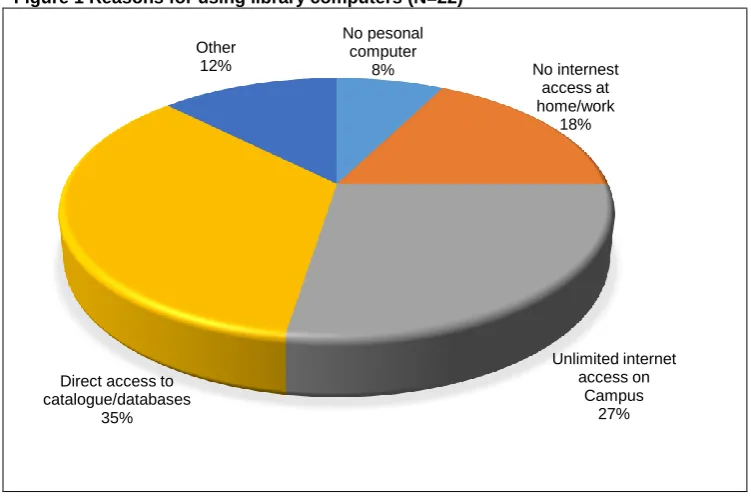
Figure 1 shows various reasons why students use computer workstations at the library. Some students mentioned that they do not have a personal computer and some lack internet at home, supporting the findings of Daniels, Darch and de Jager (2010: 128) that in disadvantaged communities computers and internet are rare resources for students. Other reasons noted by students for the use of computers at the library are unlimited internet access on campus and direct access to databases, highlighting the need for provision of internet access. This finding confirms the gaps that Bornman (2016: 2) identified between South African population groups regarding access to computers and internet. Some students noted the efficiency of library networked computers in comparison to connecting personal electronic devices to the internet via low bandwidth campus WiFi hotspots. Librarians and students noted that connecting to the internet via WiFi is slower than via desktop and that the number of hotspots is limited. Slow internet connectivity also surfaced from students’ responses as a challenge as shown in Section 5.5. Students are also driven to depend on campus computers by their reluctance to carry their laptops for security reasons (avoiding theft or personal attack). Librarians confirm the issue of security as they noted the library’s experience of theft of loaned iPads that had been donated, requiring their (expensive) replacement. In support of this, Fuchs and Horak (2008: 115) noted the high crime rates among low-income communities in South Africa.
Figure 1 Reasons for using library computers (N=22)
5.3 Programmes established to promote the use of e-services
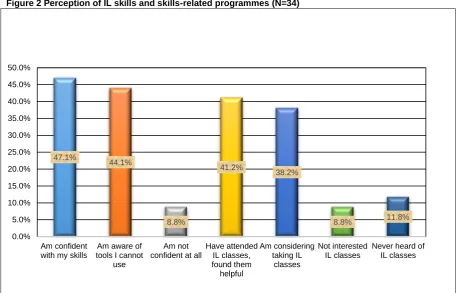
Students were asked to rate their information literacy (IL) skills, their awareness of the availability of IL classes on campus, and their need for such classes. The responses are summarised in Figure 2. It should be noted that this question was biased in favour of IL, since this is regarded as a critical skill in satisfying user information needs. The responses show that a material number of postgraduate students are not confident with their IL skills and some have indicated struggles with various electronic tools. Others indicated the need for skills and for increased awareness of availability of the IL programmes at UWC. In support of some issues depicted in Figure 2, interviewees noted that some postgraduate users lack both computer and information literacy skills. Lack of prior exposure to ICTs has already been confirmed as a contributor to lack
No pesonal computer
8% No internest
access at home/work
18%
Unlimited internet access on
Campus 27% Direct access to
catalogue/databases 35%
of information-related skills: evidence of the impact of apartheid. The indication by some students of no interest in attending IL classes may be attributed to students regarding themselves as information literate, in respect of which two librarians noted that some students confuse experience with Google search as being adequately IL-skilled.
Figure 2 Perception of IL skills and skills-related programmes (N=34)
Other librarians raised the notion of the mental divide, which they described as hesitation with or negative attitude towards experimenting with electronic devices, or undermining library services being offered. Librarians noted that some students fail to do small tasks like frequently checking emails in order to keep up to date with daily academic business. The argument is that, although students lack exposure to electronic devices, the previously disadvantaged should be eager to learn and interact with new technologies when the opportunity arises in order to improve their situation. This ostensible mental divide prevents individual growth and the exercising of the democratic right to access knowledge that satisfies diverse information needs, since users will be challenged to exhaustively manipulate the technologies available. However, the attendance of development (training) programmes depends entirely on an individual’s effort and interest to learn.
Most librarians acknowledged that some master’s students do not fully utilise the available e-services for various reasons. Lack of awareness among postgraduate students of the availability of e-books, electronic theses, tutorials, self-study guides and other services like online bookings for training was noted, as was lack of knowledge to differentiate academic resources and other online materials, particularly for academic development and reference purposes. Librarians acknowledged that UWC Library has listed IL as a major priority and is working collaboratively with other networks to establish an IL curriculum that can be embedded into the broader education curriculum to support lifelong learning. The recently-demanded transformation and decolonisation of the curriculum has called for the discarding of the apartheid system, which would entail the use of education as social democratic tool to bring a complete revolution in the education system (Mabokela & King 2001: xx). IL may and should be used advisedly, but perhaps also cautiously, to support such goals, bearing in mind a potential inherent bias of IL curricula toward western epistemologies and learning objectives.
All the librarians interviewed confirmed the existence of various other projects that promote access to e-services. Such training interventions include reference management systems like RefWorks and Mendeley and the use of electronic databases and general use of the library. This confirms the presence and bridging of various digital divide aspects of lack of ICTs and information-related skills as indicated earlier (Donoghue 2008, Naidoo 2012, Bornman 2016). Interviewees noted the availability of individual training sessions offered to cater for individual challenges. Research students attend author workshops that prepare them for the publishing of scientific research. One librarian mentioned library training programmes that aim to equip academics to use emerging technologies to deliver lectures virtually. This confirms the shift of South African higher education toward technology-oriented and enriched pedagogical practices as stated by Ng’ambi et al. (2016: 845).
UWC introduced a LMS, Ekamva, which promotes virtual learning, experiential learning and collaboration among students. Waycott et al. (2010: 1207) confirmed the use of LMSs to promote interactive learning. Some librarians observed that Ekamva has been useful in promoting knowledge development through information sharing tools such as wikis. However, intensive training would be needed to promote the exhaustive use of various emerging virtual products and tools, especially for those lacking confidence with their skills and prior exposure to ICTs. Librarians mentioned projects for the
47.1%
44.1%
8.8%
41.2%
38.2%
8.8% 11.8%
0.0% 5.0% 10.0% 15.0% 20.0% 25.0% 30.0% 35.0% 40.0% 45.0% 50.0%
Am confident with my skills
Am aware of tools I cannot
use
Am not confident at all
Have attended IL classes, found them helpful
Am considering taking IL
classes
Not interested IL classes
loaning of iPads, e-readers (to download and read electronic books) and laptops, which are made available from the library for users in need. Collaborative efforts between UWC Library and partners like DigiCape and Core (both experts in technological devices) during iPad training have also been noted. These ICT loaning projects confirm the dependence of postgraduate students on ICTs provided by academic libraries. One senior librarian commended the Faculty of Economics and Management Sciences for going the extra mile with programmes like the Digital Academic Literacy (DAL) offered as support for students to learn various applications which are useful as business and economics tools. The Knowledge Commons in the library also trains users on the general use of computers and reference management. Another useful project implemented was the QR code project in which a matrix barcode is generated to allow users to quickly scan resources using smartphones. Unfortunately, the service was limited to those with the software required to read the codes, which again further marginalised other users. UWC Library initiated various projects to support access to and use of e-services, with the priority on equipping the user with both tools and skills. Such efforts confirm the libraries’ democratic and emancipatory roles through the provision of technologies (Pyati 2007) and facilitation of skills transfer. Post-apartheid efforts reveal, at the very least, a nominal transformation of and improvement in educational resources and infrastructure at the previously disadvantaged UWC.
5.4 Perception of the effectiveness of e-services
Out of the thirty-six students who commented on the performance and effectiveness of the e-services, twenty (55.56%) expressed satisfaction with the performance of the e-services, and twenty-seven (75%) considered them to be effective or useful in meeting their needs. These findings could be an indication of the success of IL classes and the positive impact of supplementary e-devices for individual use. About 11% of students indicated that the services do not satisfy their information needs, while 11.8% confirmed that they were not well informed about the information literacy classes. Others pointed to struggles with open electronic resources, particularly where these directed users to broken links. In a similar vein, one librarian also pointed out the inefficiency of some full text links and the surfacing of broken links when opening some e-resources, especially library guides or tutorials prepared for users. This issue of resource maintenance highlights a further complexity of the digital divide: the allocation of sufficient human resources who are sufficiently skilled to ensure optimal usage. However, it is encouraging that, despite the challenges encountered, the majority of respondents find the e-services on offer to be effective in meeting their needs.
5.5 Challenges associated with e-services
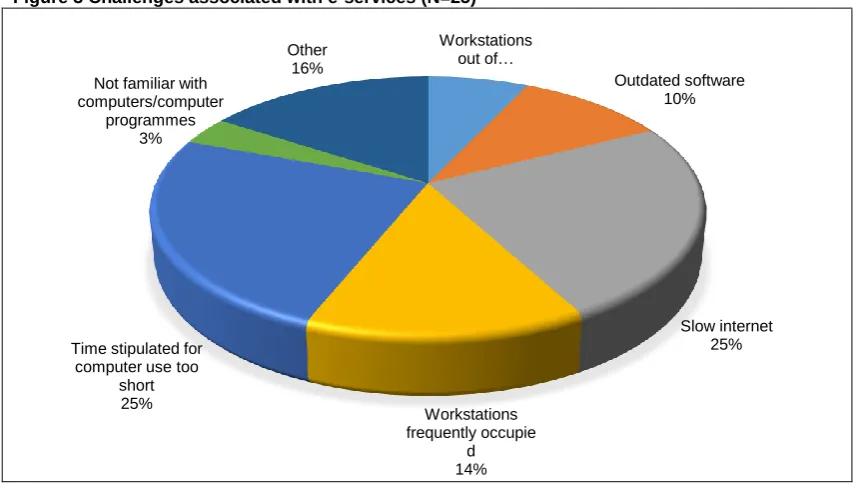
Students identified various challenges they encounter while interacting with e-services (results shown in Figure 3). Some librarians confirmed the slow internet connectivity, although bandwidth is said to have improved recently. However, moments of extremely slow internet speed have been noted during which users can barely open an online resource. Most of the challenges identified by students may point to economic challenges. If the library or the students could afford it, most of the noted challenges could be improved by subscribing to broadband, increasing the number of computers and replacing those which are outdated. The issue of security on campus has been covered above, and results here confirm the reality of these fears, as indicated by some students. Three interviewees raised a concern about insurance for e-devices since these are at high risk of being stolen. A major challenge remains in neither the library nor the students being able to afford the insurance premiums on laptops being transported to and around campus.
Most interviewees acknowledged that the institution attracts students from mixed backgrounds, with the majority of students coming from low-income communities that cannot afford various resources. Some students have no personal computers and cannot afford bandwidth to use off-campus. The library constantly has to propose projects to alleviate such challenges. According to three of the librarians, most of their users depend solely on the internet on campus. Librarians also confirmed that there are a few postgraduate users who can hardly use computers, especially those coming from low-income communities in the ‘locations’ (a term used in South Africa to refer to high-density peri-urban areas and informal settlements designated ‘non-white’ living areas under apartheid). Three librarians noted that most of the users with little or no exposure to electronic devices are foreign students from less-privileged and economically-challenged countries that struggle to provide ICT infrastructure, including internet connectivity (to promote computer education). Experiences with some mature postgraduate students struggling to use computers, including one who could barely use a mouse, were confirmed. One South African user confessed to a librarian that, in their local area, computers are locked away in schools
because teachers do not have the requisite knowledge to use the equipment – a good example of the exclusion of some
South African communities from the access to digital information, typical of how colonial exclusion mentioned by Fuchs and Horak (2008: 115) affected most indigenous people in former African colonies of Europe. Education for ‘non-whites’ was inferior and teachers were not competently prepared for the use of technology. The impact of the apartheid education system is still evident in many communities.
Naidoo and Raju (2012). This diversity of challenges supports the argument by one librarian that the digital divide cannot be entirely eradicated. However, the availability of English classes for undergraduate students experiencing language issues has been noted, although there is no clarity on whether postgraduate students with language barriers would be accommodated in such classes or not.
Figure 3 Challenges associated with e-services (N=25)
Another problem noted by librarians in trying to meet the varying information needs for users in this digital era, was the challenge of access to high quality research articles due to exorbitant journal subscription fees. Libraries in South Africa are struggling to keep up with the database subscription fees to allow user access to a variety of quality peer-reviewed scholarly content. Many of the economic challenges and access issues could degenerate in South Africa following the student protests that began in 2015, demanding free tertiary education. Universities have already experienced budget cuts since the beginning of the #FeesMustFall movement which led to the ban on fees increases for 2016. Protests in some universities are placing educational facilities in danger and activities are constantly disrupted. While the interests of the protest groups are at face value emancipatory, there is a danger that they may contribute to some of the factors that increase the digital divide.
6 Conclusion
Access to ICTs and information-related skills have been identified as key challenges in bridging the digital divide. Some students are still very much dependent on library-loaned e-devices. Slow internet speed has also been acknowledged as a major issue. Political experiences of the past have been raised as contributing factors to various aspects of the digital divide; UWC Library prioritises meeting the needs of the users in this context. However, the current economic status of the nation (for instance, the South African currency’s fluctuation) affects the purchasing of or subscriptions towards many academic products and infrastructure. Although UWC is engaging in various projects to improve access and skills, the atmosphere in South Africa could contribute to the multiplication of the digital divide challenges if the protests persist and the economy does not stabilise. From a critical theorist perspective, UWC can be viewed as a role player in human emancipation through the provision of technologies to sustain the marginalised members of its academic community. Considering the implementation of extra projects to promote access to electronic devices and e-services, the library has alleviated many challenges of the divide, thus fulfilling a democratic role for the UWC community members. The role UWC Library has been playing since apartheid in addressing the digital divide could be sustainable or even highly improved given favourable
socioeconomic circumstances
.
Acknowledgement
This research project was partly supported by a grant received from the National Research Foundation.
References
Bornman, A. 2016. Information society and digital divide in South Africa: results of longitudinal surveys. Information,
Communication & Society. 19(2): 264-278. DOI:10.1080/1369118X.2015.1065285.
Brooks, S., Donovan, P. and Rumble, C. 2005. Developing nations, the digital divide and research databases. Serials
Review. 31(4): 270-278. DOI:10.1016/j.serrev.2005.09.002.
Creswell, J. W. 2013. Qualitative inquiry and research design: choosing among five approaches. 3rd ed. Los Angeles: SAGE.
Workstations out of …
Outdated software 10%
Slow internet 25%
Workstations frequently occupie
d 14% Time stipulated for
computer use too short
25% Not familiar with computers/computer
programmes 3%
Creswell, J. 2014. Research design: qualitative, quantitative and mixed methods approaches. 4th ed. Los Angeles: SAGE.
Daniels, D., Darch, C. and de Jager, K. 2010. The research commons: a new creature in the library? Performance
Measurement and Metrics. 11(2): 116-130. DOI:10.1108/14678041011064043.
Department of Higher Education. 1997. Education White Paper 3: a programme for the transformation of higher education. Government Gazette. 386(18207):10. [Online].
http://www.education.gov.za/Resources/Legislation/WhitePapers.aspx (2 February 2014). Donoghue, A. 2008. South Africa compares digital divide to apartheid. ZDNet. 25 April. [Online].
http://www.zdnet.com/south-africa-compares-digital-divide-to-apartheid-3039405246/ (18 May 2014).
Flanagan, P. 2016. The digital divide: an inhibitor to integral human development. Journal of Catholic Social Thought. 13(2): 345-360. DOI:10.5840/jcathsoc201613212.
Fuchs, C. and Horak, E. 2008. Africa and the digital divide. Telematics and Informatics. 25(2): 99-116. DOI:10.1016/j.tele.2006.06.004.
Herselman, M. and Britton, K.G. 2002. Analysing the role of ICT in bridging the digital divide amongst learners. South
African Journal of Education. 22(4): 270-274. [Online]. http://hdl.handle.net/10520/EJC31911 (20 July 2013).
Johnson, W.R. 1982. Education: keystone of apartheid. Anthropology & Education Quarterly. 13(3): 214-237. DOI:10.1525/aeq.1982.13.3.05x0983u.
Kincheloe, J.L. 2000. Cultural studies and democratically aware teacher education: post-Fordism, civics and the worker citizen. In Democratic social education: social studies for social change. D. W. Hursh and E. Wayne Ross, Eds. New York: Falmer Press. 97-106.
Kolikant, Y.B.D. 2010. Digital natives, better learners? Students’ beliefs about how the internet influenced their ability to
learn. Computers in Human Behavior. 26(6): 1384-1391. DOI:10.1016/j.chb.2010.04.012.
Luaran, J.E., Nadzri, F.A., Rom, K.B.M. and Jain, J. 2016. The importance of Information and Communication Technology in English learning: indigenous students' perspectives. Malaysian Journal of Distance Education. 18(1): 87-101. DOI:10.21315/mjde2016.18.1.6.
Mabokela, R. O. and King, K. L. Eds. 2001. Apartheid no more: case studies of Southern African universities in the
process of transformation. London: Bergin & Gavery.
Naidoo, S. and Raju, J. 2012. Impact of the digital divide on information literacy training in a higher education context.
South African Journal of Libraries and Information Science. 78(1): 34-44. [Online].
http://sajlis.journals.ac.za/pub/article/view/46/39 (2 December 2013).
Naidoo, V. 2012. Technology in the classroom: bridging the digital divide. The skills portal. 3 August. [Online]. https://www.skillsportal.co.za/content/bridging-digital-divide (19 June 2014).
Naslund, J. and Giustini, D. 2008. Towards school library 2.0: an introduction to social software tools for teacher-librarians. School Libraries Worldwide. 14(2): 55-67. DOI:10.14288/1.0077916.
Ng’ambi, D., Brown, C., Bozalek, V., Gachago, D. and Wood, D. 2016. Technology enhanced teaching and learning in South African higher education: a rearview of a 20 year journey. British Journal of Educational Technology. 47(5): 843-858. DOI:10.1111/bjet.12485.
Oliver, M. 2011. Technological determinism in educational technology research: some alternative ways of thinking about the relationship between learning and technology. Journal of Computer Assisted Learning. 27(5): 373-384.
DOI:10.1111/j.1365-2729.2011.00406.x.
Pyati, A.K. 2007. Re-envisioning libraries in the information society: a critical theory of library technology. Ph.D. thesis. University of California.
Rivers, J.K., Rivers, P.A. and Hazell, V. 2015. Africa and technology in Higher Education: trends, challenges, and promise. International Educative Research Foundation and Publisher. 3(5). [Online].
http://ijier.net/index.php/ijier/article/view/354/273 (20 January 2016).
Robertson, H-J. 2003. Toward a theory of negativity: teacher education and information and communications technology.
Journal of Teacher Education. 54(4): 280-296. DOI:10.1177/0022487103255499.
Sayed, Y. and Jansen, J.D. Eds. 2001. Implementing education policies: the South African experience. Cape Town: UCT
Press.
Sehoole, M.T.C. 2005. Democratizing higher education policy: constraints of reform in post-apartheid South Africa. New York: Routledge.
Singh, A.M. 2004. Bridging the digital divide: the role of universities in getting South Africa closer to the global information society. South African Journal of Information Management. 6(2). [Online].
http://hdl.handle.net/10520/AJA1560683X_363 (3 December 2014).
Tapfumaneyi, K.D. and Rupande, G. 2013. The challenges of establishing digital library services in an Open and Distance Learning (ODL) environment and the potential benefits: the road towards the integration of digital and traditional library services: the case of Zimbabwe Open University (ZOU). International Journal of Advanced Research. 1(5): 519-526. [Online]. http://www.journalijar.com/uploads/2013-08-01_033517_526.pdf (4 January 2015).
Thinyane, H. 2010. Are digital natives a world-wide phenomenon? An investigation into South African first year students’ use and experience with technology. Computers & Education. 55(1): 406-414. DOI:10.1016/j.compedu.2010.02.005. Waycott, J., Bennett, S., Kennedy, G., Dalgarno, B. and Gray, K. 2010. Digital divides? Student and staff perceptions of