Original Research Article
A study on socio-cultural factors and reproductive health of women
with HIV/AIDS, in a tertiary care hospital, Kakinada,
East Godavari district, Andhra Pradesh
K. Sowmyasudha
1*, Sofia Noor
2, Alpha V. P. Tej
3, K. Satyanarayana
4INTRODUCTION
AIDS affecting mainly the young people in sexually active age group 15-49 yrs. majority are infected through unprotected sex. Un-employed, under employed, mobile and migrant youth and street children.1 The global epidemic of HIV burden by the end of 2009 is 33.3 million. In this 2.6 million were newly infected and
contributing 1.8 million deaths in total. For the year 2008-09 in India there are 22.7 lakh people living with HIV (0.29% of prevalence).1
In India's male-dominated culture, women are finding they must choose between the stigma of becoming infected with HIV from their husbands or the less desirable option of remaining childless.2,3 Women living
ABSTRACT
Background: AIDS is a fatal disease caused by Human Immune-Deficiency Virus. Transmitted by sexual contact mainly heterosexuals, street children, adolescents, migrants are also major vulnerable group to affect. Social and cultural factors have a key role in transmission of the disease.
Methods: A total of 303 positive HIV women in reproductive age group were interviewed to assess the socio-cultural factors and reproductive health among them, by using a semi-structured questionnaire. Data was analyzed by using SPSS software.
Results: Un-educated and un-employed women from nuclear family with early marriage, having predisposing factors of alcoholism, polygamous sexual relationship were affected in this study. Few of them still have sexual relations, majority of them not disclosing their disease status. Few of them facing social stigma and lacking of family support. Majority has access to treatment and they are on regular treatment. Their antenatal and post natal period is un-eventful. A few of them stopped breastfeeding to their babies. Majority have one or two children affected by disease in their family.
Conclusions: In our study we found the Major predisposing factor for the disease are STDs, alcoholism and major route of transmission is through sexual contact. A few participants have extramarital polygamous relationship and maintaining confidentiality on their disease status. Majority were on regular treatment. Most of them were not practicing family planning methods.
Keywords: HIV, AIDS, Women, Stigma Department of Community Medicine, 1
A.C.S.R. Government Medical College, Nellore, 2RIMS, Kadapa, 3Rangaraya Medical College, Kakinada, Andhra Pradesh, India
4PODT, Kakinada, Andhra Pradesh, India
Received: 12 December 2017 Revised: 17 January 2018 Accepted: 18 January 2018
*Correspondence: Dr. K. Sowmyasudha,
E-mail: [email protected]
Copyright: © the author(s), publisher and licensee Medip Academy. This is an open-access article distributed under the terms of the Creative Commons Attribution Non-Commercial License, which permits unrestricted non-commercial use, distribution, and reproduction in any medium, provided the original work is properly cited.
with AIDS are also less likely than men to seek care for sexually transmitted illness (STI) and HIV as a result of gender discrimination. Women living with AIDS have also reported financial difficulties, problems with childcare, compromised help-seeking behaviors related to stigma, role strain, and gender discrimination.4
The impact of stigma was related to guilt and shame, issues surrounding disclosure, and worries about the future. Findings from these studies can guide the design of interventions focused on increasing access to care for Women living with AIDS and bolstering their social support and emotional health, particularly as they relate to stigma.5 HIV-related stigma is pervasive in Indian society, with those living with HIV perceived as being “perverted” and “sinful”.6 These beliefs extend to those
working in the health care sector, further alienating Women living with AIDS from receiving needed care. HIV stigma in India extends to the family members of Women living with AIDS, as evidenced by the fact that children of HIV-infected parents are denied the right to go to school in some cases.7
HIV/AIDS epidemic stems its link with all aspects of society and culture. Health has a socio-cultural dimension there can be a cultural approach to HIV/AIDS prevention and care. There is a need to understand the transmission, distribution and impact of the disease in relation to social structures. The scientific literature on gender aspects of HIV suggests that the root goes deep into the socio-cultural value system, and is generally attributed to values and perception regarding health and disease especially adult health issues and cultural context of women’s role in the family and society.8-10
Work on social inequality and the political economy of HIV and AIDS has been especially important. Much current research seeks to integrate both cultural and structural concerns in providing an alternative to more individualistic behavioural research paradigms.
Among six high prevalence states In India, Andhra Pradesh is one. In Andhra Pradesh East Godavari District solely contributes more number of cases. This is one of the main reasons to study this topic in this particular geographical area.1 Government of India is announcing women specific and women oriented legislations for upliftment of women. In view of this we opted this topic to study.
Objectives
1. To study the socio-economic and cultural factors of women suffering with HIV/AIDS.
2. To study the Reproductive health among women with HIV/AIDS.
METHODS
A cross-sectional study was done in an ART centre, Government General Hospital Kakinada, among married HIV positive female patients in the age group of 18-60
yrs. study period includes 3 months starting from June to august 2012. By using a convenient sampling method, a total 303 study subjects were interviewed.11 A pre-tested, semi-structured questionnaire was used to obtain the information. Verbal consent was obtained from the participants in the beginning of the study. Those who are all willing to participate in the study included, uncooperative, not willing to participate were excluded from the study. Ethical clearance was obtained from concerned authority to conduct this study. Data analysis was done by using SPSS software version 17. Chi-square test is applied to test the significance level.
RESULTS
Socio- cultural factors
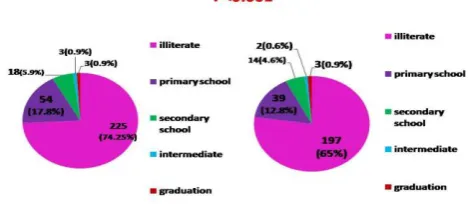
Among the study population majority 89.9% were in reproductive age group (18-45yrs). Their educational status shows 74.25% were illiterate, 17.8% were up to primary school, 5.9% were up to secondary school, 0.9% was up to intermediate education and 0.9% were graduates. Educational status of their spouse 65% were illiterates, 12.8% were up to primary school, 4.6% were up to secondary school, 0.6% were up to intermediate and 0.9% were graduates (Figure 1). Education of women vs Education of spouse p<0.001.
Figure 1: Education of study participants and their partners.
Table 1: Socio-economic status of study participants.
SES Scale Total members (%)
Class-1 2 (0.7)
Class-2 4 (1.3)
Class-3 18 (5.9)
Class-4 84 (27.7)
Class-5 195 (64.4)
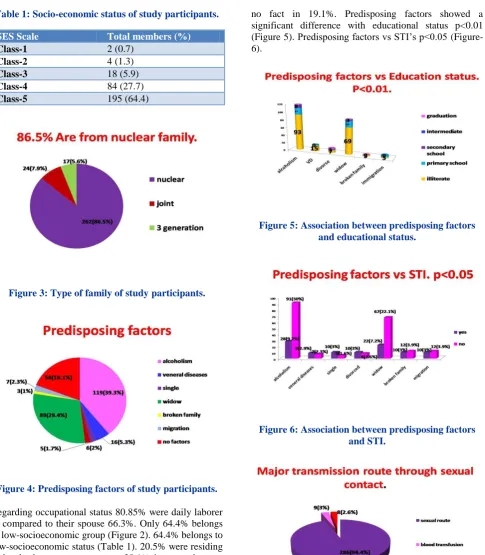
Figure 3: Type of family of study participants.
Figure 4: Predisposing factors of study participants.
Regarding occupational status 80.85% were daily laborer as compared to their spouse 66.3%. Only 64.4% belongs to low-socioeconomic group (Figure 2). 64.4% belongs to low-socioeconomic status (Table 1). 20.5% were residing in katcha houses as contrast to 28.1% in pucca houses. 86.5% were from nuclear family (Figure 3). 33.7% of the study participant’s duration of marital life only 1-5 yrs. 68.3% had one or other family members suffering with HIV. 35.7% Had Normal physical wellbeing. 93.7% Had access to get sufficient food as contrast only few of them 6.3% had insufficient food access and consumption. 89.8% Do not have any food taboos.
23.1% had h/o exposure to STI’s. Figure 4 shows a series of predisposing factors assessed in the study, i.e Alcoholism in 39.3%, widow 29.4%, veneral diseases 5.3%, broken family 1%, single 1.7%, migration 2.3%,
no fact in 19.1%. Predisposing factors showed a significant difference with educational status p<0.01 (Figure 5). Predisposing factors vs STI’s p<0.05 (Figure-6).
Figure 5: Association between predisposing factors and educational status.
Figure 6: Association between predisposing factors and STI.
Figure 7: Route of transmission of the disease.
have any extramarital relations. Only few 32%have good social interaction, 66.7% average social interaction in the society. 14.9% were suffering with societal stigma. 23.4% do not have social support (Figure 9). 15.2% doesn’t have family support. Majority 87.5% have access to health services (Figure 10). 98% of them have regular treatment seeking behavior. Access to health services vs treatment seeking behavior p<0.05. 61.4% were maintaining confidentiality on their disease status in the society.
Figure 8: Association between route of transmission and educational status.
Figure 9: Social support of the study participants
Figure 10: Access to health services of the study participants.
Reproductive health
Majority 84.2% have regular menstrual cycles.42.9% Have 2 children's affected with HIV (Figure 11). Children of 73.3% were HIV positive. Majority had regular antenatal (78.5%) and post natal (77.6%) checkups. 54.1% were delivered in Government hospital. 14.9% did not feed the babies. 58.7% were not using any family planning methods. 24.1% still have sexual relations. 17.2% of their spouses were using condoms.
Figure 11: HIV status of childrens of study participants.
DISCUSSION
In our study educational status shows 74.25% were illiterates which indicate the poor knowledge of women towards the diseases and there is a need to provide information about the disease transmission. Elemo et al also found the similar literacy levels in their study.12
In this study 23.1% had exposure to STDs, a series of predisposing factors assessed in this study was alcoholism, widow, veneral diseases, broken family. Major transmission route 94.4% through sexual contact, all these findings are correlating with the findings of UNAIDS report world AIDS DAY 2017.13 Sanni et al also reported the similar finding from their study in trends and determinants of HIV i.e 79.6% of transmission of infection occurs through sexual contact and 88.3% were on treatment ART.14 In this study we found the extramarital relations in 7.9%. Eyayou also found the similar result in their study.15 Rwandan society has known polygamy as a cultural value, until today the polygamy is very practicable evil even if it an illegal.
vulnerability to HIV and reduce access to testing and treatment Programmes.
In our study 98% of them are on regular treatment which is better than the Sunni et al i.e. only 83.3%.14 In our study Children of 73.3% were HIV positive and 14.9% Did not feed the babies,Eyayou also found the similar result in their study.15 In our study 8.7% were not using any family planning methods. Almaz also found the similar result in their study.16 To be safe from HIV infection, Heterosexual women must rely not only on their own skill, attitude, and efficacy concerning sexual behaviours and condom use, but also on their ability to convince their sexual partner to use a condom. HTV‐ prevention strategies must target Heterosexual couples and address gender norms in sexual behaviour.
Recommendations
1. Utilization and practice of family planning methods for women are recommended.
2. Sex education for all adolescent and young women is recommended. Introduction of sex education curriculum in schools and provision of information on HIV prevention also recommended.
3. Subsidies on food grains and other food substances, clothes, travel subsidies are recommended.
4. Government must adopt Policies and legislations to prevent social stigma.
5. HIV Programmes should focus on cultural practices and address the gender based vulnerability on HIV. 6. Last but not the least measures to improve the access
on preventive methods, treatment services and access to treatment services are also recommended.
Limitations
This study cannot be generalized as it is a woman based study.
CONCLUSION
More than half of the study participants were daily laborers, illiterates and low socio-economic group from nuclear families. Few of them had negative family stigma and social stigma. Major predisposing factor are STDs, alcoholism and major route of transmission is through sexual contact. Few have extramarital polygamous relationship, maintaining confidentiality on their disease status. Majority were on regular treatment. Most of them were not practicing family planning methods
Funding: No funding sources Conflict of interest: None declared
Ethical approval: The study was approved by the Institutional Ethics Committee
REFERENCES
1. Park’s textbook of Preventive and Social Medicine, 22nd edition.
2. Solomon S, Chakraborty A, Yepthomi R. A review of the HIV epidemic in India. AIDS Education and Prevention. 2004;15:658–661.
3. Solomon S, Venkatesh BA, Brown L, Verma P, Cecelia AJ, Mayer KH. Gender-related differences in quality of life domains of persons living with HIV/AIDS in South India in the era prior to greater access to antiretroviral therapy. AIDS Patient Care and STDs. 2008;22(12):999–1005.
4. Joseph EB, Bhatti RS. Psychosocial problems and coping patterns of HIV seropositive wives of men with HIV/AIDS. Social Work in Health Care. 2004;39(1):29–47.
5. Gupta RN, Wyatt GE, Swaminathan S, Rewari BB, Locke TF, Ranganath V, et al. Correlates of relationship, psychological, and sexual behavioral factors for HIV risk among Indian women. Cultural Diversity and Ethnic Minority Psychol. 2008;14(3):256–65.
6. UNAIDS, AIDS epidemic update December 2001:7 7. Kodandapani P, and Alpert PT. AIDS in India when
denial kills, Home health care Management and Practice. 2007;20(1):21-6.
8. Jana S, Basu I, Rotheram-Borus MJ, Newman P. The Sonagachi Project: A sustainable community intervention program. AIDS Education Prevent. 2004;16(5):405-14.
9. Shawn FD, Glenn F. Trends in Global Gender Inequality (Forthcoming, Social Forces). Soc Forces. 2010;88(5):1941–68.
10. Lacey E, Walters S. Continuing inequality: gender and social class influences on self perceived health after a heart attack. J Epidemiol Community Health. 2003;57(8):622–7.
11. Williams J, Hanoku B. Socio-economic status of people living with HIV/AIDS in Hyderabad city of India. Tata institute of social sciences, Mumbai. 12. Ibrahim AE. socio-cultural factors affecting sexual
and reproductive health: the roles of traditional institutions among the borana pastoralists of Oromiya, southern Ethiopia.
13. UNAIDS, AIDS epidemic update December 2017. 14. Sanni Y, Ghose B, Georges D, Vaibhav S, Michael
E. Trends and determinants of HIV/AIDS knowledge among women in Bangladesh.
15. Yetmgeta E. Socio-cultural factors in Decisions Related to Fertility in remotely located communities: the case of Suri ethnic groups. MPH thesis, Addis Ababa University, Faculty of Medicine, Department of Community Health. 2003. 16. Almaz H. Women’s education and marital fertility
in urban Ethiopia. Msc Thesis in demography, Addis Ababa University. 1997.