Original Research Article
Internet use behavior, risk profile and ‘problematic internet use’ among
undergraduate medical students: an epidemiological study
Gurpreet Singh
1, Sudhir Pasricha
2, Gurprit Singh Nanda
3*, Harinder Singh
3,
Kuntal Bandyopadhyay
4, Gaurav Ray
1INTRODUCTION
Internet has the ability to fast-track human progress, provide conduit to digital divide and build the world that accelerates innovation, entrepreneurship, and progress.1 However, on the other hand, internet use can become
problematic and can lead to gamut of diseases including psychological, mental, behavioral and social disorders.2,3 International Telecommunication Union (ITU, 2016) reports more than 3.2 billion internet users worldwide.1 India contributes second largest internet users with more than 460 million online users and it is projected that by
ABSTRACT
Background: With emerging internet use, there is need to understand differences between „normal‟ and „problematic internet use‟. The objective of the study was to estimate internet use behaviour and risk profile, prevalence of problematic internet use and to determine association among them.
Methods: A cross sectional study was undertaken among medical undergraduates. Pilot tested, structured questionnaire along with internet addiction test was administered.
Results: Total of 122 students with mean age of 20.6 years (SD 0.878) participated in the study. Majority had personal computer and smart phones (88.5% and 98.4% respectively). Students were online at place of residence, classrooms and library (97.5%, 50% and 34.4% respectively). Students were online every day for instant messenger, social networking, leisure, without purpose, emails, downloads, forums, blogging, shopping, listening to radio and gaming (91.0%, 64.8%, 32.0%, 27.9%, 22.1%, 18.0% and 14.8%, 1.6%, 6.6%, 4.1% and 8.2% respectively). False information from internet, blocking of mails, pretending, and sharing password was found in 52.5%, 71.3%, 45.1% and 36.1% students respectively. Only 4.1% students had undertaken cyber safety courses. Moderate prevalence of „problematic internet use‟ was 19.7%. Significantly higher internet use in classrooms, higher use of emails, social networking, blogging, forums, leisure, surfing without purpose, shopping, downloading and higher cyber risk was seen among those with „problematic internet use‟ (p=0.001, 0.010, 0.009, 0.021, 0.026, 0.002, 0.000, 0.000, 0.000 and 0.005 respectively).
Conclusions: Internet use has become an integral part of our lives. There is a need to estimate the baseline and develop evidence based strategies in the country.
Keywords: Problematic internet use, Internet addiction test, Internet use, Internet risk, Cyber safety
1
Station Health Organisation, Jalandhar, Punjab, India
2Senior Advisor (Community Medicine), Jalandhar, Punjab, India
3Department of Community Medicine, Punjab Institute of Medical Sciences, Jalandhar, Punjab, India 4Station Health Organisation, Amritsar, Punjab, India
Received: 02 January 2018 Revised: 17 January 2018 Accepted: 18 January 2018
*Correspondence: Dr. Gurprit Singh Nanda, E-mail: [email protected]
Copyright: © the author(s), publisher and licensee Medip Academy. This is an open-access article distributed under the terms of the Creative Commons Attribution Non-Commercial License, which permits unrestricted non-commercial use, distribution, and reproduction in any medium, provided the original work is properly cited.
the year 2021, the numbers will further increase to around 635.8 million.4 Further, studies indicate fast growing „internet penetrance‟ among students with around 80% students being online.5
Problematic internet use has been defined as a maladaptive preoccupation with internet use, experienced as irresistible, for periods of time longer than intended with significant distress or impairment resulting from internet use and absence of other psychiatric pathology that might explain the excessive internet use, such as mania or hypomania.5 An individual with problematic internet use exhibits damaging and uncontrollable internet use and is characterised by an impulsive as well as compulsive disorder, which lies within the ambit of impulse-control disorders.6-8 Compulsive use of internet by individuals was defined as internet addiction by Dr. Goldberg in 1995. It was considered as behavioural addiction fulfilling core diagnositic components for addiction viz., salience, tolerance, mood modification, conflict, withdrawal and relapse.9 Later, term pathological internet use replaced the term internet addiction, since addiction refers to dependency resulting from psychoactive substances.10 Subsequently, testing of cognitive behavioral model of pathological internet use pointed towards a greater role of behavioural symptoms such as social isolation rather than psychopathology. Hence, in year 2000, Shapira et al replaced the term internet addiction with problematic internet use.7
Measurement of level of problematic internet use has been a challenge. Various scales are available to measure the severity of problematic internet use. Internet addictive disorder scale developed by Goldberg consist of 11 items but is qualitative in nature. Internet addiction scale developed by Chen consists of 26 items on a Likert scale, however, is recommended only for adolescents. Internet related addictive behavior inventory (IRABI) developed by Brenner consists of 32 items on a dichotomous scale. Young‟s internet addiction test is the only scale which has been validated and tested for psychometric properties, has shown concurrent validity as well as good internal consistency and is a valid and reliable tool recommended for research purposes.11,12
In the present era of emerging internet use, there is a need to understand differences between normal and problematic use of internet. Despite the fact and increasing evidence on problematic internet use, there is dearth of data on basic epidemiology of internet use behaviour and risk profile associated with it.8 Numerous studies have been carried out across the globe on internet addiction with focus on adolescents. However, there is lack of studies from developing countries, which have assessed internet use behaviour, risk profile and the problematic internet use in totality. Thus, the present study was carried out to estimate internet use behaviour, internet use risk profile, prevalence of problematic internet use and to determine association among them.
METHODS
The present study was a cross sectional study conducted among final year undergraduates of a medical college in Northern India undergoing rotation in Department of Community Medicine during January-July 2017. The students were introduced to the topic of „problematic internet use‟ during small classroom sessions/tutorials. For each tutorial, a group of four to five students prepared a presentation and presented to rest of the students as a seminar topic. The data was collected in form of a structured questionnaire which pilot tested in the students was preparing the seminar. Pilot study data was not included in the main study.
Data collection tool was designed with four domains viz., participant characteristics, internet use behavior, internet use risk profile and internet addiction test. Participant‟s details included gender, age, and availability of internet compatible devices. Internet use behavior profiling focused on the accessibility and use of internet at various places such as place of residence, classrooms and library. Also, frequency of internet use on different platforms such as social networking, forums, leisure activities, shopping, downloading, gaming, radio and without any specific purpose was assessed. Internet use risk profile was assessed on basis of whether they had received false information during internet use „or‟ had pretended to be someone else while using internet „or‟ had deliberately interacted with someone whose identity is not known „or‟ played a prank with someone known „or‟ blocked mails „or‟ had shared their passwords in past one month. Further, participants were asked if they had undertaken any safety course ever. Problematic internet use was assessed using Young‟s internet addiction test. It consisted of 20 item questionnaire to measure severity of compulsiveness of internet use. Each item was assessed on a Likert scale with score range from 1-5 with 1 indicating rare and subsequent scores indicating increasing severity as occasional, frequent, occasional and always respectively. Score obtained for each item was added to obtain the comprehensive score which ranged from 20 to 100. Increasing score indicated increasing severity of internet addiction. Score upto and including 49 was labeled as average online user. Participants with total score from 50-79 were likely to have experienced occasional/frequent problems because of internet use and were labeled as moderate problematic internet use. Participants with scores of 80 and above were those with severe problematic internet use and were likely to have significant problems due to internet use in their lives. Data was entered in excel and analysed using SPSS ver 21.0 software
RESULTS
Internet use behavior
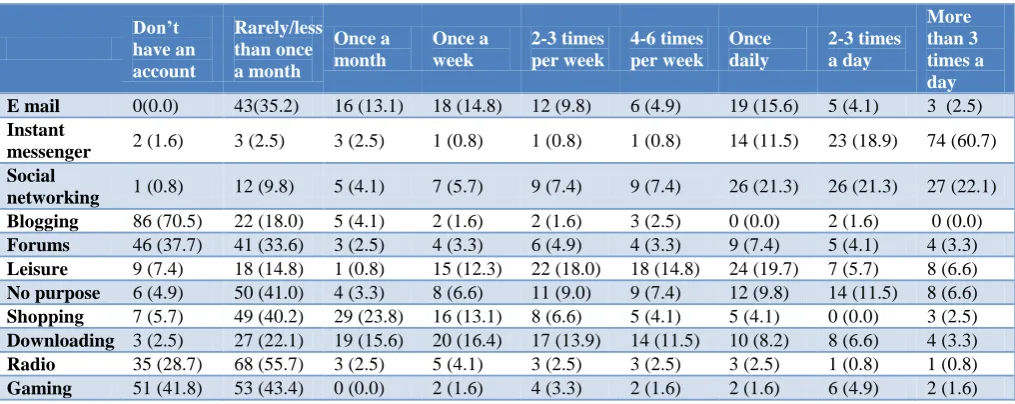
Internet availability through landline and wireless network was found across the campus as open network for students. Personal computer and smart phones were found to be available with 88.5% and 98.4% students respectively. Majority (97.5%) of students accessed internet at place of residence. However, a large proportion of students were found to be accessing internet during their classroom sessions as well as in the library (50% and 34.4% respectively) (Table 1). The frequency of use of internet for varied purposes is represented as radar diagram in Figure 1 and Table 2. It was observed that the frequency of use of internet varied with the purpose of use. Majority of study participants were found to be online on daily basis for platforms such as instant messenger (91.0%) and social networking sites (64.8%). Being online on daily basis for leisure activities, without
purpose, e mails, downloading and forums was found in 32.0%, 27.9%, 22.1%, 18.0% and 14.8% respectively. On other hand, daily use of internet for blogging, shopping, listening to radio and gaming was seen in only 1.6%, 6.6%, 4.1% and 8.2% respectively.
Table 1: Availability and accessibility of internet devices (N=122).
Study variable Frequency (%)
Availability of internet connection
Personal computer 108 (88.5)
Smart phone 120 (98.4)
College campus access 122 (100.0) Place of access
Place of residence 119 (97.5)
Classroom 61 (50.0)
Library 42 (34.4)
Figure 1: Frequency of internet use among medical undergraduates.
Table 2: Frequency of internet use among medical undergraduates.*
Don’t have an account
Rarely/less than once a month
Once a month
Once a week
2-3 times per week
4-6 times per week
Once daily
2-3 times a day
More than 3 times a day E mail 0(0.0) 43(35.2) 16 (13.1) 18 (14.8) 12 (9.8) 6 (4.9) 19 (15.6) 5 (4.1) 3 (2.5) Instant
messenger 2 (1.6) 3 (2.5) 3 (2.5) 1 (0.8) 1 (0.8) 1 (0.8) 14 (11.5) 23 (18.9) 74 (60.7) Social
networking 1 (0.8) 12 (9.8) 5 (4.1) 7 (5.7) 9 (7.4) 9 (7.4) 26 (21.3) 26 (21.3) 27 (22.1) Blogging 86 (70.5) 22 (18.0) 5 (4.1) 2 (1.6) 2 (1.6) 3 (2.5) 0 (0.0) 2 (1.6) 0 (0.0) Forums 46 (37.7) 41 (33.6) 3 (2.5) 4 (3.3) 6 (4.9) 4 (3.3) 9 (7.4) 5 (4.1) 4 (3.3) Leisure 9 (7.4) 18 (14.8) 1 (0.8) 15 (12.3) 22 (18.0) 18 (14.8) 24 (19.7) 7 (5.7) 8 (6.6) No purpose 6 (4.9) 50 (41.0) 4 (3.3) 8 (6.6) 11 (9.0) 9 (7.4) 12 (9.8) 14 (11.5) 8 (6.6) Shopping 7 (5.7) 49 (40.2) 29 (23.8) 16 (13.1) 8 (6.6) 5 (4.1) 5 (4.1) 0 (0.0) 3 (2.5) Downloading 3 (2.5) 27 (22.1) 19 (15.6) 20 (16.4) 17 (13.9) 14 (11.5) 10 (8.2) 8 (6.6) 4 (3.3) Radio 35 (28.7) 68 (55.7) 3 (2.5) 5 (4.1) 3 (2.5) 3 (2.5) 3 (2.5) 1 (0.8) 1 (0.8) Gaming 51 (41.8) 53 (43.4) 0 (0.0) 2 (1.6) 4 (3.3) 2 (1.6) 2 (1.6) 6 (4.9) 2 (1.6) *Totals are row wise
0 20 40 60 80 100
E mail Instant
Messenger Social
networking
Blogging
Forums
Leisure No purpose
Shopping Downloading Radio Gaming
Don‟t have an account Rarely
Table 3: Internet use risk profile.
Study variables Frequency (%)
Received false info 64 (52.5)
Pretended to be someone else 55 (45.1)
Played a prank 14 (11.5)
Blocked mail 87 (71.3)
Shared password 44 (36.1)
Safety course undertaken 5 (4.1)
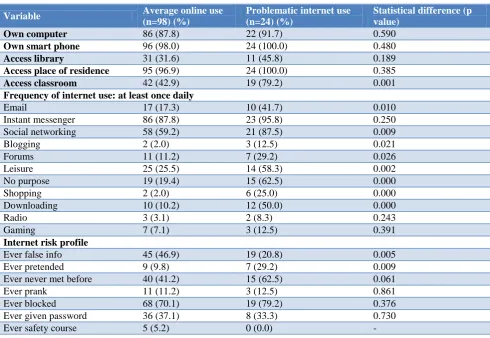
Table 4: Comparison of ‘average online user’ with ‘problematic internet use’ according to internet use behavior and internet use risk profile.
Variable Average online use
(n=98) (%)
Problematic internet use (n=24) (%)
Statistical difference (p value)
Own computer 86 (87.8) 22 (91.7) 0.590
Own smart phone 96 (98.0) 24 (100.0) 0.480
Access library 31 (31.6) 11 (45.8) 0.189
Access place of residence 95 (96.9) 24 (100.0) 0.385
Access classroom 42 (42.9) 19 (79.2) 0.001
Frequency of internet use: at least once daily
Email 17 (17.3) 10 (41.7) 0.010
Instant messenger 86 (87.8) 23 (95.8) 0.250
Social networking 58 (59.2) 21 (87.5) 0.009
Blogging 2 (2.0) 3 (12.5) 0.021
Forums 11 (11.2) 7 (29.2) 0.026
Leisure 25 (25.5) 14 (58.3) 0.002
No purpose 19 (19.4) 15 (62.5) 0.000
Shopping 2 (2.0) 6 (25.0) 0.000
Downloading 10 (10.2) 12 (50.0) 0.000
Radio 3 (3.1) 2 (8.3) 0.243
Gaming 7 (7.1) 3 (12.5) 0.391
Internet risk profile
Ever false info 45 (46.9) 19 (20.8) 0.005
Ever pretended 9 (9.8) 7 (29.2) 0.009
Ever never met before 40 (41.2) 15 (62.5) 0.061
Ever prank 11 (11.2) 3 (12.5) 0.861
Ever blocked 68 (70.1) 19 (79.2) 0.376
Ever given password 36 (37.1) 8 (33.3) 0.730
Ever safety course 5 (5.2) 0 (0.0) -
Internet use risk profile
Majority (52.5%) of participants were found to have received false information from the internet sources. Also, majority (71.3%) had blocked mail because of unknown sender/inappropriate content. Further, 45.1% and 36.1% of study participants were found to be pretending as someone else while online and had shared the password respectively. However, only a few (4.1%) of the students were found to have undertaken a safety course (Table 3).
‘Problematic internet use’
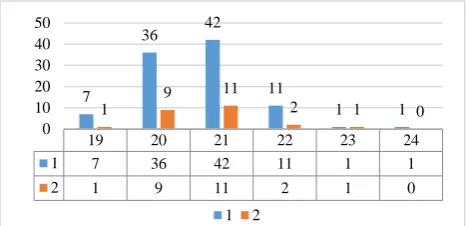
As shown in Figure 2, majority (80.3%) were found to be average online users. Moderate problematic internet use was found in 24 (19.7%). None of the student was found
to have severe problematic internet use and no statistically significant difference was found with age (p=0.868).
more likely to be pretending as someone else while online (p=0.009). None of the participant with problematic internet use was found to have undergone a cyber-security course as compared to 5.2% of online average users.
Figure 2: Age distribution of ‘problematic internet use’.
1 =Average online user; 2=Problematic internet use; Chi square test for trend -value 1.863, df–5, p=0.868.
DISCUSSION
The present study brings forward salient aspects of internet use behaviour, risk profile and prevalence of problematic internet use among medical undergraduates. There is lack of epidemiological data on problematic internet use on global and country level. Further, varied prevalence rates have been found among adolescents in different situations. However, it is estimated that 1-18% of individuals in adolescent age group have problematic internet use in Western as well as Eastern societies.5 In the present study, majority (80.3%) of the medical undergraduates were found to be average online users and 19.7% were found to have moderate problematic internet use. The study findings are similar to the previously published evidence on the subject, however, nil prevalence of severe problematic internet use was observed in the present study. Online surveys have reported higher prevalence rates (4-10%) as compared to surveys conducted in general population (0.3-0.7%).13 In study carried out by Goel et al among Indian adolescents, 74.5% were average users, 24.8% were possible addicts and 0.7% were internet addicts.3 Possible explanations to nil prevalence of severe problematic internet use in the present study may be attributed to higher levels of knowledge among medical undergraduates resulting in early detection of behavioural changes, institution of corrective behavioural measures themselves and the exhaustive academic curriculum which may pose a barrier to indulge in internet for prolonged periods of time.
In the present study, those with problematic internet use were found to have different internet behaviour than average online users. They were found to be accessing internet significantly more in classroom. This finding can be compared with internet abuse at workplace which has been reported earlier.14 Studies carried out by Goel et al and Kanwal et al among adolescents also reported higher
use of internet among those with problematic internet use.3,15 Compulsive internet behaviour has been attributed as an important risk factor in declining academic progress among students as more time is spent on internet rather than focusing on assignments. There is decline in ability to concentrate on real life instructions and students tend to skip classroom sessions leading to abseentism. Further, the frequency of use was also found to be significantly more among those with problematic internet use on platforms such as emails, social networking sites, blogging, forums, online leisure activities, surfing without purpose, online shopping and downloading. Previous studies have also documented similar patterns with significantly more indulgence among „internet addicts‟ in chatting, social networking and downloading internet content.3 This finding holds greater importance when assessing internet use behavior in an individual as risk factor for problematic internet use.
The present study also documents high level of cyber threat among Internet users. Majority (52.5% and 71.3%) of internet users had received false information and reported blocking of mail because of unknown sender/inappropriate content. Further, 45.1% had pretended to be someone else online and 36.1% had shared the password. On the other hand, only 4.1% had undertaken cyber security courses. We were unable to find a comparative data on these findings among adolescents in the country. Data on internet breach provided by Risk Based Security, Inc reported 736 million records that were exposed in 2015. Further, internet security threat report published by Symantec reported 39% underreporting of data breach incidents.1 Cyber security is concerned with everyone and the present study provides evidence for an urgent need to escalate cyber security measures among online users in the country especially adolescents and young adults who are more active and vulnerable. The vision of „digital economy‟ to prosper growth, innovation and social prosperity cannot be achieved without a trusted open network access. There is an unmet need for instituting cyber security measures among internet users in the country and road maps need to be developed to address the ever increasing concern in the country.
CONCLUSION
Internet use has increased by leaps and bounds and has become an integral part of our lives. There is a need to understand internet use behaviours, internet use risk profiles and prevalence of problematic internet use to address these issues in the country. Large scale multicentric studies need to be undertaken to estimate the baseline and develop evidence based strategies in the country.
Funding: No funding sources Conflict of interest: None declared
Ethical approval: The study was approved by the Institutional Ethics Committee
19 20 21 22 23 24
1 7 36 42 11 1 1
2 1 9 11 2 1 0
7
36 42
11
1 1
1
9 11
2 1 0
0 10 20 30 40 50
REFERENCES
1. Global Internet Report 2016. Available at: https://www.internetsociety.org/globalinternetreport /2016/. Accessed 6 December 2017.
2. O‟Reilly M. Internet addiction: a new disorder enters the medical lexicon. Canadian Med Assoc J. 1996;154:1882–3.
3. Goel D, Subramanyam A, Kamath R. A study on the prevalence of internet addiction and its association with psychopathology in Indian adolescents. Indian J Psychiatry. 2013;55:140-3.
4. Internet usage in India. Available at: https://www.statista.com/topics/2157/internet-usage-in-india/. Accessed 6 December 2017. 5. Chang J P-C, Hung C-C. Problematic internet use.
In Rey JM (ed), IACAPAP e-Textbook of Child and Adolescent Mental Health. Geneva: International Association for Child and Adolescent Psychiatry and Allied Professions, 2012.
6. Stein DJ. Internet addiction, Internet psychotherapy. Am J Psychiatr. 1997;153:890.
7. Shapira NA, Goldsmith TD, Keck PA, et al. Psychiatric features of individuals with problematic Internet use. J Affect Disorder. 2000;57:267–72. 8. Dell‟Osso B, Altamura AC, Allen A, Marazziti D,
Hollander E, et al. Epidemiologic and clinical updates on impulse control disorders: a critical review. European Arch Psychiatr Clin Neurosci. 2006;256:464–75.
9. Mark G. Does internet and computer “addiction” exist? Some case study evidence. Cyberpsychol Behav. 2000;3:211–8.
10. Davis RA. A cognitive behavioral model of pathological internet use (PIU) Comput Hum Behav. 2001;17:187–95.
11. Brenner V. Psychology of computer use: XLVII. Parameters of Internet Use, abuse, and addiction: The first 90 days of the Internet Usage Survey. Psychol Rep. 1997;80:879–82.
12. Widyanto L, McMurran M. The psychometric properties of the internet addiction test. Cyberpsychol Behav. 2004;7:443–50.
13. Sadock BJ, Sadock VA. 9th ed. Philadelphia: Lippincott Williams and Wilkins. Kaplon and Sadock Comprehensive Textbook of Psychiatry; 2009: 1063–1064.
14. Young KS, Case CJ. Internet abuse in the workplace: New trends in risk management. Cyberpsychol Behav. 2004;7:105–11.
15. Kanwal N, Archana PA. Internet addiction in students: A cause of concern. Cyberpsychol Behav. 2003;6:653–6.
Cite this article as: Singh G, Pasricha S, Nanda GS, Singh H, Bandyopadhyay K, Ray G.Internet use behavior, risk profile and „problematic internet use‟ among undergraduate medical students: an