Original Research Article
Alcoholic beverage preference and in person with alcohol dependence:
southern Tamil Nadu
Vikhram Ramasubramanian
1*, Ramasubramanian Chellamuthu
1,2, P. Raja Soundara Pandian
1,
S. Mathumathi
1, R. Selvikumari
1, R. Gopi
1INTRODUCTION
Alcohol contains calories, but has no nutritional values there are a number of alcoholic beverages made by using different sources of sugar for the fermentation process, rum made from molasses, wine from grapes, beer from malted barley, and berries whisky from malted grains.1
There are different type alcohol beverages available in the market, but the alcohol concentration is varies in its types. The brandy, whisky and rum contain 40-50% of
alcohol. Arrack, gin and vodka alcohol concentration are 50-60%, 40-50%and 35-60% respectively. Wine contains 10-22% of alcohol concentration .The low concentration alcohol beverages are toddy (5-10%), beer (4-8%) and breezer (3-5%).
Worldwide about two billion of people consume alcoholic beverages and one-third of the population is likely having diagnosable alcohol disorders. World Health Organisation indicates that one-fourth to one-third of male population drink alcohol in South East Asian
ABSTRACT
Background: Very little is known about the types of alcoholic beverages and the relationship between beverage preference and possibility of developing alcohol dependence. The aim of this study was to determine the type of alcoholic beverages consumed by alcohol abusers who have been diagnosed for alcohol dependence and their relationship to the pattern of drinking.
Methods: The study was performed on all clients visiting the psychiatric outpatient clinics of M.S. Chellamuthu Trust and Research Foundation, and Ahana Hospitals, Madurai, Tamil Nadu which comprises of mixed socioeconomic class. Subjects were screened for alcohol dependence using Alcohol use disorder questionnaire (AUDIT)” and validated with DSM IVTR criteria for alcohol dependence and their pattern of drinking. Study was limited to male subjects visiting these centres whose ages were between 18 to 60 years.
Results: Among all types of beverages, brandy (64.28%) was the most commonly used beverage, followed by whisky (19.31%) and rum (7.14%), vodka (4.23%) or beer (3.96%) and with a very low affinity for wine (1.05%). Brandy appeared to be the most preferred alcoholic beverage in subjects who are alcohol dependent.
Conclusions: Despite its ease of availability and affordability of brandy, there exists an increased preference in choice associated with risk taking behavioural pattern of drinking; further biological studies may be helpful to understand physiological mechanism of creating dependence.
Keywords: Alcohol beverage, Alcohol dependence, AUDIT, Brandy Department of Psychiatrist, 1
Ahana Hospitals, 2M.S. Chellamuthu Trust and Research Foundation, Madurai, Tamil Nadu, India
Received: 10 February 2018
Revised: 07 March 2018
Accepted: 09 March 2018
*Correspondence:
Dr. Vikhram Ramasubramanian, E-mail: [email protected]
Copyright: © the author(s), publisher and licensee Medip Academy. This is an open-access article distributed under the terms of the Creative Commons Attribution Non-Commercial License, which permits unrestricted non-commercial use, distribution, and reproduction in any medium, provided the original work is properly cited.
countries and in female population the trends has been increased. In human societies the alcohol consumption has been used from the beginning of recorded history.2 The variety of alcohol intake around the world is evolving continuously and the pattern of alcohol consumption is apparently influenced by the cultural differences.3
Alcohol dependence is one of the significant issues in India and assessed that 34-42% of grown-up Indian population reports having utilized liquor as a part of their lifetime; 5-7% has been evaluated to be abusing alcohol and 10-20 million of individuals have been assessed to have been taken treatment for alcohol dependence. Prior times, the alcohols were acquired from plants like palm tree and later on the refined spirits entered into the human society. As for the Global Burden Report, the liquor utilization represented 1.2% of aggregate demise and for 1.6 % of aggregate disability adjusted life years in 1990 in India. However limited details are known about the types of alcoholic beverages and the relationship between beverage preference and possibility of developing alcohol dependence.Alcohol is causally related to more medical conditions and it is the global burden of disease which accounts for one of the leading causes of death and disability as tobacco and hypertension.4,5
In all nations of the world where liquor is not precluded, the alcohol drinks consumed frequently are wine, beer, brandy and whisky. Though globalization is making alcohol beverage preferences more uniform across countries and it is still possible to observe national wide beverage preferences across the country.6 Investigations of alcoholic drink inclination are critical for various reasons. The patterns of utilization have a tendency to differ crosswise over diverse drinks. Wine, case in point, is for the most part taken with meals and in moderately little sums. This example of admission has been connected with helpful impacts for coronary illness, despite the fact that the impact is not connected with wine just however with any alcoholic drink. 7
The objective of this study is to determine the type of alcoholic beverages consumed by alcohol abusers who have been diagnosed for alcohol dependence and also examine their relationship to the pattern of drinking such as brandy, whisky, wine, beer, and vodka across southern Tamil Nadu of India. This has not been carried out in the recent past. Accordingly, the present study expanding the knowledge of alcohol beverage preference and alcohol dependence in this essential ethnic group and covers a gap in the literature.
METHODS
All new subjects who have had visited the outpatient department with the history of alcohol abuse at department of psychiatry, M.S. Chellamuthu Trust and Research Foundation, and Ahana Hospitals, Madurai, Tamil Nadu during July 2017- January 2018 were
enrolled in the study. There were 466 subjects were approached for this study, 48 subjects were screen failure due to the co- morbid substance use, apart from caffeine and nicotine and 40 subjects did not give consent to participate in this study and 378 male subjects were enrolled. Inclusion criteria included 1) Adult Males; 2) Aged between 18 –60 years; 3) Subjects who fulfilled the criteria of alcohol dependence as per DSM IV TR. Exclusion criteria included 1) Subjects having co-morbid psychiatric diagnosis and mental retardation; 2) Subjects with complicated withdrawal, i.e. delirium. Subject or relatives who refused to give consent to the study; 3) Subjects who were dangerously ill and who had very poor medical condition were excluded; 4) Subjects having co-morbid substances use apart from caffeine and nicotine. The collected data were coded and entered into the excel sheet. Statistical analysis was done using the SPSS 22.0 Version.
Sample
All subjects with the history of alcohol use during the 12 months were screened using Alcohol use disorder questionnaire (AUDIT). Patient who had a score of >8 were evaluated by psychiatrist to evaluate for alcohol dependence based on DSM IV TR 303.90. A semi structured proforma was administered to patient who fulfilled the DSM criteria. Severity of Alcohol Dependence Questionnaire (SADQ-C) was administered to evaluate the severity of the dependence 378 subjects fulfilled the inclusion criteria from all the three centers.
Ethical committee approval
Ethical committee approval was obtained from Institutional ethics committee, Radianz Health care and Research, Madurai and Tamil Nadu.
RESULTS
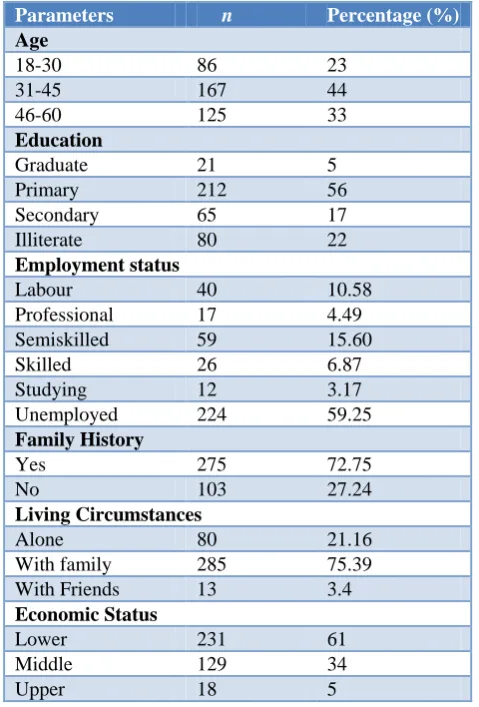
The study concluded that among the three age groups, the middle aged group (31-45 yrs) appears to be at the higher risk of alcohol abuse and followed by 46-60 years and 18-30 years. Mean age of the subject was 38±12.07 year. The overall prevalence of alcohol consumption was in each age group respectively, 23% (18-30), 44% (31-45), 33% (46-60). Among the alcohol consumers, Majority of the subjects had completed primary level of education (56%). Among the alcohol users, the most of the subjects were unemployed 59.25%, the student group had very low level of alcohol consumption.Family history of alcohol was the second major predictor for current alcohol consumption.72.75% of subjects had family history of alcohol consuming in this study.Majority of the subjects were married and living along with spouse/ family 75.39% and the subjects who stayed with friends had less level of alcohol consumption 3.4% (Table 1).
Table 1: Socio- demographic characteristics.
Parameters n Percentage (%)
Age
18-30 86 23
31-45 167 44
46-60 125 33
Education
Graduate 21 5
Primary 212 56
Secondary 65 17
Illiterate 80 22
Employment status
Labour 40 10.58
Professional 17 4.49
Semiskilled 59 15.60
Skilled 26 6.87
Studying 12 3.17
Unemployed 224 59.25
Family History
Yes 275 72.75
No 103 27.24
Living Circumstances
Alone 80 21.16
With family 285 75.39
With Friends 13 3.4
Economic Status
Lower 231 61
Middle 129 34
Upper 18 5
Table 2: Alcohol preference.
Varieties n Percentage (%)
Beer 15 3.96
Brandy 243 64.28
Rum 27 7.14
Vodka 16 4.23
Whisky 73 19.31
Wine 4 1.05
Table 3: Beverage types and duration of abuse.
Varieties <10
years
11-20 years
21-30 years
>30 years
Brandy 73 86 54 30
Beer - 15 - -
Rum 6 9 8 4
Vodka 7 2 5 2
Whisky 37 10 6 20
Wine 2 - 2 - Among the alcohol users, the 33.06% subjects had <10 years of duration of abuse, 11-20 years (32.27%), 21-30 years (19.84%) and >30 years (14.81) and brandy was the most preferred beverage in all the groups (Table 3).
Table 4: Age and beverage preference.
Varieties 18-30 31-45 46-60
Brandy 58 107 78
Beer 8 7 -
Rum 5 10 12
Vodka 5 5 6
Whisky 14 40 19
Wine 1 1 2
In all the age groups brandy was the preferred drink and wine was the least preferred by subjects. In 31-45 aged subjects had high level of brandy preference (44%) and 18-30aged subjects had low level of brandy preference (24%) (Table 4).
Table 5: Beverage preference during initiation of abuse/ and at present.
Beverage Preference Change
Initial Current No. %
Beer 88 15 -73 -83
Brandy 114 243 +129 +113
Rum 80 27 -53 - 66
Vodka 42 16 -26 - 62
Whisky 40 73 +33 + 83
Wine 14 4 -10 -71.40 Data shows that subjects who had consumed beer, vodka, wine and rum had shifted their preference to other types of beverages. In our sample, the initial preference of brandy increased by two fold (Table 5).
DISCUSSION
In southern Tamil Nadu, there are three types of alcoholic drinks which are consumed most regularly: 1) Arrack, a customary beverage produced (both lawfully and illicit) by distilling fermented molasses, rice, sugarcane, raw brown sugar, or fruit; it has an alcohol content ranging from 20% to 40%.8 2) Palm wine, another traditional alcoholic beverage produced from the sap of different types of palm tree such as the Palmyra, coconut palms and date palms,which has an alcohol content extending from 20% to 40%.9 3) Imported liquors, such as, brandy, whiskey, and rum. Beer is also consumed in the Southern Tamil Nadu region, although less commonly than the three sorts of beverages listed above.10
essential consumers of alcoholic drinks. On the other hand, the rate of men who had consumed an alcoholic drinks in the past year extending from 16.7% in Chennai city in Southern India. Conversely, the liquor utilization rates among ladies were reliably low (i.e., short of what 5%).11
Another epidemiological study directed in the country territories of Rajasthan exhibited that in spite of the fact that liquor utilization had ended up acknowledged among men, it was still occasional among ladies. In general, during 1980s liquor utilization evidently had turned into an acknowledged recreation movement for men who were married and living in little families (i.e., spouse and not more than three children) in this rural area.12
In this study, those who drank beer, vodka and rum had changed their preference to other types of beverages; Compare to other groups, brandy preference has been increased form initial stage. The reason for preference change was more pleasurable feelings in brandy than other beverage. Those who were middle aged, aged 31 to 45 years, in comparison with other groups, were more likely to have alcohol dependence.The previous study also reported the prevalence of alcohol dependence is high among the 26-45 year age-group.13
Studies in the southern regions of India have demonstrated a higher prevalence of liquor utilization among the poor and lesser educated.14,15 The present study revealed that most of them belonging to low economic status showed a higher rate (61%) of alcohol consumption compared to middle (34%) and upper economic status (5%). Additionally, less educated (56%) had higher consumption rate when compared to higher educated (5%). The alcohol use is not associated with the individual income.
Negative peer pressure is one of the major influencing factors in consumption of alcohol. Most of them consider that alcohol use is a coping mechanism and believe that it relieves the stress.
Most of the participants reported that the reasons for alcohol consumption are parental consumption of alcohol, alcohol abuse and dependence. The present study revealed family history had a maximum effect on alcohol consumption.
Brandy had highest mean consumption among men in the group compare to other beverages.Family history of alcohol was the second major predictor for current alcohol dependence. Previously some of the studies reported the similar pattern of alcohol dependence.16,17
Final data show that the beer, vodka, wine and rum preference changed to other types of beverages such as brandy and whisky. However, the initial preference of brandy increased by two fold than whisky. Brandy and
whisky preference increased by 113% and 83%, other beverage preference drastically decreased.
This study has strengths and few limitations. It collected comprehensive information on alcohol consumption and beverage preference only from Southern Tamil Nadu region. The sample size was moderately small and the results cannot be generalized to the broader community based on this study alone. Further studies with a longer study period and higher sample size, including other traditional beverages may definitely be helpful to identify the accurate results in Southern Tamil Nadu region.
CONCLUSION
The present study has been helpful in understanding the distribution of various socio demographic factors associated with alcohol dependence and alcohol beverage preference. Brandy appeared to be the most preferred alcoholic beverage in subjects who are alcohol dependent. Family dynamics does not appear to be a protective factor against alcohol abuse. Despite its ease of availability and affordability of brandy, there exists an increased preference in choice associated with risk taking behavioural pattern of drinking; further biological studies may be helpful to understand physiological mechanism of creating dependence.
Funding: No funding sources Conflict of interest: None declared
Ethical approval: The study was approved by the Institutional Ethics Committee
REFERENCES
1. Basavanthappa BT. Psychiatric Mental Health Nursing “2nd, Ed, Jaypeedehli; 2007: 544-545. 2. Das SK, Balakrishnan V, Vasudevan DM. Alcohol:
Its health and social impact in India. Natl Med J India. 2006;19:94–9.
3. Room R, Babor T, Rehm J. Alcohol and public health. Lancet. 2005; 365:519–30.
4. Murray CJ, Lopez AD. Global mortality, disability, and the contribution of risk factors: Global Burden of Disease Study. Lancet. 1997;349:1436–42. 5. Rehm J, Rehn N, Room R, Monteiro M, Gmel G,
Jernigan D, et al. The global distribution of average volume of alcohol consumption and patterns of drinking. Eur Addict Res. 2003;9:147–56.
6. Caetano R, Vaeth PAC, Ramisetty-Mikler S, Rodriguez LA. The Hispanic Americans Baseline Alcohol Survey (HABLAS): Alcoholic beverage preference across Hispanic national groups. Alcohol Clin Exp Res. 2009;33(1):150–9.
8. Patil PR, Wagh MP, Chaudhari SR. Eccentricity Of Alcoholism, Related Harms and Its Treatment: A Review. International J Pharm Res Develop. 2014;5(11):89–101.
9. Rundel, Philip W. The Chilean Wine Palm in the Mildred E. Mathias Botanical Garden ,Newsletter, Fall; 2002: 5;4.
10. Benegal V. India: alcohol and public health in National experiences. Addiction. 2005;100:1051–6. 11. Isaac M. In: Grant M., ed. Alcohol and Emerging
Markets: Patterns, Problems and Responses. Philadelphia: Brunner/Mazel; 1998: 145–175. 12. Sundaram KR, Mohan D, Advani GB, Sharma HK,
Bajaj JS. Alcohol abuse In a rural community in India. Part I: Epidemiological Study. Drug Alcohol Dependence. 1984;14:27–36.
13. Girish N, Kavita R, Gururaj G, Benegal V. Alcohol use and implications for public health: patterns of use in four communities. Indian J Community Med. 2010;35:238–44.
14. John A, Barman D, Bal G, Chandy J, Samuel M, Thokchom. Hazardous alcoholuse in rural southern
India: nature, prevalence and risk factors. Natl Med J India. 2009;22:123–5.
15. Dutta R, Gnanasekaran S, Suchithra S, Srilalitha V, Sujitha R, Sivaranjani SS, et al. A Population based Study on Alcoholism among Adult Males in a Rural area, Tamil Nadu, India. J Clin Diagn Res. 2014;8(6):JC01–3.
16. Chuang YC, Ennett ST, Bauman KE, Foshee VA. Neighbourhood influences on Adolescent cigarette and alcohol use: mediating effects through parent and peer behaviours. J Health Soc Behav. 2005;46:187-204.
17. Khosla V, Thankappan KR, Mini GK, Sarma PS. Prevalence & predictors of alcohol use among college students in Ludhiana, Punjab, India. Indian J Med Res. 2008;128(1):79-81.