Reducing Latency by Providing Location Based
Services using Hybrid Cache in Ad Hoc Networks
Mr. C. Gopala Krishnan
Department of Computer Science, Anna University Tirunelveli-07 Email:[email protected]
Dr. V. Kavitha
Department of Computer Science, Anna University Tirunelveli-07 [email protected]
Ms. J. Jesu Vedha Nayahi
Department of Computer Science, Anna University Tirunelveli-07 [email protected]
---ABSTRACT--- Broadcast Queries (BQs) refer to spatial queries whose answers rely on the location of the inquirer. Efficient processing of BQs is of critical importance with the ever-increasing deployment and use of mobile technologies. Novel approach is based on peer-to-peer sharing, which enables us to process queries without delay at a mobile host by using query results cached in its neighboring mobile peers. We design and evaluate cooperative caching techniques to efficiently support data access in ad hoc networks. We first propose two schemes: Cache Data, which caches the data, and Cache Path, which caches the data path. After analyzing the performance of those two schemes, we propose a hybrid approach (Hybrid Cache), which can further improve the performance by taking advantage of Cache Data and Cache Path while avoiding their weaknesses. Cache replacement policies are also studied to further improve the performance. Simulation results show that the proposed schemes can significantly reduce the query delay and message complexity when compared to other caching schemes.
Keywords-Ad hoc networks, Cooperative cache, Cache management, Cache replacement policy, Simulations.
--- Date of Submission: March 31, 2010 Revised: April 22, 2010 Date of Acceptance: June 06, 2010
---1. INTRODUCTION
B
roadcast query processing is becoming an integral part of many new mobile applications. Recently, there has been a growing interest in the use of broadcast queries (BQs), which represent a set of queries that retrieve information based on mobile users’ current locations [1], [2]. Novel query processing techniques must be devised to handle the following new challenges:1.Mobile query semantics. In a mobile environment, a
typical BQ is of the form “find the top-three nearest hospitals.” The result of the query depends on the location of its requester. Caching and sharing of query results must take into consideration the location of the query issuer.
2. High workload. The database resides in a centralized
server, which typically serves a large mobile user community through wireless communication. Consequently, bandwidth constraints and scalability become the two most important design concerns of BQ algorithms [2].
3. Query promptness and accuracy. Due to user mobility,
answer to an BQ will lose their relevancy if there is a long delay in query processing or in communication. For example, answers to the query “find the top-three nearest hospitals” received after 5 minutes of high-speed driving will become meaningless. Instead, a prompt, albeit approximate, top-three nearest hospitals, may serve the user much better. This is an importance issue, as a long latency in a high workload wireless environment is not unusual.
geographical area with a single transmitter. With the broadcast model, MHs do not submit queries. Instead, they tune in to the broadcast channel for information that they desire. Hence, the user’s location is not revealed. One of the limitations of the broadcast model is that it restricts data access to be sequential. Queries can only be fulfilled after all the required on-air data arrives. This is why in some cases, a 5-minute delay to the query “find the top-three nearest hospitals” would not be unusual.
Alleviating this limitation, we propose a scalable low-latency approach for processing BQs in broadcast environments. Our approach leverages ad hoc networks to share information among mobile clients in a peer-to -peer (P2P) manner [10], [11].
The rationale behind our approach is based on the following observations:
• As mentioned previously, when a mobile user launches a nearest neighbor (NN) query, in many situations, the user would prefer an approximate result that arrives with a short response time rather than an accurate result with a long latency.
• The results of spatial queries often exhibit spatial locality. For example, if two MHs are close to each other, the result sets of their spatial queries may overlap significantly. Query results of a mobile peer are valuable for two reasons: 1) they can be used to answer queries of the current MH directly and 2) they can be used to dramatically reduce the latency for the current MH relative to on-air information.
• P2P approach can be valuable for applications where the response time is an important concern. Through mobile cooperative caching[5] of the result sets,query results can be efficiently shared among mobile clients.
BQs concentrate on two common types of Query searches, namely, kNN queries and window
queries (WQs). The contributions of existing study are given as follows:
1. Identify certain characteristics of BQs that enable the development of effective sharing methods in broadcast environments. We introduce a set of algorithms that verify whether data received from neighboring
clients are complete, partial, or irrelevant answers to the posed query.
2. Utilize a P2P-based sharing method to improve the current approaches in answering on-air kNN queries and WQs.
3. Evaluate BQ approach through a probabilistic analysis of the hit ratio in sharing. In addition, through extensive simulation experiments, we evaluate the benefits of our approach with different parameter sets.
2. WIRELESS DATA BROADCAST
In general, there are two approaches for mobile data access. One is the on-demand access model, and the other is the wireless broadcast model. For the on-demand access model, point-to-point connections are established between the server and the mobile clients, and the server processes queries that the clients submit on demand. For the wireless broadcast model, the server repeatedly broadcasts all the information in wireless channels, and the clients are responsible for filtering the information. The advantage of the broadcast model over the on-demand model is that it is a scalable approach. However, the broadcast model has large latency, as clients have to wait for the next broadcast cycle broadcasting cycle. If a client misses the packets that it needs, it has to wait for the next broadcast cycle.
To facilitate information retrieval on wireless broadcast channels, the server usually transmits an index structure, along with data objects. A well-known broadcast index structure is the (1, m)[9] indexing allocation method . As we can see in Fig. 1, the whole index is broadcast preceding every 1/m fraction of the data file. Because the index is available m times in one cycle, it allows a mobile client easy access to the index so that it can predict the arrival time of its desired data in a timely manner, and once it knows the arrival time, it only needs to tune into the broadcast channel when the data bucket arrives. This mechanism is important for battery-based devices.
Fig. 1. The Hilbert-curve-based index structure. The numbers represent index values.
Thus, the general access protocol for retrieving data on a wireless broadcast channel involves three main steps[15] :
• The initial probe. A client tunes in to the broadcast channel and determines when the next index segment will be broadcast.
• Data retrieval. The client tunes in to the channel when packets containing the required data arrive and then downloads all the required information.
However, nearly all the existing spatial access methods are designed for databases with random access disks. These existing techniques cannot be used effectively in a wireless broadcast environment, where only sequential data access is supported. Zheng et al. [19] proposed indexing the spatial data on the server by a space-filling curve. The Hilbert curve [20] was chosen for this purpose because of its superior locality. The index values of the data packets represent the order in which these data packets are broadcast. For example, the Hilbert curve in Fig. 1 tries grouping data of close values so that they can be accessed within a short interval when they are broadcast sequentially. The MHs use on-air search algorithms [19] to answer LBSQs (kNN and WQs) over data that arrives in the order prescribed by the Hilbert curve.
2.1 SPATIAL QUERIES
Existing work focus on two common types of spatial queries, namely, kNNqueries and WQs[17]. With R-tree-based [15] spatial indices, depth-first search (DFS) and best first search (BFS)[8] have been the prevalent branch-and-bound techniques for processing NN queries. The DFS method recursively expands the index nodes for searching NN candidates. At each newly visited nonleaf node, DFS computes the ordering metrics for all its child nodes and applies pruning strategies to remove unnecessary branches. When a leaf node is reached, the data objects are retrieved, and the NN candidates are updated. Comparatively, the BFS technique utilizes a priority queue to store nodes to be explored through the search process. The nodes in the queue are sorted according to their minimum distance (MINDIST) to the query point. During the search process, BFS repeatedly dequeues the top entry in the queue and enqueues its child nodes with their MINDIST into the queue. When a data entry is dequeued, it is inserted into the result set. For WQs that find objects within a specified area, the R-tree families[3],[16] provide efficient access to disk-based databases. Basically, an R-tree structure groups objects close to each other into a minimum bounding rectangle (MBR), and a range query only visits MBRs that overlap with the query area.
2.2 COOPERATIVE CACHING
Caching is a key technique to improve data retrieval performance in widely distributed environments Hara and Madria proposed three data replica allocation methods in ad hoc networks by considering the access frequency from MHs to each data item and the status of the network connection With the increasing deployment of new P2P wireless
communication technologies, P2P cooperative caching becomes an effective sharing alternative With this technique,[4],[7].MHs communicate with neighboring peers in an ad hoc manner for information sharing instead of relying solely on the communication between remote information sources .
P2P cooperative caching can bring about several distinctive benefits to a mobile system: improved access latency, reduced server workload, and alleviated point-to- point channel congestion. In this research, we leverage the P2P caching technique to alleviate the inherent access latency limitation in wireless broadcast environments.
2.3 SHARING-BASED NN QUERIES
Fig. 2 shows an example of an on-air kNN query based on the Hilbert curve index structure [19]. At first, by scanning the on-air index, the k-nearest object to the query point is found, and a minimal circle centered at q and containing all those k objects is constructed. The MBR of that circle, enclosing at least k objects, serves as the search range. Consequently, q has to receive the data packets that covers the MBR from the broadcast channel for retrieving its k-nearest objects. As shown in Fig. 2, the related packets span a long segment in the index sequence, that is, between 5 and 58, which will require a long retrieval time. The other problem with this search algorithm is that the indexing information has to be replicated in the broadcast cycle to enable twice scanning. The first scan is for deciding the kNN search range, and the second scan is for retrieving k objects based on the search range [19].
Therefore, the Sharing-Based Nearest Neighbor (SBNN) query approach to improve the preceding on-air kNN query algorithm. The SBNN algorithm attempts to verify the validity of k objects by processing results obtained from several peers..
3. OVERVIEW
The wireless data broadcast model has good scalability for supporting an almost-unlimited number of clients[9] .Its main limitation lies in its sequential data access: the access latency becomes longer as the number of data items increases. If we can provide (approximate) answers to spatial queries before the arrival of related data packets, we will overcome the limitation of the broadcast model.
solutions but require a short response time (for example, the query “What are the top-three nearest hospitals?” issued by a motorist on a highway).
21 22 25 26 37 38 41 42
20 23 24 27 36 39 40 43
19 18 29 28 35 34 45 44
16 17 30 31 32 33 46 47
15 12 11 10 53 52 51 48
14 13 8 q 54 55 50 49
1 2 7 6 57 56 61 62
0 3 4 5 58
59 60 63
Fig. 2. An on-air kNN query example. The numbers represent index values
3.1NEAREST NEIGHBOR VERIFICATION
When an MH q executes SBNN, it first broadcasts a request to all its single-hop peers for their cached spatial data. Each peer that receives the request returns the verified region MBR and the cached POIs to q. Then, q combines the verified regions of all the replying peers, each bounded by its MBR, into a merged verified region MVR (the polygon in Fig. 3). The merging process is carried out by the MapOverlay algorithm [6] (line 4 in Algorithm 1). The core of SBNN is the NN verification (NNV) method, whose objective is to verify whether a POI oi obtained from peers is a valid (that is, the top-k) NN of the MH q.
Let IP denote the data collected by q from j peers pi,… pj. Consequently, the merged verified region MVR can be represented as
MVR =p1.VR U p2.VR U ….. U pj VR
Suppose that the boundary of MVR consists of k edges, IE ={e1,e2, . . . ek}, and there are l POIs,
! ={o1, o2,…..ol} inside the MVR. Let es " IE be the edge that has the shortest distance to q. An example is given in Fig. 3, where k=10, and e1 has the shortest distance to q.
Fig. 3. Because e1 has the shortest distance to q and ||q,o1||<=||q,e1||,POI is verified as a valid NN of MHq.
The NNV method uses a heap H to maintain the entries of verified and unverified POIs.Initially, H is empty. The NNV method inserts POIs to H as it verifies objects from MHs in the vicinity of q. The heap H maintains the POIs in ascending order in terms of their euclidean distances to q. nverified objects are kept in H only if the number of verified objects is lower than what was requested by the query. The NNV method is formalized in Algorithm 1. Since the verified-region merging process dominates the algorithm complexity, the NNV method can be computed in O(n log n+i log n) time,
where n is the total edge number of the two merged polygons, and i is the number of intersection points.
Algorithm : NNV(q,H,k)
1: P← peer nodes responding to the query request issued from q.
2: MVR ←Ф
3: for #p$ IP do
4: MVR U= p.V R and ! U p. !
5: end for
6: #oi "!, sort according to ||q, oi||
7: Compute ||q,es||, where edge es has the shortest distance to q among all the edges of MVR 8: i= 1
9: while |H| < k and i <= | ! | do 10: if ||q, oi||<=||q,es|| then 11: H.verified U = oi 12: else
13: H.verified U = oi 14: i++
15: end if 16: end while 17: return H
may agree to accept a kNN data set with unverified elements, where the objects are not guaranteed to be the top kNNs.However, the correctness of these approximate results can be estimated and will be discussed in the next section. If the result quality is the most important concern, the client has to wait until it receives all the required data packets from the broadcast channel. Nevertheless, the partial results in H can be used to decrease the required data packets and thus speed up the on-air data collection.
3.2 APPROXIMATE NEAREST NEIGHBOR
We calculate the probability that the unverified ith NN o of a query point q is actually the true ith NN of q. The reason that o cannot be verified is because there is a region that is not covered by q’s neighboring peers. As long as a POI exists in the region, o cannot be q’s ith NN. We denote such a region as o’s unverified region. We assume that the POIs are Poisson distributed in our environment based on our experiments of several common POI types (gas stations, grocery stores, etc.) with chi-square tests [13], [14]. The probability of finding another POI in the unverified region Ui of an unverified POI oi can be calculated with respect to the area of Ui. We formulate the correctness of an unverified POI based on the probability model
4. PROPOSED BASIC COOPERATIVE CACHE
SCHEMES
In this section, we propose two basic cooperative cache schemes and analyze their performance.
4.1 SYSTEM MODEL
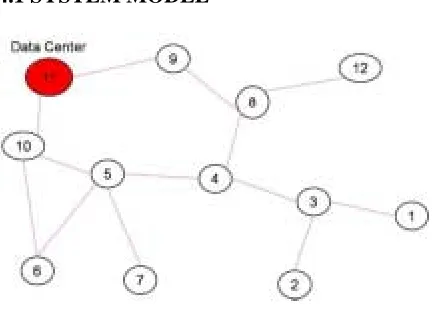
Fig 4.1 System Model
Fig 4.1 shows part of an ad hoc network. Some nodes in the ad hoc network may have wireless interfaces to connect to the wireless infrastructure such as wireless LAN or cellular networks. Suppose node N11 is a data source (center), which contains a database of n items d1; d2; . . . ; dn. Note that N11 may be a node connecting to the wired network which has the database. In ad hoc networks, a data request is forwarded
hop-by hop until it reaches the data center and then the data center sends the requested data back. Various routing algorithms have been designed to route messages in ad hoc networks. To reduce the bandwidth consumption and the query delay, the number of hops between the data center and the requester should be as small as possible. Although routing protocols can be used to achieve this goal, there is a limitation on how much they can achieve. In the following, we propose two basic cooperative caching schemes: Cache Data and Cache Path.
4.1.1 CACHE THE DATA
In CacheData, the node caches a passing-by data item di locally when it finds that di is popular, i.e., there were many requests for di, or it has enough free cache space. For example, in Fig.4.1, both N6 and N7 request di through N5, N5 knows that di is popular and caches it locally. Future requests by N3, N4, or N5 can be served by N5 directly. Since CacheData needs extra space to save the data, it should be used prudently. Suppose the data center receives several requests for di forwarded by N3. Nodes along the path N3 _N4 _ N5 may all think that di is a popular item and should be cached. However, it wastes a large amount of cache space if three of them all cache di.
To avoid this, a conservative rule should be followed: A node does not cache the data if all requests for the data are from the same node. As in the previous example, all requests received by N5 are from N4, which in turn are from N3. With the new rule, N4 and N5 do not cache di. If the requests received by N3 are from different nodes such as N1 and N2, N3 will cache the data. If the requests all come from N1, N3 will not cache the data, but N1 will cache it. Certainly, if N5 receives requests for di from N6 and N7 later, it may also cache di. Note that di is at least cached at the requesting node, which can use it to serve the next query.
This conservative rule is designed to reduce the cache Space requirement. In some situations, e.g., when the cache size is very large or for some particular data that are interested by most nodes, the conservative rule may decrease the cache performance because data are not cached at every intermediate node.However, in mobile networks, nodes usually have limited cache spaces and we do not assume that some data are interested by all nodes. Therefore, the conservative rule is adopted in this paper.
4.1.2 CACHE THE DATA PATH
N4. Note that many routing algorithms (such as AODV[and DSR provide the hop count information between the source and destination. By caching the data path for each data item, bandwidth and the query delay can be reduced since the data can be obtained through fewer number of hops. However, recording the map between data items and caching nodes increases routing overhead.
In the following, we propose some optimization techniques. When saving the path information, a node need not save all the node information along the path. Instead, it can save only the destination node information, as the path from current router to the destination can be found by the underlying routing algorithm. In CachePath, a node does not need to record the path information of all passing-by data.
For example, when di flows from N11 to destination node N1 along the path N5 _ N4 _ N3, N4 and N5 need not cache the path information of di since N4 and N5 are closer to the data center than the caching node N1. Thus, a node only needs to record the data path when it is closer to the caching node than the data center. Due to mobility, the node which caches the data may move. The cached data may be replaced due to the cache size limitation. As a result, the node which modified the route should reroute the request to the original data center after it finds out the problem. Thus, the cached path may not be reliable and using it may adversely increase the overhead. To deal with this issue, a node Ni caches the data path only when the caching node, say Nj, is very close. system tuning threshold, called TH, when CachePath is used.
5. HYBRID CACHING SCHEME
The performance analysis showed that Cache Path and Cache Data can significantly improve the system performance. We also found that Cache Path performs better in some situations such as small cache size or low data update rate, while CacheData performs better in other situations.
5.1 HYBRID ALGORITHM
To further improve the performance, we propose a hybrid scheme Hybrid Cache to take advantage of Cache Data and Cache Path while avoiding their weaknesses. Specifically, when a node forwards a data item, it caches the data or path based on some criteria. These criteria include the data item size si, the TTL time TTLi, and the Hsave. For a data item di, the following heuristics are used to decide whether to cache data or path
• If si is small, CacheData should be adopted because the data item only needs a very small part of the cache; otherwise, CachePath should be adopted to
save cache space. The threshold value for data size is denoted as Ts.
• If TTLi is small, CachePath is not a good choice because the data item may be invalid soon. Using CachePath may result in chasing the wrong path and end up with resending the query to the data center. Thus, CacheData should be used in this situation. If TTLi is large, CachePath should be adopted. The threshold value for TTL is a system tuning parameter and denoted as Tttl.
• If Hsave is large, CachePath is a good choice because it can save a large number of hops; otherwise,CacheData should be adopted to improve the performance if there is enough empty space in the cache. We adopt the threshold value TH used in CachePath as the threshold value.
These threshold values should be set carefully as they may affect the system performance. Their effects and how to set them are studied through simulations
ALGORITHM ( Hybrid Cache)
When a data item di arrives:
if (di is the requested data by the current node) then cache data item di;
return;
If (an old version of di is in the cache)then Update the cached copy;
Else if (si <Ts or there is an invalid copy in the cache Or there is a cached path for di ) then
Cache data item di;
Else if (Hsave > Th and TTLi > Tttl )then Cache the Path of di;
Si – size of data item H Hop Ts,Th – Thresholds TTL –Time to Live
When a request for data item di arrives:
If(there is a valid copy in cache ) then send di to the requester ;
Else if (there is a valid path for di in the cache) then
Forward the request to the caching node; Else
Forward the request to the data center.
Tttl –system tuning Parameter (Threshold value)
Section 5.1 shows the algorithmthat applies these heuristics in Hybrid Cache. In our design, caching a data path only needs to save a node id in the cache. This overhead is very small. Therefore, in Hybrid Cache, when a data item di needs to be cached using Cache Data, the path for di is also cached. Later, if the cache replacement algorithm decides to remove di, it removes the cached data while keeping the path for di. From some point of view, Cache Data degrades to Cache-Path for di. Similarly, Cache Path can be upgraded to CacheData again when di passes by.
6. PERFORMANCE EVALUATION
The performance evaluation includes three sections. The simulation model is given in Section 6.1. In Section 6.2, simulated environments and screenshots are shown. Section 6.3 shows the performance graph of cache data,cache path and hybrid cache from the analytical results.
6.1 THE SIMULATION MODEL
The simulation is based on ns-2 with Cygwin Environment.. In our simulation, AODV (Ad Hoc On Demand Distance Vector) used as an underlying routing algorithm, Since it is better than DSDV and I-DSDV(Improved Direct sequence Distance Vector) .The aforesaid fact is justified by following results.
Packet Delivery Fraction of AODV
Figure 6.1 a)
From the Figure 6.1a) it is shown that AODV perform better when the number of nodes increases because nodes become more stationary will lead to more stable path from source to destination DSDV performance dropped as number of nodes increase because more packets dropped due to link breaks. I-DSDV is better than I-DSDV especially when the number of nodes is between 20 and 35. I-DSDV improved the PDF since it find new route to destination when link breaks existed.
End to End Delay of AODV
Figure 6.1 b)
From the Figure 6.1 b) it is clear that AODV didn’t produce so much delay even the number of nodes increased. It is better than other two protocols. The performance of I-DSDV is slight better than DSDV especially when the number of nodes between 15 and 30. It shows that, the I-DSDV protocol improved the DSDV but slightly lower than AODV when the nodes is higher.We assume that the wireless bandwidth is 2 Mb/s, and the radio range is 200m to 250m.
6.2 SIMULATION
Experiments were run using different workloads and system settings. The design of wireless scenario is shown in the Fig 6.2 (a).In this caching of any node and caching of path is shown. In Figure 6.2(b) and (c)the system model of the ad hoc network is shown. In this totally seven nodes are shown. In that one node acting as as a Data Center and remaining nodes have peer to peer connection.
As per the Hybrid cache algorithm Cache Path and Cache Data have been done with the help of ns2 simulator. Caching of data is done when the node 0 requests the data from the data center. If the request is again from the node 0 , the node 0 itself analyze for the data and get the results .If some other node in this ad hoc network request for the same data again ,a node which has the path id of the node1 will respond for the request.
6.2 b) Ad Hoc Model
6.2 c) Request of node 1 and Response from Data center (node 0)
6.3 PERFORMANCE GRAPH
6.3 Transmission Range Experiments
The graph 6.3 shows the comparison graph of cache data ,cache path and hybrid cache.Comparison has been done by taking transmission Range as a parameter.From the Analytical results we can understand that hybrid cache methodology gives the gradual growth while increasing transmission range. Hybrid cache is better than cache data and cache path.Since In this scenario we have considered cache data and cache path. We have considered cache data whenever it is essential (depending upon threshold level and size of a data) and considered cache path(depending upon threshold of Time to live of a data item).
7. CONCLUSION AND FUTURE WORK
This paper presented a novel approach for reducing the spatial query access latency by leveraging results from nearby peers by applying Hybrid cache Mechanism. Specifically, we proposed three schemes: Cache Path, Cache Data, and Hybrid Cache. In Cache Data, intermediate nodes cache the data to serve future requests instead of fetching data from the data center. In CachePath, mobile nodes cache the data path and use it to redirect future requests to the nearby node which has the data instead of the faraway data center. Hybrid Cache takes advantage of CacheData and CachePath while avoiding their weaknesses. Cache Replacement policies are also studied to further improve the cache performance. Simulation results showed that the proposed schemes can significantly reduce the query delay when compared to SimpleCache and significantly reduce the message complexity when compared to FloodCache The experiment results indicate that our method can reduce the access to the wireless broadcast channel by a significant amount, for example, up to 90 percent.
REFERENCES
[1]. S.Acharya, R.Alonso,M.J. Franklin, and S.B. Zdonik, “BroadcastDisks: Data Management for Asymmetric Communications Environments,” Proc.ACM SIGMOD’95, pp.199-210, 1995.
[2]. D.Barbara´ , “Mobile Computing and Databases: A Survey,”IEEE Trans. Knowledge and Data Eng., vol. 11, no. 1, pp. 108-117, Jan./Feb. 1999.
[3]. N.Beckmann, H.-P. Kriegel, R. Schneider, and B. Seeger, “The R*-Tree: An Efficient and Robust Access Method for Points and Rectangles,” Proc. ACM SIGMOD ’90, pp. 322-331, 1990.
[4]. C. Y. Chow, H. Va Leong, and A. Chan, “Peer-to-Peer Cooperative Caching in Mobile Environment,” Proc. 24th IEEE Int’l Conf. Distributed Computing Systems Workshops (ICDCSW ’04), pp. 528-533, 2004.
[5]. C.-Y. Chow, H. Va Leong, and A.T.S. Chan, “Distributed Group- Based Cooperative Caching in a Mobile Broadcast Environment,” Mobile Data Management, pp. 97-106, 2005.
[6]. M. de Berg, M. van Kreveld, M. Overmars, and O. Schwarzkopf, Computational Geometry Algorithms and Applications, second ed. Springer, 2000.
[7]. T.Hara, “Cooperative Caching by Mobile Clients in Push-Based Information Systems,” Proc. 11th ACM Int’lConf.Information and Knowledge Management, pp.186-193, 2002.
[8]. G.R. Hjaltason and H. Samet, “Distance Browsing
Database Systems, vol. 24, no. 2, pp. 265-318, 1999.
[9]. T.Imielinski, S. Viswanathan, and B.R. Badrinath, “Data on Air: Organization and Access,” IEEE Trans. Knowledge and Data Eng., vol. 9, no. 3, pp. 353-372, May-June 1997.
[10].W.-S. Ku and R. Zimmermann, “Location-Based Spatial Queries with Data Sharing in Mobile Environments,” Proc. 22nd IEEE Int’l Conf. Data Eng. (ICDE ’06) Workshops, p.140, 2006.
[11].W.-S. Ku, R. Zimmermann, and H. Wang, “Location-Based Spatial Queries with Data Sharing in Wireless Broadcast Environments,” Proc. 23rd IEEE Int’l Conf. Data Eng. (ICDE), 2007.
[12].M.F. Mabel, C.-Y. Chow, and W.G. Aref, “The New Casper: Query Processing for Location Services without Compromising Privacy,” Proc. 32nd Int’l Conf. Very Large Data Bases (VLDB ’06), pp. 763-774, 2006.
[13].D.C. Montgomery and G.C. Runger, Applied Statistics and Probability for Engineers, second ed. John Wiley & Sons, 1998.
[14].J.L. Ringuest, “A Chi-Square Statistic for Validating Simulation- Generated Responses,” Computers and Operations Research, vol. 13,no. 4, pp. 379-385, 1986.
[15].N. Roussopoulos, S. Kelley, and F. Vincent, “Nearest Neighbor Queries,” Proc. ACM SIGMOD ’95, pp. 71-79, 1995.
[16].T.K. Sells, N. Roussopoulos, and C. Faloutsos, “The R+-Tree: A Dynamic Index for Multi- Dimensional Objects,” Proc. 13th Int’l Conf. Very Large Data Bases (VLDB ’87), pp. 507-518, 1987. [17].W.-S. Ku, R. Zimmermann, and H.
Wang,“Location-Based Spatial Query Processing in Wireless Broadcast Environments,” IEEE Trans. Mobile Computing,vol. 7, no.6, pp. 778-791, June .2008.
[18].B. Zheng and D. Lun Lee, “Information Dissemination via Wireless Broadcast,” Comm. ACM, vol. 48, no. 5, pp. 105-110, 2005.
[19].B. Zheng, W.-C. Lee, and D. Lun Lee, “Spatial Queries in Wireless Broadcast Systems,” Wireless Networks, vol. 10, no. 6, pp. 723-736, 2004.
[20].H.V. Jagadish, “Analysis of the Hilbert Curve for Representing Two-Dimensional Space,” Information Processing Letters, vol. 62, no. 1, pp. 17-22, 1997.
Authors Biography
Mr.C.Gopala Krishnan received his B.E. degree in Computer science Engg in 2002 from Madurai Kama Raj University and M.E. degree in Computer Science and Engineering in 2010 from Anna University Tirunelveli, Tirunelveli, India. His areas of interest are Mobile computing, operating systems and Computer Networks. He has presented many papers in national and International Conferences in various fields. As part of this paper, he is working on developing communication protocols for wireless networks—protocols optimized for wireless and mobility that can support file and database access. He is also investigating operating systems support for mobile hosts .He is a member of ISTE.
Dr.V.Kavitha obtained her B.E degree in Computer Science and Engineering in 1996 from MS University and ME
degree in Computer Science and Engineering in 2000 from Madurai Kama Raj University. She is the University Rank Holder in UG and Gold Medalist in PG.She received PhD degree in Computer Science and Engineering from Anna University Chennai in 2009. Right from 1996 She is in the Department of Computer Science & Engineering under various designations. Presently She is working as Asst. Prof in the Department of CSE at Anna University Tirunelveli..In addition she is the Director In-Charge of University V.O.C College of Engineering. Tuticorin. Currently, under her guidance ten Research Scholars are pursuing PhD as full time and part time. Her research interests are Wireless networks, Mobile Computing, Network Security, Wireless Sensor Networks, Image Processing, Cloud Computing .She has published many papers in National and International journals in areas such as Network security, Mobile Computing, wireless network security, and Cloud Computing. She is a life time member of ISTE.