Original Research Article
Doctor shopping behaviour and its determinants among people with
chronic diseases in rural Kancheepuram district, Tamil Nadu:
a cross-sectional study
Muthukumar Tharumaraj
1*, Kalaivani Annadurai
1,
Jerrin Cinthiya
2, Karnaboopathy Ranganathan
1INTRODUCTION
Doctor shopping is defined as the practice of patient seeking multiple health care providers without making efforts to coordinate care or informing physicians of the multiple care givers for the same illness or to procure prescription drugs illicitly.1 Even though, Consumer Protection act states to sought second opinion as the right of the patient, it often leads to lack of continuum of care and increasing health care cost.2 Doctor shopping
behaviour ranges from 6.3% to 53% depends upon the definition of doctor shopping and sample of the study. Literature studies have cited physician related factors, illness related factors and psychological factors of the patients as the important predictors of doctor shopping. It often reflects the trust of the patient over the physician. There has been a major metamorphosis in the trust of patients over health care system from blind faith to a calculated and strategic approach over a period of time ABSTRACT
Background: Doctor shopping is defined as the practice of patient seeking multiple health care providers without making efforts to coordinate care or informing physicians of the multiple care givers for the same illness or to procure prescription drugs illicitly. This study was planned to explore the doctor shopping behaviour and its determinants among people with chronic diseases in rural Kancheepuram district, Tamil Nadu.
Methods: A cross sectional study was conducted among patients of chronic diseases residing in Sembakkam village, Kancheepuram District, Tamil Nadu. Data was collected using a pre-tested semi-structured schedule adopted from Agarwal et al will be used.
Results: Prevalence of doctor shopping was found to be 73.7% among the study population which is visiting more than one doctor for the same diagnosis. The main reason given by the participants for consulting more than one doctor was consistence of the symptoms (34%) followed by location of the health facility (15.9%) and non-acceptance of the diagnosis (15.5%).
Conclusions: Patient education, good interpersonal communication skills, and health system strengthening measures can increase responsiveness of the community toward the health systems and thereby reduce doctor shopping behaviour.
Keywords: Cross sectional study, Doctor shopping, Rural
1Department of Community Medicine, 1,2Shri Sathya Sai Medical College and Research Institute, Sri Balaji
Vidyapeeth (SBV) (Deemed to be university) Ammapettai, Kancheepuram, Tamil Nadu, India
Received: 20 September 2019
Revised: 18 November 2019
Accepted: 19 November 2019
*Correspondence:
Dr. Muthukumar Tharumaraj, E-mail: [email protected]
Copyright: © the author(s), publisher and licensee Medip Academy. This is an open-access article distributed under the terms of the Creative Commons Attribution Non-Commercial License, which permits unrestricted non-commercial use, distribution, and reproduction in any medium, provided the original work is properly cited.
because of changing socio-political environment of health care system in India.3
Moreover, non-communicable diseases accounts for 53% of burden of disease in India and about 20% of India’s population is having at least one chronic disease and over 10% of the population is having more than one chronic diseases.4 Growing burden of the chronic diseases and lack of adequate trust of patients over health care system has immense effect on the pattern of health seeking behaviour of chronic patients. There is still a paucity of research on the evaluation of doctor shopping behaviour in the context of chronic diseases in India. So, this study is planned to explore the doctor shopping behaviour and its determinants among people with chronic diseases in rural Kancheepuram district, Tamil Nadu.
METHODS
A cross sectional study was conducted among patients of chronic diseases residing in Sembakkam village, Kancheepuram District, Tamil Nadu. Data was collected using a pre-tested semi-structured schedule adopted from Agarwal S et al was used.2 It was translated to local language Tamil while interviewing the participants. Details of their socio demographic data was asked in part I of the schedule, part II consist of questions pertaining to their doctor shopping behaviour and part III consist of questions pertaining to factors responsible for doctor shopping behaviour. The data was collected between June and August 2018 among patients with chronic diseases residing in Sembakkam village of Kancheepuram district, Tamil Nadu. Patients with chronic diseases like diabetes mellitus, hypertension, coronary artery diseases, chronic obstructive pulmonary diseases, cancer, stroke, tuberculosis, and other diseases for which they are taking treatment for more than three months and adults of age 18 and above (either male or female) residing in this area was included in the study and Patients who were not willing to participate in the study was excluded from the study. Houses that were locked even after three visits were not included.
Sampling method and sample size- Prevalence of chronic diseases was found to be 20% in the general population of India, as reported by Partnership to Fight Chronic Disease advisory report was used to calculate the required sample size.4
N=[Z α2 p×q]/d2=[4×20×80] / (5)2=256, (where Z α2=4, p=20, q=80 and d=5% absolute error). Assuming a 5% non-response rate, the final sample size is approximated to 270. List of patients with chronic diseases will be obtained local village health nurse and will be line listed. Sample size of 270 will be chosen using simple random sampling method through random number table.
Institution Ethical committee clearance was obtained. Participants were explained about the study and importance of their participation in the study. Those who were willing to take part in the study were included after getting an informed consent.
Statistical analysis
The collected data were entered in Microsoft Excel and analyzed using the statistical software SPSS version 21.0 Chi square test was applied for testing difference in proportion and a p value less than 0.05 was considered statistically significant.
Operational definition
Doctor shopping
For the study purpose doctor shopping is defined as the behavior of visiting more than one doctor for the same disease or diagnosis.
RESULTS
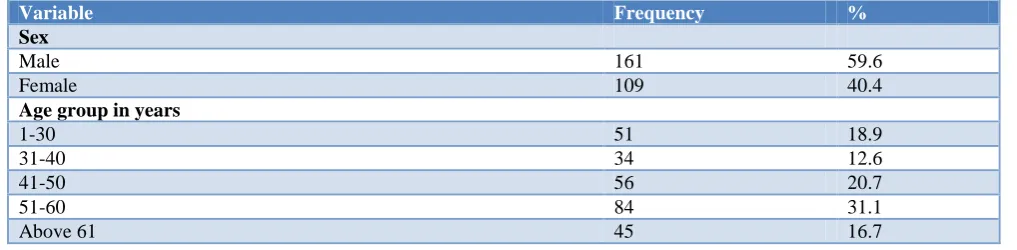
A total of 270 people participated in the study, out of which majority of the study participant were male (59.6%), more than 30% of the participants were in the age group of 51-60 years. Most of the study participants were Hindus by religion (76.7) followed by Christians and Muslims. 60% of the participants belong to nuclear family and maximum numbers (85.2%) of participants were married at the time of study. Maximum numbers of the study participants were educated up to UG/PG (28.5%) followed by diploma holders (22.2%), more than 20% of the study participants were semiskilled workers followed by skilled workers (13%), about 30% of the participants belongs to upper middle class according to modified BG Prasad classification (Table 1).
Table 1: Socio demographic profile of the study participants (n=270).
Variable Frequency %
Sex
Male 161 59.6
Female 109 40.4
Age group in years
1-30 51 18.9
31-40 34 12.6
41-50 56 20.7
51-60 84 31.1
Above 61 45 16.7
Variable Frequency %
Religion
Hindu 207 76.7
Muslim 24 8.9
Christian 39 14.4
Type of family
Nuclear 162 60.0
Joint 21 7.8
Extended nuclear 87 32.2
Marital status
Single 31 11.5
Married 230 85.2
Separated 2 0.7
Widowed 7 2.6
Education
No schooling 21 7.8
Less than primary school 41 15.2
Primary school completed 7 2.6
High school completed 19 7.0
Higher secondary completed 38 14.1
Intermediate/diploma 60 22.2
UG/PG 77 28.5
Professional 7 2.6
Occupation
Professional 7 2.6
Semi-Professional 38 14.1
Skilled 35 13.0
Semi-skilled 55 20.4
Unskilled 25 9.3
Student 21 7.8
Unemployed/house wife 89 33.0
Socio economic status
Class I 27 10.0
Class II 79 29.3
Class III 56 20.7
Class IV 67 24.8
Class V 41 15.2
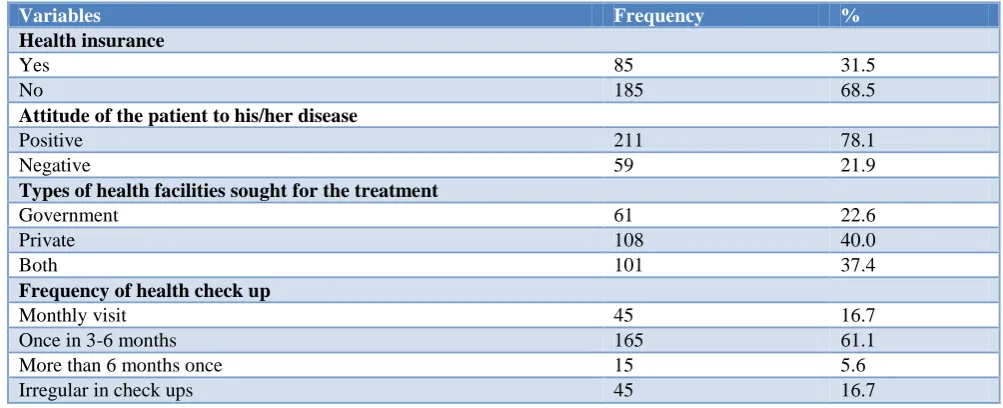
Table 2: Factors attributing to doctor shopping (n=270).
Variables Frequency %
Health insurance
Yes 85 31.5
No 185 68.5
Attitude of the patient to his/her disease
Positive 211 78.1
Negative 59 21.9
Types of health facilities sought for the treatment
Government 61 22.6
Private 108 40.0
Both 101 37.4
Frequency of health check up
Monthly visit 45 16.7
Once in 3-6 months 165 61.1
More than 6 months once 15 5.6
Irregular in check ups 45 16.7
Variables Frequency %
Number of doctors consulted since the time of diagnosis
1 71 26.3
2 78 28.9
3 86 31.9
4 24 8.9
>4 11 4.1
Simultaneous consultation with more than one physician
Yes 12 4.4
No 31 11.5
NA 227 84.1
Reasons*
Inconvenient consultation hours 9.0 2.92
Long waiting hours 2.0 0.65
Location of the health facility 49 15.91
Lack of better communication 7 2.27
Persistence of symptoms 105.0 34.09
Worsening of the symptoms 5 1.62
Non acceptance of the diagnosis 48.0 15.58
Non acceptance of the treatment 5.0 1.62
Lack of trust over doctors 1.0 0.32
Lack of availability of regular physicians 4.0 1.30
Prescription of costly drugs 2.0 0.65
Other reasons 71.0 23.05
Choice of the physician depends on
Consultation fee 37 9.32
Holding of post graduate degree in that specialty 85 21.41 Word of mouth referral by neighbours 126 31.74 Better infrastructure of the hospital 5 1.26
Advertisement of the hospital 23 5.79
Location of health facility 103 25.94
Number of patients visiting the hospital 18 4.53
Satisfaction with the current treating physician
Fully satisfied 75 27.8
Partial satisfaction 117 43.3
Yet to decide on the satisfaction level 27 10.0
Can’t say 49 18.1
Still not satisfied 2 0.7
*Multiple response question.
In this study, 78% of the study participants had positive attitude towards their disease, private health facility is the most preferred health facility for their illness (40%). Regarding the frequency of health check up 61% of the participants does health check up every 3-6 months,
A total 73.7% of the participants consulted more than one doctor at the time of diagnosis out of which 4.4% was simultaneous consultation with two doctors (Table 2).
The main reason given by the participants for consulting more than one doctor was consistence of the symptoms (34%) followed by location of the health facility (15.9%) and non-acceptance of the diagnosis (15.5%) and regarding the choice of physician, word of mouth (31.7%) was the major reason for the participants to choose a doctor followed by the location of the health facility
(26%). And only 27.8% of the study participants were fully satisfied by the current treating physician (Table 2).
In this study the prevalence of doctor shopping is found to be 73.7%, and this practice is more among males compared to female, participants in the age group of 51- 60 years and people living in nuclear family. From the results it is found that the participants who are diploma or degree holder practice doctor shopping more compared to other. The association between the gender, age, religion, marital status, occupation and doctor shopping were found to be statistically significant (Table 3).
between doctor shopping and duration of chronic diseases, type of health facility visited and frequency of
the health checkup were found to be statistically significant (Table 4).
Table 3: Association between doctor shopping and socio demographic profile of the study participants (n=270).
Variable Doctor shopping Total Chi-square value
(p value)
Yes No
Sex Male 53 108 161 9.026 (0.003)
Female 18 91 109
Age
21-30 3 48 51
23.879 (0.000)
31-40 4 30 34
41-50 20 36 56
51-60 28 56 84
Above 61 16 29 45
Religion
Hindu 56 151 207
5.331 (0.062)
Muslim 2 22 24
Christian 13 26 39
Type of family
Nuclear 42 120 162
0.594 (0.743)
Joint 7 14 21
Extended nuclear 22 65 87
Marital status
Single 0 31 31
17.973 (0.000) Currently married 70 160 230
Separated 0 2 2
Widowed 1 6 7
Education
No schooling 8 13 21
5.239 (0.634) Less than primary school 11 30 41
Primary school completed 2 5 7 High school completed 4 15 19 Higher secondary completed 11 27 38 Intermediate/diploma 19 41 60
UG/PG 15 62 77
Professional 1 6 7
Occupation
Professional 1 6 7
14.543 (0.020)
Semi-professional 13 25 38
Skilled 10 25 35
Semi-skilled 18 37 55
Unskilled 9 16 25
Student 0 21 21
Unemployed/ house wife 20 69 89
Per capita income
Class I 8 19 27
2.273 (0.686)
Class II 16 63 79
Class III 17 39 56
Class IV 19 48 67
Class V 11 30 41
Table 4: Association between doctor shopping and other attributing factors (n=270).
Variable Doctor shopping Total Chi-square value
(p value)
Yes No
Duration of chronic Less than 2 105 23 128 10.519
Disease in years
3 to 4 65 34 99
(0.013)
5 to 6 15 10 25
Above 6 14 4 18
Attitude of the patients Positive 159 52 211 1.359 (0.244)
Negative 40 19 59
Family h/o similar complaints Yes 17 15 32 7.932 (0.005)
No 182 56 238
Variable Doctor shopping Total Chi-square value (p value)
Yes No
Type of health facility
Government 17 44 61
100.154 (0.000)
Private 83 25 108
Both 99 2 101
Frequency of the health check up
Monthly visit 39 6 45
8.350 (0.037) Once in 3-6 months 119 46 165
More than 6 months 13 2 15 Irregular check-up 28 17 45
Simultaneous consultation with more than one physician
Yes 24 8 32
0.031 (0.525)
No 175 63 238
Satisfaction with the current treating physician
Fully satisfied 41 34 75
46.922 (0.000) Partial satisfaction 25 92 117
Yet decide on the
satisfaction level 1 26 27
Can’t say 4 45 49
Still not satisfied 0 2 2
Discussion of previous consultation with current physician
Yes 54 199 253
50.850 (0.000)
No 17 0 17
DISCUSSION
Not many studies on doctor shopping was done in this region of the country, this study found the prevalence of doctor shopping to be 73.7% among the rural population of Kancheepuram district which is consulting more than one doctor for the same diagnosis on their own accord without any doctor’s referral. This is one of the few studies which assessed doctor shopping in this region of the country. This was not in concordance to a review which states that the rate of doctor - shopping for general conditions in other countries varies from 6.3 % to 56%.1 the difference is mainly because in other studies consulting two or three doctors was considered as doctor shopping but in this study patients visiting more than one doctor is considered as doctor shopping. Because of no improvement in symptoms, the doctor shoppers either tend to seek the advice of their family members, friends, and relatives or on their own accord look for alternative physicians.
Out of the patients who were doctor shopping 17 patients are consulting the government physicians while 83 patients are availing private facilities and 99 are availing both government and private facility at present. Change in their treatment facility was mainly due to consistence of the symptoms followed by location of the health facility and non-acceptance of the diagnosis. According to the available literature, there is a change in treatment seeking behavior for a number of reasons like persistence of symptoms, lack of understanding of the diagnosis or the treatment, and/or no improvement in the illness, extended waiting times, inconvenient office hours or locations, undesirable attitude of the physician and insufficient time for communication between the doctor and the patient.1 In this regard, Yeung et al, determined that extended waiting times contributed to doctor shopping among patients in a
Hong Kong community medicine clinic.5 Feroni et al, reported that physician attitude, particularly being stringent, stern, or strict, as a factor in doctor shopping among French patients in buprenorphine maintenance programs.6 In another study, the most striking characteristics of doctor-shopping patients were chronicity of illness (p<0.005), inability to understand doctor’s explanations (p<0.005), and high general health questionnaire scores (p<0.05).7
There is a need for good interpersonal communication skills between the doctor and the patient. Spending of appropriate amount of time for consultation by the physician and education on importance of continuity of care will result in better understanding of the disease condition by the patients. Economic factors in doctor shopping behavior can be addressed by health system measures like strengthening the chronic disease clinics, especially in government hospitals. Implementing a proper referral system with efficient data exchange could also strengthen their care delivery. Seeking multiple physicians leads to poor continuity of care and adds excess costs to health care systems. This can lead to increase trust of the community in government facilities and quality of care received. This can reduce out of pocket expenditures due to chronic diseases as well. The response from the participants might be biased as the study was conducted by a medical professional and smaller sample size were couple of limitations of the study.
CONCLUSION
and non-acceptance of the diagnosis. Patient education, good interpersonal communication skills, and health system strengthening measures by inversing the quality and quantity of the health centers at rural areas can increase responsiveness of the community toward the health systems and thereby reduce doctor shopping behaviour. Doctor shopping is a worldwide phenomenon that concerns both health care providers and its users. It is therefore in the best interests of all parties to have a deeper understanding of this phenomenon and formulate solutions to address the problem.
Recommendations
Keeping in mind the high prevalence of Doctor Shopping, the whole community of this specific population patient education, good interpersonal communication skills, and health system strengthening measures can increase responsiveness of the community toward the health systems and thereby reduce doctor shopping behaviour. Since location of the health facility was one of the reasons for doctor shopping, adequate health services should be provided for the population.
Funding: ICMR STS project Conflict of interest: None declared
Ethical approval: The study was approved by the Institutional Ethics Committee
REFERENCES
1. Sansone RA, Sansone LA. Doctor shopping: A phenomenon of many themes. Innov Clin Neurosci. 2012;9:42-6.
2. Agrawal S, Lakshminarayanan S, Kar SS. Doctor shopping behavior among diabetic patients in urban Puducherry. Int J Adv Med Health Res. 2016;3:20-4.
3. Gopicharan V. Trust in healthcare: An evolving concept. Ind Journal Med Ethics. 2016;10(2):79. 4. Partnership to fight chronic disease and strategic
partners group. Commitment to reduce the burden of non-communicable disease in India, 2015. Available at: http://fightchronicdisease.in/wp-content/uploads /2015/09/Roundtables-Consultation-Paper.pdf. Accessed on 11th January 2018.
5. Yeung RY, Leung GM, McGhee SM, Johnston JM. Waiting time and doctor shopping in a mixed medical economy. Health Econ. 2004;13:1137-44. 6. Feroni I, Peretti-Watel P, Paraponaris A. French
general practitioners’ attitudes and prescription patterns toward buprenorphine maintenance treatment: does doctor shopping reflect buprenorphine misuse? J Addict Dis. 2005;24:7-22. 7. Sato T, Takeichi M, Shiraham M, Fukui T, Gude
JK. Doctor shopping patients and users of alternative medicine among Japanese primary care patients. Gen Hosp Psychiatry. 1995;17:115-25.