
IJSRSET185417 | Published : 28 February 2018 | January-February-2018 [(5) 4 : 80-88 ]
National Conference on 'Advanced Analytical Tools for Materials Characterization' (AATMC-2018) © 2018 IJSRSET | Volume 5 | Issue 4 | Print ISSN : 2395-1990 | Online ISSN : 2394-4099 Themed Section: Science and Technology
80
Protease Production Using Solid State Fermentation
Dhaliwal MK*, Patil RN, Sambare S
Department of Microbiology, Birla College, Kalyan, Maharashtra, India
ABSTRACT
Proteases are enzymes that break down protein molecules through peptide bond hydrolysis. Microbial proteases are the most important industrial enzymes with considerable applications in food, medicines and pharmacy. They are extracellular enzymes that can be produced by both submerged and solid state fermentation (SSF). Aspergillus sp. are known to produce various types of proteases. Solid state fermentation processes generally use natural raw materials as carbon and energy source. Different agro-industrial waste products will be evaluated to check possibility of potential utilization of substrates in SSF. The production of enzymes by bioprocesses is a good value added to agro industry residues. A comparative study was carried out on the production of protease using Wheat bran and Rice bran as substrates in solid state fermentation by Aspergillus niger ATCC 16404. Among them Wheat bran produced higher activity protease as 1.785 U/ml than Rice bran 1.487 U/ml activity under solid state fermentation conditions. The optimized conditions for producing maximum yield of protease were incubation at room temperature (28±2)°C, 120hours, pH 6, concentration of nitrogen source 0.5% and additional carbon source is 1% sucrose. The protease production from agricultural waste products can be commercially used in detergents and leather industry and it adds great value to agro-industrial wastes.
Keywords: Bioprocess, Protease, Solid State Fermentation, Bran, Optimization.
I.
INTRODUCTION
Enzymes are biocatalysts that determine the patterns of chemical and energy transformations. The most striking characteristics of enzymes are their catalytic power and specificity Proteolytic enzymes are included in a sub-class of the enzymes hydrolases. These enzymes hydrolyse proteins into smaller peptides and amino acids by cleavage of peptide bonds (Munawar et. al., 2014). Their involvement in the life cycle of disease-causing organisms has led them to become a potential target for developing therapeutic agents against fatal diseases such as cancer and AIDS (Sawant et. al., 2014).
A. Classification of proteases
On the basis of the site of action on protein substrates, proteases are broadly classified as endopeptidases or exopeptidases enzymes (Sawant et. al., 2014). The endopeptidases are divided into four subgroups based on their catalytic mechanism, serine protease, aspartic protease, cysteine protease, and metalloproteases (Rawlings and Barrett, 1993). Several species of strains including fungi (Aspergillus flavus, Aspergillus melleus, Aspergillus niger,
Chrysosporium keratinophilum, Fusarium
produce proteases. Fungi elaborate a wide variety of proteolytic enzymes than bacteria and also offer an advantage as the mycelium can be grown on cheaper substrate, broad range of pH and the mycelium can also be easily removed from the final product (Sri lakshmi et. al., 2014).
Protease production under solid-state fermentation has been investigated using Bacillus sp. (Prakasham et. al., 2005; Akcan et. al., 2011, Imtiaz et. al., 2013, Mukhtar et. al., 2013; Sathyavrathan et. al., 2014; Pant et. al., 2015; Ortiz et. al., 2016). Solid state
fermentation
Solid-state fermentation has been defined as the process with solid materials as substrate with near-absence of water content, generally using natural raw materials as carbon and energy source. Solid-state fermentation has many advantages including superior volumetric productivity, use of inexpensive substrate, simpler downstream processing, lower energy requirement and low wastewater output (Özkan et. al., 2011; Sri lakshmi et. al., 2014). Solid-state fermentation is especially suited for the growth of fungi because of their lower moisture (30 to 80%)
requirements compared with the bacteria
(Sankeerthana et. al., 2013; Mukhtar et. al., 2009). Rice bran was used as the substrate for screening nine strains of Rhizopus sp. for neutral protease production by Solid state fermentation (Alagarsamy et. al., 2006; Chutmanop et. al., 2008).
The growth and production of protease by Aspergillus has been studied by using rice bran, rice mill waste, vegetable waste, oil cakes, wheat bran, fruit waste (Mukhtar et. al., 2009; Paranthaman et. al., 2009; Madhumithah et. al., 2011; Kranthi et. al., 2012; Sankeerthana et. al., 2013; Dutta et. al., 2014; Munawar et. al., 2014; Santhi, 2014).
Protease production by Fusarium oxysporum on rice bran under solid-state fermentation was studied (Ali et. al., 2013).
Protease production by a thermophilic fungus Humicola grisea was evaluated in solid state fermentation (SSF) with different substrates and also under the influence of different activators and inhibitors. The environmental conditions of the fermentation play a vital role in the growth and metabolic production of microbial population (Sri lakshmi et. al., 2014). Optimization of different media components can greatly affect the enzyme production cost (Joo et. al., 2003; Wang et. al., 2008; Schrickx et. al., 1995).
Applications of proteases
Viral proteases have gained importance due to their functional involvement in the processing of the proteins of viruses that cause diseases such as AIDS and cancer (Rawlings and Barrett, 1993). All of the virus-encoded peptidases are endopeptidases. Retroviral aspartyl proteases that are required for viral assembly and replication are homo-dimers and are expressed as a part of the poly protein precursor. The mature protease is released by autolysis of the precursor (Kuo et. al., 1994).
Besides extended application for nutritional and pharmaceutical purposes, proteases from natural sources are also widely used tools in biotechnolgical practices. Their degradative properties make them useful for general protein digestion in tissue dissociation, cell isolation, and cell culturing. The specificity and the predictability of cleavages by proteases enables their use for more specific tasks such as antibody fragment production, the removal of affinity tags from recombinant proteins and specific protein digestion in the proteomics field mainly for protein sequencing (Mótyán et al., 2013). Due to their key role in the life-cycle of many hosts
and pathogens they have great medical,
al., 2002). Proteases that are used in the food and detergent industries are prepared in bulk quantities and used as crude preparations; whereas those that are used in medicine are produced in small amounts but require extensive purification before they can be used (Bholay and Niranjan, 2012).
In the present work we have studied the production of protease by solid-state fermentation using different agro-industrial waste products like rice bran and wheat bran as cheap substrates and the effect of physico-chemical parameters like pH, temperature, concentration of nitrogen and different carbon sources on protease production.
II.
MATERIALS AND METHOD
The organism used in the present study was Aspergillus niger ATCC 16404 obtained from Microbial Type Culture Collection & Gene Bank and maintained on potato dextrose agar slants.
1. Collection of substrates:
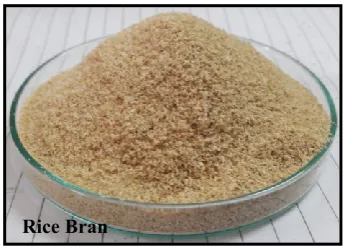
Different agro-industrial waste residues- rice bran and wheat bran were used. Rice bran was collected from rice-mill from the area nearby Kalyan, India in polythene bag. The sample was grounded in dry blender until the size of the particles reached the desired size and stored at ambient condition for further use. Wheat bran was purchased from online store amazon.in and used as it is as substrate.
Figure 1: Substrates used for solid state fermentation
2. Inoculum Preparation:
The inoculum was prepared by dispersing the spores from a week-old fungal slant culture in 0.1 % Tween-80 solution with a sterile inoculation loop (Paranthaman et. al., 2009).
3. Solid-State Fermentation:
Ten grams of each substrate (rice bran and wheat bran) was taken in a 250 ml Erlenmeyer flask separately, moistened with 15 ml of the salt solution (Ammonium chloride-0.5g; Sodium nitrate-0.5;
Potassium dihydrogen orthophosphate-0.2g;
Magnesium sulphate-0.2mg; Sodium chloride-0.1g per 100ml distilled water). The flasks were plugged tightly with cotton wool, sterilized at 121.5°C for 15 min, cooled, inoculated with 1 ml of fungal spore suspension (100 spores/ml) and incubated at 37°C for 120 hr (Paranthaman et. al., 2009).
4. Extraction of Crude Enzyme:
A solution of Tween-80 (0.1 %) was added in to the 100 ml of distilled water. 50 ml, of this water was added to the fermented substrate and homogenized the substrate on a rotary shaker at 120 rpm for 12 h. The content of flask was filtered with help of 4-fold muslin cloth. The suspended solids were removed by centrifuging the homogenate at 8000 x g at 4°C for 15 min and the resultant supernatant was used for analytical studies (Paranthaman et. al., 2009).
5. Protein Estimation in Crude Enzyme
Amount of protein in crude enzyme was determined by Lowry’s method of protein estimation, in which 0.5ml of crude enzyme, 0.5ml of distilled water was reacted with 5ml of Lowry’s reagent C (Folin-Wheat Bran
Ciocaltaeu reagent) and 0.5ml of Reagent D (0.5N NaOH) and the absorbance was read at 660nm. Absorbance was compared with the standard graph prepared by reacting known concentration of protein ranging from 50 µg/ml to 250 µg/ml with the Lowry’s reagents and plotting a graph between concentration of protein Bovine Serum Albumin and OD at 660 nm (Lowry et.al., 1951).
6. Measurement of enzymatic activity
Protease activity in the culture supernatant was determined according to the method of Tsuchida et. al., (1986) using casein as a substrate. A mixture of 500 μl of 1% (w/v) of casein in 50 mM phosphate buffer, pH 7 and 200 μl crude enzyme extract were incubated in a water bath at 40°C for 20 minutes. After 20 minutes, the enzyme reaction was terminated by the addition of 1 ml of 10% (w/v) trichloroacetic acid (TCA) and was kept at room temperature for 15 minutes. Then, the reaction mixture was centrifuged to separate the unreacted casein at 10,000 rpm for 5 minutes. The supernatant mixed with 2.5 ml of 0.4M Na2CO3 and 1 ml of 3-fold diluted Folin Ciocalteau reagent. The resulting solution was incubated at room temperature in the dark for 30 minutes and absorbance of the blue color developed was measured at 660 nm against a reagent blank using a tyrosine standard. One international unit (IU) of protease activity is the amount of enzyme, which liberates 1 μmol of tyrosine per min. (Mohapatra et. al., 2003).
7. Optimization of fermentation conditions
Production of protease from Aspergillus niger was optimized by controlling different physico chemical parameters like pH, temperature, carbon source and concentration of nitrogen source.
8. Initial pH of medium
The effect of initial pH on protease production was studied by changing the initial growth medium pH from 2, 3 and 6 with 1N Lactic acid/ NaOH before sterilization at 121°C for 15 min. and optimum pH for protease production was determined.
9. Incubation temperature:
The effect of temperature was studied by incubating the inoculated flasks at different temperatures viz. room temperature (28±2)°C, 37°C and 55°C.
10. Effect of concentration of supplementary nitrogen sources
Whether the addition of supplementary nitrogen sources could enhance the production of protease was tested by supplying an inorganic nitrogen source (NaNO3 and NH4Cl) at a level of 0.5% w/w in the medium. The flasks were then incubated for 5 days at room temperature. At the end of the incubation period, protease production in cell free supernatant was determined. Further, nitrogen source was optimized with different concentrations [0.3, 0.5, 0.7% (w/v)].
11. Effect of carbon sources
The effect of carbon sources on enzyme production was investigated by supplementing the basal salt solution, pH 7, with 1% (w/v) of different carbon sources, viz., maltose, lactose, and sucrose. The flasks were then incubated for 5 days at room temperature. At the end of the incubation period, protease production in cell free supernatant was determined.
12. Partial purification of Protease:
About 20 ml of the crude enzyme extract prepared was brought to 80% saturation by adding solid ammonium sulphate salt with continuous stirring. The mixture was left overnight at 4°C. The mixture was centrifuged at 10,000 rpm for 20 minutes and the pallete was dissolved in 30ml of 50mM phosphate buffer (pH 7) which was then subjected to dialysis (Shanmugapriya et. al., 2012).
III.
RESULT AND DISCUSSION
1. Protease production by solid state fermentation The production of protease by the standard culture Aspergillus niger ATCC 16404 in solid state fermentation using solid substrates that have been moistened with a salt solution is done. The enzyme activity of protease produced was calculated using tyrosine standard by Folin-Lowry method.
The selection of an ideal agro-biotech waste for enzyme production in solid state fermentation process depends upon several factors, mainly related with cost and availability of substrate material (Paranthaman et. al., 2009).
2. Effect of different substrates on protease production
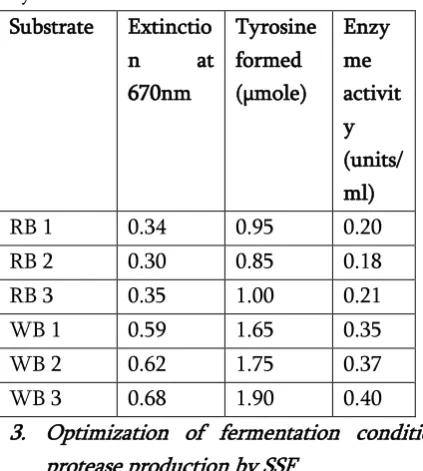
Two different agro-waste substrates were used for solid state fermentation viz., wheat bran and rice bran. Five grams of each substrate were weighed and hydrated with 10 ml of basal salt solution containing (g): NaCl; 0.1g, MgSO4.7H2O; 0.2g, KH2PO4; 0.2g, NH4Cl2; 0.5g and NaNO3; 0.5g dissolved in 100ml of distilled water (Coral et al. 2003). Flasks containing fermentation medium were autoclaved, cooled and inoculated with 1.0ml of Aspergillus niger ATCC 16404 spore suspension prepared in 0.1% Tween 80 solution, incubated for 120 hrs at 30°C. Rice bran and Wheat bran were used as substrate. Wheat bran was the suitable substrate for production of protease at pH 6 and (28±2)°C, enzyme activity 0.850 U/ml. When grown on rice bran, the fungus produced protease showing 0.799 U/ml enzyme activity [Table 1]. The protein content of wheat bran (14-16%) is higher compared to rice bran (7-8%). This could be the factor for lower production of protease when rice bran was used as a substrate.
Table 1: Enzyme activity of protease produced by the culture on rice bran (RB) and wheat bran (WB) by SSF
Substrate Extinctio
n at
670nm
Tyrosine formed (µmole)
Enzy me activit y (units/ ml)
RB 1 0.34 0.95 0.20
RB 2 0.30 0.85 0.18
RB 3 0.35 1.00 0.21
WB 1 0.59 1.65 0.35
WB 2 0.62 1.75 0.37
WB 3 0.68 1.90 0.40
3. Optimization of fermentation conditions for
protease production by SSF
Different fermentation conditions that may affect production of protease from A. niger were optimized as follows:
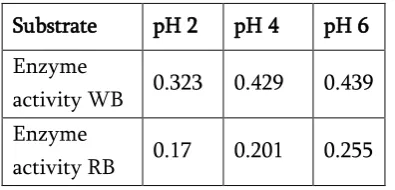
Production of the enzymes by mold culture mostly depends on the pH of medium. Therefore, the effect of different pH values on the production of protease
by A. niger was studied. Production of the protease
Table 2: Enzyme activity of protease using different substrates at different pH values
Substrate pH 2 pH 4 pH 6
Enzyme
activity WB 0.323 0.429 0.439
Enzyme
activity RB 0.17 0.201 0.255
Maximum protease production was obtained at room temperature (28±2)°C and protease activity was found to be 0.850 Units/ml for wheat bran and 0.799 Units/ml for rice bran (Table 3). In contrast, by reports of Paranthaman et. al., (2009), fermentation carried out at 35°C was best suited for protease production. Protease activity was decreased with increase in temperature. Higher temperature (55°C) is found to have some adverse effect on metabolic activities of microorganisms and cause inhibition of growth of the fungus. The enzyme is denatured by losing its catalytic properties at high temperature due to stretching and breaking of weak hydrogen bonds within enzyme structure.
Table 3: Enzyme activity of protease using different substrates at different temperatures
Substrate (28±2)°C 37°C 55°C
Enzyme
activity WB 0.850 0.828 0.00
Enzyme
activity RB 0.799 0.733 0.00
The effect of the concentration ammonium chloride and sodium nitrate on the protease production was studied using the range of 0.3-7.0% of nitrogen sources. A gradual increase in protease activity was observed with the increment of nitrogen source concentration and it declines after 0.5% (Table 4).
Table 4, Enzyme activity of protease using different
concentrations of nitrogen sources during SSF
Substrate Concentration of
nitrogen source
0.3% 0.5% 0.7% Enzyme activity WB 1.615 1.402 1.36 Enzyme activity RB 1.402 1.44 0.977
The highest protease activity (1.8Units/ml) was obtained when sucrose was used as a carbon source while the least protease activity (1.59Units/ml) was produced when maltose was used (Table 5). Madzak
et al. (2000) also recorded that sucrose was a good
substrate for production of extracellular proteases.
Table 5: Enzyme activity of protease using different carbon sources during SSF
Substrate Carbon source
Sucrose Maltose Lactose Enzyme
activity WB 1.785 1.46 1.657
Enzyme
activity RB 1.487 1.402 1.326
IV.
CONCLUSION
Proteases are specialized proteolytic enzymes that are widely distributed nearly in all plants, animals and microorganisms. Proteases from microbial sources are preferred to those from other sources since they possess almost all the characteristics desired for their biotechnological applications. Fungal proteases are more preferred by researchers due to high diversity, broad substrate specificity, and stability under extreme fermentation conditions. In this study, the conditions for protease production by
A.niger in solid state fermentation medium were
optimized.
V.
REFERENCES
[1] Akcan, N., Uyar, F. (2011). Production of extracellular alkaline protease from Bacillus subtilis RSKK96 with solid state fermentation. Eurasian Journal of Biosciences 5:64-72.
[2] Alagarsamy, S., Paul, D., Chandran, S., Szakacs, G., Soccol, C. R. and Pandey, A., (2006). Rice bran as a substrate for proteolytic enzyme production. Brazilian Archives of Biology and Technology-an International Journal 49 (5): 843-851.
[3] Ali, S. S., Vidhale, N. N. (2013). Protease production by Fusarium oxysporum in solid- state fermentation using rice bran. American Journal of Microbiological Research 1(3):45-47. [4] Bholay, A. D. and Niranjan, P., (2012). Bacterial
extracellular alkaline proteases and its industrial applications. International Research Journal Biological Science, 1(7):1-5.
[5] Chutmanop, J., Chuichulcherm, S., Chisty, Y.
and Srinophakun, P., (2008). Protease
production by Aspergillus oryzae in solid-state fermentation using agroindustrial substrates.
Journal of Chemical Technology and
Biotechnology, 83:1012–1018.
[6] Coral, G., Arikan, B., unaldi, M. N. and Guvenmez, H., (2003). Thermostable alkaline protease produced by an Aspergillus niger strain. Annals of Microbiology 53(4): 491 – 498.
[7] Dutta, M., Chamendra, N., Pai, S. G., Pramod, T. and Siddalingeshwara, K.G., (2014). Isolation and screening of agro-waste substrates for protease production through solid state fermentation. International Journal of Current Microbiology and Applied Sciences 3(3): 774-781.
[8] Gupta, A. and Khare, S. K., (2007). Enhanced production and characterization of a solvent
stable protease from solvent tolerant
Pseudomonas aeruginosa. Enzyyme
Microbiological Technology, 42: 11-16.
[9] Gupta, R., Beg, Q. K., Khan, S. and Chauhan, B.,
(2002). An overview on fermentation,
downstream processing and properties of
microbial alkaline proteases. Applied
Microbiology Biotechnology, 60: 381-395. [10]Immanuel, G., Bhagavath, C., Raj, P. I.,
Esakkiraj, P., and Palavesam, A., (2006). Production and partial purification of cellulase by Aspergillus niger and A. fumigatus fermented in Coir waste and sawdust. The Internet Journal of Microbiology, 3(1):11
[11]Imtiaz, S., Mukhtar, H. and Ikram, H. (2013). Production of alkaline protease by Bacillus subtilis using solid state fermentation. African Journal of Microbiology Research, 7(16): 1558-1568.
[12]Joo, H. S., Kumar, C. G., Park, G. C., Paik, S. R. and Chang, C. S., (2003). Oxidant and SDS-stable alkaline protease from Bacillus clausii I-52, production and some properties, Journal of Applied Microbiology, 95: 267-272.
[13]Karuna, J. and Ayyanna, C., (1993). Production
of semi-alkaline protease enzyme from
Aspergillus spp. Proceedings of the Ninth National Convention of Chemical Engineers and International Symposium on Importance of
Biotechnology in Coming Decades,
Viskhapatnam India.
[14]Kranthi, V.S., Rao, D. M. and Jaganmohan, P. (2012). Production of protease by Aspergillus flavus through solid state fermentation using different oil seed cakes. International Journal of Microbiological Research 3(1):12-15.
[15]Kuo, L. C. and Shafer, J. A., (1994). Retroviral proteases. Methods Enzymology, 3: 178-241. [16]Li, Q., Yi, L., Marek, P. and Iverson, B. L.,
(2013). Commercial proteases: Present and future. FEBS Letters, 587: 1155–1163.
[17]Lowry O.H., Rosebrough N.J. Farr A.L. and. Randall R.J., (1951). Protein measurement with Folin phenol reagent. Journal of Biological Chemistry, 193: 265-275.
fermentation using Aspergillus niger. World Journal of Agricultural Sciences 7(5): 550-555. [19]Madzak, C., Treton, B. and Blanchin-Roland, S.,
(2000). Strong hybrid promoters and integrative expression/secretion vectors for quasi-constitutive expression of heterologous proteins in the yeast Yarrowia lipolytica, Journal Molecular Microbiology Biotechnology, 2(2): 207-216.
[20]Mohapatra, B. R., Bapuji, M. and Sree, A., (2003). Production of industrial enzymes (amylase, carboxymethylcellulase and protease) by bacteria isolated from marine sedentary organisms. Acta Biotechnology, 23: 75-84. [21]1Mótyán, J. A., Tóth, F. and Tozsér, J., (2013).
Research applications of proteolytic enzymes in molecular biology. Biomolecules, 3: 923-942. [22]Mukhtar, H. and Haq, I., (2013). Comparative
evaluation of agroindustrial byproducts for the production of alkaline protease by wild and mutant strains of Bacillus subtilis in submerged and solid state fermentation. The Scientific World Journal 538067.
[23]Mukhtar, H. and Ikram, H. (2009). Production of acid protease by Aspergillus niger using solid state fermentation. Pakistan Journal of Zoology 41(4):253-260.
[24]Munawar, T. M., Aruna, K., Swamy, A.V.N.,
(2014). Production, purification and
characterization of alkaline protease from agro industrial wastes by using Aspergillus terreus (AB661667) under solid state fermentation. International Journal of Advanced Research in Engineering and Applied Sciences 3(10): 12-23. [25]Ortiz, G. E., Noseda, D. G., PonceMora, M. C.,
Recupero, M. N., Blasco, M. and Albertó, E., (2016). A comparative study of new Aspergillus strains for proteolytic enzymes production by solid state fermentation. Enzyme Research 3016149.
[26]Ozkan, E. and Ertan, F. (2011). Production and determination of some biochemical properties of protease enzyme by Trichothecium roseum
under solid state fermentation. Romanian Biotechnological Letters 17(1):6903-6912. [27]Pant, G., Prakash, A., Pavani, J. V. P., Bera, S.,
Deviram, G. V. N. S., Kumar, A., Panchpuri, M., Prasuna, R. G. (2015). Production, optimization and partial purification of protease from Bacillus subtilis. Journal of Taibah University for Science 9:50–55.
[28]Paranthaman, R., Alagusundaram, K. and Indhumathi, J. (2009). Production of protease from rice mill wastes by Aspergillus niger in solid state fermentation. World Journal of Agricultural Sciences 5(3):308-312.
[29]Prabhavathy, G., Pandian, M. R. and Senthilkumar, B., (2012). Optimization and production of extracellular alkaline protease by solid state fermentation using Bacillus subtilis. Journal of Academic and Industrial Research, 1(7): 427-430.
[30]Prakasham, R.S., Rao, C. S. and Sharma, P.N., (2006). Green gram husk-an inexpensive substrate for alkaline protease production by Bacillus sp. in solid-state fermentation. Bioresource Technology, 97: 1449–1454.
[31]Rawling, N.D. and Barrett, A.J., (1994). Families of aspartic peptidases, and those of unknown mechanism. Methods Enzymology, 248: 105-120.
[32]Rawlings, N.D. and Barrett, A.J., (1993).
Evolutionary families of peptidases.
Biochemistry Journal, 290: 205-218.
[33]Sankeerthana, C., Pinjar, S., Jambagi, R. T., Bhavimani, S., Anupama, S., Sarovar, B., and Inamdar, S.R., (2013). Production and partial characterization of protease from Aspergillus flavus using rice mill waste as a substrate and its comparision with Aspergillus niger protease. International Journal of Current Engineering and Technology, (1):143-147.
[35]Sathyavrathan, P. and Krithika, S., (2014). Production and optimization of protease from Bacillus licheniformis NRRL-NRS-1264 using cheap source substrates by submerged (SMF) and solid-state fermentation (SSF). International Journal of Chemical Technology and Research, 6(1): 286-292.
[36]Sawant, R. and Nagendran, S. (2014). Protease:
An enzyme with multiple industrial
Applications. World Journal of Pharmacy and Pharmaceutical Sciences, 3(6):568-579.
[37]Schrickx, J. M., Stouthamer, A. H. and Verseveld, H. W., (1995). Growth behaviour and glucoamylase production by Aspergillus niger N402 and a glucoamylase overproducing transformant in recycling culture without a nitrogen source. Applied Microbiolology and Biotechnology, 43: 109–116.
[38]Shanmugapriya, K., Saravana, P. S.,
Krishnapriya, Monoharan M., Mythili, A., and Joseph S., (2012). Isolation, screening and partial purification of cellulase from cellulose producing bacteria. International Journal of Advanced Biotechnology and Research, 3(1): 509-514. [39]Sri lakshmi, J., Madhavi, J. and Ammani, K.
(2014). Protease production by Humicola grisea through solid state fermentation. Global Journal of Bio-science and Biotechnology, 3(3): 230-235. [40]Tsuchida, O., Yamagota, Y., Ishizuka, J., Arai, J.,
Yamada, J., Takeuchi, M. and Chishima, E., (1986). An alkaline protease of an alkalophilic Bacillus sp. Current Microbiology, 14: 7-12. [41]Wang, Q., Hou, Y., Xu, Z., Miao, J. and Li, G.,
![加成性雜訊環境下運用特徵參數統計補償法於強健性語音辨識 (Feature Statistics Compensation for Robust Speech Recognition in Additive Noise Environments) [In Chinese]](data:image/gif;base64,R0lGODlhAQABAIAAAP///wAAACH5BAEAAAAALAAAAAABAAEAAAICRAEAOw==)