Original Research Article
A study on the weekly iron and folic acid supplementation in the
government schools and anganwadi centres in urban field practicing
area of a tertiary health care centre, Hyderabad, Telangana
Jyothi Lakshmi Naga Vemuri
1, Sri Harsha Kandikonda
2,
S. Bhavana Laxmi
1, R. L. Lakshman Rao
1*
INTRODUCTION
An adolescent is defined as an individual aged 10-19 years by the United Nations. The vast majority of the world’s adolescents, 88%, live in developing countries.1
Anemia is a major public health problem which is preventable. Globally, anaemia affects 1.62 billion which corresponds to 24.8% of the population. The population
group with the greatest number of individuals affected is non-pregnant women (468.4 million).2 According to NFHS-4, in Telangana, the prevalence of anemia in non-pregnant women is 56.9%.3 The correction of anemia in the adolescent age group helps to prevent its intergenerational impact thus reducing maternal and infant morbidity. National Iron Plus Initiative (NIPI) -Life cycle approach for iron deficiency anaemia and ABSTRACT
Background: Anemia is a major public health problem especially in adolescent age group because of its intergenerational impact. The Ministry of Health and Family Welfare, India launched the weekly iron and folic acid supplementation programme for adolescent girls and boys. The objectives of the study were to study the awareness of the weekly iron and folic acid supplementation in preventing anemia in the study subjects; to assess the implementation of the weekly iron and folic acid supplementation in government schools and anganwadi centres.
Methods: A cross-sectional study was carried out in the 4 government schools and 11 anganwadi centres of the urban field practising area of a tertiary health care centre, Osmania Medical College, Hyderabad. All the students who were present at the time of study, the teachers and anganwadi workers, who gave consent were included. The study was carried out for a period of 3 months (August to October, 2018) using a pretested schedule.
Results: A total of 313 students, 21 teachers and 10 anganwadi workers had participated in the study. Among school students, only 15% had awareness of anemia. Girls had better knowledge than boys (p<0.05). The benefits of iron folic acid tablets were known to 17% students and 67% teachers. Most commonly side effects were nausea, vomiting and stomach pain. Irregular supply of tablets and poor maintainence of records was seen.
Conclusions: The supply and distribution of tablets was found to be not in accordance with the guidelines of the programme.There is need of regular orientation to the teachers and anganwadi workers and nutrition education meetings for behaviour change communication to the parents.
Keywords: Iron and folic acid, Anganwadi, Adolescent, Schools
1
Department ofCommunity Medicine, Osmania Medical College, Hyderabad, Telangana, India
2
Osmania Medical College, Hyderabad, Telangana, India
Received: 28 December 2018
Revised: 29 January 2019
Accepted: 31 January 2019
*Correspondence:
Dr. R. L. Lakshman Rao,
E-mail: [email protected]
Copyright: © the author(s), publisher and licensee Medip Academy. This is an open-access article distributed under the terms of the Creative Commons Attribution Non-Commercial License, which permits unrestricted non-commercial use, distribution, and reproduction in any medium, provided the original work is properly cited.
weekly iron folic acid supplementation for adolescent girls and boys are the initiatives taken by United Nations International Children’s Emergency Fund (UNICEF) to control Adolescent Anaemia in the year 2000 in a phased manner.4-6 It includes the components of Weekly Iron and folic acid (100 mg elemental Iron and 500 μg folic acid round the year) + Biannual Deworming (Albendazole 400 mg every six months) + Nutrition Health Education.4
Government of India launched the universalisation of WIFS programme all over the country in 2012 targeting 108 million adolescent girls and boys both. School going Adolescent Girls and Boys (6th to 12th classes) and Adolescent Girls who are not in school are the target groups.4 The adolescent girls and boys in the schools are reached by teachers and out of school adolescents by the anganwadi workers. Iron and folic acid tablets are given on a fixed day in a week for the 52 weeks in a year to be consumed under direct supervision.6 The present study aimed to assess the awareness of the weekly iron and folic acid supplementation in preventing anemia in the school going adolescents, teachers and anganwadi workers and to assess the implementation of the weekly iron and folic acid supplementation in government schools and anganwadi centres.
METHODS
A cross-sectional study was carried out in the four government schools and eleven anganwadi centres of the urban field practising area of a Tertiary health care
centre, Osmania Medical College, Hyderabad. All the students of 6th to 10th class who were present at the time of study, the teachers who were present and anganwadi workers, were included in the study after taking informed consent and permission from the principals of the schools. Of eleven anganwadi centres, one anganwadi worker was in charge of two centres, hence the anganwadi workers interviewed were ten. A total of 21 teachers, 313 students and 10 anganwadi workers participated in the study.
The study was carried out for a period of 3 months (August to October, 2018) using a pretested schedule.
Data Collection and Analysis was carried out using Excel version 7 and Epi Info version 7.2.
RESULTS
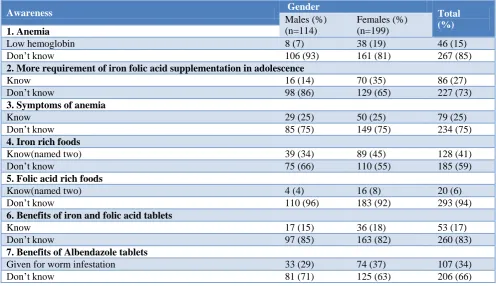
A total of 313 students from four government schools participated in the study of whom 36% (114) were males and 64% (199) were females.
The mean age (yrs) of the students was 13.58±1.68. Only 15% (46) had awareness of the definition of anemia and 27% (86) knew that there is increased requirement of iron folic acid in adolescence.
Females had better knowledge about anemia and iron folic acid requirement in adolescence than males (p<0.05).
Table 1: Awareness among students on the weekly iron and folic acid supplementation in reducing anemia and WIFS implementation.
Awareness Gender Total
(%) Males (%)
(n=114)
Females (%) (n=199)
1. Anemia
Low hemoglobin 8 (7) 38 (19) 46 (15)
Don’t know 106 (93) 161 (81) 267 (85)
2. More requirement of iron folic acid supplementation in adolescence
Know 16 (14) 70 (35) 86 (27)
Don’t know 98 (86) 129 (65) 227 (73)
3. Symptoms of anemia
Know 29 (25) 50 (25) 79 (25)
Don’t know 85 (75) 149 (75) 234 (75)
4. Iron rich foods
Know(named two) 39 (34) 89 (45) 128 (41)
Don’t know 75 (66) 110 (55) 185 (59)
5. Folic acid rich foods
Know(named two) 4 (4) 16 (8) 20 (6)
Don’t know 110 (96) 183 (92) 293 (94)
6. Benefits of iron and folic acid tablets
Know 17 (15) 36 (18) 53 (17)
Don’t know 97 (85) 163 (82) 260 (83)
7. Benefits of Albendazole tablets
Given for worm infestation 33 (29) 74 (37) 107 (34)
Awareness
Gender
Total (%) Males (%)
(n=114)
Females (%) (n=199)
8.Albendazole to be consumed once every six months
Know 3 (3) 23 (12) 26 (8)
Don’t know 111 (97) 176 (88) 287 (92)
9.Examination for pallor by teachers
Yes 69 (61) 100 (50.3) 169 (54)
No 45 (39) 99 (49.7) 144 (46)
More than one responses were allowed.
Table 2: Influence of gender on awareness of iron and folic acid supplementation in students.
Gender
Anemia means low Hb
Adolescents require more iron and folic acid
Symptoms of anemia
Benefits of iron folic acid
Benefits of albendazole
Albendazole taken twice in a year once in 6 months
Examination of pallor by teachers
Yes No Yes No Yes No Yes No Yes No Yes No Yes No
Females 38 161 70 129 50 149 36 163 74 125 23 176 100 99
Males 8 106 16 98 29 85 17 97 33 81 3 111 69 45
Chi square 8.434 16.26 - - - 7.582 -
P value 0.003 0.00005 P>0.05 P>0.05 p>0.05 0.005 p>0.05
Symptoms of anemia (like easy fatigue, loss of concentration in studies, loss of apetite, irregular menstruation in girls) were known to 25% (79) students. The awareness on symptoms of anemia didn’t show significance in relation to gender.
The iron rich foods (students named atleast two) and folic acid rich foods (students named atleast two) were known to 41% (128) and 6% (20) respectively.
The benefits of iron folic acid tablets were known to 17% (53). The albendazole tablet is being given for worm infestation was known to 34% (107).
Only 8% (26) knew that albendazole has to be taken biannually once in six months. The awareness of taking albendazole tablet once in six months is significant in females than males (p<0.05).
Figure 1: Reasons of non-compliance to iron folic acid tablets as reported by students.
The examination for pallor by teachers was reported by 54% (169). All the students reported irregular supply of tablets.
The side effects of tablets reported by students were nausea-23% (73), stomach pain-8% (26) and vomiting-4% (13) (Figure 1).
Teachers
A total of twenty one teachers which included 6 (29%) male teachers and 15 (71%) female teachers participated in the study.
The mean age (yrs) of the teachers was 41.09±11.1. The total eligible students for weekly iron and folic acid supplementation in all the schools as reported by teachers were 411.
All the teachers reported irregular supply of tablets. The teachers reported that there was no regular orientation to the weekly iron and folic acid supplementation programme.
71% (15) teachers reported that there was resistance from the parents to the weekly iron and folic acid tablets and albendazole tablets.
The reasons for non-compliance of the students to the iron folic acid tablets according to teachers were unpleasant taste (2), nausea (2), vomiting (5), stomach pain (3) and others (9).
73
26
13 0
10 20 30 40 50 60 70 80
Figure 2: Reasons for non-compliance of students to iron folic acid tablets as reported by teachers.
67% (14) teachers knew the benefits of weekly iron folic acid supplementation programme.
71% (15) teachers were of the opinion that the weekly iron folic acid supplementation programme was useful to the students.
Only 57% (12) teachers knew that the albendazole tablets treat the worm infestation.
42% (9) teachers had awareness that albendazole tablets were given biannually once in six months. There was no maintainence of WIFS records in the school.
Anganwadi workers
A total of 10 anganwadi workers of 11 anganwadi centres participated in the study.
Figure 3: Reasons for non-compliance of adolescent girls to the iron-folic acid tablets reported by
anganwadi workers.
The mean age (yrs) of the anganwadi workers was 40.9±8.14.
Total number of out of school adolescent girls enrolled in the anganwadi centres under WIFS programme were 587. All 587 adolescent girls were given albendazole tablets.
The anganwadi workers reported irregular supply of tablets. No nutrition education was imparted by the anganwadi workers.
The reasons of non-compliance of adolescent girls to iron folic acid tablets were nausea (5), vomiting (4) and stomach pain (1).
DISCUSSION
About half of the students (n=554) were aware about iron-rich foods and about one-third of the students were aware about folic acid–rich foods in the study by Sarada and Thilak.8 The knowledge regarding anemia is 96% in girls and 84% in boys in the above study.8
The present study showed the awareness regarding iron rich foods is 41% and folic acid rich foods as 6%. Females showed significant awareness about anemia compared to males. The importance of providing nutrition education to the students is to be noted.
Fears of harm/unpleasant side effects have significant association with non-compliance to IFA tablet as shown by Dr. Arkaprabha Sau in West Bengal.9 The reason for non-compliance to IFA by students, teachers and the anganwadi workers in the present study also showed the side effects as the cause.
In a study by Kumar et al done at Kanchipuram, 80% (n=331) reported no benefits with IFA tablets and 70% were not aware of symptoms of anemia.10 In the present study also, 83% were unaware of the benefits of IFA tablets and 75% didn’t know the symptoms of anemia.
The teachers reported that the supply, stock and storage of IFA tablets was regular and adequate in Midhun kumar GH., etal study.10 In the present study, the teachers, anganwadi workers and the students reported the irregular supply of tablets.
In a study by Kumar et al, parent’s opposition was reported as 4.15% for not taking IFA tablets.10 In the present study, 71% of the teachers reported the parents’ resistance to IFA tablets to their children.
Strengths of the study
The study has explored the three points of the WIFS programme, the beneficiaries, the teachers who were incharge for school going adolescents and the anganwadi workers who were responsible for out of school adolescents.
2 2
5 3
9
Unpleasant taste Nausea
Vomiting Stomach pain
Others
5 1
4
1
0 1 2 3 4 5 6
Limitations of the study
The study couldn’t check the consumption of all the 52 weeks IFA tablets by the adolescent students and out-of-school adolescents as the records were not available.
CONCLUSION
The supply and distribution of tablets was found to be not in accordance with the guidelines of the programme. There is need of regular orientation to the teachers and anganwadi workers and nutrition education meetings for behaviour change communication to the parents. Periodic monitoring of the supplies, stocks and records of WIFS programme is needed. The importance of the IFA tablets and albendazole tablets in the prevention of iron deficiency anemia is needed to be educated by information, education and communication by social media. Encouraging the children to grow kitchen garden and explaining them the importance of nutrition is important. Resistance from the parents can be overcome by explaining the parents and children the importance of the programme and before hand explanation of the side effects.The importance of taking tablets after food and under supervision should be strictly followed.
ACKNOWLEDGEMENTS
The study would not be done without thanking the principals, the teachers, the students of the schools and the anganwadi workers for their support and consent.
Funding: No funding sources Conflict of interest: None declared Ethical approval: Not required
REFERENCES
1. UNICEF. The State of the World's Children 2011-Executive Summary: Adolescence an age of opportunity: UNICEF; 2011. Available at: https://www.unicef.org/publications/index_57468.ht ml. Accessed on 23rd September, 2018.
2. de Benoist B, eds. Worldwide prevalence of anaemia 1993-2005. WHO Global Database on Anaemia Geneva, World Health Organization, 2008. Available at: https://www.who.int/vmnis/anaemia/ prevalence/summary/anaemia_data_status_t2/en/. Accessed on 10th September 2018.
3. National Family Health Survey-4 2015 -16, Ministry of Health and Family welfare, Government of India; State Fact Sheet Telangana. Available at: http://rchiips.org/NFHS/factsheet_NFHS-4.shtml. Accessed on 10th October 2018.
4. Wifs webinar-dr.dureja Available at: https://www.spring-nutrition.org/sites/default/files/ events/wifs_webinar_dr._dureja_23042016_f.pdf. Accessed on 15th September, 2018.
5. Iron Plus Initiative. Guidelines for Control of Iron Deficiency Anaemia. Adolescent Division. Ministry of Health and Family Welfare. Government of India. Available at: http://www.nrhm.gov.in/ images/pdf/programmes/child‑health/guidelines/ Control‑of‑Iron‑Deficiency‑Anaemia.pdf. Accessed on 2nd October, 2018.
6. Operational framework. Weekly Iron and Folic Acid Supplementation Programme for Adolescents. Ministry of Health and Family Welfare. Government of India; 2012. Available at: http://www.nrhm.gov.in/images/pdf/programmes/wi fs/operational‑framework‑wifs/operational_ framework_wifs.pdf. Accessed on 2nd September, 2018.
7. NRHM Components: Reproductive & Child Health: Adolescent Health: WIFS. Available at: nhm.gov.in/.../reproductive-child-health/adolescent-health/wifs.html. Accessed on 15th September, 2018 8. Sarada AK, Thilak SA. Evaluation of Weekly Iron and Folic Acid Supplementation Programme for adolescents in rural schools of Kannur, North Kerala, India: A Cross-sectional Study. Int J Med Sci Public Health. 2016;5:2259-63.
9. Sau A. A Study on Weekly Iron and Folic Acid Supplementation (WIFS) Programme in a School at Rural Area of West Bengal, India. IOSR J Dent Med Sci. 2016;15(6):47-50.
10. Kumar MGH, Patnaik S, Selvaraj K, Anbalagan J. Evaluation of Weekly Iron and Folic Acid Supplementation Program for Adolescents in Rural Kanchipuram, India. Nat J Res Community Med. 2018;7(2):101-3.