Original Research Article
Pilot studies on the prevalence and association of TCF7L2
polymorphisms in non-diabetic participants and type 2
diabetic patients of South Tamil Nadu
Balaji Ramanathan, Jeyasudha Murugan, Kumaravel Velayutham, Vishali Thavamani,
Rajamanickam Chellam, Rohini Gomathinayagam*
INTRODUCTION
Statistical evidences indicate that 62.4 million people are diabetic in India and more alarmingly about 77.2 million people are pre-diabetic, attributing to the fact that India ranks second in the global prevalence of diabetes. A strong influence of genetic factors in the risk of incidence of diabetes in Indians has been suggested because Indians exhibit diabetes prone ‘Asian Indian phenotype’ that is
typically characterized by increased visceral fat, waist circumference, hyper insulinemia and insulin resistance.1
Single nucleotide polymorphisms (SNPs) are highly incident and widely established genetic variants that are genetically mapped to disease incidence, progression. T2DM specific linkage and functional studies pinpoint that the transcription factor 7-like 2 (TCF7L2) Wnt pathway regulatory gene located in chromosome 10q25.3, plays an important role in islet cell survival, proliferation,
ABSTRACT
Background: Genetic predisposition plays a critical role in the incidence of type 2 diabetes mellitus (T2DM). While a few reports strongly associate TCF7L2 gene polymorphisms in the T2DM incidence in India, data pertaining to the prevalence of these polymorphisms in the south Tamil Nadu population has been lacking. Hence, the present study aims to determine the prevalence and association of the TCF7L2 gene variants rs7903146, rs12255372 in the regional population of south Tamil Nadu.
Methods: Peripheral blood samples from controls, T2DM patients were utilized to isolate genomic DNA and genotyping was carried out using PCR based strategies, direct sequencing. Socio-demographic details, anthropometric measurements, determination of postprandial, random blood glucose levels and oral glucose tolerance test (OGTT) were further carried out to evaluate the predisposition risk for T2DM.
Results: 50% of the control group participants and 73.9% of the T2DM patients were positive (CT/TT) for the TCF7L2 polymorphism rs7903146. The rs12255372 SNP was less prevalent in the controls, patients and was dispersed in only 25% of the controls and 60.9% (GT/TT) of the patients. The 60 minutes plasma glucose levels for the oral glucose tolerance test (OGTT) was higher (143.3±19.8) in the rs7903146 and rs12255372 positive control participants.
Conclusions: The study results reveal that TCF7L2 polymorphisms are dispersed in the regional population and further large scale, long term follow up studies will aid preventive and therapeutic measures in T2DM.
Keywords: TCF7L2, Genetic predisposition, rs7903146, rs12255372, T2DM
Department ofMolecular Genetics, Alpha Health Foundation, Mela Anuppanady, Madurai, Tamil Nadu, India
Received: 29 January 2019
Revised: 09 February 2019
Accepted: 11 February 2019
*Correspondence:
Dr. Rohini Gomathinayagam,
E-mail: [email protected]
Copyright: © the author(s), publisher and licensee Medip Academy. This is an open-access article distributed under the terms of the Creative Commons Attribution Non-Commercial License, which permits unrestricted non-commercial use, distribution, and reproduction in any medium, provided the original work is properly cited.
regeneration, synthesis of the incretin GLP-1 (glucagon like peptide-1), lipid and glucose metabolism and is strongly associated with the risk of incidence of T2DM.2-7 The rs7903146, rs12255372 intronic variants of the TCF7L2 gene are reported to functionally impair glucagon, insulin, incretin secretions; impair glucose regulation, tolerance and modulate body mass index (BMI).8,9
While population specific studies on the association of TCF7L2 with T2DM in regions of North India, Chennai and Hyderabad exists, the prevalence and distribution of these allelic variants in south Tamil Nadu has been obscure.10-13 Hence the present study aims in determining the incidence and prevalence of the TCF7L2 polymorphisms rs7903146, rs12255372 in the regional south Tamil Nadu population, and understand their influence in the risk of incidence of T2DM.
METHODS
The risk of T2DM incidence in the rs7903146, rs12255372 SNP positive participants was aimed to be determined at Alpha hospital and research centre/Alpha health foundation, south Tamil Nadu, India. The study was conducted over a period of 11-12 months (February 2018–January 2019) with the approval of the Institutional Ethical Committee (AHRC). Upon informed consent, socio-demographic details, anthropometric measurements
and biochemical assessments (blood pressure,
postprandial and random blood glucose levels) were carried out in the study population. OGTT (oral glucose tolerance test) was further carried out (overnight fast, administration of 75 g of oral glucose) and determination of plasma glucose levels at 60, 120 minutes.
Genomic DNA was extracted from peripheral blood samples of 20 healthy non-diabetic controls and 23 T2DM patients, using a QIAamp DNA Blood Mini Kit (QIAGEN India Pvt. Ltd, New Delhi, India) according to the manufacturer’s protocol. Quantitative and qualitative (260/280 nm absorbance ratio) assessment of the DNA samples were carried out using a nanodrop, Thermo scientific, India. Determination of the presence of the TCF7L2 polymorphism rs7903146 was carried out by PCR amplification of a region corresponding to a 318 bp product using the forward primer 5’-GGTAATGCAGA TGTGATGAGATCT-3’, and the reverse primer 5’-AGA
TGAAATGTAGCAGTGAAGTGC-3’. The PCR
conditions pertained to an initial denaturation of 3 minutes at 94°C followed by 32 cycles of denaturation for 1 minute at 94°C, annealing for 1 min at 58°C and extension for 1 min at 72°C and final extension of 5 min at 72°C.
A 352 bp PCR product encompassing the region corresponding to the rs12255372 SNP was obtained using PCR with the conditions pertaining to the initial denaturation of 5 minutes at 94°C, followed by 30 cycles of denaturation for 1 minutes at 94°C, annealing for 30
seconds at 52°C and elongation for 1 minutes at 72°C, with a final elongation of 5 minutes at 72°C, using the forward primer 5’-TTTTGTTAATGGCTTGCAGGT-3’, and the reverse primer 5’ GCGCATGCTAATTTCC TGTC-3’. Allele specific PCR (T allele) was also carried out for the TCF7L2 polymorphism rs12255372 (256 bp)
using the forward primer 5'-TTTTGTTAAT
GGCTTGCAGGT-3' and 5'-GGCCTGAGTAATTA
TCAGAATATGATA-3' reverse primer (conditions corresponded to initial denaturation of 5 minutes at 94°C, followed by 30 cycles of 1 minutes denaturation at 94°C, 30 seconds annealing at 60°C, 1 minutes primer extension at 72°C and final extension of 5 minutes at 72°C).
The PCR products were visualized after electrophoresis using a UV gel documentation system (Medicare, Chennai, India) and further gel extracted, purified and utilized for direct sequencing (Agrigenome, Kochi, Kerala). Statistical analysis was carried out using Graph Pad Prism version 7.04 for Windows, Graph Pad Software, La Jolla California USA.
RESULTS
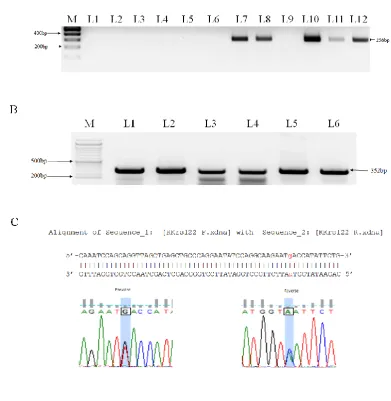
Figure 1A, Figure 2B represent the PCR amplified regions pertaining to a 318 bp product of the TCF7L2 gene that encompasses the single nucleotide change for rs7903146 (C>T), and a 352 bp for the rs12255372 (G>T) SNPs, respectively. Figure 2A represents the allele specific PCR product (256 bp) for identifying the presence of the T allele change in the rs12255372 SNP positive participants. Genotyping was carried out utilizing direct sequencing of the PCR products and the results (representative images presented in Figure 1B, Figure 2C) enabled the identification of wild type, heterozygous and homozygous carriers for the TCF7L2 SNPs.
Table 1: Genotype prevalence of the rs7903146 and rs12255372 positive non diabetic controls and T2DM
patients of south Tamil Nadu, India.
Percentage
prevalence rs7903146 rs12255372
CC CT/TT GG GT/TT
Controls 50 50 75 25
Patients 26.1 73.9 39.1 60.9
Collectively, as indicated in Table 1 the percentage
prevalence of the rs7903146 (CT/TT) positive
the results from the present study indicate that prevalence of TCF7L2 polymorphisms was significantly incident in
the T2DM population than the non-diabetic controls (p<0.05).
Figure 1: Determination of the incidence of the TCF7L2 SNP rs7903146 in non-diabetic controls and T2DM patients using PCR and direct sequencing: (A) PCR amplification of a 318bp product that encompasses the
rs7903146 intronic region. M-100bp ladder; L2- L5: controls, L6-L11:T2DM patients. The product was electrophoretically separated and visualized in a 1% agarose gel; (B) Representative images for the direct sequencing results of a heterozygous positive T2DM patient sample. The forward and reverse sequences were
aligned and the C to T change is presented in the aligned forward and reverse sequences.
Table 2: Age, BMI and postprandial blood glucose levels of the TCF7L2 rs7903146, rs12255372 SNP positive and negative patients. Data presented are mean±SEM.
TCF7L2 Polymorphisms
rs7903146 rs12255372
Controls Patients Controls Patients
CC CT/TT CC CT/TT GG GT/TT GG GT/TT
Age 26.50±1.6 28.13±2.6 39.4±2.01 32.07±5.7 26.5±1.7 29±5.6 37.1±1.8 37.4±3.1
BMI 24.59±1.5 25.13±1.3 27.21±2.5 30.17±2.3 23±0.9 28.5±2.2 26.8±1.8 30.4±2.4
PPBS 105.2±2.8 108.2±4.8 312.4±37.8 232.83±32.2 103.7±2.4 121.0±2.3 310.2±34 229±32.2
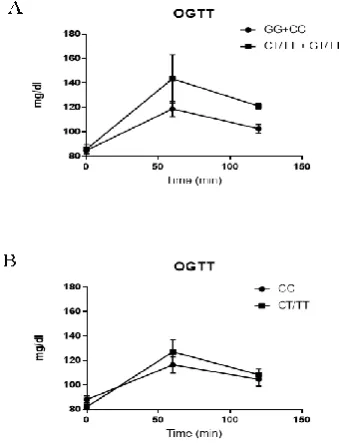
Further, in order to understand the impact of the rs7903146 CT/TT genotypes on the OGTT of the non diabetic controls (mean age 26.15±1.4), we tested glucose tolerance following prior studies on consenting carriers and non-carriers after an overnight fast and subsequent 75g glucose administration (Fig. 3A, 3B). As observed from the results presented in Fig.3A, the plasma glucose concentrations in both the rs7903146, rs12255372 carriers was higher (143.3±19.8) than the non-SNP carriers (118.6±6.3), amidst the non-diabetic controls. Earlier studies have reported abnormal plasma blood glucose levels in non-diabetic rs7903146 carriers when compared to the wild type carriers 9, and in concordance with such studies, the present study OGTT assessments evidence that while the rs7903146 negative CC carriers in the control non-diabetic group exhibited a lower mean
(116.4±6.6) blood glucose level, the rs7903146 SNP positive group presented a close to significance, higher mean value (127.0±10.8), indicating the need for further large scale studies.
a mean of 30.17±2.3. The present study results also bring forward a similar trend in the BMI among the rs12255372 SNP positive non-diabetic and diabetic participants. The heterogeneous, homogenous carriers for
the SNP presented a higher BMI level (28.5±2.2, 30.4±2.4 respectively) when compared to the non-carrier wild type participants (23±0.9, 26.8±1.8 respectively).
Figure 2: Determination of the incidence of the TCF7L2 SNP rs1225536 in non-diabetic controls, T2DM patients using allele specific PCR (ASP) and direct sequencing: (A) representative image of the results from ASP (T allele):
M–100 bp ladder, L1-L6 and L9 are negative for rs1225536; L7, L8, L10, L11, L12 are positive for the 256 bp T allele specific product; (B) PCR amplification of a 352 bp product that encompasses the rs12255372 intronic region,
M-50 bp ladder; L1-L2: controls, L3-L6:T2DM patients. The product was electrophoretically separated and visualized using a 1% agarose gel; (C) representative images for the direct sequencing results of a heterozygous
positive T2DM patient sample. The change in nucleotide G to T for the TCF7L2 rs1225536 is presented in the aligned forward and reverse sequences.
DISCUSSION
The current situation in the Indian diabetic scenario could be described as a crisis situation as statistical evidences proclaim that 101.2 million Indians would be diabetic by 2030.14 Therefore management strategies primarily underline the critical need to prescreen for diabetes and
SNP, followed by the rs12255372 was relatively higher in the T2DM participants and is in conjunction with other earlier reports that investigated the prevalence of these SNPs.1,2,15,16
Figure 3: Oral glucose tolerant test in non-diabetic control participants: (A) plasma glucose concentration (60, 120 minutes) was assessed after an
overnight fast and 75 g oral glucose in non-diabetic controls. The rs7903146, rs12255372 SNP positive
participants presented a higher plasma glucose concentration at 60, 120 minutes; (B) plasma glucose concentration (60, 120 minutes) during an OGTT test in non-diabetic controls. The rs7903146 participants
displayed higher levels of plasma glucose concentration at 60 minutes in comparison to the
other groups. Data presented are mean±SEM.
Mechanistic studies addressing the presence and association of these polymorphisms in the risk of incidence of T2DM highlight that carriers of the SNPs exhibit modulations in glucagon and insulin secretion, oral glucose tolerance, leptin regulation and adipose tissue metabolism.1,8,9,17 In order to understand the risk of incidence of T2DM in the non-diabetic controls (mean age 26.15±1.4) of the present study we carried out an OGTT and similar to other earlier reports, the present data also indicates that the risk allele carriers exhibited relatively higher plasma glucose levels, thus indicating that proper counseling, dietary interventions and physical exercise could play a vital role in the preventive management of T2DM.
Strong research evidences in the recent decade have also pinpointed that genetic factors attribute for 50-80% BMI variations, and amidst several loci that influence BMI, the rs7903146 TCF7L2 SNP is widely associated with a lean body mass.18-22 While the current study BMI data is in
contradiction to such reports and presents a marginal increase in the mean of the SNP positive participants, it would only be agreeable that such a finding could significantly change with an increase in sample size. In contrast to the association of the rs7903146 SNP with lean body mass, the rs12255372 GT/TT genotype has been strongly associated with metabolic syndrome/ increased waist circumference.23-25 Hence it could be suggested that the present study data may fall in line with these reports, as the rs12255372 positive participants tended to exhibit a relatively greater BMI and abnormal OGTT results.
Taken together, the present pilot study data indicates that the TCF7L2 polymorphisms are frequently incident in the south Tamil Nadu non diabetic and diabetic T2DM population. Hence screening for the TCF7L2 SNPs rs7903146 and rs12255372 polymorphisms in the south Tamil Nadu population would serve to prevent further incidence of T2DM.
CONCLUSION
Screening for the rs7903146, rs12255372 TCF7L2 polymorphisms in the south Tamil Nadu population would promote awareness regarding the genetic factors influencing the incidence of T2DM, and enable activities that would prevent its incidence in the genetically predisposed population.
Funding: No funding sources Conflict of interest: None declared
Ethical approval: The study was approved by the Institutional Ethics Committee
REFERENCES
1. Bodhini D, Gaal S, Shatwan I, Ramya K, Ellahi B,
Surendran S, et al. Interaction between TCF7L2 polymorphism and dietary fat intake on high density
lipoprotein cholesterol. PLoS One.
2017;12(11):e0188382.
2. Khan IA, Poornima S, Jahan P, Rao P, Hasan Q. Type 2 Diabetes Mellitus and the Association of Candidate Genes in Asian Indian Population from Hyderabad, India. J Clin Diagn Res. 2015;9(11):1-5.
3. Imamura M, Maeda S. Genetics of type 2 diabetes:
the GWAS era and future perspectives. Endocr J. 2011;58(9):723-39.
4. Sladek R, Rocheleau G, Rung J, Dina C, Shen L, Serre D, et al. A genome-wide association study identifies novel risk loci for type 2 diabetes. Nature. 2007;445(7130):881-5.
5. Florez JC, Jablonski KA, Bayley N, Pollin TI, de Bakker PI, Shuldiner AR, et al. TCF7L2 polymorphisms and progression to diabetes in the Diabetes Prevention Program. N Engl J Med. 2006;355(3):241-50.
6. Saxena R, Hivert MF, Langenberg C, Tanaka T,
in GIPR influences the glucose and insulin responses to an oral glucose challenge. Nat Genet. 2010;42(2):142-8.
7. Lyssenko V, Lupi R, Marchetti P, Del Guerra S, Orho-Melander M, Almgren P, et al. Mechanisms by which common variants in the TCF7L2 gene increase risk of type 2 diabetes. J Clin Invest. 2007;117(8):2155-63.
8. Fernandez-Rhodes L, Howard AG, Graff M, Isasi
CR, Highland HM, Young KL, et al. Complex patterns of direct and indirect association between the transcription Factor-7 like 2 gene, body mass index and type 2 diabetes diagnosis in adulthood in the Hispanic Community Health Study/Study of Latinos. BMC Obes. 2018;5:26.
9. Lu J, Varghese RT, Zhou L, Vella A, Jensen MD. Glucose tolerance and free fatty acid metabolism in adults with variations in TCF7L2 rs7903146. Metabolism. 2017;68:55-63.
10. Chandak GR, Janipalli CS, Bhaskar S, Kulkarni SR,
Mohankrishna P, Hattersley AT, et al. Common variants in the TCF7L2 gene are strongly associated with type 2 diabetes mellitus in the Indian population. Diabetologia. 2007;50(1):63-7.
11. Chauhan G, Spurgeon CJ, Tabassum R, Bhaskar S,
Kulkarni SR, Mahajan A, et al. Impact of common variants of PPARG, KCNJ11, TCF7L2, SLC30A8, HHEX, CDKN2A, IGF2BP2, and CDKAL1 on the risk of type 2 diabetes in 5,164 Indians. Diabetes. 2010;59(8):2068-74.
12. Sanghera DK, Nath SK, Ortega L, Gambarelli M, Kim-Howard X, Singh JR, et al. TCF7L2 polymorphisms are associated with type 2 diabetes in Khatri Sikhs from North India: genetic variation
affects lipid levels. Ann Hum Genet.
2008;72(4):499-509.
13. Sanghera DK, Ortega L, Han S, Singh J, Ralhan SK,
Wander GS, et al. Impact of nine common type 2 diabetes risk polymorphisms in Asian Indian Sikhs: PPARG2 (Pro12Ala), IGF2BP2, TCF7L2 and FTO variants confer a significant risk. BMC Med Genet. 2008;9:59.
14. Vilvanathan S, Gurusamy U, Mukta V, Das AK,
Chandrasekaran A. Allele and genotype frequency of a genetic variant in ataxia telangiectasia mutated gene affecting glycemic response to metformin in South Indian population. Indian J Endocrinol Metab. 2014;18(6):850-4.
15. Grant SF, Thorleifsson G, Reynisdottir I,
Benediktsson R, Manolescu A, Sainz J, et al. Variant of transcription factor 7-like 2 (TCF7L2) gene confers risk of type 2 diabetes. Nat Genet. 2006;38(3):320-3.
16. Gupta V, Vinay DG, Rafiq S, Kranthikumar MV, Janipalli CS, Giambartolomei C, et al. Association
analysis of 31 common polymorphisms with type 2 diabetes and its related traits in Indian sib pairs. Diabetologia. 2012;55(2):349-57.
17. Mohan V, Goldhaber-Fiebert JD, Radha V,
Gokulakrishnan K. Screening with OGTT alone or in combination with the Indian diabetes risk score or genotyping of TCF7L2 to detect undiagnosed type 2 diabetes in Asian Indians. Indian J Med Res. 2011;133:294-9.
18. Stunkard AJ, Harris JR, Pedersen NL, McClearn GE. The body-mass index of twins who have been reared apart. N Engl J Med. 1990;322(21):1483-7.
19. Wardle J, Carnell S, Haworth CM, Plomin R.
Evidence for a strong genetic influence on childhood adiposity despite the force of the obesogenic environment. Am J Clin Nutr. 2008;87(2):398-404.
20. Pigeyre M, Yazdi FT, Kaur Y, Meyre D. Recent progress in genetics, epigenetics and metagenomics unveils the pathophysiology of human obesity. Clin Sci (Lond). 2016;130(12):943-86.
21. Salinas YD, Wang L, DeWan AT. Multiethnic
genome-wide association study identifies ethnic-specific associations with body mass index in Hispanics and African Americans. BMC Genet. 2016;17(1):78.
22. Locke AE, Kahali B, Berndt SI, Justice AE, Pers TH, Day FR, et al. Genetic studies of body mass index yield new insights for obesity biology. Nature. 2015;518(7538):197-206.
23. Dhawan D, Padh H. Genetic variations in TCF7L2 influence therapeutic response to sulfonylureas in Indian diabetics. Diabetes Res Clin Pract. 2016;121:35-40.
24. Moran Y, Labrador L, Camargo ME, Fernandez D,
Chiurillo MA. Design of an allele-specific PCR assay to genotype the rs12255372 SNP in a pilot study of association between common TCF7L2 polymorphisms and type 2 diabetes in Venezuelans. Arch Endocrinol Metab. 2015;60(3):246-51.
25. Katsoulis K, Paschou SA, Hatzi E, Tigas S,
Georgiou I, Tsatsoulis A. TCF7L2 gene variants predispose to the development of type 2 diabetes
mellitus among individuals with metabolic
syndrome. Epub. 2018;17(3):359-65.
Cite this article as: Ramanathan B, Murugan J, Velayutham K, Thavamani V, Chellam R,
Gomathinayagam R.Pilot studies on the prevalence