Original Research Article
Association of postnatal care with neonatal mortality in India: evidences
from DLHS-4 data
Jai Kishun*
INTRODUCTION
Neo-natal mortality refers to the deaths of children during the period of 0-28 days per thousand live births. Neonatal deaths account for a major proportion of child deaths globally.1 Global neonatal mortality declined from 32 deaths per 1,000 live births in 1990 to 23 in 2010.2,3 As per Sustainable Development Goals 3 (SDG 3), by 2030 end all countries aiming to reduce neonatal mortality to at least as low as 12 per 1,000 live births.4 Though India has
realized impressive gains in child survival over the last two decades, the country could not achieve the Millennium Development Goal (MDG 4), which aimed to reduce Under-Five Mortality (U5MR) by two third between 1990 and 2015.5 As per SRS report 2016 at the National level, the neo-natal mortality rate is 24 and ranges from 14 in urban areas to 27 in rural areas.6
The major causes of neonatal deaths are Infections (33%) such as Pneumonia, Septicemia and Umbilical Cord infection; Prematurity (35%) i.e. birth of newborn before
ABSTRACT
Background: About 0.76 million neonates die every year in India, the highest for any country in the world. Globally antenatal care (ANC) and postnatal care (PNC) of the new born is being promoted as a strategy to reduce neonatal deaths. This paper examines the association of PNC and advice given to women about care of neonates with neonatal mortality in India.
Methods: Used DLHS-4 data (2012-13), 319965 ever married women aged 15-49 years from 21 States/UTs of India were covered. Overall 89876 (96.46%) live births were reported from last pregnancy. Bivariate and multiple logistic regression were used to examine associations between exposure and outcome variables.
Results: Almost 50% of mothers did not receive advices about neonate care. Children whose mothers did not advised for breastfeeding were 1.42 time more likely to die (CI= 1.16-1.75, p<0.001) than those who received this advice. Crude odds ratio for advice on keeping the neonate warm was 1.43 (CI=1.19-1.71, p<0.001), for advice on cleanliness was 1.55 (CI=1.25-1.93, p<0.001), for better nutrition for mother and child was 1.28 (CI=1.04-1.57, p=0.022). Neonates whose weight were not measured were 1.63 times (CI=0.94-1.67) more likely to die than those whose weight were measured, though this result was not statistically significant. The odds ratios were not much different when the socioeconomic and demographic characteristics were adjusted in the model.
Conclusions: Neonatal mortality was high among those who did not receive advices during ANC for new born care and PNC check-up for neonates. Though Government of India launched a number of interventions their implementation needs to be strengthened.
Keywords: Postnatal care, Neonatal mortality, Logistic regression, DLHS-4, India
Department ofBiostatistics and Health Informatics, SGPGIMS, Lucknow, Uttar Pradesh, India
Received: 05 December 2018
Revised: 10 January 2019
Accepted: 11 January 2019
*Correspondence:
Dr. Jai Kishun,
E-mail: [email protected]
Copyright: © the author(s), publisher and licensee Medip Academy. This is an open-access article distributed under the terms of the Creative Commons Attribution Non-Commercial License, which permits unrestricted non-commercial use, distribution, and reproduction in any medium, provided the original work is properly cited.
37 weeks of gestation and Asphyxia (20%) i.e. inability to breathe immediately after birth and leads to lack of oxygen.7,8 The majority of deaths are preventable through appropriate postnatal care provided immediately after delivery.9 Literature suggests that postnatal care practices are effective measures in improving neonatal survival.10 The content of PNC should include education regarding immediate and exclusive breastfeeding, hand washing, warming of the baby, hygienic cord cleaning, as well as examination of danger signs for the mother and baby and appropriate referral for care.11
Only few studies in India have examined the relationship between postnatal care and neonatal deaths.10,12 Singh et al. used DLHS-3 data, conducted in 2007-08, to assess the association between postnatal care for newborns and neonatal mortality.12 They considered four explanatory variables to associate with the neonatal death which were during ANC, mother received any advice on keeping baby warm, newborn received any check-up within 24 hours of birth, newborn was checked in a government facility and newborn was checked in a private facility. Fadel et al conducted a case-control study with about 300,000 live births and 4,000 neonatal deaths to examine the effect of, place of delivery and postnatal check-up on neonatal mortality.10 Some other studies have investigated the effect of ANC utilization on birth outcomes, particularly on neonatal mortality.13-16 Our objective in the present paper is to determine the association of neonatal death in India with antenatal advices received by mothers and PNC practices reported using the latest round of DLHS-4 data.
METHODS
Survey design: Fourth round data of DLHS-4 were used, conducted in 2012–13 in 275 districts spread over 21 states and union territories of India. A multi-stage stratified sampling design was adopted for selection of representative sample of each district in DLHS-4. Rural and urban areas of a district are considered as natural strata. Weighting factors were also used to make the sample representative to the population. Overall 319,695 ever married women of age 15–49 years were interviewed in the survey. Details on age, age at marriage, place of birth, educational attainment, number of biological children ever born and surviving by sex were collected. Accounts of ante-natal checks, experience of pregnancy related complications, place of delivery, delivery attendant and post-partum care, together with history of contraceptive use, sex preference of children and fertility intentions were recorded. The availability of postnatal care (PNC) information in DLHS-4 provided us an opportunity to investigate the association between PNC and mortality during the neonatal period.
Outcome and exposure variables: The outcome variable
of interest is neonatal mortality which occurred within 28 days after the live birth. Neonatal mortality is defined as the probability of dying in the first 28 days of life. The
exposure variables of interest are measures of PNC i.e. Whether the newborn received any check-up after delivery of birth?, was the birth weight of the baby taken?, number of check-ups take place within one week of birth? and whether the newborn was examined in a government/private health facility or home?. These explanatory variables were computed in order to investigate the association between PNC and mortality during neonatal period. We also utilized variable of ANC like ‘during (any of) your antenatal visit(s), did you received advice on the following at least once’ which contain information about breastfeeding, keeping the baby warm, the need for cleanliness at the time of delivery, Family planning for spacing, Family planning for limiting, better nutrition for mother and child and need for institutional delivery.
Statistical analysis: State weights were used to correct oversampling and to maintain the representativeness of the data as well as the statistical soundness of indicators calculated based on these data. Pearson Chi-square test were used to examine statistical significance of association between awareness of child survive and neonatal mortality and multiple logistic regression were obtained by adjusting sociodemographic and economic characteristics of women. In this study, STATA-12 was used to analyze the data. Results were considered significant at five percent level of significance.
RESULTS
Status of ANC and PNC of ever married women
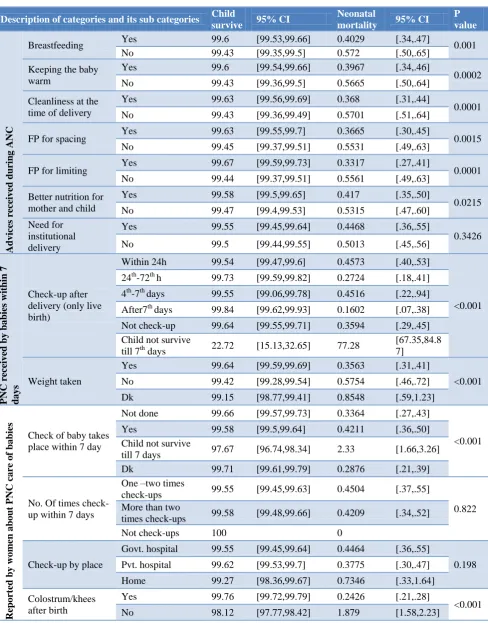
Table 1 depicts the detailed information on advice during ANC, PNC services and baby received check-up, which were provided by the last pregnant women. Overall, 50.98% women received advice on breastfeeding, 47.55% keeping baby warm, 41.7% cleanliness at the time of delivery, 36.11% family planning for spacing, 31.32% family planning for limiting, 40.03% better nutrition for mother and child and 28.99% for institutional delivery. Child received check-up after delivery (only live birth), around 60% of babies received check-up within 24 hours and 11.36% within 24 hours to 72 hours while 23.32% did not received any check-up. More than 80% babies weight taken at birth. Of the 55.62% women how reported check-up of baby takes place within 7 days, 48.63% had received check-up one to two times, 51.27% more than two times while others either check-up not done at all/child not survive till one week/don’t know. 54.55% check-up done at government and 43.79% at private hospital while others on at home. Around 90% women feed milk colostrums/kheesto baby till first few days after child birth.
not received advices with p<0.001. Few indicators such as advice on need for institutional delivery, number of times baby received check-up within 7 days and child received check-up by place were not fond significantly associated child survival and neonatal mortality. Overall, 99.64% baby survive whose weight taken within 7 days than 99.42% those weight not taken and 99.15% whose response were don’t know, p<0.001. Chances of survival of babies were significantly less in those who have not feed their babies mother milk till few days from births.
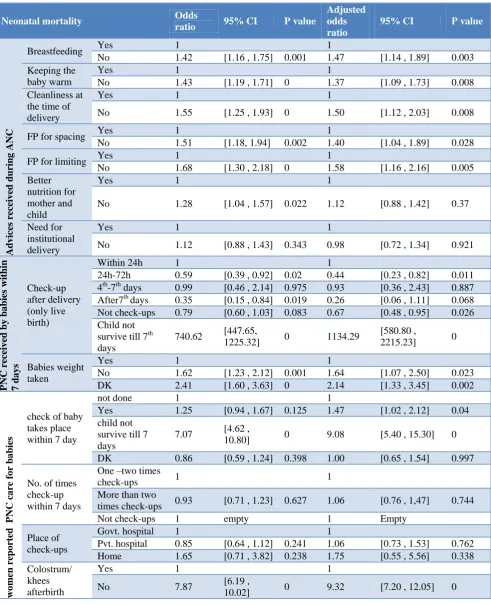
Table 3 shows the results of binary and multiple logistic regression analysis for the factors related to ANC and PNC care with neonatal mortality. Crude odds ratio and adjusted odds ratio both shows that the non-recipients of advices during ANC such as breastfeeding (AOR=1.47; 95% CI: 1.14-1.89), keeping baby warm (AOR=1.37; 95% CI: 1.09-1.73), cleanliness at the time of delivery (AOR=1.50; 95% CI: 1.12-2.03), family planning for spacing (AOR=1.40; 95% CI: 1.04-1.89), family planning
for limiting (AOR=1.58; 95% CI: 1.16-2.16), better nutrition for mother and child (AOR=1.12; 95% CI: 0.88-1.42) and need for institutional delivery (AOR=0.98; 95% CI: 0.72-1.34) have higher chance of neonatal mortality as compared to the mothers who received advices. As compared to reference categories (i.e. child who received check-up within 24 hours) babies who received check-up within 24-72 hours (AOR=0.44; 95% CI: 0.23-0.82, p=0.011) and not check-up (AOR=0.67; 95% CI: 0.48-0.95, p=0.026) were found statistically significant whereas babies who received check-up within 4-7th day and after 7th days were not statistically significant. Babies whose weight not measured after birth were 1.64 times more likely to have neonatal mortality than whose weight taken after the birth. Number of times baby received up within 7 days and place of check-ups were not statistically significant. Babies who did not receive colostrum/khees after the birth were 7.87 times more likely to die than those who received colostrum/cheese within first 28 days of life.
Table 1: Characteristics of ANC advices and PNC services to pregnant women.
Description of categories and its sub categories Frequency %
Advice
s recei
ve
d d
urin
g
ANC
Breastfeeding Yes 44,189 50.98
No 42,496 49.02
Keeping the baby warm Yes 41,223 47.55
No 45,462 52.45
Cleanliness at the time of delivery Yes 36,150 41.7
No 50,535 58.3
FP for spacing Yes 31,302 36.11
No 55,383 63.89
FP for limiting Yes 27,153 31.32
No 59,532 68.68
Better nutrition for mother and child Yes 34,700 40.03
No 51,985 59.97
Need for institutional delivery Yes 25,133 28.99
No 61,552 71.01
PNC rece
ive
d
by
babi
es
with
in
7 da
ys
Check-up after delivery (only live birth)
Within 24h 51,233 59.98 24th-72th h 9,702 11.36 4th-7th days 1,521 1.78 After7th days 2,948 3.45 Not check-up 19,923 23.32 Child not survive 88 0.1
Weight taken
Yes 68,573 80.36
No 13,262 15.54
DK 3,492 4.09
Rep
ort
ed by
wo
m
en
abou
t
PNC
care
f
b
ab
ie
s
Check-up of baby takes place within 7 day
Not done 22,903 26.85
Yes 47,454 55.62
Child not survive till 7th days 1,308 1.53
DK 13,649 16
No. Of times check-up within 7 days
One –two times check-ups 22,881 48.63 More than two times check-ups 24,126 51.27 Not check-ups 49 0.1
Check-up by place
Govt. hospital 25,901 54.55 Pvt. hospital 20,792 43.79
Home 785 1.65
Colostrum/khees after birth Yes 76,765 89.97
Table 2: Bivariate association of ANC Advices and PNC services with neonatal mortality.
Description of categories and its sub categories Child
survive 95% CI
Neonatal
mortality 95% CI
P value
Advice
s recei
ve
d d
urin
g A
N
C
Breastfeeding Yes 99.6 [99.53,99.66] 0.4029 [.34,.47] 0.001 No 99.43 [99.35,99.5] 0.572 [.50,.65]
Keeping the baby warm
Yes 99.6 [99.54,99.66] 0.3967 [.34,.46]
0.0002 No 99.43 [99.36,99.5] 0.5665 [.50,.64]
Cleanliness at the time of delivery
Yes 99.63 [99.56,99.69] 0.368 [.31,.44]
0.0001 No 99.43 [99.36,99.49] 0.5701 [.51,.64]
FP for spacing Yes 99.63 [99.55,99.7] 0.3665 [.30,.45] 0.0015 No 99.45 [99.37,99.51] 0.5531 [.49,.63]
FP for limiting Yes 99.67 [99.59,99.73] 0.3317 [.27,.41] 0.0001 No 99.44 [99.37,99.51] 0.5561 [.49,.63]
Better nutrition for mother and child
Yes 99.58 [99.5,99.65] 0.417 [.35,.50]
0.0215 No 99.47 [99.4,99.53] 0.5315 [.47,.60]
Need for institutional delivery
Yes 99.55 [99.45,99.64] 0.4468 [.36,.55]
0.3426 No 99.5 [99.44,99.55] 0.5013 [.45,.56]
PNC rece
ive
d
by
babi
es w
it
hin 7
days
Check-up after delivery (only live birth)
Within 24h 99.54 [99.47,99.6] 0.4573 [.40,.53]
<0.001 24th-72th h 99.73 [99.59,99.82] 0.2724 [.18,.41]
4th-7th days 99.55 [99.06,99.78] 0.4516 [.22,.94] After7th days 99.84 [99.62,99.93] 0.1602 [.07,.38] Not check-up 99.64 [99.55,99.71] 0.3594 [.29,.45] Child not survive
till 7th days 22.72 [15.13,32.65] 77.28
[67.35,84.8 7]
Weight taken
Yes 99.64 [99.59,99.69] 0.3563 [.31,.41]
<0.001 No 99.42 [99.28,99.54] 0.5754 [.46,.72]
Dk 99.15 [98.77,99.41] 0.8548 [.59,1.23]
R
ep
ort
ed by
wo
m
en
abou
t PNC
c
are
of
b
ab
ie
s
Check of baby takes place within 7 day
Not done 99.66 [99.57,99.73] 0.3364 [.27,.43]
<0.001 Yes 99.58 [99.5,99.64] 0.4211 [.36,.50]
Child not survive
till 7 days 97.67 [96.74,98.34] 2.33 [1.66,3.26] Dk 99.71 [99.61,99.79] 0.2876 [.21,.39]
No. Of times check-up within 7 days
One –two times
check-ups 99.55 [99.45,99.63] 0.4504 [.37,.55]
0.822 More than two
times check-ups 99.58 [99.48,99.66] 0.4209 [.34,.52] Not check-ups 100 0
Check-up by place
Govt. hospital 99.55 [99.45,99.64] 0.4464 [.36,.55]
0.198 Pvt. hospital 99.62 [99.53,99.7] 0.3775 [.30,.47]
Home 99.27 [98.36,99.67] 0.7346 [.33,1.64] Colostrum/khees
after birth
Yes 99.76 [99.72,99.79] 0.2426 [.21,.28]
Table 3: Multivariate association of ANC advices and PNC services with neonatal mortality.
Neonatal mortality Odds
ratio 95% CI P value
Adjusted odds ratio
95% CI P value
Advice
s recei
ve
d d
urin
g A
N
C
Breastfeeding Yes 1 1
No 1.42 [1.16 , 1.75] 0.001 1.47 [1.14 , 1.89] 0.003 Keeping the
baby warm
Yes 1 1
No 1.43 [1.19 , 1.71] 0 1.37 [1.09 , 1.73] 0.008 Cleanliness at
the time of delivery
Yes 1 1
No 1.55 [1.25 , 1.93] 0 1.50 [1.12 , 2.03] 0.008
FP for spacing Yes 1 1
No 1.51 [1.18, 1.94] 0.002 1.40 [1.04 , 1.89] 0.028
FP for limiting Yes 1 1
No 1.68 [1.30 , 2.18] 0 1.58 [1.16 , 2.16] 0.005 Better
nutrition for mother and child
Yes 1 1
No 1.28 [1.04 , 1.57] 0.022 1.12 [0.88 , 1.42] 0.37
Need for institutional delivery
Yes 1 1
No 1.12 [0.88 , 1.43] 0.343 0.98 [0.72 , 1.34] 0.921
PNC rece
ive
d
by
babi
es w
it
hin
7
d
ays
Check-up after delivery (only live birth)
Within 24h 1 1
24h-72h 0.59 [0.39 , 0.92] 0.02 0.44 [0.23 , 0.82] 0.011 4th-7th days 0.99 [0.46 , 2.14] 0.975 0.93 [0.36 , 2.43] 0.887 After7th days 0.35 [0.15 , 0.84] 0.019 0.26 [0.06 , 1.11] 0.068 Not check-ups 0.79 [0.60 , 1.03] 0.083 0.67 [0.48 , 0.95] 0.026 Child not
survive till 7th days
740.62 [447.65,
1225.32] 0 1134.29
[580.80 ,
2215.23] 0
Babies weight taken
Yes 1 1
No 1.62 [1.23 , 2.12] 0.001 1.64 [1.07 , 2.50] 0.023 DK 2.41 [1.60 , 3.63] 0 2.14 [1.33 , 3.45] 0.002
wo
m
en re
po
rt
ed P
NC c
are
fo
r b
ab
ie
s
check of baby takes place within 7 day
not done 1 1
Yes 1.25 [0.94 , 1.67] 0.125 1.47 [1.02 , 2.12] 0.04 child not
survive till 7 days
7.07 [4.62 ,
10.80] 0 9.08 [5.40 , 15.30] 0 DK 0.86 [0.59 , 1.24] 0.398 1.00 [0.65 , 1.54] 0.997
No. of times check-up within 7 days
One –two times
check-ups 1 1
More than two
times check-ups 0.93 [0.71 , 1.23] 0.627 1.06 [0.76 , 1,47] 0.744 Not check-ups 1 empty 1 Empty
Place of check-ups
Govt. hospital 1 1
Pvt. hospital 0.85 [0.64 , 1.12] 0.241 1.06 [0.73 , 1.53] 0.762 Home 1.65 [0.71 , 3.82] 0.238 1.75 [0.55 , 5.56] 0.338 Colostrum/
khees afterbirth
Yes 1 1
No 7.87 [6.19 ,
10.02] 0 9.32 [7.20 , 12.05] 0
DISCUSSION
ANC and PNC are being promoted as a strategy to save newborn lives, but only few studies have evaluated associations of PNC care with neonatal mortality in India.
over 21 states and union territories of India under the leadership of Ministry of Health and Family Welfare (MoHFW), Government of India. However, data did not include nine EAG states of India.
ANC improves the survival and health of babies directly by reducing stillbirths and neonatal deaths and indirectly by providing an entry point for health contacts with the woman at a key point in the continuum of care.17 In 2016, the WHO introduced new guidelines for ANC, which recommend a minimum of eight ANC contacts during pregnancy. The goal of this new guideline is to fully use the opportunity of providing ANC to save lives of child as well as mothers.18 Counselling to pregnant women on cleanliness, nutrition for mother, complication during pregnancy, keeping baby warm during antenatal or postnatal care is likely to save lives of a number of newborn during the crucial first few days of birth. Our findings shows that more than 50% women did not received advices on ANC care during their pregnancy. It also shows that 99.6% children survived when the mother received advices on breastfeeding, keeping baby warm and cleanliness at the time of delivery as compared to 99.43% children who did not receive any advice.
The PNC check-ups within first few days could be an effective means to prevent some of the main causes of neonatal death, particularly some of the deaths to pre-term newborn and deaths due to sepsis, meningitis, pneumonia and diarrhoea.19 If all new born received high impact and cost-effective interventions during the postnatal period, it is estimated that neonatal mortality could be reduced by between 10-27%.20 Early breast-feeding initiation might additionally provide protection against some non-infectious causes of death.21 Our finding support that significantly more children (99.76%) survived when fed mother’s milk till few days after of birth than those who have not fed (98.12%).
The results of this paper supports the fact that promotion of maternal and new-born care practices through implementation of community-based packages, including promotion of essential new-born care and community mobilization, are effective in improving neonatal survival in low income settings.
CONCLUSION
It is concluded that the advices given during ANC visit and postnatal care within one week after the birth is protective against neonatal mortality. This study contributes to the literature and clarifies the importance of advices during ANC visits and PNC on a health outcome of global importance. It is also concluded that some massive and comprehensive awareness programme for the women who were less educated and socioeconomically disadvantaged needs to be launch. More emphasis given to unskilled health workers responsible for providing awareness during ANC and PNC, so that burden of neonatal mortality country like
India can be avoided. Though Government of India launched a number of interventions their implementation needs to be strengthened.
Funding: No funding sources Conflict of interest: None declared
Ethical approval: The study was approved by the Institutional Ethics Committee
REFERENCES
1. Berman P, Ahuja R. Government health spending in India. Economic and Political Weekly. 2008;28:209-16.
2. Lawn J E, Kerber K, Enweronu-Laryea C, Cousens S. 3.6 million neonatal deaths-what is progressing and what is not?. In Seminars in perinatology. 2010;34:371-86.
3. Lawn J E, Cousens S, Zupan J, Lancet Neonatal Survival Steering Team. 4 million neonatal deaths: when? Where? Why?. The lancet. 2005;365(9462):891-900.
4. United Nation. Transforming our world: the 2030 Agenda for Sustainable Development, 2015. Available at: https://sustainabledevelopment.un.org/ post2015/transformingourworld. Accessed 28 November 2018.
5. NIMS, ICMR, UNICEF. Infant and child Mortality in India: Levels, Trends and Determinants, National Institute of Medical Statistics (NIMS), Indian Council for Medical Research (ICMR), UNICEF India Country Office, New Delhi, India, 2012. Available at http://unicef.in/PressReleases/374/The-Infant-and-Child-Mortality-India. Accessed 28 November 2018.
6. Ministry of Home Affairs, Government of India. SRS Statistical Report, Office of the Registrar General & Census Commissioner, India, 2016. Available at http://www.censusindia.gov.in/vital_ statistics/SRS_Reports__2016.html. Accessed 30 November 2018.
7. NRHM, 2017, http://nrhm.gov.in/nrhm-components/rmnch-a/child-health-immunization. html, SRS Bulletin, Sample Registration System, Registrar General, India, Vital Statistics Division, West Block 1, Wing 1, 2nd Floor, R. K. Puram, New Delhi-110 066. Accessed 01 December 2018. 8. Saunik S, Jaiswal C, Nair R, Radkar A, Patil A,
Irani S, et al. Analysis of neonatal deaths in Maharashtra: policy implications. Int J Community Med Public Health. 2017;4:4513-9.
9. World Health Organization, United Nations Children’s Fund. Home visits for the newborn child: a strategy to improve survival, 2009. Available at http://whqlibdoc.who.int/hq/2009/WHO_FCH_CA H_09.02_eng.pdf. Accessed 30 November 2018. 10. Fadel S A, Ram U, Morris S K, Begum R, Shet A,
11. World Health Organization. Maternal, newborn, child and adolescent health – Topics at a glance – New born health: Postnatal Care, 2013. Available at https://www.who.int/maternal_child_adolescent/ne wborns/postnatal_care/en/ Accessed 10 October 2018.
12. Singh A, Yadav A, Singh A. Utilization of postnatal care for newborns and its association with neonatal mortality in India: an analytical appraisal. BMC pregnancy and childbirth. 2012;12(1):33.
13. Raatikainen K, Heiskanen N, Heinonen S. Under-attending free antenatal care is associated with adverse pregnancy outcomes. BMC public health. 2007;7(1):268.
14. Hollowell J, Oakley L, Kurinczuk JJ, Brocklehurst P, Gray R. The effectiveness of antenatal care programmes to reduce infant mortality and preterm birth in socially disadvantaged and vulnerable women in high-income countries: a systematic review. BMC pregnancy and childbirth. 2011;11(1):13.
15. Ibrahim J, Yorifuji T, Tsuda T, Kashima S, Doi H. Frequency of antenatal care visits and neonatal mortality in Indonesia. J Trop Pediatr. 2011;58(3):184-8.
16. Singh A, Pallikadavath S, Ram F, Alagarajan M. Do antenatal care interventions improve neonatal survival in India? Health Policy Planning. 2013;29(7): 842-8.
17. Lincetto O, Mothebesoane-Anoh S, Gomez P, Munjanja S. Opportunities for Africa's newborns: Practical data, policy and programmatic support for newborn care in Africa. Antenatal care. 2006;55-62. 18. World Health Organization. WHO
Recommendations on Antenatal Care for a Positive Pregnancy Experience, 2016. Available at http://apps.who.int/iris/bitstream/10665/250796/1/9 789241549912-eng.pdf. Accessed 02 December 2018.
19. Singh K, Brodish P, Haney E. Postnatal care by provider type and neonatal death in sub-Saharan Africa: a multilevel analysis. BMC public health. 2014;14(1):941.
20. Federal Democratic Republic of Ethiopia, Ministry of Health, Postnatal Care, Blended Learning Module for the Health Extension Programme. Available at www.open.edu/openlearncreate/mod/resource/view. php?id=50813. Accessed 02 December 2018. 21. Debes AK, Kohli A, Walker N, Edmond K, Mullany
LC. Time to initiation of breastfeeding and neonatal mortality and morbidity: a systematic review. BMC public health. 2013;13(3):19.