Original Research Article
Knowledge about rabies among urban adult residents,
Agartala, West Tripura: a cross sectional study
Chanda Mog*, Arundhati Roy, Paramita Choudhuri
INTRODUCTION
Rabies is one of the oldest recognized diseases affecting humans and one of the most important zoonotic diseases in India. Rabies is primarily a disease of terrestrial and airborne mammals, including dogs, wolves, foxes, coyotes, jackals, cats, bobcats, lions, mongooses, skunks, badgers, bats, monkeys and humans. The dog has been, and still is, the main reservoir of rabies in India.1 True burden of rabies in India is not fully known; although as per available information, it causes 18000-20000 deaths every year.2 Rabies incidence in India has been constant for a decade, without any obvious declining trend, and reported incidence is probably an underestimation of true
incidence because in India rabies is still not a notifiable disease. This situation is rooted in a general lack of awareness of preventive measures, which translates into insufficient dog vaccination, an uncontrolled canine population, poor knowledge of proper post-exposure prophylaxis on the part of many medical professionals, and an irregular supply of anti-rabies vaccine and immunoglobulin, particularly in primary-health-care facilities.3
Most of the deaths following dog bites due to rabies can be prevented by simple wound washing, proper treatment, vaccination, anti-rabies immunoglobulins.4 Community awareness regarding rabies and treatment
ABSTRACT
Background: India is endemic for rabies accounting for 36% of the world death. Low awareness of the need to seek health care after a dog bite claims the lives of more than 55,000 people each year, mostly Asia and Arica. The objective of the study was to estimate the level of knowledge about rabies among adult population in urban area and also to find out the factors associated with level of knowledge.
Methods: The cross sectional study was carried out among 200 adult population of Agartala Municipal Corporation area for a period of one month and study subjects were selected by using multistage sampling technique. A predesigned, pretested, structured interview schedule was used for data collection. Data were analyzed by SPSS version 20. Chi-square and Fisher's exact was used to find out the factors associated with level of knowledge and p value <0.5 considered as a significant.
Results: The present study showed that mean age of the respondents was 45.23±14.7 years. Among them 54.5% were female, 32% home maker and 39% had completed graduation. Out of 200 respondents, 167 respondents were heard about the term „Rabies‟ i.e., 83.5% and 33 respondent‟s i.e., 16.5% never heard about the term „Rabies‟ but only 20.5% subjects knew correctly that rabies was caused by virus. In our study, adequate knowledge on rabies was found 40% and only one factor i.e., literacy (p=0.002) was found significantly associated with level of knowledge.
Conclusions: The study findings indicate that still there is need to be increase adequate level of knowledge about rabies among adult residents in urban area.
Keywords: Knowledge, Rabies, Adults, Urban, Tripura
Department of Community Medicine, Agartala Government Medical College, Agartala, Tripura, India
Received: 19 June 2019
Accepted: 20 July 2019
*Correspondence:
Dr. Chanda Mog,
E-mail: [email protected]
Copyright: © the author(s), publisher and licensee Medip Academy. This is an open-access article distributed under the terms of the Creative Commons Attribution Non-Commercial License, which permits unrestricted non-commercial use, distribution, and reproduction in any medium, provided the original work is properly cited.
seeking behaviors are critical both for the prevention and control of the disease in human and animals.5
Therefore this study was aimed to assess the level of knowledge about rabies and the factors associated with level of knowledge among adult population in urban area.
METHODS
A community based cross sectional study was conducted among 200 adult residents in urban area of Agartala Municipal Corporation (AMC) from14th July 2018 to 14th August 2018. Consented adult population aged of 18 years and above residing permanently in AMC area were recruited for the study and a predesigned, pretested, structured interview schedule was used for collection of data. If there were more than one adult member at the time of data collection, one subject was selected by
lottery method. Residents of the selected household were unavailable after three successive visits were excluded. The study was conducted after getting approval from Institutional Ethics Committee of Agartala Govt. Medical College.
Sample size
Sample size was calculated considering prevalence of adequate knowledge about rabies to be 48.5%, with an allowable error of 15% and using formula.6
Sampling method
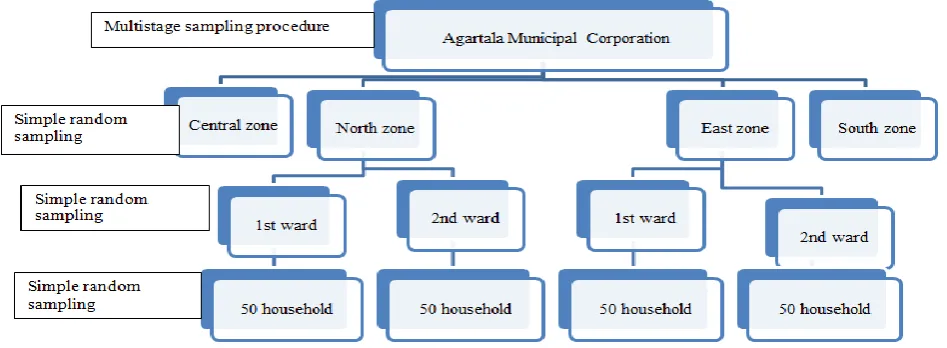
Multistage sampling method was followed for selecting the study participants.
Figure 1: Sampling algorithm.
Data analysis
Data were analyzed using SPSS version 20. Descriptive statistics were expressed as frequencies and percentages. Chi square statistics and Fisher‟s exact test were applied s to assess the association among different variables with P value 0.05 considered as statistically significant.
Operational definitions
There were 16 questions on knowledge.
Those who gave correct answers were given score “one” and those who gave wrong answers were given “zero”. The highest possible answer was 16.
For deciding adequate knowledge- Median score was taken as a cut of value. Those participants scoring more than median were said to have adequate knowledge.
For deciding inadequate knowledge- Those participants scoring less than and equal to median were said to have inadequate knowledge.
RESULTS
A total number of 200 subjects were interviewed. Among them, 22.5% belonged to age group of 30-34 years and 22% were aged more than 60 years. Mean age of the respondents was 45.23±14.7 years. Maximum numbers of subjects were females (54.5%), home maker (32%) and married (80%). Majority of them had completed graduation (39%), belonged to general caste (66.5%) and Hindu by religion (99%).
and symptoms of rabies in human, only 16.5% and 22% of them knew correctly about it.
Table 1: Knowledge about immediate action following dog/cat/other suspected animal bite.
Majority of the respondents (60.5%) knew that bite, scratch as well as licking on broken skin serves as modes of transmission of rabies.
In the present study, 66.5% respondents had correct knowledge about immediate care following dog/cat/other
suspected animal bite but 13% of them thought that washing with antiseptic solution to be done immediately and 1.5% of subjects opined that lime application to be first option as immediate care (Table 1).
Table 2: Knowledge of respondents about prevention of human rabies by vaccination.
Characteristics Frequency Percentage (%)
Yes 129 65.5
No 23 11.0
Don’t know 38 18.5
Not heard about rabies
10 5.0
Total 200 100
Almost less than half of the subjects (46.5%) said that rabies can be cured after development of signs and symptoms. 90.5% respondents were preferred to consult with doctor or go to hospital, while only 2% and 2.5% participants preferred to consult with local quack and traditional healer respectively after dog/cat/other suspected animal bite. Maximum number of the study subjects (65.5%) believed that by vaccination human rabies can be prevented but 18.5% of them had no idea about it (Table 2).
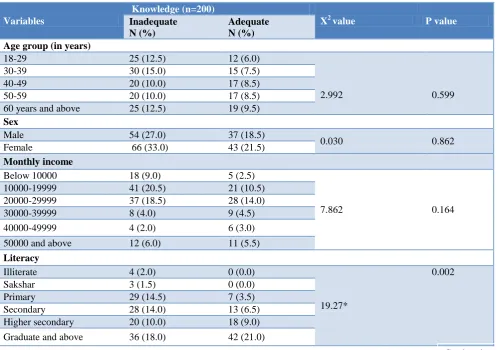
Table 3: Association between factors and level of knowledge about rabies.
Variables
Knowledge (n=200)
X2 value P value
Inadequate N (%)
Adequate N (%) Age group (in years)
18-29 25 (12.5) 12 (6.0)
2.992 0.599
30-39 30 (15.0) 15 (7.5)
40-49 20 (10.0) 17 (8.5)
50-59 20 (10.0) 17 (8.5)
60 years and above 25 (12.5) 19 (9.5)
Sex
Male 54 (27.0) 37 (18.5)
0.030 0.862
Female 66 (33.0) 43 (21.5)
Monthly income
Below 10000 18 (9.0) 5 (2.5)
7.862 0.164
10000-19999 41 (20.5) 21 (10.5) 20000-29999 37 (18.5) 28 (14.0) 30000-39999 8 (4.0) 9 (4.5) 40000-49999 4 (2.0) 6 (3.0) 50000 and above 12 (6.0) 11 (5.5)
Literacy
Illiterate 4 (2.0) 0 (0.0)
19.27*
0.002
Sakshar 3 (1.5) 0 (0.0)
Primary 29 (14.5) 7 (3.5)
Secondary 28 (14.0) 13 (6.5) Higher secondary 20 (10.0) 18 (9.0) Graduate and above 36 (18.0) 42 (21.0)
Characteristics Frequency Percentage (%)
Wash with water
only 10 5
Wash with water
and soap 133 66.5
Wash with
antiseptic solution 26 13
Apply lime 3 1.5
Others 10 5
Don’t know 8 4
Not heard about
rabies 10 5
Total 200 100
Variables
Knowledge (n=200)
X2 value P value
Inadequate Adequate N (%) N (%) Occupation
Govt. service 13 (6.5) 11 (5.5)
3.395*
0.907 Private job 7 (3.5) 4 (2.0)
Unemployed 5 (2.5) 6 (3.0)
Home maker 39 (19.5) 25 (12.5) Retired person 17 (8.5) 11 (5.5)
Laborer 3 (1.5) 1 (0.5)
Businessman and self
employed 17 (8.5) 10 (5.0)
Students 4 (2.0) 5 (2.5)
Others 15 (7.5) 7 (3.5)
Caste
General 79 (39.5) 54 (27.0)
3.062 0.382
Schedule caste 17 (8.5) 8 (4.0) Schedule tribe 9 (4.5) 3 (1.5)
OBC 15 (7.5) 15 (7.5)
Marital status
Married 97 (48.5) 63 (31.5)
1.304
0.521
Unmarried 16 (8.0) 9 (4.5)
Widowed 7 (3.5) 8 (4.0)
Religion
Hindu 119 (59.5) 79 (39.5)
0.084* 0.772
Christian 1 (0.5) 1 (0.5)
Type of family
Nuclear family 94 (47.0) 66 (33.0)
0.521 0.470
Joint family 26 (13.0) 14 (7.0)
Dog ownership status
Yes 3 (1.5) 5 (2.5)
1.758* 0.185
No 117 (58.5) 75 (37.5)
Chi-square test and Fisher‟s exact test (*) applied, indicate p<0 .05.
Whereas 58% respondents knew that rabies vaccines were available at government facilities and 27.5% respondents opined that 3 doses of vaccine were needed while 9% respondents still believed that 14 doses were needed after dog/cat/suspected animal bite and 19.5% had no idea regarding doses of rabies vaccination. Most of the respondents (80%) opined positively about visiting health facility if vaccine was not received immediately for any reason following dog/cat/other suspected animal bite. 43.5% of the respondents was cautious and would take vaccine even after a vaccinated dog bites them and (44%) of the respondents would opt for revaccination if animal bites after receiving full course of anti-rabies vaccination. In our study, factors like age, sex, occupation, type of family, monthly income were not found any association with the level knowledge on rabies but only one factor i.e., literacy (p=0.002) was found associated (Table 3).
DISCUSSION
In the present study, 60% of study subjects had inadequate knowledge on rabies which was little bit
higher than the study conducted by Jalina et al in Manipur where it was 51.5% but differs from similar study reported by Yuvaraj et al where it was 32% only.6,7 In a similar study done in Puducherryfound that (49.7%) were unemployed and 15% were dog owners.7 This report was in contrast with our study findings. In a study conducted by Alie et al reported that 100% had heard about rabies but in our study, it was 83.5% and 74.1% study conducted in Bangalore.8,9
WHO collaborative study findings i.e., 68.7% have heard about the rabies, 60.7% were aware that dog bite causes rabies. Valekar et al study reported 111 (77%) were aware that dog bite causes disease; whereas out of these 52 (46.8%) were aware that rabies is caused by dog bite.10
our study findings (39.5%). Regarding transmission of rabies, 60.5% respondents knew correctly as compared to study done in Puducherry, where 98.9% respondents answered that rabies can be transmitted by animal bites.7 In our study, 66.5% respondents revealed that the wounded area should be washed with soap and water immediately following bite of suspected animals and 1.5% of subjects opined that lime application to be first option as immediate care as in comparison with the study done in Maharashtra showed that it was 44.4% and application of lime 16.6%.10 Chopra et al study observed that only 22% respondents had washed the wound with soap and water.12
In a study conducted by Valekar et al showed 125 (90.5%) said that the vaccine is available in government hospitals while 13 (9.4%) said in private hospitals. A large number of participants answered 14 injections 46 (31.9%) followed by 7 injections 22 (15.2%), 5 injections 28 (19.4%).10 The observation was in contrast with our study findings. The present study reported that 90.5% subjects would like to consult with doctor following bite of suspected animals and was found similar in Jalina et al study.6
In our study, only literacy was found associated with level of knowledge on rabies but Tripathy et al study reported that KAP score was significantly associated with age, sex, education and residence whereas Chopra et al study reported that sex, religion and marital status were significantly associated with knowledge level.11,12
CONCLUSION
In the present study, still there is needed to be increase the level of knowledge especially among the adult population. The level of adequate knowledge (40%) was found lower in our study than other study. The findings of our result may not be generalizable to other settings as study was done only in urban area of Agartala Municipal Corporation of Tripura.
Recommendations
Public education campaigns and more IEC activities need to be conducted to make people more aware regarding rabies. Encouraging immediate post exposure prophylaxis for the victimized individuals by wounds must be immediately washed with soap and running water for 15 minutes rabies vaccination and immunoglobulin should to be given depending on the category of exposure.
Limitations
Study was carried out during office hours; hence mostly females and home makers were interviewed.
ACKNOWLEDGEMENTS
We would like to thank all the study participants involved in this study and their full co-operation with us.
Funding: No funding sources Conflict of interest: None declared
Ethical approval: The study was approved by the Institutional Ethics Committee
REFERENCES
1. Public health: rabies in India-NIBI-NIH. Available at: https://www.ncbi.nlm-nih.gov/pmc/articles/ pmc22 44675. Accessed on 12 July 2018.
2. World Health Organization, Rabies. Available at: www.searo.who.int/india/topics/rabies. Accessed on 12 July 2018.
3. Kole AK, Roy R, Kole DC. WHO. Human rabies in India: rabies a problem needing more attention. Bull World Health Organization. 2014;92:230. 4. Murugan V, Amol D, Kalaiselvan G. A Community
based cross sectional study of dog bites in children in a rural district of Tamil Nadu. Int J Med Sci Public Health. 2017;6(1):109-12.
5. Ghosh S, Chowdhury S, Haider N, Bhowmik RK R, Rana MS, Marma ASP, et al. Awareness of rabies and response to dog bites in a Bangladesh community. Vet Med Sci. 2016;2(3):161-9.
6. Laishram J, Chaudhuri S, Devi HS, Konjengbam S. Knowledge and practice on rabies in an urban community of Manipur, India. J. Evolution Med Dent Sci. 2016;37(5):2234-7.
7. Krishnamoorthy Y, Vijayageetha M, Sarkar S. Awareness about rabies among general population and treatment seeking behaviour following dog-bite in rural Puducherry: a community based cross-sectional study. Int J Community Med Public Health. 2018;5(6):2557-63.
8. Alie A, Assefa A, Derso S, Ayele B. Assessment of knowledge, attitude and practice on rabies in and around debretabor, South Gondar, Northwest Ethiopia. Int J Basic Applied Virol. 2015;4(1):28-34.
9. Mrudu H, Riyaz BS, Selvi T. Community perception regarding rabies prevention and stray dog control in urban slums In India. J Infect Public Health. 2012;5(6):374-80.
10. Valekar SS, Kshirsagar VM, Ashturkar DM, Mhaske M, Chawla PS, Fernandez K. A cross-sectional study of awareness regarding dog bite and its management in rural community of Maharashtra. Int J Community Med Public Health. 2014;1(1):8-11.
12. Chopra D, Jauhari N, Dhungana H, Nasrah. Assessment of awareness about rabies and the animal bite among the staff nurses in a medical institute in Lucknow. Int J Community Med Public Health. 2017;4(6):2046-51.