http://www.ijcmph.com pISSN 2394-6032 | eISSN 2394-6040
Original Research Article
Adherence to recommended intra-partum guidelines of high risk
pregnancies: a study in North Bengal Medical College,
Darjeeling district, West Bengal, India
Sumanta Chakraborty
1*, Sunamika Banerjee
2INTRODUCTION
One of the Sustainable Development Goals (SDG 3) has been formulated with the aim to reduce global maternal mortality ratio by less than 70 per 100,000 live births with no country having maternal mortality rate of more than twice the global average.1
Maternal and child health have long been a priority concern as pregnancy and childbirth conceal implicit threat to women’s health. These high risk groups in these vulnerable conditions, if not appropriately attended, roll on to even dreaded maternal near-miss cases. High risk cases primarily include anaemia in pregnancy, pregnancy induced hypertension, preterm labour, antepartum haemorrhage and their associated complications.
ABSTRACT
Background: High risk pregnancies in intra-partum period are vulnerable, and if not appropriately attended, may roll on to maternal death or dreaded maternal near-miss cases. Despite the presence of a number of standard treatment guidelines designed to address most of the high risk conditions, their adherence and implementation continues to be uncommon. To assess the adherence to recommended guidelines during referral of high risk pregnancies in labour in mothers of the difficult terrains of eastern Himalaya.
Methods: A descriptive epidemiological study with cross-sectional design was conducted among mothers with high risk pregnancies admitted in the labour ward, North Bengal Medical College Hospital, Darjeeling. 433 subjects were studied using complete enumeration technique.
Results: Anaemia in pregnancy (22%), obstructed labour (19%), pre-term rupture of membranes (15%) and pregnancy induced hypertension (15%) were the high risk conditions identified. Referral linkage existed in most (70.7%) but no pre-referral treatment was given to 61.4% of the intra-partum mothers. Multivariate analysis shows mothers with age more than 35 years (AOR 4.97), bad obstetric history (AOR 2.40) & not attended by doctors (AOR 5.02) were found to be having more odds of missing the pre-referral treatment. About 86% of the gaps in pre-referral treatment were due to doctors not attending patients, lack of referral communication, not providing JSSK facilities and non-maintenance of Partograph as per Pareto analysis.
Conclusions: Most of the non-adherence to standard treatment guidelines in high risk intra-partum mothers are related to health service delivery and can be ameliorated through proper administrative measures.
Keywords: High risk pregnancies, Intra-partum mothers, Adherence, Pre-referral treatment, Darjeeling, Pareto analysis
1
Department of Community Medicine, Bankura Sammilani Medical College, Bankura, 2Department of Economics, Calcutta University, Kolkata, West Bengal, India
Received: 24 June 2019 Revised: 15 July 2019 Accepted: 16 July 2019
*Correspondence: Dr. Sumanta Chakraborty,
E-mail: [email protected]
Copyright: © the author(s), publisher and licensee Medip Academy. This is an open-access article distributed under the terms of the Creative Commons Attribution Non-Commercial License, which permits unrestricted non-commercial use, distribution, and reproduction in any medium, provided the original work is properly cited.
So, ensuring maternal survival, decreasing maternal and neonatal mortality is of paramount importance to achieve favourable maternal and child health indicators-a surrogate marker for wellbeing of a nation. However, worldwide, every day about 830 women die from preventable causes related to pregnancy and child birth.1 Maternal mortality ratio in India and West Bengal currently are 178 and 117 per 1,00,000 live births respectively.3 A community based study in Karnataka in 2015 revealed prevalence of high risk pregnancy as 37%. Among them hypertension and preterm labour was present in 10.8% and 13.5% cases respectively.4 30% of women need emergency care during delivery.5 Referral rate was found to be 15.2% with common reasons for referral being non progressive labour (14.8%), severe anaemia (10.3%), pre-eclampsia (10.3%), mal-presentation (9.7%) and postpartum haemorrhage (9.7%).6 Also, pre-referral treatment was not received by 58.9% intra-natal mothers and a delay model study revealed 25.7% cases not receiving quality care due to third delay.6,7 These led to potentially life threatening maternal condition in 52% cases, 68.4% maternal near miss cases and 84.1% maternal death.7
Also, some mothers are referred to tertiary health facilities without any complications mostly from primary health care level and some from secondary health care level, putting an increased work load at the tertiary care level and thereby overcrowded wards and decreased patient satisfaction. There are guidelines of whom to refer and what the mother should receive from the sub-centre level to the BEmOnC centre and from there if need be to the CEmOnC centre. This linkage of services at each level following strictly the guidelines is essential to curb maternal mortality and morbidity.
Thus successful interplay of infrastructural components and functional referral systems would lead to increased utilization and optimum delivery of services by beneficiaries and health care providers respectively paving way for a healthier future. Operational guidelines for BEmOnC and CEmOnC levels, Standard Treatment Guidelines (STG) for high risk cases, Safe Childbirth Checklist (WHO), MNH Toolkits and Mother friendly hospital initiatives have emerged. Hence, synchronisation and working in accordance to structured recommended guidelines with appropriate referrals is the burning need of the hour.
There is dearth of published literature on adequacy and appropriateness of existing referral linkage of antenatal women in labour and their adherence to recommended guidelines at various levels of health care facilities like BEmOnC and CEmOnC centres, in this part of the country. Thus in the aforesaid context, a situational assessment of mothers in labour, especially high risk cases attending the only rural tertiary care hospital catering to the remote hilly difficult terrain of Darjeeling district is attempted.
Objectives
To assess the adherence to recommended guidelines during referral of high risk pregnancies in labour in mothers of the difficult terrains of eastern Himalaya.
METHODS
Study type and design
The present study was a descriptive epidemiological study with cross-sectional design conducted between July 2016 and September 2016 at the department of Obstetrics, North Bengal Medical College Hospital (NBMCH), Darjeeling, a tertiary care teaching hospital with undergraduate and post graduate medical courses. It caters populations from difficult and hilly terrains of eastern Himalayas with cases also attending from bordering nations. There are only 30 beds in the labour ward of North Bengal Medical College & Hospital. Total deliveries per month are about 800. Total high risk intra-partum mothers admission per day is about 4. The Study subjects were all intra-partum high risk mothers attending for delivery at North Bengal Medical College and Hospital. The intra-partum high risk conditions included were anaemia in pregnancy, antepartum haemorrhage, pregnancy induced hypertension, eclampsia, obstructed labour, multi-foetal gestation, mal presentation and pre-term rupture of membrane. The cases were defined and the pre-referral treatment was assessed as per Standard Treatment Guidelines of Government of West Bengal.
Sample size and sampling technique
Complete enumeration of all high risk pregnancies admitted in the labour ward of North Bengal Medical College & Hospital in Darjeeling district of West Bengal fulfilling the study criteria. 433 subjects were studied using complete enumeration technique during our study period.
Exclusion criteria
Non-availability of study subjects or even after two repeated visits.
Unwilling study subjects.
Non availability of relevant records.
Severely ill study subjects.
Deaf and dumb study subjects.
Developmental delays among study subjects.
Tools and techniques
observation, check-list monitoring and reviewing of records.
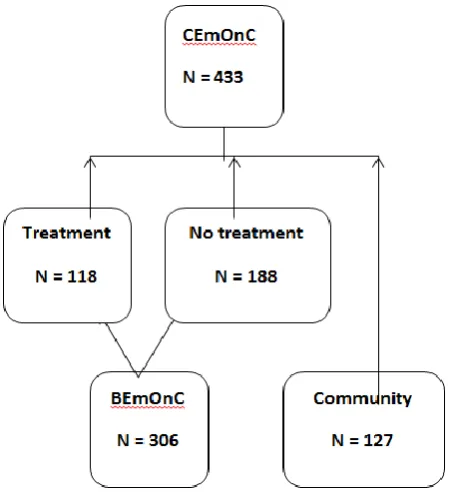
Figure 1: Flow chart showing referral linkage of study subjects.
Statistical methods
All data were entered into the IBM Statistical Package of Social Sciences (SPSS) v20. After entering the data, they were checked for accuracy and inconsistencies resolved by comparing with the raw data. Bivariate and multivariate logistic regression using adherences to standard treatment guidelines as pre-referral treatment in high risk intra-partum mothers as the outcome variable were done. The association of the factors was determined at the individual level and after adjusting using the Odds ratio and the 95% confidence intervals were calculated. All hypothesis testing were two tailed and p value of ≤0.05 was considered statistically significant.
Ethical considerations
The study was conducted after the approval of the Institutional Ethics Committee of North Bengal Medical College, Darjeeling. Informed consent was obtained for all the study participants.
RESULTS
Between July-September’16 there were 433 admissions of high risk intra-partum mothers in the obstetric inpatient department of the North Bengal Medical College and Hospitals. By complete enumeration technique all the patients were included in our study. Majority of the study subjects were in the age group of 20-34 years (75.1%), Hindus (59.8%), literate (90.5%), home-maker (50.9%) and belong to lower
socio-economic class (54.5%) as per modified B.G. Prasad’s scale. There was considerable inter-district (49.2%) and inter-state (6.2%) referral of intra-partum high risk mothers (Table 1).
Table 1:Socio-demographic distribution of study subjects (n=433).
Socio-demographic correlates
High risk conditions N (%)
Age group (in years)
<20 72 (16.6) 20-34 325 (75.1)
≥34 36 (8.3)
Religion
Hindu 258 (59.6) Muslim 95 (21.9) Christian 64 (14.8) Buddhist 16 (3.7)
Residence
Darjeeling 193 (44.6) Inter-district 213 (49.2) Inter-state 27 (6.2) Literacy
status
Illiterate 41 (9.5) Literate 392 (90.5)
Occupation Home-maker 220 (50.9) Working 213 (49.1)
Socio-economic status
Upper class 197 (45.5)
Lower class 236 (54.5)
Figure 2:Pie diagram showing distribution of intra-partum mothers according to the high risk conditions
of pregnancy (n=433).
The most common high risk intra-partum condition identified in the study was anaemia in pregnancy (22%) followed by obstructed labour (15%) (Figure 2). Gaps in pre-referral treatment was highest in eclampsia (80%) followed in close succession by antepartum haemorrhage (79.5%) and anaemia in pregnancy (78.1%) (Figure 3).
Anaemia in pregnancy
22%
APH 13%
Multi-foetal gestation
9% Malpresentatio
n 6% PIH 15%
Eclampsia 1%
PROM 15% Obstructed
labour 19%
High risk intra-partum mothers
Anaemia in pregnancy
APH
Multi-foetal gestation
Malpresentation
PIH
Eclampsia
PROM
Figure 3: Gaps identified in pre-referral management of study subjects (n=306).
Bivariate analysis
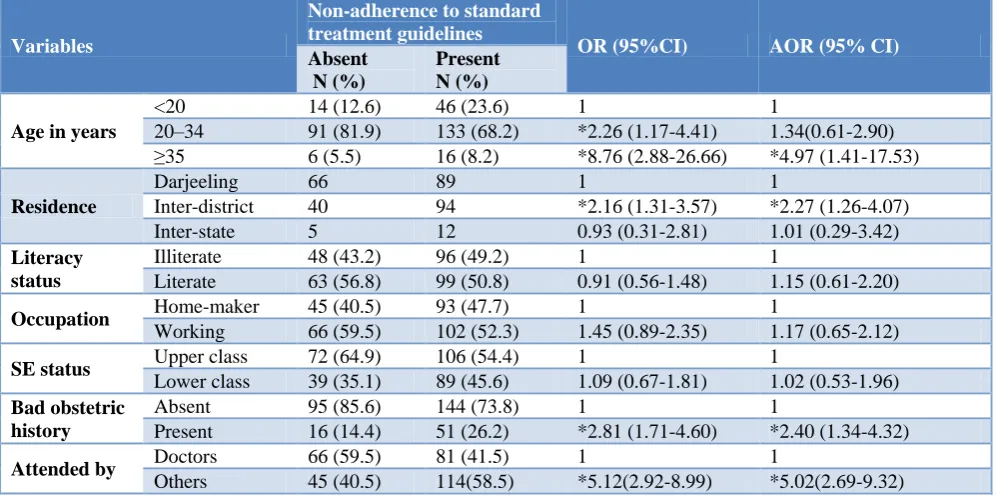
On bivariate analysis following factors were found to be significantly associated with non-adherence to standard treatment guidelines in high risk intra-partum mothers as follows:- age more than 35 years (OR: 8.76; 95% CI: 2.88, 26.66), having bad obstetric history (OR: 2.81; 95% CI:1.71, 4.60) , inter-district referred mothers (OR: 2.27; 95% CI: 1.31, 3.57) and those not attended by doctors (OR: 5.02; 95% CI: 2.69, 9.32) (Table 2).
Multivariate analysis
Following adjustment the following factors were seen to be statistically significantly associated with non-adherence to standard treatment guidelines in high risk intra-partum mothers as follows:- age more than 35 years
(AOR: 4.97; 95% CI: 1.41,17.53), having bad obstetric history (AOR: 2.40; 95% CI:1.34, 4.32) & those not attended by doctors (AOR: 5.12; 95% CI: 2.92,8.99) (Table 2).
Pareto analysis
About 86% of the gaps in pre-referral treatment were due to doctors not seeing the patients, lack of referral communication, not providing JSSK facilities and non-maintenance of Partograph as per Pareto analysis (Figure 4).
(*multiple responses present)
Figure 4: Pareto analysis of reasons for non-adherence of standard treatment guidelines in
pre-referral management of high risk intra-partum mothers.
Table 2:Unadjusted and adjusted odds of non-adherence to standard treatment guidelines in high risk intra-partum mothers (n=306).
Variables
Non-adherence to standard treatment guidelines
OR (95%CI) AOR (95% CI) Absent
N (%)
Present N (%)
Age in years
<20 14 (12.6) 46 (23.6) 1 1
20–34 91 (81.9) 133 (68.2) *2.26 (1.17-4.41) 1.34(0.61-2.90) ≥35 6 (5.5) 16 (8.2) *8.76 (2.88-26.66) *4.97 (1.41-17.53)
Residence
Darjeeling 66 89 1 1
Inter-district 40 94 *2.16 (1.31-3.57) *2.27 (1.26-4.07) Inter-state 5 12 0.93 (0.31-2.81) 1.01 (0.29-3.42) Literacy
status
Illiterate 48 (43.2) 96 (49.2) 1 1
Literate 63 (56.8) 99 (50.8) 0.91 (0.56-1.48) 1.15 (0.61-2.20)
Occupation Home-maker 45 (40.5) 93 (47.7) 1 1
Working 66 (59.5) 102 (52.3) 1.45 (0.89-2.35) 1.17 (0.65-2.12)
SE status Upper class 72 (64.9) 106 (54.4) 1 1
Lower class 39 (35.1) 89 (45.6) 1.09 (0.67-1.81) 1.02 (0.53-1.96) Bad obstetric
history
Absent 95 (85.6) 144 (73.8) 1 1
Present 16 (14.4) 51 (26.2) *2.81 (1.71-4.60) *2.40 (1.34-4.32)
Attended by Doctors 66 (59.5) 81 (41.5) 1 1
Others 45 (40.5) 114(58.5) *5.12(2.92-8.99) *5.02(2.69-9.32) *- Statistical significance.
78.1 79.5
40.7 52.9 23.8
80
65.2 60.4 61.4
0% 10% 20% 30% 40% 50% 60% 70% 80% 90% 100%
159 156 148
83 76
16 25%
49% 73%
86%
97% 100%
0% 10% 20% 30% 40% 50% 60% 70% 80% 90% 100%
0 20 40 60 80 100 120 140 160 180
Numbers
Percentage
DISCUSSION
The present study identifies several factors as predictors of non-adherence to standard treatment guidelines in high risk intra-partum mothers such as age of mother more than 35 years, mothers having bad obstetric history, mothers not attended by doctors in the primary care set-up etc. The study also pin-points some gaps based on interview of patients and care-givers and review of treatment and referral records as doctors not seeing the patients, lack of referral communication, not providing JSSK facilities and non-maintenance of Partograph. On Pareto analysis applying six-sigma principles, it may be inferred that if these factors were appropriately taken care of, may decrease the non-adherence to standard treatment guidelines by 86%.
A community based study in Karnataka in 2015 revealed prevalence of high risk pregnancy as 37%. Among them hypertension and preterm labour was present in 10.8% and 13.5% cases respectively.4 30% of women need emergency care during delivery.5 The index study was a hospital based study, so prevalence of high risk pregnancy was beyond our scope.
The most common high risk intra-partum condition identified in the index study was anaemia in pregnancy (22%) followed by obstructed labour (15%). While a study in a study in Gujarat, referral rate was found to be 15.2% with most common reasons for referral being non progressive labour (14.8%), severe anaemia (10.3%), and pre-eclampsia (10.3%)in the global scenario a study in Netherlands revealed that request for pain relief (30.5%) was the most common cause of referral.6,7
In our study, referral linkage exists in most (70.7%) but no pre-referral treatment was given to 61.4% of the intra-partum mothers while in a study in Gujarat pre-referral treatment was not received by 58.9% intra-natal mothers.6 A delay model multi-centric study in Brazil revealed 25.7% cases not receiving quality care due to third delay which resulted in potentially life threatening maternal condition in 52% cases, 68.4% maternal near miss cases and 84.1% maternal death.8
On multivariate analysis in our study, age of mothers more than 35 years, inter-district referrals, bad obstetric history of mothers and doctors not attending the patients were found to be predictors of non-receipt of pre-referral treatment in the intra-partum period. A multi-centric study in Gujarat and Tamil Nadu revealed that mothers education, road accessibility, JSY facility predicts institutional deliveries in expecting mothers.9
Empathy of midwives and physicians, communication of information, physical comfort and services were the predictors of satisfaction of Czech intra-partum mothers.10 By Pareto analysis, we found that lack of referral communication, physicians absence in attending the patients were found as reasons of non-adherence to pre-referral treatment guidelines in high risk intra-partum
mothers in the present study. Thus, it can be inferred that empathy, risk communications were more important a reason in mother’s satisfaction, even more than her pain management.
CONCLUSION
Even with the best possible antenatal screening, any delivery can become a complicated one requiring emergency intervention. So, institutional delivery is preached and practised and is the call of the day presently. The 3 tier health care delivery system in India has stipulated guidelines on management of pregnancy cases and its complications such that if appropriately adhered to may curb the maternal and neonatal morbidities & mortalities.
Limitations
Our study was institution based in a tertiary care centre, so the prevalence of referral could not be ascertained. A larger study considering the infrastructural and logistics issues in the primary care set up on the one hand and the training need and motivational factors of the health care providers on the other hand may help a better synchronization of the health care delivery system and thereby ensure a favourable outcome in terms of maternal and child health issues. Recall bias and poor documentation on the part of health care providers were other constraints of the study, which was taken care of by short recall period (24 hours) and reviewing of medical and referral records.
ACKNOWLEDGEMENTS
Heartily indebted to Community Medicine Obstetrics Department of North Bengal Medical College for allowing me to carry on the study and the study subjects for providing information required for the study.
Funding: No funding sources Conflict of interest: None declared
Ethical approval: The study was approved by the Institutional Ethics Committee of North Bengal Medical College.
REFERENCES
1. World Health Organization. Fact sheet no. 348: Maternal mortality, 2015. Available at http://www.who.int/mediacentre/factsheets/fs348/en Accessed 28 March 2019.
2. Montgomery AL, Ram U, Kumar R, Jha P. Million Death Study Collaborators. Maternal mortality in India: causes and healthcare service use based on a nationally representative survey. PloS ONE. 2014 15;9(1):e83331.
4. Pradeep MK, Gnanadeep NV, Umesh RD, Pushpa SP. Prevalence of high risk pregnancy in rural Dharwad. IOSR J Dent Med Sci. 2015;14(10):29-32.
5. Unfpaorg. Available at https://www.unfpa.org/. Accessed 28 March 2019.
6. Patel HC, Singh BB, Moitra M, Kantharia SL. Obstetric referrals: scenario at a primary health centre in Gujarat. Natl J Community Med. 2012;3(4):711-4.
7. Perdok H, Jans S, Verhoeven C, Dillen VJ, Mol BW, de Jonge A. Intrapartum referral from primary to secondary care in the Netherlands: a retrospective cohort study on management of labor and outcomes. Birth. 2015;42(2):156-64.
8. Pacagnella RC, Cecatti JG, Parpinelli MA, Sousa MH, Haddad SM, Costa ML, et al. Delays in receiving obstetric care and poor maternal outcomes: results from a national multicentre
cross-sectional study. BMC Pregnancy Childbirth. 2014;14(1):159.
9. Vora KS, Koblinsky SA, Koblinsky MA. Predictors of maternal health services utilization by poor, rural women: a comparative study in Indian States of Gujarat and Tamil Nadu. J Health Popul Nutr. 2015;33(1):9.
10. Takács L, Seidlerová JM, Šulová L, Hoskovcová SH. Social psychological predictors of satisfaction with intrapartum and postpartum care–what matters to women in Czech maternity hospitals. Open Med. 2015;10(1):119-27.