© 2018 IJSRSET | Volume 4 | Issue 7 | Print ISSN: 2395-1990 | Online ISSN : 2394-4099 Themed Section : Engineering and Technology
Replacement of Fine Aggregates by Foundry Sand In Plain
Cement Concrete
Rajat V. Sontakke, Preeti P. Shinde, Anil V. Jadhao, Priyanka B. Dupare, Prof. Sagar Nimkar Civil Engineering Department, JMSS, ShriShankarprasad Agnihotri College of Engineering,Wardha,
Maharashtra, India
ABSTRACT
Foundries for the metal-casting industry generate by- products such as used foundry sand. Metal foundries use large amounts of the metal casting process. Foundries successfully recycle and reuse the sand many times in a foundry and the remaining sand that is termed as foundry sand is removed from foundry. Foundry sand is uniformly sized, high-quality silica sand that is combined with a binder and used to form molds for ferrous and nonferrous castings. Used foundry-sand properties vary due to the type of equipment used for foundry processing, the types of additives, the number of times the sand is reused, and the type and amount of binder. Within the concrete industry, the most successful examples have been using coal fly ash to make high-quality, durable concrete and recycling old, demolished concrete as aggregate for new concrete. This study presents the information about the opportunities for sustainable and economical concrete. Applications of foundry sand, which is technically, sound, environmentally safe for sustainable development. Use of foundry sand in various engineering applications can solve the problem of disposal of foundry sand and other purposes. Foundry sand consists primarily of silica sand, coated with a thin film of burnt carbon, residual and dust. Foundry sand can be used in concrete to improve its strength and other durability factors. Foundry Sand can be used as a partial replacement of cement or as a partial replacement of fine aggregates or total replacement of fine aggregate and as supplementary addition to achieve different properties of concrete.
Keywords: Strength of Cubes, Waste Foundry Sand, Concrete
I.
INTRODUCTIONFoundry sand consists primarily of clean, uniformly sized, high-quality silica sand or lake sand that is bonded to form molds for ferrous (iron and steel) and nonferrous (copper, aluminum, brass) metal castings. Although these sands are clean prior to use, after casting they may contain Ferrous (iron and steel) industries account for approximately 95 percent of foundry sand used for castings. The automotive industry and its parts suppliers are the major generators of foundry sand.
In addition to green sand molds, chemically bonded sand cast systems are also used. These systems involve the use of one or more organic binders (usually proprietary) in conjunction with catalysts and different hardening/setting procedures. Foundry sand makes up about 97 percent of this mixture. Chemically bonded systems are most often used for "cores" (used to produce cavities that are not practical to produce by normal molding operations) and for molds for nonferrous castings.
The annual generation of foundry waste (including dust and spent foundry sand) in the United States is believed to range from 9 to 13.6 million metric tons (10 to 15 million tons).Typically, about 1 ton of foundry sand is required for each ton of iron or steel casting produced.
II.
EXPERIMENTAL MATERIALS(a).Foundry sand
Waste foundry sand (WFS) is a by-product of the metal casting industries generated from the released moulds for casting after several reuses. Foundry sand is basically high quality silica sand. Depending upon the type of binders used , waste foundry sand or used foundry sand can be classified into green sand and chemically bonded sand. Foundry sand is a high-quality uniform silica sand that is used to make molds and cores for ferrous and nonferrous metal castings. Foundry sands typically comprise of 80% high quality silica sand, 5-10% bentonite clay, 2 to 5%water and less than 5% sea coal.
Figure 1. Waste Foundry Sand
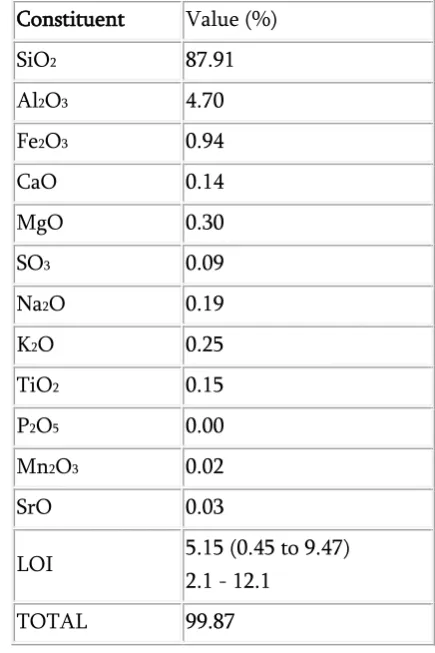
Table 1 Chemical Properties Of Foundry Sand
Constituent Value (%)
SiO2 87.91
Al2O3 4.70
Fe2O3 0.94
CaO 0.14
MgO 0.30
SO3 0.09
Na2O 0.19
K2O 0.25
TiO2 0.15
P2O5 0.00
Mn2O3 0.02
SrO 0.03
LOI 5.15 (0.45 to 9.47) 2.1 - 12.1
TOTAL 99.87
(b).CEMENT
FIGURE 2. Acc Cement (43 Grade)
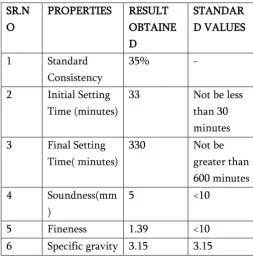
TABLE 2. PHYSICAL PROPERTIES OF CEMENT
SR.N O
PROPERTIES RESULT OBTAINE D
STANDAR D VALUES
1 Standard Consistency
35% -
2 Initial Setting Time (minutes)
33 Not be less
than 30 minutes 3 Final Setting
Time( minutes)
330 Not be
greater than 600 minutes 4 Soundness(mm
)
5 <10
5 Fineness 1.39 <10
6 Specific gravity 3.15 3.15
(C)AGGREGATES
Aggregate is a natural deposit of sand and gravel and also give structure to the concrete. It occupies almost 75% to 80% of volume in concrete and hence shows influence on various properties such as workability, strength, durability and economy of concrete. To increase the density of concrete aggregate is frequently use in different sizes. Aggregate acts as reinforcement and introduce strength to the overall composite material. Aggregate
is also used as base material for roads, railroads and under foundation due to its good strength.
FIGURE 3 -Aggregates
(d)WATER
Water plays an important role in concrete as it gives a chemical reactions in concrete also it should be clean and suitable for use and it should not contain salts. It is also used for cuing purpose. Water is must for the mixing of concrete.
III.
LITATURE REVIEWFollowing authors have reported that, the use of used foundry sand in various civil engineering applications.
[1] Tarun naik and his team investigated the performance of fresh and hardened concrete containing waste foundry sand in place of fine aggregate. Concrete mixes were proportioned to replace 25% and 35% by weight of regular concrete with clean foundry sand and used foundry sand. The result of this investigation showed that mix containing 25% discarded foundry sand showed about 10% higher compressive strength of the control mix was about 20%-30% higher than the mixes containing discarded foundry sands. They observed that no difference in the density of fresh and hardened concrete.
compressive strength and tensile strength of hardened concrete of 28 days were measured. The results showed that (i) flow value and compressive strength of mortar is very rapidly decreased with increasing the replacement ratio of COW and CLW; (ii) Bleeding of concrete with COW, CLW are decreased according to increasing replacement ratio of COW and CLW; (iii) concrete mixed with COW of 30%, compressive and tensile strengths of concrete are higher than those of any other concrete without COW, whereas concrete mixed with CLW, compressive and tensile becomes risky as to the structural and durability requirements. However they also added that their work may not be generalized, because the FSW composition varies according to the manufacturing process and in all cases it is advisable to carry out preliminary tests in order to verify the effects caused by the use of FSW in the concrete production
[3] Gurpreet Singh and Rafat Siddique investigated the strength and durability properties of concrete mixtures, in which natural sand was replaced with five percentage (0%, 5%, 10%, 15% and 20%) of waste foundry sand (WFS) by weight. Compression test and splitting tensile strength test were carried out at the age of 7, 28 and 91 days and Modulus of elasticity, ultrasonic pulse velocity and Rapid Chloride Permeability test were conducted at the age of 28 and 91 days. The abrasion resistance of concrete containing WFS was also investigated. Based on the results obtained they concluded that (i) Maximum increase in compressive strength, splitting tensile strength and modulus of elasticity of concrete was observed with 15% WFS, both at 28 and 91 days; (ii) WFS increases the ultrasonic pulse velocity values and decreased the chloride ion penetration in concrete; (iii) Abrasion resistance of concrete increased with the increase in WFS content. They also added that WFS can be suitably used in making structural grade concrete, as well as for applications where abrasion is also important parameter.
[4] Khatib and Herki investigated the concrete produced by replacing the fine aggregates with 0%,
30%, 60% and 100% WFS. The water content, coarse aggregate, cement and the water to cement ratio remained constant. The properties investigated at 7, 28 and 90 days curing times. The results indicate that there is systematic increase in water absorption by capillary action, a decrease in compressive strength and Ultrasonic pulse velocity with increasing amounts of WFS in concrete. They also reported that adequate strength can be achieved using an appropriate replacement level of foundry sand.
[5] Kumbhar investigated the various mechanical properties of concrete containing used foundry sand. Concrete was produced by replacing natural sand with UFS in various percentages (10%, 20%, 30% and 40%). Based on the test results they concluded that (i) workability goes on reducing with increase in UFS content; (ii) At 28-days, Compressive strength, splitting tensile strength and flexural tensile strength for different replacement levels of UFS is increased whereas flexural tensile strength goes on reducing for UFS content more than 20%; (iii) At 28-days, the modulus of elasticity values increases with replacement of UFS up to 20%. They also concluded that the UFS can be utilized as a replacement to regular sand in concrete up to about 20%.
IV.
DISCUSSIONV.
RESULT Replacement of foundary sand (%)
Average ultimate compressiv
e strength at 7 days(N/mm
2)
Average ultimate compressiv
e strength at 14 days(N/mm
2)
Average ultimate compressiv
e strength at 28 days(N/mm
2)
0% 17.50 21.50 28.50
10% 17.11 20.56 25.48
30% 17.19 21.85 26.17
50% 17.26 21.70 31.11
VI.
GRAPHICAL REPRESENTATIONVII.
CONCLUSIONThe compressive strength of concrete can be investigated for further percentage of waste foundry sand as a partial replacement of fine sand aggregate.The following specific conclusion are drawn from the results obtain from the investigation;
1. Compressive strength of concrete increased with the increase in sand replacement with various replacement levels of foundry sand. However, at each replacement level of fine aggregate with foundry
sand, an increase in strength was observed with the increase in age.
2. Incorporation of waste foundry sand increases the strength of blocks and percentage of replacement was found in 50%.
3. Workability is decreases with the increase of foundry sand content because of very fine particles. 4. The problems of disposal and maintenance cost of land filling is reduced.
5. Use of waste foundry sand in concrete reduces the production of waste through metal industries i.e. it’s an eco-friendly building material.
VIII.
REFERENCES[1]. Shetty M.S. (2005). Concrete technology theory and practice. First Illustrative Revised Edition. [2]. Indian standard code IS 383 - 1959 for coarse
and fine aggregate from natural sources for concrete.
[3]. Indian standard code IS 2386 - 1963 for method of test for aggregate for concrete.
[4]. India standard code IS 456:2000 for plain and reinforced cement concrete
[5]. Indian standard code IS 10262 - 2009 and IS 10262 - 1982 for concrete mix proportion. [6]. Indian standard code IS 516: 1959, Methods of
test for the strength of concrete
[7]. Mahima Ganeshan, Dr. Sreevidya V. Salim P.M.”waste foundry sand as a replacement for fine aggregate in high strength solid masonary blocks.
[8]. Rafat Siddique, Geert de Schutterb, Albert Noumowec, “Effect of used-foundry sand on the mechanical properties of concrete”, Construction and building materials, Elsevier, vol .23, Issue.2, pp. 976-980, 2009.
[9]. Rafat Siddique, Geert de Schutterb, Albert Noumowec, “Effect of used-foundry sand on the mechanical properties of concrete”, Construction and building materials, Elsevier, vol .23, Issue.2, pp. 976-980, 2009.
0 5 10 15 20 25 30 35
0% 10% 30% 50%
% Replacement Vs Compressive
strength
7 days compressive strength
14 days compressive strength