Original Research Article
Determinants of maternal deaths amongst mothers who suffered from
post-partum haemorrhage: a community-based case control study
Divya Khanna
1*, Jai Veer Singh
2, Monika Agarwal
3, Vishwajeet Kumar
4INTRODUCTION
Postpartum haemorrhage (PPH) is the leading cause of maternal deaths, accounting for about 35% of all maternal deaths.1 There is a continuing trend of reduction in maternal deaths globally however, developing countries still experience higher numbers of maternal deaths in comparison to developed countries.2 Most deaths (about 99%) from PPH occur in lower and middle
income countries compared with only 1% in industrialized nations.3,4
The World Health Organization estimates that, of the 529 000 maternal deaths occurring every year 136,000 take place in India amongst which postpartum haemorrhage (PPH) being the most (29.6%) commonly reported complication.5 Haemorrhage is considered as the major cause of maternal death in India: 38% of maternal deaths
ABSTRACT
Background: The WHO estimates that, of the 529 000 maternal deaths occurring every year 136 000 take place in India amongst which postpartum haemorrhage (PPH) being the most (29.6%) commonly reported complication. However deaths from PPH can be prevented. The purpose of this study was to identify the risk factors contributing to maternal deaths amongst women who develop PPH.
Methods: This was a community based paired case-control study done in rural areas of Lucknow, UP (India) done in a period of one year. Thirty-one maternal deaths due to PPH (cases) were matched and compared with two mothers who survived from PPH (controls). Data was analysed using SPSS version 17.0 and Open Epi version 2.3. The appropriate significance test was applied using MacNemar test for paired data. Risk factors obtained significant in bivariate analysis were subjected to conditional multiple logistic regressions for adjustment and controlling the effect of confounding variables. Results have been given in form of unadjusted Odds ratio (UOR) and adjusted Odds ratio (AOR).
Results: It was seen that the mothers who had taken ≥4 antenatal visits during the index pregnancy had a protective effect against deaths due to PPH. Home delivery raised the odds of death by seven times.
Conclusions: Deaths due to PPH can be reduced by ensuring institutional delivery, good antenatal care and better referral facilities, especially for mothers from weaker sections of society.
Keywords: Case-control study, Post-partum haemorrhage, Maternal death
Department of Community Medicine, 1Heritage Institute of Medical Sciences, Varanasi, 3King George’s Medical University, Lucknow, Uttar Pradesh, India
2Department of Community Medicine & Principal, Hind Institute of Medical Sciences, Barabanki, Uttar Pradesh, India 4Director of Community Empowerment Lab, Lucknow, Uttar Pradesh, India
Received: 19 May 2018
Revised: 04 June 2018
Accepted: 05 June 2018
*Correspondence:
Dr. Divya Khanna,
E-mail: [email protected]
Copyright: © the author(s), publisher and licensee Medip Academy. This is an open-access article distributed under the terms of the Creative Commons Attribution Non-Commercial License, which permits unrestricted non-commercial use, distribution, and reproduction in any medium, provided the original work is properly cited.
were by haemorrhage, mostly postpartum haemorrhage, according to an SRS analysis.6 Several studies have stated that obstetric complications are inevitable. It was estimated that in 2015, roughly 303,000 women lives were lost during and following pregnancy and childbirth. Majority of these deaths occurred in low-resource settings, and most could have been prevented.7,8
It can be seen that despite established interventions to prevent and treat postpartum haemorrhage (e.g., active management of the third stage of labour), haemorrhage continues to be the leading individual cause of maternal death. Currently available data does not seem to establish if the persistence of deaths due to haemorrhage despite effective interventions is from the result of a failure to implement such critical life-saving interventions. The three delays model given for maternal death by Thaddeus et al applies to the PPH as well in form of delay in deciding to seek care (delay 1), delay in reaching the
health facility (delay 2), delay in receiving quality emergency obstetric care (delay 3).9 Our study aimed to find out the potential factors working in the background of events leading to deaths due to postpartum haemorrhage.
METHODS
The current research article is a subset of a larger community-based case-control study conducted on 90 maternal deaths identified during the one year study period (August 2011 to September 2011). Study participants were the females (age group of 15-49 years) in the study area who either delivered and were alive after 42 days of the postpartum period or died within 42 days of termination of pregnancy in the reference period. All maternal deaths identified in all the rural blocks during the study period were enrolled. Maternal death was defined as per ICD-10 coding (Table 1).10
Table 1: Case and control definitions.
Cases
Inclusion criteria
Maternal death (ICD-10 definition) is defined as death of a woman during pregnancy or within 42 days from the end of pregnancy, irrespective of the duration and site of pregnancy, from any cause related to or aggravated by the pregnancy or its management, but not accidental or incidental causes10.
Exclusion criteria
1. Non co-operative families
2.Mothers who died due to accidental/incidental causes
3. Late maternal deaths (ICD-10 definition: deaths due to direct or indirect obstetric causes after 42 days of termination of pregnancy but less than one year of termination of
pregnancy.)
4. Maternal deaths due to rare non- pregnancy related causes (like leukaemia, burns) were not enrolled because of difficulty in finding matched controls.
5. Mothers residing in urban part of Lucknow during the study period.
Controls
Inclusion criteria
Geographical matched control: Defined as mother who lived in same village where a
maternal death took place and had delivered normally in the same reference period without any obstetric complications (which needed urgent hospitalization) during ante-/intra-/post-natal period and was alive after 42 days of post-partum period. Random selection was done from the list of deliveries that took place in same geographical area and in same reference period using ASHAs delivery register.
Complication matched control: was defined as a mother who had a similar biomedical
complication (either direct obstetric causes or indirect medical causes of morbidity which needed hospitalization) and was admitted for the complication at a tertiary health centre of Lucknow such as district hospitals or medical college for management but survived and was alive after 42 days of post-partum period.
Exclusion criteria
1. Non co-operative families
2. Mothers who did not deliver in the reference period
3. Mothers residing in urban part of Lucknow during the study period.
The study area was Lucknow district, which is the capital of Uttar Pradesh, the most populated state of India and grouped under the poor performing states with respect to various health indicators. As per census 2011 Lucknow catered a population of 4,588,455 with an average literacy rate of 79.33 Sex Ratio of 940 per 1000 males far below the national average. The number of Primary health centre (PHC) and Community health centre (CHC)
were 0.25 PHC and 0.96 CHC per Lac of the population, not meeting the standard norms.11
available only at District and Apex teaching hospitals. Parts of the study area are also served by small private hospitals offering various levels patient care.
Maternal deaths whose cause of death was postpartum haemorrhage were taken as cases and were compared with two controls. The controls were those mothers who survived from postpartum haemorrhage. All controls were drawn from the same community from where the maternal death cases were taken. The nine blocks of Lucknow made a total population of 15, 50,737 (Census 2011). The crude birth rate of rural Lucknow was 29.7 per thousand live births (Census 2011) and maternal mortality ratio for Uttar Pradesh was 359 per 100,000 live births (SRS 2009).11,12 Hence the estimated live births will be 46,057 and 165 maternal deaths in a year at the given rates. Due to deficient reporting for various reasons described later we expected reporting of maternal deaths between 25-40%. A total of 90 maternal deaths were identified during the study period. Amongst these 31 maternal deaths were due to PPH and were compared with 62 controls.
Maternal deaths were identified by gathering information from village health information system (ASHA, ANM). Information from the CHCs record registers of the study area was also taken. The case tracking process was hindered by factors such as under-reporting, deficient registers, fears of reporting deaths by ASHA. Thereafter a home visit was made to the family of deceased after the suitable mourning period. Best suitable respondents were interviewed after taking informed consent using pretested schedules in the local language. For controls mothers self-reported symptoms were taken and family was inquired for logistics and health seeking
Data collection was done through two schedules. Verbal autopsy was conducted using UNICEF’s maternal and perinatal death inquiry and response tool and was used for ascertaining the cause of maternal death. A pre-tested and semi-structured schedule was used for both cases and controls to identify their biosocial characteristics, reproductive history, ante-, intra-, postnatal history of index pregnancy and information on the sequence of events at the time of death and how the mother survived from obstetric complication. ICD-10 definitions were used for complications during pregnancy and delivery. The completed interview schedules were reviewed by chief and co-supervisors to identify and verify the cause of death and cause of death was assigned using the 10th revision of the International Classification of Disease (ICD-10).10 Relevant modifications were made in the schedule to overcome the difficulties faced during pretesting.
Data was tabulated on Microsoft Excel sheet and analyzed by using the software SPSS, Version 17.0 and Open Epi, Version 2.3. All variables were entered as categorical. The appropriate significance test was applied using MacNemar test for paired data. Bivariate analysis
was carried out to compare the characteristics (independent /predictor variables) of the cases and controls with a dichotomous outcome which was maternal death or maternal survival and unadjusted odds ratio (OR) and 95% confidence intervals were calculated for risk factors of maternal death. Risk factors obtained significant in bivariate analysis were subjected to conditional multiple logistic regressions for adjustment and controlling the effect of confounding variables and the results have been given in form of unadjusted OR (UOR) and Adjusted OR (AOR).
Ethical Consideration
The study received clearance from the Ethical Board Committee of the King George’s Medical University, Lucknow, UP, India. The objective, purpose of the study were explained to all the participants in their local language and written informed consent taken.
RESULTS
Of the 90 maternal deaths identified during the study period 31 deaths were due to postpartum haemorrhage (34.4%).
Bio-social characteristics
Illiteracy and occupational status of husbands came out to be a significant risk factor on conditional logistic regression. Those families where husbands were earning whole of the year had a protective effect on maternal death. All these variables can be taken as proxies for poor socio-economic status being a risk factor maternal death. Age at marriage and age of the first conception was not found to be a risk factor maternal death due to postpartum haemorrhage (Table 2).
Reproductive characteristics
Gravida of the mother, presence of bad obstetric history were also not found to be significant risk factors for maternal deaths. However the presence of anaemia during index pregnancy raised the odds of death by PPH nearly by five times(Table 2).
Health care utilization characteristics
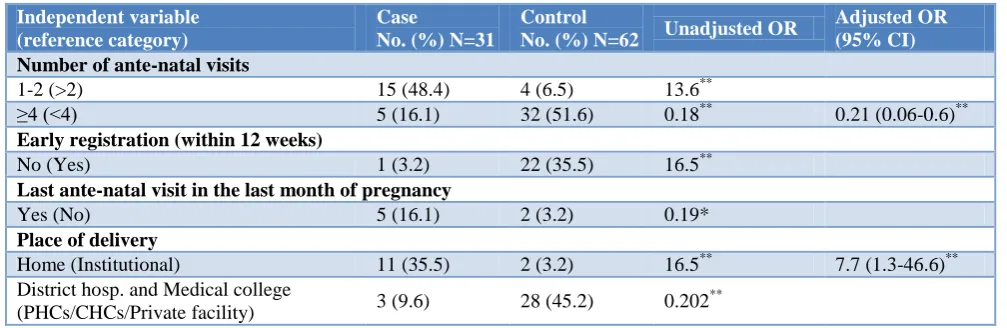
Mothers who had taken four or more antenatal visits during the index pregnancy had a protective effect. Home delivery raised the odds of death by nearly seven times and mothers who had not received any postnatal care were at five-fold higher risk of death(Table 3).
Health seeking characteristics after the onset of illness
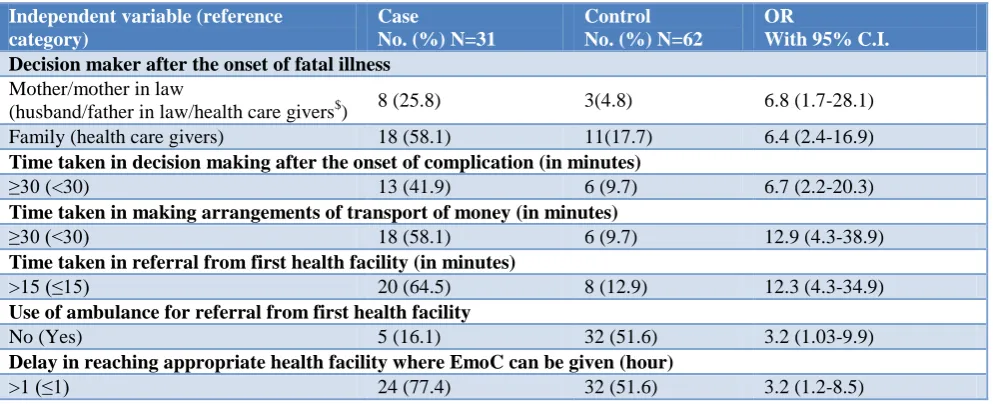
proxy indicators for each other. Hence the Odds ratio mentioned are generated from Mac Nemar test. It was seen that where decision makers to seek health care after the onset of complication were mothers or mother in laws the risk of death increased by nearly seven times compared to the families where the decision was taken by male members of the family or health caregivers such as ASHA, ANM or local doctor. Delay of 30 minutes or more in making the decision to seek health care after the onset of illness increased risk of death by nearly seven times. Similarly time taken to make arrangements for
money and transport exceeding thirty minutes increased risk of death to as high as thirteen times. Delay in referral from first health facility beyond fifteen minutes raised odds of death by twelve times. Mothers who couldn't avail ambulance facility for referral were at three-fold higher risk of death compared to mothers who had availed this facility. Mothers who received emergency obstetrical care beyond one hour after onset of illness were at three times higher chances of death compared to mothers who received this care within the span of one hour (Table 4).
Table 2: Bivariate and multivariate analysis results as Odds ratio (OR) for biosocial and reproductive characteristics of the cases and controls along with 95% confidence intervals (CI).
Independent variable (reference category)
Case
No. (%) N=31
Control
No. (%) N=62 Unadjusted OR
Adjusted OR (95% CI) Age of the mother during index pregnancy
≥35 years (<35) 3 (9.6) 2 (3.2) 3.2
Caste of the family
SC (others) 25 (80.6) 40 (64.5) 2.3
Occupational status of husband
Agri/non agri Labour 23 (74.2) 28(45.2) 3.5** 6.5 (1.6-26.8)**
Literacy status of mothers
Illiterate (literate) 20 (64.5) 28 (45.2) 2.2
Literacy status of husband
Illiterate (literate) 19 (61.3) 16(25.8) 4.5* 4.9 (1.3-17.6)**
Whether earning whole year
Yes (No) 17 (54.8) 28(45.2) 0.68** 0.24(0.14-0.6)**
Age at marriage (in completed years)
Below 18 (above 18) 6 (19.4) 8(12.9) 1.6
Age at first conception (in completed years)
Below 21 (above 21) 17 (54.8) 32 (51.6) 1.14
Gravida of mother during index pregnancy
Primi gravida (others) 6 (19.4) 10 (16.1) 1.6 Grand multipara (others) 5 (16.1) 8(12.9) 1.3
Presence of bad obstetric history
Yes (No) 16 (64) 30(57.7) 0.77
Presence of Anaemia during index pregnancy
Yes (No) 20 (64.5) 14(22.6) 6.8** 5.2 (1.5-18.6)*
**p value highly significant; *p value significant.
Table3. Bivariate and multivariate analysis results as Odds ratio (OR) for health care utilization characteristics of the cases and controls during the index pregnancy along with 95% confidence intervals (CI)
Independent variable (reference category)
Case
No. (%) N=31
Control
No. (%) N=62 Unadjusted OR
Adjusted OR (95% CI) Number of ante-natal visits
1-2 (>2) 15 (48.4) 4 (6.5) 13.6**
≥4 (<4) 5 (16.1) 32 (51.6) 0.18** 0.21 (0.06-0.6)**
Early registration (within 12 weeks)
No (Yes) 1 (3.2) 22 (35.5) 16.5**
Last ante-natal visit in the last month of pregnancy
Yes (No) 5 (16.1) 2 (3.2) 0.19*
Place of delivery
Home (Institutional) 11 (35.5) 2 (3.2) 16.5** 7.7 (1.3-46.6)** District hosp. and Medical college
(PHCs/CHCs/Private facility) 3 (9.6) 28 (45.2) 0.202
**
Independent variable (reference category)
Case
No. (%)N=31
Control
No. (%)N=62 Unadjusted OR
Adjusted OR (95% CI) Was she ever facilitated/suggested for place of delivery
No (Yes) 13 (41.9) 8 (12.9) 4.9*
Post natal care ever taken
Yes (No) 3 (9.7) 22 (35.5) 5.1* 5.3 (1.3-21.8)*
*p value significant; **p value highly significant.
Table 4: Bivariate and multivariate analysis results as Odds ratio (OR) for health care seeking characteristics and delays after the onset of complication amongst the cases and controls during the index pregnancy along with 95%
confidence intervals (CI).
Independent variable (reference category)
Case
No. (%) N=31
Control No. (%) N=62
OR
With 95% C.I. Decision maker after the onset of fatal illness
Mother/mother in law
(husband/father in law/health care givers$) 8 (25.8) 3(4.8) 6.8 (1.7-28.1) Family (health care givers) 18 (58.1) 11(17.7) 6.4 (2.4-16.9)
Time taken in decision making after the onset of complication (in minutes)
≥30 (<30) 13 (41.9) 6 (9.7) 6.7 (2.2-20.3)
Time taken in making arrangements of transport of money (in minutes)
≥30 (<30) 18 (58.1) 6 (9.7) 12.9 (4.3-38.9)
Time taken in referral from first health facility (in minutes)
>15 (≤15) 20 (64.5) 8 (12.9) 12.3 (4.3-34.9)
Use of ambulance for referral from first health facility
No (Yes) 5 (16.1) 32 (51.6) 3.2 (1.03-9.9)
Delay in reaching appropriate health facility where EmoC can be given (hour)
>1 (≤1) 24 (77.4) 32 (51.6) 3.2 (1.2-8.5)
DISCUSSION
Postpartum haemorrhage came out as the most important biomedical cause of death in our study (34.4%). This is in concordance with the disease-specific maternal mortality picture of India as well as worldwide.6,7 Post-partum hemorrhage is an obstetrical emergency hence the mothers who were spared from the delays in getting appropriate health care were the ones who survived. In line with three delays model proposed by Thaddeus et al our study reflected that those mothers who had to bear delay in decision making to seek care, to arrange money and transport, delay in referral and finally delay in getting appropriate treatment were the ones who died. 9
Postpartum haemorrhage can be fatal for mother but if the timely and appropriate intervention cannot be given in the golden hourthen so many lives can be saved.13 Delay in referral may indirectly indicate a delay in recognition or ignorance of bleeding per vagina post-delivery as a maternal danger sign for immediate intervention. Further studies and qualitative research can throw more light on it.
Mother in-laws and mothers as decision makers increased the chances of risk of death in our study. Several studies have shown that this section of society play a crucial role in decision making related to maternal well-being and our study supports the same.14-17Husbands lack of education
was reflected as an important determinant of maternal survival. This finding is supported by several other studies.18,19 However, lack of education of mothers was not found to be of any significant role in maternal survival which has also been observed by Ganatra et al, and their justification that women in our setup play a distant role as decision maker especially when it comes to her own health an illness might hold true.8
Logistic factors play a crucial role in saving time and lives. Our study reflected that lack of ambulance, delay in making arrangement for money and transport, delay in referral were important risk factors which lead to maternal death after the development of PPH. Our findings are in line with several other studies which identify these delays as an important cause of maternal death. 9,20
Age at time of index pregnancy, at time of marriage, age at first conception and gravida were not found to be significant risk factors due to maternal death. This can be partly explained as these factors could probably be present in both the mothers who survived as well as those who died due to post-partum haemorrhage and acted as risk factors for the development of PPH. However certain studies have mentioned age at the time of pregnancy of ≥35 years as a risk factor for severe PPH ultimately leading to death.24,25
Limitations of the study
Small sample size: Since maternal death being a rare
event the sample size was small and hence weaker risk factors may not have been detected.
Recall bias: The result may be influenced by the recall bias as the reference period was large and families who faced the event long back couldn't gave as good an information as those who faced the event recently especially regarding logistics and delays. To minimize this bias we interviewed the family as early as possible.
Information bias: In our study respondents amongst cases were the family members whereas the controls responded personally. Hence some variables/events may have gone unnoticed by the family members. To minimize this bias we tried to collect information from the best suitable respondent who was there at the time of specific pregnancy-related events
CONCLUSION
Deaths due to PPH can be reduced by narrowing the time gap for timely interventions by ensuring institutional delivery, good antenatal care and providing better referral and transport facilities, especially for mothers from weaker sections of society.
Mothers should be empowered to become decision makers for their childbirth, Birth preparedness can help the mother to deliver safely. Key decision makers of the family should be made aware about maternal danger signs and educated about the urgency for safe institutional delivery and immediate transportation of mother to an appropriate institution where facility for emergency obstetric care and blood transfusion is available.
It’s the need of the hour that peripheral health facilities should be well equipped with EmoC and ambulance/referral services so that they can timely save a mother from PPH. Also, we have very limited data so far to emphasize the role of social factors contributing to maternal death due to PPH. Further in-depth study with good qualitative research can help us understand the community behavior towards this deadly complication and develop appropriate measures.
ACKNOWLEDGEMENTS
We thank to all the mothers and the family members of the deceased who gave us full support despite of such difficult times. Without them this study would not have happened. Special thanks to Dr. Aarti Kumar from Community Empowerment Lab, Lucknow who helped us in different stages of the study.
Funding: No funding sources Conflict of interest: None declared
Ethical approval: The study was approved by the Institutional Ethics Committee of King George’s Medical University
REFERENCES
1. WHO and UNICEF. Countdown to 2015: Maternal, newborn & child survival. Building a Future for women and children: the 2012 report. Geneva: World Health Organization and UN Children’s Fund, 2012.
2. WHO, UNICEF, UN Population Fund and the World Bank. Trends in maternal mortality: 1990 to 2010. WHO, UNICEF, UNFPA and The World Bank estimates. Geneva: World Health Organization, 2012.
3. Miller S, Lester F, Hensleigh P. Prevention and Treatment of Postpartum Hemorrhage: New Advances for Low-Resource Settings. J Midwifery & Women’s Health. 2004;49(4):283–92.
4. Haeri S, Dildy III GA. Maternal Mortality From Hemorrhage. Seminars Perinatol. 2012;36(1):48–55. 5. Freedman LP, Waldman RJ, Pinho HD, Wirth ME,
Chowdhury AM, Rosenfield A. UN Millennium Project 2005. Who's got the power? transforming health systems for women and children. Task force on child health and maternal health. UN Millennium Project 2005. Who's got the power? transforming health systems for women and children. Task force on child health and maternal health. 2005.
6. Registrar General of India. Maternal mortality in India: 1997-2003: trends, causes and risk factors: Table 6. New Delhi: Office of the Registrar General of India; 2006: 23.
7. Alkema L, Chou D, Hogan D, Zhang S, Moller AB, Gemmill A, et al. Global, regional, and national levels and trends in maternal mortality between 1990 and 2015, with scenario-based projections to 2030: a systematic analysis by the UN Maternal Mortality Estimation Inter-Agency Group. Lancet. 2016;387(10017):462-74.
8. Ganatra BR, Coyaji KJ, Rao VN. Too far, too little, too late: a community-based case-control study of maternal mortality in rural west Maharashtra, India. Bull World Health Organization. 1998;76(6):591-8. 9. Thaddeus S, Maine D. Too far to walk: maternal
10. International classification of disease (ICD). World Health Organization; Available at: http://www.who. int/classifications/icd/en/index.htm. Accessed on 14 May 2012.
11. Lucknow district: Census 2011 data. Available at: https://www.census2011.co.in/census/district/528-lucknow.htm Accessed on 24 September 2012. 12. Special Bulletin on Maternal Mortality in India
200-7-09. Sample Registration System. New Delhi: Office of Registrar General of India, 2011.
13. Lalonde A, Daviss B, Acosta A, Herschderfer K. Postpartum hemorrhage today: ICM/FIGO initiative 2004–2006. Int J Gynecol Obstet. 2006;94:243-53. 14. Simkhada B, Porter MA, Teijlingen ER. The role of
mothers-in-law in antenatal care decision-making in Nepal: a qualitative study. BMC Pregnancy Childbirth. 2010;10(34):1-10.
15. Mesko N, Osrin D, Tamang S, Shrestha BP, Manandhar DS, Manandhar M. Care for perinatal illness in rural Nepal: a descriptive study with cross-sectional and qualitative components. BMC International Health Human Rights. 2003;3(1):3. 16. Mumtaz Z, Salway SM. Gender, pregnancy and the
uptake of antenatal care services in Pakistan. Sociol Health Illness. 2007;29(1):1-26.
17. Erci B: Barriers to utilization of prenatal care services in Turkey. J Nursing Scholarship. 2003;35(3):269-73.
18. Short S, Zhang F: Use of maternal health services in rural China. Popul Stud (Camb). 2004;58(1):3-19. 19. Gabrysch S, Campbell Oona MR. Still too far to
walk: Literature review of the determinants of delivery service. BMC Pregnancy and Childbirth. 2009;9(34):1-18.
20. Mgawadere F, Unkels R, Kazembe A, van den Broek N. Factors associated with maternal mortality in Malawi: Application of the 3 delays model. BMC Pregnancy Childbirth. 2017;17(1):219.
21. Ahmed S, Creanga AA, Gillespie DG, Tsui AO. Economic Status, Education and Empowerment: Implications for Maternal Health Service Utilization in Developing Countries. PLoS ONE. 2010;5(6):11190.
22. Puri A, Yadav I, Jain N. Maternal mortality in an urban tertiary care hospital of north India. J Obstet Gynecol India. 2011;61(3):280–5.
23. Geller SE, Adams MG, Kelly PJ, Kodkany BS, Derman RJ. Postpartum hemorrhage in resource-poor settings. Int J Gynecol Obstet. 2006;92:202– 11.
24. Al-Zirqi I, Vangen S, Forsen L, Stray-Pedersen B. Prevalence and risk factors of severe obstetric haemorrhage. BJOG Int J Obstet Gynaecol. 2008;115(10):1265–72.
25. Tort J, Rozenberg P, Traorѐ M, Fournier P, Dumont A, et al. Factors associated with postpartum hemorrhage maternal deaths in referral hospitals in Senegal and Mali: A cross sectional epidemiological survey. BMC Pregnancy Childbirth. 2015;15(235):1-9.